Cup

Twenty-ninth Sunday in Ordinary Time
October 20, 2024

Today’s Readings:

https://bible.usccb.org/bible/readings/102024.cfm


James and John, the sons of Zebedee, came to Jesus and said to him,
“Teacher, we want you to do for us whatever we ask of you.” 
He replied, “What do you wish me to do for you?” 
They answered him, “Grant that in your glory
we may sit one at your right and the other at your left.” 
Jesus said to them, “You do not know what you are asking. 
Can you drink the cup that I drink
or be baptized with the baptism with which I am baptized?” 
They said to him, “We can.” 
Jesus said to them, “The cup that I drink, you will drink,
and with the baptism with which I am baptized, you will be baptized –
Mark 10:35-39


In this familiar passage, Jesus calls James and John to a new level of discipleship. They may not have fully realized the implications of their enthusuastic request. Jesus makes it clear: there is no easy road to glory but he will accompany us throughout the journey.

Today, in God’s Lavish Mercy:
We ponder what God may be requiring of us to go deeper into our spiritual life. We are already spiritual people, but are there small things, unnoticed things, that would bring us more into alignment with the Gospel? Or, perhaps, are there big things that we must face and change in order to be true disciples?


Poetry: Hymn – Micah Mattis

“Great is thy faithfulness,” 
Say the leaves to the light.
“Oh God, my father,”
Says darkness to night.

“There is no shadow,”
Says the eye to the sun.
“Of turning with thee,”
As tears start to burn.

“All I have needed,”
Says the sand to the storm.
“Thy hand has provided,”
Say the combs to the swarm.

“Great is thy faithfulness,”
Says the cup to the brim.
“Lord unto me,”
Say I to him.

Music: Great Is Thy Faithfulness – Thomas Chisholm and William Runyan

Death

Saturday of the Twenty-Fifth Week in Ordinary Time
September 28, 2024

Today’s Readings:

https://bible.usccb.org/bible/readings/092824.cfm


Alleluia, alleluia.
Our Savior Christ Jesus destroyed death
and brought life to light through the Gospel.


Today’s readings may strike us as grim. The Book of Ecclesiastes acknowledges our discomfort with the darkness inherent in faith. We believe because we do not know. If we knew, there would be no need for faith. But at times our believing is challenged by our life circumstances. Thus is the story of Ecclesiastes – all in life that confronts our faith.

In our Gospel, Jesus introduces the hard reality of his impending death. He challenges the faith and commitment of the disciples as the time of testing approaches.

Today, in God’s Lavish Mercy:
Acknowledging the truth of today’s readings, we choose to pray with them in the light of the Resurrection as it is so beautifully and simply stated in our Responsorial Psalm.


Poetry: from John Donne’s Holy Sonnets – Death Be Not Proud

Death, be not proud, though some have called thee
Mighty and dreadful, for thou art not so;
For those whom thou think'st thou dost overthrow
Die not, poor Death, nor yet canst thou kill me.
From rest and sleep, which but thy pictures be,
Much pleasure; then from thee much more must flow,
And soonest our best men with thee do go,
Rest of their bones, and soul's delivery.
Thou art slave to fate, chance, kings, and desperate men,
And dost with poison, war, and sickness dwell,
And poppy or charms can make us sleep as well
And better than thy stroke; why swell'st thou then?
One short sleep past, we wake eternally
And death shall be no more; Death, thou shalt die.

Music: Cantata, BWV 31 – “The Heavens Laugh” – J.S. Bach

The heavens laugh! The earth shouts with joy
and what she bears in her bosom.
The creator lives! God most high triumphs
and is free from the bonds of death.
He who has chosen the grave for rest,
the Holiest, cannot decay.

Flint

Twenty-fourth Sunday in Ordinary Time
September 15, 2024

Today’s Readings:

https://bible.usccb.org/bible/readings/091524.cfm


The Lord GOD opens my ear that I may hear;
and I have not rebelled,
have not turned back.
I gave my back to those who beat me,
my cheeks to those who plucked my beard;
my face I did not shield
from buffets and spitting.

The Lord GOD is my help,
therefore I am not disgraced;
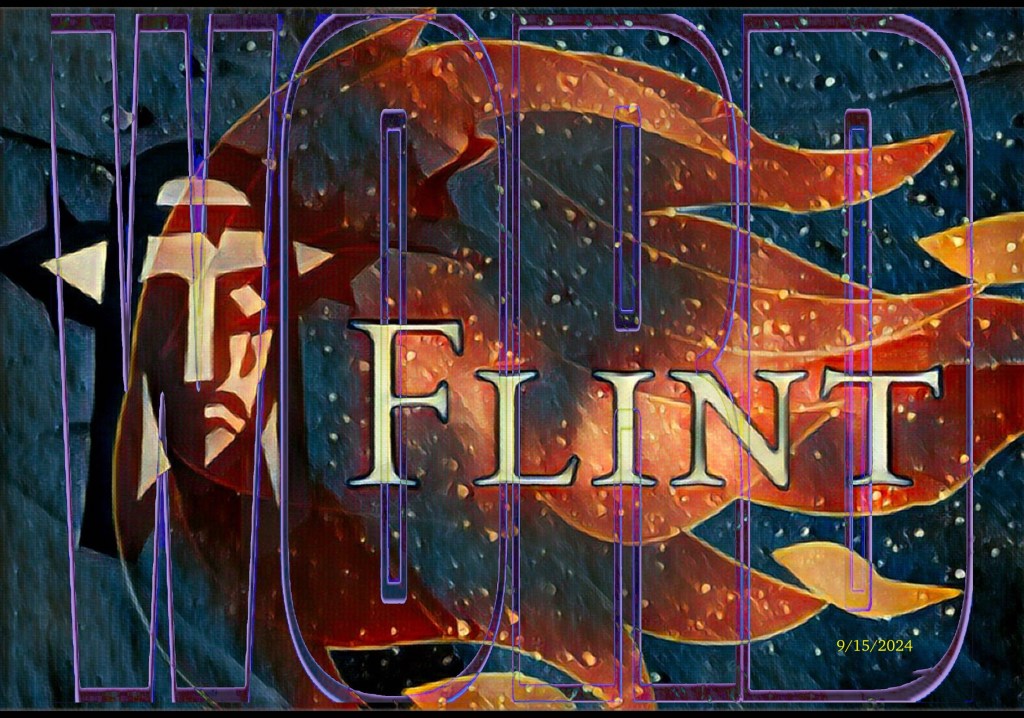
I have set my face like flint,
knowing that I shall not be put to shame.
Isaiah 50:5-7


This solemn reading from Isaiah follows appropriately on yesterday’s honoring of the Holy Cross.

Isaiah writes of the prophet who, during the Babylonia Captivity, suffers for his testimony to the Truth.

The passage foretells Jesus’s embrace of his suffering for the sake of our Redemption.

Today, in God’s Lavish Mercy:
As we pray with Isaiah and Jesus, we ask to deeply reverence God’s participation in the suffering of Creation – both in the human and the natural world.


Poetry: The Grandeur of God – Gerard Manley Hopkins

The world is charged with the grandeur of God.
It will flame out, like shining from shook foil; It gathers to a greatness, like the ooze of oil
Crushed. Why do men then now not reck his rod?
Generations have trod, have trod, have trod;
And all is seared with trade; bleared, smeared with toil; And wears man's smudge and shares man's smell: the soil
Is bare now, nor can foot feel, being shod.
And for all this, nature is never spent;
There lives the dearest freshness deep down things; And though the last lights off the black West went Oh, morning, at the brown brink eastward, springs-
Because the Holy Ghost over the bent
World broods with warm breast and with ah! bright wings.

Music: Pie Jesu – Gabriel Fauré

The French creator of the soul-stirring Pie Jesu, Gabriel Fauré, was one of the premier composers and directors of the 19th/20th centuries though, surprisingly, he was not a man of deep faith. Yet, he must have had a mystical soul. The Pie Jesu is the centerpiece of Fauré’s Requiem, which he completed in 1890, and which is often considered his greatest composition. It is undoubtedly imbued with the deepest sentiments of devotion.

A requiem, as such, is a distinct musical genre and a Christian liturgical art form. In essence, it is a small symphony meant to provide deep solace to mourners at the loss of a loved one, although it is rarely played at funerals. Full requiems are generally too long for that! Nonetheless, all the great composers from the 15th century onward created their own requiems.

It is believed that Fauré composed this piece in honor of his own father a few years after the elder Fauré’s death, but the composer never revealed his motive. This Requiem was, fittingly, performed at Fauré’s own funeral in 1924.

Notes on the Requiem itself
Fauré’s Requiem has seven sections, and the Pie Jesu (Merciful Jesus) is easily the most beautiful of the seven, but not by much. The Agnus Dei and In Paradisum are exquisite in their own right.

It is interesting to note that Fauré replaced the Dies Irae (Day of Wrath) of traditional requiems with the Pie Jesu, emphasizing mercy rather than judgment, and also anticipating in some way the Divine Mercy devotion of the 20th century.

In the video below, the incomparable lyric soprano, Kathleen Battle, performs her ravishing interpretation of the lovely Pie Jesu.

Holy Cross

Feast of the Exaltation of the Holy Cross
September 14, 2024

Today’s Readings:

https://bible.usccb.org/bible/readings/091424.cfm


Christ Jesus, though he was in the form of God,
did not regard equality with God something to be grasped.
Rather, he emptied himself,
taking the form of a slave,
coming in human likeness;
and found human in appearance,
he humbled himself,
becoming obedient to death,
even death on a cross.
Because of this, God greatly exalted him
and bestowed on him the name
that is above every name,
that at the name of Jesus
every knee should bend,
of those in heaven and on earth and under the earth,
and every tongue confess that
Jesus Christ is Lord,
to the glory of God the Father.
Philippians 2:6-11


In this profoundly beautiful passage from Philippians, Paul captures the complete essence of the Paschal Mystery. Every phrase is rich in meaning inviting us to explore its depths in awe.

No poetry is offered today. Take the time to really rest in these words and the glorious Truth they reveal


Music: Jesus The Lord – Roc O’Connor – St. Louis Jesuits

Jesus. Jesus.
Let all creation bend the knee
to the Lord.
In him we live,
we move and have our being
In him the Christ, in him the king!
Jesus, the Lord.

Jesus. Jesus.
Let all creation bend the knee
to the Lord.
Though Son,
he did not cling to godliness
but emptied himself, became a slave!
Jesus, the Lord.

Jesus. Jesus.
Let all creation bend the knee
to the Lord.
He lived
obediently his Father’s will
accepting his death, death on a tree!
Jesus, the Lord.

Jesus. Jesus.
Let all creation bend the knee
to the Lord.

Recompense

Twenty-third Sunday in Ordinary Time
September 8, 2024

Today’s Readings:

https://bible.usccb.org/bible/readings/090824.cfm


Thus says the LORD:
Say to those whose hearts are frightened:
Be strong, fear not!
Here is your God,
he comes with vindication;
with divine recompense
he comes to save you.
Then will the eyes of the blind be opened,
the ears of the deaf be cleared;
then will the lame leap like a stag,
then the tongue of the mute will sing.
Streams will burst forth in the desert,
and rivers in the steppe.
The burning sands will become pools, 
and the thirsty ground, springs of water.
Isaiah 35:4-7


Isaiah’s prophecy foretells the time when God will turn the world upside down. It will be time of vindication for all those who have suffered. In God’s realm, even nature will be blessed by the recompense of salvation – by what they earned by their faithfulness.

Today, in God’s Lavish Mercy:
We look to the Gospel – the Good News of Jesus – to guide us so that we may foster this recompense for all people and in our own time. Those tied only to material values do not understand the infinite hope of a world turned upside-down by Jesus.


Poetry: Ain’t I A Woman – Sojourner Truth

A formerly enslaved person, Sojourner Truth became an outspoken advocate for abolition, temperance, and civil and women’s rights in the nineteenth century. In this poem she gives us an insight into her view of the world turned “upside-down”.


That man over there say
a woman needs to be helped into carriages
and lifted over ditches
and to have the best place everywhere.
Nobody ever helped me into carriages
or over mud puddles
or gives me a best place…
And ain’t I a woman?
Look at me
Look at my arm!
I have plowed and planted
and gathered into barns
and no man could head me…

And ain’t I a woman?
I could work as much
and eat as much as a man —
when I could get to it —
and bear the lash as well
and ain’t I a woman?

I have born 13 children
and seen most all sold into slavery
and when I cried out a mother’s grief
none but Jesus heard me…

And ain’t I a woman?
that little man in black there say
a woman can’t have as much rights as a man
cause Christ wasn’t a woman
Where did your Christ come from?
From God and a woman!
Man had nothing to do with him!
If the first woman God ever made
was strong enough to turn the world
upside down, all alone
together women ought to be able to turn it
rightside up again.


Music: Upside Down – Jonny Diaz

Jesus Christ

Monday of the Twenty-second Week in Ordinary Time
September 2, 2024

today’s Readings:

https://bible.usccb.org/bible/readings/090224.cfm


When I came to you, brothers and sisters,
proclaiming the mystery of God,
I did not come with sublimity of words or of wisdom.
For I resolved to know nothing while I was with you
except Jesus Christ, and him crucified.
1 Corinthians 2:1-2


Paul gets it, and he wants to give it to his listeners. Jesus Christ is the First and the Last Word. When Paul was given the gift of faith, he embraced the whole mystery of Christ, Passion, Death, and Resurrection.

Today, in God’s Lavish Mercy:
Who is the Christ that I believe in? Only a God of personal prosperity and abundance? Or a God Who continues to take flesh, suffer, and rise in my life and the lives of my sisters and brothers?


Prose: from Henri Nouwen

Suffering invites us
to place our hurts in larger hands.
In Christ we see God suffering – for us.
And calling us to share in
God’s suffering love for a hurting world.
The small and even overpowering pains of our lives
are intimately connected with
the greater pains of Christ.
Our daily sorrows are anchored
in a greater sorrow
and therefore a larger hope.


Music: Gabriel’s Oboe – Ennio Morricone

Foolish

Friday of the Twenty-first Week in Ordinary Time
August 30, 2024

Today’s Readings:

https://bible.usccb.org/bible/readings/083024.cfm


Brothers and sisters:
Christ did not send me to baptize but to preach the Gospel,
and not with the wisdom of human eloquence,
so that the cross of Christ might not be emptied of its meaning.

The message of the cross is foolishness to those who are perishing,
but to us who are being saved it is the power of God.
1 Corinthians 1:17-18


Paul writes that the meaning of the Cross depends on who you are. If you believe, it manifests God’s Power. If you do not believe, it signifies foolishness.

The Gospel and the Cross turn the realities of the world upside down. For those who have falsely believed that power exists in egotism, legalism, division, aggression, vengeance, and greed, Paul says, “No!”. These are only signs that you are perishing.

The power of the Cross is manifested in mercy, justice, community, peace, forgiveness and generosity. This is the path to salvation.

Today, in God’s Lavish Mercy:
We ask for the courage to trust the contradictory wisdom of the Gospel, and to live a life that reveals the “foolish” power of the Cross.


Poetry: Jesus Is Nailed to the Cross – Malcolm Guite

See, as they strip the robe from off his back
And spread his arms and nail them to the cross,
The dark nails pierce him and the sky turns black,
And love is firmly fastened on to loss.
But here, a pure change happens.
On this tree, loss becomes gain, death opens into birth.
Here wounding heals and fastening makes free,

Earth breathes in heaven, heaven roots in earth.
And here we see the length, the breadth, the height,
Where love and hatred meet and love stays true,
Where sin meets grace and darkness turns to light,
We see what love can bear and be and do.
And here our Saviour calls us to his side,
His love is free, his arms are open wide.

Music: The Power of the Cross – Stuart Townend

Unless…

Feast of Saint Lawrence, Deacon and Martyr
August 10, 2024

Today’s Readings:

https://bible.usccb.org/bible/readings/081024.cfm


Jesus said to his disciples:
“Amen, amen, I say to you,
unless a grain of wheat falls to the ground and dies,
it remains just a grain of wheat;
but if it dies, it produces much fruit.
John 12:24


The great paradox of existence is that, in order to live, we must die. It is a truth endemic to all Creation. It is a reality lived out in all relationships.

Jesus cites this universal truth to teach his disciples the key to eternal life. We must die to self to find our life in God.

Today, in God’s Lavish Mercy:
We prayerfully reflect on the times when this truth has been evident in our lives. When have we found new life? When have we experienced the freedom to grow? What had to die in us before these graces could transform us?


Poetry: Unless a Grain of WheatMalcolm Guite

Oh let me fall as grain to the good earth
And die away from all dry separation,
Die to my sole self, and find new birth
Within that very death, a dark fruition,
Deep in this crowded underground, to learn
The earthy otherness of every other,
To know that nothing is achieved alone
But only where these other fallen gather.

If I bear fruit and break through to bright air,
Then fall upon me with your freeing flail
To shuck this husk and leave me sheer and clear
As heaven-handled Hopkins, that my fall
May be more fruitful and my autumn still
A golden evening where your barns are full.

Music: Unless a Grain of Wheat Shall Fall – Bernadette Farrell

Answer

Saturday of the Seventeenth Week in Ordinary Time
August 3, 2024

Today’s Readings:

https://bible.usccb.org/bible/readings/080324.cfm


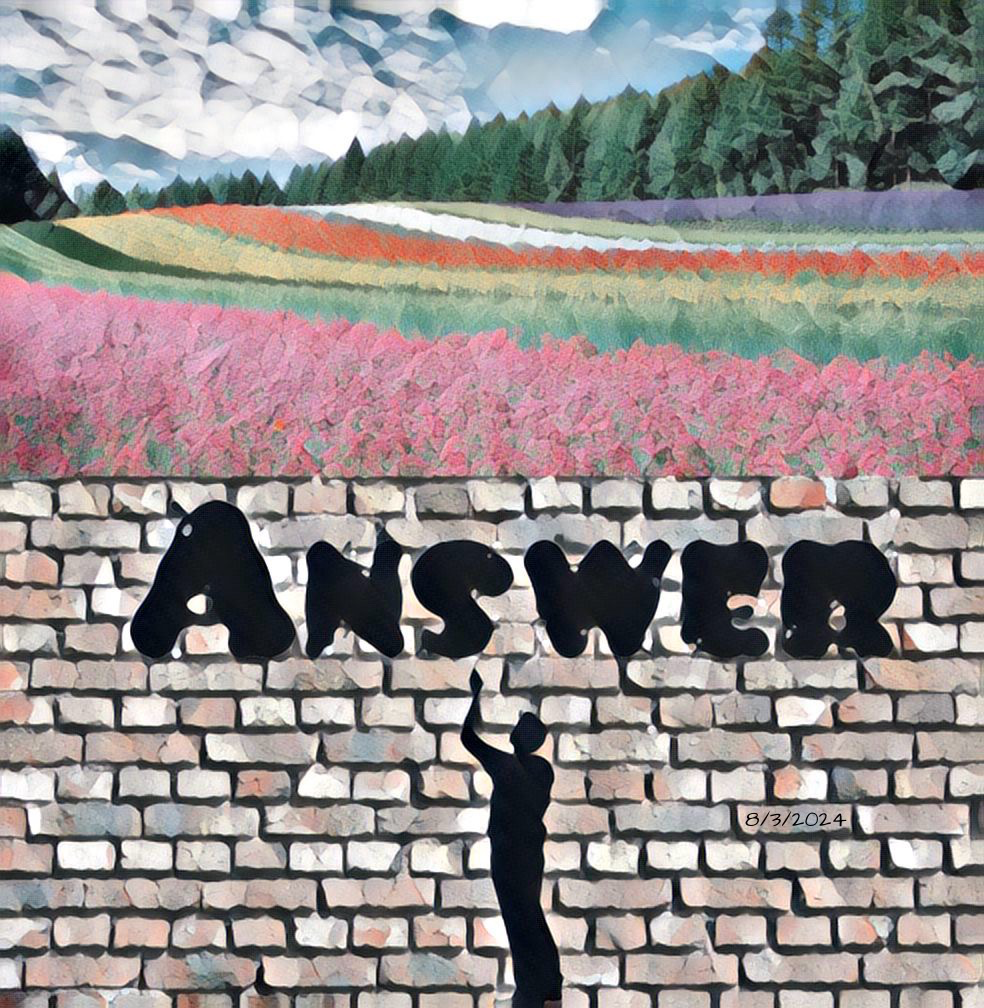
In today’s readings, both Jeremiah and John the Baptist encounter persecution. Jeremiah is saved, but John is not. Maybe both of them had questions about how, when they were so dedicated to God, evil yet pursued them. Perhaps they felt they had run into a spiritual wall. Ever felt like that?

Our Responsorial Psalm captures the longing for an answer – an understanding of how and why God works in our lives.

Lord, in your great love,
answer me.

Psalm 69:14

Today, in God’s Lavish Mercy:
I think it’s safe to say that we all have questions about life and death, good and evil, grace and darkness, worldly success and spiritual peace, God’s Presence and God’s apparent absence.


Poetry: The Answer – Carl Sandberg

You have spoken the answer.
A child searches far sometimes
Into the red dust
                       On a dark rose leaf
And so you have gone far
                       For the answer is:
                                           Silence.

   In the republic
Of the winking stars
                       and spent cataclysms
Sure we are it is off there the answer is hidden and folded over,
Sleeping in the sun, careless whether it is Sunday or any other
    day of the week,

Knowing silence will bring all one way or another.

Have we not seen
Purple of the pansy
            out of the mulch
            and mold
            crawl
            into a dusk
            of velvet?
            blur of yellow?
Almost we thought from nowhere but it was the silence,
            the future,
            working.


Music: Popule Meus – Motet by Tomás Luis de Victoria (1548-1611)

Ecce lignum crucis:
In quo salus mundi pependit,
Venite, adoremus.

Popule meus, quid feci tibi?
Aut in quo contristavi te?
Responde mihi.

Quia eduxi te de terra Aegypti,
Parasti Crucem Salvatori tuo.

Hagios o Theos. Sanctus Deus.
Hagios Ischyros. Sanctus Fortis.
Hagios Athanatos, eleison himas.
Sanctus Immortalis, miserere nobis.

Quia eduxi te per desertum
Quadraginta annis,
Et manna cibavi te,
Et introduxi te in terram satis bonam,
Parasti Crucem Salvatori tuo.

Hagios o Theos. Sanctus Deus.
Hagios Ischyros. Sanctus Fortis.
Hagios Athanatos, eleison himas.
Sanctus Immortalis, miserere nobis.

Ego propter te flagellavi Aegyptum
Cum primogenitis suis:
Et tu me flagellatum tradidisti.

Popule meus, quid feci tibi?
Aut in quo contristavi te?
Responde mihi.

Ego te eduxi de Aegypto,
Demerso Pharone in mare Rubrum,
Et tu me tradidisti
Principibus sacerdotum.

Popule meus, quid feci tibi?
Aut in quo contristavi te?
Responde mihi.

Ego ante te aperui mare,
Et tu aperuisti lancea latus meum.

Popule meus, quid feci tibi?
Aut in quo contristavi te?
Responde mihi.

Behold the wood of the cross:
On which hung the salvation of the world,
Come, let us adore.

O my people, what have I done to you?
Or wherein have I grieved you?
Answer me.

Because I led you out of the land of Egypt:
You have prepared a Cross for your Saviour.

O Holy God. O Holy God.
O Holy Strong One. O Holy Strong One.
O Holy and Immortal, have mercy upon us.

Because I led you through the desert,
For forty years,
And fed you with manna,
And brought you into a land exceeding good,
You have prepared a Cross for your Savior.

O Holy God. O Holy God.
O Holy Strong One. O Holy Strong One.
O Holy and Immortal, have mercy upon us.

For you I scourged Egypt,
And its firstborn,
And you have delivered me to be scourged.

O my people, what have I done to you?
Or wherein have I grieved you?
Answer me.

I brought you out of Egypt,
And sank Pharaoh in the Red Sea,
And you bave delivered Me
To the chief priests.

O my people, what have I done to you?
Or wherein have I grieved you?
Answer me.

I opened the sea before you,
And you have opened my side with a spear.

O my people, what have I done to you?
Or wherein have I grieved you?
Answer me.

Peace

Memorial of Saint Bonaventure, Bishop and Doctor of the Church
July 15, 2024

Today’s Readings:

https://bible.usccb.org/bible/readings/071524.cfm


Jesus said to his Apostles:
“Do not think that I have come to bring peace upon the earth.
I have come to bring not peace but the sword.
For I have come to set
a man against his father,
a daughter against her mother,
and a daughter-in-law against her mother-in-law;
and one’s enemies will be those of his household.
Matthew 10:34-36


I would not have liked hearing these words from Jesus, would you? The last thing I would have ever wanted was to be set against my precious mother! So WHAT is Jesus talking about?

These words are central to Christ’s mandate to his disciples. He is telling them that they will inevitably meet painful conflict while living out his mission. Sometimes the conflict will even be within their families and among their friends.

This is because God’s Peace is not quiet indifference but the striving for just equanimity for all people. This is the sword of discipleship – we must cut ourselves away from anything that turns us from a just and merciful God.

Today, in God’s Lavish Mercy,
We pray for graced insight that we may see where the sword is pointing in our lives, and for courage that we may do the necessary cutting to be worthy disciples and build an honest peace in our world.


Poetry: Swords Into Plowshares – Daniel Berrigan, SJ
This poem was written in response to the conviction of the Plowshares Eight, of whom Berrigan was a member, for their civil disobedience against nuclear war.


Everything enhances, everything
gives glory—everything!

Between bark and bite
Judge Salus’s undermined soul
betrays him, mutters
very alleluias.

The iron cells—
Row on row of rose trellised
Mansions, bridal chambers!

Curses, vans, keys, guards—behold
the imperial lions of our vast acres!

And when hammers come down
and our years are tossed to four winds—

why, flowers blind the eye, the saints
pelt us with flowers!

For every hour
scant with discomfort
(the mastiff’s baleful eye,
the bailiff’s mastery)—

see, the Lord’s hands heap
eon upon eon,
like fruit bowls at a feast.


Music: Go Light Your World – Chris Rice