The First to Die for Christ

Feast of Saint Stephen, first martyr
December 26, 2023

Today’s Readings:

https://bible.usccb.org/bible/readings/122623.cfm


The Demidoff Altarpiece: Saint Stephen
Representation of St. Stephen
from The Demidoff Altarpiece
by Carlo Crivelli,
an Italian Renaissance painter
of the late fifteenth century.

Today, in God’s Lavish Mercy, we celebrate the Feast of St. Stephen, first martyr for the Christian faith. 

Stephen said,
“Behold, I see the heavens opened and the Son of Man
standing at the right hand of God.”
But they cried out in a loud voice, covered their ears,
and rushed upon him together.
They threw him out of the city, and began to stone him.
The witnesses laid down their cloaks
at the feet of a young man named Saul.
As they were stoning Stephen, he called out
“Lord Jesus, receive my spirit.”


The commemoration and readings are a drastic turn from singing angels and worshiping shepherds. The Liturgy moves quickly from welcoming a cooing baby to weeping at the death of innocence. Why?

One thought might be to keep us practical and focused on what life in Christ truly means.

Stephen, like Jesus, “was filled with grace and power, … working great wonders and signs among the people.” He, as Jesus would, met vicious resistance to his message of love and reconciliation. He, as Jesus would, died a martyr’s death while forgiving his enemies.


The Church turns us to the stark truth for anyone who lets Christ truly be born in their hearts. We will suffer as Jesus did – as Stephen did. The grace and power of Christ in our life will be met with resistance, or at least indifference.

Brother will hand over brother to death,
and the father his child;
children will rise up against parents and have them put to death.
You will be hated by all because of my name,
but whoever endures to the end will be saved.


We may not shed blood but, in Christ, we will die to self. When we act for justice for the poor and mercy for the suffering, we will be politically frustrated and persecuted. When we forgive rather than hate, we will be mocked. Powerful people, like the yet unconverted Saul in today’s second reading, may catalyze our suffering by their determined hard-heartedness.

Our Gospel confirms the painful truth:

“You will be hated by all because of my name,
but whoever endures to the end will be saved.”

Tomorrow, the liturgy picks up the poetic readings from John’s letters. These are delights to the soul. 

But for today, it is a hard look, with Stephen, at what Christmas ultimately invites us to.


Poetry: St. Stephen by Malcolm Guite

Witness for Jesus, man of fruitful blood,
Your martyrdom begins and stands for all.
They saw the stones, you saw the face of God,
And sowed a seed that blossomed in St. Paul.
When Saul departed breathing threats and slaughter
He had to pass through that Damascus gate
Where he had held the coats and heard the laughter
As Christ, alive in you, forgave his hate,
And showed him the same light you saw from heaven
And taught him, through his blindness, how to see;
Christ did not ask ‘Why were you stoning Stephen?’
But ‘Saul, why are you persecuting me?’
Each martyr after you adds to his story,
As clouds of witness shine through clouds of glory.

Music: Gabriel’s Oboe from the movie “The Mission”, played by Henrik Chaim Goldschmidt,  principal oboist of The Royal Danish Orchestra in Copenhagen, Denmark.

Look Up!

Memorial of Saint Lucy, Virgin and Martyr
Wednesday of the Second Week of Advent
December 13, 2023

Today’s Readings:

https://bible.usccb.org/bible/readings/121323.cfm


St. Lucy – Giovanni Ricca (1603-56)

Today, in God’s Lavish Mercy, we venerate St. Lucy, beloved and popular martyr of the 3rd century. Here is an encapsulation of her story from Wikipedia:

The oldest record of her story comes from the fifth-century Acts of the Martyrs. The single fact upon which various accounts agree is that a disappointed suitor accused Lucy of being a Christian, and she was executed in Syracuse, Sicily, in the year 304 during the Diocletianic Persecution. Her veneration spread to Rome, and by the sixth century to the whole Church. (Wiki)

The suitor was disappointed because Lucy chose to give her dowry to the poor - apparently the only reason he was marrying her. Tradition maintains that, at her martyrdom, Lucy's eyes were gouged out, an added violence of Diocletian who was angered at her prophecy of his impending downfall.

Isn’t it a bit amazing that an ordinary human story, as dramatic as it might have been, can endure for 2000 years?

We human beings treasure the witness of those whose courage and goodness we wish to imitate. They give us hope and wisdom. They light life’s way that is sometimes overshadowed by our worries. And we pass our confidences down to the generations we love hoping to strengthen them in faith.

The name “Lucy” comes from the Latin word “lux” which means “light”. St. Lucy’s life has inspired and illuminated the path for countless generations of believers, particularly those whose physical or spiritual sight or insight has been darkened or violated.


The same God who fired Lucy’s heart summons us today in the words of Isaiah. How fitting that we are called to lift up our eyes – to see, as Lucy did, beyond mere physical appearances, that our eternal Creator sustains us.

To whom can you liken me as an equal?
says the Holy One.
Lift up your eyes on high
and see who has created these things:…

… Do you not know
or have you not heard?
The LORD is the eternal God,
creator of the ends of the earth.
He does not faint nor grow weary,
and his knowledge is beyond scrutiny.
He gives strength to the fainting;
for the weak he makes vigor abound.
Though young men faint and grow weary,
and youths stagger and fall,
They that hope in the LORD will renew their strength,
they will soar as with eagles’ wings;
They will run and not grow weary,
walk and not grow faint.

Isaiah 40:24-41, excerpts

Poetry: Saint Lucie’s Day by Thomas Merton

Lucy, whose day is in our darkest season,
(Although your name is full of light,)
We walkers in the murk and rain and flesh and sense,
Lost in the midnight of our dead world's winter solstice
Look for the fogs to open on your friendly star.
We have long since cut down the summer of our history;
Our cheerful towns have all gone out like fireflies in October.
The fields are flooded and the vines are bare:
How have our long days dwindled, and now the world is frozen!
Locked in the cold jails of our stubborn will,
Oh, hear the shovels growling in the gravel.
This is the way they'll make our beds forever,
Ours, whose Decembers have put out the sun:
Doors of whose souls are shut against the summertime!
Martyr, whose short day sees our winter and our Calvary,
Show us some light, who seem forsaken by the sky;
We have so dwelt in darkness that our eyes are screened
and dim,
And all but blinded by the weakest ray.
Hallow the vespers and December of our life,
O martyred Lucy:
Console our solstice with your friendly day.

Music: Candlelight Carol – John Rutter

St. Lucy’s inextinguishable faith was fired by the Light Whom we await this Advent. As we kindle our Advent candles, our hearts sing in renewed hope.

Miracles

Feast of Saint Andrew, Apostle
November 30, 2023

Today’s Readings:

https://bible.usccb.org/bible/readings/113023.cfm


Rom 10_17 Andrew

Today, in God’s Lavish Mercy, we celebrate the Feast of St. Andrew, the brother of Peter, also a fisherman, a beloved Apostle and friend of Jesus.

Our Gospel tells the story of Andrew’s call.

As Jesus was walking by the Sea of Galilee, he saw two brothers,
Simon who is called Peter, and his brother Andrew,
casting a net into the sea; they were fishermen.
He said to them,
“Come after me, and I will make you fishers of men.”
At once they left their nets and followed him.

Matthew 4;18-20

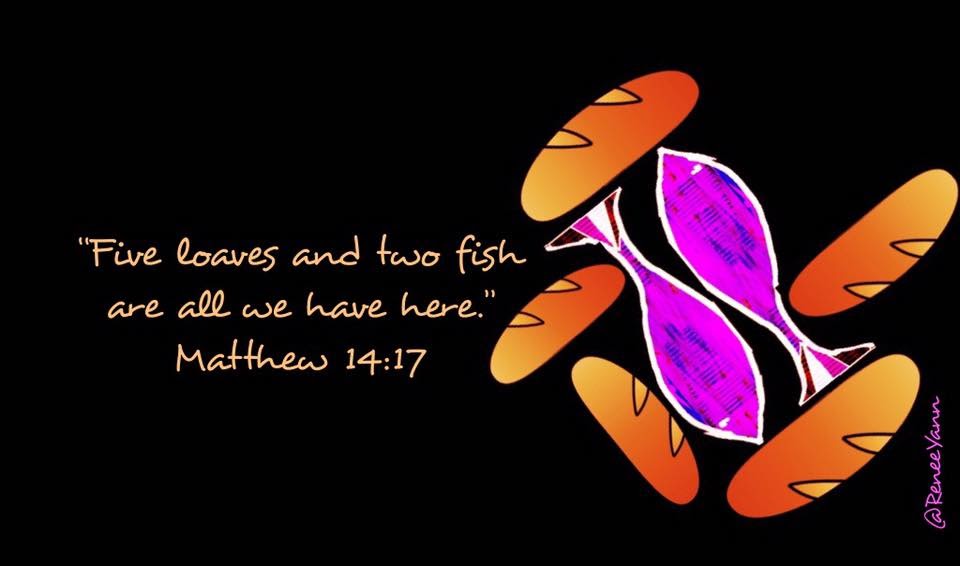
Another favorite passage about Andrew is when he points out to Jesus that, in the hungry crowd, there is a young boy with five loaves and two fish. 

One of the disciples—it was Andrew, brother to Simon Peter—said,
“There’s a little boy here who has five barley loaves and two fish.
But that’s a drop in the bucket for a crowd like this.”
Jesus said, “Make the people sit down.”
There was a nice carpet of green grass in this place.
They sat down, about five thousand of them.
Then Jesus took the bread and, having given thanks,
gave it to those who were seated.
He did the same with the fish.
All ate as much as they wanted.

John 6:8-11

How simple and complete was Andrew’s faith! Those seven little groceries must have seemed so minute among 5000. Can you picture Andrew looking into Jesus’s eyes as if to say, “I know it’s not much but you can do anything!” Maybe it was that one devoted look that prompted Jesus to perform this amazing miracle!


We trust that our deep devotion and faith can move God’s heart too – or, more accurately, can move our hearts to embrace God’s Presence. On this feast of St. Andrew, many people begin a prayer which carries them through to Christmas. Praying it, we ask for particular favors from God.

I love this prayer because it was taught to me by my mother, a woman blessed with simple faith like Andrew’s. As I recite it, I ask to be gifted with the same kind of faith.

( Another reason I love it is this: how often in life do you get a chance to say a word like “vouchsafe“! )

St. Andrew Christmas Novena
Hail and blessed be the hour and moment
in which the Son of God was born of the most pure Virgin Mary,
at midnight, in Bethlehem, in the piercing cold.
In that hour vouchsafe, I beseech Thee, O my God,
to hear my prayer and grant my desires
through the merits of Our Savior Jesus Christ,
and of His blessed Mother. Amen.


As we draw near to the Season of great blessings, we see our world filled with conflict and violence. Let’s fold our Advent prayers around its many wounds.


Poetry: Monet Refuses the Operation – Lisel Mueller

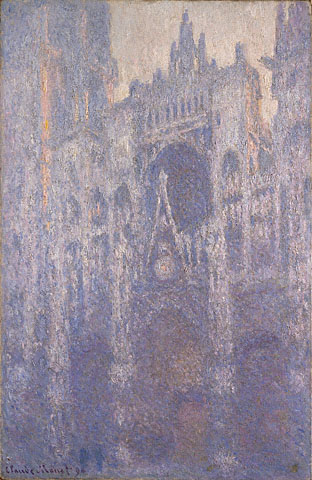
How wonderful to allow ourselves to see the world differently – to see it charged with heavenly illuminations and latent miracles!

Rouen Cathedral: Morning Light (1894) – Claude Monet

Doctor, you say there are no haloes
around the streetlights in Paris
and what I see is an aberration
caused by old age, an affliction.
I tell you it has taken me all my life
to arrive at the vision of gas lamps as angels,
to soften and blur and finally banish
the edges you regret I don’t see,
to learn that the line I called the horizon
does not exist and sky and water,
so long apart, are the same state of being.
Fifty-four years before I could see
Rouen cathedral is built
of parallel shafts of sun,
and now you want to restore
my youthful errors: fixed
notions of top and bottom,
the illusion of three-dimensional space,
wisteria separate
from the bridge it covers.
What can I say to convince you
the Houses of Parliament dissolve
night after night to become
the fluid dream of the Thames?
I will not return to a universe
of objects that don’t know each other,
as if islands were not the lost children
of one great continent. The world
is flux, and light becomes what it touches,
becomes water, lilies on water,
above and below water,
becomes lilac and mauve and yellow
and white and cerulean lamps,
small fists passing sunlight
so quickly to one another
that it would take long, streaming hair
inside my brush to catch it.
To paint the speed of light!
Our weighted shapes, these verticals,
burn to mix with air
and change our bones, skin, clothes
to gases. Doctor,
if only you could see
how heaven pulls earth into its arms
and how infinitely the heart expands
to claim this world, blue vapor without end.

Music:  Hear my prayer, O Lord is an eight-part choral anthem by the English composer Henry Purcell (1659–1695). The anthem is a setting of the first verse of Psalm 102 in the version of the Book of Common Prayer. Purcell composed it c. 1682 at the beginning of his tenure as Organist and Master of the Choristers for Westminster Abbey.

Cradled in Mercy’s Arms

The Solemnity of Our Lord Jesus Christ, King of the Universe
November 26, 2023

Today’s Readings:

https://bible.usccb.org/bible/readings/112623.cfm


Today, in God’s Lavish Mercy, on this feast of Christ the King, we might expect our readings to be filled with triumphal metaphors for God – conquerer, ruler, omnipotent and, yes, distant from us.

Instead, today’s passages offer us images of God as a devoted, simple, and caring shepherd – the tenderest of roles in our natural world.

Thus says the Lord GOD:
I myself will look after and tend my sheep.
As a shepherd tends his flock
when he finds himself among his scattered sheep,
so will I tend my sheep.
I will rescue them from every place where they were scattered
when it was cloudy and dark.


What an unexpected “King” this is! Rather than groveling before his majesty, we are lifted shivering to his warm shoulders. We are rescued from our cloudy shadows and raised into his light.


In Corinthians, Paul instructs us that Christ is King for one reason: he has conquered death. Death is the darkest of shadows from which we long to be rescued – both the small deaths of loss, bereavement, failure, addiction, illness, depression – and the inevitable ending of the life we cherish in ourselves and others. Christ, the kingly shepherd, finds us even when we are lost and confused in fears such as these.


In our Gospel, Jesus says that he will easily find us in our shadows because we are already marked by a certain light – our acts of mercy toward his least ones:

‘Lord, when did we see you hungry and feed you,
or thirsty and give you drink? 
When did we see you a stranger and welcome you,
or naked and clothe you? 
When did we see you ill or in prison, and visit you?’
And the king will say to them in reply,
‘Amen, I say to you, whatever you did
for one of the least brothers of mine, you did for me.’


For our prayer today, we might just ask the kingly shepherd to lift us close to the Divine Heart, to hum Mercy over us in a healing lullaby, so that we might return it freely to our wounded world.


Prayer: Our beautiful Responsorial Psalm will be our poetry for today.

The LORD is my shepherd; I shall not want.
In verdant pastures I rest.
Beside restful waters God leads me;
refreshing my soul.
guiding me in right paths
in the safety of God's Name.
You spread the table before me
in the sight of my foes;
you anoint my head with oil;
my cup overflows.
Only goodness and kindness follow me
all the days of my life;
and I shall dwell in the house of the LORD
for years to come.

Music: Shepherd Me, O God – Marty Haugen

Trust not Fear

Memorial of Saint Cecilia, Virgin and Martyr
Wednesday of the Thirty-third Week in Ordinary Time
November 22, 2023

Today’s Readings:

https://bible.usccb.org/bible/readings/112223.cfm


Today, in God’s Lavish Mercy, our two readings are dramatically intense. 

Who can read the story of the Maccabean Martyrs without a mix of horror, empathy, and astonishment?

It happened that seven brothers with their mother were arrested
and tortured with whips and scourges by the king,
to force them to eat pork in violation of God’s law.
Most admirable and worthy of everlasting remembrance was the mother,
who saw her seven sons perish in a single day,
yet bore it courageously because of her hope in the Lord.

2 Maccabees 7: 1;20

And don’t we all feel a pang of pity for the poor, fearful servant who hid his talent in a handkerchief much to the King’s displeasure?

‘Sir, here is your gold coin;
I kept it stored away in a handkerchief,
for I was afraid of you, because you are a demanding man;
you take up what you did not lay down
and you harvest what you did not plant.’
He said to him,
‘With your own words I shall condemn you,
you wicked servant.
You knew I was a demanding man,
taking up what I did not lay down
and harvesting what I did not plant;
why did you not put my money in a bank?

Luke 19:20-23

The two stories paint a contrasting picture of courageous faith against fearful subservience. The difference between the actors lies in their capacity, or lack thereof, to look beyond themselves toward eternal life.

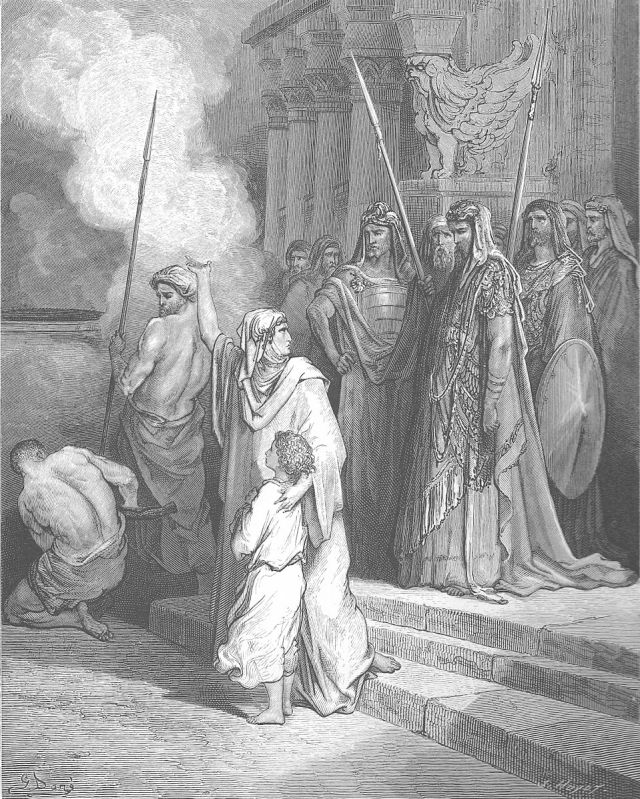
The Courage of a Mother – Gustave Doré

Mother Maccabee bolsters her sons with her faith in a life beyond their current circumstances:

… the Creator of the universe
who shapes each man’s beginning,
as he brings about the origin of everything,
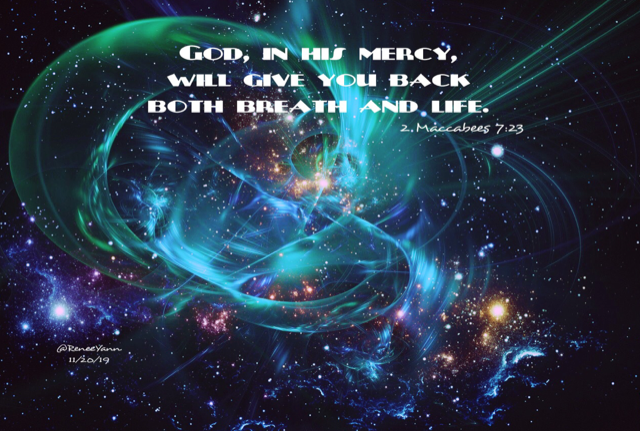
he, in his mercy,
will give you back both breath and life,
because you now disregard yourselves
for the sake of his law.


The poor soul in Jesus’s parable doesn’t have that faith and vision. His perception of God, represented by the King, is one of only harsh judgment. His fear causes him to bury not only his talent, but also his openness to the possibilities of grace and transformed relationship with God.


Jesus told his parable because indeed the Kingdom was at hand. He and his disciples were near Jerusalem where the Passion, Death and Resurrection events would begin.

He wants his followers to realize the challenging gift they have been given in their call to be his disciples. He wants them to see that it is now on them to magnify his message courageously and generously until he returns to perfect the Kingdom.

He wants us to understand that too.


Poetry – John Milton, Sonnet 19

Milton (1608- 1674) is widely considered one of the preeminent writers of the English language. By 1652, Milton had become totally blind and had to dictate his verse. He appears to wonder, in this sonnet, how his God-given talent for writing will be enhanced now that he is “light denied”. He looks to another parable for his answer – the Parable of the Workers. Even those who only stood and waited were rewarded.

When I consider how my light is spent,
Ere half my days, in this dark world and wide,
And that one Talent which is death to hide
Lodged with me useless, though my Soul more bent
To serve therewith my Maker, and present
My true account, lest he returning chide;
“Doth God exact day-labor, light denied?”
I fondly ask. But patience, to prevent
That murmur, soon replies, “God doth not need
Either man’s work or his own gifts; who best
Bear his mild yoke, they serve him best. His state
Is Kingly. Thousands at his bidding speed
And post o’er Land and Ocean without rest:
They also serve who only stand and wait.”

Music:   Be Not Afraid – written by Bob Dufford, SJ, sung here by Cat Jahnke

Outrageous Faith

Memorial of Saint Frances Xavier Cabrini
Monday of the Thirty-second Week in Ordinary Time
November 13, 2023

Today’s Readings:

https://bible.usccb.org/bible/readings/111323.cfm


Today, in God’s Lavish Mercy, we have only three weeks left in Ordinary Time before Advent. Today, we begin a week of first readings from the beautifully written Book of Wisdom.

These will be counterpointed by readings from Luke 17, filled with familiar images like millstones, mustard seeds, ungrateful lepers, a grateful one, and the one plowman taken from a field while the shocked other is left.


While our Gospel readings call us to be alert to the end of time and the coming of the Reign of God, our Wisdom readings – while cautionary – stretch us beyond time to the awareness of an Eternal Love rooted in our own hearts:

For wisdom is a kindly spirit,
yet she acquits not the blasphemer of their guilty lips;
Because God is the witness of the inmost self
and the sure observer of the heart
and the listener to the tongue.
For the Spirit of the Lord fills the world,
is all-embracing, and knows what the human heart says.

Wisdom 1: 6-7

In our Gospel, Jesus calls us to model goodness, practice forgiveness, and exercise an outrageous faith.

And the Apostles said to the Lord, “Increase our faith.”
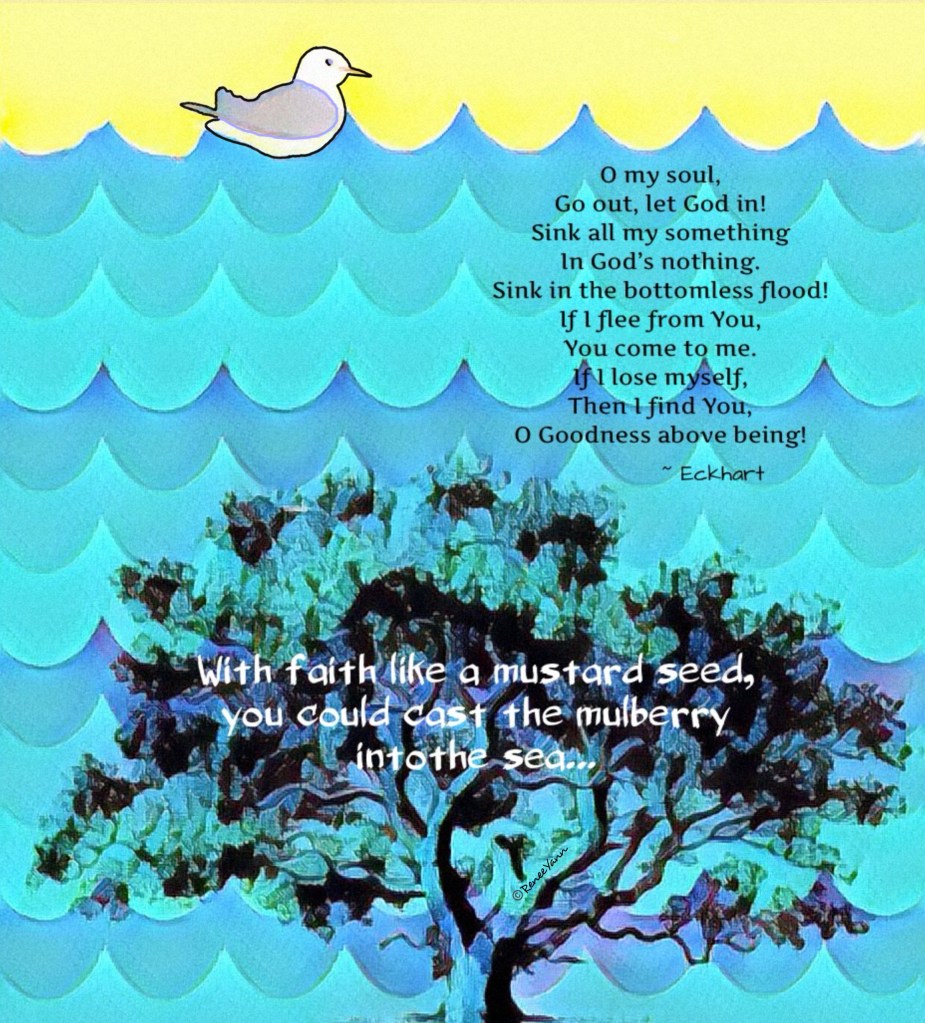
The Lord replied, “If you have faith the size of a mustard seed,
you would say to this mulberry tree,
‘Be uprooted and planted in the sea,’ and it would obey you.”

Luke 17: 5-6

Perhaps we’re not really too interested in throwing a mulberry tree into the sea, but let’s desire to live our faith so fully that the world considers us outrageously foolish for the sake of Christ.

Thinking about that this morning, I remember dear Mr. Stein, the owner of the delicatessen where I worked throughout my high school years. The Stein family loved me and all were so kind to me. But when I told them I would be leaving to enter the convent, they were shocked and terribly upset. You would have thought I was leaving for a life sentence in Sing Sing! Mr. Stein took me aside and said, “Renee, please don’t be so foolish and waste your life! I’ll buy you a new car if you don’t go!”

Besides the fact that I didn’t drive at the time, Mr. Stein’s offer didn’t sway me. I knew the treasure I had found. I just hoped that, watching my life unfold over the coming years, Mr. Stein (and quite a few other skeptics!) might recognize the treasure too.
(P.S. I didn’t learn to drive for almost another twenty years!)


Poetry: The Mustard Seed – Meister Eckhart

I.

In the Beginning
High above understanding
Is ever the Word.
O rich treasure,
There the Beginning always bore the Beginning.
O Father’s Breast,
From thy delight
The Word ever flows!
Yet the bosom
Retains the Word, truly.

II.

From the two as one source,
The fire of love.
The bond of both,
Known to both,
Flows the All-Sweet Spirit
Co-equal,
Undivided
The Three are One.
Do you understand why? No.
It best understands itself.

III.

The bond of three
Causes deep fear.
Of this circle
There is no understanding.
Here is a depth without ground.
Check and mate
To time, forms, place!
The wondrous circle
Is the Principle,
Its point never moves.

IV.

The mountain of this point
Ascend without activity.
O intellect!
The road leads you
Into a marvelous desert,
So broad, so wide,
It stretches out immeasurably.
The desert has,
Neither time nor place,
Its mode of being is singular.

V.

The good desert
No foot disturbs it,
Created being
Never enters there:
It is, and no one knows why.
It is here, it is there,
It is far, it is near,
It is deep, it is high,
It is in such a way
That it is neither this nor that.

VI.

It is light, it is clear,
It is totally dark,
It is unnamed,
It is unknown,
Free of beginning or end.
It stands still,
Pure, unclothed.
Who knows its dwelling?
Let him come forth
And tells us what sort it is.

VII.

Become like a child,
Become deaf, become blind.
Your own something
Must become nothing;
Drive away all something, all nothing!
Leave place, leave time,
Avoid even image!
Go without a way
On the narrow path,
Then you will find the desert’s track.

VIII.

O my soul,
Go out, let God in!
Sink all my something
In God’s nothing.
Sink in the bottomless flood!
If I flee from You,
You come to me.
If I lose myself,
Then I find You,
O Goodness above being!

Music: This Ancient Love – Carolyn McDade

Preventing One Another

Tuesday of the Thirty-first Week in Ordinary Time
November 7, 2023

Today’s Readings:

https://bible.usccb.org/bible/readings/110723.cfm


Today, in God’s Lavish Mercy, Paul gives us one of his most heartfelt and beautiful passages, and Jesus offers us a puzzling parable about the kingdom.

Rms12_10 honor

Paul’s exhortation to sincere holiness is a passage that warrants frequent reading. At any given point in our lives, one or another of its encouragements will seem to ring profoundly true with our circumstances.

One of the lines that I particularly cherish goes like this in the old Douay-Rheims version, which is where I first encountered it as a young girl:

Love one another with fraternal charity:
with honor preventing one another.

The bolded phrase fascinated me. I didn’t understand what it meant. From what were we to prevent one another?

It was not until I came to the convent that I begin to discern the power of this verse. At the time (during the Dark Ages, of course), the Sisters lived under the 1952 Constitutions of the Sisters of Mercy, an adaptation of the ancient Rule of St. Augustine. As postulants, we each received a 4×6, 128 page copy of the Rule. In direct and intentional language, it set the frame for our whole lives.

I nearly memorized it, especially Chapter 14 on Union and Charity. Right in the middle of the Chapter, I found this precious line:

They (the Sisters) shall sincerely respect one another. The young shall reverence the old and all shall unceasingly try in true humility to promote constant mutual cordiality and deference, “with honor preventing one another”.

Sister Inez, our dear early instructor, explained that this meant to anticipate the needs of our beloved sisters, especially the elderly; to do for them what might be difficult for them before they had to ask. In other words, to prevent their need. She said that this anticipatory charity should mark our service toward everyone, especially the poor, sick and ignorant whom we would vow to serve.


The more all of us can live together with this mutual love and respect, the closer we come to the kingdom of God, to the banquet table described in today’s Gospel. Jesus came to gather us all around this table. Pity on those who resist his invitation because their lives are entangled in self-interested endeavors. Their places are taken by “the poor, the crippled, the blind and the lame” and all those on the margins of society.

As we join our sisters and brothers at the banquet of life, may we love and serve one another sincerely, always with honor preventing one another.


Poetry: Emily Dickinson

If I can stop one heart from breaking,
I shall not live in vain;
If I can ease one life the aching,
Or cool one pain,
Or help one fainting robin
Unto his nest again,
I shall not live in vain.

Music: a little motion mantra this morning. Maybe you might want to get up outta’ that chair and join in🤗

Phat Phylacteries!

Thirty-first Sunday in Ordinary Time
November 5, 2023


Today’s Readings:

https://bible.usccb.org/bible/readings/110523.cfm


Today, in God’s Lavish Mercy, our readings perfectly complement one another delivering a clear message: all leadership, including spiritual leadership, requires the disciplines of humility, honesty, justice, mercy, and love.

These disciplines are so easy to lose in the euphoria of power and the delusions of superiority. Malachi, prophet of the 5th century before Christ, vehemently points this out. Speaking for God, the prophet states:

O priests, … I will send a curse upon you
and of your blessing I will make a curse.
You have turned aside from the way,
and have caused many to falter by your instruction;
you have made void the covenant of Levi,
says the LORD of hosts.
I, therefore, have made you contemptible
and base before all the people,
since you do not keep my ways,
but show partiality in your decisions.

Malachi 2:2

Five hundred years later, Jesus echoes the rebuke to his own generation:

Do not follow the example of the scribes and Pharisees.
For they preach but they do not practice.
They tie up heavy burdens hard to carry
and lay them on people’s shoulders,
but they will not lift a finger to move them.
All their works are performed to be seen.
They widen their phylacteries and lengthen their tassels.
They love places of honor at banquets, seats of honor in synagogues,
greetings in marketplaces, and the salutation ‘Rabbi.’

Matthew 23: 3-7

What are phylacteries anyway, and what is Jesus talking about when he describes them as widened?


The wearing of phylacteries in Jewish practice is similar to Christians wearing crosses or being signed with ashes on Ash Wednesday, All of these devotional acts are intended to demonstrate one’s faith and invite others to faithful practice. But when exaggerated, such practices draw attention to oneself rather than to the faith. It is often an attempt to proclaim the superiority of one’s faith perhaps because, in our hearts, we are unsure of it.


Jesus says that such exaggerated devotion is unnecessary when our lives speak for themselves, demonstrating faith through our works of mercy.

You have but one teacher, and you are all brothers.
Call no one on earth your father;
you have but one Father in heaven.
Do not be called ‘Master’;
you have but one master, the Christ.
The greatest among you must be your servant.
Whoever exalts himself will be humbled;
but whoever humbles himself will be exalted.

Matthew 23: 8-12

We are all leaders at some level in our lives — parents, teachers, supervisors, politicians, clinicians, and everyone who has influence over another’s life. In each of these roles, our soul’s lens can be turned toward ourselves, or it can be turned in merciful care toward the other. The way we effectively turn the lens is to continually deepen ourselves in the greatest commandment: Love God above all things and your neighbor as yourself.


Poetry: Some keep the Sabbath going to Church – Emily Dickinson

Some keep the Sabbath going to Church –
I keep it, staying at Home –
With a Bobolink for a Chorister –
And an Orchard, for a Dome –
Some keep the Sabbath in Surplice –
I, just wear my Wings –
And instead of tolling the Bell, for Church,
Our little Sexton – sings.
God preaches, a noted Clergyman –
And the sermon is never long,
So instead of getting to Heaven, at last –
I’m going, all along.

Music: Where I Find God – Larry Fleet

The night I hit rock bottom, sittin’ on an old barstool
He paid my tab and put me in a cab, but he didn’t have to
But he could see I was hurtin’, oh, I wish I’d got his name
‘Cause I didn’t feel worth savin’, but he saved me just the same

That day out on the water, when the fish just wouldn’t bite
I put my pole down, I floated around, was just so quiet
And I could hear my old man sayin’ “Son, just be still
‘Cause you can’t find peace like this in a bottle or a pill”

From a bar stool to that Evinrude
Sunday mornin’ in a church pew
In a deer stand or a hay field
An interstate back to Nashville
A Chevrolet with the windows down
Me and him just ridin’ around
Sometimes, whether I’m lookin’ for Him or not
That’s where I find God

Sometimes late at night, I lie there and listen
To the sound of her heart beatin’
And the song the crickets are singin’
And I don’t know what they’re sayin’
But it sounds like a hymn to me
Naw, I ain’t too good at prayin’
But thanks for everything

From a bar stool, to that Evinrude
Sunday mornin’ in a church pew
In a deer stand or a hay field
An interstate back to Nashville
A Chevrolet with the windows down
Me and him just ridin’ around
Sometimes, whether I’m lookin’ for Him or not
That’s where I find God

From a bar stool, to that Evinrude
Sunday mornin’ in a church pew
In a deer stand or a hay field
An interstate back to Nashville
A Chevrolet with the windows down
Me and him just ridin’ around
Talkin’, well I do that a lot
Well, I do that a lot
That’s where I find God

Humble Desire

Memorial of Saint Charles Borromeo, Bishop
Saturday of the Thirtieth Week in Ordinary Time
November 4, 2023

Today’s Readings:

https://bible.usccb.org/bible/readings/110423.cfm


Today, in God’s Lavish Mercy, the message of the readings seems to be that we can miss out on grace if we don’t humbly pay attention to its call.


It’s tough to miss out on something when you really want it. I’ve told the story here before of the elderly gentleman at the supermarket ice cream freezer. He was having trouble locating his favorite pineapple ice cream among the oceans of mint chocolate chip and moosetracks. Reaching into the freezer to help him, I found the last pineapple carton. He was delighted but instead of taking it, he said, “Won’t you please try it, I think you will love it. It would make me happy if you did.” In a sense, he missed out on something he really wanted, but he gained something immensely more important.


Paul wants his fellow Israelites to do something similar. He tells them that because they hesitated to embrace Christ’s message, they missed out for a while. In their place, the Gentiles have received the Gospel. But now Paul is asking his fellow Israelites to complete the Gospel community by joining and welcoming the larger Church.

But through their transgression
salvation has come to the Gentiles,
so as to make them jealous.
Now if their transgression is enrichment for the world,
and if their diminished number is enrichment for the Gentiles,
how much more their full number.

Romans 11: 11-12

Our Gospel offers a slightly different approach. Yes, it’s tough to miss out on something you really want. But it’s even worse to miss out because you’re too dense, dumb, or distracted to know what’s good for you.

The invitees to the wedding banquet are so self-absorbed that they don’t even consider the comfort of their fellow guests. Their pride merits them the lowest seat at the table while the humble guests are brought up closer to the host.


“When you are invited by someone to a wedding banquet,
do not recline at table in the place of honor.
A more distinguished guest than you may have been invited by him,
and the host who invited both of you may approach you and say,
‘Give your place to this man,’
and then you would proceed with embarrassment
to take the lowest place.
Rather, when you are invited,
go and take the lowest place
so that when the host comes to you he may say,
‘My friend, move up to a higher position.’
Then you will enjoy the esteem of your companions at the table.
For everyone who exalts himself will be humbled,
but the one who humbles himself will be exalted.”

Luke 14: 8-11

The proud guests in the Gospel really wanted the prestigious seats. But these were seats that only the host (God) could give. Grappling to land the best chair, they got in their own way and missed the sacred invitation which only the humble can hear.


Song Poem: I Don’t Want to be a Pharisee – for your fine listening pleasure and sophisticated spiritual enrichment: 😉

I don’t want to be a pharisee
Or anyone like that.
It’s stupid swallowing camels
Whilst straining out a gnat.
To keep the letter of the law,
They forgot the people it was for.
So I don’t want to be a Pharisee,
I don’t want to be a Pharisee,
I don’t want to be a Pharisee
Or anyone like that.

But They Kept Silent

Friday of the Thirtieth Week in Ordinary Time
November 3, 2023

Today’s Readings:

https://bible.usccb.org/bible/readings/110323.cfm


Today, in God’s Lavish Mercy, as we read our scriptures for the day, we sense that both Jesus and Paul suffer heartbreak for those who resist the Gospel.

Brothers and sisters:
I speak the truth in Christ, I do not lie;
my conscience joins with the Holy Spirit in bearing me witness
that I have great sorrow and constant anguish in my heart.
For I could wish that I myself were accursed and cut off from Christ
for the sake of my own people,
my kindred according to the flesh.

Romans 9:1-3

Paul expresses his deep regret that his own people, the Israelites, resist the Messiah who is God’s final gift to them in a long line of unique blessings:

They are children of Israel;
theirs the adoption, the glory, the covenants,
the giving of the law, the worship, and the promises;
theirs the patriarchs, and from them,
according to the flesh, is the Christ,
who is over all, God blessed forever. Amen.

Romans 9:4-5

In our Gospel, Jesus encounters a man with a withered hand. From the get-go, Jesus plans to heal the suffering man, but he decides to use the occasion to teach the Pharisees a lesson.

Jesus invites the scholars and Pharisees to move beyond the written Law and into the true practice of its spirit:

Jesus spoke to the scholars of the law and Pharisees in reply, asking,
“Is it lawful to cure on the sabbath or not?”
But they kept silent; so he took the man and,
after he had healed him, dismissed him.
Then he said to them
“Who among you, if your son or ox falls into a cistern,
would not immediately pull him out on the sabbath day?”
But they were unable to answer his question.

Luke 14: 5-6

What Jesus asked was apparently too much for them. They were so encrusted in the worldly benefits the Law had brought them that they couldn’t challenge themselves to hear Jesus’s message. So they were silent – they gave no response to the divine invitation to life-giving change.

And to be fair to the Pharisees, Jesus’s invitation was a huge challenge. Their lives had become entirely dependent on a system that had lost its true meaning. The Law no longer led them to God but to themselves. They had lost the way through the woods, as you will see in Kipling’s poem below.


There are many levels on which we can pray with this passage. We are surely aware of the same kind of resistant silences in ourselves and in our world.

We may be caught in a sort of personal woods where we can’t make our way through to a life-giving choice or, like the Pharisees, to an inclusive, merciful understanding.

Or we may see this kind of entrapment happening in a beloved’s life.

Or we may see the atrophic effects of dead, unreviewed laws in our country, world, and Church. Failing to adapt laws that have lost their true spirit allows us to normalize outrageous behaviors based on manufactured”legality”. The image of a 16-year-old carrying an AK-47 down a neighborhood street, “legally” shooting unarmed protesters, comes to my mind!

All of these situations arise when we are entwined in a system that no longer gives life. The spirit and energy of the Gospel is the key to our un-entwining. Let’s pray for it in ourselves and in our very knotted world.


Poetry: The Way Through the Woods – Rudyard Kipling

They shut the road through the woods
Seventy years ago.
Weather and rain have undone it again,
And now you would never know
There was once a road through the woods
Before they planted the trees.
It is underneath the coppice and heath,
And the thin anemones.
Only the keeper sees
That, where the ring-dove broods,
And the badgers roll at ease,
There was once a road through the woods.

Yet, if you enter the woods
Of a summer evening late,
When the night-air cools on the trout-ringed pools
Where the otter whistles his mate,
(They fear not men in the woods,
Because they see so few.)
You will hear the beat of a horse’s feet,
And the swish of a skirt in the dew,
Steadily cantering through
The misty solitudes,
As though they perfectly knew
The old lost road through the woods.
But there is no road through the woods.

Music: Dave Eggar – Fallen Leaves