Choose to Believe

Saturday of the Twenty-fourth Week in Ordinary Time
September 17, 2022

Today’s Readings:

https://bible.usccb.org/bible/readings/091722.cfm

Today, in God’s Lavish Mercy, Paul strongly confronts the doubts of the Corinthian community regarding the Resurrection.

Someone may say, “How are the dead raised? 
With what kind of body will they come back?”
You fool!

1 Corinthians 15:35

Remember that these post-Resurrection Christians had expected an immediate Parousia, or end of time. They thought that with the completion of Christ’s redemptive act, that was it! Time for heaven for all us believers. Yippee!

Well, not so fast!

When Parousia didn’t happen, the people grew a little confounded. They began to awaken to  the hard lesson  that redemption is not time-bound, but continues in the timeless gift of grace given to new generations. It is up to us to work through our own lives to become one with the Pascal Mystery of Christ.

In the miracle of God’s eternity, each of us has the chance to engage the power of Christ’s Passion, Death and Resurrection by the faithful living of our own lives – no matter if we have lived in the first or the twenty-first century. 


God doesn’t do “time” and doesn’t have a calendar.

But still I feel for those struggling Corinthians! It’s hard to believe sometimes, don’t you agree? It’s hard to wade through the sometimes tumultuous unfolding of our lives and history to find God.

When I taught eighth graders many years ago, one intelligent young girl asked me this question:

What if everything you believe is wrong? 
Was the way you live your life worth it?

It was a powerful question and it has stayed with me for half a century. I continue to ask myself versions of the same question especially when I can’t find God in the circumstances of my life or world – when children are sick, or old people suffer, or human beings dreadfully hurt one another – and I have no answers.

Like the early Corinthians, I ask God, “Where are You? I thought your Resurrection healed all this? I thought You had redeemed our suffering world! 


Paul and Jesus, in our readings today, give us images to help us mature in a long and lasting faith that doesn’t answer but receives these questions with trust and hope.

What you sow is not brought to life unless it dies.
And what you sow is not the body that is to be
but a bare kernel of wheat, perhaps, or of some other kind.

So also is the resurrection of the dead.
It is sown corruptible; it is raised incorruptible.
It is sown dishonorable; it is raised glorious.
It is sown weak; it is raised powerful.
It is sown a natural body; it is raised a spiritual body.
If there is a natural body, there is also a spiritual one.

1 Corinthians 15

By faith, the power of Christ’s Resurrection has been sown in us like a seed. Because we are creatures of time, that power needs time to root itself in every aspect of our lives – our choices, actions, our very nature.

Jesus tells us that God is sowing the seeds of the Resurrection in our lives. Our job is simply provide good soil by choosing to believe and act on God’s Word.

“This is the meaning of the parable. 
The seed is the word of God.
Those on the path are the ones who have heard,
but the Devil comes and takes away the word from their hearts
that they may not believe and be saved.
Those on rocky ground are the ones who, when they hear,
receive the word with joy, but they have no root;
they believe only for a time and fall away in time of temptation.
As for the seed that fell among thorns,
they are the ones who have heard, but as they go along,
they are choked by the anxieties and riches and pleasures of life, 
and they fail to produce mature fruit.
But as for the seed that fell on rich soil,
they are the ones who, when they have heard the word,
embrace it with a generous and good heart,
and bear fruit through perseverance.”

Luke 8:5-11

Poetry: Flickering Mind – Denise Levertov

Lord, not you
it is I who am absent.
At first
belief was a joy I kept in secret,
stealing alone
into sacred places:
a quick glance, and away -- and back,
circling.
I have long since uttered your name
but now
I elude your presence.
I stop
to think about you, and my mind
at once
like a minnow darts away,
darts
into the shadows, into gleams that fret
unceasing over
the river's purling and passing.
Not for one second
will my self hold still, but wanders
anywhere,
everywhere it can turn.  Not you,
it is I am absent.
You are the stream, the fish, the light,
the pulsing shadow.
You the unchanging presence, in whom all
moves and changes.
How can I focus my flickering, perceive
at the fountain's heart
the sapphire I know is there?

Music: Out of Time – Liz Story

God’s Eye-Apple

Memorial of Saints Cornelius, Pope, and Cyprian, Bishop, Martyrs
September 16, 2022

Today’s Readings:

https://bible.usccb.org/bible/readings/091622.cfm

Today, in God’s Lavish Mercy, we pray with Psalm 17, a confident prayer calling on God’s intervention.

The psalmist tenders a plea:

Hear, O LORD, a just suit;
attend to my outcry;
hearken to my prayer 
from lips without deceit. Psalm 17:1

But before reiterating that plea, the pray-er convinces God that she is worthy of an answer:

You have tested my heart,
searched it in the night.
You have tried me by fire,
but find no malice in me.
My mouth has not transgressed
as others often do.
As your lips have instructed me,
I have kept from the way of the lawless.Psalm 17: 3-4


It sounds a little boastful but it really isn’t. The one who prays this psalm is very familiar with God and God with her. There are no secrets between them. She knows that she is infinitely loved and protected, not despite her vulnerability but because of it. 

The psalmist, from long experience, is confident asking for help, as we would be asking a friend to turn and listen to us:

I call upon you; answer me, O God.
Turn your ear to me; hear my speech.Psalm 17: 7


Have you ever been asked for prayers because you are “a good prayer”? 
It happens to nuns all the time.

But no one’s prayer is more powerful than another. We say “Of course” to such requests because it is our intention to join our prayer with that of the requester.

Show your wonderful mercy,
you who deliver with your right arm
those who seek refuge from their foes.
Keep me as the apple of your eye;
hide me in the shadow of your wingsPsalm 17: 8-9

Each of us is God’s “eye-apple”. Each of us, when we give ourselves to a long familiarity with God, will be wrapped in the confidence of one whose prayer is always answered.

( In a second posting, I’ll be sending on an extra meditation on The Eye of God by Macrina Wiederkehr – beautifully profound.)


Poetry: As Kingfishers Catch Fire – Gerard Manley Hopkins

by Alcedo Atthis

As kingfishers catch fire, dragonflies draw flame; 
As tumbled over rim in roundy wells 
Stones ring; like each tucked string tells, each hung bell’s 
Bow swung finds tongue to fling out broad its name; 
Each mortal thing does one thing and the same: 
Deals out that being indoors each one dwells; 
Selves — goes itself; myself it speaks and spells, 
Crying Whát I dó is me: for that I came. 

I say móre: the just man justices; 
Keeps grace: thát keeps all his goings graces; 
Acts in God’s eye what in God’s eye he is — 
Chríst — for Christ plays in ten thousand places, 
Lovely in limbs, and lovely in eyes not his 
To the Father through the features of men’s faces. 


Music:   The Apple of My Eye by Umb-5 and Sam Carter

Sometimes a non-spiritual song captures a spiritual meaning in a beautiful way. Let God sing to you with this lovely song.

Mater Dolorosa

Memorial of Our Lady of Sorrows
September 15, 2022

Today’s Readings for Our Mother of Sorrows

https://bible.usccb.org/bible/readings/0915-memorial-our-lady-sorrows.cfm

Today, in God’s Lavish Mercy, we pray with Our Mother of Sorrows.

sorrows

Poetry: Pieta – R.S. Thomas

Always the same hills
Crown the horizon,
Remote witnesses
Of the still scene
And in the foreground
The tall Cross,
Sombre, untenanted,
Aches for the Body
That is back in the cradle
of a maid's arms.

Mary’s greatest sorrows came, not from circumstances she bore personally, but from her anguish at the sufferings of Jesus. Like so many mothers, fathers, spouses, children and friends, Mary suffered because she loved.

It is so hard to watch someone we love endure pain. We feel helpless, lost and perhaps angry. We may be tempted to turn away from our beloved’s pain because it empties us as well as them.

This is the beauty and power of Mary’s love: it did not turn. Mary’s devotion accompanied Jesus – even through crucifixion and death – for the sake of our salvation.

Today’s liturgy offers us the powerful sequence “Stabat Mater”.

Stabat Mater Dolorosa is considered one of the seven greatest Latin hymns of all time. It is based upon the prophecy of Simeon that a sword was to pierce the heart of His mother, Mary (Lk 2:35). The hymn originated in the 13th century during the peak of Franciscan devotion to the crucified Jesus and has been attributed to Pope Innocent III (d. 1216), St. Bonaventure, or more commonly, Jacopone da Todi (1230-1306), who is considered by most to be the real author.

The hymn is often associated with the Stations of the Cross. In 1727 it was prescribed as a Sequence for the Mass of the Seven Sorrows of Mary (September 15) where it is still used today. (preces-latinae.org)

Music: Stabat Mater Dolorosa – Giovanni Battista Pergolesi (1710-1736)
This is a glorious rendition. If you have time, you might listen to it on a rainy afternoon or evening as you pray.

STABAT Mater dolorosa
iuxta Crucem lacrimosa,
dum pendebat Filius. 
At the Cross her station keeping,
stood the mournful Mother weeping,
close to Jesus to the last. 
Cuius animam gementem,
contristatam et dolentem
pertransivit gladius. 
Through her heart, His sorrow sharing,
all His bitter anguish bearing,
now at length the sword has passed. 
O quam tristis et afflicta
fuit illa benedicta,
mater Unigeniti! 
O how sad and sore distressed
was that Mother, highly blest,
of the sole-begotten One. 
Quae maerebat et dolebat,
pia Mater, dum videbat
nati poenas inclyti. 
Christ above in torment hangs,
she beneath beholds the pangs
of her dying glorious Son. 
Quis est homo qui non fleret,
matrem Christi si videret
in tanto supplicio? 
Is there one who would not weep,
whelmed in miseries so deep,
Christ’s dear Mother to behold? 
Quis non posset contristari
Christi Matrem contemplari
dolentem cum Filio? 
Can the human heart refrain
from partaking in her pain,
in that Mother’s pain untold? 
Pro peccatis suae gentis
vidit Iesum in tormentis,
et flagellis subditum. 
Bruised, derided, cursed, defiled,
she beheld her tender Child
All with bloody scourges rent: 
Vidit suum dulcem Natum
moriendo desolatum,
dum emisit spiritum. 
For the sins of His own nation,
saw Him hang in desolation,
Till His spirit forth He sent. 
Eia, Mater, fons amoris
me sentire vim doloris
fac, ut tecum lugeam. 
O thou Mother! fount of love!
Touch my spirit from above,
make my heart with thine accord: 
Fac, ut ardeat cor meum
in amando Christum Deum
ut sibi complaceam. 
Make me feel as thou hast felt;
make my soul to glow and melt
with the love of Christ my Lord. 
Sancta Mater, istud agas,
crucifixi fige plagas
cordi meo valide. 
Holy Mother! pierce me through,
in my heart each wound renew
of my Savior crucified: 
Tui Nati vulnerati,
tam dignati pro me pati,
poenas mecum divide. 
Let me share with thee His pain,
who for all my sins was slain,
who for me in torments died. 
Fac me tecum pie flere,
crucifixo condolere,
donec ego vixero. 
Let me mingle tears with thee,
mourning Him who mourned for me,
all the days that I may live: 
Iuxta Crucem tecum stare,
et me tibi sociare
in planctu desidero. 
By the Cross with thee to stay,
there with thee to weep and pray,
is all I ask of thee to give. 
Virgo virginum praeclara,
mihi iam non sis amara,
fac me tecum plangere. 
Virgin of all virgins blest!,
Listen to my fond request:
let me share thy grief divine; 
Fac, ut portem Christi mortem,
passionis fac consortem,
et plagas recolere. 
Let me, to my latest breath,
in my body bear the death
of that dying Son of thine. 
Fac me plagis vulnerari,
fac me Cruce inebriari,
et cruore Filii. 
Wounded with His every wound,
steep my soul till it hath swooned,
in His very Blood away; 
Flammis ne urar succensus,
per te, Virgo, sim defensus
in die iudicii. 
Be to me, O Virgin, nigh,
lest in flames I burn and die,
in His awful Judgment Day. 
Christe, cum sit hinc exire,
da per Matrem me venire
ad palmam victoriae. 
Christ, when Thou shalt call me hence,
by Thy Mother my defense,
by Thy Cross my victory; 
Quando corpus morietur,
fac, ut animae donetur
paradisi gloria. Amen. 
While my body here decays,
may my soul Thy goodness praise,
safe in paradise with Thee. Amen.
From the Liturgia Horarum. Translation by Fr. Edward Caswall (1814-1878)

The Sign of the Cross

Feast of the Exaltation of the Holy Cross
Wednesday, September 14, 2022

Today’s Readings

https://bible.usccb.org/bible/readings/091422.cfm

Today, in God’s Lavish Mercy, on this Feast of the Exaltation of the Holy Cross, our readings include the sublime Philippians Canticle.

To me, this is the most beautiful passage in the Bible – so beautiful that nothing else needs to be said about it.

As we read this canticle lovingly and prayerfully today, may we take all the suffering of the world to Christ’s outstretched arms – even our own small or large heartaches and longings.


Poetry: Jessica Powers – The Sign of the Cross

The lovers of Christ lift out their hands 
to the great gift of suffering. 
For how could they seek to be warmed and clothed 
and delicately fed, 
to wallow in praise and to drink deep draughts 
of an undeserved affection,
have castle for home and a silken couch for bed, 
when He the worthy went forth, wounded and hated, 
and grudged of even a place to lay His head?
This is the badge of the friends of the Man of Sorrows: 
the mark of the cross, faint replica of His, 
become ubiquitous now; it spreads like a wild blossom 
on the mountains of time and in each of the crevices. 
Oh, seek that land where it grows in a rich abundance 
with its thorny stem and its scent like bitter wine, 
for wherever Christ walks He casts its seed
and He scatters its purple petals. 

It is the flower of His marked elect, 
and the fruit it bears is divine. 
Choose it, my heart. It is a beautiful sign.

Music: Philippians Canticle ~ John Michael Talbot

And if there be therefore any consolation
And if there be therefore any comfort in his love
And if there be therefore any fellowship in spirit
If any tender mercies and compassion

We will fulfill His joy
And we will be like-minded
We will fulfill His joy
We can dwell in one accord
And nothing will be done
Through striving or vainglory
We will esteem all others better than ourselves

This is the mind of Jesus
This is the mind of Our Lord
And if we follow Him
Then we must be like-minded
In all humility
We will offer up our love

Though in the form of God
He required no reputation
Though in the form of God
He required nothing but to serve
And in the form of God
He required only to be human
And worthy to receive
Required only to give

Heartfelt Mercy

Memorial of Saint John Chrysostom, Bishop and Doctor of the Church
Tuesday, September 13, 2022

Today’s Readings

https://bible.usccb.org/bible/readings/091322.cfm

Today, in God’s Lavish Mercy, Paul reminds us and calls us to live as Christ’s Body.

As a body is one though it has many parts,
and all the parts of the body, though many, are one body,
so also Christ.
For in one Spirit we were all baptized into one Body,
whether Jews or Greeks, slaves or free persons,
and we were all given to drink of one Spirit.
Now the body is not a single part, but many.
Now you are Christ’s Body, and individually parts of it.

1 Corinthians 12:12-14

Our prayer might lead us to ask ourselves, “How exactly have I been part of Christ’s Body in my life today?”.


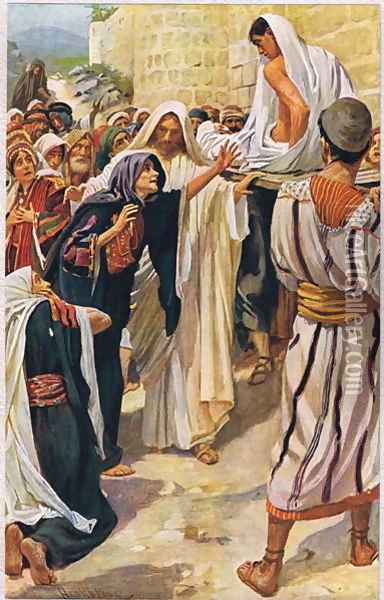
The Gospel story of the widow of Nain could help us answer. Reading it, I remember standing by a large walkway window at the Louisville Airport on a sweltering July day in 2005.

Down on the heat-softened tarmac, a small bevy of soldiers stood at attention. Slowly, a flag-draped casket was lowered into their waiting arms. Just to the side, a huddled family, waited as well. Two children clung to either side of their young mother. An older couple stood behind her, hands gentled on her shoulders.

At the window, several other travelers gathered in silence. A few teenage boys removed their inverted baseball caps when they noticed a distinguished older gentleman stand tall and hold a salute.

No one who witnessed that brief ceremony will ever forget it. The grief, reverence and astonishment at life’s fragility emblazoned the moment on every witnessing heart.


When Jesus passed the gates of Nain on that ancient morning, he had a like experience. He saw this “only son of a widowed mother”. Once again, shaken to his roots with compassion –splancha, he pulled heaven down to heal heart-breaking loss.

As Jesus drew near to the gate of the city
a man who had died was being carried out,
the only son of his widowed mother.

How I wished Jesus were flying out of Louisville that day in 2005! But then I realized He was there. The miracle was hidden, but still real. The Divine Compassion flowed through me, through the reverent gathering beside me, through the soldiers’ honoring arms, through the long prayerful memory we would all forever share.

That young man from Nain was raised from the dead… for a while. He, like all of us, eventually died. The miracle was not about him and his life. The miracle was the visible sign of God’s Lavish Mercy for us – God’s “feeling-with-us” in all our experiences. That compassion, whether miraculously visible or not, is always with us. It just took a different form that day in Louisville.

The baptismal commission to be Christ’s Body in the world calls each of us to the same type of compassion, of “being with” those who suffer, of honoring the God-given life of every person, and of believing in its ultimate resurrection.

Poetry: FIRSTBORN SONS AND THE WIDOW OF NAIN (LUKE 7:11–15)
by Irene Zimmerman, OSF

Jesus halted on the road outside Nain
where a woman’s wailing drenched the air.
Out of the gates poured a somber procession
of dark-shawled women, hushed children,
young men bearing a litter that held
a body swathed in burial clothes,
and the woman, walking alone.

A widow then—another bundle
of begging rags at the city gates.
A bruised reed!

Her loud grief labored and churned in him till
“Halt!” he shouted.
The crowd, the woman, the dead man stopped.
Dust, raised by sandaled feet,
settled down again on the sandy road.
Insects waited in shocked silence.
He walked to the litter, grasped a dead hand.
“Young man,” he called
in a voice that shook the walls of Sheol,
“I command you, rise!” The linens stirred.
Two firstborn sons from Nazareth and Nain
met, eye to eye. He placed the pulsing hand into hers.
“Woman, behold your son,” he smiled.

Music:  The Body of Christ – Sarah Hart

Entwined in Faith

Saturday of the Twenty-Third Week in Ordinary Time
September 10, 2022

Today’s Readings:

https://bible.usccb.org/bible/readings/091022.cfm

Today, in God’s Lavish Mercy, both Paul and Jesus caution their listeners to be single-hearted and resolute in their faith and practice.

Paul tells these early Corinthian Christians not to participate in dinners served at pagan temples. The meat at these meals had been sacrificed to idols so that to participate in the dinner appeared to give approbation to the idolatrous practice.

My beloved ones, avoid idolatry.
I am speaking as to sensible people;
judge for yourselves what I am saying.

….

You cannot drink the cup of the Lord and also the cup of demons.
You cannot partake of the table of the Lord and of the table of demons.


Paul’s key message is that now this baptized community belongs to a new faith which worships one God through Jesus Christ. Their lives must witness this gift and commitment.

My beloved ones, avoid idolatry.
I am speaking as to sensible people;
judge for yourselves what I am saying.
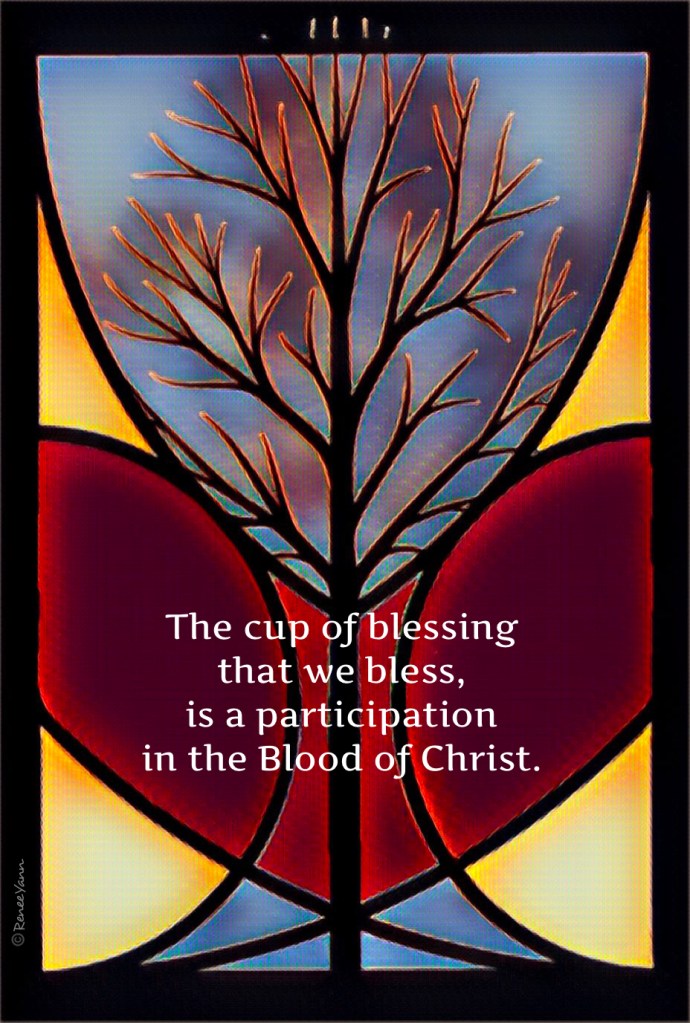
The cup of blessing that we bless,
is it not a participation in the Blood of Christ?
The bread that we break,
is it not a participation in the Body of Christ?
Because the loaf of bread is one,
we, though many, are one Body,
for we all partake of the one loaf.


In our Gospel, Jesus describes that steadfast witness in terms of a tree. When we are truly knit into the love of God in Jesus Christ, we flourish with God’s own life.

A good tree does not bear rotten fruit,
nor does a rotten tree bear good fruit.
For every tree is known by its own fruit.
For people do not pick figs from thornbushes,
nor do they gather grapes from brambles.
A good person out of the store of goodness in his heart produces good,
but an evil person out of a store of evil produces evil;
for from the fullness of the heart the mouth speaks.

Each day, each moment, gives us the opportunity to root our lives deeply in our faith. We ask God for that sacred entwining – like a tree which reaches deep into the ground for life, or like a well-founded house whose bedrock is deep and stable.

I will show you what someone is like who comes to me,
listens to my words, and acts on them.
That one is like someone building a house,
who dug deeply and laid the foundation on rock;
when the flood came, the river burst against that house
but could not shake it because it had been well built.

Poetry: Love and Harmony – William Blake

This poem is often interpreted to describe the picture of a perfect marriage where love and harmony allow otherwise separate entities to “entwine”. However, Blake was, beyond a poet, a mystic. His poems almost always contain a central analogy of the human relationship with the Divine. I think this poem does as well and can be read as a type of prayer to be fully entwined with God, in love and harmony.

Love and harmony combine,
And round our souls entwine
While thy branches mix with mine,
And our roots together join.
Joys upon our branches sit,
Chirping loud and singing sweet;
Like gentle streams beneath our feet
Innocence and virtue meet.
Thou the golden fruit dost bear,
I am clad in flowers fair;
Thy sweet boughs perfume the air,
And the turtle buildeth there.
There she sits and feeds her young,
Sweet I hear her mournful song;
And thy lovely leaves among,
There is love, I hear his tongue.
There his charming nest doth lay,
There he sleeps the night away;
There he sports along the day,
And doth among our branches play.

Music: The Memory of Trees- Enya

Wisdom, please ….

Twenty-third Sunday in Ordinary Time
September 4, 2022

Today, in God’s Lavish Mercy, we continue to move into the final segments of Luke’s Gospel which we have been reading on Sundays throughout this liturgical year.

Today, the Church links three readings which, at first glance, might seem unrelated.

  • Our first reading from Wisdom reminds us of God’s infinite wisdom, incomprehensible to our human minds.
  • Paul, in his letter to Philemon, begs for the loving inclusion of Onesimus, an enslaved person, into the Colossian community.
  • In our Gospel, Jesus makes this harsh pronouncement:

If anyone comes to me without hating his father and mother,
wife and children, brothers and sisters,
and even his own life,
he cannot be my disciple.


How might we interpret these disparate passages to find a message of wholeness for our prayer?

Wis9_13 gods mind

Let’s start with Jesus. In no uncertain terms, he challenges his disciples to move out of their small worlds into God’s big world. That Godly world is not defined by family, nor by any condition other than our common Creaturehood in God … not by:

word gram

Jesus says the sacred community is defined only by shared and irrevocable commitment to the Gospel of love and mercy.


Paul knows and loves Onesimus, the slave, as a brother in this community. In his letter, Paul encourages Philemon to do the same.


Sometimes as human beings, filled with all kinds of insecurities, we tend to build enclaves that make us feel safe. We like to be with “our kind”. We invent borders to filter out those whose differences we don’t understand. We allow fear to grow with that lack of understanding. Within the enclosure of our self-protectionism, we eventually forget that we are all one, equal, precious, beautiful and beloved by God.

Such toxic attitudes are the soil for slavery, war, ethnic cleansing, racial supremacy, human trafficking, destructive nationalism, and all the other sacrileges committed by humans against the human family.

Wisdom reminds us that only God can open
the tight circle of our fears, judgments and isolations
– only God whose infinite love encompasses all.
Jesus tells us that we find that love
only by lifting up the cross and following him.

Wisdom tells us to put it in God’s hands, and to respond to God’s challenge in the preaching of Jesus Christ.

Who can know your way of thinking, O God
… except you give us wisdom

 and send your Holy Spirit from on high
 thus stretching the hearts of those on earth

Today I pray, may God do this for me,
and for all our tight, convoluted
and troubled world.


Poetic Prayer of Hildegard of Bingen

Hildegard of Bingen (c. 1098 – 17 September 1179), was a German Benedictine abbess and polymath active as a writer, composer, philosopher, mystic, visionary, and as a medical writer and practitioner during the High Middle Ages. She is one of the best-known composers of sacred monophony, as well as the most recorded in modern history. She has been considered by scholars to be the founder of scientific natural history in Germany.

I am Wisdom. 
Mine is the blast of the resounding Word 
through which all creation came to be, 
and I quickened all things with my breath 
so that not one of them is mortal in its kind; 
for I am Life.

Indeed I am Life, whole and undivided 
-- not hewn from any stone, 
or budded from branches, 
or rooted in virile strength; 
but all that lives has its root in Me.
 
For Wisdom is the root 
whose blossom is the resounding Word....
I flame above the beauty of the fields 
to signify the earth 
-- the matter from which humanity was made.

I shine in the waters to indicate the soul, 
for, as water suffuses the whole earth, 
the soul pervades the whole body. 

I burn in the sun and the moon to denote Wisdom, 
and the stars are the innumerable words of Wisdom.

Music: Who Has Known (an Advent hymn, but perfect I think for today’s readings)

Alleluia: Poppin’ Good Faith

Memorial of Saint Gregory the Great,
Pope and Doctor of the Church
Saturday, September 2, 2022

Today’s Readings:

https://bible.usccb.org/bible/readings/090322.cfm

Alleluia, alleluia.
I am the way and the truth and the life, says the Lord;
no one comes to the Father except through me.

Today, in God’s Lavish Mercy, our readings encourage us to live a Spirit-inspired faith rather than one of appearances.

At first, I found our first reading uninspiring. So I did a little research which helped me to appreciate that 1 Corinthians shows us a “toddler Church” trying to discover itself. 

Paul is her teacher, but Paul is not always with her. Other influences, theories and even conspiracies can influence her emerging self-awareness. Some of these influences might include those who think they are in charge, and begin to set rules and roles for the early Church’s life without Paul’s direction.

In today’s passage from Corinthians, Paul uses a lot of sarcasm to warn the community not to get ahead of themselves in shaping their faith community. He wants them not to rely on structures and functions but on the uncontainable power of the Holy Spirit to inspire and create a path for God’s love and mercy in the world.

Paul reminds the Corinthians that everything they have they received. They are not to feel entitled by their gifts but humble, grateful and open to his apostolic teaching and example.

Brothers and sisters:
Learn from myself and Apollos not to go beyond what is written,
so that none of you will be inflated with pride
in favor of one person over against another.
Who confers distinction upon you?
What do you possess that you have not received?
But if you have received it,
why are you boasting as if you did not receive it?

Jesus is saying the same thing to the Pharisees in our Gospel today. They boast that they are the arbiters and interpreters of the faith.

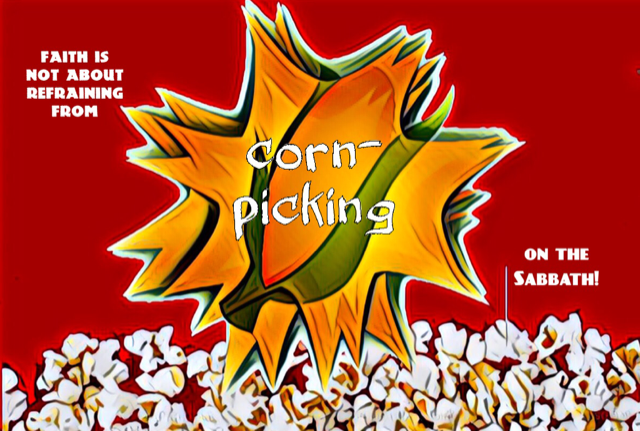
But faith is not about refraining from corn-picking on the Sabbath! We make rules like this because we are afraid of the power of the Holy Spirit to transform us. So instead, we push God’s Spirit into the confines of a corn husk where we are safe from God’s transformative call that might upset our comfort.

Jesus tells the Pharisees to be like David. Although not faultless, David got it! He lived a life of passionate love for and relationship with God which refused to be confined by imposed definitions.

David and the Temple Bread

Jesus said to them in reply,
“Have you not read what David did
when he and those who were with him were hungry?
How he went into the house of God, took the bread of offering,
which only the priests could lawfully eat,
ate of it, and shared it with his companions?”
Then he said to them, “The Son of Man is lord of the sabbath.”


Surely there are lessons here for our own Church as we are invited to transformation by the Gospel and by the inspired teaching of Pope Francis. Like Jesus, he is a breaker of corn husks and some are frightened by the charismatic challenges he places before us.

Our Verse assures us that by opening our hearts to the Gospel’s call, we will find true life.

Alleluia, alleluia.
I am the way and the truth and the life, says the Lord;
no one comes to the fullness of God except through me.


Poetry: TO LIVE WITH THE SPIRIT – Jessica Powers

To live with the Spirit of God is to be a listener.
It is to keep the vigil of mystery,
earthless and still.
One leans to catch the stirring of the Spirit,
strange as the wind’s will.
The soul that walks where the wind of the Spirit blows
turns like a wandering weather-vane toward love.
It may lament like Job or Jeremiah,
echo the wounded hart, the mateless dove.
It may rejoice in spaciousness of meadow
that emulates the freedom of the sky.
Always it walks in waylessness, unknowing;
it has cast down forever from its hand
the compass of the whither and the why.
To live with the Spirit of God is to be a lover.
It is becoming love, and like to Him
toward Whom we strain with metaphors of creatures:
fire-sweep and water-rush and the wind’s whim.
The soul is all activity, all silence;
and though it surges Godward to its goal,
it holds, as moving earth holds sleeping noonday,
the peace that is the listening of the soul.

In Place of Music: John Michael Talbot speaking on today’s Gospel

And a beautiful song for your quiet:

Alleluia: Call to Discipleship

Thursday of the Twenty-second Week in Ordinary Time
September 1, 2022

Today, in God’s Lavish Mercy, our readings lead us to consider our call.

Lk5_11 leftJPG

The call to discipleship comes to us within the other calls of our life: the call to be a good parent, spouse, sibling, child. It comes in the call to be a moral, values-driven employer; an honest, hard-working employee; a supportive, engaged co-worker. Christ asks us to mirror him as neighbor, friend, colleague, and citizen.

In whatever skill or profession we practice, Christ asks us to exercise it as he would – to choose, judge and behave as he would.


In our Gospel, the first disciples are astonished at the miracle of the fishes. Like a lightening bolt, that astonishment transforms their world view. They now see Christ as the Center of their lives. They drop their nets on the seashore. They leave everything to follow him.


What is it that we must leave to make Christ the center of our lives? What nets are we caught in that keep us from freeing the call within us?

We are challenged by a world filled with the entanglements of greed, destructive power, aggression, bigotry, lies, and political & social pretense. How much have these infected the purity of our desire to follow Jesus?


Poetry: On St. Peter Casting Away His Nets at Our Saviour’s Call – Richard Crashaw

Thou hast the art on't Peter; and canst tell 
To cast thy Nets on all occasions well. 
When Christ calls, and thy Nets would have thee stay: 
To cast them well's to cast them quite away.

Music: Lord, You Have Come to the Seashore- Caesareo Gabarain

Lord, You have come to the seashore
Neither searching for…the rich nor the wise,…
desiring only…that I should follow
Refrain:
O Lord, with your eyes set upon me,
gently smiling, you have spoken my name;
all I longed for I have found by the water.
At your side, I will seek other shores.

Lord, see my goods, my possessions;
in my boat you find…no power, no wealth…
Will you accept then…my nets and labor?

Lord,…take my hands and direct them
Help me spend myself in seeking the lost,…
returning love for…the love you gave me.

Lord,…as I drift on the waters…
be the resting place…of my restless heart,…
my life’s companion,…my friend and refuge.

Alleluia: The Prophet

Memorial of the Passion of Saint John the Baptist
Monday, August 29, 2022

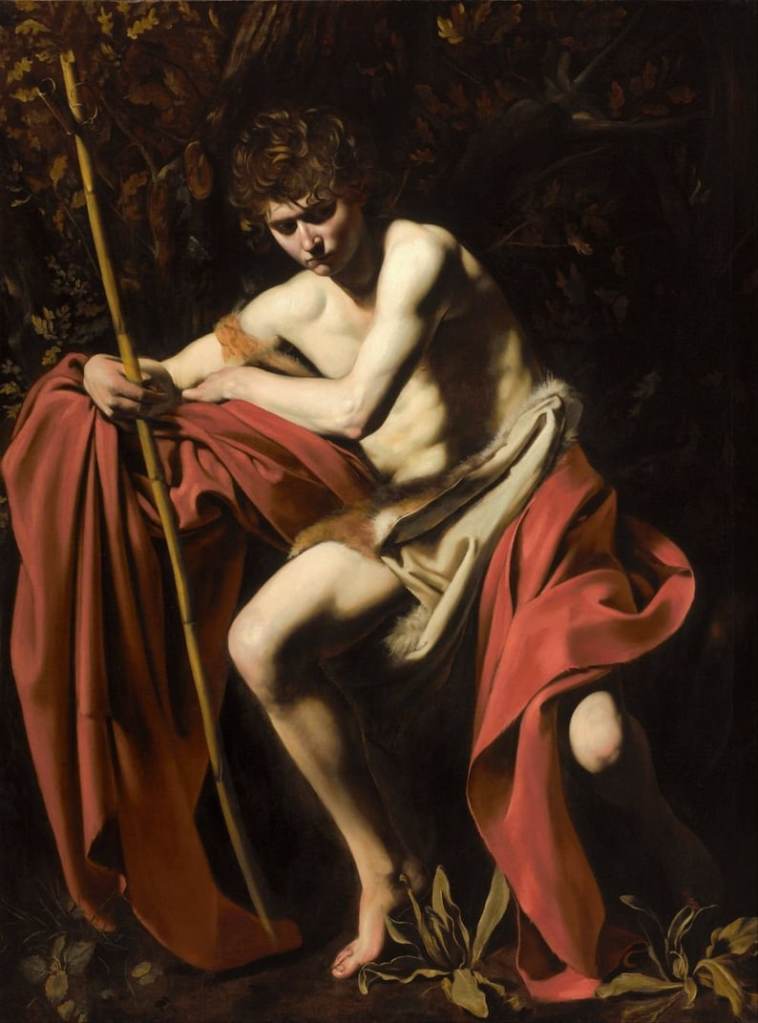
John the Baptist – Caravaggio

Today’s Readings

https://bible.usccb.org/bible/readings/082922.cfm

Alleluia, alleluia.
Blessed are those who are persecuted
for the sake of righteousness,
for theirs is the Kingdom of heaven.

Today, in God’s Lavish Mercy, we commemorate the Passion of John the Baptist who, besides Mary, was the greatest saint embracing both the Old and the New Testaments.

When I was young, the memorial was simply referred to as “The Beheading of John the Baptist”. The term “passion” captures its meaning so much more clearly:

  • it inclines us to realize the similarities between John’s passion and death and that of Jesus.
  • it shifts the power of the event to John, who chose his fate by the courage of his witness, rather than to see Herod, the “beheader”, as the agent of the story.

John’s whole prophetic life was part of his “passion”. It inevitably led him to this ultimate confrontation with evil.


Walter Bruggemann, in his transformational book “The Prophetic Imagination” writes about prophets. He indicates that prophets emerge in the context of “totalism” – those paralyzing systems which attempt to control and dominate all freedom and possibility.

Totalism kills ideas, hope, freedom, choice, self-determination, and creativity for the sake of controlling reality for its own advantage. Totalism is the ultimate “abusive relationship“.


Brueggemann defines the prophet as one engaged in these three tasks:

  • the prophet is clear on the force and illegitimacy of the totalism.
  • the prophet pronounces the truth about the force of the totalism that contradicts the purpose of God.
  • the prophet articulates the alternative world that God has promised, and that God is actually creating within the chaos around us.

Every age requires prophets because every age is infected with “Herods” trying to thwart God’s reign of love, mercy, truth, freedom, and joy. In our own time, the poison of totalism is quite evident in those systems fueled by racism, militarism, financial duplicity, desecration of the earth, and the sad array of other ideologies that cripple humanity.

Today, as we pray with this great saint, may we be inspired to respond to our own prophetic call – to be prophetic signs of love, mutual reverence, joy, Gospel justice, holy encouragement and lavish mercy for our world.


Poetry: On Reason and Passion – Rabindranath Tagore

And the priestess spoke again and said: Speak to us of Reason and Passion.
     And he answered, saying:
     Your soul is oftentimes a battlefield, upon which your reason and your judgement wage war against your passion and your appetite. 
     Would that I could be the peacemaker in your soul, that I might turn the discord and the rivalry of your elements into oneness and melody.
     But how shall I, unless you yourselves be also the peacemakers, nay, the lovers of all your elements?

     Your reason and your passion are the rudder and the sails of your seafaring soul.
     If either your sails or your rudder be broken, you can but toss and drift, or else be held at a standstill in mid-seas.
     For reason, ruling alone, is a force confining and passion, unattended, is a flame that burns to its own destruction.
     Therefore let your soul exalt your reason to the height of passion, that it may sing;
     And let it direct your passion with reason, that your passion may live through its own daily resurrection and like the phoenix rise above its own ashes.

     I would have your consider your judgment and your appetite even as you would two loved guests in your house.
     Surely you would not honour one guest above the other; for he who is more mindful of one loses the love and the faith of both.

     Among the hills, when you sit in the cool shade of the white poplars, sharing the peace and serenity of distant fields, and meadows—then let your heart say in silence, “God rests in reason.”
     And when the storm comes, and the mighty wind shakes the forest, and thunder and lightning proclaim the majesty of the sky,—then let your heart say in awe, “God moves in passion.”
     And since you are a breath in God’s sphere, and a leaf in God’s forest, you too should rest in reason and move in passion.

Music: I think of this song by Simon and Garfunkel as the modern day song of John the Baptist.