Psalm 25: Let Your Word Teach Me

Third Sunday in Ordinary Time 

Sunday of the Word of God

January 24, 2021


Today, in God’s Lavish Mercy, we pray with Psalm 25, a simple, heartfelt plea to learn God’s ways and to be blessed by that learning.

Your ways, O LORD, make known to me;
    teach me your paths,
Guide me in your truth and teach me,
    for you are God my savior.

Psalm 25: 4-5

The psalmist’s prayer is so fitting
for this special Sunday
which is dedicated as the
“Sunday of the Word of God”.

Pope Francis called for this commemoration with his Apostolic Letter “Aperuit illis”. The Latin words come from Luke 24:45, referring to Jesus’s post-Resurrection appearance to his confused disciples.

Then he opened their minds
to understand the scriptures.

While they were still speaking about this, he stood in their midst and said to them, “Peace be with you.” But they were startled and terrified and thought that they were seeing a ghost.
Then he said to them, “Why are you troubled? And why do questions arise in your hearts?
Look at my hands and my feet, that it is I myself. Touch me and see, because a ghost does not have flesh and bones as you can see I have.” And as he said this, he showed them his hands and his feet.

While they were still incredulous for joy and were amazed, he asked them, “Have you anything here to eat?” They gave him a piece of baked fish; he took it and ate it in front of them.
He said to them, “These are my words that I spoke to you while I was still with you, that everything written about me in the law of Moses and in the prophets and psalms must be fulfilled.”
Then he opened their minds to understand the scriptures.

Luke 24: 36-45

The Pope’s letter institutes the annual observance
of the 3rd Sunday of Ordinary Time
as “Sunday of the Word of God”,
devoted to the celebration, study and
dissemination of the Word of God.

Pope Francis wrote this:

A profound bond links sacred Scripture and the faith of believers. Since faith comes from hearing, and what is heard is based on the word of Christ (cf. Rom 10:17), believers are bound to listen attentively to the word of the Lord, both in the celebration of the liturgy and in their personal prayer and reflection.

Aperuit Illis, 7

If you are reading this blog, you already seek an ever deeper, more loving relationship with God through sacred scripture. But with our Infinite God, there is always more.

Let us use today’s Psalm 25 to reflect on and reaffirm that core relationship in our lives. Let’s re-examine the dedicated time we give to scriptural prayer and “lectio divina” to make it more intentional, quiet, and consistent.


For a good explanation of lectio divina, see the Transforming Center’s website:


In the spirit of Psalm 25, we pray to always be held in God’s merciful attention, and to hold God in ours through prayer and desire.

Remember that your compassion, O LORD,
    and your love are from of old.
In your kindness remember me,
    because of your goodness, O LORD.

Psalm 25: 6-7

These are two books that I love, and have mentioned before, to help deepen our scriptural prayer:

Too Deep for Words – Thelma Hall

The Flowing Grace of Now – Macrina Wiederkehr – (Kindle edition on sale now for just $2.99)


Poetry: The Opening of Eyes – David Whyte

That day I saw beneath dark clouds 
the passing light over the water
and I heard the voice of the world speak out,
I knew then, as I had before
life is no passing memory of what has been
nor the remaining pages in a great book
waiting to be read.
It is the opening of eyes long closed.
It is the vision of far off things
seen for the silence they hold.
It is the heart after years
of secret conversing
speaking out loud in the clear air.
It is Moses in the desert
fallen to his knees before the lit bush.
It is the man throwing away his shoes
as if to enter heaven
and finding himself astonished,
opened at last,
fallen in love with solid ground.

Music: Word of God Speak – MercyMe 

Psalm 110: A Chasuble of Justice

Monday of the Second Week in Ordinary Time

January 18, 2021


Today, in God’s Lavish Mercy, we pray with Psalm 110 where we are re-introduced to Melchizedek, the first priest mentioned in Genesis 14.


Yours is princely power in the day of your birth, in holy splendor;
    before the daystar, like the dew, I have begotten you.”
The LORD has sworn, and will not repent:
    “You are a priest forever, according to the order of Melchizedek.”

Psalm 110: 3-4

And our two readings today show us Jesus, the one High Priest, through whom we are fully redeemed.

In the days when he was in the Flesh,
Jesus offered prayers and supplications with loud cries and tears
to the one who was able to save him from death,
and he was heard because of his reverence.
Son though he was, he learned obedience from what he suffered;
and when he was made perfect,
he became the source of eternal salvation for all who obey him.

Hebrews 5: 7-9

It is so appropriate to consider the meaning of priesthood as we commemorate the life of Rev. Dr. Martin Luther King. In the image of Christ, Dr. King wore a chasuble of justice for our time.

A priest is one :

  • who is set apart
  • who mediates the Divine
  • who bears witness
  • who ministers
  • who offers sacrifice
  • who transforms through prophetic hope

As a Catholic priest vests with the chasuble for Mass, this prayer is said:

Domine, qui dixisti:
Jugum meum suave est et onus meum leve:
fac, ut istud portare sic valeam,
quod consequar tuam gratiam.

Lord, you have said:
My yoke is sweet and my burden is light.
Grant that I may carry your yoke well
so as to obtain your grace.

Indeed, Martin Luther King “carried the yoke well”
to obtain the grace of justice for all of us.


Poetry: two poems in which the poet, Margaret Walker, uses the persona of Amos the Prophet to describe Martin Luther King. One poem is written before, and one after, Dr. King’s assassination.

Amos, 1963 – Margaret Walker – 1914-1997

Amos is a Shepherd of suffering sheep;
A pastor preaching in the depths of Alabama
Preaching social justice to the Southland
Preaching to the poor a new gospel of love
With the words of a god and the dreams of a man
Amos is our loving Shepherd of the sheep
Crying out to the stricken land
“You have sold the righteous for silver
And the poor for a pair of shoes.
My God is a mighty avenger
And He shall come with His rod in His hand.”
Preaching to the persecuted and the disinherited millions
Preaching love and justice to the solid southern land
Amos is a Prophet with a vision of brotherly love
With a vision and a dream of the red hills of Georgia
“When Justice shall roll down like water
And righteousness like a mighty stream.”
Amos is our Shepherd standing in the Shadow of our God
Tending his flocks all over the hills of Albany
And the seething streets of Selma and of bitter Birmingham.

Amos (Postscript, 1968)

From Montgomery to Memphis he marches
He stands on the threshold of tomorrow
He breaks the bars of iron and they remove the signs
He opens the gates of our prisons.
He speaks to the captive hearts of America
He bares raw their conscience
He is a man of peace for the people
Amos is a Prophet of the Lord
Amos speaks through Eternity
The glorious Word of the Lord!

Music: American Dream – Bobby Womack

Psalm 40: God’s Whisper

Second Sunday in Ordinary Time

January 17, 2021


Today, in God’s Lavish Mercy, we pray with Psalm 40, the prayer of one at home with God:

I delight to do your will, my God;
your law is in my inner being!

Psalm 40:9

We are reminded that we find this kind of peace by believing and listening to our experience:

Throughout our readings today, God leans over heaven’s edge to whisper into human experience.


Samuel’s Call by Joshua Reynolds

In our first reading, that whisper comes in a sacred call to a listening Samuel:

When Samuel went to sleep in his place,
the LORD came and revealed his presence,
calling out as before, “Samuel, Samuel!”
Samuel answered, “Speak, for your servant is listening.”

1 Samuel 3: 9-10

In our second reading, Paul reminds us that the
Whispering Spirit is already resident within us:


Do you not know that your body
is a temple of the Holy Spirit within you,
whom you have from God, 
and that you are not your own?

1 Corinthians 6: 19

In our Gospel, Jesus – the Word, the Divine Whisper – invites us to come to him, to see his power with us in our ordinary lives.

The two disciples said to Jesus,
“Rabbi, where do you live?”
He said to them, “Come, and you will see.”

John 1: 39

Praying with Psalm 40 can turn our hearts
to listening for God’s voice
under and within our experiences. 

  • It can wake us up, as Samuel was awakened.
  • It can attune us to the melody deep within our hearts.
  • It can reiterate God’s invitation to live our lives so fully in the Beloved’s Presence that, even without a sound, we know each other’s thoughts.

Poetry: from Whispers of the Beloved by Rumi

Do you know what the music is saying?
“Come follow me and you will find the way.
Your mistakes can also lead you to the Truth.
When you ask, the answer will be given.”

Music: All Praise to Him – Sovereign Grace Music

Psalm 105: Wondrous Deeds

Wednesday of the First Week in Ordinary Time

January 13, 2021

Today, in God’s Lavish Mercy, we pray with Psalm 105 celebrating God’s covenanted faithfulness to us.

Give thanks to the LORD, invoke God’s name;
    make known among the nations God’s deeds.
Sing, sing God’s praise,
    proclaim all God’s wondrous deeds.
(because…) The Lord remembers the covenant for ever.

Psalm 105: 1-2, 8

We certainly can spend some time in prayer today remembering God’s faithfulness to us personally. A grateful review of our life journey can always offer new insights into God’s love and generosity.

But more specifically, our psalm calls us to plumb the two readings which it connects.

  • Hebrews reminds us that God’s love is so extreme that God took Flesh in Jesus to teach us, in terms we could understand, the degree of God’s love.
  • In Mark, we see the early expression of that love, as Jesus reveals his healing power to the wretchedly suffering crowds.

In these readings, we learn that God’s promise endures to each generation:

God remembers the covenant forever
    which was made binding for a thousand generations– 
Which was entered into with Abraham
    and by God’s oath to Isaac.

Psalm 105: 8

In Chronos Time, this enduring covenant was enfleshed in Jesus. It continues in Kairos Time through each person’s Baptism into Christ through the Holy Spirit.

In other words,
we are the agents of God’s covenant with the world. Our lives must enflesh God’s Mercy for our times.

In his letter to Titus, Paul puts this clearly:

But when the kindness and love of God our Savior appeared, we were saved not because of righteous things we had done, but because of God’s mercy. God saved us through the washing of rebirth and renewal by the Holy Spirit, poured out on us generously through Jesus Christ our Savior, so that, having been justified by God’s grace, we might become heirs having the hope of eternal life.  

Titus 3: 4-7

May the message of these readings free us,
inspire us, and impel us
to a grace-filled response.


Poetry: Grace by Jill Peláez Baumgartner

Is it the transparency
and lift of air?
Is it release
as when the pebble
flings out of the slingshot
or the tethered dog
suddenly is without lead?

Or is it more like standing
on a dark beach
at midnight,
the surf loud
with its own revolution,
the horizon invisible,
the entire world the threat
of rushing water?

No one who swims 
at night in the ocean
feels weightless
embracing armfuls of water
against the ballast
of the waves’ fight.

Swimming:
toward the shore lights
or out into the vast bed
of the sea's white fires?

Music: Confitemini Domino – Psalm 105 – Orlando di Lasso (first published in 1562)

Confitemini Domino et invocate nomen ejus,

annuntiate inter gentes opera ejus,

cantate ei et psallite ei.

Narrate omnia mirabilia ejus,

laudamini in nomine sancto ejus,

laetetur cor quaerentium Dominum.

Give glory to the Lord, and call upon his name,

declare his deeds among the Gentiles,

sing to him, yea sing praises to him.

Relate all his wondrous works,

Glory ye in his holy name,

let the heart of them rejoice that seek the Lord.

Psalm 97: Ordinary?

Monday of the First Week in Ordinary Time

January 11,2021


Today, in God’s Lavish Mercy, we pray with Psalm 97 which reminds us that, as Jesus begins his earthly ministry, he is accompanied by the unseen powers of heaven.

The heavens proclaim his justice,
and all peoples see his glory.
Let all his angels worship him.

Psalm 97: 6-7

The psalm is reflective of the glorious passage from our first reading describing the Divinity of Jesus:

The Son of God is…
the refulgence of God’s glory, 
the very imprint of God’s being,
who sustains all things by his mighty word.
When he had accomplished purification from sins, 
he took his seat at the right hand of the Majesty on high,
as far superior to the angels
as the name he has inherited is more excellent than theirs.

Hebrews 1: 3-4

These seem perfect readings to begin a season described as “Ordinary Time” because they remind us that the power of Jesus Christ is far from ordinary.

And our days do not feel like ordinary times, do they? They are both fraught with threat and charged with hope.

They are times belabored by pandemic struggle, political vitriol, climate dissolution, global strife and systemic oppression.

But they are also times bristling with breakthrough discovery, civic renewal, social consciousness, communal courage and spiritual awakening.


Just as in our Gospel on this first day of “Ordinary Time”, Jesus asks his disciples to “Come”, dream extraordinary dreams with him, so he asks us. 

He asks us to believe
that there are unseen angels attending us.
 
He asks us to remember that we, like him,
are made in the refulgent image of God.


He calls us, like Simon and Andrew, to believe
that our “ordinary time” is actually the “time of fulfillment”:

This is the time of fulfillment.
The Kingdom of God is at hand.
Repent, and believe in the Gospel.

Mark 1:15

Poetry: Maya Angelou – Touched by an Angel

We, unaccustomed to courage,
exiles from delight,
live coiled in shells of loneliness
until love leaves its high holy temple
and comes into our sight
to liberate us into life.

Love arrives
and in its train come ecstasies
old memories of pleasure
ancient histories of pain.
Yet if we are bold,
love strikes away the chains of fear
from our souls.

We are weaned from our timidity
In the flush of love's light
we dare be brave
And suddenly we see
that love costs all we are
and will ever be.
Yet it is only love
which sets us free.

Music: Ordinary Time – Marie Bellet

There will come a day for quiet kitchen mornings
Lunches with the girls, book clubs in the afternoon
There will come a day for chintz flowers on my sofa
Just the perfect lipstick, matching purse and shoes.

There will come a day without constant interruption
Confusing all my senses, my reason and my rhyme
But for now I trip on the backpacks in the hallway
Scrub the crayon from the walls that mark this ordinary time.

There will come a day for uneventful dinners
When no one drops their fork or spills their milk upon the floor
There will come a day, I’ll be wiser, I’ll be thinner
I will finish conversations before running out the door.

Well, isn’t that the way it is for all those happy women
Who smile at me from magazines there in the checkout line?
What about the tired, the simple and forgotten?
Blessed be the ordinary here in ordinary time.

He said “Who will feed my sheep?
Who will heed their cry?”
I said “I am vain and weak
But surely I will try.

You know everything
And You know that I’m
Just an ordinary woman 
here in ordinary time”.

There will come a day when everything is order
And I will be the queen of everything I see
But how my heart will leap to find one backpack in the hallway
With the promise of a face, and a story just for me.

So may I never yearn for those cocktail conversations
Clever observations made for fashionable minds
May I finally learn to be happy and have patience
With the constant changing rhythm of this ordinary time,
The constant changing rhythm of this ordinary time.

Psalm 149: Let’s Dance Again!

Saturday after Epiphany

January 9, 2021

Today, in God’s Lavish Mercy, we pray with Psalm 149.

Our psalm contains a brief line tucked at its center which foreshadows the entire message of the Gospel. 

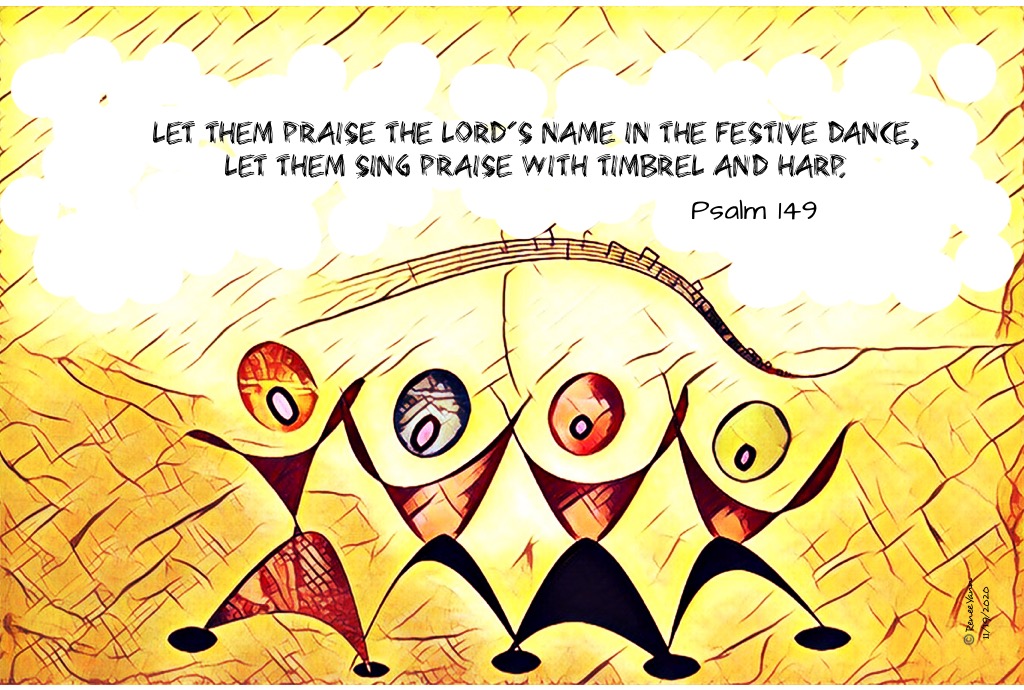
Let them praise God’s name in the festive dance,
let them sing praise with timbrel and harp.
For the LORD loves us,
and adorns the lowly with victory.


We will find a dancing, singing joy when we give ourselves to these truths:

  • God loves us irrevocably
  • We can fully receive this great love to the degree that we become like Christ whose image we find among the poor, lowly, and suffering.

Poetry: Dance from Rumi

Come to me, and I shall dance with you
In the temples, on the beaches, through the crowded streets
Be you man or woman, plant or animal, slave or free
I shall show you the brilliant crystal fires, shining within
I shall show you the beauty deep within your soul
I shall show the path beyond Heaven.
Only dance, and your illusions will blow in the wind
Dance, and make joyous the love around you
Dance, and your veils which hide the Light
Shall swirl in a heap at your feet.

Music: Psalm 149 – Antonín Dvořák

Psalm 27: Can We Love Like This?

Wednesday after Epiphany

January 6, 2021

Today, in God’s Lavish Mercy, as we once again pray with Psalm 27, we do so in the light of our seminal first reading from John:

God is love, 
and when we remain in love 
we remain in God 
and God in us.

1 John 4:16

How can we love like that?

Psalm 27 tells us how God does it:

For the Lord rescues the poor who cry out,
and the afflicted who have no other help.
The Lord has pity for the lowly and the poor;
and saves the lives of the poor.

Psalm 27: 12-13

Our psalm gives us the measure for love in our lives. Who are the suffering ones in the circle of our experience? How are we widening that circle to offer loving mercy with greater energy and fidelity?


The Spiritual and Corporal Works of Mercy can be our guide as we seek to stretch our love in ever-widening circles.

The Corporal Works of Mercy

To feed the hungry
To give water to the thirsty
To clothe the naked
To shelter the homeless
To visit the sick
To visit the imprisoned, and ransom the captive
To bury the dead


The Spiritual Works of Mercy

To instruct the ignorant.
To counsel the doubtful.
To admonish sinners.
To bear patiently those who wrong us.
To forgive offenses.
To comfort the afflicted.
To pray for the living and the dead.


Poetry: Widening Circles – Rainer Maria Rilke

I live my life in widening circles
that reach out across the world.
I may not complete this last one
but I give myself to it.
I circle around God, around the primordial tower.
I’ve been circling for thousands of years
and I still don’t know: am I a falcon,
a storm, or a great song?

Music: The Mercy Song – Paul Alexander

The Epiphany of Our Lord

January 3, 2021

Today, in God’s Lavish Mercy, and on this glorious feast, we pray with Psalm 72.

It is a gorgeous psalm that fills our senses with lights, and scents, and the tactile experience of an ancient and sacred world:

  • we inhale the flower of justice
  • wrap ourselves in its profound peace
  • gaze on a distant, moonless universe
  • stretch our prayer from sea to sea,
  • and our praise to the ends of the earth

We see the ancient nations gather in homage,
carrying the gems, spices and bounty of their homelands.

We, too, kneel in astounded wonder that this vulnerable child, 
hidden in the far reaches of both geography and imagination,
carries to us the Promise of the Ages.

We, too, trust the star, rising in our own hearts.


Psalm 72 echoes our beautiful first reading from Isaiah, another masterpiece that, in itself, is enough simply to read and savor:

Rise up in splendor, Jerusalem!  
Your light has come,
the glory of the Lord shines upon you.
See, darkness covers the earth,
and thick clouds cover the peoples;
but upon you the LORD shines,
and over you appears his glory.

Isaiah 60: 1-2

In Isaiah, these magnificent verses follow two chapters of gloom and darkness. They break forth in true epiphany to say, “Your Light has come!” – now your life must begin to shine as well.

Epiphany is not simply about kings and camels. It is not simply about a  crèche and a star. 

It is about Divine Revelation hovering over our dailyness. It is about us, opening our eyes in faith and responsiveness to our ever-present God.

The feast of Epiphany reminds us:

Look at your life today.
The star did not pass you by.
Open your eyes and find it.
Once you have seen it,
live in its Light.

Poetry: The Journey of the Magi – T.S. Eliot

Eliot wrote the poem after his conversion to Anglicanism ( He had been a Unitarian.) The poem conveys his struggle to grow in the light of his new faith. The “journey” is life-long and demanding in a world that often  contradicts that faith.

“A cold coming we had of it,
Just the worst time of the year
For a journey, and such a long journey:
The ways deep and the weather sharp,
The very dead of winter.”
And the camels galled, sore-footed, refractory,
Lying down in the melting snow.
There were times we regretted
The summer palaces on slopes, the terraces,
And the silken girls bringing sherbet.
Then the camel men cursing and grumbling
And running away, and wanting their liquor and women,
And the night-fires going out, and the lack of shelters,
And the cities hostile and the towns unfriendly
And the villages dirty and charging high prices:
A hard time we had of it.
At the end we preferred to travel all night,
Sleeping in snatches,
With the voices singing in our ears, saying
That this was all folly.


Then at dawn we came down to a temperate valley,
Wet, below the snow line, smelling of vegetation;
With a running stream and a water-mill beating the darkness,
And three trees on the low sky,
And an old white horse galloped away in the meadow.
Then we came to a tavern with vine-leaves over the lintel,
Six hands at an open door dicing for pieces of silver,
And feet kicking the empty wine-skins.
But there was no information, and so we continued
And arrived at evening, not a moment too soon
Finding the place; it was (you may say) satisfactory.

All this was a long time ago, I remember,
And I would do it again, but set down
This set down
This: were we led all that way for
Birth or Death? There was a Birth, certainly,
We had evidence and no doubt. I had seen birth and death,
But had thought they were different; this Birth was
Hard and bitter agony for us, like Death, our death.
We returned to our places, these Kingdoms,
But no longer at ease here, in the old dispensation,
With an alien people clutching their gods.
I should be glad of another death.


Music: The People that Walk in Darkness – Bob Dufford, SJ

The people that walk in darkness 
 have seen, have seen a great light.
 And on those who dwell in endless gloom, 
 a light has shone.
 
Refrain: 
For a Child is born this day: 
Rejoice, rejoice.
Daughter of Zion, awake. 
The glory of God is born.
 
And they shall name Him counselor, 
shall call Him mighty God.
And He shall rule from age to age: 
Prince of Peace.
 
Refrain
 
Darkness covers the earth; 
thick clouds govern its pe0ple.
But the Lord will bring them light; 
the Lord will bring them light.
 
Refrain
 
The people that walk in darkness 
have seen, have seen a great light.
And on those who dwell in endless gloom, 
a light has shone.
 

Refrain

Praying with Anna

December 30, 2020


Today, in God’s Lavish Mercy, since our Responsorial is again Psalm 96, let’s pray with Anna the Prophetess from today’s Gospel.

We have so much to learn from Anna,
a woman completely wrapped in mystery
until she bursts through these verses
in the brilliance of prophecy!


Anna:

  • advanced in years – yet still vitally engaged in the search for God
  • widowed early – then giving the long, solitary years to a Messianic Hope
  • a faster and a prayer – witnessing the fruitfulness of a contemplative life

Even in today’s brief Gospel appearance, Anna calls us to spiritual depths by her

  • Steely fidelity 
  • Pregnant solitude
  • Eternal hope
  • Quiet intimacy with God

Anna spent decades, waiting in her own “Cloud of Unknowing”. In the miraculous inverse of the spiritual life, her shadows were filled with Light.

When you first begin, you find only darkness, and as it were a cloud of unknowing. You don’t know what this means except that in your will you feel a simple steadfast intention reaching out towards God. Do what you will, and this darkness and this cloud remain between you and God… Reconcile yourself to wait in this darkness as long as is necessary, but still go on longing after him whom you love.

from “The Cloud of Unknowing”

In today’s Gospel, we meet Anna, a First Witness, stepping out of the deepened shadows and sharing her long-nurtured Light:

And coming forward at that very time,
Anna gave thanks to God and spoke about the child
to all who were awaiting the redemption of Jerusalem.

Luke 2:38

In our prayer today,
let’s listen to what Anna might reveal to us.

Reflective Prose: from The Cloud of Unknowing, an anonymous 14th century work on mysticism and prayer.

The nature of love 
is that it shares everything. 
Love Jesus, and everything he has is yours.
…He may, perhaps, 
send out a shaft of spiritual light, 
which pierces this cloud of unknowing beteween you, 
and show you some of his secrets… 
then will you feel your affection flame 
with the fire of his love, 
far more than I could possibly describe…

In place of music today: Anna the Prophetess by Leddy Hammock and Sue K. Riley

Now, in this moment I close my outer eyes 
and look within with my inner eyes.
I see a vision of wonder,
for I am the daughter of the vision of God,
of the tribe of the blessed ones,
a soul under grace.
I judge not by appearances.
I believe in God’s promises.
I fast from shadows and I live on light.

From my youth, I have served at the temple,
a vessel to a holy purpose.
Prayer is the temple where I dwell
Here I behold the image of the Lord.
I close my eyes and behold that image,
the eyes of the Infinite beholding me
all through the ages,
so tenderly gazing with love and compassion,
enfolding me.

Prayer is the temple where I dwell.
Here, I behold the image of the Lord.
The thoughts held in mind 
are mirrored in kind all around me,
reflecting through all that I see.
Now, I behold with inner vision
the wonders that will be in the fullness of time.

The dreams of all my days and nights
are incensed in the inner sanctum.
My thoughts of truth are flowers on the altar of light.
In the presence of the Holy of Holies,
I keep the high watch.
Gifted with the inner sight,
I see beyond the present.

I am an old, old soul, yet ageless in eternity.
Though outer eyes may seem to dim with time,
the inner eyes are crystal clear.
Though outer vision may seem obscured by time and place,

or clouded by the sorrows and the slavery of sense,
another world’s revealed so clear.
And what I see will be.
My thoughts are giving form,
And held in mind, shall reproduce in kind.

O Lord, I take a long loving look at the real.
I prophesy.
Christ is here.
I have seen the Lord, Thine image, 
and held that image to my own heart.
I am the Spirit of Imagination.
I am Anna, the prophetess, woman of power.

Guadalupe: The Largesse of Mercy

Feast of Our Lady of Guadalupe

December 12, 2020


Today, in God’s Lavish Mercy, we pray in praise of Mary, with a passage from the Book of Judith as our Responsorial Psalm:

Blessed are you, daughter, by the Most High God,
above all the women on earth;
and blessed be the LORD God, 
the creator of heaven and earth.

Judith 13:18

Judith rescues her people’s future by an act of heroism against the enemy. That “deed of hope” saves the whole community from deadly oppression.

You are the highest honor of our human race.
Your deed of hope will never be forgotten
by those who tell of the might of God.

Judith 13:19

Judith’s deeds foreshadow Mary’s sublime obedience to the power of God. Her dynamic faith and trust free Mary to respond to God’s outrageous willingness to become flesh for our salvation.

Mary said,
“Behold, I am the handmaid of the Lord.
May it be done to me according to your word.”

Luke 1:38

Down through history, Mary continues to inspire that kind of faith in God’s People. Today, we remember two such inspired individuals:

Saint Juan Diego who, in receiving graces from Our Lady of Guadalupe, offered a “deed of hope” for the Mexican people.


Venerable Catherine McAuley who, in responding to her founder’s call, released the “deed of hope” ever afterward known as “the Sisters of Mercy”.


What “deed of hope” wants firing
in your heart today?

Let’s look to Mary and the Saints she has inspired, to encourage us.

Poetry: from Hafiz

Light
Will someday split you open
Even if your life is now a cage,

For a divine seed, the crown of destiny,
Is hidden and sown in an ancient fertile plain
You hold the title to.

Love will surely burst you wide open
Into an unfettered, blooming new galaxy…
A life–giving radiance will come,
The Beloved’s gratuity will come…..


Music: Sub Tuum Praesidium- “Beneath Thy Protection” – is the oldest preserved extant hymn to the the Blessed Virgin Mary. (mid 3rd century)

Sub tuum praesidium
confugimus,
Sancta Dei Genetrix.
Nostras deprecationes ne despicias
in necessitatibus nostris,
sed a periculis cunctis
libera nos semper,
Virgo gloriosa et benedicta.

We fly to Thy protection,
O Holy Mother of God;
Do not despise our petitions
in our necessities,
but deliver us always
from all dangers,
O Glorious and Blessed Virgin.