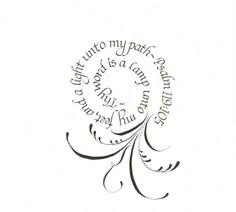
Psalm 119: A Lamp

Memorial of Saint Pius of Pietrelcina, Priestalso commonly known as Padre Pio.
Padre Pio died during the night of 23 September 1968, at the age of 81. On 16 June 2002, he was proclaimed a saint by Pope John Paul II. In his homily, the Pope said, “The life and mission of Padre Pio prove that difficulties and sorrows, if accepted out of love, are transformed into a privileged way of holiness, which opens onto the horizons of a greater good, known only to the Lord.”

September 23, 2020


Today, in God’s Lavish Mercy, we continue praying with Psalm 119 which, with its 176 verses, is the longest psalm as well as the longest chapter in the Bible. So this could go on forever, right?

Well, it doesn’t. Even though Psalm 119 is used for the Responsorial a total of 22 times during the total liturgical cycle, we won’t see it again for a week or so.

However, the liturgical frequency of this psalm should alert us to the importance of its teachings. Although long and somewhat complex in its acrostic structure, the psalm is direct and simple in its message:

Learn, love and live God’s ways.


Today’s verses liken such pursuit to finding a lamp in the darkness:

Praying with this refrain, we might be able to recall a time we were enveloped in darkness, either material, emotional, or spiritual. Most of us become at least a little frightened by such conditions. We get disoriented. We don’t know if we will be able to find our way out.

The psalmist attests to similar experiences, and voices a confident call on God for deliverance. That confidence grows from the psalmist’s desire and commitment to walk in holy discernment:

From every evil way I withhold my feet,
that I may keep your words.
Through your precepts I gain discernment;
therefore I hate every false way.
Falsehood I hate and abhor;
your law I love.

In this beautiful verse, the psalmist’s confidence is confirmed by God’s faithful endurance:

The law of your mouth is to me more precious
than thousands of gold and silver pieces.
Your word, O LORD, endures forever;
it is firm as the heavens.


Poetry: One, One, One – Rumi
The lamps are different. 
But the Light is the same. 
So many garish lamps in the dying brain's lamp shop, 
Forget about them. 
Concentrate on essence, concentrate on Light. 
In lucid bliss, calmly smoking off its own holy fire, 
The Light streams toward you from all things, 
All people, all possible permutations of good, evil, thought, passion. 

The lamps are different, 
But the Light is the same. 
One matter, one energy, one Light, one Light-mind, 
Endlessly emanating all things. 
One turning and burning diamond, 
One, one, one. 

Ground yourself, strip yourself down, 
To blind loving silence. 
Stay there, until you see 
You are gazing at the Light 
With its own ageless eyes.

Music: Beati Quorem Via – Charles Villiers Stanford, sung by voces 8
The title of this hymn is the first verse of Psalm 119 in Latin. Translation below.

Blessed are they whose road is straight,
who walk in the law of the Lord.

Beati quorum via integra est:
qui ambulant in lege Domini

Psalm 19: Declare God’s Glory

Feast of Saint Matthew, Apostle and Evangelist

September 21, 2020


Today, in God’s Lavish Mercy, we pray with Psalm 19, one of the unique “Torah Psalms” (1, 19, 119) in which Israel celebrates the divine structure of life in all Creation, including ourselves.

James Luther Mays, in his article The Place of the Torah-Psalms in the Psalter, suggests that these psalms serve as a guide to how all the other psalms are to be read, interpreted and prayed.


Walter Brueggemann describes life without God as “normless” – without the structure of grace and relationship with God that holds all Creation in abundant Life. He refers to the Torah as a “norming” dynamism, and writes:

And when Israel … used the term “Torah” (never meaning simply or simplistically “law”), it refers to the entire legacy of norming that is elastic, dynamic, fluid, and summoning. The outcome of that legacy in the Psalter is the great Torah Psalms in which Israel celebrates, with joy, that the creator God has not left the world as a normless blob but has instilled in the very structure of creation the transformative capacity for enacted fidelity. That is why Psalm 19 juxtaposes the glory of creation that attests the creator (vv. 1–6) with the commandments that are the source of life.


Our verses today for the Feast of St. Matthew include this phrase…

Their message goes out through all the earth.

… perhaps equating the universal ministry of the Apostles to the transformative power and witness of the heavens to God’s immutable glory.

The heavens declare the glory of God;
and the firmament proclaims his handiwork.
Day pours out the word to day,
and night to night imparts knowledge.
Not a word nor a discourse
whose voice is not heard;
Through all the earth their voice resounds,
and to the ends of the world, their message.


The teaching of the Apostles is codified for Catholics in the Apostles Creed. We might want to pray it slowly today, attentive to those “norming ” beliefs – our sort of fundamental “Torah” – which hold our lives in graceful relationship with God through Jesus Christ.

Apostles Creed

I believe in God, the Father Almighty, 
Creator of Heaven and earth;
and in Jesus Christ, His only Son Our Lord,
Who was conceived by the Holy Spirit, 
born of the Virgin Mary, 
suffered under Pontius Pilate, 
was crucified, died, and was buried.
He descended into Hell; 
the third day He rose again from the dead;
He ascended into Heaven, 
and sits at the right hand of God, the Father almighty; 
from thence He shall come to judge the living and the dead.
I believe in the Holy Spirit, 
the holy Catholic Church, 
the communion of saints, 
the forgiveness of sins, 
the resurrection of the body 
and life everlasting.
Amen.

Poetry: XIX Caeli Ennarant by Malcolm Guite

In that still place where earth and heaven meet
Under mysterious starlight, raise your head
And gaze up at their glory:  ‘the complete

Consort dancing’ as a poet said
Of his own words. But these are all God’s words;
A shining poem, waiting to be read

Afresh in every heart. Now look towards
The brightening east, and see the splendid sun
Rise and rejoice, the icon of his lord’s

True light. Be joyful with him, watch him run
His course, receive the gift and treasure of his light
Pouring like honeyed gold till day is done

As sweet and strong as all God’s laws, as right
As all his judgements and as clean and pure,
All given for your growth, and your delight!


Music: Wonderland – David Nevis

Psalm 145: Always Mercy

Twenty-fifth Sunday in Ordinary Time

September 20, 2020

Today, in God’s Lavish Mercy, we pray with Psalm 145 which, with our Sunday readings, ties together the themes of call and commitment.

In our first reading, Isaiah proclaims a repentant urgency to that call:

Seek the LORD 
while he may be found,
call him 
while he is still near.


In our second reading, Paul confirms his own ultimate commitment to that call and urges his followers to imitate him:

Christ will be magnified in my body,
whether by life or by death….

Only, conduct yourselves in a way worthy of the gospel of Christ, so that, whether I come and see you or am absent, I may hear news of you, that you are standing firm in one spirit, with one mind struggling together for the faith of the gospel.


But our Gospel reveals that not everyone responds immediately to God’s voice in their lives. Some of us come late to the call of grace. Nevertheless, our generous God seeks us, time and again, and embraces us fully no matter how close to the evening.

The early hires chafe against this system, imagining themselves somehow deprived by the Master’s abundance. Perhaps we heard attitudes like theirs expressed in self-sufficient phrases like:

  • but I’ve worked hard for everything I have
  • you need to earn your way in life
  • it’s not a free ride
  • if you can’t stand the heat, get out of the kitchen

Walter Brueggemann writes that the Psalms refute such an attitude:

The counter-world of the Psalms
contradicts our closely held world of self-sufficiency
by mediating to us a world confident in God’s preferential option
for those who call on him in their ultimate dependence.


Psalm 145 lifts us beyond our selfish imaginations. It expresses the grateful praise of one who, swaddled in God’s lavish blessing, recognizes that Divine Justice looks like Mercy not calculation.

The LORD is gracious and merciful,
slow to anger and of great kindness.
The LORD is good to all
and compassionate toward all his works.


Poem: by Rumi

By the mercy of God,
Paradise has eight doors.
One of those is the door of repentance, child. 
All the others are sometimes open, 
sometimes shut, 
but the door of repentance is never closed. 
Come seize the opportunity: 
the door is open; 
carry your baggage there at once.

Music: I Will Praise Your Name – Marty Haugen, David Haas

Psalm 33: Convinced!

Memorial of Saints Cornelius, Pope, and Cyprian, Bishop, Martyrs

Wednesday, September 16, 2020


Today, in God’s Lavish Mercy, we pray with verses from Psalm 33, the whole of which is the steadfast prayer of a person convinced of God!

As we read through Psalm 33, there is no hem and haw, no grey! It’s about God as the center of the psalmist’s, and the nation’s, life:

Know that the LORD is God;
Who made us, Whose we are;
God’s people, the flock God tends.


Our first reading grows from a similar conviction. Paul tells the Corinthians that our rootedness in God is not about spiritual eloquence, knowledge or holy detachment. He allows that it’s a little bit about faith and hope. But, over all things, it’s about love.


Lesson: We can’t be like the Gospel’s marketplace children. There should be but one song in our hearts – the same one Love sang as Love created each one of us in Her image.

For upright is the word of the LORD,
and all his works are trustworthy.
He loves justice and right;
of the kindness of the LORD the earth is full.


Poetry: Great Heart of God – (Nicholas) Vachel Lindsay (1879 – 1931), an American poet who is considered a founder of modern singing poetry, as he referred to it, in which verses are meant to be sung or chanted.

O great heart of God, 

Once vague and lost to me, 
Why do I throb with your throb to-night, 
In this land, eternity? 

O little heart of God, 
Sweet intruding stranger, 
You are laughing in my human breast, 
A Christ-child in a manger. 

Heart, dear heart of God, 
Beside you now I kneel, 
Strong heart of faith. O heart not mine, 
Where God has set His seal. 

Wild thundering heart of God 
Out of my doubt I come, 
And my foolish feet with prophets' feet, 
March with the prophets' drum. 

Music: Coulin – James Last – just a lovely instrumental to pray with today. ❤️

Psalm 139: Lord, You Know Me

Thursday of the Twenty-third Week in Ordinary Time

Thursday, September 10, 2020

Today, in God’s Lavish Mercy, we pray with Psalm 139, such a deeply personal and beautiful meditation. It is all we need for our prayer today.


Psalm 139
For the director of music. Of David. A psalm.

You have searched me, Lord,
    and you know me.

You know when I sit and when I rise;
    you perceive my thoughts from afar.

You discern my going out and my lying down;
    you are familiar with all my ways.

Before a word is on my tongue
    you, Lord, know it completely.

You hem me in behind and before,
    and you lay your hand upon me.

Such knowledge is too wonderful for me,
    too lofty for me to attain.

Where can I go from your Spirit?
    Where can I flee from your presence?

If I go up to the heavens, you are there;
    if I make my bed in the depths, you are there.

If I rise on the wings of the dawn,
    if I settle on the far side of the sea,
10 
even there your hand will guide me,
    your right hand will hold me fast.
11 
If I say, “Surely the darkness will hide me
    and the light become night around me,”
12 
even the darkness will not be dark to you;
    the night will shine like the day,
    for darkness is as light to you.
13 
For you created my inmost being;
    you knit me together in my mother’s womb.
14 
I praise you because I am fearfully and wonderfully made;
    your works are wonderful,
    I know that full well.
15 
My frame was not hidden from you
    when I was made in the secret place,
    when I was woven together in the depths of the earth.
16 
Your eyes saw my unformed body;
    all the days ordained for me were written in your book
    before one of them came to be.
17 
How precious to me are your thoughts,[a] God!
    How vast is the sum of them!
18 
Were I to count them,
    they would outnumber the grains of sand—
    when I awake, I am still with you.
19 
If only you, God, would slay the wicked!
    Away from me, you who are bloodthirsty!
20 
They speak of you with evil intent;
    your adversaries misuse your name.
21 
Do I not hate those who hate you, Lord,
    and abhor those who are in rebellion against you?
22 
I have nothing but hatred for them;
    I count them my enemies.
23 
Search me, God, and know my heart;
test me and know my anxious thoughts.
24 
See if there is any offensive way in me,
and lead me in the way everlasting.

O God, You Search Me and You Know Me- Bernadette Farrell

Psalm 45: God Longs for Us

Wednesday, September 9, 2020

Today, in God’s Lavish Mercy, we pray with Psalm 45 which scripture scholars interpret as a Davidic wedding song. Many believe it refers to the marriage of a king to the daughter of a royal foreign house.

The psalm is set today between two powerful readings. 

In our first reading, Paul gives an extended opinion piece on celibacy and marriage, a reading which has spawned countless academic interpretations. Our Gospel, pivotal to our understanding of holiness, also has generated abundant scholarly commentary.

We may finish today’s readings wondering who must I be to become the person God wants me to be? Celibate? Poor? Hungry? Sorrowful? Persecuted?  Like Francis Thompson in his famous poem, The Hound of Heaven, we may feel pursued by a God we might rather ignore!

For, though I knew His love Who followèd, 
        Yet was I sore adread 
Lest, having Him, I must have naught beside

Indeed, the answer is not simple. Each person’s path to God’s heart is different. The readings don’t give us a foolproof map. Instead, they give us prompts about where we might go off the path.

In other words, the readings spread the stars across our heavens. But we must find our own bearings in life to allow us to continually deepen our relationship with God. If our current circumstances and choices prevent that in any way, we must reorient ourselves.


For me the lesson is this. God desires our complete love and worship. God wants to be the center of our lives. That’s why we exist. All the rest is incidental.

Our psalm captures it in this way:

Hear, my child, and see; turn your ear,
forget those things to which you are accustomed.
So shall the Lord desire your full commitment;
the Lord Whom you must worship with your life.


Our Gospel is uncompromising in its warning that obsession with material goods, personal comfort, and selfish success blocks our awareness of how distant we can grow from God:

But woe to you who are rich,
for you have received your consolation.
But woe to you who are filled now,
for you will be hungry.
Woe to you who laugh now,
for you will grieve and weep.
Woe to you when all speak well of you,
for their ancestors treated the false 
prophets in this way.


We are blessed if we are free of these woes, but it is hard in a culture spiritually crippled by these obsessions.

Psalm 45 calls us to “bend our ear” toward God’s invitation. By sincere prayer and loving vigilance, we can hear the Divine whisper within our circumstances, leading us to fullness of life with God. We will recognize it by this: it always calls us to justice, mercy, and charity.

You love justice and hate wrongdoing;
therefore God, your God, has anointed you
with the oil of gladness above your peers.


Poetry: Excerpt from The Hound of Heaven by Francis Thompson

( It’s a little “frilly” with early 20th century Romanticism, but – oh my! – some of its lines get burned into the memory!)

I fled Him, down the nights and down the days; 
I fled Him, down the arches of the years; 
I fled Him, down the labyrinthine ways 
Of my own mind; and in the mist of tears 
I hid from Him, and under running laughter. 
Up vistaed hopes I sped; 
And shot, precipitated, 
Adown Titanic glooms of chasmèd fears, 
From those strong Feet that followed, followed after. 
But with unhurrying chase, 
And unperturbèd pace, 
Deliberate speed, majestic instancy, 
They beat—and a Voice beat 
More instant than the Feet— 
‘All things betray thee, who betrayest Me.’ 

Music: I Long for You – Ro Atilano

Psalm 13: Mary’s Trust

Feast of the Nativity of the Blessed Virgin Mary

Tuesday, September 8, 2020

Today, in God’s Lavish Mercy, on our Blessed Mother’s birthday, we pray with the beautiful final verses of Psalm 13.

These verses embody an immense shift in form from the psalm’s early lines. Early on, the psalmist cries out four times, “How long, O Lord?”.

How long: 

  • Will you forget me?
  • Will you hide your face from me?
  • Must I carry sorrow in my soul?
  • Will my enemy triumph over me?

Referring to these early verses reminds us that Mary’s life was full of sorrow as well as joy. On a feast like today, we think of Mary in her heavenly glory. But in her lifetime, Mary suffered many sorrows. She was an unwed mother, a refugee, and a widow. She was the mother of an executed “criminal” and a leader of his persecuted band.

The Julian of Norwich, “Her Showing of Love”

What was it that allowed Mary to transcend sorrow and claim joy? Our psalm verses today help us to understand. They show the psalmist turning to heartfelt prayer., trusting God’s abiding protection.

Look upon me, answer me, LORD, my God!
Give light to my eyes lest I sleep in death,
Lest my enemy say, “I have prevailed,”
lest my foes rejoice at my downfall.


That deep trust ultimately yields not only peace,
but joy.
Mary, singer of the Magnificat,
is the quintessence of that holy joy.


But I trust in your mercy.
Grant my heart joy in your salvation,
I will sing to the LORD,
Who has dealt bountifully with me!

Today, in our prayer, we ask Mary to love and guide us through the challenges of our lives.


Poetry: Three Days – Madeleine L’Engle

Friday:
When you agree to be the mother of God
you make no conditions, no stipulations.
You flinch before neither cruel thorn nor rod.
You accept the tears; you endure the tribulations.
But, my God, I didn't know it would be like this.
I didn't ask for a child so different from others.
I wanted only the ordinary bliss,
to be the most mundane of mothers.

Saturday:
When I first saw the mystery of the Word
made flesh I never thought that in his side
I'd see the callous wound of Roman sword
piercing my heart on the hill where he died.
How can the Word be silenced? Where has it gone?
Where are the angel voices that sang at his birth?
My frail heart falters. I need the light of the Son.
What is this darkness over the face of the earth?
Sunday:
Dear God, He has come, the Word has come again.
There is no terror left in silence, in clouds, in gloom.
He has conquered the hate; he has overcome the pain.
Where, days ago, was death lies only an empty tomb.
The secret should have come to me with his birth,
when glory shone through darkness, peace through strife.
For every birth follows a kind of death, and only after pain comes life.

Music: Magnificat – Daughters of Mary

(To see Latin and English verses, click the little arrowhead just below the picture on the right.)

Psalm 5: Bless Our Work

Monday of the Twenty-third Week in Ordinary Time

Monday, September 7, 2020

Today, in God’s Lavish Mercy, we pray with Psalm 5. It seems to me a good prayer for Labor Day which we celebrate today in the United States.

Psalm 5 is the prayer of an upright person seeking God’s justice and protection in order to live in God’s favor.

Then all who trust in you will be glad
and forever shout for joy.
You will protect them and those will rejoice in you
who love your name.
For you, LORD, bless the just ones;
surrounding them with favor like a shield.

The U.S labor movement grew out of similar desires for protection and justice. The inequities and hardships experienced by laborers at the turn of the 19th century led to protests and changes. These are recognized and celebrated on Labor Day.


Catholic social teaching, beginning with Pope Leo XIII’s encyclical Rerum Novarum (“On the Condition of Labor”), has a long history of support for labor and unions.

“The most lasting effect of Rerum Novarum to Catholic social teaching was its approval of labor unions. Pope Leo observed that employers would not necessarily act in the best interests of their employees. Therefore, workers “must form associations among themselves and unite their forces so as to shake off courageously the yoke of so unrighteous and intolerable an oppression.” His hope was that social harmony would emerge as the three – employers, workers, and government – worked together: “Capital cannot do without labor, nor labor without capital. Mutual agreement results in pleasantness and good order; perpetual conflict necessarily produces confusion and outrage.” (Website: Diocese of Harrisburg)


Today, as we pray Psalm 5:

  • Let’s remember that all labor is a gift of participation in God’s continual act of Creation
  • Let’s be conscious of all those throughout the world whose labor is exploited. 
  • Let’s pray for all those unable to work for any reason, especially due to the effects of COVID 19.
  • Let’s give thanks for the labor of all our brothers and sisters which contribute to our wellbeing and happiness.
  • Let’s take time today to recognize the joy and blessings of our own labors throughout our lives.
  • And let’s ask ourselves these most important questions:

Why do I work?
What do I hope for as the fruit of my labors?

Our answers will tell us much about who we really are.


Poetry: What Work Is– Philip Levine

We stand in the rain in a long line
waiting at Ford Highland Park. For work.
You know what work is—if you’re
old enough to read this you know what
work is, although you may not do it.
Forget you. This is about waiting,
shifting from one foot to another.
Feeling the light rain falling like mist
into your hair, blurring your vision
until you think you see your own brother
ahead of you, maybe ten places.
You rub your glasses with your fingers,
and of course it’s someone else’s brother,
narrower across the shoulders than
yours but with the same sad slouch, the grin
that does not hide the stubbornness,
the sad refusal to give in to
rain, to the hours of wasted waiting,
to the knowledge that somewhere ahead
a man is waiting who will say, “No,
we’re not hiring today,” for any
reason he wants. You love your brother,
now suddenly you can hardly stand
the love flooding you for your brother,
who’s not beside you or behind or
ahead because he’s home trying to   
sleep off a miserable night shift
at Cadillac so he can get up
before noon to study his German.
Works eight hours a night so he can sing
Wagner, the opera you hate most,
the worst music ever invented.
How long has it been since you told him
you loved him, held his wide shoulders,
opened your eyes wide and said those words,
and maybe kissed his cheek? You’ve never
done something so simple, so obvious,
not because you’re too young or too dumb,
not because you’re jealous or even mean
or incapable of crying in
the presence of another man, no,   
just because you don’t know what work is.

Music: Bread and Roses – Joan Baez

( Bread and Roses” is a political slogan well as the name of an associated poem and song. It originated from a speech given by American women’s suffrage activist Helen Todd; a line in that speech about “bread for all, and roses too” inspired the title of the poem Bread and Roses by James Oppenheim. The poem was first published in December 1911, with the attribution line “‘Bread for all, and Roses, too’—a slogan of the women in the West.” The poem has been translated into other languages and has been set to music by at least three composers.
The phrase is commonly associated with the successful textile strike in Massachusetts between January and March 1912, now often referred to as the “Bread and Roses strike”. The slogan pairing bread and roses, appealing for both fair wages and dignified conditions, found resonance as transcending “the sometimes tedious struggles for marginal economic advances” in the “light of labor struggles as based on striving for dignity and respect”, as Robert J. S. Ross wrote in 2013.)

As we go marching, marching
In the beauty of the day
A million darkened kitchens
A thousand mill lofts grey
Are touched with all the radiance
That a sudden sun discloses
For the people hear us singing
Bread and roses, bread and roses

As we go marching, marching
We battle too for men
For they are women’s children
And we mother them again
Our lives shall not be sweetened
From birth until life closes
Hearts starve as well as bodies
Give us bread, but give us roses

As we go marching, marching
We bring the greater days
For the rising of the women
Means the rising of the race
No more the drudge and idler
Ten that toil where one reposes
But the sharing of life’s glories
Bread and roses, bread and roses

Psalm 24: Vanity, Vanity

Memorial of Saint Gregory the Great, Pope and Doctor of the Church

Thursday, September 3, 2020


Today, in God’s Lavish Mercy, we pray with Psalm 24 which encourages us to be sinless, pure of heart, and humble. And that’s hard!

Who can ascend the mountain of the LORD?
or who may stand in his holy place?
He whose hands are sinless, whose heart is clean,
who desires not what is vain.


Do you remember the song “You’re So Vain”? Here is a reminder.

The song expresses a common understanding of the word “vanity”:

excessive pride in or admiration of one’s own appearance or achievement


We all know people who seem to think they’re hot stuff. Maybe we’re even one of them! But I think that often a person behaving vainly really is quite unsure of himself.

The apparent vanity is a veneer to hide the emptiness inside. It is a veiled fear that, rather than being “all that”, one is really “not enough”.

The word vanity comes from the Latin root vanus which means empty – not “empty” with a readiness to be filled. Instead it connotes an emptiness that rattles with accumulated pretenses and falsehoods. It is a place of loud but lonely echoes.


Paul addresses this kind of emptiness when he writes to the Corinthians. He tells them not to get caught up in the contest of human vanity because we already are sufficient in God’s love and grace. Everything important is already ours in Christ, in God.

So let no one boast about human beings, for everything belongs to you,
Paul or Apollos or Cephas,
or the world or life or death,
or the present or the future:
all belong to you, and you to Christ, and Christ to God.


Psalm 24 assures us that to participate in this blessing, to be embraced by God’s favor only this is sufficient:

Who can stand in God’s holy place?
The clean of hand and pure of heart,
who have not given their soul to useless things,
to what is vain.
They will receive blessings from the LORD,
and justice from their saving God.


Poetry: Vanity by George Herbert

The fleet astronomer can bore 
And thread the spheres with his quick-piercing mind: 
He views their stations, walks from door to door, 
         Surveys, as if he had designed 
To make a purchase there; he sees their dances, 
                   And knoweth long before 
Both their full-eyes aspècts, and secret glances. 
         
         The nimble diver with his side 
Cuts through the working waves, that he may fetch 
His dearly-earnèd pearl, which God did hide 
         On purpose from the venturous wretch; 
That he might save his life, and also hers 
                   Who with excessive pride 
Her own destruction and his danger wears. 
         
         The subtle chymic can divest 
And strip the creature naked, till he find 
The callow principles within their nest: 
         There he imparts to them his mind, 
Admitted to their bed-chamber, before 
                   They appear trim and dressed 
To ordinary suitors at the door. 
         
       What hath not man sought out and found, 
But his dear God? who yet his glorious law 
Embosoms in us, mellowing the ground 
         With showers and frosts, with love and awe, 
So that we need not say, “Where’s this command?” 
                   Poor man, thou searchest round 
To find out death, but missest life at hand.

Song: As We Seek Your Face – Divine Hymns

Psalm 119: Divine Thread

Monday of the Twenty-second Week in Ordinary Time

August 31, 2020


Today, in God’s Lavish Mercy, we pray with Psalm 119, a song of the wisdom that comes from holiness.

Your command has made me wiser than my enemies,
for it is ever with me.
I have more understanding than all my teachers
when your decrees are my meditation.
I have more discernment than the elders,
because I observe your precepts.

Psalm 119: 97-98

And we’ve all met them, haven’t we – those grounded, simple, wise and joyful people whose spirits are tied to that Sacred Thread running through all Creation. These blessed souls may be young or old, schooled or not. No matter – they shine with the reflection of Wisdom Itself.

Paul humbly claims such wisdom in our first reading. It is not a worldly persuasiveness, but rather a demonstration of truth and power grounded in the Spirit.

… my message and my proclamation
were not with persuasive words of wisdom,
but with a demonstration of spirit and power,
so that your faith might rest not on human wisdom
but on the power of God.

1 Corinthians 2: 4-5

In our Gospel, Jesus chooses his hometown synagogue to announce that he is the fulfillment of Isaiah’s prophecy, the Spirit and Wisdom of God:

The Spirit of the Lord is upon me,
because he has anointed me
to bring glad tidings to the poor.
He has sent me to proclaim liberty to captives
and recovery of sight to the blind,
to let the oppressed go free,
and to proclaim a year acceptable to the Lord.

Luke 4: 18-19 (Isaiah 61: 1-2)

Jesus is the Incarnation of Wisdom, the Divine Spirit that surpasses all human understanding.

Many turned away from Jesus at this proclamation. May we never be among them.

From every evil way I withhold my feet,
that I may keep your words.
From your ordinances I turn not away,
for you have instructed me.

Psalm 119: 101-102

Poetry: Wisdom by Rumi

I have one small drop of knowing in my soul. 
Let it dissolve in Your ocean.


Music: Be Thou My Vision – Eden’s Bridge ( On the video, you can drop the menu you down using the little arrowhead on the right under the picture. The Irish and English lyrics will then be displayed.)