All That Is Withered

Memorial of Saint Peter Claver, Priest

September 9, 2019

Click here for readings

Today, in Mercy, Paul and Jesus share a similar situation.

Paul is imprisoned in Rome. Visited by Epaphras, a citizen of Colossae, Paul seizes the chance to write to these Christians whom he has never seen in person. Paul tells the Colossians that his singular intention is to preach the truth of the Gospel so that they, and all the world, may be transformed in Christ.

to bring to completion for you the word of God,
the mystery hidden from ages and from generations past.

That “mystery” is the nature of God as Love, only fleetingly accessible before its full revelation in the Person of Jesus Christ.
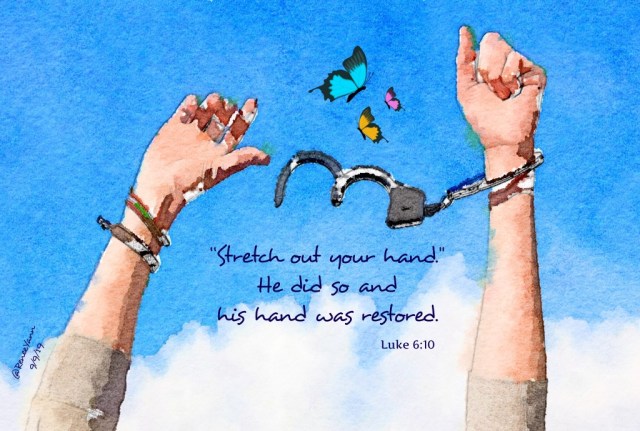
Luke6_10 withered hand

Jesus too, in today’s Gospel, is in a sort of prison. The prison consists of the entrenched resistance of people like the Pharisees. They are so entangled in the deceitful and self- serving interpretation of Law that they are blind to the revelation before them. They wait to pounce on Jesus if, contrary to the laws of the Sabbath, he heals a man’s withered hand.

Jesus tries logic in today’s account:

Then Jesus said to them,
“I ask you, is it lawful to do good on the sabbath
rather than to do evil,
to save life rather than to destroy it?”

Unable to resist the logic, the Pharisees retreat to anger. They begin to plot the removal of this Truth they cannot counter. The saddest part of these resistances is that they estrange the resisters from their own good, from their own freedom, from their own salvation.

In our world, we see so many places closed off to the Mystery of Love.  We see people imprisoning themselves in their own resistance and hate while they plot to build barriers against others. We see it in our geo-political world, in our Church, in our workplaces, in ourselves.

It takes courage to recognize and turn from such self-destructive fixations. We must be alert and brave to cooperate with our own transformation in grace.

This is why Paul writes of …

the great struggle I am having for you
and for those in Laodicea
and all who have not seen me face to face,
that their hearts may be encouraged
as they are brought together in love,
to have all the richness of assured understanding,
for the knowledge of the mystery of God, Christ,
in whom are hidden all the treasures of wisdom and knowledge.

This is why God continues to offer grace in the gift of Jesus Christ, healing all that is “withered” in us when we lift it up in faith.

Music: God Will Make a Way – Dan Moen

The Wisdom of God

Twenty-third Sunday in Ordinary Time

September 8, 2019

Click here for readings

Today, in Mercy, the Church links three readings which, at first glance, seem unrelated.

  • Our first reading from Wisdom reminds us of God’s infinite wisdom, incomprehensible to our human minds.
  • Paul, in his letter to Philemon, begs for the loving inclusion of Onesimus, an enslaved person, into the Colossian community.
  • In today’s Gospel, Jesus  makes the harsh pronouncement:

If anyone comes to me without hating his father and mother,
wife and children, brothers and sisters,
and even his own life,
he cannot be my disciple.

How might we interpret these disparate passages to find a message of wholeness for our prayer?

Wis9_13 gods mind

Let’s start with Jesus. In no uncertain terms, he challenges his disciples to move out of their small worlds into God’s big world. That Godly world is not defined by family, nor by any condition other than our common Creaturehood in God … not by:

word gram

Jesus says the sacred community is defined only by shared and irrevocable commitment to the Gospel of love and mercy.

Paul knows and loves Onesimus, the slave, as a brother in this community. In his letter, Paul encourages Philemon to do the same.

Sometimes as human beings, filled with all kinds of insecurities, we tend to build enclaves that make us feel safe. We like to be with “our kind”. We invent borders to filter out those whose differences we don’t understand. We allow fear to grow out of that lack of understanding. Within the enclosure of our self-protectionism, we eventually forget that we are all one, equal, precious, beautiful and beloved by God.

Such toxic attitudes are the soil for slavery, war, ethnic cleansing, racial supremacy,   human trafficking, destructive nationalism, and all the other sacrileges committed by humans against the human family.

Wisdom reminds us that only God can open the tight circle of our fears, judgments and isolations – only God whose infinite love encompasses all. Jesus tells us that we find that love only by lifting up the cross and following him.

Wisdom tells us to put it in God’s hands, and to respond to God’s challenge in the preaching of Jesus Christ.

Who can know your way of thinking, O God
… except you give us wisdom

 and send your Holy Spirit from on high
 thus stretching the hearts of those on earth

Today I pray, may God do this for me, and for all our tight, convoluted and troubled world.

Music: Who Has Known (an Advent hymn, but perfect I think for today’s readings)

God is a Sliding Board!

Saturday of the Twenty-second Week in Ordinary Time

September 7, 2019

Click here for readings

Today, in Mercy,  Paul references some pretty mean-spirited Colossians:

You once were alienated and hostile in mind
because of evil deeds.

Whoa! Where did these meanies come from amid all the blessed populace?
They must have been nice to be around!

All of us have been in the presence of such off-kilter people. They seem all twisted in their own negativity and judgmentalism. There is no joy in them, no warmth, no kindness. Unhappily, we may even have such a person at times.

Paul is clear on the cure for such ill-temper:

  • Reconciliation through a persevering faith
  • Stability in hope, grounded the Gospel

If you have ever used a GPS device while driving, you have probably had the same experience as I have. At least five annoying times per journey, the gal is my dashboard shouts:

Recalculating route!

Paul says that with our reconciliation through the Passion, Death and Resurrection of Jesus, there is no need to recalculate. As our Responsorial Psalm tells us:

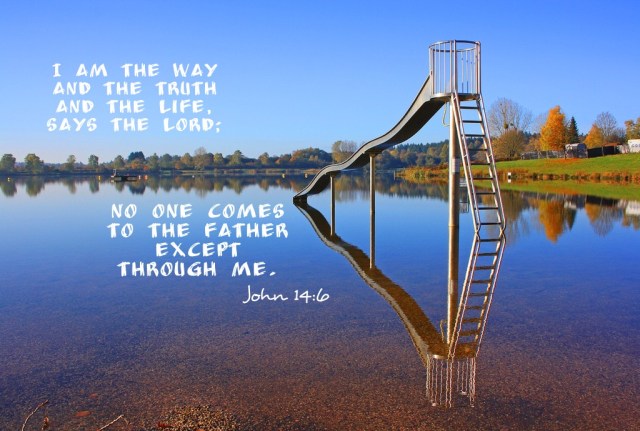
I am the way and the truth and the life, says the Lord;
no one comes to the Father except through me.

Once again in our Gospel, the Pharisees try to distract from the clarity of Jesus’ message. They worry about the tiniest grains rather than the Radiant Truth in their midst. They keep trying to recalculate a route through their circuitous laws rather than opening their hearts to the Way.

It’s easy to get infected with such running around in circles. The bigness of God can be scary. We sometimes make up useless curves to avoid God’s awesomeness.

Jn14_6slide

Indeed, God is a sliding board with no handrails! But, Paul assures us that we are riding it in Christ’s arms.

Music: I Am the Way, the Truth and the Life – Bob Hurd

All Things Hold Together

Friday of the Twenty-second Week in Ordinary Time

September 6, 2019

Click here for readings

Today, in Mercy, our readings challenge us to see things differently- to see with God’s eyes.

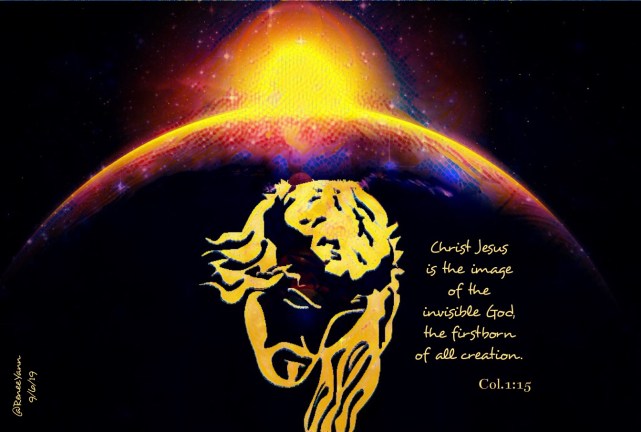
Col1_15 image of God

Paul invites us first with the glorious Colossians Hymn. No words can enhance it. Let us savor it in itself:

Christ Jesus is the image of the invisible God,
the firstborn of all creation.
For in him were created all things in heaven and on earth,
the visible and the invisible,
whether thrones or dominions or principalities or powers;
all things were created through him and for him.
He is before all things,
and in him all things hold together.
He is the head of the Body, the Church.
He is the beginning, the firstborn from the dead,
that in all things he himself might be preeminent.
For in him all the fullness was pleased to dwell,
and through him to reconcile all things for him,
making peace by the Blood of his cross
through him, whether those on earth or those in heaven.


wineskin
Ancient wineskins were not like the fancy botas we see today. They were formed from the entire skin of the animal. As the new wine fermented inside, the skin expanded with the fermentation. It ultimately stretched beyond further use. – thus the necessity for new skins for new wine.


Jesus, in our Gospel, tells us we must become new wineskins in order to hold the vibrant gift of new life in Christ. He says the old ways, stiffened by pharisaical pretensions, have lost the elasticity of grace. He warns us to avoid the accretions of showy religious practice which may bury and inhibit sincere faith.


Jesus is the new wine of love and mercy, and our hearts must become his new wineskins.

As we pray, this poetic musical piece may inspire us. … in Him, all things hold together …

Music: The Christ Hymn – Alana Levandoski

Don’t Take It for Granted

Wednesday of the Twenty-second Week in Ordinary Time

September 4, 2019

Click here for readings

Today, in Mercy,  we begin a little over a week of readings from Colossians. Paul loves this community in a way similar to the Thessalonians. The Colossians’ faith has been tested and has proven true.

But Paul wants to protect their faith because it is being newly tested by a round of heresies and social challenges.

The words of these scriptures want to protect and direct us too.

We, like the people in today’s Gospel, are familiar with Jesus. But familiarity can breed things not so obvious as contempt. It can breed indifference, ingratitude, unexamined expectations, taking our blessings for granted. (Examination of Conscience Alert!!)

col1_6

Both Colossians and Luke today encourage us to recognize the unparalleled gift of our faith – to protect, nurture, rejoice in and share it.

Just as in the whole world
the Gospel is bearing fruit and growing,

so also among you,
from the day you heard it
and came to know
the grace of God in truth.

Music: Bless Our God – John Foley (Lyrics below) Just a beautiful song — I love it!

Our Laboring Mother

Memorial of Saint Gregory the Great, Pope and Doctor of the Church

Tuesday, September  3, 2019

Click here for readings

Today, in Mercy, Paul again affirms the faith and prudence of the Thessalonians:

Concerning times and seasons, brothers and sisters,
you have no need for anything to be written to you.
For you yourselves know very well
that the day of the Lord will come like a thief at night.

He paints a dire picture of those “times and seasons”, likening them to the onset of labor pains. But like a mother’s labor, these pains ultimately yield life:

For God did not destine us for wrath,
but to gain salvation through our Lord Jesus Christ.

So Christ, our Laboring Mother, delivers us – even through seasons of suffering and evil – to a new day. And we – we are the midwives to one another’s salvation:

Therefore, encourage one another
and build one another up,
as indeed you do.

This honest encouragement is so essential for us in our faith communities because, without it, the mystery of suffering and evil overwhelm us. 

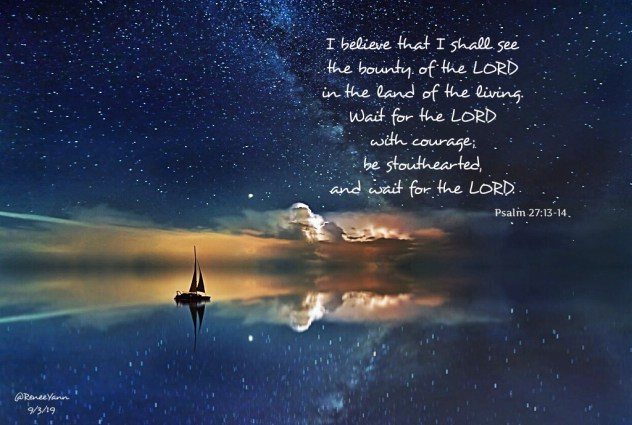
Ps27_13

It is both awesome and fearsome to truly encounter Mystery. In its presence, we are rudderless: we cannot explain, control, or humanly rationalize it. Mystery can only be comprehended by greater Mystery. Suffering can only be plumbed by the greater Mystery of Love.

And we know Love’s Name: Jesus by Roc O’Connor (Lyrics below)

Refrain:

Jesus, Jesus
Let all creation bend the knee to the Lord.

1. In Him we live, we move and have our being;
In Him the Christ, In Him the King!
Jesus the Lord.

2. Though Son, He did not cling to Godliness,
But emptied Himself, became a slave!
Jesus the Lord.

3. He lived obediently His Father’s will
Accepting His death, death on a cross!
Jesus the Lord.

You’re Invited – (and so is everyone else)

Twenty-second Sunday in Ordinary Time

September 1, 2019

Click here for readings

Today, in Mercy, our readings share the common theme of humility, instructing us that the virtue is essential to our salvation.

Lk14_11 humbled

Humility, of course, gets a bad rap in our dominating, “me” culture. We tend to think of humiliation, servitude, inelegance rather than the actual root of the word: humus -“of the earth”.

I was fascinated last week by a small fracas arising from the unconsidered remarks of one of our Phillies baseball players. The team has been running hot and cold – with a little bit too much cold for some fans. The famous Philly “boos” have been flying. Frustrated with these, outfielder Sean Rodriguez referred to the disgruntled fans as “entitled”. 

angry

Uh oh! They didn’t like that. We prefer to think of ourselves as “deserving “, right?

Humility is that virtue which helps us realize that we are not “entitled” or “deserving” of anything over and above other human beings. It roots us in the respect for each other that refuses to rank the worth of other human beings. 

The social leverage that comes from wealth, power, and influence can beguile us. We become lost in a maze of stereotypes, rankings and prejudices which are the foundation of social injustice.


We hear among ourselves justifying phrases for our entitlement like:

  • well, I earned what I have
  • at least I paid for it
  • “they” need to work if they want to have …(food, healthcare, housing…)
  • it’s their own fault for … (dropping out of school, taking drugs, ….)
  • that’s just the way it is in “those” countries. The people are …(lazy, stupid, violent …)
  • “they” don’t need what I need. “They” are used to being … (poor, disabled, sick …)

And probably the most dangerous of all the phrases:

  • it’s not my problem
  • I’m not the one exiling, bombing, blocking, trafficking, enslaving “them”

Today’s readings enjoin us: it is my problem. My attitude, choices, vote, conversation, and lifestyle matter at the banquet of life we are all meant to share.

My intention to humbly join and rejoice with all Creation, to take a seat beside and never above my sister and brother – this is my “entitlement” to the one banquet that matters.

When you hold a banquet,
invite the poor, the crippled, the lame, the blind;
blessed indeed will you be because of their inability to repay you.
For you will be repaid at the resurrection of the righteous.

Music:  A Place at the Table – Lori True and Shirley Elena Murray

God Invests in Us

Saturday of the Twenty-first Week in Ordinary Time

August 31, 2019

Click here for readings

Today, in Mercy, Paul again shows his great admiration for the commitment of the Thessalonians:

You have no need for anyone to write you about fraternal charity…
( in other words, you already live it.)

Don’t we all wish that line could be written, without reservation, to us?

In our Gospel, Jesus tells us the familiar parable of the talents which shows what God would look for in order to say as much to us.

Mt25_25

On the surface this story looks like one about material goods or personal capabilities – about how we use our individual gifts to further God’s reign. Certainly that is one valuable interpretation.

But think about the talents in the story. They did not belong to the servants. They belonged to the master.

This parable is about God’s talents, God’s nature, and how we either frustrate or facilitate their effectiveness in God’s Creation.

We are the means by which God is present in the world.

God invests God’s own heart  in us – Unconditional Love, Lavish Mercy, Infinite Hope, the Perfection of Compassion, Sacred Accompaniment, Abiding Fidelity.

If we tender these divine “talents” to others with care and generosity, we become good and faithful reflections of God’s own presence.

What about the poor soul who buried the talents under his own fear and small-mindedness? Sad, right? But that self-protective, parsimonious little burier hides in all of us.

We know the blockades we put up against God’s Grace. Let us look sincerely at them today, asking to be worthy of the trust invested in us to multiply God’s grace in the world.

Music: Psalm 131 – written by Marty Goetz

Heart-Light

Friday of the Twenty-first Week in Ordinary Time

Friday, August 30, 2019

Click here for readings

Today, in Mercy, Paul describes for the Thessalonians how precious they are to God.

It is in a beautiful line of thought in today’s passage, but the thought is hidden in a thread through Paul’s sermon about marriage practices. It seems that some Thessalonians were playing a sort of “Bachelor/Bachelorette” game, devoid of the reverence marriage deserves.

But within Paul’s spousal instructions is this tender verse:

This is the will of God, your holiness.

1Thes4_3

God wants us to be blessed and completed with holiness. What is holiness? 

Merriam-Webster has a few definitions, the most helpful of which is this:

devoted entirely to the deity or the work of the deity


But maybe we could think of holiness this way:

  • Seeing deeply through circumstances to the heart of God
  • Learning to beat with that Heart in a mutual rhythm of grace and trust
  • Singing that rhythm into a longing world by a life of mercy and love

Some of the world’s longing will always remain in us too. But Jesus tells us, in today’s Gospel, that our longing will be filled when the Bridegroom comes. Still, he cautions us to be ready – to have an abundance of oil to light our heart-lamps for God.

So today, let’s squeeze that precious oil out of every moment – every opportunity to find, love, and serve God in the people and circumstances of our lives.

Music: a little bit of a stretch today.  But if you listen inside the lyrics, I think you’ll find connections to today’s reflection. (Besides, who can’t be uplifted by Neil Diamond? 🙂


A Passion Like Christ’s

Memorial of the Passion of Saint John the Baptist

Thursday, August 29, 2019

Readings: http://www.usccb.org/bible/readings/082919.cfm

Today, in Mercy, we commemorate the Passion of John the Baptist who, besides Mary, was the greatest saint embracing both the Old and the New Testaments.

When I was young, the memorial was simply referred to as “The Beheading of John the Baptist”. The term “passion” captures its meaning so much more clearly:

  • it inclines us to realize the similarities between John’s passion and death and that of Jesus.
  • it shifts the power of the event to John, who chose his fate by the courage of his witness, rather than to see Herod, the “beheader”, as the agent of the story.

John’s whole prophetic life was part of his “passion”. It inevitably led him to this ultimate confrontation with evil.

Walter Bruggemann, in his transformational book “The Prophetic Imagination” writes about prophets. He indicates that prophets emerge in the context of “totalism” – those paralyzing systems which attempt to control and dominate all freedom and possibility.

Totalism kills ideas, hope, freedom, choice, self-determination, and creativity for the sake of controlling reality for its own advantage. Totalism is the ultimate “abusive relationship “.

Brueggemann defines the prophet as one engaged in these three tasks:

  • the prophet is clear on the force and illegitimacy of the totalism.
  • the prophet pronounces the truth about the force of the totalism that contradicts the purpose of God.
  • the prophet articulates the alternative world that God has promised, and that God is actually creating within the chaos around us.

Every age requires prophets because every age is infected with “Herods” trying to thwart God’s reign of love, mercy, truth, freedom, and joy. In our own time, the poison of totalism is quite evident in those systems fueled by racism, militarism, financial duplicity, desecration of the earth, and the sad array of other ideologies that cripple humanity.

Today, as we pray with this great saint, may we be inspired to respond to our own prophetic call – to be prophetic signs of love, mutual reverence, joy, Gospel justice,and lavish mercy for our world.

Music: I think of this song by Simon and Garfunkel as the modern day song of John the Baptist.

https://youtu.be/XgbBLKet14E