A Psalm from Jeremiah

Saturday of the Fifth Week of Lent

March 27, 2021


Today, in God’s Lavish Mercy, we pray a responsorial from the Book of Jeremiah:

The Lord will guard us, as a shepherd guards the flock.

The psalm today, with the first reading, brings assurance that God remains with us through suffering and will heal and make us whole again.

That reassurance is needed as we hear the Gospel’s tone darken. After the raising of Lazarus, the whole nation waits to see what will happen to Jesus as Passover nears.


I think, in some ways, impending doom is almost worse than doom itself. Picture the part in a movie where the attacker waits in the dark while the victim tiptoes into lurking danger.

That frightening music they always play! Sometimes the tension heightens to the point that I have to hit the mute or close my eyes!


Entry of Christ into Jerusalem, a 1617 oil painting by Flemish Baroque painter Anthony van Dyck

This is what all surrounding Jerusalem felt like in today’s Gospel. The dark edge of evil hangs in inevitable threat.

But for Jesus, who walked in the hidden light of the Father, the moment brought more than threatening shadows. It was time to fulfill an ancient promise. It was time to offer the greatest act of Love.

Hear the word of the LORD, O nations,
    proclaim it on distant isles, and say:
He who scattered Israel, now gathers them together,
    he guards them as a shepherd his flock.
The LORD shall ransom Jacob,
    he shall redeem him from the hand of his conqueror.

Jeremiah 31: 10-12

As Jesus went off alone to Ephraim to prepare his heart and soul for this ultimate fulfillment, perhaps a prayer from Jeremiah strengthened him, a remembered promise from Ezekiel focused him.

Let us pray with Jesus today as he asks the Father to “shepherd” him. With Jesus, may we find our own strengths and understandings in these ancient prophets.


Poetry: Redemption by George Herbert (1593-1633)who was a Welsh-born poet, orator, and priest of the Church of England. His poetry is associated with the writings of the metaphysical poets, and he is recognised as “one of the foremost British devotional lyricists.”

Having been tenant long to a rich lord, 
    Not thriving, I resolvèd to be bold, 
    And make a suit unto him, to afford 
A new small-rented lease, and cancel th’ old. 

In heaven at his manor I him sought; 
    They told me there that he was lately gone 
    About some land, which he had dearly bought 
Long since on earth, to take possessiòn. 

I straight returned, and knowing his great birth, 
    Sought him accordingly in great resorts; 
    In cities, theaters, gardens, parks, and courts; 

At length I heard a ragged noise and mirth 
    Of thieves and murderers; there I him espied, 
    Who straight, Your suit is granted, said, and died.

Music: Like a Shepherd – St. Louis Jesuits

Psalm 81: Through the Storm

Friday of the Third Week of Lent

March 12, 2021


Today, in God’s Lavish Mercy, we pray with Psalm 81, another call to listen to God’s Word in order to find the fullness of life:

If only my people would hear me,
    and Israel walk in my ways,
I would feed them with the best of wheat,
    and with honey from the rock I would fill them.


But honestly, isn’t it hard to listen sometimes. Even the psalm suggests that there are such loud, distracting events in our lives that we sometimes can’t hear that Word:

In distress you called, and I rescued you.
 Unseen, I answered you in thunder;
    I tested you at the waters of Meribah.
Hear, my people, and I will admonish you;
    O Israel, will you not hear me?


The psalm shows us that God’s deepest Word
comes to us in thunder, in storm.
It is a truth Jesus embraced on Calvary.
It is a truth our lives will sometimes require of us.


This morning my prayer is filled with thoughts of my friend whose young daughter died last week. When even I, who never met Emily, can feel the overwhelming sadness of her untimely death, what unbearable storm must surround her parents! How can they hear the word of faith in the tumult?


Many years ago, I attended an evening event on the other side of my state. During the ceremony, a tornado touched down very nearby. After several frightening hours, I was able to travel back to my hotel, about five miles away.

But the roads were blocked with debris. The streets lights and signs had been blown down. And I was completely unfamiliar with the vicinity. I did eventually make it “home” to the hotel, but it wasn’t the same as I had left it. Part of the roof lay across the street. The window in my room had been fractured and boarded up.

For me, the memory is a parable about suffering. When the storm comes, we may pass through it, but we are not unchanged. Our world is not unchanged.

Jesus was not unchanged by Good Friday and Easter Sunday. By hearing God’s Word in the storm, Jesus was transformed. This is the legacy of faith Christ has given us in the Paschal Mystery. May it strengthen, heal, and transform us this Lent. May it comfort all those who so dearly love Emily.


Poetry: The Man Watching  by Rainer Maria Rilke, Translated by Robert Bly

I can tell by the way the trees beat, after
so many dull days, on my worried windowpanes
that a storm is coming,
and I hear the far-off fields say things
I can’t bear without a friend,
I can’t love without a sister.

The storm, the shifter of shapes, drives on 
across the woods and across time,
and the world looks as if it had no age:
the landscape, like a line in the psalm book, 
is seriousness and weight and eternity.

What we choose to fight is so tiny! 
What fights with us is so great. 
If only we would let ourselves be dominated
as things do by some immense storm, 
we would become strong too, and not need names.

When we win it’s with small things, 
and the triumph itself makes us small. 
What is extraordinary and eternal
does not want to be bent by us. 
I mean the Angel who appeared
to the wrestlers of the Old Testament:
when the wrestlers’ sinews 
grew long like metal strings, 
he felt them under his fingers 
like chords of deep music.

Whoever was beaten by this Angel 
(who often simply declined the fight) 
went away proud and strengthened
and great from that harsh hand, 
that kneaded him as if to change his shape. 
Winning does not tempt that man. 
This is how he grows: by being defeated, decisively, 
by constantly greater beings.


Music: Moonlight Sonata in a Thunderstorm 

Psalm 128: Awesome Blessing!

Thirty-third Sunday in Ordinary Time

November 15, 2020


Today, in God’s Lavish Mercy, we pray with Psalm 128 which is used this Sunday to connect a series of readings about “fruitfulness” and its eternal endurance.


Our readings today intensify a tone evident in recent weeks – a theme I call “end of the line warnings”. Just two weeks out from Advent, and the end of the 2020 Liturgical Year, we have our annual confrontation with “The End Times”.

I have never enjoyed these readings. They actually scared me as a child, and they don’t make me too carefree even now. The only thing that makes them tolerable is that they herald the coming of Advent, a favorite time for hope-filled readings. 


  • But to get to those Advent scriptural delights, we have to face:
  • sudden disaster like labor pains
  • darkness like a thief in the night
  • alert and sober sleeplessness
  • and, if we’re not vigilant, a potential toss into the darkness outside where there will be wailing and grinding of teeth.

In the midst of these terror-producing readings, Psalm 128 can be like a calming cup of camomile tea. It reminds us – serenely, yet directly – of enduring blessings and how we secure them.

Blessed are you who fear the LORD,
who walk in the Lord’s ways!
For you shall eat the fruit of your handiwork;
blessed shall you be, and favored.


Today’s readings are sprinkled with two usually contrasting words: fear and blessing. However, our prayer may lead us to realize that these actions can be complementary from a spiritual perspective.

When we live in awe, or holy fear,  before God’s Presence and Power, our life is blessed with fruitful – just and merciful – relationships with all Creation, including an anticipated joy in our eternal home. As Christine Robinson transliterates Psalm 128:

You are blessed, who know God’s grace
and who follow the Way of Life.
Happiness and contentment are yours.
Your home is a place of growth and love.
Your city a better place for your life in it.
Your life of faithful work, prayerful reflection,and shared love
blesses those around you with life and peace.

…and you can look forward with joy to your continuing eternal life with God and God’s beloved family.


Poetry: To Heaven by Ben Johnson who is among the best-known writers and theorists of English Renaissance literature, second in reputation only to Shakespeare. A prolific dramatist and a man of letters highly learned in the classics, he profoundly influenced the Augustan age through his emphasis on the precepts of Horace, Aristotle, and other classical Greek and Latin thinkers.

Good and great God, can I not think of thee 
But it must straight my melancholy be? 
Is it interpreted in me disease 
That, laden with my sins, I seek for ease? 
Oh be thou witness, that the reins dost know 
And hearts of all, if I be sad for show, 
And judge me after; if I dare pretend 
To ought but grace or aim at other end. 
As thou art all, so be thou all to me, 
First, midst, and last, converted one, and three; 
My faith, my hope, my love; and in this state 
My judge, my witness, and my advocate. 
Where have I been this while exil'd from thee? 
And whither rap'd, now thou but stoop'st to me? 
Dwell, dwell here still. O, being everywhere, 
How can I doubt to find thee ever here? 
I know my state, both full of shame and scorn, 
Conceiv'd in sin, and unto labour borne, 
Standing with fear, and must with horror fall, 
And destin'd unto judgment, after all. 
I feel my griefs too, and there scarce is ground 
Upon my flesh t' inflict another wound. 
Yet dare I not complain, or wish for death 
With holy Paul, lest it be thought the breath 
Of discontent; or that these prayers be 
For weariness of life, not love of thee. 

Music: Benedictus – Karl Jenkins

Psalm 23: Light through the Dark

 The Commemoration of All the Faithful Departed(All Souls)

November 2, 2020

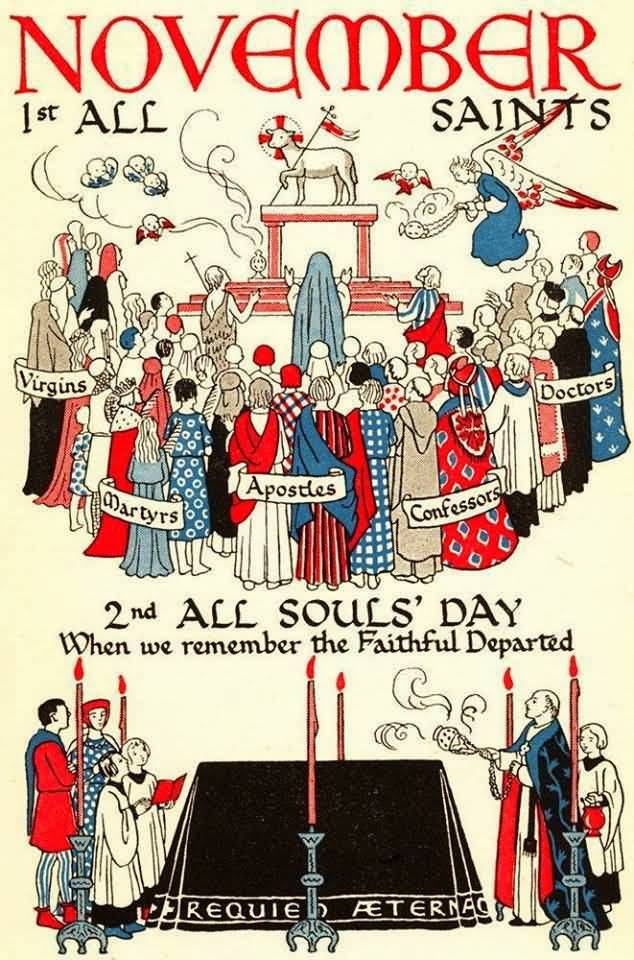
Today, in God’s Lavish Mercy, we commemorate the Holy Souls, a remembrance inextricably tied to yesterday’s celebration of All Saints. It is as if yesterday we prayed in the moon’s full light. Today, we pray on its shadow side.


We pray with Psalm 23, a psalm we have prayed scores of times at the funeral Masses of beloved family and friends. 

Just last month, we prayed it with a lighter tone, focusing on the sunlit field and restful waters.


Today, on this tender feast, we pray this psalm in its grey tones, with a lingering sense of bereavement and perhaps some uncertainty about afterlife’s mysteries.

In paradisum deducant te Angeli; 
May the angels lead you into paradise;
in tuo adventu suscipiant te martyres, 
may the martyrs receive you at your arrival
et perducant te in civitatem sanctam Jerusalem. 
and lead you to the holy city Jerusalem.
Chorus angelorum te suscipiat, 
May choirs of angels receive you 
et cum Lazaro quondam paupere 
and with Lazarus, once poor,
æternam habeas requiem.
may you have eternal rest.


The popular theology – or more clearly “devotionalism”- surrounding All Souls Day has always challenged me. There is a discomfort with the concept of purgatory, and a time of temporal punishment for faithful but imperfect souls. I have always felt that there is enough suffering in this life to redeem us from the sinfulness we struggle with.

Our modern ideas of purgatory and hell still limp under concepts left over from the Middle Ages – fire, brimstone, and devils with pitch forks. My memory still shivers with images from my grade school choir when, at every funeral Mass, we sang the heavy tones of the Dies Irae with a priest clothed in black vestments.


Post-Vatican II theology has infused hope into that devotional gloom. It has refocused us on the truth informing our understanding of death so beautifully described in our reading from Wisdom:

The souls of the just are in the hand of God,
and no torment shall touch them.
They seemed, in the view of the foolish, to be dead;
and their passing away was thought an affliction
and their going forth from us, utter destruction.
But they are in peace.

Wisdom 3:1-3

So what might be a reflective understanding of the core theology underlying this important day? The truth is that any theology is imperfect, and we do our best to imagine what is beyond our imagination.

But here are some ideas or beliefs that help my prayer:

  • our souls endure beyond physical death since they are the Breath of God
  • Christ has already paid the price of our sins and redeemed us on the Cross
  • still, we never lose our free will either in life or in death
  • we are free to choose for God or against God
  • some choose total alienation (popularly conceptualized as “hell”)
  • some choose union, but their choices are fragmented and weak at times, casting shadows over our wholeness or holiness 
  • those weak fragmentations may be healed in us even after death (purgatory) until the fullness of God’s Grace “dawns” on us and within us
  • that healing can be fostered by our prayer for one another throughout the Communion of Saints

All Souls Day is the celebration of that prayer and that healing
for those who have gone before us.
Today, we embrace all those beloved souls in our prayer,
and join the prayer of the whole Church for them.


Poetry: Comfort by Christine Robinson

I am a child of God
  I have everything I need.
This beautiful earth feeds my body.
  You feed my soul.

You guide me in the ways of Life,
  for You are Life.
And though I will walk through dark places, and eventually to death,
  I need never be afraid.

For You are with me always,
  In You I can find comfort.
With Your help, I can face whatever comes.
  
My joy overflows.
Your goodness and blessing will be with me
  Every day of my life -- and forever.

Music: Bach: Cantata No. 112, Der Herr ist mein getreuer Hirt 

Weepers

Wednesday of the Seventh Week of Easter

May 27, 2020

Click here for readings

Today, in Mercy, Jesus and Paul continue their heart-wrenching farewell addresses.

We’ve become accustomed to the passages and may read them without much emotional investment, but honestly they are real “weepers” – like movies where you have to bite the edge of your popcorn cup to keep from sobbing out loud.


paul-s-farewell-to-ephesian-elders-sacred-biblical-history-old-new-testament-two-hundred-forty-images-ed-st-69560609
St. Paul Bids Farewell to the Ephesians

Look at Acts, for example, and put yourself in the scene:

When Paul had finished speaking
he knelt down and prayed with them all.
They were all weeping loudly
as they threw their arms around Paul and kissed him,
for they were deeply distressed that he had said
that they would never see his face again.
Then they escorted him to the ship.


blessing


The verses from John are not quite so emotional, but picture yourself being prayed over like this. You sense that this is really a final blessing. You know these may be some of Christ’s last words you will ever hear.

Holy Father, keep them in your name
that you have given me,
so that they may be one just as we are one.


As we pray with today’s scriptures, we are reminded that goodbyes are awfully hard. We need to mourn them within a community of faith lest our hearts break from their weight. 


So many of us, in these sorrowful times, feel that deep longing. We need to tell one another the stories of our loved ones, to sing together our belief in eternal life, to prove that we can still laugh with old memories, to cry at the sight of one another’s tears.

But in an atmosphere of overwhelming loss, the pandemic has denied us this kind of faith-supported mourning.

Jn17_11 keep

Someday, we will gather as we once did. Together, we will pick up the fabric of our common life and finger the places where it has thinned with the passings of our beloveds.

Until then, let us take great hope in the core of Jesus’s message today:

Father, now I am coming to you.
I speak this in the world

so that those you have given me
may share my joy completely.

All that we love, and may seem to have lost, is preserved and transformed – complete and joyful – in the infinite love of God. 

We too can be there in our prayer. We may be shaken by loss, but we are confident in faith. We know and believe that we are all kept in God’s Name.

Music: Aaronic Benediction – Misha and Marty Goetz

Eternal Life: I Like It!

Seventh Sunday of Easter

May 24, 2020

Click here for readings

John 17_3 eternalJPG

Today, in Mercy, Jesus defines for us what it means to have eternal life. And the parameters of that definition are so far beyond our limited perceptions — at least mine.


The first time I heard the phrase “eternal life”, I was a three-year-old staring up at the edge of my grandmother’s casket. In those days, family members were “waked” at home for three days. Before Father Connolly came to say a few prayers, I had been lifted up to see Grandmom, icy white in her pretty blue gown, definitely in a sleep I had never seen before.

girl blue
Later, as the priest intoned blessings over her, I was too little to see over that casket’s edge, so I wondered if she might already have left to find eternal life when he mentioned it. I hoped she could take the blue dress with her because she looked so pretty in it.


Thus began my lifelong quest to understand where Grandmom had gone and to insure this elusive “eternal life” for myself someday. My early catechism lessons presented  a “Plant Now – Reap Later” view of eternal life.  Remember this from the Baltimore Catechism?

  1. Why did God make you?
  2. God made me to know Him, to love Him, and to serve Him in this world, and to be happy with Him forever in the next.

( However, I prefer this verion of the query which I heard recently.  When asked why God made her, a little girl responded, “Because He thought I’d like it!”)


Still as a result of our early catechesis, many of us consider “eternal life” a future state achieved after death or perhaps not until the Second Coming.

In today’s reading, and throughout John’s Gospel, Jesus begs to differ.

byrneBrendan Byrne, SJ, New Testament scholar, when describing the Prologue of John’s Gospel, says this:
(The central notion of John’s Gospel is this…) The entire life of Jesus Christ will be a playing out, in the field of time, of the divine communion of love that exists between the Father and the Son. Played out in the human sphere, it will be accessible to human beings, so that they, as “children of God”, may be drawn into Jesus’ filial communion of love with the Father and so come to share the divine eternal life.

In other words, as we deepen in our relationship with Christ, we deepen in divine and eternal life. For those whose life is anchored in faith, we rejoice in eternal life now as well as forever.


brownRaymond E. Brown, premier Johannine scholar, says that we find this “eternal life” in the ordinary stuff of our human life, transformed by the sacramental touch of the Incarnate Christ:


We must stress that the Johannine Jesus is not engaged in cosmetic improvement of the quality of life on earth, offering more abundant water and food, with sharper vision and a longer span of years. From another world come his gifts, even if confusingly they bear the same names that our language gives to what we so eagerly seek on earth: food, light, and life. In reality, however, his gifts go beyond anything we could hope for, satisfying needs we scarcely knew we had and doing so permanently.


May we see every aspect of our lives in this sacred light, convinced in our hearts that God made us “because He thought we’d like it”, and wanting to share eternal life with us right now and forever.

Music:  O Love of God, How Strong and True – written by  Horatius Bonar (1808-1889),
(sung here by Washington National Cathedral Choir who sang it as well at President Reagan’s funeral in 2004.)

O love of God, how strong and true!
Eternal, and yet ever new;
Uncomprehended and unbought,
Beyond all knowledge and all thought.

O love of God, how deep and great!
Far deeper than man’s deepest hate;
Self-fed, self-kindled like the light,
Changeless, eternal, infinite.

O heavenly love, how precious still,
In days of weariness and ill,
In nights of pain and helplessness,
To heal, to comfort, and to bless!

O wide embracing, wondrous love!
We read thee in the sky above,
We read thee in the earth below,
In seas that swell, and streams that flow.

We read thee best in him who came
To bear for us the cross of shame;
Sent by the Father from on high,
Our life to live, our death to die.

We read thy power to bless and save,
Even in the darkness of the grave;
Still more in resurrection light
We read the fulness of thy might.

O love of God, our shield and stay
Through all the perils of our way!
Eternal love, in thee we rest,
For ever safe, for ever blest.


We’ll Meet Again

Friday of the Sixth Week of Easter

May 22, 2020

Click here for readings

Today, in Mercy, Jesus acknowledges the difficulty of living a Christian life in a hostile world, especially without his physical presence to lead the disciples.

John16_22 separation

He knows that his friends are anguished at the thought of being separated from him. He compares their heartbreak to the pain of a mother in labor. The comparison is a perfect one because labor pains yield a gift that washes away the memory of suffering:

… when she has given birth to a child,
she no longer remembers the pain because of her joy
that a child has been born into the world.

Jesus tries to comfort his followers with this analogy, but he doesn’t deny the sorrow they are experiencing. Jesus knows that separation from what we dearly love can be a crushing experience. He knows that change often carries unwanted loss.

joys and sorrows

Our lives are braided into this cycle of labor, birth, love, loss, sorrow and joy. Jesus assures us that if we live this cycle in faith and hope, all things return to him in glory:

But I will see you again, and your hearts will rejoice,
and no one will take your joy away from you.

At those times in our lives when we feel more the absence than the presence of God, (perhaps these pandemic days), remembering the endurance and bravery of others may help us. Although it’s not a religious song, this melody kept playing itself in my heart as I read today’s Gospel. It opened my spirit to a very comforting prayer time.

Music: We’ll Meet Again – Dame Vera Lynn

Dame Vera Margaret Lynn Welch, CH,DBD, OStJ, age 103, is a British singer of traditional popular music, songwriter and actress, whose musical recordings and performances were enormously popular during World War II.

She is widely known as “the Forces Sweetheart” and gave outdoor concerts for the troops in Egypt, India and Burma during the war. The songs most associated with her are “We’ll Meet Again”, “The White Cliffs of Dover”, “A Nightingale Sang in Berkeley Square”, and “There’ll Always Be an England”. For more on her generous and fascinating life, Click here

Be Kindled

Tuesday of the Sixth Week of Easter

May 19, 2020

Click here for readings

Today, in Mercy, Jesus counsels the disciples as they grieve his impending departure. He assures them that they will be consoled and animated by the Holy Spirit whom he will send to them.

Jn16_7 spiritJPG

We all understand how the disciples feel. They love Jesus. They have been through hell and high water with him. They are comfortable with him. They have learned to be brave with him beside them.

All in all, they can’t imagine going on without him by their side.

Jesus, as he has so often had to tell them, says “You don’t quite get it!”. He explains that there will be no vacuum – that the Divine Presence will forever be with them in the form of the Holy Spirit. They are about to catch fire with the Love between Jesus and the Father! They should rejoice!

Balance Plus Minus

But, you know, it took these disciples three years of see-saw living with Jesus to fully embrace his Presence. It’s going to take more than a speech to kindle in them the full wonder of the Holy Spirit. It’s going to take a lifetime. It’s going to take thousands of little matches striking again and again in their hearts.

Decision by decision, action by action, they must now allow the Spirit to bring God’s Presence to life within them.


Slide1

When Catherine McAuley, the first Sister of Mercy, died, her beloved sisters kneeling at her bedside felt a lot like the disciples in today’s Gospel. How would they carry on the works of mercy without Catherine beside them? But as those of us who never knew Catherine realize, she left a living Spirit burning within those sisters which has descended to all her followers for nearly 200 years.

Within Catherine, as within all faithful disciples of Jesus, the Holy Spirit inspires, generates, and sustains the Presence of God for the sanctification of all Creation. The Spirit pours out over the world in our works of mercy toward all who hunger for Life.


Like the early disciples, we may wish Jesus would come along and cook us a beach breakfast so we could just sit down and talk to him in the flesh. But Jesus tells us today, as he told his disciples:

But I tell you the truth, it is better for you that I go.
For if I do not go, the Advocate will not come to you.
But if I go, I will send the Spirit to you.

Let us ask for the kind of faith that can believe, see, and sit down with that Holy Spirit in our hearts, catching Her fire, lighting the world with Mercy.

Music: Holy Spirit, Living Breath of God – The Gettys
(with Gabriel’s Oboe from the movie  “The Mission”)

Live Your Resurrection Power!

Third Sunday of Easter

April 26, 2020

Click here for readings

Today, in Mercy, our Eastertide readings once again pull us into the full power of the Resurrection.

Act2_24

Just listen to Peter who stands and raises his mighty voice over the gathered crowd:

Let this be known to you, and listen to my words.
You who are Israelites, hear these words.
Jesus the Nazarene was a man commended to you by God …
This man … you killed, using lawless men to crucify him.
But God raised him up,
releasing him from the throes of death,

because it was impossible for him to be held by it.

There is no fear in Peter. There is only the courage that comes from certainty in God’s power over death. This is the grace of Resurrection Faith.


Resurrection Faith is a power we intensely need in these times that so test us. 

We may be severely tested like those suffering illness and loss; like those valiantly serving the suffering. Or we, like many, may simply be challenged by our self-isolation and radical disruption of routine.

emmaus nuns
In that, we may be like the disciples walking home to Emmaus. They didn’t die on Calvary. They weren’t even retained as followers of Jesus. They simply drifted away from their Hope. They were going home to a sad but comfortable dinner adequate enough to invite a stranger.

Yet they were heartbroken. The world they had loved and hoped in had been shattered. Everything they believed in appeared to be contradicted by the Cross. Most devastating of all, they were at a loss to imagine a future. 

Aren’t we at least a little bit like them?

Aren’t we dazed that the reality we trusted seems to have disappeared overnight? Aren’t we too trying to figure out what we do now in the vacuum? Aren’t we too so blinded by sadness that we might fail to see God walking right beside us?


In our second reading, Peter gives us the formula to break through such blindness:

    • Invoke God as your Father
    • Remain faithful to your good works
    • Conduct yourselves with reverence during the time of your sojourning,
    • Realize that you are already ransomed from death by the precious blood of Christ

Practicing this kind of Resurrection Faith in troubled times makes us not only unafraid of death but, more importantly, unafraid of life. Because I think that is what really most cripples us – not any fear of dying, but rather our fear of fully living our life in God.

We worry about what we have to lose if we live like that, don’t we?

By jeopardizing everything most precious to us, these pandemic times make clear all that we have to lose. But they also make clear the powers in us impossible to chain: how we love, hope, serve and believe. Neither death nor pandemic has power over these living graces.


Like the Emmaus disciples, our hearts burn within us, too, with an ardent mix of longing, confusion, and stubborn trust. Like them, let us sit down with Jesus at the table of our lives. Let his patient voice speak to our souls and clear our vision. The Resurrection power of God is alive in all things. May we recognize that Power even in these seemingly contradictory times.

cross

Because Christ rose from the dead, it is impossible for any form of death to hold us captive. On this Third Sunday of Easter, our readings invite us to truly believe that. Let’s fully accept the invitation, dear friends. Let’s live like we believe!

Music: Christ Our Hope in Life and Death – The Gettys 

Holy Saturday: Entombed with Christ

Holy Saturday

April 11, 2020

Click here for readings of the Vigil Liturgy


Jesus in tomb
The Body of the Dead Christ in the Tomb by Hans Holbein (c. 1522)

Today, in Mercy, we wait, entombed with Jesus. The waiting has a surreal sense every year as we commemorate this day with no liturgy of its own.  But this year, it takes on a eerie resemblance to our own global stasis in this pandemic – a time in which we tap into many deep and unexplored feelings.

Eliot

Here are two poems that may help us explore the spiritual dimensions of Holy Saturday in this unique Year of Our Lord 2020.

meynell


levertov

Music: God Rested – Andrew Peterson