Monday of the Second Week of Easter

April 12, 2021

Today, in God’s Lavish Mercy, we pray with Psalm 2 which poses an eternally recurring question:

Yesterday I read that it was the 21st anniversary of The Belfast Agreement. This is also known as the Good Friday Agreement, because it was reached on Good Friday, 10 April 1998. It was an agreement between the British and Irish governments, and most of the political parties in Northern Ireland, on how Northern Ireland should be governed. The talks leading to the Agreement addressed issues which had caused conflict during previous decades. The aim was establish a new, “devolved government” for Northern Ireland in which unionists and nationalists would share power.


But at the same time I also read another current article:

For nearly a week, crowds of Protestant and Catholic youth have provoked one another through the gaps in the wall, video footage from journalists at the scene shows. Stemming from decades-old tensions referred to as “the troubles,” the reignited violence has been, in part, caused by Britain’s exit from the European Union.


On any given day, we could take these stories and substitute the names of other countries, each struggling through cycles of strife, attempts at peace, and recurrence of violence.

The psalmist’s question echoes and the answer, over the ages, remains the same.

Why do the nations rage? They rage from the abuse of power, money, and human dignity.


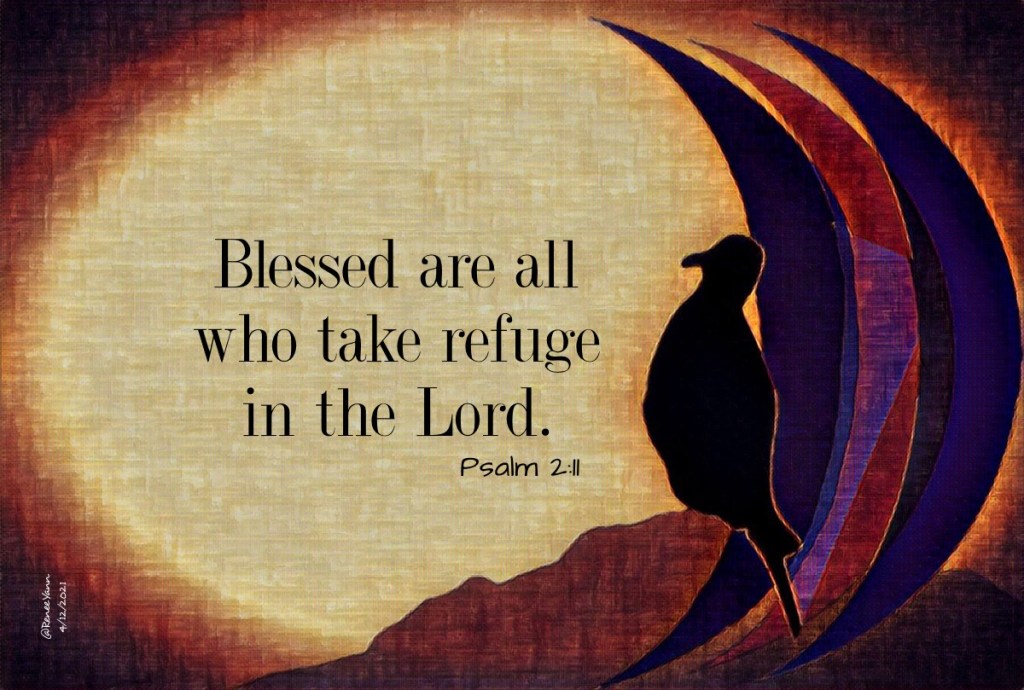
What is the antidote to this recurring rage? Our psalm tells us it is simple – not easy – but simple. We must take refuge in God, govern our lives by God’s desire for good for every person, every creature.

Every war leaves our world worse than it was before. War is a failure of politics and of humanity, a shameful capitulation, a stinging defeat before the forces of evil. Let us not remain mired in theoretical discussions, but touch the wounded flesh of the victims. Let us look once more at all those civilians whose killing was considered “collateral damage”. Let us ask the victims themselves. Let us think of the refugees and displaced, those who suffered the effects of atomic radiation or chemical attacks, the mothers who lost their children, and the boys and girls maimed or deprived of their childhood. Let us hear the true stories of these victims of violence, look at reality through their eyes, and listen with an open heart to the stories they tell. In this way, we will be able to grasp the abyss of evil at the heart of war. Nor will it trouble us to be deemed naive for choosing peace.

Pope Francis: Fratelli Tutti #261

Poetry: Dover Beach by Matthew Arnold

The sea is calm to-night,
The tide is full, the moon lies fair
Upon the straits; on the French coast the light
Gleams and is gone; the cliffs of England stand,
Glimmering and vast, out in the tranquil bay.
Come to the window, sweet is the night-air!
Only, from the long line of spray
Where the sea meets the moon-blanched land,
Listen! you hear the grating roar
Of pebbles which the waves draw back, and fling,
At their return, up the high strand,
Begin, and cease, and then again begin,
With tremulous cadence slow, and bring
The eternal note of sadness in.

Sophocles long ago
Heard it on the Aegean, and it brought
Into his mind the turbid ebb and flow
Of human misery; we
Find also in the sound a thought,
Hearing it by this distant northern sea.

The sea of faith
Was once, too, at the full, and round earth's shore
Lay like the folds of a bright girdle furled.
But now I only hear
Its melancholy, long, withdrawing roar,
Retreating, to the breath
Of the night-wind, down the vast edges drear
And naked shingles of the world.

Ah, love, let us be true
To one another! for the world which seems
To lie before us like a land of dreams,
So various, so beautiful, so new,
Hath really neither joy, nor love, nor light,
Nor certitude, nor peace, nor help for pain;
And we are here as on a darkling plain
Swept with confused alarms of struggle and flight,
Where ignorant armies clash by night.

Easter Saturday

April 10, 2021

Today, in God’s Lavish Mercy, we pray again with Psalm 118, today’s verses a song of utter confidence in, and thanks for, God’s faithfulness.

Give thanks to the LORD who is is good,
    whose mercy endures forever.
My strength and my courage is the LORD,
    who has been my savior.
The joyful shout of victory
    in the tents of the just.

Psalm 118: 1, 14-15

That profound trust and gratitude are captured in the enduring word:

“Forever” is a word we tend to toss about carelessly, as in:

It took my pizza forever to get here!

I promise I’ll love you forever.

Really? Could “forever” possibly apply in both these cases????


I think, in fact, we cannot begin to conceptualize “forever”, just as we cannot possibly conceptualize God.

What we can do is 

  • to pick up the fabric of our life as it flows through time, 
  • to place it with trust in God’s enduring love, 
  • to slowly, continually become knit into God’s faithfulness, 
  • to finally become still as, in each moment, that Love carries us to “forever”.

Poetry: two selections today

Forever – is composed of Nows by Emily Dickinson

Forever – is composed of Nows –
‘Tis not a different time –
Except for Infiniteness –
And Latitude of Home –
From this – experienced Here –
Remove the Dates – to These –
Let Months dissolve in further Months –
And Years – exhale in Years –
Without Debate – or Pause –
Or Celebrated Days –
No different Our Years would be
From Anno Dominies 

From Miracles by C.S. Lewis

It is probable that Nature is not really in Time 
and almost certain that God is not. 
Time is probably (like perspective) the mode of our perception. 
There is therefore in reality no question of God's 
at one point in time (the moment of creation) 
adapting the material history of this universe 
in advance to free acts 
which you or I are to perform 
at a later point in Time.

To God
all the physical events and all the human acts 
are present in an eternal Now. 
The liberation of finite wills 
and the creation of the whole material history of the universe 
(related to the acts of those wills in all the necessary complexity) 
is to God a single operation. 
In this sense God did not create the universe long ago 
but creates it at this minute—at every minute.

Music: Swept Across Forever – Tim Janis

Easter Friday: Cornerstone

April 9, 2021

Today, in God’s Lavish Mercy, we pray with Psalm 118:

The stone which the builders rejected
    has become the cornerstone.
By the LORD has this been done;
    it is wonderful in our eyes.

Psalm 118:22

That “Stone”, rejected by the builders, is the Crucified Christ, the sight of whom was an abomination to those who expected a battle-victorious messiah.

But Jesus is among us to stand in contradiction to everything that limits the power of God. In Jesus’s Name

  • the poor are rich
  • the lost are found
  • the foolish are wise
  • the persecuted are blessed
  • the dead are raised to life

As Peter says in Acts, worldly rejection holds no sway over the power of this Name:

There is no salvation through anyone else,
nor is there any other name under heaven
given to the human race by which we are to be saved

Acts 4:12
The Miraculous Catch – James Tissot

This is the mysterious lesson of the Cross, a lesson accessed only through faith, a faith the disciples exercise in today’s beautiful Gospel story.

This morning, we might wish to join Jesus for his “Breakfast on the Beach”, feeding our spirits in his resurrected Light. The truth he gives us goes beyond any purely human understanding. Let us listen with our deep hearts; see with grace-filled eyes.


Poetry: True Cornerstone by Robert Morris,  a prominent American poet of the mid-19th century

What is the Mason's cornerstone? 
Does the mysterious temple rest 
On earthly ground — from east to west — 
From north to south — and this alone? 

What is the Mason's cornerstone? 
Is it to toil for fame and pelf, 
To magnify our petty self, 
And love our friends — and this alone? 

No, no; the Mason's cornerstone — 
A deeper, stronger, nobler base, 
Which time and foe cannot displace — 
IS FAITH IN God — and this alone! 

'Tis this which makes the mystic tie 
Loving and true, divinely good, 
A grand, united brotherhood, 
Cemented 'neath the All-seeing Eye. 

'Tis this which gives the sweetest tone 
To Mason's melodies; the gleam 
To loving eyes; the brightest gem 
That sparkles in the Mason's crown. 

'Tis this which makes the Mason's grip 
A chain indissolubly strong; 
It banishes all fraud, and wrong, 
And coldness from our fellowship. 

Oh, cornerstone, divine, divine! 
Oh, FAITH IN God ! it buoys us up, 
And gives to darkest hours a hope, 

And makes the heart a holy shrine. 
Brothers, be this your cornerstone; 
Build every wish and hope on this; 
Of present joy, of future bliss, 
On earth, in Heaven — and this alone!

Music: Loed, When You Came – Kitty Cleveland

Lord, when you came to the seashore 
you weren’t seeking the wise or the wealthy, 
but only asking that I might follow.

O Lord, in my eyes you were gazing, 
Kindly smiling,My name you were saying; 
All I treasured,I have left on the sand there; 
Close to you, I will find other seas.

Señor me has mirado a los ojos,
Sonriendo has dicho mi nombre,
En la rena he dejado mi barca, 
junto a ti buscaré otro mar.

Lord, you knew what my boat carried:
Neither money nor weapons for fighting, 
but nets for fishing my daily labor. 

Lord, have you need of my labor, hands for service,
A heart made for loving, my arms for lifting the poor and broken? 

Lord, send me where you would have me, to a village,
Or heart of the city; I will remember that you are with me.

Easter Thursday: Psalm 8

April 8, 2021

Today, in God’s Lavish Mercy, we pray with Psalm 8 – “a unique hymn of praise of God as Creator”, according to scripture scholar Roland Murphy, O.Carm.

Murphy goes on to explain:

Normally a hymn calls upon people to praise God, but not here. A communal refrain forms an inclusio (vv.2,10) for an individual hymn of admiration (vv.3-9)

(“Inclusio” is biblical theology jargon. It means a literary device based on a concentric principle, also known as bracketing or an envelope structure, which consists of creating a frame by placing similar material at the beginning and end of a section)

We might like to use the idea of an “inclusio” in our own prayer – 

  • just taking that one phrase from the psalm which strikes our heart
  • beginning our prayer time with its rhythm
  • repeating it gently and continuously
  • letting it speak to us without further words
  • letting its images blossom in our prayer
  • letting it take us deeper into God’s heartbeat
  • closing our prayer time and entering our day with its cadence informing our spirit.

Prose: from William Butler Yeats

The purpose of rhythm …
is to prolong the moment of contemplation
– the moment when we are both asleep and awake,
which is the one moment of creation
— by hushing us with an alluring monotony,
while it holds us waking by variety…


Music: Heartbeat – Shankar Esaan Loy

Easter Wednesday

Wednesday in the Octave of Easter

April 7, 2021

Today, in God’s Lavish Mercy, we pray with Psalm 105 as the psalmist rejoices in seeking and being found by God.

Our scripture passages today invite us to walk:

  • beside one long crippled and amazed at unexpected healing
  • beside the psalmist and all who seek the Lord
  • beside the Emmaus disciples as they shed their confusion into the already present Light

The readings call us to deeper, more faith-filled journeys that

  • challenge our passively accepted inhibitions
  • appreciate the journey as part of the destination
  • open our eyes to Grace otherwise invisible to our unhopeful hearts

Poetry: excerpt from The Wasteland by T.S.Eliot

Who is the third who walks always beside you?
When I count, there are only you and I together
But when I look ahead up the white road
There is always another one walking beside you
Gliding wrapt in a brown mantle, hooded
I do not know whether a man or a woman
—But who is that on the other side of you?

Music: Turn Around, Look at Me – The Vogues

Easter Tuesday: He Knows My Name

Tuesday in the Octave of Easter

April 6, 2021

Jesus said to her, “Mary!”
She turned and said to him in Hebrew, “Rabbouni” 

Today, in God’s Lavish Mercy, we pray with Psalm 33 which connects two powerful readings from Acts and John’s Gospel.

Acts describes for us a gathered crowd which, upon Peter’s inspired preaching, become a repentant, converting community. Peter speaks a word that changes them. They are struck through to their core by the enormity of Christ’s sacrifice for them.

Now when they heard (Peter’s preaching),
they were cut to the heart,
and they asked Peter and the other Apostles,
“What are we to do, my brothers?”

Acts 2:37

In our Gospel, a bereaved Mary Magdalene’s heart is cut as well – with sorrow, confusion, and grief. But in that moment when Jesus simply speaks her name, she is awakened, healed, and energized.


What Word is it that our heart longs for today as we pray? What healing, light, and conversion do these readings hold for us as we open our hearts to Easter grace? 

We, too, like Peter’s congregation, have come to hear a Word that transforms us. We, too, like Mary have been waiting in Hope outside the tomb. As we pray today’s scriptures, let’s listen for our name.


Our soul waits for the LORD,
    who is our help and our shield.
May your kindness, O LORD, be upon us
    who have put our hope in you.

Psalm 33:20,22

Poetry: Say My Name – Meleika Gesa-Fatafehi

It is a good day to think about how important one’s name is to them, especially as it expresses our spiritual, familial and cultural rootedness. Meleika Gesa-Fatafehi is a proud Black/Indigenous, Pasifika and West Asian writer. She is from Murray (Mer) Island, from the Zagareb and Dauareb tribes.

My name was my name before
                            I walked among the living
               before I could breathe
               before I had lungs to fill
before my great grandmother passed
               and everyone was left to grieve

My name was birthed from a dream
               A whisper from gods to a king
               A shout into the stars that produced
                             another that shone as bright
They held me without being burnt, humming lullabies in pidgin

My name was passed down from my
               ancestors
They acknowledged my roots grew in two
               places
So, they ripped my name from the ocean
               and mixed it into the bloodlines of my totems

My name has survived the destruction of worlds
and the genocidal rebirthing of so-called ones
It’s escaped the overwhelmed jaw of the death bringer
               Many a time
It has survived the conflicts that resulted in my gods,
               from both lands, knowing me as kin,
but noticing that I am painfully unrecognisable and lost
They are incapable of understanding
               the foreign tongue that was forced on me

My name has escaped cyclones and their daughters
It has been blessed by the dead
As they mixed dirt, salt and liquid red,
               into my flesh
My name is the definition of resilience
It is a warrior that manifested because of warriors

So, excuse me as I roll my eyes or sigh as you
mispronounce my name
               over and over again
Or when you give me another
               that dishonours my mother and father
That doesn’t acknowledge my lineage to my island home
or the scents of rainforest and ocean foam
You will not stand here on stolen land
               and whitewash my name
For it is two words intertwined
               holding as much power as a hurricane
Say it right or don’t say it at all
For I am Meleika
               I will answer when you call


Music: You Know My Name – Brooklyn Tabernacle Choir

(You may come upon an ad in the middle of today’s music — because it is rather long. Just clip the “Skip Ads” after a few seconds and you’ll get back to the choir)

Psalm 16: Easter Monday

Monday in the Octave of Easter

April 5, 2021


Today, in God’s Lavish Mercy, we pray with Psalm 16 in the light of our first reading from the Acts of the Apostles.

For the next seven weeks, our first readings will come from Acts, allowing us to journey with the early Church as it finds its way after Jesus’s Resurrection. At the same time, our Responsorial Psalms will enhance our spiritual understanding of the message of Acts. To support my prayer over these weeks, I will be using a book by scripture scholar William S. Kurz, SJ, Acts of the Apostles.


Kurz calls today’s passage, “Peter’s Argument from Scripture That Jesus Is the Christ (2:22–32)”. Peter structures this argument on two psalms, 16 and 110. He says that Psalm 16 is a foreshadowing of the Resurrected Messiah:

For David says of him:

    I saw the Lord ever before me,
        with him at my right hand I shall not be disturbed.
    Therefore my heart has been glad and my tongue has exulted;
        my flesh, too, will dwell in hope, 
    because you will not abandon my soul to the nether world,
        nor will you suffer your holy one to see corruption.
    You have made known to me the paths of life;
        you will fill me with joy in your presence.

Acts 2: 25-28 / Psalm 16: 8-11

Peter is instructing, proving, and convincing his audience that Jesus is indeed the promised Messiah who allows us all to conquer death with him. If we believe and live this Truth, all that is deathly has no power over us.

As we drink in the beauty of Spring blossoming all around us, let us place into the Easter Light any hint of fear, darkness or death we carry hidden in our hearts.


Poetry: Easter Wings – George Herbert (1593–1633)

Lord, Who createdst man in wealth and store,
        Though foolishly he lost the same,
              Decaying more and more,
                      Till he became
                        Most poore:
                        With Thee
                      O let me rise,
              As larks, harmoniously,
        And sing this day Thy victories:
Then shall the fall further the flight in me.
My tender age in sorrow did beginne;
  And still with sicknesses and shame
        Thou didst so punish sinne,
                  That I became
                   Most thinne.
                    With Thee
                Let me combine,
      And feel this day Thy victorie;
    For, if I imp my wing on Thine,
Affliction shall advance the flight in me.

Music: Christus – Franz Liszt

Lyrics: 

Christus vincit, Christus regnat,
Christus imperat in sempiterna saecula.
Hosanna in excelsis,
Halleluja.
Amen!

Christ conquers, Christ reigns,
Christ rules eternally.
Glory in the highest.
Alleluia!
Amen

Easter Sunday 2021

The Resurrection of the Lord 

April 4, 2021


Today, in God’s Lavish Mercy, we sing with the psalmist:

This is the day the Lord has made; 
let us rejoice and be glad.
Alleluia!

Psalm 118:24

Poetry: Mary Ann Bernard – Resurrection

Long, long, long ago;
Way before this winter’s snow
First fell upon these weathered fields;
I used to sit and watch and feel
And dream of how the spring would be,
When through the winter’s stormy sea
She’d raise her green and growing head,
Her warmth would resurrect the dead.

Long before this winter’s snow
I dreamt of this day’s sunny glow
And thought somehow my pain would pass
With winter’s pain, and peace like grass
Would simply grow.  (But) The pain’s not gone.
It’s still as cold and hard and long
As lonely pain has ever been,
It cuts so deep and fear within.

Long before this winter’s snow
I ran from pain, looked high and low
For some fast way to get around
Its hurt and cold.  I’d have found,
If I had looked at what was there,
That things don’t follow fast or fair.
That life goes on, and times do change,
And grass does grow despite life’s pains.

Long before this winter’s snow
I thought that this day’s sunny glow,
The smiling children and growing things
And flowers bright were brought by spring.
Now, I know the sun does shine,
That children smile, and from the dark, cold, grime
A flower comes.  It groans, yet sings,
And through its pain, its peace begins.

Music: An Easter Hallelujah – Cassandra and Callahan Star

Closing the Book

Saturday of the Seventh Week of Easter

May 30, 2020

Click here for readings

Today, in Mercy, on this day before Pentecost, we close the book on both Acts and John’s Gospel, companions we have been praying with since mid-April.

When I read a really great book, I hate it to end. The characters and their story linger in my mind. The places where I’ve pictured them seem real – as if I’ve visited there myself. And the core of their stories becomes part of me, a reference point for my own experience.

Hopefully, the same thing happens when we read and pray with scripture. 

bible


apostles

As we leave Acts today, we should feel like we know the early disciples better, especially Peter, Paul, Barnabas, Stephen, Lydia and others whose story might have touched us. We should better understand the ups and downs of the early Church, the passion for mission, and the evolution of faith – and how these speak to our own times.


Finishing John, we have a slightly different picture of Jesus from that of the Synoptic Gospels of Matthew, Mark, and Luke. We see a Jesus full of Light, his human existence described through the lens of his Divinity. Johannine scholar Raymond E. Brown describes the difference like this:

That Jesus is the center of John’s message is confirmed by even a hasty reading of the Gospel itself. The emphasis on the Kingdom of God, so prominent in the Synoptic Gospels, has yielded in John to an emphasis on Jesus as the embodiment of life, truth, and light. No more is the parabolic language introduced by “The kingdom of God is like,..”; rather we hear the majestic “I am ” Whereas it is the Kingdom that the Synoptic Gospels describe in terms of vineyard, wheat, shepherd and sheep, in John it is Jesus who is the vine, the bread, the shepherd, and the sheepgate.


shepherdvineeucharist


Today, in our prayer, we might want to glance back through these books, reminding ourselves of the words, phrases and stories that touched our own experience most deeply. 

John_I

Sketching such phrases – perhaps in a daily prayer journal –  is a good way to let our minds turn them over and over again in prayer, discovering new depths with each turn.


Music:  Cavalleria Rusticana: Easter Hymn – Pietro Mascagni, featuring Australian soprano Kiandra Howarth

I thought we’d close these two wonderful books, and the Easter Season, with a bang. (Lyrics and explanation below)


Click here to learn more about Cavalleria rusticana: The Easter Hymn

Lyrics:
LATIN AND ENGLISH:
CHORUS (within the church)
Regina coeli, laetare—Alleluia!
Quia, quem meruisti portare—Alleluia!
Resurrexit sicut dixit—Alleluia!

CHORUS (in the square)
We rejoice that our Saviour is living!
He all-glorious arose from the dead;
Joys of heaven the Lord to us giving,
All the sorrows of darkness are fled!
(The chorus goes out slowly)


ITALIAN:
CORO INTERNO (dalla Chiesa.)
Regina coeli, laetare—Alleluja!
Quia, quem meruisti portare—Alleluja!
Resurrexit sicut dixit—Alleluja!

CORO ESTERNO (sulla piazza.)
Inneggiamo, il Signor non è morto.
Ei fulgente ha dischiuso l’avel,
inneggiamo al Signore risorto
oggi asceso alla gloria del Ciel!
(il Coro esce lentamente)


Take My Hand

Friday of the Seventh Week of Easter

May 29, 2020

Click here for readings

festus
Window in St. Paul’s Cathedral, Melbourne – Paul Pleads His Case (Festus in yellow)

Today, in Mercy, Paul’s case goes before Festus and King Herod Agrippa. Just in case you are confused, like I was, about just who this particular Herod is, this family tree from Wikipedia helped:

chart

This King Agrippa was Marcus Julius Agrippa II (A.D. 27-100), son of Agrippa I (Acts 12:1-25) and great-grandson of Herod the Great (Mt 2:1-23). 

I offer these facts for no real spiritual reason, but they remind me that these biblical characters were real people, like us, engaging (or not) a real life of faith. (Also, I thought it was fun to see how uncreative they were in naming their babies 🙂


In our Gospel, Jesus once again prepares Peter for his tremendous responsibility in the building of that faith. Jesus asks Peter three times, “Do you love Me?”. By the third interrogation, Peter’s answer sounds a little intense:

“Lord, you know everything; you know that I love you.”

Hearing this response, Jesus lays the full burden of Peter’s life upon his shoulders. Not only must Peter “feed” the faith of Jesus’s followers, he must do so by giving over all control to God:

“Amen, amen, I say to you, when you were younger,
you used to dress yourself and go where you wanted;
but when you grow old, you will stretch out your hands,
and someone else will dress you
and lead you where you do not want to go.”

hand

Like Peter,
we too are given the gift and responsibility
of living a faithful life.
Like Peter, we all learn through the years,
that life comes to us in unexpected ways.
In reality, life often chooses us
rather than the other way around.

As we pray with these passages, we might want to look back over our lives for those points where life challenged or unbalanced us. What unexpected blessings came from those surprises/shocks? When God’s plan contradicted our own, how were we eventually blessed with courage, hope and insight?

We are the person we are today because of how we responded to God’s mysterious plan for our lives. Did we reach out our hand and let God lead us? Do we still need to do some letting go in order to enjoy that kind of freedom?

Music:  Precious Lord, Take My Hand – written by Thomas A. Dorsey, sung here by the Great Mahalia Jackson

When my way groweth drear

Precious Lord, linger near-ear

When my li-ight is almost gone

Hear my cry, hear my call

Hold my ha-and lest I fa-all

Take my hand, precious Lor-ord

Lead me on

Precious Lord, take my hand

Lead me on, let me sta-and

I am tired, I’m weak, I am worn

Through the storm, through the night

Lead me on to the li-ight

Take my ha-and, precious Lor-ord

Lead me home

When my work is all done

And my race here is are you-un

Let me see-ee by the light

Thou hast shown

That fair city so bright

Where the lantern is the li-ight

Take my ha-and, precious Lor-ord

Lead me on

Precious Lord, take my hand

Lead me on, let me sta-and

I am tired, I’m weak, I am worn

Through the storm, through the night

Lead me on to the li-ight

Take my ha-and, precious Lor-ord

Lead me home