Psalm 1: The First Word

Wednesday of the Twenty-eighth Week in Ordinary Time

October 14, 2020


Today, in God’s Lavish Mercy, we pray with Psalm 1.
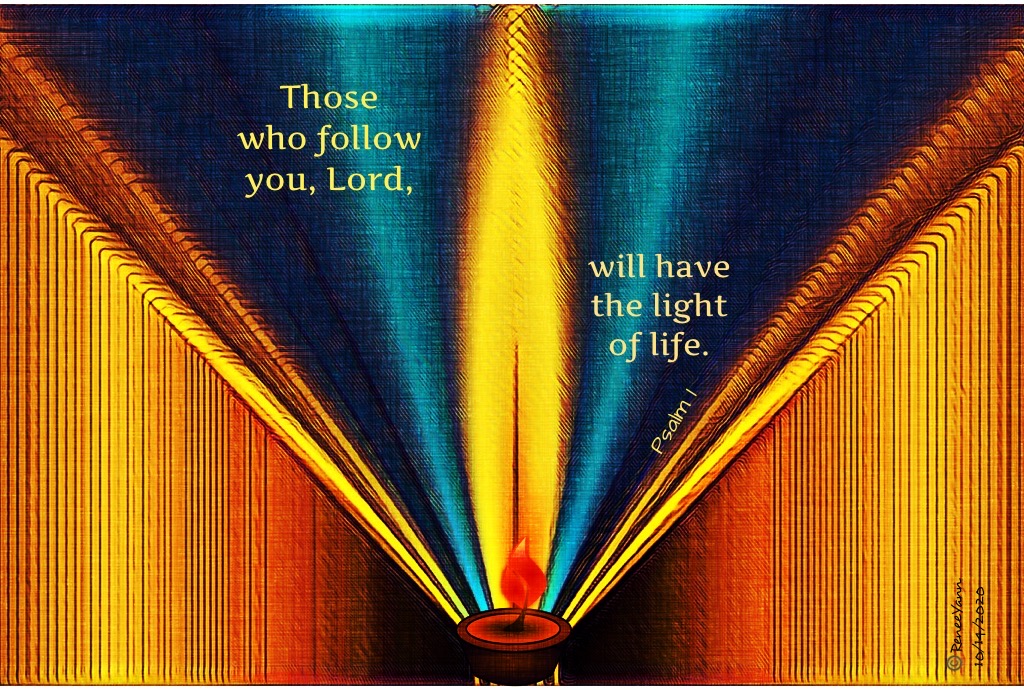
Patrick D. Miller, Hebrew Scriptures scholar, suggests that Psalm 1 “sets the agenda for the Psalter through its identification of the way of the righteous and the way of the wicked as well as their respective fates” along with “its emphasis on the Torah, the joy of studying it and its positive benefits for those who do“.

Blessed the one who follows not
the counsel of the wicked
Nor walks in the way of sinners,
nor sits in the company of the insolent,
But delights in the law of the LORD
and meditates on God’s law day and night.

Psalm 1:1-2

What does it really mean to “meditate on God’s law day and night”? Become a monk? Read the Bible all day? Never sleep?

Of course not. I think it means to live in the firm belief that God is in everything, and to train our hearts to see and respond to that Omnipresent Love.

We all know people who, no matter the circumstances, are focused on good and radiate a joyful confidence. There is a light within them and a peace around them. The living of their ordinary lives is a meditation on God’s order in all things.

Such a person …

… is like a tree
planted near running water,
That yields its fruit in due season,
and whose leaves never fade.
Whatever that faithful one does, prospers.

Psalm 1:3

It doesn’t mean there aren’t challenges … even protests, righteous anger, sadness and pain. Think of Jesus as he overturned the Temple tables!

It means rather that the focus is never lost because …
Creation’s sacred order is our Light;
and God’s law has taught ours hearts 
to find our joy in its Beauty.

my transliteration of Psalm 1:2

Let’s be that tree near
the running water of Grace!🙏


Poem: On Beauty by Khalil Gibran

And a poet said, Speak to us of Beauty.
     And he answered:
     Where shall you seek beauty, and how
shall you find her unless she herself be your
way and your guide?
     And how shall you speak of her except
she be the weaver of your speech?
    
The aggrieved and the injured say,
“Beauty is kind and gentle.
     Like a young mother half-shy of her
own glory she walks among us.”
     And the passionate say, “Nay, beauty is
a thing of might and dread.
     Like the tempest she shakes the earth
beneath us and the sky above us.”
    
The tired and the weary say, “Beauty is
of soft whisperings. She speaks in our spirit.
     Her voice yields to our silences like a faint
light that quivers in fear of the shadow.”
     But the restless say, “We have heard her
shouting among the mountains,
     And with her cries came the sound of
hoofs, and the beating of wings and
the roaring of lions.”
    
At night the watchmen of the city say,
“Beauty shall rise with the dawn from the
east.”
     And at noontide the toilers and 
the wayfarers say, 
“We have seen her leaning over
the earth from the windows of the sunset.”
    
In winter say the snow-bound, “She shall
come with the spring leaping upon the hills.”
     And in the summer heat the reapers say,
“We have seen her dancing with the autumn
leaves, and we saw a drift of snow in her hair.”
     All these things have you said of beauty,
     Yet in truth you spoke not of her but of
needs unsatisfied,
     And beauty is not a need but an ecstasy.
     It is not a mouth thirsting nor an empty
hand stretched forth,
     But rather a heart enflamed and a soul enchanted.
     It is not the image you would see nor the
song you would hear,
     But rather an image you see though you
close your eyes and a song you hear though
you shut your ears.
     It is not the sap within the furrowed bark,
nor a wing attached to a claw,
     But rather a garden for ever in bloom and
a flock of angels for ever in flight.
    
People of Orphalese, beauty is life when
life unveils her holy face.
     But you are life and you are the veil.
     Beauty is eternity gazing at itself in a mirror.
But you are eternity and you are the mirror.


Music: I Delight in You, Lord – David Baroni
The Benedictus

Thursday of the Twenty-seventh Week in Ordinary Time

October 8, 2020


Today, in God’s Lavish Mercy, for our Responsorial, we pray with a passage from Luke’s Gospel. This passage is known as the Benedictus or Canticle of Zechariah. It is one of three canticles in the first two chapters of Luke, the others being the Magnificat and the Nunc Dimittis. The Angelic Hymn is often considered a fourth.


At the Wednesday General Audiences given by the Pope, a theme is chosen for “catechesis” or teaching. From October 2001 until February 2006, Popes John Paul II and Benedict XVI gave their teachings based on the Psalms. JPII closed the first section of these audiences with these words:

“Our commentary on the Psalms and canticles from Morning Prayer concludes today with the Canticle of Zechariah, commonly known as the Benedictus. It is a prophetic canticle, in which the father of John the Baptist, indicates three events in God’s liberation of Israel: the covenant with Abraham, the covenant with David, and the new covenant with Christ. Like the “dawn from on high,” Christ gives light and guides us into the way of peace.”

Wednesday General Audience, October 1, 2003

As we pray with the hope-filled verses of the Benedictus, we pray in a world still seeking the fullness of that Dawn of Tender Mercy …

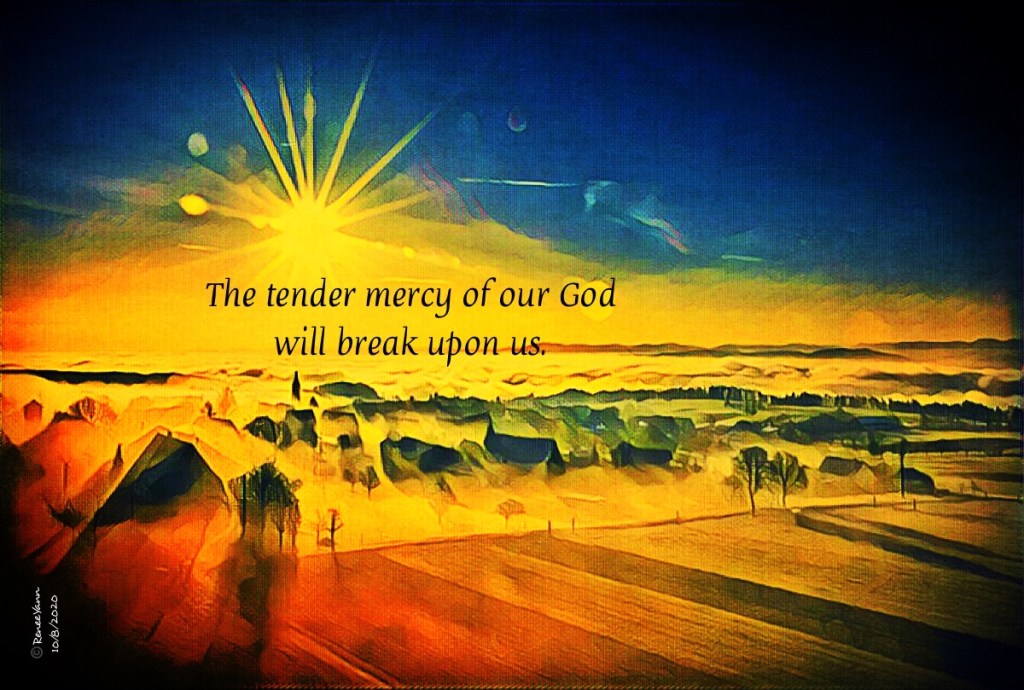
… the tender mercy of our God
by which the daybreak from on high will visit us
to shine on those who sit in darkness and death’s shadow,
to guide our feet into the path of peace.


Pope Francis’s closing prayer in Fratelli Tutti reflects the same hope as his predecessors for that universal Dawn, that rising of Love in our hearts.

O God, Trinity of love,
from the profound communion 
of your divine life, 
pour out upon us a torrent 
of fraternal love.

Grant us the love reflected 
in the actions of Jesus, 
in his family of Nazareth,
and in the early Christian community.

Grant that we Christians 
may live the Gospel, 
discovering Christ in each human being, 
recognizing him crucified
in the sufferings of the abandoned
and forgotten of our world,
and risen in each brother or sister 
who makes a new start.

Come, Holy Spirit, 
show us your beauty, 
reflected in all the peoples of the earth,
so that we may discover anew
that all are important 
and all are necessary, 
different faces of the one humanity
that God so loves. Amen.

Music: A Mass for Peace: Benedictus- Karl Jenkins 

Psalm 25: God’s Will?

Twenty-sixth Sunday in Ordinary Time

September 27, 2020


Today, in God’s Lavish Mercy, we pray with Psalm 25, set perfectly in the midst of a few readings that speak to us about, among other things , “the Father’s Will”.

I think there is no greater spiritual mystery than the meaning of  “God’s Will”, (and not wanting to show up Thomas Aquinas, I’ll resist explaining it here. 😂🧐)

But we’ve all heard attempts at explaining it, haven’t we, especially as it relates to suffering— as in:

  • everything that happens is God’s Will, so we must accept it
  • God wills our suffering to test us
  • if God wills that we suffer, He will give us the strength to endure it

I just don’t think so … not the God I love and Who loves me.

But these attempts to explain suffering are understandable because we want to rationalize the things we fear. Most of us, I think, struggle with the problem of evil and suffering in the world. We want to know what to do when, as Rabbi Kushner wrote, “… Bad Things Happen to Good People”.


Our first reading from Ezekiel shows us that even the ancient peoples met this struggle. The prophet seems to suggest that if you’re bad, you’ll suffer. If you repent, you won’t. Well, we all know that’s not quite the reality! But nice try, Ezekiel.

Our psalm gently leads to another way of facing suffering as the psalmist prays for wisdom, compassion and divine guidance. In the Garden of Gethsemane, Jesus himself prayed like this as he confronted his impending suffering.


In our second reading, Paul places before us the example of Jesus who, in the face of suffering, was transformed by love:

Praying with these readings, each one of us must come to our own peace with the mystery of suffering. What we can be sure of is this: God’s Will is always for our wholeness and joy as so simply taught to us when we were little children:

God made me to know, love, and serve God, 
and to be happy with God in this world and forever.

Our Gospel tells us that such happiness comes through faith and loving service, through responding to “the Father’s Will”.  May we have the insight, the love and the courage!


Poetry: Of Being by Denise Levertov 

I know this happiness
is provisional:

       the looming presences—
       great suffering, great fear—

       withdraw only
       into peripheral vision:

but ineluctable this shimmering
of wind in the blue leaves:

this flood of stillness
widening the lake of sky:

this need to dance,
this need to kneel:

       this mystery:

Music: To You, O Lord (Psalm 25) Graham Kendrick

Psalm 90: So beautiful…

Thursday of the Twenty-fifth Week in Ordinary Time

September 25, 2020


Today, in God’s Lavish Mercy, we pray with Psalm 90 and the hopeful refrain:

Fill us at daybreak with your kindness,
that we may shout for joy and gladness all our days.

For today, I am just going to stay with that verse and with this song that I love. I hope you find it as beautiful as I do.

Poetry: a prose poem I wrote a few years ago:

Each morning, every soul is called 
out of sleep into life, out of darkness into dawn.  
As surely as the flower is kissed by the sun, 
as gently as grass is refreshed by the rain, 
the sparrow is called from its nest; 
the fox from its hollow. 

From the Oriental Sunrise, all across the nations, 
the curtain is drawn back in revelation. 
Every country is slowly illuminated  
– across its seas and deserts, 
plains and mountains, 
wars and peace. 

Across your own soul, 
all your personal geographies awaken, 
lit one by one with the awareness of life. 

Each person whose breath has crossed your life 
– be they lover, friend, sister, 
or the shadow of a stranger 
momentarily passing on a distant afternoon 
– each one, this morning, will be struck like a candle 
by the Morning Spark, by the kindling of God. 
Will they catch fire with their lives? Will you?

We are ignited by God 
to live God’s sacred life in our time. 
We will each unfurl in a vital flame 
or smolder in the embers of our unawareness. 
From the depths of our poverty 
or the shallowness of our wealth, 
it makes no difference. 
It is the same Light. 
We will all be touched. 

What differs are the shadows 
each of us has wrapped about our hearts, 
those deceptive veils where we hide 
from the mercifully incisive brilliance of God. 

What veil might I lay aside today? 
Distraction, worry, vengeance, resentment, 
self-importance, laziness, 
a failure of intention in my choices, 
the enslavement of a toxic relationship?  

At this moment in time, what unveiling 
will allow me to embrace God’s amazing gift of life?

Will I look fully into God’s bright eyes today 
by facing my own heart? 
Will I let God look back at me 
through the hearts of those 
with whom I share this sunrise?   

Psalm 119: A Lamp

Memorial of Saint Pius of Pietrelcina, Priestalso commonly known as Padre Pio.
Padre Pio died during the night of 23 September 1968, at the age of 81. On 16 June 2002, he was proclaimed a saint by Pope John Paul II. In his homily, the Pope said, “The life and mission of Padre Pio prove that difficulties and sorrows, if accepted out of love, are transformed into a privileged way of holiness, which opens onto the horizons of a greater good, known only to the Lord.”

September 23, 2020


Today, in God’s Lavish Mercy, we continue praying with Psalm 119 which, with its 176 verses, is the longest psalm as well as the longest chapter in the Bible. So this could go on forever, right?

Well, it doesn’t. Even though Psalm 119 is used for the Responsorial a total of 22 times during the total liturgical cycle, we won’t see it again for a week or so.

However, the liturgical frequency of this psalm should alert us to the importance of its teachings. Although long and somewhat complex in its acrostic structure, the psalm is direct and simple in its message:

Learn, love and live God’s ways.


Today’s verses liken such pursuit to finding a lamp in the darkness:

Praying with this refrain, we might be able to recall a time we were enveloped in darkness, either material, emotional, or spiritual. Most of us become at least a little frightened by such conditions. We get disoriented. We don’t know if we will be able to find our way out.

The psalmist attests to similar experiences, and voices a confident call on God for deliverance. That confidence grows from the psalmist’s desire and commitment to walk in holy discernment:

From every evil way I withhold my feet,
that I may keep your words.
Through your precepts I gain discernment;
therefore I hate every false way.
Falsehood I hate and abhor;
your law I love.

In this beautiful verse, the psalmist’s confidence is confirmed by God’s faithful endurance:

The law of your mouth is to me more precious
than thousands of gold and silver pieces.
Your word, O LORD, endures forever;
it is firm as the heavens.


Poetry: One, One, One – Rumi

The lamps are different. 
But the Light is the same. 
So many garish lamps in the dying brain's lamp shop, 
Forget about them. 
Concentrate on essence, concentrate on Light. 
In lucid bliss, calmly smoking off its own holy fire, 
The Light streams toward you from all things, 
All people, all possible permutations of good, evil, thought, passion. 

The lamps are different, 
But the Light is the same. 
One matter, one energy, one Light, one Light-mind, 
Endlessly emanating all things. 
One turning and burning diamond, 
One, one, one. 

Ground yourself, strip yourself down, 
To blind loving silence. 
Stay there, until you see 
You are gazing at the Light 
With its own ageless eyes.

Music: Beati Quorem Via – Charles Villiers Stanford, sung by voces 8
The title of this hymn is the first verse of Psalm 119 in Latin. Translation below.

Blessed are they whose road is straight,
who walk in the law of the Lord.

Beati quorum via integra est:
qui ambulant in lege Domini

Psalm 84: The Presence

Friday, September 11, 2020


Today, in God’s Lavish Mercy, we pray with Psalm 84 in which the psalmist expresses great love and longing to dwell in God’s protection.

My soul yearns and pines 
for the courts of the LORD.
My heart and my flesh
cry out for the living God.


The psalm, while it alludes to the Temple as God’s house, offers a broader and deeper understanding of that sacred dwelling place. Psalm 84 describes an abiding so universal that it welcomes even the sparrow into its embrace.

Even the sparrow finds a home,
and the swallow a nest
in which she puts her young—
Your sanctuaries, O LORD of hosts,
my king and my God!


Praying today with this lovely psalm, I focus on my desire to be completely embraced by God – to feel that unquestioning faith, trust, hope and love in all circumstances of my life . This kind of confidence doesn’t come from any temple, building, or church. It comes from the Presence we find WITHIN our “temples”. If that Presence is gone, the “temple”is simply a pile of bricks.


An image rose in my mind of my niece Katelyn when she was about 18 months old. My mother had just died. When my brother and family arrived at Mom’s house shortly after, little Katelyn scurried quickly to the kitchen, my mother’s usual habitat. She wanted that irreplaceable hug from Grandmom. But the kitchen chair was empty. Katelyn touched the chair and, still pre-verbal, looked up at me wondering and confused – much like I was. The kitchen had become a temple without a presence. Neither she nor I were sure where to touch the love that had once been there.

Katelyn’s glance is burned on my memory even now, over 30 years later. I have seen it in so many eyes since then, where lives have been struck with a sadness or tragedy that takes their heart away.


Psalm 84 reminds us that the healing of such bereavements happens in the Heart of God, the immutable Presence holding all our “temples” in its palm.

Blessed they who dwell in Your house!
continually they praise you.
Blessed they whose strength you are!
their hearts are set faithfully upon life’s journey.


We experience all kinds of death, loss, darkness and emptiness in our lives. In those times, how do we touch God’s abiding love? How do we find Light?

Psalm 84 encourages us to be honest with God, to express our longing, to believe God wants our good, and to be sincere in our desire for God’s Presence in our lives.

For a sun and a shield is the LORD God;
grace and glory bestowing;
The LORD withholds no good thing
from those who walk in sincerity. 


Poetry: To Be Held – Linda Hogan

To be held
by the light
was what I wanted,
to be a tree drinking the rain,
no longer parched in this hot land.
To be roots in a tunnel growing
but also to be sheltering the inborn leaves
and the green slide of mineral
down the immense distances
into infinite comfort
and the land here, only clay,
still contains and consumes
the thirsty need
the way a tree always shelters the unborn life
waiting for the healing
after the storm
which has been our life.

Music: Heinrich Schütz set Psalm 84 in the German translation by Martin Luther as part of his Op.2, Psalmen Davids sampt etlichen Moteten und Concerten.

Psalm 24: Vanity, Vanity

Memorial of Saint Gregory the Great, Pope and Doctor of the Church

Thursday, September 3, 2020


Today, in God’s Lavish Mercy, we pray with Psalm 24 which encourages us to be sinless, pure of heart, and humble. And that’s hard!

Who can ascend the mountain of the LORD?
or who may stand in his holy place?
He whose hands are sinless, whose heart is clean,
who desires not what is vain.


Do you remember the song “You’re So Vain”? Here is a reminder.

The song expresses a common understanding of the word “vanity”:

excessive pride in or admiration of one’s own appearance or achievement


We all know people who seem to think they’re hot stuff. Maybe we’re even one of them! But I think that often a person behaving vainly really is quite unsure of himself.

The apparent vanity is a veneer to hide the emptiness inside. It is a veiled fear that, rather than being “all that”, one is really “not enough”.

The word vanity comes from the Latin root vanus which means empty – not “empty” with a readiness to be filled. Instead it connotes an emptiness that rattles with accumulated pretenses and falsehoods. It is a place of loud but lonely echoes.


Paul addresses this kind of emptiness when he writes to the Corinthians. He tells them not to get caught up in the contest of human vanity because we already are sufficient in God’s love and grace. Everything important is already ours in Christ, in God.

So let no one boast about human beings, for everything belongs to you,
Paul or Apollos or Cephas,
or the world or life or death,
or the present or the future:
all belong to you, and you to Christ, and Christ to God.


Psalm 24 assures us that to participate in this blessing, to be embraced by God’s favor only this is sufficient:

Who can stand in God’s holy place?
The clean of hand and pure of heart,
who have not given their soul to useless things,
to what is vain.
They will receive blessings from the LORD,
and justice from their saving God.


Poetry: Vanity by George Herbert

The fleet astronomer can bore 
And thread the spheres with his quick-piercing mind: 
He views their stations, walks from door to door, 
         Surveys, as if he had designed 
To make a purchase there; he sees their dances, 
                   And knoweth long before 
Both their full-eyes aspècts, and secret glances. 
         
         The nimble diver with his side 
Cuts through the working waves, that he may fetch 
His dearly-earnèd pearl, which God did hide 
         On purpose from the venturous wretch; 
That he might save his life, and also hers 
                   Who with excessive pride 
Her own destruction and his danger wears. 
         
         The subtle chymic can divest 
And strip the creature naked, till he find 
The callow principles within their nest: 
         There he imparts to them his mind, 
Admitted to their bed-chamber, before 
                   They appear trim and dressed 
To ordinary suitors at the door. 
         
       What hath not man sought out and found, 
But his dear God? who yet his glorious law 
Embosoms in us, mellowing the ground 
         With showers and frosts, with love and awe, 
So that we need not say, “Where’s this command?” 
                   Poor man, thou searchest round 
To find out death, but missest life at hand.

Song: As We Seek Your Face – Divine Hymns

Psalm 33: Fashioned by God

Wednesday of the Twenty-second Week in Ordinary Time

Wednesday, September 2, 2020


Today, in God’s Lavish Mercy, we pray again with Psalm 33, this time with one different verse from a few days ago:

From heaven’s fixed throne God beholds
all who dwell on the earth,
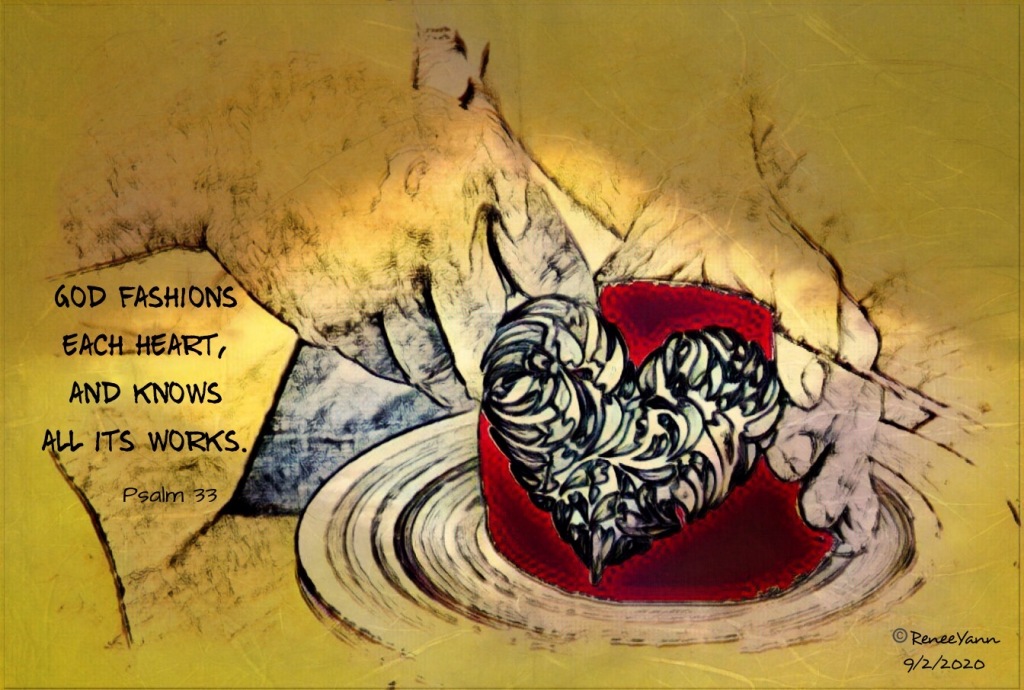
God Who fashions each heart
and knows all its works.

Think of that: God fashions each heart.

The phrase has special meaning for me today because, yesterday, we welcomed a precious new baby girl into our family.

I look at her newborn innocence and realize that she is the freshest, most hopeful breath of God, still so wrapped in the heavenly air from Whom we all receive life.


We all received that Breath once and it lives eternally within us. Every one of us has received a heart fashioned in God’s own image.

Sometimes that reality is hard to believe about ourselves and others, as it seems to have been for the Corinthians in today’s first reading. Sometimes we make a real mess of the gift we have been given!

Nevertheless, the gift is true and remains true despite our worst efforts!😉


Reflecting on today’s Gospel, there may be “various diseases” and dysfunctions that we wish to bring to the healing hands of Jesus today – for ourselves and for our world. We ask God to restore our innocence and hope throughout our lives and world.

In order to remember and live within the sacred truth that God breathed us into being, we might repeat today’s psalm refrain throughout our day:

Blessed are we, chosen to be God’s own.


Poetry: Two poems today to bless our dear new child Claire:

Songs of Innocence - William Blake
Little Lamb who made thee
Dost thou know who made thee
Gave thee life & bid thee feed.
By the stream & o’er the mead;
Gave thee clothing of delight,
Softest clothing wooly bright;
Gave thee such a tender voice,
Making all the vales rejoice!
Little Lamb who made thee?
Dost thou know who made thee?

Little Lamb, I’ll tell thee; 
Little Lamb, I’ll tell thee:
He is called by thy name, 
For He calls Himself a Lamb 
He is meek, and He is mild, 
He became a little child.
I a child, and thou a lamb, 
We are called by His name. 
Little Lamb, God bless thee! 
Little Lamb, God bless thee!


Christina Rossetti - Holy Innocents
Sleep, little baby, sleep;
The holy Angels love thee,
And guard thy bed, and keep
A blessed watch above thee.
No spirit can come near
Nor evil beast to harm thee:
Sleep, sweet, devoid of fear
Where nothing need alarm thee.
The love which doth not sleep,
The eternal Arms around thee:
The shepherd of the sheep
In perfect love hath found thee.
Sleep through the holy night,
Christ-kept from snare and sorrow,
Until thou wake to light
And love and warmth to-morrow.

Music: Innocence – Roberto Cacciapaglia

Psalm 113: Awesome!

Wednesday of the Nineteenth Week in Ordinary Time

August 12, 2020

Today, in God’s Lavish Mercy, we pray with Psalm 113, a magnificent hymn praising God in the heavens. 

The psalm is commonly used at Vespers, the evening prayer of the Church – and no wonder. How often in the evening do we look to the glorious skies, emblazoned with the setting sun, and turn our minds to God!

Who is like the LORD, our God, who is enthroned on high,
and looks upon the heavens and the earth below?


It is in contemplating the sky’s immensity that we begin to appreciate the Divine Infinity.


Last night, I FaceTimed with my niece and her toddler boy, a joy she frequently offers me. During the call, my grandnephew carried his little tablet to the window, opened his “SkyView” app, and began exploring the heavens. Even the youngest “pueri” (Latin for “boys, children, servants”) spontaneously offer our Vespers in answer to God’s Beauty!


As we pray this psalm, at whatever time of day, we can let ourselves rest in silent awe, aware of God’s majesty – that Majesty which deigns to create, love and eternally sustain each one of us beloved “pueri”.


Poetry: Stars by Majorie Pickthall

Photo by Ruvim on Pexels.com
Now in the West the slender moon lies low, 
And now Orion glimmers through the trees, 
Clearing the earth with even pace and slow, 
And now the stately-moving Pleiades, 
In that soft infinite darkness overhead 
Hang jewel-wise upon a silver thread. 
And all the lonelier stars that have their place, 
Calm lamps within the distant southern sky, 
And planet-dust upon the edge of space, 
Look down upon the fretful world, and I 
Look up to outer vastness unafraid 
And see the stars which sang when earth was made. 

Music: Laudate Pueri – Claudio Monteverdi

Laudate, pueri, Dominum; 
laudate nomen Domini.
Sit nomen Domini benedictum 
ex hoc nunc et usque in saeculum.
A solis ortu usque ad occasum 
laudabile nomen Domini.
Excelsus super omnes gentes Dominus, 
et super caelos gloria ejus.
Quis sicut Dominus Deus noster, 
qui in altis habitat, 
et humilia respicit in caelo et in terra?
Suscitans a terra inopem, 
et de stercore erigens pauperem:
ut collocet eum cum principibus, 
cum principibus populi sui.
Qui habitare facit sterilem in domo, 
matrem filiorum laetantem.

Psalm 36: Whew!

Thursday of the Sixteenth Week in Ordinary Time

July 23, 2020

From 2016:
Today, in Mercy, we pray to be childlike. As life seasons us, it also sometimes hardens us with an impermeability that prevents continued spiritual growth. We pray for the gifts of trust, hope and faith to return our hearts to the openness of a child that we may respond joyfully to the Holy Spirit.


Today, in God’s Lavish Mercy, we pray with Psalm 36, a praise hymn of David after a frightening encounter with an enemy.

I could have used this psalm last week. Someone immensely dear to me was hospitalized with suspicion of Covid 19. The fear, for him and for all who love him, was pretty overwhelming.

I did manage a prayer of abandonment before the negative diagnosis was returned about 36 hours later. But I’m rather sure that, like most of my attempts at abandonment, it was somewhat half-hearted. I really wanted my own will and hoped God’s Will was in alignment. Blessedly, it was.

But I would like to deepen in true trust and abandonment to God’s care for me and for all of us.


Psalm 36 gives us a chance to examine David’s prayer of abandonment, which drawing on a long history of God’s wisdom and favor, deeply trusts himself to God.

In our prayer today, we might recall God’s faithful care throughout our lives and release into God’s hands any worries we carry. Let us simply receive that infinite, refreshing fountain of grace pouring over all Creation.

Fountain of Life stained glass window at the Church of St. Maria del Mar in Barcelona,  copyright José Luíz Bernardes Ribeiro, https://creativecommons.org/licenses/by-sa/3.0/

Poetry:  Fountains in the sea by Marin Sorescu, translated by Seamus Heaney

Sorescu was a Romanian poet and playwright and one of the most popular figures to emerge from Romanian literary culture since the 1960s. He died in 1996, the year he was nominated for the Nobel Prize in Literature

Seamus Heaney, who died in 2013, was an Irish poet, playwright and translator. He received the 1995 Nobel Prize in Literature.

Fountains in the sea

Water: no matter how much, there is still not enough.
Cunning life keeps asking for more and then a drop more.
Our ankles are weighted with lead, we delve under the wave.
We bend to our spades, we survive the force of the gusher.

Our bodies fountain with sweat in the deeps of the sea,
Our forehead aches and holds like a sunken prow.
We are out of breath, divining the heart of the geyser,
Constellations are bobbing like corks above on the swell.

Earth is a waterwheel, the buckets go up and go down,
But to keep the whole aqueous architecture standing its ground
We must make a ring with our bodies and dance out a round
On the dreamt eye of water, the dreamt eye of water, the dreamt eye of water.

Water: no matter how much, there is still not enough.
Come rain, come thunder, come deluged dams washed away,
Our thirst is unquenchable. A cloud in the water’s a siren.
We become two shades, deliquescent, drowning in song.

My love, under the tall sky of hope
Our love and our love alone
Keeps dowsing for water.
Sinking the well of each other, digging together.
Each one the other’s phantom limb in the sea.

Music: Your Love, Oh Lord – Third Day