Deep Law of the Heart

Sixth Sunday in Ordinary Time

February 16, 2020

Click here for readings

Ps119 Law


Today, in Mercy, our readings are all about LAW.

It’s a word we hear a lot about today, isn’t it? 

  • Rule of Law. 
  • Breaking the Law. 
  • Immigration Law.
  • Mother-in-Law.

You name it, LAW is all around us. So we should already know all about what today’s scripture passages describe – right?

Not really. 

230-2303502_law-clipart-law-and-order-clip-art.png


The “law” we are accustomed to discussing is about agreements constructed by human beings – some of those “agreements” better than others. They are interpreted, stretched, amended, honored, ignored, bypassed, and dissolved by human beings as well.

Sometimes, we equate these “laws” with justice which, at their best, we hope they are. But the LAW of today’s readings is above and beyond these humanly defined agreements. 


This LAW emanates from God. It is pure, whole, complete and holy. It is derived from the perfect nature of God which is, at once, both justice and mercy.

Sirach invites us to thrive in the perfection of God’s Law:

If you choose you can keep the commandments,
they will save you;

if you trust in God, you too shall live.

Paul tells the Corinthians that those “mature” in grace are able to receive the mystery of this Divine Law.

We speak a wisdom to those who are mature,
not a wisdom of this age,
nor of the rulers of this age who are passing away.

It is a “mysterious and hidden” Wisdom which the rulers/law makers of Paul’s age did not understand. Because when the Perfect Law became flesh in Jesus Christ, they could not comprehend him.


In our Gospel, Jesus is very clear. He is the fulfillment, not the abolishment of the Law. To live truly within that fulfillment, his disciples must go the extra mile – that is, they must infuse their practice of law/justice with the essence of Love and Mercy.


soup

In the five years since I retired, I’ve gotten pretty good at making soup. When I’m a little lazy, I use a commercial stock for my broth. But when I want to make a soup extra special – truly my own – I make my own bone broth. It makes all the difference.


I think growing in our understanding of God’s Law is a little bit like that. It is the “perfect broth” that requires us to put our whole hearts into it. When we consume it, we are nourished, sustained, changed.

Paul says that we can’t even imagine the “broth” God has prepared for us when we live, delight, and become transformed in God’s Law:

Eye has not seen, and ear has not heard,
and what has not entered the human heart,
what God has prepared for those who love him,

Music:  Eye HAs Not Seen – Marty Haugen

Shine!

Fifth Sunday in Ordinary Time

February 9, 2020

Click here for readings

Today, in Mercy, our readings are threaded on a theme of light, justice, and healing.

Is58_8wound

Isaiah writes to a formerly exiled community trying to restore itself after returning to Jerusalem. Tensions, meanness, and dissatisfactions tear at the community. Focus on religious rituals becomes excessive while communitarian practices are ignored.

It is a sad and fractious time for Israel.

Isaiah tells them they are missing the whole point.  The path to healing their national soul is not through empty religious words and practices.

If you remove from your midst
oppression, false accusation and malicious speech;
if you bestow your bread on the hungry
and satisfy the afflicted;
then light shall rise for you in the darkness,
and the gloom shall become for you like midday.


In our second reading, Paul writes to the Corinthian community similarly disturbed. He reminds the Corinthians that he came to build Christian community among them humbly and open to the Holy Spirit. Like Isaiah in the first reading, Paul now reminds his community not to miss the point:

I came to you in weakness …
so that your faith might rest
not on human wisdom

but on the power of God.


Jesus tells his disciples to let that power of God shine in them by virtue of their good deeds — the very same deeds Isaiah recommends to his listeners:

Share your bread with the hungry,
shelter the oppressed and the homeless;
clothe the naked when you see them,
and do not turn your back on your own.


In sum, our readings caution us that failures in charity and mercy wound us, both as individuals and as a community. Meanness kills – not only its object, but its subject as well.

When we remove all meanness from our actions, the Light shines, healing all our wounds.

Music:  Let Your Light Shine – Mike Balhoff and Darryl Ducote

Eulogy

Friday of the Fourth Week in Ordinary Time

February 7, 2020

Click here for readings

Today, in Mercy, Sirach gives us a beautiful eulogy for King David.

A eulogy sets a particular frame of remembrance around a person’s life. Like Sirach today, that frame tries to capture the positive accomplishments of the person who has died. We set aside any mistakes and negativity. Or we acknowledge them as Sirach has done for David by invoking God’s forgiveness:

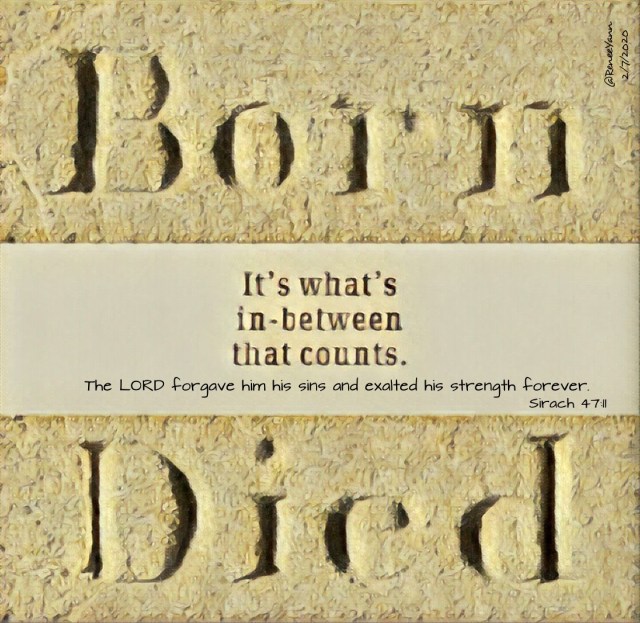
The LORD forgave him his sins
and exalted his strength forever.


To tell the truth, I’ve attended a few funerals where I wondered what the speaker might come up with in a positive regard. You know, you need more than a sentence or two for a decent eulogy! Despite my wondering, every tribute has provided an enriching lesson on the sacred beauty of a human life.

Sir47_1 eulogy

There are times when I leave such a life celebration thinking, “Gosh, I never realized that about him!” or “Wow, there are so many things we don’t understand about someone’s life!” 

If only we could treat every living person with the same honor their eulogies inspire!


In our Gospel, we read the sad and violent story of John the Baptist’s martyrdom. It’s a passage filled with the best and the worst of the human heart. One would wonder what kind of eulogy could have eventually been crafted for the likes of Herod, Herodias, and Salome.

But for John the Baptist, Jesus had given him the perfect epitaph even before John died.

I say to you, among those born of women
there is no one greater than John;

In the verse, Jesus also reveals what it takes to earn greatest accolade in God’s eyes:

… yet the one who is least in the kingdom of God
is greater than John.

Luke 7:28


When Jesus spoke that verse, John had not yet died. If Jesus said anything about John after his death, the words are not recorded. All we have is this poignant response from Matthew:

Later, John’s disciples came for his body and buried it.
Then they went and told Jesus what had happened.
As soon as Jesus heard the news,
he left in a boat to a remote area to be alone.
But the crowds heard where he was headed
and followed on foot from many towns.
Jesus saw the huge crowd as he stepped from the boat,
and he had compassion on them and healed their sick.
Matthew 14: 12-14


As we pray today with the legacies of David and the Baptist, we might consider what we’d want to see engraved on our own tombstones. I’ve told my friends I’d like to see this:

She was kind.

Still working on it!😉

What about you?

Music: Lay Me Down – in this song, two icons of country music, Loretta Lynn and Willie Nelson sing their own kind of eulogy. (Lyrics below)

Lay Me Down
I raised my head and set myself
In the eye of the storm, in the belly of a whale
My spirit stood on solid ground
I’ll be at peace when they lay me down
When I was a child, I cried
Until my needs were satisfied
My needs have grown up, pound for pound
I’ll be at peace when they lay me down
When they lay me down someday
My soul will rise, then fly away
This old world will turn around
I’ll be at peace when they lay me down
This life isn’t fair, it seems
It’s filled with tears and broken dreams
There are no tears where I am bound
And I’ll be at peace when they lay me down
When they lay me down some day
My soul will rise, then fly away
This old world will turn around
I’ll be at peace when they lay down
When they lay me down some day
My soul will rise and fly away
This old world will turn around
I’ll be at peace when they lay me down
When I was a child, I cried

Mercy Surrounds Us

Memorial of Saint Agatha, virgin and martyr

February 5, 2020

Click here for today’s readings

Today, in Mercy, David gets himself in trouble once again.

In the later years of his kingship, David is pretty impressed with himself. The kingdom has grown exponentially. There is peace and prosperity. David wants a census taken so that he can assess his capacity for new expansion.

So why does God get so mad about this census? The Book of Exodus sets out that a person has the right to number only his own belongings. The People belong to God, not to David. David’s pride and self-satisfaction has taken him over.

Ps32_deep waters

However, as usual, David repents. This is probably the best lesson we can learn from him. Then, in a greatly allegorized treatment, God gives David a choice of three punishments.


Passages like this can confuse us if we interpret them literally. Does God really interact and punish like this? 

It helps to remember the purpose of these writings — not to relay a factual history, but rather to tell a story that helps us grow in relationship with God.

What I believe happened here is that a pestilence did fall upon the country. At the same time, David realized that his heart had grown selfish and graceless. He took the natural event as a sign to turn back to God. And then the writers told the story in a way that the ancient peoples could relate to – with a God that forgives but gets even.


In our Gospel, Jesus preaches another vision of God – a vision of Complete Mercy, especially toward the vulnerable, weak, and sinful. That pretty much includes all of us.

Jesus releases the power of this Divine Mercy by his words and miracles. But his own family and neighbors reject him. They are more comfortable with a God who behaves like they do – meting out more judgement and punishment (preferably toward others!😉) than mercy and inclusive benediction.

In this Gospel, we begin to see Jesus as One who asks not only for repentance but for conversion – for a new way of being with God and neighbor, the way of Love.

How might we have responded had we been in that neighborhood synagogue? How are we responding today?

Music: Today’s Responsorial Psalm 32 – Marty Goetz ( Lyrics below)

Psalm 32 – Marty Goetz

These are periled times we live in, trouble everywhere
Weary hearts will often give in to this world’s despair
But high and over all, our Father knows our every care
And in His Book, if you will look, you’ll find His promise there

(Chorus)
He who trusts in the Lord
Mercy shall surround him
He who trusts in the Lord
Mercy shall surround him
Be glad in the Lord and rejoice
You upright in heart, lift up your voice
For great is His mercy toward all who trust in the Lord

Soon will be the time when we will see the Holy One
Oh how sweet to know that He’ll complete what He’s begun
And blessed is the man who stands forgiven in God’s son
And blessed are they who in that day will hear Him say, “Well done”

(Chorus)

Gracious is He and slow to anger
His loving kindness has no end
With love to embrace both friend and stranger
Reaching out to one and all, who upon His name will call

(Chorus)

Mercy is His reward
For all who trust, for the pure and just
Who put their trust in the Lord
For all who trust for the pure and just who put their trust in the Lord

Outrageous Grace

Monday of the Fourth Week in Ordinary Time

February 3, 2020

Click here for readings

Today, in Mercy, we have two highly dramatic passages. If there were an Oscar category for “Best Biblical Drama”, these stories would definitely be nominees!

In our ongoing “David Saga”, the troubled king flees Jerusalem because his own son Absalom is plotting to overthrow him. David, at this point in time, is humbled and not a little wearied by the theatrics of his life. His sins continue to haunt him and wreak a recompense. 


dirt thrower
Shimei curses David by Julius Schnorr von Karolsfeld

In today’s passage, we meet Shimei who has his own little miniseries going on in the Bible. Shimei is part of Saul’s family and holds David responsible for Saul’s demise. When meeting David in this passage, Shimei dangerously, and we might say stupidly, sets on him, throwing dirt and stones at the King. David prevents the troops from responding to the wildly outraged man. David even suggests that God may be trying to teach David something in the attack.


In our Gospel, we meet another wildly outraged man. This one is tormented by his inner demons, causing him also to put himself in dangerous situations. Jesus names this man’s tormentor and casts it out, giving the man control of himself again.


Have you ever been so offended, humiliated or injured that you felt outrage for yourself or another? Such fury chains us, making rationality and reconciliation close to impossible. Sometimes, it renders us impotent to name and address the deep source of our indignation. Instead, we lash out with stones of anger and hate – throwing the dirt of condemnation rather than seeking inner balance and healing.

dementor

Most of us have encountered large or small “dementors” in our life. (Thanks for the term AND the image, Harry Potter) 


But when I think of those who have endured unbelievable degrees of torment, I am amazed at their stories of faith and resolution: Anne Frank, Victor Frankel, Nelson Mandela, Harriet Tubman …. Jesus Christ. How did they come through it whole and blessed?


Mk5_1_20demoniac

Maybe the possessed man in Mark’s Gospel was just lucky that day to run into Jesus. Or maybe he sought out Christ, trying to find stability in the midst of his derangement.

When we face our own imbalances can we stay still long enough to ask, as David did, “What is God teaching me in this. How can this lead me closer to God?” If we could, might we not be surprised to see our demons named, cast into the greater sea of God’s eternal wisdom, peace and love?

Music: Amazing Grace – Sean Clive

God loves …. always!

Saturday of the Third Week in Ordinary Time

February 1, 2020

Click here for readings

Today, in Mercy, David gets his comeuppance after his sinful forays.

david weeps
David Weeps – wikipedia.org – not for commercial use

The passage is hard to deal with. It suggests that God is vengeful, and gets us back for going against him. That’s not the God Who loves me.

Like much of the Old Testament, the writer is interpreting the circumstances of life in order to teach a lesson. The lesson here is not that God is a payback God. The core lesson is that our choices have repercussions, and should always be made in the light of God’s hope for us.

Sometimes in our own lives, we think of God as reacting in a human way to us – getting angry, forgetting us, paying us back, testing us, punishing us. Like the disciples in today’s storm-tossed boat, our faith is weak and maybe misdirected.

God is Love, and Love only. God is NEVER “I’ll getcha’ “. Deep faith directs us to find God’s love – God’s continuing call to intimacy – in every circumstance of our lives. 

God didn’t kill David’s illegitimate son. It just happened, the way so much of life happens. We can blame God if we want to, but we’re missing the point. 

The point is that God is with us in the inevitable joys and sorrows of our lives saying, as he did to his distraught shipmates:

“Why are you terrified?
Do you not yet have faith?”

Ps51

Our Gospel assures us that God is with us, “sleeping” even in our rocky boat. By faith and prayer, we “wake God”, as we actually wake ourselves to the truth of God’s immutable, loving Presence in our lives.

Music:  You Raise Me Up – Selah

Home

Wednesday of the Third Week in Ordinary Time

January 29, 2020

Click here for readings

Today, in Mercy, our readings are about being at home with God.

home

In our passage from 2 Samuel, a highly anthropomorphized God informs David that He is sick of living in a tent while being carried to and fro. God goes on to recount for David all that God has done for him, demonstrating that David can fully trust God. 

God wants a home. In other words, it’s time to make a permanent commitment and “move in together” into each other’s hearts.


sowerIn today’s Gospel, we find the familiar story of the Sower and the Seed. While the story doesn’t specifically mention “home”, Jesus indicates that only those “at home” with God’s Word will understand the true meaning of the parables.

You may have had the joy of visiting friends who greet you with the invitation, “Make yourself at home”. These friends will have done everything they can to make that possible – clean house, fresh bed linens, your brand of coffee, your favorite meals. They want you to be completely comfortable for your stay.

Well, God wants to stay forever within us. And God wants us to stay forever in God. That mutuality of homecoming is the whole purpose of our lives.

We know how to create this sacred hospitality for our friends. Let today’s reading remind us to do this for God as well by:

  • “learning” God within the Sacred Word of scripture
  • joy and awe at God’s desire to be with us
  • attention to those tendernesses that invite and welcome God
  • continual gratitude for God’s Presence
  • delighting God by our acts of love and hospitality

Music: Welcome to My Heart – Dean Martin
(Even though the song was not directed toward God, it works for me. I hope it does for you too.)

Redeemed!

Third Sunday in Ordinary Time

January 26, 2020

Click here for readings

Today, in Mercy, our readings are all about redemption… and what a free and glorious gift it is.

How thrilling are these verses?

Anguish has taken wing, dispelled is darkness:
for there is no gloom where but now there was distress.
The people who walked in darkness
have seen a great light;
upon those who dwelt in the land of gloom
a light has shone.

When I read them, I so much want to meet Isaiah, to get him to sign my Bible, to come to my house for soup and bread! Because he is filled with hope and exultation at the Mercy of God, just like I want my life to be!

IMG_2297

Paul, sensing some jealous competition in his Corinthian buddies, tells them  — Get a grip! You are obsessing over incidentals when we have been redeemed and made one in the Passion, Death, and Resurrection of Jesus Christ!

Then, when I read these beautiful, lilting lines in the Gospel …

He left Nazareth and went to live in Capernaum by the sea,
in the region of Zebulun and Naphtali,
that what had been said through Isaiah the prophet
might be fulfilled:

Land of Zebulun and land of Naphtali,
the way to the sea, beyond the Jordan,
Galilee of the Gentiles,
the people who sit in darkness have seen a great light,
on those dwelling in a land overshadowed by death
light has arisen.

…I so want to go live with Jesus too, right there on Capernaum’s shores, because he was the very House of Mercy inviting us all to dwell anew in him. 

Jesus is the Living Redemption prophesied by Isaiah. He is the reason Paul turned his life upside down. Jesus is the Great Light in our darkness.

Praise and thank our Generous God!

Music: Streets of Capernaum – Clay Crosse

God Gets Tough

Feast of the Conversion of Saint Paul, Apostle

January 25, 2020

Click here for today’s readings

Today, in Mercy, we ride with Paul on the road to Damascus, there to be struck with him by a Godly Light.

800px-La_conversión_de_san_Pablo_(Murillo)
The Conversion of St. Paul — Bartolomé Esteban Murillo

Have you ever been knocked off your “high horse” by the sudden realization of something to which you had been totally blind? It’s shocking, isn’t it? 

We might react by castigating ourselves with remarks like:

  • How could I have missed that?
  • Wow, I was really stupid, or foolish, or naïve, or prejudiced, or misled, or … or what?

God, in a kind of ironic twist, strikes Paul blind in order to cure him of his real blindness: the right he claimed to persecute others for a faith he didn’t understand.

Sometimes God has to be pretty tough with us to wake us up to the truth of our souls. John Donne, the pre-eminent English metaphysical poet, prayed for that kind of Divine Toughness in his poem Batter my heart, three-personed God.

png-divider-lines--1400

Since I have blogged twice previously about this feast,


Links available here:

Click here for 1/24/2019 Reflection

Click here for 4/19/2018 Reflection


I thought my readers might like to pray with Donne’s poem, read by Tom O’Bedlam

Holy Sonnets: Batter my heart, three-person’d God
Batter my heart, three-person’d God, for you
As yet but knock, breathe, shine, and seek to mend;
That I may rise and stand, o’erthrow me, and bend
Your force to break, blow, burn, and make me new.
I, like an usurp’d town to another due,
Labor to admit you, but oh, to no end;
Reason, your viceroy in me, me should defend,
But is captiv’d, and proves weak or untrue.
Yet dearly I love you, and would be lov’d fain,
But am betroth’d unto your enemy;
Divorce me, untie or break that knot again,
Take me to you, imprison me, for I,
Except you enthrall me, never shall be free,
Nor ever chaste, except you ravish me.

Here also is a musical interpretation of the poem.
The University of South Florida Chamber Singers perform Richard Nance’s “Batter my heart” under the direction of Dr. James Bass 

The Green-Eyed Monster

Thursday of the Second Week in Ordinary Time

January 23, 2020

Click here for readings

Today, in Mercy, both David and Jesus deal with the effects of immense popularity.

jealous

In David’s case, Saul is so jealous and threatened by David’s military success that he plots to murder him. Saul’s son Jonathan, David’s dear friend intervenes to turn his father’s evil intention. Ultimately though, Saul remains a man destroyed by jealousy.


green eye

Jealousy is aptly characterized as the “Green-Eyed Monster”:

The phrase ‘green-eyed jealousy’ was used by, and possibly coined by, Shakespeare to denote jealousy, in The Merchant of Venice, 1596.

In Othello, 1604, Shakespeare refers explicitly to the ‘green-eyed monster’ as jealousy when treacherous Iago counsels Othello:

O, beware, my lord, of jealousy;
It is the green-eyed monster which doth mock
The meat it feeds on; that cuckold lives in bliss
Who, certain of his fate, loves not his wronger;
But, O, what damned minutes tells he o’er
Who dotes, yet doubts, suspects, yet strongly loves!


These powerful words capture what it is like to feel, or to be the object of, jealousy – a feeling which grows out of one’s own insecurity. But since it is a feeling, it is not a sin. It is when we act on our jealousy, as Saul planned to do, that we sin.

I think, at sometime in our lives, most of us have experienced jealousy- either as donor or recipient. How we responded either fortified or eroded our character. Sincere reflection on those responses can continue to help us grow in charity.

Thinking about that, I benefitted from reading this passage from the Catholic Encyclopedia:

Jealousy is here taken to be synonymous with envy. It is defined to be a sorrow which one entertains at another’s well-being because of a view that one’s own excellence is in consequence lessened. Its distinctive malice comes from the opposition it implies to the supreme virtue of charity. The law of love constrains us to rejoice rather than to be distressed at the good fortune of our neighbor.

Our daily prayer and ever-deepening relationship with God can free us to face any “green-eyed monsters” we encounter, turning them into occasions of grace. Let’s pray for that!

Music:  Envy and Jealousy – Sweet Comfort Band (Lyrics below)