The Stars Will Teach Us

Wednesday of the Twelfth Week in Ordinary Time

June 26, 2019

Click here for readings

Today, in Mercy, our reading from Genesis invites us further into the gift of our faith.

We see God break into Abram’s life through a vision.

“Fear not!”, God says.
I am your shield;
I will make your reward very great.”

So Abram must have been a little frightened when God decided to visit him here. But why?

What Abram was nervous about was this: despite God’s earlier promise to him, Abram and Sarai were still childless – barren. In fact, he was so concerned that God would not prove true to the promise, that he was making plans about his own future without God’s help.

… if I keep on being childless
(I will) have as my heir
the steward of my house, Eliezer…

Abram was a very practical guy. His newly-sprouted faith expected practical, even instant results. It would take some time for Abraham to grow into a faith rooted in relationship rather than signs; to realize that faithful relationship is for the long run, not the immediate answer.

Gen15_5_stars

God helps Abram to understand this long, deep view.

God took him outside and said:
“Look up at the sky and count the stars, if you can.
Just so,” he added, “shall your descendants be.”

Abram looked at these stars, made and sustained by God’s hand. He saw that this God Who was inviting him to relationship was beyond time, beyond numbering, beyond human definitions – boundless in life, mercy and love. And so, letting go of his need for concreteness and Immediacy,

Abram put his faith in the LORD,
who credited it to him
as an act of righteousness.

Today’s scripture may lead us consider our own relationship with God, God’s promise in our life, how we are being drawn beyond our limited expectations. Is there a place of barrenness, an unmet need, a broken expectation shaking our heart or spirit? Let’s ask to abandon all these things to God’s love.

We might even want “to go outside” ourselves, literally or figuratively, asking God to teach us how God’s Presence in our life is infinite, even beyond the stars – if we have a faithful heart to see.

Music: Beyond the Moon and Stars – Dan Schutte 

Will We Live Our Faith Out Loud?

Tuesday of the Twelfth Week in Ordinary Time

June 25, 2019

Click here for readings

Today, in Mercy, we begin several weeks of readings from the Book of Genesis. 

Some people think of Genesis as a literal history. Others think of it more as a myth. Was there a real Adam and Eve? A real apple? A real snake?

When we get caught up in these ambivalences about Genesis, we are likely to miss the whole point. And the whole point, according to Hebrew Scripture scholar Walter Brueggemann is this:

… these texts should be taken neither as history nor as myth.
Rather, we insist that the text is a proclamation
of God’s decisive dealings with his creation. 


“God’s decisive dealings with God’s Creation…”

What a powerful phrase! So over the next few weeks, here is our opportunity:

How does God want to be with us,
to love us,
and to share the ongoing Creation with us?


Today’s reading, according to Brueggemann, is the second part of a four-part drama:

Genesis 11: 30—25: 18 “The Embraced Call of God”
Will Abraham live by faith? 

This second segment poses a profound question to us, and to our Church:
Have we embraced God’s call in our lives and will we live our faith OUT LOUD!

Jesus asks us the same question in today’s Gospel: Will we live our faith OUT LOUD?


Will we:
“Do to others whatever you would have them do to you.”

cage

How to help children at the border and in inhuman detention centers:

Click here.


Music: By Faith -Keith and Kristyn Getty

The Baptist: A Life for God

Solemnity of the Nativity of Saint John the Baptist 

June 24, 2019

Click here for readings

Today, in Mercy, we celebrate one of the greatest figures of the Bible, John the Baptist. He prepared the way for the Lord.

John the Baptist
Icon of St. John the Baptist (16th c.) Dionysiou Monastery

When I think of John’s role in Salvation History, I am reminded of a captivating poem by Geoffrey Brown, author of Road of the Heart Cave:

The Heart Cave

I must remember

To go down to the heart cave
& sweep it clean; make it warm
with a fire on the hearth,
& candles in their niches,
the pictures on the walls
       glowing with a quiet light.
       I must remember

To go down to the heart cave
       & make the bed
with the quilt from home,
strew
the rushes on the floor
hang
lavender and sage
         from the corners.
         I must go down

                                           To the heart cave & be there
                                           when You come.


John the Baptist went down to the heart cave of our human perception of God.  He understood, in an inexpressible way, that God was about to do something astounding in human history.  God was about to become part of it!

John understood this with unquestioning faith, the way we understand heaven but cannot rationalize it. Understanding it, he knew that the world needed to turn itself toward God – to repent – in radical and ardent expectation.

This was his call and his message – this extraordinary man, dressed in his camel hair vestments, preaching at the desert’s edge.

We might pray to John today to be turned from anything that distracts us from God, to long for God’s presence in our hearts and in our world, to love deeply and make a welcome home for Christ within us.

( On this Feast, 53 years ago, my entrance companions and I professed our vows. I think of all of them with love today. May I humbly ask you, dear readers, to join me in prayer for us as we thank God for the gift of our lives in Mercy.)

Music: Apolytikion of the Synaxis of St. John the Baptist ( Dismissal Hymn of the Assembly for St. John the Baptist from the Greek Liturgy)

The Ultimate Gift

The Solemnity of the Most Holy Body and Blood of Christ

Sunday, June 23, 2019

Click here for readings

Today, in Mercy, we celebrate a glorious feast, one through which we can trace the continuing evolution of Eucharistic theology.

CorpusJPG

Some of us will remember celebrating the Feast of Corpus Christi, perhaps as children. The Host, carried in a beautiful monstrance, was processed through the neighborhood, bringing blessing to all who gathered.

process
Where did they get all those men!!!!

While a rare occurrence today, and considered by some a saccharine expression of devotionalism, the practice was intended to convey a central belief of our faith. It is a belief whose theology continues to evolve and deepen with the passing years:

In the gift of Eucharist,
Jesus Christ has made us
one Body with Him.
We are One Body in Christ.


A significant step in the evolution of this theology occured with the issuing of the encyclical MYSTICI CORPORIS CHRISTI ( Pope Pius XII, 1943). In this letter, we see a theology beginning to unfold to include not only Christ’s presence on the altar and in the Host, but in the very lives of the faithful.

The Sacrament of the Eucharist is itself a striking and wonderful figure of the unity of the Church, if we consider how in the bread to be consecrated many grains go to form one whole,and that in it the very Author of supernatural grace is given to us, so that through Him we may receive the spirit of charity in which we are bidden to live now no longer our own life but the life of Christ, and to love the Redeemer Himself in all the members of His social Body.


In his encyclical, ECCLESIA DE EUCHARISTIA (2003), Pope John Paul II, expands this teaching:

By the gift of the Holy Spirit at Pentecost the Church was born and set out upon the pathways of the world, yet a decisive moment in her taking shape was certainly the institution of the Eucharist in the Upper Room. Her foundation and wellspring is the whole Triduum paschale, but this is as it were gathered up, foreshadowed and “concentrated’ for ever in the gift of the Eucharist. In this gift Jesus Christ entrusted to his Church the perennial making present of the paschal mystery. With it he brought about a mysterious “oneness in time” between that Triduum and the passage of the centuries.


The infinite mystery of God’s relationship with us in Jesus Christ continues to call us to deeper understanding of our relationship with one another. Let us pray today for greater love and fuller surrender of our hearts to this awesome, self-emptying mystery.

At the heart of the Christian faith shines an open table without exclusion, where Christ is the chef, the host, and the food of life. The broken bread and the pouring wine manifests the Divine attitude to welcome especially the ones who are brokenhearted, neglected, rejected and crushed. And we are transformed into the body and blood of boundless and creative love, incorporated into the same divine DNA as everyone else – regardless of species, ethnicity, religion, gender, nationality, appearance, or social class. (Ivan Nicolleto)

(Brother Ivan Nicoletto, a Benedictine Camaldolese monk,  author and retreat director residing at Incarnation Monastery in Berkeley. He wrote Journey of Faith, Journey of the Universe. The Lectionary and the New Cosmology, published by Liturgical Press in 2015.)

Music: Somos El Cuerpo de Cristo- Jaime Cortez, Bob Hurd
(Lyrics below)

Somos el cuerpo de Cristo.
We are the body of Christ.
Hemos oído el llamado;
we’ve answered “Yes” to the call of the Lord.

Somos el cuerpo de Cristo.
We are the body of Christ.
Traemos su santo mensaje.
We come to bring the God’s News to the world.

Que nuestras acciones reflejen justicia;
Somos el cuerpo de Cristo.
Stopping abuse and relieving the hungry,
We are the body of Christ.

Vamos al mundo a cuidar su rebaño.
Somos el cuerpo de Cristo.
Serving each other we build up the kingdom;
We are the body of Christ.

What is “Mammon” Anyway?

Saturday of the Eleventh Week in Ordinary Time

June 22, 2019

Click here for readings

Life’s dilemmas confound some of us:

Dickens


Today, in Mercy,  Jesus addresses the confounding problem of spiritual schizophrenia.

No one can serve two masters.
He will either hate one and love the other,
or be devoted to one and despise the other.
You cannot serve God and mammon.

Mammon (μαμωνᾷ), a concept that is rather simplistically translated as “money”, actually connotes a much more complex meaning. Strong’s Concordance of the Bible offers related words that help enrich our understanding of the word “mammon”:

  • Excess
  • Dis-ease
  • Unrighteousness 
  • Imbalance

This is the dissonance Jesus speaks to in today’s Gospel. “Money”, or possessions, – like good wine – in excess can dehumanize us. We can become entangled, addicted and covetous of it. We can forget who we truly are when we allow ourselves to drown in it. We can lose connection to the community in which we exist.

But we need “money”, don’t we? Very few people desire real material poverty. How does Jesus guide us to face this internal dichotomy?

Mt6_33 FIRST

Jesus says that our FIRST concern must be the Kingdom of God. Motivated by that core intention, the rest of our concerns will fall into proper place.  Pope Francis reiterates this truth for our times in the encyclical “Laudato Sì”. Let’s pray with it today:

Christian spirituality proposes an alternative understanding of the quality of life, and encourages a prophetic and contemplative lifestyle, one capable of deep enjoyment free of the obsession with consumption. We need to take up an ancient lesson, found in different religious traditions and also in the Bible. It is the conviction that “less is more”. A constant flood of new consumer goods can baffle the heart and prevent us from cherishing each thing and each moment. To be serenely present to each reality, however small it may be, opens us to much greater horizons of understanding and personal fulfilment. Christian spirituality proposes a growth marked by moderation and the capacity to be happy with little. It is a return to that simplicity which allows us to stop and appreciate the small things, to be grateful for the opportunities which life affords us, to be spiritually detached from what we possess, and not to succumb to sadness for what we lack. This implies avoiding the dynamic of dominion and the mere accumulation of pleasures. (223)

Music: Seek Ye First – Maranatha Singers

Is Scrooge My Hero?

Memorial of Saint Aloysius Gonzaga, Religious

June 21, 2019

Click here for readings

Today, in Mercy, Jesus puts the whole spiritual life in a nutshell:

Luke heart treasure

When I was a kid (and maybe even now), one of my favorite cartoon characters was Uncle Scrooge McDuck.

Scrooge

I was amazed to think that someone could accumulate all that money, and fascinated to see that all he wanted to do was sit on it!

Both Uncle Scrooge and Jesus pose some deep questions to us today.

  • How much do we really need to make us happy?
  • Will having it actually make us happy in the long run?
  • Where does our happiness come from, if we have happiness at all?

We have seen the theme in a hundred books and movies – poor little rich boy or girl starving for love. We all seem to realize that true wealth comes from love. But do we live and choose by that understanding?

Possessions can distract us from what is truly essential for our soul. Greed and selfishness can kill the Spirit within us.

Our coöptation by materialism and greediness doesn’t have to rise to the level of Scrooge’s mounted millions. So often a miserly heart is crippled by things much more complex than money. We can be sinfully stingy with:

  • our attention to those deemed unimportant
  • our kindness to those struggling with life
  • our forgiveness to the unappreciative 
  • our presuppositions about what belongs to whom

The following parable has always shaken me down at the root of my assumed entitlements:

A young woman was waiting to catch a flight in the boarding area of the airport. Given that her wait was going to be several hours she decided to buy a book to read along with a packet of cookies to enjoy. She sat down in an armchair in the VIP room of the airport to relax and read her book in peace. 

Beside the armchair where the packet of cookies lay, a man was seated next to her reading his magazine.  When the woman reached into the packet of cookies to take the first cookie, the man next to her also took one. She was irritated but said nothing. “What nerve this man has!” she thought.  For each cookie she took the man also took a cookie. 

She was infuriated but didn’t want to cause a scene. When only one cookie remained she thought to herself, “what will this horrible man do now?” The man reached down and broke the cookie into even halves and handed one half to her. It was more than she could handle!  She grabbed her things in a huff, refused the half, and stormed off to the boarding area.  

When she got onto her seat on the plane she reached into her purse to get her reading glasses and, to her surprise, her packet of cookies was sitting there untouched and unopened.

We might wish to spend some prayer time considering the application of this story to our own attitudes.

Music: Where Your Treasure Is – Marty Haugen

The Jealousy of God

Thursday of the Eleventh Week in Ordinary Time

June 20, 2019

Click here for readings

Today, in Mercy, we continue to read from Paul’s ardent letter to the Corinthians.

2 Cor 11_2

Second Corinthians gives us Paul, preaching at his passionate height. Paul loves the Corinthian community. I think the city’s personality was a good bit like his own. 

A dynamic cosmopolitan center, Corinth is situated on the southern side of an isthmus between two gulfs. This geography predisposed the site to become an active shipping center, highly populated with merchants and travelers from all over the known world.  

An informative article on preachingsource.com quotes Leon Morris, noted New Testament scholar, in describing the city as “intellectually alert, materially prosperous, and morally corrupt.”

Click here for article

This population would present just the kind of challenge to motivate Paul. His intellectual acuity, familiarity with prosperity, and repented moral challenges made him the perfect evangelist for this morally hungry community.

And he is highly successful in giving them the Gospel.

It is after he departs to continue the mission elsewhere that problems arise. New preachers come behind him, distorting the core message of the Cross and Resurrection. In today’s letter, Paul begs his beloved community not too be wooed by this diluted preaching.

Today’s Church is not immune from such dilution. Some preachers bend the Holy Word to fit their own agendas. We have, for example, the errancy of the “prosperity gospel”, the divisiveness of strident tradionalism, and the distortions of a flawed fundamentalism which equates faith with nationalism, ethnic supremacy, and economic domination.

When Paul speaks of loving the Corinthian community with the “jealousy” of God, he fore-echoes Pope Francis in his first Apostolic Exhortation, “Evangelii Gaudium”, (The Joy of the Gospel). Here are a few compelling excerpts for our prayer today as we consider what the Gospel means to us:

  • “The Gospel, radiant with the glory of Christ’s cross, constantly invites us to rejoice.”
  • “Before all else, the Gospel invites us to respond to the God of love who saves us, to see God in others and to go forth from ourselves to seek the good of others.”
  • “On the lips of the catechist the first proclamation must ring out over and over: ‘Jesus Christ loves you; he gave his life to save you; and now he is living at your side every day to enlighten, strengthen and free you.’”

Music: The Gospel – Ryan Stevenson

Character. Remember it?

Wednesday of the Eleventh Week in Ordinary Time

June 19, 2019

Click here for readings

Today, in Mercy, Jesus and Paul offer us lessons in character, something sorely needed in today’s world.

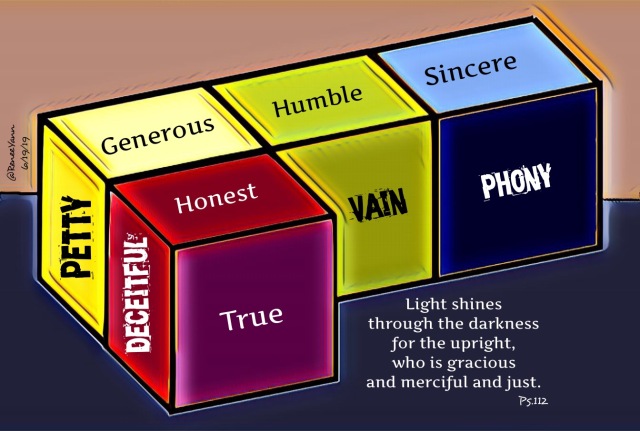
Ps112 characterJPG

Sometimes I think I’m just getting old, but I feel like our culture has abandoned the pursuit of “character”. 

Who are the models held up for our children? Overpaid, spoiled sports icons? Fat cat, indifferent politicians? Grossly sexualized entertainers? Self-indulgent religious and civic officials?

What are the messages our kids receive through our media? Unless you are the richest, the strongest, the flashiest, the cleverest, etc., you fail?

What about us adults? We are bombarded with these messages too. What do we begin to believe about ourselves and who we should be in the world?

Today our readings tell us this: Be upright, gracious, merciful and just. Be generous, humble and brave without needing to be recognized for it. Be honest, sincere, and wise. Wow! Are you kidding me?

As we continue to nourish our character, as we help our children build theirs, there are many blocks to choose from. We can turn every experience, act and choice either to light or to darkness, either to self or to God.

As we pray these readings today, let us ask for the grace to see ourselves clearly with God’s eyes- always true and always merciful. Let us ask for the courage and character to be someone God delights to see.

Music: Sanctify Me, O God – Rexband

Be Perfected in Mercy

Tuesday of the Eleventh Week in Ordinary Time

June 18, 2019

Click here for readings

Today, in Mercy, both Jesus and Paul teach us about the true meaning of charity and community.

Mt5_43_48 PerfectJPG

Throughout his journey among the Gentile Christians, Paul conducts a collection for the poor of the Jerusalem Church.


Galatians 2:9-10

James, Cephas, and John, those esteemed as pillars, gave me and Barnabas the right hand of fellowship when they recognized the grace given to me. They agreed that we should go to the Gentiles, and they to the circumcised. All they asked was that we should continue to remember the poor, the very thing I had been eager to do all along.


Romans 15:25-26

Now, however, I am on my way to Jerusalem in the service of the Lord’s people there. For Macedonia and Achaia were pleased to make a contribution for the poor among the Lord’s people in Jerusalem.


In today’s passage, Paul encourages the Corinthians to contribute by holding up to them the generosity of the churches of Macedonia. Great strategy, eh?

In our Gospel, Jesus shows how deep our generosity, hospitality, mercy, forgiveness,  and love should be: boundless. He gives such a reasonable argument:

For if you love those who love you,
what recompense will you have?
Do not the tax collectors do the same?

Jesus tells us that we must far exceed the tax collectors, that we must be “perfect as our Heavenly Father is perfect” – perfected, whole, and completed by Mercy and Love.

For Paul, this meant embracing both the Jewish and Gentile Christians as one community.

For Jesus, it means loving all Creation as God Loves.

Beloved friends, what does it mean for us?

Music: In Perfect Charity – Randall deBruyn (Lyrics below)

Verse 1

O most high and glorious God,
Cast your light into the darkness of my heart.
Give me right faith, and certain hope,
And perfect, perfect charity.
Give me true insight, Lord, and wisdom,
That I may always live within your ever holy will,
Lord may your light within me burn,
Shining out in perfect charity.

Verse 2

O most high and glorious God,
Open wide the door that leads me to your love.
Give me your firm, yet gentle strength;
May I live that perfect charity.
Lord, may your peace be ever in me,
That I may always seek to serve your children here on earth;
That I may find my home in you,
And live in perfect charity.

Verse 3

Then most high and thankful praise
I will sing unto the glory of your name:
To Father, Son, and Spirit bright,
Living Presence, Perfect Charity.
Praise to the Love that shines in splendour,
That lights the pathways of my heart,
And brings me close to you. O Holy One,
Invite me in, where you live in perfect charity.

Hmmm. The Other Cheek?

Monday of the Eleventh Week in Ordinary Time

June 17, 2019

Click here for readings

Today, in Mercy, our reading from Matthew again shows us how revolutionary Jesus really was!

Yield

For the Jews who listened to Jesus, and for us still listening, today’s instructions might be some of the hardest to swallow! These readings encompass a phrase classically known as the lex talionis or the law of talion.

We may not be familiar with the phrase but we probably are quite familiar with the practice. Most of us begin it very early in life, at least in my young neighborhood we did. It went like this: Harry bites you, you bite him back. Janey pushes you, you push her harder. Margie takes your pickle, you take her peach. Right? Isn’t that the way it should be?

Well, Jesus says not, although his listeners had lived by variations of this law from the time of:

Exodus 21:23-25
But if there is harm, then you shall pay life for life, eye for eye, tooth for tooth, hand for hand, foot for foot, burn for burn, wound for wound, stripe for stripe.

and Leviticus 24:19-21
Anyone who injures their neighbor is to be injured in the same manner: fracture for fracture, eye for eye, tooth for tooth. The one who has inflicted the injury must suffer the same injury.

Believe it or not, these harsh injunctions were actually intended to placate situations by preventing a backlash disproportionate to the original crime.

But Jesus says that is not enough. He says not to resist the evildoer. Scholars have considered for centuries exactly what this means. 

Does it mean to ignore evil, not calling it out for what it is? Obviously not, because Jesus Himself was quick to name the evils of his times.

Does it mean to be a doormat for evil-hearted people to walk all over? Definitely not. Jesus stood up to his persecutors and clearly named their wrong-doing.

What it means is not to return evil for evil, not to respond in-kind, as Paul writes in 1 Thessalonians 5:15

See that no one repays another with evil for evil,
but always seek after that which is good
for one another and for all people.

One of the key Critical Concerns of the Sisters of Mercy is non-violence. I find it one of the most challenging.

Mercy

This article, written by Rosemarie Tresp, RSM proved very helpful to me. You might find it so as well.

Click here for article

Music: Make Me a Channel of Your Peace – written by Sebastian Temple, sung by Susan Boyle