Wisdom, please ….

Twenty-third Sunday in Ordinary Time
September 4, 2022

Today, in God’s Lavish Mercy, we continue to move into the final segments of Luke’s Gospel which we have been reading on Sundays throughout this liturgical year.

Today, the Church links three readings which, at first glance, might seem unrelated.

  • Our first reading from Wisdom reminds us of God’s infinite wisdom, incomprehensible to our human minds.
  • Paul, in his letter to Philemon, begs for the loving inclusion of Onesimus, an enslaved person, into the Colossian community.
  • In our Gospel, Jesus makes this harsh pronouncement:

If anyone comes to me without hating his father and mother,
wife and children, brothers and sisters,
and even his own life,
he cannot be my disciple.


How might we interpret these disparate passages to find a message of wholeness for our prayer?

Wis9_13 gods mind

Let’s start with Jesus. In no uncertain terms, he challenges his disciples to move out of their small worlds into God’s big world. That Godly world is not defined by family, nor by any condition other than our common Creaturehood in God … not by:

word gram

Jesus says the sacred community is defined only by shared and irrevocable commitment to the Gospel of love and mercy.


Paul knows and loves Onesimus, the slave, as a brother in this community. In his letter, Paul encourages Philemon to do the same.


Sometimes as human beings, filled with all kinds of insecurities, we tend to build enclaves that make us feel safe. We like to be with “our kind”. We invent borders to filter out those whose differences we don’t understand. We allow fear to grow with that lack of understanding. Within the enclosure of our self-protectionism, we eventually forget that we are all one, equal, precious, beautiful and beloved by God.

Such toxic attitudes are the soil for slavery, war, ethnic cleansing, racial supremacy, human trafficking, destructive nationalism, and all the other sacrileges committed by humans against the human family.

Wisdom reminds us that only God can open
the tight circle of our fears, judgments and isolations
– only God whose infinite love encompasses all.
Jesus tells us that we find that love
only by lifting up the cross and following him.

Wisdom tells us to put it in God’s hands, and to respond to God’s challenge in the preaching of Jesus Christ.

Who can know your way of thinking, O God
… except you give us wisdom

 and send your Holy Spirit from on high
 thus stretching the hearts of those on earth

Today I pray, may God do this for me,
and for all our tight, convoluted
and troubled world.


Poetic Prayer of Hildegard of Bingen

Hildegard of Bingen (c. 1098 – 17 September 1179), was a German Benedictine abbess and polymath active as a writer, composer, philosopher, mystic, visionary, and as a medical writer and practitioner during the High Middle Ages. She is one of the best-known composers of sacred monophony, as well as the most recorded in modern history. She has been considered by scholars to be the founder of scientific natural history in Germany.

I am Wisdom. 
Mine is the blast of the resounding Word 
through which all creation came to be, 
and I quickened all things with my breath 
so that not one of them is mortal in its kind; 
for I am Life.

Indeed I am Life, whole and undivided 
-- not hewn from any stone, 
or budded from branches, 
or rooted in virile strength; 
but all that lives has its root in Me.
 
For Wisdom is the root 
whose blossom is the resounding Word....
I flame above the beauty of the fields 
to signify the earth 
-- the matter from which humanity was made.

I shine in the waters to indicate the soul, 
for, as water suffuses the whole earth, 
the soul pervades the whole body. 

I burn in the sun and the moon to denote Wisdom, 
and the stars are the innumerable words of Wisdom.

Music: Who Has Known (an Advent hymn, but perfect I think for today’s readings)

Alleluia: The Fig Tree

Feast of Saint Bartholomew, Apostle
August 24, 2022

Today’s Readings:

https://bible.usccb.org/bible/readings/082422.cfm

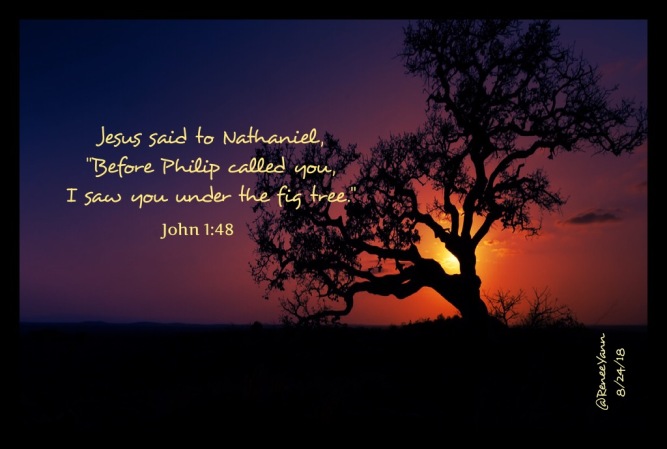
Jn 1_48 fig

Today, in God’s Lavish Mercy, we celebrate the Feast of the Apostle Bartholomew, also known as Nathaniel. As with many of the Apostles, little is known of Bartholomew’s life outside of a few Gospel stories. John’s Gospel tells the wonderful story of Nathaniel’s call by Christ.

The encounter is a very personal one. Jesus and Nathaniel share a conversation that must have impressed the other listeners because it was remembered and recounted word for word in the Gospel.

One exchange, in particular, carries deep significance for Nathaniel. Jesus says that there is no duplicity, or pretense, in Nathaniel. There is a transparency in him shared even with God. Nathaniel wonders out loud , “How do you know me?” Jesus answers, “Before Philip called you, I saw you under the fig tree.”

Saint Bartholomew – El Greco

What was going on with Nathaniel under that fig tree? A moment of intense prayer, questioning, decision, doubt, hope? Whatever it was, Jesus had shared it, even at a distance. When Nathaniel realizes this, his faith in Jesus and vocation to follow Him are confirmed. Nathaniel professes, “Rabbi, you are the Son of God; you are the King of Israel.”


Where are the fig trees in your life story — those moments when, looking back, you realize that God was with you even though seeming distant?

What have been the turning points in your faith, when you came out from under the shadow of a challenging experience, to the grateful amazement that God had accompanied you through it?

What are those pivotal, intimate moments when it was just you and God – those transparent moments that changed your life?

If you can’t recall any such moments, perhaps you are not giving yourself the time and space to let God reach you.

It might be time to seek out a “fig tree” – a place of spiritual solitude where you may speak honestly and directly to God about the most important things in your life. Open your heart, like Nathaniel, to hear what God already knows about you.

Poetry: The Banyan Tree – Rabindranath Tagore

O you shaggy-headed banyan tree
standing on the bank of the pond,
have you forgotten the little child,
like the birds that have
nested in your branches and left you?

Do you not remember
how he sat at the window
and wondered at
the tangle of your roots
plunged underground?

The women would come
to fill their jars in the pond,
and your huge black shadow
would wriggle on the water
like sleep struggling to wake up.

Sunlight danced on the ripples
like restless tiny shuttles
weaving golden tapestry
Two ducks swam by the weedy margin
above their shadows, and
the child would sit still and think.

He longed to be the wind
and blow through your resting branches,
to be your shadow and
lengthen with the day on the water,
to be a bird and perch
on your topmost twig, and to float like
those ducks among the weeds and shadows.


Forest Lake with Boy Fishing – Alfred Wahlberg

Music: The Memory of Trees – Enya (Some lyrical New Age music to listen to under your fig tree!)

Alleluia: Discerning Word

Tuesday of the Twenty-first Week in Ordinary Time
August 23, 2022

Today’s Readings:

https://bible.usccb.org/bible/readings/082322.cfm

Alleluia, alleluia.
The word of God is living and effective,
able to discern reflections and thoughts of the heart.

Today, in God’s Lavish Mercy, Jesus and Paul both get downright serious about true spiritual discernment — in other words,

“Stop the bull(ony)!

The passage from Thessalonians indicates that “conspiracy theories” are not just a sick modern phenomenon. Apparently some religious charlatans were trying to delude the neophyte Christian community with threats about the end of the world. Paul is adamant in his advice:

Do not to be shaken out of your minds suddenly,
or to be alarmed either by a “spirit,”
or by an oral statement,
or by a letter allegedly from us
to the effect that the day of the Lord is at hand.
Let no one deceive you in any way.

2 Thessolians 2:2

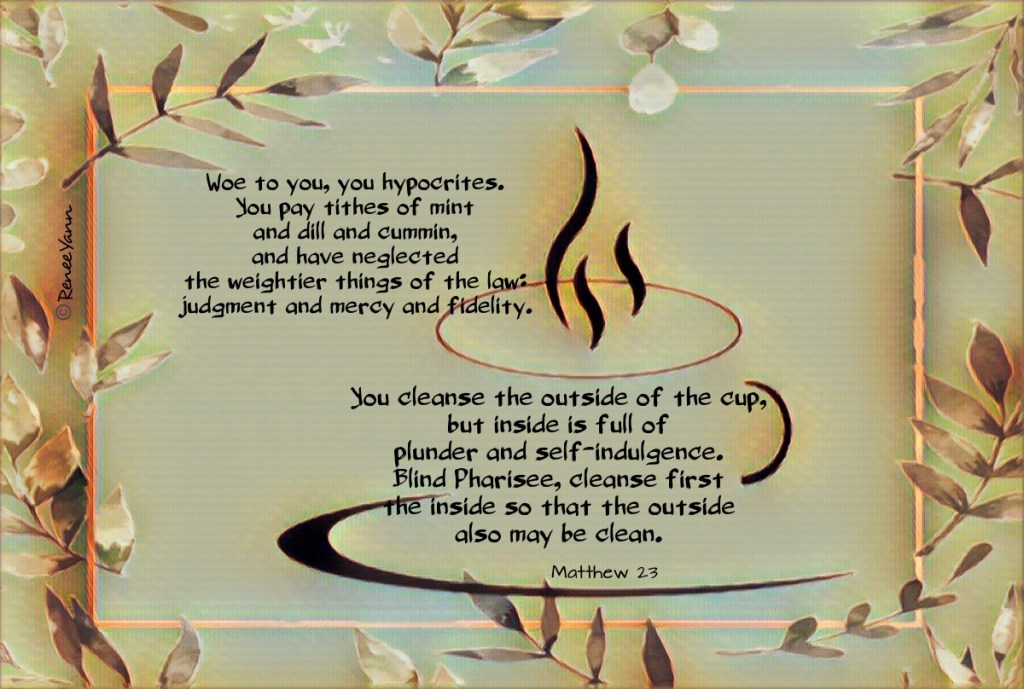
Jesus “woes” the Pharisees once again for a similar type of deluding behavior. For their own advancement, they impose minute religious entanglements which block the true purpose of the law:

Woe to you, scribes and Pharisees, you hypocrites.
You pay tithes of mint and dill and cummin,
and have neglected the weightier things of the law:
judgment and mercy and fidelity.
But these you should have done, without neglecting the others.

Matthew 23:23

Jesus employs a great image to correct such delusions:

You cleanse the outside of cup and dish,
but inside they are full of plunder and self-indulgence.
Blind Pharisee, cleanse first the inside of the cup,
so that the outside also may be clean.

Matthew 23:25

In matters of faith, always look inside the cup for “justice, mercy and fidelity”. If instead you find “plunder and self-indulgences”, you can be sure it is not the word of God.

Alleluia, alleluia.
The word of God is living and effective,
able to discern reflections and thoughts of the heart.


Poetry: A Cup Story – Author Unknown

You are holding a cup of coffee when 
someone comes along and accidentally bumps you 
and shakes your arm, 
making you spill coffee everywhere.
Why did you spill the coffee?
Because someone bumped into you, right?
Wrong answer.
You spilled the coffee because coffee was in the cup.
If tea had been in it, you would have spilled tea.
Whatever is inside the cup is what will come out.
Therefore, when life comes along and shakes you,
whatever is inside of you will come out. 
So each of us has to ask ourselves..... what's in my cup?
When life gets bumpy, what spills over?
Joy, gratefulness, peace, and humility?
Or anger, bitterness, harsh words, and reactions?
We choose what's in our cup!

Music: Inside of the Cup – Ernst Samuel

Alleluia: Blessings or Woe

Memorial of The Queenship of the Blessed Virgin Mary
August 22, 2022

Today’s Readings:

https://bible.usccb.org/bible/readings/082222.cfm

Alleluia, alleluia.
My sheep hear my voice, says the Lord;
I know them, and they follow me.

Today, in God’s Lavish Mercy, we jump into several weeks of readings from:

  • Paul’s letters – a little of Thessalonians and a lot of Corinthians
  • a little of Matthew’s Gospel and a lot of Luke’s

Still centering on our daily Alleluia Verse, as we have been since after Eastertide, we open our prayer to the experience of these early communities as they deepened in their Christian story.

Thessoloniki, Greece

Thessalonika was one of the first cities where Paul worked to form a Christian community. That church suffered persecution but showed “endurance and faith”. Paul obviously has great affection for these steadfast believers, an affection which reflects God’s own love for them.


We ought to thank God always for you, brothers and sisters,
as is fitting, because your faith flourishes ever more,
and the love of every one of you for one another grows ever greater.


Matthew’s Gospel shows us Jesus in an opposite situation from Paul. Jesus is speaking out to a faithless group – Pharisees and scribes who pervert religion with meaningless superficialities which make it harder for people to reach God. 

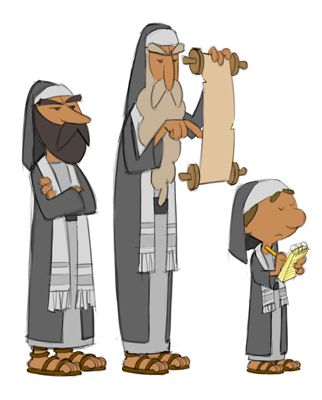
Animation character designs by Cedric Hohnstadt of the Pharisees for the video series “What’s In The Bible?”

Rather than gratitude and blessing, Jesus preaches woe to those who so subvert the faith journey of their community.

Woe to you, blind guides, who say,
‘If one swears by the temple, it means nothing,
but if one swears by the gold of the temple, one is obligated.’
Blind fools, which is greater, the gold,
or the temple that made the gold sacred?


“religious” distortions vs. sincere faith

One would think it should be easy to tell the difference between true faith and manipulative “religion“. But apparently, it’s not so easy. In every age, including our own, we see people caught up in the distortions of religion which disrespect human rights and freedom.

When we see religion used as a pretext for violence, exclusion, political advancement or economic domination, those “woes” should start ringing in our head.

One who swears by the altar swears by it and all that is upon it;
one who swears by the temple swears by it
and by the one who dwells in it;
one who swears by heaven swears by the throne of God
and by the one who is seated on it.

This advice from Jesus could be a little confusing, but in essence it calls us to be sincere and direct in our approach to God and to our sisters and brothers. It is a teaching offered more clearly in an earlier Matthean passage, the Sermon on the Mount:

But I tell you do not swear at all, either by heaven since that is God’s throne, or by earth, since that is His footstool, or by Jerusalem, since that is the city of the great King. Do not swear by your own head either, since you cannot turn a single hair white or black. All you need say is ‘Yes’ if you mean ‘yes’, ‘No’ if you mean ‘No’; anything more than this comes from the Evil One.

Matthew 5:34-37

Poetry: Poetics of Faith – Denise Levertov 

‘Straight to the point’
           can ricochet,
                      unconvincing.
Circumlocution, analogy,
           parable’s ambiguities, provide
                      context, stepping-stones.
 
Most of the time. And then
 
the lightning power
           amidst these indirections,
                      of plain
unheralded miracle!
           For example,
                      as if forgetting
to prepare them, He simply
           walks on water
                      towards them, casually –
and impetuous Peter, empowered,
           jumps from the boat and rushes
                      On wave-tip to meet Him –
a few steps, anyway –
           (till it occurs to him,
                      ‘I can’t, this is preposterous’
and Jesus has to grab him,
           tumble his weight
                      back over the gunwale).
Sustaining those light and swift
           steps was more than Peter
                      could manage. Still,
years later,
           his toes and insteps, just before sleep,
                      would remember their passage.
 

Music: Roberto Cacciapaglia – Angel Falls

just some lovely instrumental music to accompany your thoughts as you pray.

Alleluia: Who’s Coming to the Party?

Twenty-first Sunday in Ordinary Time
August 21, 2022

Today’s Readings:

https://bible.usccb.org/bible/readings/082122.cfm

Alleluia, alleluia.
I am the way, the truth and the life, says the Lord;
no one comes to the Father, except through me.

Today, in God’s Lavish Mercy, we glimpse what the great gathering in heaven might be like.

The Kingdom of Heaven by Frank Bramley

Have you ever gotten an e-vite in your email? Perhaps an invitation to a gala event or a birthday party? All you need do to respond is to click a “Yes” or “ No” button. And then you can look to see who else has been invited and what response each has clicked. You can get a pretty clear picture of what the party will be like – chummy, snobby, noisy, elegant, boring, mind-blowing ….


Isaiah records a guest list for us of all who will be invited to God’s party. That “party” described in Isaiah 66 imagines a restored Jerusalem and a rebuilt Temple. It is an image of what Creation will look like when enveloped in God at the end times. It’s pretty cool!

They shall bring all your brothers and sisters from all the nations
as an offering to the LORD,
on horses and in chariots, in carts, upon mules and dromedaries,
to Jerusalem, my holy mountain, says the LORD…

Isaiah’s community really needed to hear that encouraging vision because the Temple-less Jerusalem they were living in had been devastated by the Babylonian invasions. For the Israelites, the Temple and the Holy City modeled the Kingdom to come. They had a long way to go before their environment was restored to Isaiah’s predicted dimensions. Isaiah helps them journey through present reality for the sake of future hope.


In our second reading, Paul gives a similar kind of encouragement to Hebrew converts who were finding difficulties in the pursuit of their new Christian faith. They too had to learn to suffer through in order to realize their hope.

At the time,
all discipline seems a cause not for joy but for pain,
yet later it brings the peaceful fruit of righteousness
to those who are trained by it.
So strengthen your drooping hands and your weak knees. 
Make straight paths for your feet,
that what is lame may not be disjointed but healed.


When questioned about heaven, Jesus says it’s not a piece of cake to get in. You have to “know somebody”, and that somebody is the God of your heart.

Jesus answered them,
“Strive to enter through the narrow gate,
for many, I tell you, will attempt to enter
but will not be strong enough. 

Jesus echoes Isaiah in describing the glorious mix of guests at the heavenly party:

And people will come from the east and the west
and from the north and the south
and will recline at table in the kingdom of God. 
For behold, some are last who will be first,
and some are first who will be last.

Christ Surrounded by Singing and Music – Hans Hemling

I know I want to be at that party. And we all want to see one another there, right?!

So let’s help each other:

  • get on our “horses, chariots, carts, mules, dromedaries” or any other assistance for our journey
  • strengthen our drooping hands to reach for righteousness
  • find the narrow gate and pass through it
  • finally recline at the table

Poetry: God – Khalil Gibran

In the ancient days, when the first quiver of speech came to my lips, I ascended the holy mountain and spoke unto God, saying, “Master, I am thy slave. Thy hidden will is my law and I shall obey thee for ever more.”

But God made no answer, and like a mighty tempest passed away.

And after a thousand years I ascended the holy mountain and again spoke unto God, saying, “Creator, I am thy creation. Out of clay hast thou fashioned me and to thee I owe mine all.”

And God made no answer, but like a thousand swift wings passed away.

And after a thousand years I climbed the holy mountain and spoke unto God again, saying, “Father, I am thy son. In pity and love thou hast given me birth, and through love and worship I shall inherit thy kingdom.”

And God made no answer, and like the mist that veils the distant hills he passed away.

And after a thousand years I climbed the sacred mountain and again spoke unto God, saying, “My God, my aim and my fulfilment; I am thy yesterday and thou are my tomorrow. I am thy root in the earth and thou art my flower in the sky, and together we grow before the face of the sun.”

Then God leaned over me, and in my ears whispered words of sweetness, and even as the sea that enfoldeth a brook that runneth down to her, he enfolded me.

And when I descended to the valleys and the plains God was there also.


Music: Paradise by Mehdi – a beautiful composition to put a little kick in your step on the way up the Mountain! 🙂

Alleluia: God is God; We Are Not

Tuesday of the Twentieth Week in Ordinary Time
August 16, 2022

Today’s Readings:

https://bible.usccb.org/bible/readings/081622.cfm

Alleluia, alleluia.
Jesus Christ became poor although he was rich
So that by his poverty you might become rich.

Today, in God’s Lavish Mercy, our readings confront us with a few spiritual cautions.

In our first reading, Ezekiel lets the Prince of Tyre know that he has really messed up his spiritual life:

Thus says the Lord GOD:

Because you are haughty of heart,
you say, “A god am I!
I occupy a godly throne
in the heart of the sea!”—
And yet you are a man, and not a god,
however you may think yourself like a god.

This Tyrian prince Ithobalus reigned over a wealthy and politically powerful nation – a nation which had become arrogant and domineering in its relationship to other peoples. The word Ezekiel uses describes the condition perfectly: haughty. The prince was so haughty that he considered himself equal to — and in no need of — God.

We, of course, can learn a lesson from vainglorious Ithobalus. No material possession or personal strength makes us equal to God or renders us independent of God’s governance and care. According to Ezekiel, old Itho was about to find that out the hard way!


In our Gospel, Jesus talks about how we can get caught up in ourselves similarly to Ithobaal.

Jesus said to his disciples:
“Amen, I say to you, it will be hard for one who is rich
to enter the Kingdom of heaven.
Again I say to you,
it is easier for a camel to pass through the eye of a needle
than for one who is rich to enter the Kingdom of God.”

When we read this passage, I think most of us picture material riches. And certainly the saying holds true in that case. But it also holds true for other types of “riches” – strengths or possessions that we use in arrogance and indifference toward others’ needs.


Prose: Pope Francis preached about such things in a homily on this passage from the prophet Amos:

Woe to the complacent in Zion, to those who feel secure … lying upon beds of ivory! . They eat, they drink, they sing, they play and they care nothing about other people’s troubles. (Am 6:1,4)

How does something like this happen? How do some people, perhaps ourselves included, end up becoming self-absorbed and finding security in material things which ultimately rob us of our face, our human face? This is what happens when we become complacent, when we no longer remember God. “Woe to the complacent in Zion”, says the prophet. If we don’t think about God, everything ends up flat, everything ends up being about “me” and my own comfort. Life, the world, other people, all of these become unreal, they no longer matter, everything boils down to one thing: having. When we no longer remember God, we too become unreal, we too become empty; like the rich man in the Gospel, we no longer have a face! Those who run after nothing become nothing – as another great prophet Jeremiah, observed (cf. Jer 2:5). We are made in God’s image and likeness, not the image and likeness of material objects, of idols!

Pope Francis – September 29, 2013

Music: Jesu, Joy of Our Desiring – J.S. Bach, interpreted by Daniel Kobialka

Alleluia: Green Grapes!

Saturday of the Nineteenth Week in Ordinary Time
August 13, 2022

Today’s Readings:

https://bible.usccb.org/bible/readings/081322.cfm

Today, in God’s Lavish Mercy, the core of our readings is about innocence and authenticity. But you have to dig a little to get to that. Maybe, like me, you finished  our first reading asking, “So what’s with the green grapes!?”

A common expression in ancient Israel suggested that people’s bad luck was a punishment for their parent’s sins. It was a handy way of avoiding responsibility for one’s own foolish actions, often the actual source of one’s misfortune.

Ezekiel uses the expression to teach a lesson about the nature of God’s love and forgiveness. God loves us completely – without prejudice, without vengeance. There is no record of faults to “set our teeth on edge”. There are no “green grapes” on God’s table. God only wants our wholeness.

Therefore I will judge you, house of Israel,
each one according to their own ways, says the Lord GOD.
Turn and be converted from all your crimes,
that they may be no cause of guilt for you.
Cast away from you all the crimes you have committed,
and make for yourselves a new heart and a new spirit.


God will not let us hide behind excuses like a bogus “Green Grapes Theory”. As in any loving relationship, we must be honest with God, own our faults, seek forgiveness, and love ardently.

Jesus uses the example of a little child to show us how to do this. Each one of us is born with a core of innocence and authenticity. These are the attributes of God’s life in us. Throughout our lives there are times when we hide these blessings under our sinfulness. Some people bury them so deep that they lose touch with their own sacred integrity.

Jesus calls us back out of our excuses and our excesses, just as the Lord called Ezekiel’s community. We are invited to an eternal covenant rooted in the gift of divine innocence and authenticity given to us at our creation.

Jesus said:
Let the children come to me,
and do not prevent them;
for the Kingdom of heaven
belongs to such as these.

Poetry: The Pursuit – Henry Vaughn

LORD ! what a busy, restless thing
Hast Thou made man !
Each day and hour he is on wing,
Rests not a span ;
Then having lost the sun and light,
By clouds surpris’d,
He keeps a commerce in the night
With air disguis’d.
Hadst Thou given to this active dust
A state untir’d,
The lost son had not left the husk,
Nor home desir’d.
That was Thy secret, and it is
Thy mercy too ;
For when all fails to bring to bliss,
Then this must do.
Ah, Lord ! and what a purchase will that be,
To take us sick, that sound would not take Thee !

Music: Tender Hearted – Jeanne Cotter

Alleluia: Called

Memorial of Saint Dominic, Priest
August 8, 2022

Today’s Readings:

https://bible.usccb.org/bible/readings/080822.cfm

Alleluia, alleluia.
God has called you through the Gospel
to possess the glory of our Lord Jesus Christ.


by Michelangelo on the ceiling of the Sistine Chapel in the Vatican between 1508 to 1512

Today, in God’s Lavish Mercy, we begin nearly two weeks of first readings from the prophet Ezekiel, and this first one is a real WOW!

As I looked, a stormwind came from the North,
a huge cloud with flashing fire enveloped in brightness,
from the midst of which (the midst of the fire)
something gleamed like electrum.
Within it were figures resembling four living creatures
that looked like this: their form was human.

Ezekiel 1:4-6

Walter Brueggemann calls Ezekiel “the prophet who had fantasies and hallucinations”. Nevertheless, Ezekiel is considered a prophet because like all prophets, Ezekiel “noticed what no one else noticed” — Ezekiel “saw death coming” to Israel.

Ezekiel did not blame the king, the government, the military or the war planners for this terrible death to come. He blamed the religious community, the clergy, the prophets: “My hands will be against the prophets who see delusive visions and give lying messages” (13:9). Ezekiel blamed the religious community because that community is responsible for truth-telling.

Truth-Telling and Peacemaking: A Reflection on Ezekiel
by Walter Brueggemann

I think it might be safe to say that most religious communities – and the people who comprise them – do not want to hear such things about themselves. Abraham Heschel, one of the greatest theologians and philosophers of the 20th century said this:

The prophets had disdain for those to whom God was comfort and security; to them God was a challenge, an incessant demand. He is compassion, but not a compromise; justice, but not inclemency. Tranquility is unknown to the soul of a prophet. The miseries of the world give him no rest. While others are callous, and even callous to their callousness and unaware of their insensitivity, the prophets remain examples of supreme impatience with evil, distracted by neither might nor applause, by neither success nor beauty. Their intense sensitivity to right and wrong is due to their intense sensitivity to God’s concern for right and wrong. They feel fiercely because they hear deeply.

from: What Are Prophets For?

By Abraham Joshua Heschel
MARCH 25, 2020

In today’s Gospel, Jesus informs his disciples that he too will endure a prophet’s suffering:

As Jesus and his disciples were gathering in Galilee,
Jesus said to them,
“The Son of Man is to be handed over to men,
and they will kill him, and he will be raised on the third day.”
And they were overwhelmed with grief.

Matthew 17:22-23

As we reflect on what these readings mean for us in our lives, our Alleluia Verse offers a key phrase:

Alleluia, alleluia.
God has called you through the Gospel
To possess the glory of our Lord Jesus Christ.

…through the Gospel

Unless we know and cherish the Gospel, we Christians cannot hear our call.


Poetry: The Call of a Christian – John Greenleaf Whittier

Not always as the whirlwind's rush 
On Horeb's mount of fear, 
Not always as the burning bush 
To Midian's shepherd seer, 
Nor as the awful voice which came 
To Israel's prophet bards, 
Nor as the tongues of cloven flame, 
Nor gift of fearful words,-- 
Not always thus, with outward sign 
Of fire or voice from Heaven,
The message of a truth divine, 
The call of Godis given! 
Awaking in the human heart 
Love for the true and right,-- 
Zeal for the Christian's better part, 
Strength for the Christian's fight. 
Nor unto manhood's heart alone
The holy influence steals 
Warm with a rapture not its own, 
The heart of woman feels! 
As she who by Samaria's wall
The Saviour's errand sought,-- 
As those who with the fervent Paul 
And meek Aquila wrought: 
Or those meek ones whose martyrdom 
Rome's gathered grandeur saw 
Or those who in their Alpine home
Braved the Crusader's war, 
When the green Vaudois, trembling, heard, 
Through all its vales of death, 
The martyr's song of triumph poured 
From woman's failing breath. 
And gently, by a thousand things 
Which o'er our spirits pass, 
Like breezes o'er the harp's fine strings, 
Or vapors o'er a glass, 
Leaving their token strange and new 
Of music or of shade, 
The summons to the right and true 
And merciful is made. 
Oh, then, if gleams of truth and light
Flash o'er thy waiting mind, 
Unfolding to thy mental sight 
The wants of human-kind; 
If, brooding over human grief,
The earnest wish is known 
To soothe and gladden with relief 
An anguish not thine own; 
Though heralded with naught of fear, 
Or outward sign or show; 
Though only to the inward ear 
It whispers soft and low; 
Though dropping, as the manna fell, 
Unseen, yet from above, 
Noiseless as dew-fall, heed it well,--- 
Thy Father's call of love!

Music: God is Calling through the Whisper

Alleluia: Nets and Clay

Thursday of the Seventeenth Week in Ordinary Time
July 28, 2022

Today’s Readings:

https://bible.usccb.org/bible/readings/072822.cfm

Today, in God’s Lavish Mercy, Jeremiah gives us the wonderful image of the potter and the clay. Through this image, Israel is called to repentance, faith and transformation.

Whenever the object of clay which the potter was making
turned out badly in his hand, 
he tried again,
making of the clay another object of whatever sort he pleased.
Then the word of the LORD came to me:
Can I not do to you, house of Israel,
as this potter has done? says the LORD.
Indeed, like clay in the hand of the potter,
so are you in my hand, house of Israel.

The passage carries the warning that some of potter’s attempts don’t quite cut it. They will be culled for the  spiritual “recycle bin”. Today’s Gospel offers a similar forewarning.

The Kingdom of heaven is like a net thrown into the sea,
which collects fish of every kind.
When it is full they haul it ashore
and sit down to put what is good into buckets.
What is bad they throw away.
Thus it will be at the end of the age.


Friends, we all want to make it into the heavenly bucket, right? So let’s sincerely pray the prayer of our Alleluia Verse:

Alleluia, alleluia.
Open our heart, O Lord,
to listen to the words of your Son.


Poetry: The Song of the Potter – Henry Wadsworth Longfellow 

Turn, turn, my wheel! Turn round and round,
Without a pause, without a sound:
So spins the flying world away!
This clay, well mixed with marl and sand,
Follows the motion of my hand;
For some must follow, and some command,
Though all are made of clay!

Turn, turn, my wheel! All things must change
To something new, to something strange;
Nothing that is can pause or stay;
The moon will wax, the moon will wane,
The mist and cloud will turn to rain,
The rain to mist and cloud again,
To-morrow be to-day.

Turn, turn, my wheel! All life is brief;
What now is bud will soon be leaf,
What now is leaf will soon decay;
The wind blows east, the wind blows west;
The blue eggs in the robin’s nest
Will soon have wings and beak and breast,
And flutter and fly away.

Turn, turn, my wheel! This earthen jar
A touch can make, a touch can mar;
And shall it to the Potter say,
What makest thou? Thou hast no hand?
As men who think to understand
A world by their Creator planned,
Who wiser is than they.

Turn, turn, my wheel! ‘Tis nature’s plan
The child should grow into the man,
The man grow wrinkled, old, and gray;
In youth the heart exults and sings,
The pulses leap, the feet have wings;
In age the cricket chirps, and brings
The harvest home of day.

Turn, turn, my wheel! The human race,
Of every tongue, of every place,
Caucasian, Coptic, or Malay,
All that inhabit this great earth,
Whatever be their rank or worth,
Are kindred and allied by birth,
And made of the same clay.

Turn, turn, my wheel! What is begun
At daybreak must at dark be done,
To-morrow will be another day;
To-morrow the hot furnace flame
Will search the heart and try the frame,
And stamp with honor or with shame
These vessels made of clay.

Stop, stop, my wheel! Too soon, too soon
The noon will be the afternoon,
Too soon to-day be yesterday;
Behind us in our path we cast
The broken potsherds of the past,
And all are ground to dust at last,
And trodden into clay.


Music: The Potter’s Hand- Helen  Baylor

I know for sure, all of my days are held in Your hands
Crafted into Your perfect plan
You gently call me, into Your presence
Guiding me by, Your Holy Spirit
Teach me dear Lord
To live all of my life through Your eyes
I’m captured by, Your Holy calling
Set me apart
I know You’re drawing me to Yourself
Lead me Lord I pray
Take me, and mold me
Use me, fill me
I give my life to the Potter’s hands
Hold me, You guide me
Lead me, walk beside me
I give my life to the Potter’s hand
You gently call me, into Your presence
Guiding me by, Your Holy Spirit
Teach me dear Lord
To live all of my life through Your eyes
I’m captured by, Your Holy calling
Set me apart
I know You’re drawing me to Yourself
Lead me Lord I pray
Take me, and mold me
Use me, fill me
I give my life to my Potter’s hands
Hold me, You guide me
Lead me, walk beside me
I give my life to my Potter’s hand
Take me, and mold me
Use me, fill me
I give my life to my Potter’s hands
Hold me, You guide me
Lead me, walk beside me
I give my life to my Potter’s hand
Give Him everything
Give Him everything
Right now, give Him everything
Everything
Give Him everything
Lord, I give it all
To You

Alleluia: God’s Own Children

Seventeenth Sunday in Ordinary Time
July 24, 2022

Today’s Readings:

https://bible.usccb.org/bible/readings/072422.cfm

Today, in God’s Lavish Mercy, a dominant theme connects all our readings: We are, and are loved as, God’s very own children.

Alleluia, alleluia.
You have received a Spirit of adoption,
through which we cry, Abba, Father.

God’s own children … hmmm.

In our reading from Genesis, some folks aren’t doing too well with that. Imagine being so bad that God would have to come down and check you out! Yikes! Not good! It’s like when you and your cousins were pillow-fighting in the basement and your Mom called down the stairs, “Don’t make me come down there!

Don’t Make Me Come Down There!!!!

You knew what to do, didn’t you? Just cut it out! Apparently, Moses isn’t quite so sure that his buddies will behave, but nevertheless does his level best to save the few good apples in the barrel.

This highly anthropomorphic story still carries a very solid truth:

God loves us without reservation
and wants us to return that love
by growing in God’s likeness.

Paul tells the Colossians that God has forgiven, redeemed and raised them with Christ

You were buried with him in baptism,
in which you were also raised with him
through faith in the power of God,
who raised him from the dead.

In our Alleluia Verse from Romans,
Paul describes our new status
as one of “adoption”,
allowing us to call God “Abba”.

Jesus shows us how to be God’s children by sharing with us the intimacies of his talks with his Father.

Father, hallowed be your name,
your kingdom come.
Give us each day our daily bread
and forgive us our sins
for we ourselves forgive everyone in debt to us,
and do not subject us to the final test.

Jesus indicates that we can put this prayer in action by being forgiving and selfless people.

If you then, who are inclined toward selfishness,
know how to give good gifts to your children,
how much more will the Father in heaven
give the Holy Spirit to those who ask him?”


Poetry: O Magne Pater – Hildegard of Bingen

O magne Pater,
in magna necessitate sumus.
Nunc igitur obsecramus, obsecramus te
per Verbum tuum
per quod nos constituisti
plenos quibus indigemus.
Nunc placeat tibi, Pater,
quia te decet, ut aspicias in nos
per adiutorium tuum,
ut non deficiamus, et
ne nomen tuum in nobis obscuretur,
et per ipsum nomen tuum
dignare nos adiuvare.
O Father great,
in great necessity we are.
Thus we now beg, we beg of you
according to your Word,
through whom you once established us
full of all that we now lack.
Now may it please you, Father,
as it behooves you—look upon us
with your kindly aid,
lest we should fail again
and, lost, forget your name.
By that your name we pray—
please kindly help and bring us aid!
thanks to hildegard-society.org

Music: O Magne Pater – Hildegard of Bingen