Today, in God’s Lavish Mercy, we pray in the power of the Gospel:
Ephphatha! Be opened:
All minds to God’s omnipresence
All hearts to God’s infinite love
All spirits to God’s tender proposals
All eyes to God’s eternal vision
All ears to God’s cry in the poor
All mouths to speak God’s Word in justice
All plans to the rhythm of God’s freedom
All dreams to God’s dream for all.
Be opened – especially in me today. 🙏 Amen!
Poetry: Be Opened! – Malcolm Guite
Be opened. Oh if only we might be!
Speak to a heart that’s closed in on itself:
‘Be opened and the truth will set you free’,
Speak to a world imprisoned in its wealth:

'Be opened! Learn to learn from poverty’,
 Speak to a church that closes and excludes,
And makes rejection its own litany:
‘Be opened, opened to the multitudes

For whom I died but whom you have dismissed
 Be opened, opened, opened,’ how you sigh
And still we do not hear you. We have missed
Both cry and crisis, we make no reply.

Take us aside, for we are deaf and dumb
Spit on us Lord and touch each tongue-tied tongue.
Today, in God’s Lavish Mercy, we pray with Psalm 98 which we reflected on just this past Saturday on the feast of St. Augustine. Here’s a refresher if you’d care to glance back.
Because they proclaim God’s faithfulness, today’s psalm verses ready us to receive the Gospel’s expansive injunction:
As we pass through the waters of life, we each meet our own “deeps”. Sometimes we do not recognize them as the sacred places where we are to meet God’s call.
Sometimes we see only their choppy surface, their tangled riptides, their frightening shadows.
Sometimes we miss the bounty held in the mystery of these moments. We fold our nets and try to sail away.
As he did for the weary disciples, Jesus
lovingly contradicts our fear,
releases our hope,
fills the flimsy net of our faith to bursting …
… if we will just trust his Word, and cast out with him over the waters of our lives.
Today, in God’s Lavish Mercy, we pray with Psalm 27 which pivots around two themes:
the first theme in verses 1-6: God’s infinite power and our convinced hope in God’s protection
One thing I ask of the LORD; this I seek: To dwell in the LORD’s house all the days of my life, To gaze on the LORD’s beauty, to visit his temple. For God will hide me in his shelter in time of trouble, He will conceal me in the cover of his tent; and set me high upon a rock.
Psalm 27: 4-5
the second theme in verses 7-14: a confession of faith and a call to perseverance
I believe that I shall see the bounty of the LORD in the land of the living. Wait for the LORD with courage; be stouthearted, and wait for the LORD.
Psalm 27: 13-14
The psalm follows so well on our reading from Thessalonians in which Paul calls upon that community to:
trust hope believe persevere
These practices are the linchpins of a vibrant faith. They hold us fast to God’s heart, allowing us to live in God’s house – and God in ours.
Our Gospel today shows us that it is certainly possible for dark spirits to take up residence in our hearts. Praying a prayer like Psalm 27 puts a watchman on our heart’s door, inviting the Holy One alone to live at our core.
Poetry: Covenant – Margaret Halaska, OSF
God
knocks at my door
seeking a home for his son.

Rent is cheap, I say.

I don’t want to rent. I want to buy, says God.

I’m not sure I want to sell,
but you might come in and look around.

I think I will, says God.

I might let you have a room or two.

I like it, says God. I’ll take the two. You might decide to give me more some day.
I can wait, says God.

I’d like to give you more,
but it’s a bit difficult. I need some space for me.

I know, says God, but I’ll wait. I like what I see.

Hm, maybe I can let you have another room.
I really don’t need that much.

Thanks, says God, I’ll take it. I like what I see.

I’d like to give you the whole house
but I’m not sure …

Think on it, says God. I wouldn’t put you out.
Your house would be mine and my son would live in it.
You’d have more space than you’d ever had before.

I don’t understand at all.

I know, says God, but I can’t tell you about that.
You’ll have to discover it for yourself.
That can only happen if you let me have the whole house.

A bit risky, I say.

Yes, says God, but try me.

I’m not sure –
I’ll let you know.

I can wait, says God, I like what I see.
Music: Psalm 27 – Marc Antoine Charpentier
This Latin chant is noted here as Psalm 26 which would have been its designation in the Vulgate translation of the Bible in Charpentier’s era.)
Today, in God’s Lavish Mercy, we read from James who writes elegantly to his community. He reminds them and us that all gifts originate in our changeless, loving God Who breathed us into life from Infinite and Lavish Mercy.
Then James just so simply enjoins us:
So hear God’s Word of Love in your hearts
Be good by doing good for the afflicted
James says that doing this is “religion pure and undefined”.
James 1:27
In our Gospel, Jesus reinforces this truth. The Pharisees want to condemn Jesus and the disciples for breaking a ritual hand-washing rule. Jesus says those human rules are lip-worship. What God wants is a loving and sincere heart proven by loving and sincere deeds.
On this last Sunday of August, let us rejoice in the gifts God has given us- life, faith, the ability to love and hope. Let us reach out by prayer and service to those who might be blessed by our sharing.
That reach can be so simple: a smile, a phone call, a small courtesy, a solitary prayer. Or it can be huge: a long-delayed forgiveness, a turning from unhealthy or unholy behaviors, a commitment to faith and service. We ask the Creator of Lights to inspire us.
Poetry – excerpt from George MacDonald’s poem “Light”. I’ll post the entire poem separately today – long and very beautiful. Many of you may enjoy it.
Gentle winds through forests calling;
    Big waves on the sea-shore falling;
    Bright birds through the thick leaves glancing;
    Light boats on the big waves dancing;
    Children in the clear pool laving;
    Mountain streams glad music giving;
    Yellow corn and green grass waving;
    Long-haired, bright-eyed maidens living;
    Light on all things, even as now--
    God, our Father, it is Thou!
    Light, O Radiant! thou didst come abroad,
    To mediate 'twixt our ignorance and God;
    Forming ever without form;
    Showing, but thyself unseen;
    Pouring stillness on the storm;
    Making life where death had been!
    If thou, Light, didst cease to be,
    Death and Chaos soon were out,
    Weltering o'er the slimy sea,
    Riding on the whirlwind's rout;
    And if God did cease to be,
    O Beloved! where were we?

Father of Lights, pure and unspeakable,
    On whom no changing shadow ever fell!
    Thy light we know not, are content to see;
    And shall we doubt because we know not Thee?
    Or, when thy wisdom cannot be expressed,
    Fear lest dark vapors dwell within thy breast?
    Nay, nay, ye shadows on our souls descending!
    Ye bear good witness to the light on high,
    Sad shades of something 'twixt us and the sky!
    And this word, known and unknown radiant blending,
    Shall make us rest, like children in the night,--
    Word infinite in meaning: God is Light.
    We walk in mystery all the shining day
    Of light unfathomed that bestows our seeing,
    Unknown its source, unknown its ebb and flow:
    Thy living light's eternal fountain-play
    In ceaseless rainbow pulse bestows our being--
    Its motions, whence or whither, who shall know?
    O Light, if I had said all I could say
    Of thy essential glory and thy might,
    Something within my heart unsaid yet lay,
    And there for lack of words unsaid must stay:
    For God is Light.
Today, in God’s Lavish Mercy, as we pray with Psalm 34, our Sunday readings present us with spiritual ultimatums.
In our first reading, sensing his impending death, Joshua gathers the tribes on the Great Plains of Shechem – the land of their father Abraham. Joshua requires a commitment from the people:
“If it does not please you to serve the LORD, decide today whom you will serve … As for me and my household, we will serve the LORD.”
Joshua 24:15
In other words, “fish or cut bait” – you’re either with God, or you’re not. And your lives should reflect the choice.
In our Gospel, Jesus too feels death’s approach. His teachings have become more intense and direct, particularly regarding the Eucharist. This intensity has caused some of his listeners to waver. They’re not sure they can accept his words. Some drift away.
Jesus challenges the Twelve, those on whom he depends to carry his message after his death.
“Do you also want to leave?
These readings talk about the big choices, the soul’s orientation, either:
to seek and respond to God in our daily interactions
to be indifferent toward God’s Presence in our lives
Jesus’s question is before us all the time? Do we hear it?
(As for the unfortunate and contested second reading from Ephesians, this long but superb article from Elizabeth Johnson is worth your time.)
You see, I want a lot.
Perhaps I want everything:
The darkness that comes with every infinite fall
And the shivering blaze of every step up.
So many live on and want nothing
And are raised to the rank of prince
By the slippery ease of their light judgments
But what you love to see are faces
That do work and feel thirst…
You have not grown old,
And it is not too late to dive
Into your increasing depths where life
Calmly gives out its own secret.
Today, in God’s Lavish Mercy, our readings capture the essence of life in God through Christ.
The first reading from Kings tells how Elijah, after eating the food God had provided him, was able to endure the long journey to God’s mountain. There, the sweetest whisper carried to Elijah the voice of God!
In today’s Gospel passage, Jesus makes clear that no one makes that journey into the heart of God unless God calls us. But Jesus says that the invitation is given to all who believe. He says that, just as with Elijah, the Father gives us food – Jesus himself – the bread of life.
The second reading from Ephesians says that we have already “been sealed for the day of redemption through the Holy Spirit.” Paul says that, given this amazing gift, we have only one job:
So be imitators of God, as beloved children, and live in love, as Christ loved us and handed himself over for us as a sacrificial offering to God for a fragrant aroma.
We are so accustomed to hearing these astounding passages that we may miss how astounding they really are. But Macrina Wiederkehr says:
When Jesus’ words begin to sound naive to our 21st century minds, let us look through the words, in between the words, underneath for a deeper truth.
Macrina Wiederkehr, OSB
Pierre Teilhard de Chardin, the great Jesuit mystical theologian, upon reading these passages, saw the mystery of the Body of Christ. He saw our call to be the heart of Christ in the world. He saw Christ’s promise to become one with us in Eucharist. He saw that, through this Infinite Love played out in our ordinary lives, God continues to redeem Creation.
In each soul, God loves and partly saves the whole world which that soul sums up in an incommunicable and particular way.
The Divine Milieu
Poetry: Love after Love by Derek Walcott
The time will come when with elation you will greet yourself arriving at your own door, in your own mirror and each will smile at the other’s welcome and say, sit here, eat. You will love again the stranger who was your self
Give wine, give bread. Give back your heart to itself, to the stranger who has loved you all your life whom you ignored for another who knows you by heart
Take down the love letters from the bookshelf, the photographs, the desperate notes, peel your own image from the mirror. Sit. Feast on your life.
Music: Quintessence – Spencer Brewer
May this lovely instrumental piece help take us to a deeply prayerful place as we contemplate God’s gift in Jesus.
Psalm 95 is a summons to rejoice, but laced within it are stern reminders to remember and repent.
Oh, that today you would hear his voice: “Harden not your hearts as at Meribah, as in the day of Massah in the desert, Where your forebearers tested me; they tested me though they had seen my works.”
Psalm 95: 8-9
The rock referred to in the psalm is the one Moses struck to release the waters. It is a contentious episode where the Israelites test God and Moses wavers in his faith.
These are the waters of Meribah, where the children of Israel contended against the Lord, and where the LORD’s sanctity was revealed among them.
Numbers 20:13
On the other hand, the rock in our Gospel passage refers to the strength and stability Peter receives and which will endure through the ages.
And so I say to you, you are Peter, and upon this rock I will build my Church, and the gates of the netherworld shall not prevail against it.
Matthew 16:18
Latin inscription on dome of St. Peter’s Basilica in Rome – ” Tu es Petrus — You are Peter and upon this rock…”
So the “rock”, like any symbol, takes its meaning and relevance from the circumstances which surround it.
This is true as well for the “rocks” we meet in our own lives. Some are sources of strength, some nearly insurmountable obstacles. Some are a test, some a consolation.
Praying with today’s psalm and other readings, we might take the time to reflect on our current or past “rocks”.
May we realize and gratefully remember how God gives life-giving water even from these seemingly unyielding sources.
Poetry: Sorrow – Renee Yann, RSM
You must be alone
    with sorrow
    before you can leave it,
    or it will crush you
    like a black, heavy rock.

    You must drive into
    the hollow of its face,
    under the ledges
    it projects against you.
    Feel its cold granite
    pressed to your grain.

    In time,
    it will allow your turning
    to rest your back
    within its curve.

    Only then,
    you will be free to leave it,
    walking lightly once again
    on yielding earth.

    When you return, it will be freely,
    on a pilgrimage,
    to touch the name you carved once
    with the anguish of your heart.
Music: Rock of Ages
“Rock of Ages” is a popular Christian hymn written by the Reformed Anglican minister, the Reverend Augustus Toplady, in 1763 and first published in The Gospel Magazine in 1775.
Traditionally, it is held that Toplady drew his inspiration from an incident in the gorge of Burrington Combe in the Mendip Hills in England. Toplady, a preacher in the nearby village of Blagdon, was traveling along the gorge when he was caught in a storm. Finding shelter in a gap in the gorge, he was struck by the title and scribbled down the initial lyrics. The fissure that is believed to have sheltered Toplady (51.3254°N 2.7532°W) is now marked as the “Rock of Ages”, both on the rock itself and on some maps.
Today in God’s Lavish Mercy, we pray with our Sunday readings, so full of wisdom for our lives.
“Don’t we have anything decent to eat around here?” “There’s nothing to eat in this house !”
How many times do parents hear these complaints from their growing teenagers! The problem? They’re not looking for the apples, or eggs, or yogurt, or avocados which actually are in the fridge. They’re looking for junk!
Today’s first reading reflects a similar situation with the Jews in the desert. They are hungry, but not for the spiritual food Yahweh is offering them. They complain continuously. So God relents, feeding them manna and quail. But God is clear. He says, “I have done this so that you may know I am the Lord, your God.”
In the Gospel, Jesus admonishes his listeners, “Do not work for food that perishes but for the food that endures for eternal life.” Jesus doesn’t mean we should stop eating. He knows that we need food and other things in order to live. What He wants us to understand is that these things have only secondary importance to the food for our soul, a sustenance which we often relegate to inferior status, to “when we have time”.
In his advice to the Ephesians, Paul says that to live without spiritual awareness is “to live in the futility of our minds”. It’s a powerful phrase, generating an image of us running around in our heads after all sorts of vain worries and goals — junk.
Paul’s advice? Get over that running around! Put on a New Self!
At our essence, we are hungry for the Bread of Life. Nothing else will fill that emptiness.
we are such a mix of thorns and thread; why do You insist on living in the midst, even among the broken bowls and spilled strengths? I’ve seen You sift among the crumbs and find (I don’t know how) a loaf; what we tear, touch to make us mend; and show again to sift and share and be again the bread.
Music: Bread of Life ~ Bernadette Farrell
Bread of life, hope of the world,
Jesus Christ, our brother:
feed us now, give us life,
lead us to one another.

As we proclaim your death,
as we recall your life,
we remember your promise
to return again.

Bread of life, hope of the world,
Jesus Christ, our brother:
feed us now, give us life,
lead us to one another.

The bread we break and share
was scattered once as grain:
just as now it is gathered,
make your people one.

Bread of life, hope of the world,
Jesus Christ, our brother:
feed us now, give us life,
lead us to one another.

We eat this living bread,
we drink this saving cup:
sign of hope in our broken world,
source of lasting love.

Hold us in unity,
in love for all to see;
that the world may believe in you,
God of all who live.

You are the bread of peace,
you are the wine of joy,
broken now for your people,
poured in endless love.
Today, in God’s Lavish Mercy, we pray with Psalm 67 which calls on God to bless all people.
O God, be merciful to us and bless us, show us the light of your countenance and come to us. So may your way be known upon earth; among all nations, your salvation.
Psalm 67: 1-2
This psalm is notable for its inclusiveness of nations outside of Israel. Most psalms focus inwardly on Israel’s needs, hopes and memories. But Psalm 67 calls on God to gather and bless universally:
May the nations be glad and exult because you rule the peoples in equity; the nations on the earth you guide.
For this reason, Psalm 67 has been called “the missionary psalm”, and is such a fitting prayer on this feast of St. Ignatius who founded a community which has carried the faith throughout the world.
As we pray our psalm today, we might examine how our own faith reaches out, includes and blesses others.
Our final verses today point back to our first reading from Leviticus. While the math and calendar counting could get me pretty mixed up, the message is clear. It is a Jubilee message:
Stop.
Take a good look at your life and the harvest of your years.
Be grateful.
Be just.
Share.
Bring others into your bounty because it all belongs to God, not you.
When we do these things, Psalm 67 becomes our prayer:
Let the nations be glad and sing for joy, for you judge the peoples with equity and guide all the nations upon earth. Let the peoples praise you, O God; let all the peoples praise you. The earth has brought forth its increase; may you, O God our God, bless us. May you bless us, and may all the ends of the earth stand in awe of you.
Poetry: This Is My Song by Lloyd Stone and Georgia Harkness
This is my song, O God of all the nations,
a song of peace for lands afar and mine;
this is my home, the country where my heart is;
here are my hopes, my dreams, my holy shrine:
but other hearts in other lands are beating
with hopes and dreams as true and high as mine.

My country’s skies are bluer than the ocean,
and sunlight beams on cloverleaf and pine;
but other lands have sunlight too, and clover,
and skies are everywhere as blue as mine:
O hear my song, thou God of all the nations,
a song of peace for their land and for mine.

May truth and freedom come to every nation;
may peace abound where strife has raged so long;
that each may seek to love and build together,
a world united, righting every wrong;
a world united in its love for freedom,
proclaiming peace together in one song.
Music: Finlandia, Opus 26
The above poem is sung to the tune of the final hymn in this work by Jean Sibelius. I think you will enjoy this beautiful video, especially the young ducks about midway through. Be sure to click the little arrowhead under the right side of the video to read the great history of this musical composition.
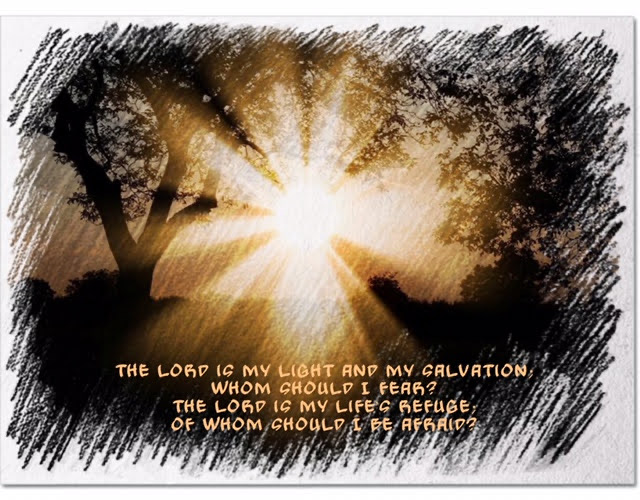
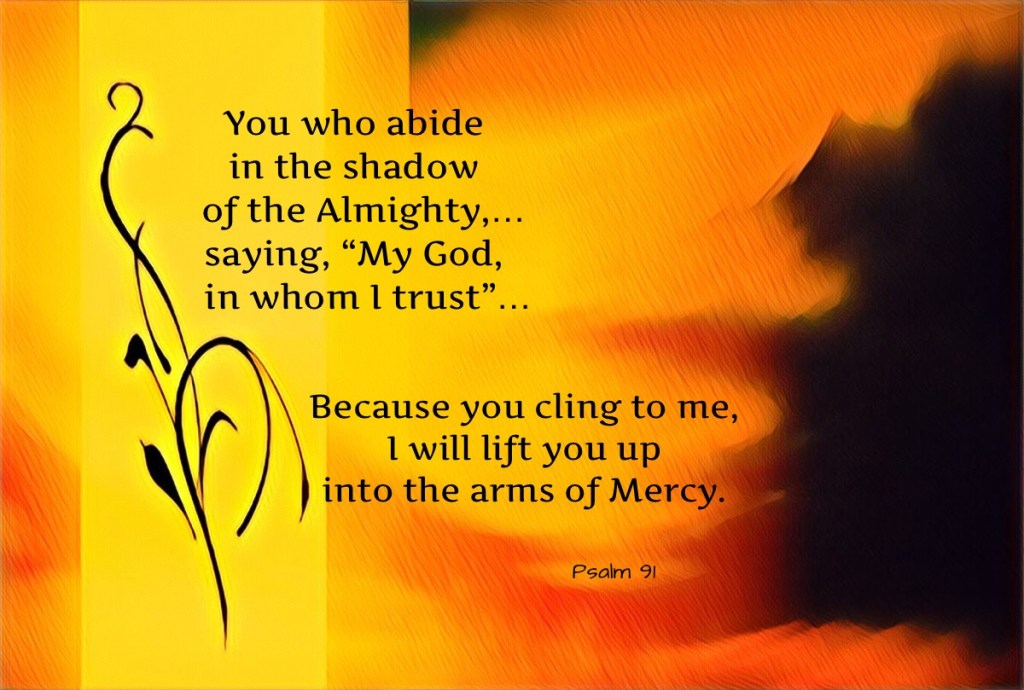
Today, in God’s Lavish Mercy, we pray with the beautiful Psalm 91, so full of images to help us experience the steadfast tenderness of God.
Our Gospel shows us this tender mercy in the story of Jesus and two complementary healings – the woman who suffered for twelve years, and the young girl who has lived only twelve years.
In both cases Jesus, by a touch received or given, gathers a broken soul under Mercy’s wing. In the mystery of that grace-filled shade, the soul is restored to the fullness of Light.
As we pray Psalm 91 today let us, like the Gospel’s woman and young girl, reach for any healing and wholeness we long for.
Is there something in us that has died too soon and longs to be reborn?
Is there something crippled in us that longs to leap once more and run free?
May we find new life under God’s infinitely caring wing which ever hovers over us in love.
Poetry: A video mix of Rumi and Hafiz, a dynamite combo!












 Lavish Mercy