Today, in Mercy, our Gospel reading is Mark’s second rendering of a great miracle of the loaves and fishes. Scholars vary on whether this passage refers to the same incident as Mark 6. However, the distinctions relate more to Biblical theology than spirituality.
For our prayer today though, I refer you to an earlier reflection on Jesus feeding the crowds because, to be honest, my mind was in a whole different place for prayer this morning. I’ll share some of that in another post for those who may be interested.
So please click below to spend your prayer time being miraculously fed by Jesus- whether it’s with the 4000 or the 5000.😉🙏
Today, in Mercy, our readings leave me wondering about what makes God tick.
In our first reading, God exacts justice for Solomon’s unfaithfulness, but He does it sort of like a prosecutor in a plea bargain.
I will deprive you of the kingdom … but not during your lifetime It is your son whom I will deprive … but I won’t take away the whole kingdom.
What’s going on with God in this reading? Well, it’s more like “What’s going on with the writer as he tries, retrospectively, to interpret God’s role in Israel’s history?”
The passage is much more than a report on exchanges between God and Solomon.
It is a testament to Israel’s unwavering faith that God is intimately involved in their lives. In every circumstance, the believing community returns to the fact that experience leads to God and not away from Him.
So “Solomon … had TURNED his heart to strange gods” BUT God had not turned from Solomon. Nor would God EVER turn because God has CHOSEN Israel.
In our Gospel, the Syrophoenician woman tries to get the favor of Jesus to turn toward her. And actually, Jesus sounds pretty mean and stingy about it.
Again the writer Mark is portraying, retrospectively, a significant time in Christ’s ministry. Jesus has really gone into hiding in a remote place. Apparently, he wants space to figure some things out. The story indicates that one of those things might be whether or not his ministry should embrace the Gentiles.
The persistence of this woman’s faith is a turning point for Jesus Who evolved, as we all do, in his understanding of his sacred role and meaning in the world.
These passages encourage us to constantly turn toward God Who lives our life with us. Such conversation helps us to grow spiritually. As we become bigger in heart and soul, so does our concept of God and what God’s hope is for us.
Music: Perfect Wisdom of Our God – The Gettys (See poem after music video)
All this “turning” brought to mind some favorites lines from T.S. Eliot:
At the still point of the turning world. Neither flesh nor fleshless; Neither from nor towards; at the still point, there the dance is, But neither arrest nor movement. And do not call it fixity, Where past and future are gathered. Neither movement from nor towards, Neither ascent nor decline. Except for the point, the still point, There would be no dance, and there is only the dance.
I happened across a website where Eliot himself reads “Burnt Norton”, the poem from which these lines are taken. Eliot fans might enjoy this. Eliot’s poems take time and work as well as simple reading. But the effort is so worth it!
Time present and time past
Are both perhaps present in time future
And time future contained in time past.
If all time is eternally present
All time is unredeemable.
What might have been is an abstraction
Remaining a perpetual possibility
Only in a world of speculation.
What might have been and what has been
Point to one end, which is always present.
Footfalls echo in the memory
Down the passage which we did not take
Towards the door we never opened
Into the rose-garden. My words echo
Thus, in your mind.
But to what purpose
Disturbing the dust on a bowl of rose-leaves
I do not know.
Other echoes
Inhabit the garden. Shall we follow?
Quick, said the bird, find them, find them,
Round the corner. Through the first gate,
Into our first world, shall we follow
The deception of the thrush? Into our first world.
There they were, dignified, invisible,
Moving without pressure, over the dead leaves,
In the autumn heat, through the vibrant air,
And the bird called, in response to
The unheard music hidden in the shrubbery,
And the unseen eyebeam crossed, for the roses
Had the look of flowers that are looked at.
There they were as our guests, accepted and accepting.
So we moved, and they, in a formal pattern,
Along the empty alley, into the box circle,
To look down into the drained pool.
Dry the pool, dry concrete, brown edged,
And the pool was filled with water out of sunlight,
And the lotos rose, quietly, quietly,
The surface glittered out of heart of light,
And they were behind us, reflected in the pool.
Then a cloud passed, and the pool was empty.
Go, said the bird, for the leaves were full of children,
Hidden excitedly, containing laughter.
Go, go, go, said the bird: human kind
Cannot bear very much reality.
Time past and time future
What might have been and what has been
Point to one end, which is always present.
II
Garlic and sapphires in the mud
Clot the bedded axle-tree.
The trilling wire in the blood
Sings below inveterate scars
Appeasing long forgotten wars.
The dance along the artery
The circulation of the lymph
Are figured in the drift of stars
Ascend to summer in the tree
We move above the moving tree
In light upon the figured leaf
And hear upon the sodden floor
Below, the boarhound and the boar
Pursue their pattern as before
But reconciled among the stars.
At the still point of the turning world. Neither flesh nor fleshless;
Neither from nor towards; at the still point, there the dance is,
But neither arrest nor movement. And do not call it fixity,
Where past and future are gathered. Neither movement from nor towards,
Neither ascent nor decline. Except for the point, the still point,
There would be no dance, and there is only the dance.
I can only say, there we have been: but I cannot say where.
And I cannot say, how long, for that is to place it in time.
The inner freedom from the practical desire,
The release from action and suffering, release from the inner
And the outer compulsion, yet surrounded
By a grace of sense, a white light still and moving,
Erhebung without motion, concentration
Without elimination, both a new world
And the old made explicit, understood
In the completion of its partial ecstasy,
The resolution of its partial horror.
Yet the enchainment of past and future
Woven in the weakness of the changing body,
Protects mankind from heaven and damnation
Which flesh cannot endure.
Time past and time future
Allow but a little consciousness.
To be conscious is not to be in time
But only in time can the moment in the rose-garden,
The moment in the arbour where the rain beat,
The moment in the draughty church at smokefall
Be remembered; involved with past and future.
Only through time time is conquered.
III
Here is a place of disaffection
Time before and time after
In a dim light: neither daylight
Investing form with lucid stillness
Turning shadow into transient beauty
Wtih slow rotation suggesting permanence
Nor darkness to purify the soul
Emptying the sensual with deprivation
Cleansing affection from the temporal.
Neither plentitude nor vacancy. Only a flicker
Over the strained time-ridden faces
Distracted from distraction by distraction
Filled with fancies and empty of meaning
Tumid apathy with no concentration
Men and bits of paper, whirled by the cold wind
That blows before and after time,
Wind in and out of unwholesome lungs
Time before and time after.
Eructation of unhealthy souls
Into the faded air, the torpid
Driven on the wind that sweeps the gloomy hills of London,
Hampstead and Clerkenwell, Campden and Putney,
Highgate, Primrose and Ludgate. Not here
Not here the darkness, in this twittering world.
Descend lower, descend only
Into the world of perpetual solitude,
World not world, but that which is not world,
Internal darkness, deprivation
And destitution of all property,
Dessication of the world of sense,
Evacuation of the world of fancy,
Inoperancy of the world of spirit;
This is the one way, and the other
Is the same, not in movement
But abstention from movement; while the world moves
In appetency, on its metalled ways
Of time past and time future.
IV
Time and the bell have buried the day,
the black cloud carries the sun away.
Will the sunflower turn to us, will the clematis
Stray down, bend to us; tendril and spray
Clutch and cling?
Chill
Fingers of yew be curled
Down on us? After the kingfisher’s wing
Has answered light to light, and is silent, the light is still
At the still point of the turning world.
V
Words move, music moves
Only in time; but that which is only living
Can only die. Words, after speech, reach
Into the silence. Only by the form, the pattern,
Can words or music reach
The stillness, as a Chinese jar still
Moves perpetually in its stillness.
Not the stillness of the violin, while the note lasts,
Not that only, but the co-existence,
Or say that the end precedes the beginning,
And the end and the beginning were always there
Before the beginning and after the end.
And all is always now. Words strain,
Crack and sometimes break, under the burden,
Under the tension, slip, slide, perish,
Will not stay still. Shrieking voices
Scolding, mocking, or merely chattering,
Always assail them. The Word in the desert
Is most attacked by voices of temptation,
The crying shadow in the funeral dance,
The loud lament of the disconsolate chimera.
The detail of the pattern is movement,
As in the figure of the ten stairs.
Desire itself is movement
Not in itself desirable;
Love is itself unmoving,
Only the cause and end of movement,
Timeless, and undesiring
Except in the aspect of time
Caught in the form of limitation
Between un-being and being.
Sudden in a shaft of sunlight
Even while the dust moves
There rises the hidden laughter
Of children in the foliage
Quick now, here, now, always —
Ridiculous the waste sad time
Stretching before and after.
Today, in Mercy, the Queen of Sheba visits Solomon. It’s another Solomon story worthy of the big screen where, in fact, it has been loosely fictionalized and adulterated many times.
Many trusted scripture scholars question the historicity of the story. Several agree that Solomon never rose to the kind of material glory described in the passage. The two books of Kings were written 500 years after Solomon lived. In many aspects, the writings offer a reflection on the meaning of his reign in Israel’s covenanted life rather than a strict account of his life.
So what might we glean from today’s passage on the mysterious queen. The story demonstrates that Solomon is so accomplished that a revered leader will come to learn from him. Once she arrives, she is overwhelmed by his material successes and strength. Solomon has constructed a dominant, rich and subservient culture.
But wait. Is there a bit of ironic judgement and, perhaps,prophetic reminder woven into the Queen’s accolades? Shifting the focus from an increasingly arrogant Solomon back to Israel’s God, she says:
Blessed be the LORD, your God, whom it has pleased to place you on the throne of Israel. In his enduring love for Israel, the LORD has made you king to carry out judgment and justice
In fact, the great wealth and power of Solomon’s kingdom was built, not on justice and judgement, but on the backs of the poor and excluded. For example, Walter Brueggemann says this:
(Solomon’s kingdom) … was an economy of extraction that regularly transferred wealth from subsistence farmers to the elite in Jerusalem, who lived off the surplus and the device and the strategy for that extraction was an exploitative tax system.
When the Biblical scribe puts the words judgment and justice into the Queen’s remarks, it may be intended to forecast the miserable end Solomon will meet because he has abandoned his responsibilities to care for all the people according the the Lord’s covenant.
This glorious, shining realm which so impressed the Queen is a kingdom built on corruption, greed, militarism, and manipulation of the poor.
The lessons for our world are obvious.
As Jesus tells us in today’s Gospel, it doesn’t matter whether we’re gilded in gold on the outside and spin our words in glorious promises. What matters are the true intentions of our hearts and the compassionate actions they inspire:
But what comes out of the person, that is what defiles him. From within, from the heart, come evil thoughts, unchastity, theft, murder, adultery, greed, malice, deceit, licentiousness, envy, blasphemy, arrogance, folly.
Ultimately, the great Solomon misses the boat on this. May his story help us not to do the same.
Also, as we pray, we may want to remember the devastated people of Yemen, the land identified as the historical Sheba. For some background on the current crisis in Yemen, see this article from Catholic Bishops
Today, in Mercy, our readings talk about how we try to “house” God.
Because God is bigger than BIG, our minds struggle. More than struggle, they actually fail, repeatedly, to define God. Yet we still try, don’t we?
We try to picture, describe, paint, quote, and interpret God. We even decide what God wants and create laws to insure God gets that.
We dilute Divinity to our human dimensions. We just can’t take it straight. We mix it and bottle it in our laws, and box it in our rituals — because we can’t manage Omnipotence.
And let’s face it, most of us like to manage things. 😉At least the Pharisees in today’s Gospel liked that kind of control. And Jesus challenges them on it.
Praying with these thoughts today, I think of my Dad. He liked an occasional jigger of really fine bourbon – savored in its unadulterated state, without water or soda – what today’s purists call “sipping whisky”.
When the doctor informed him, unfortunately in my mother’s presence, that whisky was a no-no, Dad didn’t like it. But he acquiesced. At least we thought he did.
After Dad died, my brother and I found his bottle of Kentucky bourbon wrapped in a towel in the basement dryer. You see, only Dad did the wash. Mom never liked machines.
I think Jesus would have really enjoyed my Dad as one of his original disciples. Dad liked life “straight”. His faith was simple, direct, complete and undiluted. Sitting with Jesus that Gospel day, Dad wouldn’t have washed his hands either. He would have been too busy listening to the pure, unbottled Word pouring over him.
The message I took from today’s prayer:
Be very wary of anyone who thinks they know exactly what God wants.
Let God out of the boxes I put Him in.
Invite God’s Spirit to run free through my heart.
Don’t bottle God up; don’t box God in.
Enjoy sipping God’s surprising and infinite grace.
Music:New Pharisees – Charlie Daniels Band (Lyrics below)
New Pharisees
They go walking into church every Sunday morning
They the self-appointed sin patrol
Well they whisper and they gossip behind the back
Of anybody that they can’t control
See that girl in the choir she’s got evil desires
She must be drinking from the devil’s well
She’s a downright disgrace with that paint on her face
She looks just like a Jezebel
And they’re running around putting everybody down
What are you trying to do?
You need to pick up the Book and take another look
‘Cause brother I’ve got the news for you
You know Jesus was sent with a new covenant
And he even died for you
New pharisees like a fatal disease
Always flapping your jaws trying to live by the law
You see that boy over there with that long shaggy hair
Ought to be ashamed of his self
He wearing hip-hop clothes got a ring in his nose
Don’t he know he going straight to hell
And then yesterday morning me and sister Johnson
Were talkin’ on the party line
She said that Deacon Brown was having dinner downtown
Somebody seen him with a glass of wine
And you act so righteous and you look so pious
You always pay your tithe
But there’s a rock in your heart and a fire on your tongue
And there ain’t no love in your eyes
Bad news is begotten and the devil is smiling
You gossip and you criticize
New pharisees like a fatal disease
Always flapping your jaws trying to live by the law
Well you can’t get by the law so quit flapping your jaws
New pharisees yes, you’re a lot like me
Today, in Mercy, we read about the massive celebration to dedicate Solomon’s Temple. It would have been a ceremony akin to the parades we view in movies like Ben Hur.
This video gives us a good understanding of the magnificence of the building.
Praying with the passage today, core questions repeat themselves to me:
Can God be in a building?
Is there a legitimate spiritual purpose to the cathedrals, large or small, that we build?
For me, the answer is a fluid one. Certainly, beautiful churches inspire our faith and serve as a central symbol for the unity of believers.
But throughout history, these buildings have also symbolized individual and national power, pride and greed.
A recent initiative of Pope Francis converted a 19th century palace behind the Vatican into a homeless shelter. The Pope directed this rather than the site’s upgrade to a luxurious hotel.
The building is described as having “carved wooden ceilings, frescoed walls and tiled floors — evidence of its aristocratic origins.” Sharing a meal with its first residents, Pope Francis said, “Beauty heals”.
Such healing is the real purpose of all such buildings – that their beauty heal hearts, communities, and nations. Where the purpose is lost, excess eviscerates the healing beauty.
At points in the Gospel, Jesus refers to himself as the Temple – instructing his disciples that God’s Presence now dwells in the world through him. Today’s Gospel shows us how this Presence manifests itself – through the power of compassion and justice for the poor:
Whatever villages or towns or countryside he entered, they laid the sick in the marketplaces and begged him that they might touch only the tassel on his cloak; and as many as touched it were healed.
Where God is present there is always healing. May it be so in our churches and in our hearts.
Today, in Mercy, Sirach gives us a beautiful eulogy for King David.
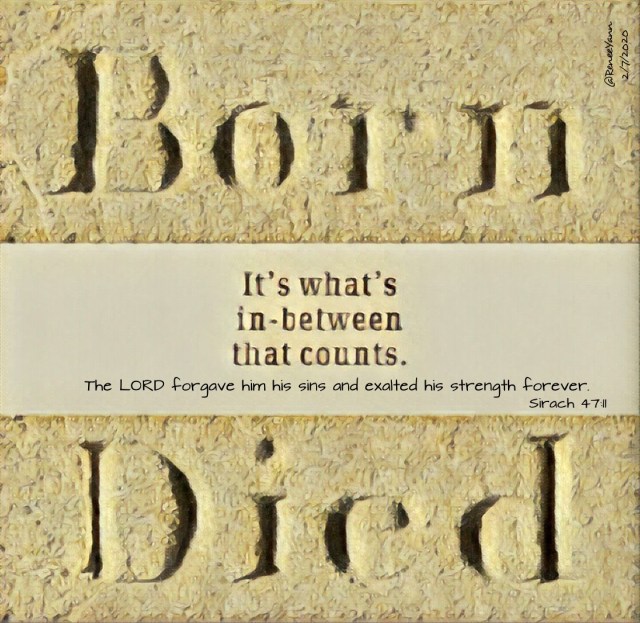
A eulogy sets a particular frame of remembrance around a person’s life. Like Sirach today, that frame tries to capture the positive accomplishments of the person who has died. We set aside any mistakes and negativity. Or we acknowledge them as Sirach has done for David by invoking God’s forgiveness:
The LORD forgave him his sins and exalted his strength forever.
To tell the truth, I’ve attended a few funerals where I wondered what the speaker might come up with in a positive regard. You know, you need more than a sentence or two for a decent eulogy! Despite my wondering, every tribute has provided an enriching lesson on the sacred beauty of a human life.
There are times when I leave such a life celebration thinking, “Gosh, I never realized that about him!” or “Wow, there are so many things we don’t understand about someone’s life!”
If only we could treat every living person with the same honor their eulogies inspire!
In our Gospel, we read the sad and violent story of John the Baptist’s martyrdom. It’s a passage filled with the best and the worst of the human heart. One would wonder what kind of eulogy could have eventually been crafted for the likes of Herod, Herodias, and Salome.
But for John the Baptist, Jesus had given him the perfect epitaph even before John died.
I say to you, among those born of women there is no one greater than John;
In the verse, Jesus also reveals what it takes to earn greatest accolade in God’s eyes:
… yet the one who is least in the kingdom of God is greater than John.
Luke 7:28
When Jesus spoke that verse, John had not yet died. If Jesus said anything about John after his death, the words are not recorded. All we have is this poignant response from Matthew:
Later, John’s disciples came for his body and buried it.
Then they went and told Jesus what had happened.
As soon as Jesus heard the news,
he left in a boat to a remote area to be alone.
But the crowds heard where he was headed
and followed on foot from many towns.
Jesus saw the huge crowd as he stepped from the boat,
and he had compassion on them and healed their sick. Matthew 14: 12-14
As we pray today with the legacies of David and the Baptist, we might consider what we’d want to see engraved on our own tombstones. I’ve told my friends I’d like to see this:
She was kind.
Still working on it!😉
What about you?
Music: Lay Me Down – in this song, two icons of country music, Loretta Lynn and Willie Nelson sing their own kind of eulogy. (Lyrics below)
I raised my head and set myself In the eye of the storm, in the belly of a whale My spirit stood on solid ground I’ll be at peace when they lay me down
When I was a child, I cried Until my needs were satisfied My needs have grown up, pound for pound I’ll be at peace when they lay me down
When they lay me down someday My soul will rise, then fly away This old world will turn around I’ll be at peace when they lay me down
This life isn’t fair, it seems It’s filled with tears and broken dreams There are no tears where I am bound And I’ll be at peace when they lay me down
When they lay me down some day My soul will rise, then fly away This old world will turn around I’ll be at peace when they lay down
When they lay me down some day My soul will rise and fly away This old world will turn around I’ll be at peace when they lay me down
Today, in Mercy, “journey” is a central theme. David takes his final journey after commissioning his son Solomon as his successor. In our Gospel, Jesus commissions the disciples for their first missionary journey.
Each of these journeys has its own “baggage requirements”.
David’s situation is easy and can be stated in a phrase we are all familiar with:
“You can’t take it with you.”
The writer of Job expresses the same sentiment:
And Job said,
“Naked I came from my mother’s womb,
and naked shall I return.
The LORD gave,
and the LORD has taken away;
blessed be the name of the LORD.” Job 1:2
It’s a lesson we seem to have a hard time learning. Whenever I pack for a trip, the challenge resurfaces.
For anyone wondering, yes this is actually me at the airport, except for the heels! 🙂
Back in my early days of flying, when there were no baggage fees, some passengers took everything but the kitchen sink on their journeys. I have a clear picture of petite women hauling suitcases bigger than themselves over to the check-in counter.
Often in life we carry a lot of baggage we don’t need. Some of it is good stuff we just can’t part with, and some of it is junk we should have tossed long ago. The point is that it’s all weight we don’t need if we want to reach our desired destination easily.
Jesus drives that point home to his disciples in today’s Gospel:
He instructed them to take nothing for the journey but a walking stick – no food, no sack, no money in their belts.
Now that’s a pretty stringent packing list! So what might it mean for our spiritual journey?
Let’s ask ourselves this:
What weighs me down from being a loving, generous, just and merciful person?
Are there things I won’t let go of because I am fearful, insecure, or selfish?
When the disciples heeded Jesus’s advice, their ensuing freedom made them capable of miracles. Might such courage do the same thing for us?
Music: Have a little fun this morning with this great old country song. Apologies to all grammarians who will spot the blatant contradiction in the title!
I Wouldn’t Take Nothing for My Journey Now – Goodman Revival
Refrain:
Well, I wouldn’t take nothin’ for my journey now
Gotta make it to Heaven somehow
Though the devil tempt me and he tried to turn me around
He’s offered everything that’s got a name
All the wealth I want and worldly fame
If I could still I wouldn’t take nothin’ for my journey now
Well, I started out travellin’ for the Lord many years ago
I’ve had a lot of heartache and I met a lot of grief and woe
But when I would stumble then I would humble down
And there I’d say, I wouldn’t take nothin’ for my journey now
Oh, there’s nothin’ in this world that’ll ever take the place of God’s love
All the silver and gold wouldn’t buy a touch from above
When the soul needs healin’ and I begin to feelin’ His power
Then I can say, thank the Lord, I wouldn’t take nothing for my journey now
Oh, I wouldn’t take nothin’ for my journey now
Gotta make it to Heaven somehow
Though the devil tempts me and he tried to turn me around
He’s offered everything that’s got a name
All the wealth I want and worldly fame
If I could still I wouldn’t take nothin’ for my journey now.
Today, in Mercy, David gets himself in trouble once again.
In the later years of his kingship, David is pretty impressed with himself. The kingdom has grown exponentially. There is peace and prosperity. David wants a census taken so that he can assess his capacity for new expansion.
So why does God get so mad about this census? The Book of Exodus sets out that a person has the right to number only his own belongings. The People belong to God, not to David. David’s pride and self-satisfaction has taken him over.
However, as usual, David repents. This is probably the best lesson we can learn from him. Then, in a greatly allegorized treatment, God gives David a choice of three punishments.
Passages like this can confuse us if we interpret them literally. Does God really interact and punish like this?
It helps to remember the purpose of these writings — not to relay a factual history, but rather to tell a story that helps us grow in relationship with God.
What I believe happened here is that a pestilence did fall upon the country. At the same time, David realized that his heart had grown selfish and graceless. He took the natural event as a sign to turn back to God. And then the writers told the story in a way that the ancient peoples could relate to – with a God that forgives but gets even.
In our Gospel, Jesus preaches another vision of God – a vision of Complete Mercy, especially toward the vulnerable, weak, and sinful. That pretty much includes all of us.
Jesus releases the power of this Divine Mercy by his words and miracles. But his own family and neighbors reject him. They are more comfortable with a God who behaves like they do – meting out more judgement and punishment (preferably toward others!😉) than mercy and inclusive benediction.
In this Gospel, we begin to see Jesus as One who asks not only for repentance but for conversion – for a new way of being with God and neighbor, the way of Love.
How might we have responded had we been in that neighborhood synagogue? How are we responding today?
These are periled times we live in, trouble everywhere
Weary hearts will often give in to this world’s despair
But high and over all, our Father knows our every care
And in His Book, if you will look, you’ll find His promise there
(Chorus)
He who trusts in the Lord
Mercy shall surround him
He who trusts in the Lord
Mercy shall surround him
Be glad in the Lord and rejoice
You upright in heart, lift up your voice
For great is His mercy toward all who trust in the Lord
Soon will be the time when we will see the Holy One
Oh how sweet to know that He’ll complete what He’s begun
And blessed is the man who stands forgiven in God’s son
And blessed are they who in that day will hear Him say, “Well done”
(Chorus)
Gracious is He and slow to anger
His loving kindness has no end
With love to embrace both friend and stranger
Reaching out to one and all, who upon His name will call
(Chorus)
Mercy is His reward
For all who trust, for the pure and just
Who put their trust in the Lord
For all who trust for the pure and just who put their trust in the Lord
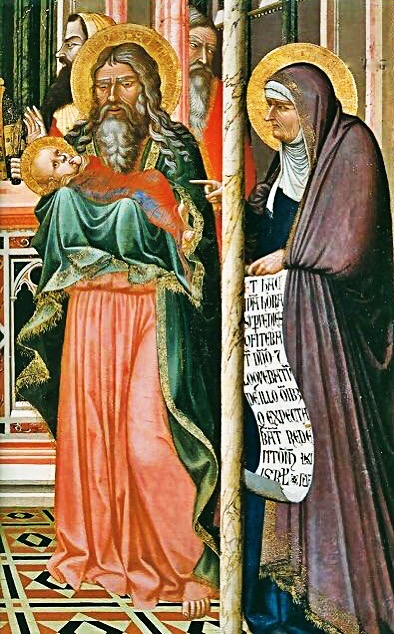
Today, in Mercy, we begin with a reading from the prophet Malachi, a hurler of fire and brimstone in the 4th-5th century before Christ. It’s an interesting choice and begs the question of how it relates to this Feast when a little baby comes to be blessed in the Temple.
Presentation of Our Lord – Ambrogio Lorenzetti (Wikipedia.org_ not for commercial use)
Ah, perhaps that’s the hinge – the Temple, both actual and symbolic.
Malachi writes at a time when the second Temple has been restored. In other words, God is about giving the people a second chance to behave according to the Covenant. But they’re not doing such a good job — especially those in charge, the priests:
A son honors his father, and a servant fears his master; If, then, I am a father, where is the honor due to me? And if I am a master, where is the fear due to me? So says the LORD of hosts to you, O priests, who disdain my name. Malachi 1:6
A Little Extra Music: Handel – But Who May Abide (You know you have time to listen just before the Super Bowl!)
Through a series of prophetic oracles, Malachi admonishes the people to repent before it is too late because no unrepentant soul will withstand the judgement.
Yes, he is coming, says the LORD of hosts. But who will endure the day of his coming? And who can stand when he appears? For he is like the refiner’s fire, or like the fuller’s lye.
In the passage from Hebrews, Paul presents the perfect priest, Jesus Christ. In taking flesh, Christ’s Body becomes the new Temple of our redemption. We stand before judgement already saved by his Passion, Death, and Resurrection.
In our Gospel, two aged and venerable prophets wait in the Temple for the Promised One. Their long years of prayer have already proven them faithful. Now, Simeon’s and Anna’s long and complete fidelity is rewarded by seeing their Savior. They know Him because they have already created a place for him in the Temple of their hearts. Now, they will meet their judgement in total peace. As Simeon’s prays:
“Now, Master, you may let your servant go in peace, according to your word, for my eyes have seen your salvation, which you prepared in the sight of all the peoples: a light for revelation to the Gentiles, and glory for your people Israel.”
It’s a beautiful, total-hearted prayer!Don’t we all hope to be able to offer it one day?
Music: Nunc Dimittis – Taizé (Latin and English text below)
Nunc dimittis servum tuum, Now dismiss your servant Domine, Domine, Lord, Lord, Secundum verbum tuum in pace. according to your word in peace Domine. Lord.
Today, in Mercy, David gets his comeuppance after his sinful forays.
David Weeps – wikipedia.org – not for commercial use
The passage is hard to deal with. It suggests that God is vengeful, and gets us back for going against him. That’s not the God Who loves me.
Like much of the Old Testament, the writer is interpreting the circumstances of life in order to teach a lesson. The lesson here is not that God is a payback God. The core lesson is that our choices have repercussions, and should always be made in the light of God’s hope for us.
Sometimes in our own lives, we think of God as reacting in a human way to us – getting angry, forgetting us, paying us back, testing us, punishing us. Like the disciples in today’s storm-tossed boat, our faith is weak and maybe misdirected.
God is Love, and Love only. God is NEVER “I’ll getcha’ “. Deep faith directs us to find God’s love – God’s continuing call to intimacy – in every circumstance of our lives.
God didn’t kill David’s illegitimate son. It just happened, the way so much of life happens. We can blame God if we want to, but we’re missing the point.
The point is that God is with us in the inevitable joys and sorrows of our lives saying, as he did to his distraught shipmates:
“Why are you terrified? Do you not yet have faith?”
Our Gospel assures us that God is with us, “sleeping” even in our rocky boat. By faith and prayer, we “wake God”, as we actually wake ourselves to the truth of God’s immutable, loving Presence in our lives.



 And Job said,




 Lavish Mercy