Choices

Friday of the Third Week of Ordinary Time

January 31, 2020

Click here for readings

Today, in Mercy, if this first reading doesn’t smack you right between the eyes, check your political pulse, dear Friends!

David has become King, called to lead his people with a largeness of heart for their good…. but…

power


Power tends to corrupt, and the corruption is hard to resist even for the likes of David. With no checks and balances on him, David commandeers anything he desires – nations, goods, women, human lives! He is convinced that he can do anything he wants to do. His choices lurch him into a spinning culture of death, evil, and selfishness.

This passage from 2 Samuel is threaded with the very same lines woven into this morning’s newspapers: plotting, manipulation, lying, obstruction, projection, irresponsibility, crudeness, disrespect….

Aren’t we just so sick and tired of it all!?

Over the coming days, we will see how David’s corruption affects him – and it’s quite a drama! But for our prayer today, what can we learn?


Perhaps the Gospel offers us a key.

Mk4_30

Jesus talks about “the Kingdom of Heaven”. He uses the symbols of a healthy harvest and a tiny mustard seed. He teaches his listeners that when the things of God are planted deep in us, we too yield a life-giving harvest. We become large-hearted, God-hearted.

Through the gift of free will, God gives us power. We can choose between good and evil, self and others, life and death. In today’s passage, David makes some huge, selfish mistakes in his choices.

Throughout history and even today, people make the same good and bad choices. When leaders make such choices, the whole world feels the impact.

Today, I might want to check how I’m doing, not only in my personal choices, but in my advocacy for a moral and just world for all people.

Music:  A Pure Heart – Rusty Nelson

Home

Wednesday of the Third Week in Ordinary Time

January 29, 2020

Click here for readings

Today, in Mercy, our readings are about being at home with God.

home

In our passage from 2 Samuel, a highly anthropomorphized God informs David that He is sick of living in a tent while being carried to and fro. God goes on to recount for David all that God has done for him, demonstrating that David can fully trust God. 

God wants a home. In other words, it’s time to make a permanent commitment and “move in together” into each other’s hearts.


sowerIn today’s Gospel, we find the familiar story of the Sower and the Seed. While the story doesn’t specifically mention “home”, Jesus indicates that only those “at home” with God’s Word will understand the true meaning of the parables.
You may have had the joy of visiting friends who greet you with the invitation, “Make yourself at home”. These friends will have done everything they can to make that possible – clean house, fresh bed linens, your brand of coffee, your favorite meals. They want you to be completely comfortable for your stay.

Well, God wants to stay forever within us. And God wants us to stay forever in God. That mutuality of homecoming is the whole purpose of our lives.

We know how to create this sacred hospitality for our friends. Let today’s reading remind us to do this for God as well by:

  • “learning” God within the Sacred Word of scripture
  • joy and awe at God’s desire to be with us
  • attention to those tendernesses that invite and welcome God
  • continual gratitude for God’s Presence
  • delighting God by our acts of love and hospitality

Music: Welcome to My Heart – Dean Martin
(Even though the song was not directed toward God, it works for me. I hope it does for you too.)

Facing the Demons

Monday of the Third Week in Ordinary Time

January 27, 2020

Click here for readings

(Sorry for the late post.  I had a brief episode of social life this afternoon. 🙂 )

Today, in Mercy, our readings talk about the polar opposites of unity and division.

Our first reading gives us David, embraced by his kinsmen, and anointed King. Strong in his unified reign, David leads his people to victory over all their enemies. His is the idyllic kingdom – the “Camelot” of the Old Testament.

Then Mark gives us Jesus, of whom David was but a pale foreshadowing. Today’s passage follows the incident in which Jesus’s kinsmen, rather than embrace him, try to “seize”him because they think he’s “out of his mind”.

Clearly, the Kingdom of Mercy for sinners and outcasts is not as acceptable as David’s kingdom of prosperity and military might. Jesus had a hard sell on his hands as his listeners have their old definitions and expectations shattered. His family can’t accept his challenge – they think he’s crazy. And now his neighbors say he is possessed by the devil!

Pretty dispiriting for Jesus, right? 

No way! Here, very early in Mark, Jesus – despite challenge – emerges as “the stronger one”:

But no one can enter a strong man’s house to plunder his property
unless he first ties up the strong man.

Jesus’s strength lies in his Oneness with the Father and the Holy Spirit, the Divine Community that embraces and inspires his mission. Human rejection, even in the ultimate form of Calvary, will not change or diminish his Truth.

Mk3_29 demons


When Jesus talks about blaspheming against the Holy Spirit, it is that kind of rejection he is describing – that place where a human heart is hardened against an abandonment to grace.

Here the sin is unforgivable because those who charge Jesus
with demonic possession see goodness as evil, and therefore
are closed to the action of God’s Spirit. This makes sense for
Mark’s readers only in terms of the preceding narrative
where Jesus, endowed with the Spirit, preaches the good news of God.  The unforgivable sin in biblical thought is similar to “hardness of heart”.

The Gospel of Mark ~ John R. Donahue, SJ, Daniel J. Harrington, SJ


Today’s Gospel reminds us to continually purify that inner heart where God wants to dwell in us. The demons that would petrify us are often more subtle than the ones in our Gospel story. They masquerade under the guise of a false “gospel” that fails to require our inner conversion to mercy, justice and love.

May we pray with today’s Responsorial Psalm that God’s faithfulness and mercy guide us as we seek to deepen in the Mystery of Christ.

Music: Deeper – Hillsong

Redeemed!

Third Sunday in Ordinary Time

January 26, 2020

Click here for readings

Today, in Mercy, our readings are all about redemption… and what a free and glorious gift it is.

How thrilling are these verses?

Anguish has taken wing, dispelled is darkness:
for there is no gloom where but now there was distress.
The people who walked in darkness
have seen a great light;
upon those who dwelt in the land of gloom
a light has shone.

When I read them, I so much want to meet Isaiah, to get him to sign my Bible, to come to my house for soup and bread! Because he is filled with hope and exultation at the Mercy of God, just like I want my life to be!

IMG_2297

Paul, sensing some jealous competition in his Corinthian buddies, tells them  — Get a grip! You are obsessing over incidentals when we have been redeemed and made one in the Passion, Death, and Resurrection of Jesus Christ!

Then, when I read these beautiful, lilting lines in the Gospel …

He left Nazareth and went to live in Capernaum by the sea,
in the region of Zebulun and Naphtali,
that what had been said through Isaiah the prophet
might be fulfilled:

Land of Zebulun and land of Naphtali,
the way to the sea, beyond the Jordan,
Galilee of the Gentiles,
the people who sit in darkness have seen a great light,
on those dwelling in a land overshadowed by death
light has arisen.

…I so want to go live with Jesus too, right there on Capernaum’s shores, because he was the very House of Mercy inviting us all to dwell anew in him. 

Jesus is the Living Redemption prophesied by Isaiah. He is the reason Paul turned his life upside down. Jesus is the Great Light in our darkness.

Praise and thank our Generous God!

Music: Streets of Capernaum – Clay Crosse

Fill the World with Love

Memorial of Saint Francis de Sales, bishop and doctor of the Church

January 24, 2020

Click here for readings

Today, in Mercy, David spares Saul’s life even though Saul is in murderous pursuit of him. (Here is a video for kids featuring the moment. But I thought it was pretty cool. Maybe you will too.)

Is David noble or naïve? Is he magnanimous or stupid? As I pray this morning, I ask myself what it is that God might be saying to me through this passage.

Two things rise up:

  1. Above all else, David is motivated by a deep respect for God’s Will and Presence in his life.

David said to his men,
“The LORD forbid that I should do such a thing to my master,
the LORD’s anointed, as to lay a hand on him,
for he is the LORD’s anointed.”

    2.  David engages Saul directly and respectfully in the hope of reaching a resolution of    their issues.

When David finished saying these things to Saul, Saul answered,
“Is that your voice, my son David?”
And Saul wept aloud.

Reverence and honesty rooted in sincere love and respect for one another! What a world we would live in if each of us practiced these things unfailingly!


In our Gospel, Jesus calls his disciples to live in the world in just such a way – to bring healing and wholeness in the Name of Christ, for the sake of Love.

Our Alleluia Verse today captures the essence of Christ’s call to them —- and to us:

God was reconciling the world to himself in Christ,
and entrusting to us the message of that reconciliation.


Music: To Fill the World with Love sung by Richard Harris
(Lyrics below, but you will no doubt recall them from the fabulous film “Goodbye Mr. Chips”.)

In the morning of my life I shall look to the sunrise.
At a moment in my life when the world is new.
And the blessing I shall ask is that God will grant me,
To be brave and strong and true,
And to fill the world with love my whole life through.

And to fill the world with love
And to fill the world with love my whole life through

In the noontime of my life I shall look to the sunshine,
At a moment in my life when the sky is blue.
And the blessing I shall ask shall remain unchanging.
To be brave and strong and true,
And to fill the world with love my whole life through

In the evening of my life I shall look to the sunset,
At a moment in my life when the night is due.
And the question I shall ask only You can answer.
Was I brave and strong and true?
Did I fill the world with love my whole life through?

To Save A Life …

Day of Prayer for the Legal Protection of Unborn Children

January 22, 2020

Click here for readings

Today, in Mercy, our first reading is stuff worthy of an action movie! Even today, in my seventh decade, I remember the first time I heard it as a spellbound child. Could young, virtually unarmed David really conquer a GIANT!

Goliath

Wrapped in the story, of course, is the spiritual nugget we are meant to take to our own heart:

…thus the whole land shall learn that Israel has a God.
All this multitude, too,
shall learn that it is not by sword or spear that the LORD saves.
                    For the battle is the LORD’s
       and he shall deliver you into our hands.


We have battles of every description all around us: military, political, economic, cultural, moral, and personal. Today’s Day of Prayer highlights one of those battles – the right to life for unborn children.

On January 22, 1973, the Supreme Court issued a 7–2 decision in favor of Roe that held that women in the United States have a fundamental right to choose whether or not to have abortions without excessive government restriction, and struck down Texas’s abortion ban as unconstitutional. (Wikipedia)

Since that fateful day, many people of faith, and certainly the Catholic Church, have fought this decision. It has been a contentious and divisive battle which has divided people into pro and anti-abortion factions.

From my perspective, one unfortunate dimension of the situation is an insufficient effort by Catholic bishops to provide wholistic definition, research, teaching, and support to Catholics on the moral imperative for the right to life in all its aspects.

Mk3_4_life

Episcopal support for right to life often degenerates into a single-issue approach which fails to instruct on other life issues such as war, death penalty, poverty, adequate health care, civil and women’s rights, and environmental justice.

At the same time, morality statements around these issues often fail to address legitimate concerns around birth control, maternity care, newborn nutritional programs, and other issues parents struggle with.

Probably what most infuriates me is the political hijacking of this single issue by those whose own moral and policy choices mock a comprehensive culture of life.

Benedictine Sister Joan Chittister said this in a 2004 interview:

“I do not believe that just because you are opposed to abortion, that that makes you pro-life. In fact, I think in many cases, your morality is deeply lacking if all you want is a child born but not a child fed, a child educated, a child housed. And why would I think that you don’t? Because you don’t want any tax money to go there. That’s not pro-life. That’s pro-birth. We need a much broader conversation on what the morality of pro-life is.”

Personally, I am deeply opposed to abortion. And I am just as deeply opposed to an inconsistent morality and a policy-making which isolates this issue to the point of stagnating ignorance and indifference on other critical life issues.

A phrase in today’s Gospel struck me as I prayed on these things. Perhaps it will strike you as well:

Jesus said to the Pharisees,
“Is it lawful to do good on the sabbath
rather than to do evil,

to save life rather than to destroy it?

Jesus acknowledges that finding moral perfection requires a balancing of goods, some of which are weightier than others. The Sabbath laws were designed to foster the spiritual life. But if their observance consigns this crippled man to hopelessness, have the laws met their goal?

If indeed a life is saved from abortion, society must continue to save that life by fostering a culture which supports it for ALL of its life..

Music: Hymn of Life – St. Teresa of Calcutta

So Much More Than a Holiday!

photo-1570492886075-77b6014064ab

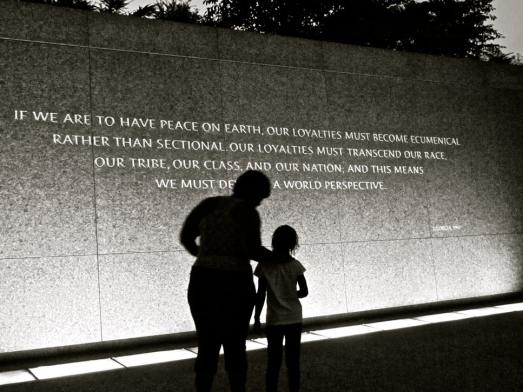
Some of us begin this day simply grateful for a holiday. Perhaps some of us forget, or some are too young to remember, how this “holiday” came to be.

But there are some among us who are old enough to remember his actual voice; to have listened — live – on that sweltering August day in 1963 when he inspired us with the words:

I have a dream.

gty_march_on_washington_martin_luther_king_ll_130819_16x9_992

There are some of us who saw him stand on the steps of the Lincoln Memorial on that golden day, the personification of President Lincoln’s vision of justice and equality.

 There are some of us who listened and watched every step he took, every prayer he said, every challenge he met with equanimity and courage.


 There are some of us who remember the very night he told us:

I have been to the mountaintop 
and I have seen the Promised Land.
I may not get there with you.
But I want you to know that we,
as a people,
will get to the promised land.


There was a whole world of us who cried when he was martyred the very next day.


Monday is no mere holiday. It is the commemoration of a giant soul who changed the world forever. And he did it not in the way that many have done it throughout history — through wars and conquest.

Martin Luther King changed the world by non-violent protest, by a leadership of love, by a faith that endures beyond the assassin’s gun.

Say his name in reverence on this commemorative day. He has given all of us — no matter our color — the hope of a more human existence. If you have not had the gift of living in his time, ask your elders who remember his face, his sound, his power to tell you the story of the freedom God gave each of us.

 In his memory, and to continue to realize his dream, we might consider these 12 steps to non-violence for our own lives.


12 Steps to Non-Violence

  1. Acknowledge your powerlessness — that our lives/culture are co-opted by subversive and pervasive violence
  2. Believe that a Power greater than ourselves can restore us to right relationship.
  3. Decide to turn our will and our lives over to that Power.
  4. Examine fearlessly our own violent inclinations.
  5. Admit to that Power, to ourselves and to another person the exact nature of our own violence.
  6. Be open to have that inclination removed.
  7. Ask to have all violence removed from our hearts and actions.
  8. List all persons to whom we have been violent by word or deed and be willing to make amends to them.
  9. Amend directly to these people wherever possible and prudent.
  10. Self-examine continuously; promptly admit recurring violence in ourselves.
  11. Seek through prayer and meditation to know the nature of Peace and Mercy.
  12. Carry the message of non-violence to others and practice it in all our interactions.

Music: “Abraham, Martin and John” is a 1968 song written by Dick Holler and sung here by Marvin Gaye. It is a tribute to the memory of four assassinated Americans, all icons of social change: Abraham Lincoln, Martin Luther King Jr., John F. Kennedy, and Robert F. Kennedy. It was written in response to the assassination of King and that of Robert Kennedy in April and June 1968, respectively. (Wikipedia)

The song reflects the mix of awe, hope, sorrow and disappointment the nation felt in those tumultuous times.


The Sacred Legacy of MLK

Monday of the Second Week in Ordinary Time

January 20, 2020

Click here for readings

MLKJPG

Today, in Mercy, as we memorialize the life and legacy of Dr. Martin Luther King, Jr., our readings speak about leadership and its continuing call to renew the world in the image of its Creator.

In our first reading, Samuel relays God’s displeasure to Saul who, though a conquering hero, has failed in humility and obedience before the Lord. 

In the story, God has given a clear direction to Saul to obliterate Israel’s centuries-old enemy, the Amalekites. Instead Saul, after executing the masses, keeps the enemy king alive as a war trophy. He appropriates the cattle as personal spoil. He also sets up a shrine to commemorate the victory as his own.

God is not happy. When we profess to lead in God’s name we must act as God directs us. In order to understand God’s direction, we must cultivate an honest, just and merciful heart.


Martin Luther King was such a leader. By his faithful obedience to God’s inspiration, Martin, at the ultimate cost, turned the tides of history toward justice and freedom.

But the tides still need turning, because there will always be those who seek “war trophies”, and personal spoil, and domination for themselves. Our times are tortured by such selfish and failed leadership, just as all of history has been from ancient Israel until 1968 and until now.

Today, as we pray with this great prophet and leader, we ask that selfless, merciful and faith-impelled souls continue to hear the call to justice in our day. May Martin’s witness strengthen and inspire us.


Music: Precious Lord, Take My Hand – Mahalia Jackson (Lyrics below)

Per Dr. King’s request, his good friend Mahalia Jackson sang his favorite hymn, “Take My Hand, Precious Lord”, though not as part of the morning funeral service but later that day at a second open-air service at Morehouse College.

Precious Lord, take my hand
Lead me on, let me stand
I am tired, I am weak, I am worn
Through the storm, through the night
Lead me on through the light
Take my hand, precious Lord
And lead me home

When my way grows dreary
Precious Lord, lead me near
When my life is almost gone
At the river I will stand
Guide my feet, hold my hand
Take my hand, precious Lord
And lead me home

Welcome, Christ, Our Light!

Second Sunday in Ordinary Time

January 19, 2020

Click here for readings

Is49_6 Light

Today, in Mercy, our readings invite us to witness the debut of Jesus Christ as he begins his public ministry.  The world has been waiting since the beginning of time and now… here He is!

Now the LORD has spoken
who formed me as his servant from the womb,
that Jacob may be brought back to him
and Israel gathered to him;
and I am made glorious in the sight of the LORD,
and my God is now my strength!

Remember when Pope Francis visited Philadelphia in 2015? The excitement? The preparation? The fanfare? What was that all about?

09222016_Pope_Francis_TC.2e16d0ba.fill-735x490
from phillyvoice.com

I think that, in one form or another, we all wanted to see and be touched by goodness. We wanted to see someone who confirmed that the world could be better than our current experience. We wanted to see the beauty of God in a human being.

The people of Jesus’s time wanted the same things. They longed for a wholeness that was beyond their grasp. They longed for healing that had continually eluded them. They longed to be renewed in faith, hope and love.

That deep longing is universal in every human life. Seeing the Pope on the Parkway won’t fill it. Even seeing Jesus one afternoon in Capernaum won’t do that. Our Alleluia Verse from John’s Gospel tells us the only way to such fulfillment:

The Word of God became flesh and dwelt among us.
To those who accepted him,
he gave power to become children of God.

In our Gospel, we see John the Baptist’s full acceptance of Jesus into his life. After that moment in the Jordan River when the Spirit descended, John’s life changed. It became a life patterned on and completed in the reality of Jesus Christ, not only his expectation.

John changed because he saw and believed. Our Gospel today invites us to the same kind of witness and testimony in our lives:

John testified further, saying,
“I saw the Spirit come down like a dove from heaven
and remain upon him.
I did not know him,
but the one who sent me to baptize with water told me,
‘On whomever you see the Spirit come down and remain,
he is the one who will baptize with the Holy Spirit.’
Now I have seen and testified that he is the Son of God.

May God give us the grace to see and respond to the reality of Christ in our own lives – in the poor, the sick, the persecuted, those longing to know God. Drawing on the beautiful Light of Christ, may we also be a testimony to God’s Merciful Presence in our world.

Music: He Shall Come Again in Glory – Philip Webb (Lyrics below)

This majestic modern hymn proclaims the hope of Christ’s second coming. Crafted for success; the arrangement captures the mystery and majesty of the text and delivers it adroitly to the choir loft with full; satisfying harmonies. Powerful! (from the East Coast Music website)

He who wept above the grave
Who stilled the raging of the wave
Meek to suffering, strong to save,
He shall come again in glory

He who sorrow’s pathway trod
He that every good bestowed
Son of Man, Son of God,
He shall come again in glory.

He who bled with scourgings sore,
He who scarlet meekly wore,
He who every sorrow bore,
He shall come again in glory.

Monarch of the smitten cheek,
Scorn of Jew and scorn of Greek,
Priest and King divinely meek,
He shall come again glory.

He who died to set us free,
He Who comes whom I shall see,
Jesus, only, only He,
He shall ever reign in glory.

Mercy says, “Of course…”

Thursday of the First Week in Ordinary Time

January 16, 2020

Click here for readings

( Our Gospel today nearly repeats a passage in Luke about which I wrote last year. Being a little lazy tonight, and wanting to watch Jeopardy- GOAT, I am offering that earlier reflection to you again. Besides, I liked it.  I hope you do, dear Friends.)

Mk1_41-of-course
This is the Greek word for “Of course!”

Today, in Mercy, Jesus shows us how to live a merciful life – through loving, generous, joyfully responsive service.

A pitiable leper interrupts Jesus on his journey to ask for help. People like this man were scorned, feared, and isolated. Their leprosy impoverished them, making them annoying beggars. Their cries usually met with indifference at best and banishment at worst.

But when this leper poses his proposal to Jesus – “If you want to, you can heal me.” — Jesus gives the spontaneous answer of a true, merciful heart: “Of course I want to!”

There is no annoyance, no suggestion that other concerns are more important. There is just the confirmation that – Yes- this is the purpose of my life: to heal, love, show mercy toward whatever suffering is in my power to touch. There is just the clear message that “You, too, poor broken leper, are Beloved of God.”

What an example and call Jesus gives us today! We are commissioned to continue this merciful touch of Christ along the path of our own lives. When circumstances offer us the opportunity to be Mercy for another, may we too respond with enthusiasm, “Of course I want to!” May we have the eyes to see through any “leprosy” to find the Beloved of God.

Music: Compassion Hymn – Kristyn and Keith Getty