Moses’s Psalm: Dark to Light

Friday of the Eighteenth Week in Ordinary Time

August 7, 2020

Today, in God’s Lavish Mercy, we pray once again with Deuteronomy 32, often referred to as the Psalm of Moses. And once again, our psalm links the heavy messages of our two main readings.

In our first reading from Nahum, the prophet describes Israel’s future restoration after the bloody destruction of Nineveh, chief city of the Assyrian conquerors.

In our Gospel, Jesus foretells his own Passion and Death, and the necessity that his disciples carry their own crosses.

The tenor of both readings is soberly captured in our psalm:

Learn then that I, I alone, am God,
and there is no god besides me.
It is I who bring both death and life,
I who inflict wounds and heal them.

Given the heavy, stormy morning here where I live, these readings are hitting me like a wet blanket! It’s hard to find the link to Light within them, but I believe there always is one – and I’ll suggest one subsequently. But first this.

Often in life, too, it’s hard to find the link to light. Harsh and insufferable realities can stubbornly darken our horizons.

Just this morning, I read about a podcast in which Michelle Obama had revealed a struggle with depression:

“These are not, they are not fulfilling times, spiritually,” Mrs Obama said. “I know that I am dealing with some form of low-grade depression. Not just because of the quarantine, but because of the racial strife, and just seeing this administration, watching the hypocrisy of it, day in and day out, is dispiriting.”


Mrs. Obama is describing her “Nineveh”.  Mine is pretty similar. What’s yours?
And how do we hold faith, even in the middle of “Nineveh”?

These assuring verses from Nahum offer the flicker of Light and the promise of Salvation. They encourage us to stay strong, remain faithful. We must keep lifting our eyes to the future that God dreams for all people, discerning its rising like the sun in a morning mist.

See, upon the mountains there advances
the bearer of good news, 
announcing peace!
Celebrate your feasts, O My people,
fulfill your vows!
…. The LORD will restore the beloved vine,
its hope, courage and strength …


Poetry: The Good God and the Evil God – Kahlil Gibran

The Good God and the Evil God 
met on the mountain top.
The Good God said, 
“Good day to you, brother.”
The Evil God did not answer.

And the Good God said, 
“You are in a bad humour today.”
“Yes,” said the Evil God, 
“for of late I have been often mistaken for you, 
called by your name, and treated 
as if I were you, and it ill-pleases me.”
And the Good God said, 
“But I too have been mistaken for you 
and called by your name.”

The Evil God walked away 
cursing the stupidity of humankind.

Music: How Beautiful – Joe Wise
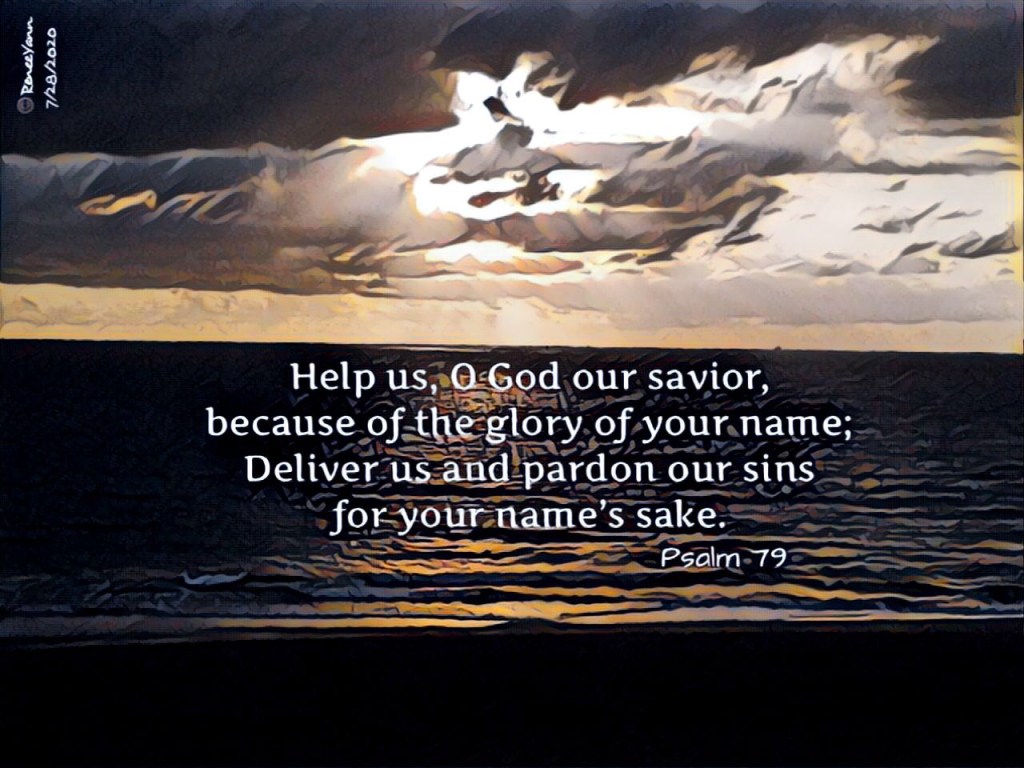
Psalm 79: Brought Low, O Lord!

Tuesday of the Seventeenth Week in Ordinary Time

July 28, 2020


Today, in God’s Lavish Mercy, we pray with Psalm 79, which is identified as “a psalm of Asaph”. The Psalms of Asaph are the twelve psalms numbered as 50 and 73–83 and either transcribed by Asaph or sung by the Asaphic choir. So Asaph is a bit like the Andrew Lloyd Weber of the Psalms, absorbing David’s prayers and rendering them in song.

One of the most important aspects of the Psalms is the deep honesty of their prayer. Those praying do not pretend to be anything but what they are: frightened, bereft, angry, delighted, grateful beyond words – whatever the situation of their lives.

Psalm 79 is a particularly moving hymn of communal lament. The psalmist prays for all the People with a nearly startling honesty:

Remember not against us the iniquities of the past;
may your compassion quickly come to us,
for we are brought very low.

Each evening, in this pandemic time, I find myself saying a very similar prayer.

Dear God, please be merciful to all our world.
We are in terrible trouble.

Help us to hold on and lead us out of darkness.


Psalm 79 compares the troubles to being imprisoned… trapped, no escape. Certainly, that is the feeling for many of us during these days when “we are brought very low” by a global disease and a dysfunctional political culture.

Let the prisoners’ sighing come before you;
with your great power free those doomed to death.


Ah, there is the hinge for our faith to hold on to … God’s great Power in all things. That merciful Power is at work despite appearances. God is able and will bring Light out of darkness, Life out of destruction.

One day – perhaps not now – but one day, we will recognize that Power. The waiting is called Faith.

Then we, your people and the sheep of your pasture,
will give thanks to you forever;
through all generations we will declare your praise.


Poetry: Prayer by John Frederick Nims


Music: Psalm 79 by Psalms Reborn

Psalm 126: The Rhythm of Life

Feast of Saint James, Apostle

July 25, 2020 

Today, in God’s Lavish Mercy, we pray with Psalm 126, one of fifteen Psalms of Ascent, which meant it would be sung in gratitude when “ascending” for prayer.

You may enjoy listening to the Psalm read accompanied by music.
Psalm 126 – Milken Archive, Jewish Choral Art in America.


Psalm 126 is popular and immediately recognizable to Jews and Christians. Thought to be written by either Ezra or the prophets at the return from the Babylonian Captivity, the psalm celebrates restoration while remembering the lessons of exile.

Israel is overwhelmed with gratitude at their deliverance, barely able to comprehend God’s goodness.

When the LORD brought back the captives of Zion,
we were like men dreaming.
Then our mouth was filled with laughter,
and our tongue with rejoicing.


Have you ever had a feeling like that, perhaps when you’ve gotten to the other side of a really rough patch in your life? Feeling like we’ve come through a dream – maybe a bad one – we can’t even find the words to thank God for helping us. We might simply laugh or cry for joy.

Psalm 126 reminds us not to let that tumultuous gratitude dissipate. The repetition of the psalm inscribes that gratitude on our hearts, transforming it to renewed hope and trust in God. As Catherine McAuley reminds us, life is a series of joys and sorrows. Both cycles can deepen our faith when we receive them in union with God.

This is your life,
joys and sorrow mingled,
one succeeding the other.

Letter to Francis Warde – May 28, 1841

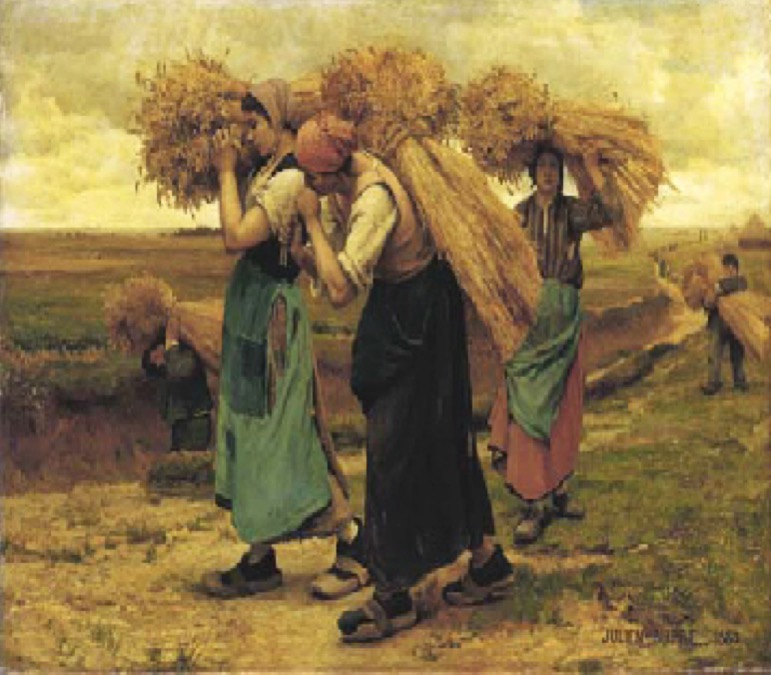
Julien Dupré (French, 1851-1910)

Psalm 126 assures us that we can meet our life experiences with hope and trust because God is faithful. Within both our “comings” and our “goings”, God abides with us and will deliver us to joy.

Although they go forth weeping,
carrying the seed to be sown,
They shall come back rejoicing,
carrying their sheaves.


Poetry:  A Short Testament by Anne Porter

Whatever harm I may have done 
In all my life in all your wide creation creation
If I cannot repair it 
I beg you to repair it, 

And then there are all the wounded 
The poor the deaf the lonely and the old
Whom I have roughly dismissed 
As if I were not one of them. 
Where I have wronged them by it 
And cannot make amends 
I ask you 
To comfort them to overflowing,

And where there are lives I may have withered around me,
Or lives of strangers far or near 
That I've destroyed in blind complicity, 
And if I cannot find them 
Or have no way to serve them,

Remember them. I beg you to remember them

When winter is over 
And all your unimaginable promises
Burst into song on death's bare branches.

Music: Hallelujah- Leonard Cohen

Jeremiah’s Psalm

Friday of the Sixteenth Week in Ordinary Time

July 24, 2020

Today, in God’s Lavish Mercy, we pray with Jeremiah’s Psalm. The verses come from chapter 31, part of what is referred to as the “Book of Comfort”. (Chapter 31-33)

In total, the Book of Jeremiah is full of woe. It was written as a message to the Jews in Babylonian exile, blaming their faithlessness for their current predicament. The prophet admonishes the people, calling them to return to the Lord and allow themselves to be made new according to God’s design.

Jeremiah is notable for its complementary tactics of confronting the people with their sorrows while comforting them with God’s mercy. 

Hear the word of the LORD, O nations,
proclaim it on distant isles, and say:
He who scattered Israel, now gathers them together,
he guards them as a shepherd his flock.


Jeremiah forces his listeners to acknowledge that their destruction is deserved. They have shifted their trust from God’s Promise to a political power that devolved into greed, militarism, and the illusion of self-sufficiency. Once that acknowledgement is accomplished, repentance and renewal are possible.

Our passage today describes that possibility:

The LORD shall ransom Jacob,
he shall redeem him from the hand of his conqueror.
Shouting, they shall mount the heights of Zion,
they shall come streaming to the LORD’s blessings:
The grain, the wine, and the oil,
the sheep and the oxen.


Believing that scripture speaks to our experiences as well as to their own times, we may discover stark parallels between our world and that of Jeremiah. As we pray with this psalm, let’s ask to see where we have shifted from God’s hope for Creation. Where do we feel a sense of loss, confusion, desperation or anger? Where have we lost truth, compassion, and reverence for the life we share with all the human community?


As my small community watches the evening news, we audibly mourn the sorry state to which our world has come. We encourage one another to moral and political responsibility to change the forces that have led to this collapse.

This cycle of acknowledgement and grace-filled action can allow us to return, as did Jeremiah’s community, to God’s dream for Creation:

I will turn their mourning into joy,
I will console and gladden them after their sorrows.


Poetry:  What Babylon Was Built About – Judson Crews (1917- 2010) American poet

Music: I Will Restore – Maranatha Music

What was lost in battle
What was taken unlawful
Where the enemy has planted his seed
And where health is ailing
And where strength is falling
I will restore to you all of this and more

I will restore
I will restore
I will restore to you all of this and more

I will restore
I will restore
I will restore to you all of this and more

Where your heart is breaking
And where dreams are forsaken
When it seems what was promised; will not be given to you
And where peace is confusion
And reality an illusion
I will restore
I will restore
I will restore to you all of this and more

Psalm 85: Believe a New World into Being

Tuesday of the Sixteenth Week in Ordinary Time

July 21, 2020


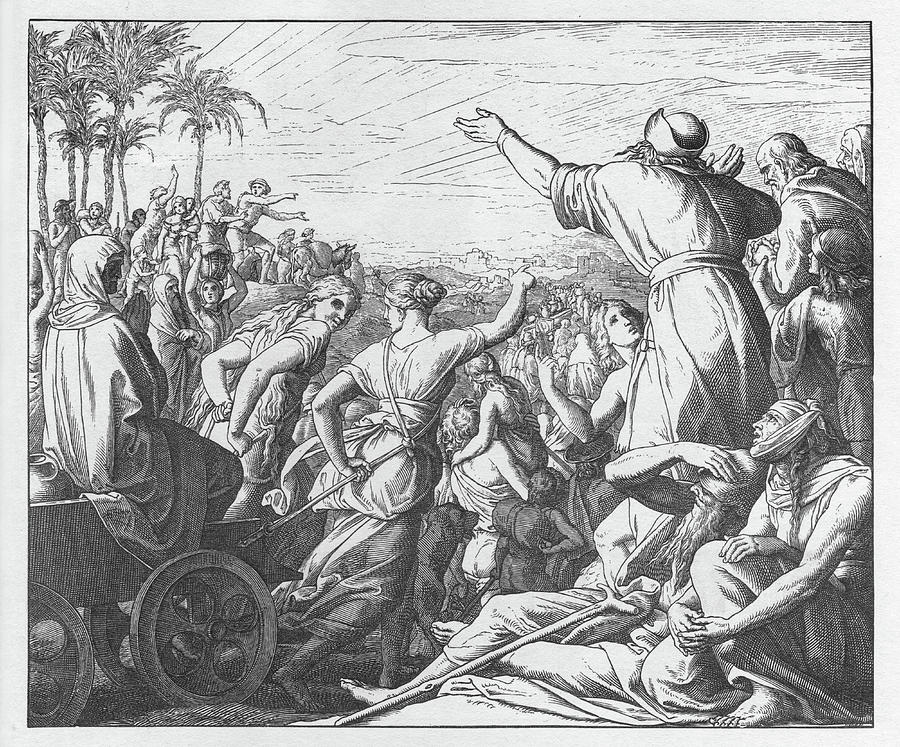
Return from Babylon by Julius Schnoor von Carolsfeld

Today, in God’s Lavish Mercy, we pray with Psalm 85. In Judaism, it is called “a psalm of returned exiles” as it reflects the experience of the Jews returning to their ravished land after the Babylonian exile. Things are a mess, and they have to start all over again to rebuild their Abrahamic nation. 

But they pray as if it is already accomplished.

Despite their suffering and captivity, the people have not lost hope in the promise of Yahweh. They expect its fulfillment and call on God to make it happen.

You have favored, O LORD, your land;
you have brought back the captives of Jacob.
You have forgiven the guilt of your people;
you have covered all their sins.
You have withdrawn all your wrath;
you have revoked your burning anger.


This is the power and beauty of a pure and faithful heart. It is free to “believe” God into action. We find this prayerful power expressed over and over in the Psalms. It is answered by God’s almighty and active desire for our good.


The Psalms mediate to us the great promise keeper whose resolve guarantees that the world is not a closed system. Creation, instead, is a world very much in process, sure to come to full shalom. Despair is the fate of a world “without god,” where there are no new gifts to be given. The Psalms refuse that world, knowing that God is not yet finished. Consequently, the Psalms can gather all the great words of the covenant and apply them to the future …

Walter Bruggemann

During these pandemic times, don’t prayer and promises like these speak to our hearts?

I find myself wondering what the world will be like when we finally “return” – come out of our “Covid exile” – what it will be like to see and hug the family, friends and community we love and miss right now, or to fully mourn those we have lost – what it will be like to resume our soul’s unworried dance with Creation and Time.


As we imagine that world, how might we hope for it to be more reflective of God’s dream for us than the world we closed down last March, than the “Babylon” we are experiencing? How will our prayers and actions for merciful justice “believe” God’s promises into reality for all God’s People?

Will you not instead give us life;
and shall not your people rejoice in you?
Show us, O LORD, your kindness,
and grant us your salvation.

I picture some ancient Jewish woman or man standing amidst the rubble of the ruined Temple. How deep did that person have to reach to find the faith and hope to move God?

I picture us standing in a very sick and dysfunctional world. Can we reach that deep ourselves by praying in the childlike, confident spirit of the Psalms:

Lord, show us your mercy and love.


Poetry: Antidotes to Fear of Death – by Rebecca Elson, a gifted Canadian–American astronomer and writer. Elson was diagnosed with non-Hodgkin’s lymphoma at the age of 29. With treatment, it went into remission, and in 1996 she married the Italian artist Angelo di Cintio. However, the cancer returned soon afterwards. Elson died of the disease in Cambridge in May 1999, at the age of 39.

A volume of wide-ranging poetry and essays she wrote from her teens until shortly before her death was published posthumously as A Responsibility to Awe in 2001 in the United Kingdom, and in 2002 in the United States. 

Antidotes to the Fear of Death

Sometimes as an antidote
To fear of death,
I eat the stars.

Those nights, lying on my back,
I suck them from the quenching dark
Til they are all, all inside me,
Pepper hot and sharp.

Sometimes, instead, I stir myself
Into a universe still young,
Still warm as blood:

No outer space, just space,
The light of all the not yet stars
Drifting like a bright mist,
And all of us, and everything
Already there
But unconstrained by form.

And sometime it’s enough
To lie down here on earth
Beside our long ancestral bones:

To walk across the cobble fields
Of our discarded skulls,
Each like a treasure, like a chrysalis,
Thinking: whatever left these husks
Flew off on bright wings.

Music: Going Home– based on Antonin Dvořák’s Largo from New World Symphony, lyrics by William Arms Fisher, sung here by Alex Boyé with the Mormon Tabernacle Choir

Psalm 10: Lord, Don’t Turn Away

Saturday of the Fifteenth Week in Ordinary Time

July 18, 2020

Today, in God’s Lavish Mercy, we pray with Psalm 10. It is known in Latin by its first mournful line:

Ut quid Domine recessisti

Lord, why are You standing so far from me?


The image that comes to my mind is of two people at a large social gathering. One is not speaking to the other because of a profound disagreement. But the other is desperately sorry and wants to be forgiven and restored. Still, the first person remains distant, off in the room’s far corner, and seems to ignore any imploring glances.


In Psalm 10, Israel is that imploring person. They lament all the discord around them and wonder why their powerful Friend seems to ignore them, failing to help.

I know that I have talked to God about this feeling hundreds of times. What about you?

I continually ask the age-old question, “Why do bad things happen to good people?” Are you not paying attention, Lord?  Did you accidentally fire the “Bad Things Gun” in the wrong direction, or do you just not care?

Why do You seem not to notice or care?


But the psalmist eventually stills herself at the center of these spinning questions. In that stillness, she rests in utter dependency on God. We creatures do not see through the mystery of good and evil, but God does. When we accept that, and look for God in the circumstances, peace settles in.

You do see, for you behold misery and sorrow,
taking them in your hands.
On you the unfortunate one depends;
of the fatherless you are the helper.


Psalm 10, for all its heart-wrenching mournfulness, is really a psalm of exultant victory. Within its prayer, the vulnerable one is transformed to comprehend the secret. God favors them and assures their deliverance by faith.

If for some reason, we might feel that God is on the other side of the room ignoring us, let us not turn away. Walk over and tug God’s sleeve with your prayer.  Lift the burdens from your shoulders into God’s open arms.

You listen, LORD, to the needs of the poor;
you strengthen their heart and incline your ear.

Poetry:  another excerpt from Burnt Norton – T.S. Eliot

IV
Time and the bell have buried the day,
the black cloud carries the sun away.
Will the sunflower turn to us, will the clematis
Stray down, bend to us; tendril and spray
Clutch and cling?
Chill
Fingers of yew be curled
Down on us? After the kingfisher’s wing
Has answered light to light, and is silent, the light is still
At the still point of the turning world.

Music: D’où vient cela – Claudin de Sermisy – written in, and sung here, in French by a German choir. This melody was originally a popular love chanson, reworked in the 16th century to be Psalm 10. I could find only the French and German translations (below). For those, like me, who understand neither, the music itself is sufficiently beautiful.

Isaiah’s Psalm

Friday of the Fifteenth Week in Ordinary Time

July 17, 2020

Today, in God’s Lavish Mercy, we pray with Isaiah 38 as our Responsorial Psalm.

Although the verses are under Isaiah, they are actually the words of Hezekiah, a king of Israel during Isaiah’s time. Our first reading relates the story of Hezekiah’s mortal illness and the prophetic role Isaiah plays in his recovery.

Our psalm reemphasizes the power and mercy of God who delivers Hezekiah from death. Hezekiah’s vibrant images reveal the depth of his desperation:

Once I said,
“In the noontime of life I must depart!
To the gates of the nether world I shall be consigned
for the rest of my years.”


We all know what the prayer for deliverance feels like. It rises from the depths of our souls and repeats itself in a constant, “Please…”. We can think of nothing else but the favor we are praying for. We linger in our begging, sometimes for years.

Hezekiah stretches into the full extent of his pain with these striking metaphors:

My dwelling, like a shepherd’s tent,
is struck down and borne away from me;
You have folded up my life, like a weaver
who severs the last thread.


Deliverance is that condition in which we, having lost all personal power to effect change, must be carried by another hand to life and well-being. If we can do that in faith, our prayer will be answered.

When it is, by either a merciful “Yes” or “No”, we will understand. It will be as if we have fallen from hanging by our fingernails into the enveloping caress of a feathered bed.

Those live whom the LORD protects;
yours is the life of my spirit.
You have given me healing and life.


Poetry: For Deliverance from a Fever by Anne Bradstreet (1612 – 1672),  the most prominent of early English poets of North America and first writer in England’s North American colonies to be published. She is the first Puritan figure in American Literature.

When sorrows had begirt me round, 
And pains within and out, 
When in my flesh no part was found, 
Then didst Thou rid me out.

My burning flesh in sweat did boil, 
My aching head did break, 
From side to side for ease I toil, 
So faint I could not speak.

Beclouded was my soul with fear 
Of Thy displeasure sore, 
Nor could I read my evidence 
Which oft I read before.

“Hide not Thy face from me!" I cried, 
"From burnings keep my soul. 
Thou know'st my heart, and hast me tried; 
I on Thy mercies roll." 

“O heal my soul," Thou know'st I said, 
"Though flesh consume to nought, 
What though in dust it shall be laid, 
To glory t' shall be brought." 

Thou heard'st, Thy rod Thou didst remove 
And spared my body frail 
Thou show'st to me Thy tender love, 
My heart no more might quail.

O, praises to my mighty God, 
Praise to my Lord, I say, 
Who hath redeemed my soul from pit, 
Praises to Him for aye. 

Music: You Will Redeem It All – Travis Cottrell

You were there at the 
loss of all the innocence
You were there at the 
dawn of all the shame 
You were there, felt the
weight of all the helplessness 
put Yourself into the agony and pain


Nothing is hidden from Your eyes 
You flood the darkness with Your light 
I have this hope
as an anchor for my soul
You will redeem it all, redeem it all
Out of the dust into something glorious
You will redeem it all, redeem it all


You are here in the middle of my circumstance
You are here bringing purpose out of pain 
You are here restoring every broken path
Speaking life, You raise me once again
Nothing is hidden from Your eyes 
Out of the ashes I will rise  
 
Hallelujah in the waiting
Hallelujah even then  
Hallelujah for the healing
You will make a way again 


Hallelujah in the waiting
Hallelujah even then  
Hallelujah for the healing
You will make a way again 


Hallelujah my Redeemer
You redeem me by Your blood
Hallelujah! What a Savior
You turn evil back for good 
 Hallelujah! What a Savior!
Hallelujah! My Redeemer!
My Redeemer!     

Psalm 102: God’s Time

Thursday of the Fifteenth Week in Ordinary Time

July 16, 2020

From 2018: Feast of Our Lady of Mount Carmel

Today, in God’s Lavish Mercy, we pray with Psalm 102, one of the seven penitential psalms. It is introduced as “the prayer of the afflicted”.

Yet, I find our verses today full of hope. They look with confidence to a better future.

You, O LORD, abide forever,
and your name through all generations.
You will arise and have mercy on Zion,
for it is time to pity her.

That last line, “for it is time to pity her”, is particularly touching as the psalmist nudges God to move forward with healing. Don’t we  pray like that sometimes?

  • Dear God, I’ve had all I can take! Please fix this — now!
  • Lord, I’ve learned my lesson. Please relent and rescue me.
  • Jesus, please let this trial be over and let us survive.
  • Lord, it is time for this to be over!

The bedrock of this prayer is the psalmist’s deep trust that God will act as God has promised:

The nations shall revere your name, O LORD,
and all the kings of the earth your glory,
When the LORD has rebuilt Zion
and appeared in his glory;
When he has regarded the prayer of the destitute,
and not despised their prayer.


You may find your heart filled with a prayer like this today. Surely, our whole human community voices a longing for the pandemic sufferings to be over. Or there may be other afflictions you carry that are testing the limits of your endurance.

Psalm 94 holds out encouragement and hope. Reach for it and let it strengthen you.

But you are forever the same, Lord, 
without beginning or end, 
infinite in your compassion, 
fathomless in your love. 
You rebuild the desolate city; 
you bring the exiles back home. 
You grant the poor your abundance; 
you guide the nations toward peace.
You hear the cry of the destitute 
and the sobbing of the oppressed. 
You soothe the pain of the captive; 
you set the prisoner free. 
Come to me too in your mercy 
and set my soul at peace.
from A Book of Psalms by Stephen Mitchell

Poetry: from Burnt Norton – T.S. Eliot

Time present and time past
Are both perhaps present in time future, 
And time future contained in time past.
If all time is eternally present
All time is unredeemable.
What might have been is an abstraction 
Remaining a perpetual possibility
Only in a world of speculation.
What might have been and what has been 
Point to one end, which is always present. 
Footfalls echo in the memory
Down the passage which we did not take 
Towards the door we never opened
Into the rose-garden. 
My words echo 
Thus, in your mind.

Music: On Time God – Deborah Kline Iantorno

Psalm 80: Restore Us!

Thursday of the Fourteenth Week in Ordinary Time

July 9, 2020

Today, in God’s Lavish Mercy, we pray with Psalm 80, a powerful song poem written by a desperate and suffering poet.

Psalm 80 seems to have been written as a plea for deliverance of the northern kingdom of Israel just before the Assyrian armies conquered it. The psalmist pleads with God to remember God’s earlier kindness and to restore Israel’s wholeness.

Once again, O LORD of hosts,
look down from heaven, and see:
Take care of this vine,
and protect what your right hand has planted,
the son of man whom you yourself made strong.


When I read this psalm, I hear something like the plea of a confused child, asking a parent: 

  • What happened to upset things? 
  • I thought you loved me? 
  • Why am I so afraid now? 
  • Why are you so unconcerned about my fear?
  • Please remember and give me back your love and blessings.
  • Please make things all right again.

It is a prayer not unlike my own in this time of pandemic, profound loss, and moral confusion. There is so much to be mourned in these painful times, and yet so much to be learned. This video, shared with me by a dear Franciscan friend, captures both the mourning and the hope within these past months:


As we experience the continued spread of COVID 19, coupled with confused leadership and astounding popular ignorance, a plea like the psalmist’s might arise in our own hearts.

Much about our lives on and with the Earth has been broken. Let us pray from our brokenness today. May Creation be restored to its sacred vitality. May our human family be renewed with transformed integrity and reverence for Creation and for one another.


Poetry: I Am the Vine – Malcolm Guite

How might it feel to be part of the vine?
Not just to see the vineyard from afar
Or even pluck the clusters, press the wine,
But to be grafted in, to feel the stir
Of inward sap that rises from our root,
Himself deep planted in the ground of Love,
To feel a leaf unfold a tender shoot,
As tendrils curled unfurl, as branches give
A little to the swelling of the grape,
In gradual perfection, round and full,
To bear within oneself the joy and hope
Of God’s good vintage, till it’s ripe and whole.
What might it mean to bide and to abide
In such rich love as makes the poor heart glad?


Music: You Are the Vine- Divine Hymns

Psalm 145: Is All Right with the World?

Fourteenth Sunday in Ordinary Time

July 5, 2020


From 2017: Today, in Mercy, we  ask God to bless our country and all its people – to give us the grace to live in justice, peace and mutuality; to give us the insight to elect decent leaders who will forge these values; to give us the courage to model these values among nations; to teach us to use our freedom humbly, responsibly and mercifully.

Today, in God’s Lavish Mercy, we pray with Psalm 145, a hymn psalm which is the last numerically to mention David in its origin.

The psalm is one of equilibrium and gratitude where the one praying is at peace within God’s generous fidelity.  By observing nature’s magnificent permanence, the psalmist both praises God and assures himself that things will be alright in the world.

Let all your works give you thanks, O LORD,
and let your faithful ones bless you.
Let them discourse of the glory of your kingdom
and speak of your might.


Reading the psalm today, I thought of Robert Browning’s famous verses from his poetic drama Pippa Passes:

The year's at the spring
And day's at the morn;
Morning's at seven;
The hill-side's dew-pearled;
The lark's on the wing;
The snail's on the thorn:
God's in his heaven—
All's right with the world!
— from Act I: Morning

The verse, though it has endured, was considered naïve when published, due to an undercurrent of civil unrest in England and the rest of Europe. Times were not as peachy as the poem pretended.


With only a superficial glance, one might tend to feel similarly about Psalm 145. Times were tough for the Israelites, as many of the Psalms make clear. These lamenting psalms often ask for deliverance, and all kinds of retribution on enemies.

Psalm 145, and some other hymns, do not. They convey a sense of contentment with the status quo. We might ask ourselves, “Did the same people compose both these kinds of songs? Did this literature, in fact, arise out of the same national experience?


I think these are perfect questions as we, in the United States, continue to celebrate Fourth of July weekend. As we pray for our country, and for the world of which we are part, contrapuntal feelings surely enter our prayer.

  • a deep love of country countered with as deep a concern for its civic health and morality
  • an appreciation for our foremothers and fathers balanced with an awareness of their failures and limitations
  • a pride in our history tinged with shame and regret for its sins
  • a desire to honor civil servants and leaders tested by a realistic concern about their values and agenda
  • a profound gratitude for our national blessings pained by the realization that not all Americans share equitably in them

As is often the case, praying the psalm offers some guidance for our questions. Our third verse in today’s responsorial selection recognizes where God’s faithful generosity wants to be focused. Despite any personal equanimity, there are those who are falling. There are among us those who are bowed down:

The LORD is faithful in all his words
and holy in all his works.
The LORD lifts up all who are falling
and raises up all who are bowed down.

A nation – an earthly community – which sees and attends to those who are so burdened will be blessed by God with the same justice and balance that renders “all right in the heavens”.

Music: The Eyes of All Wait Upon Thee – Syracuse University Singers