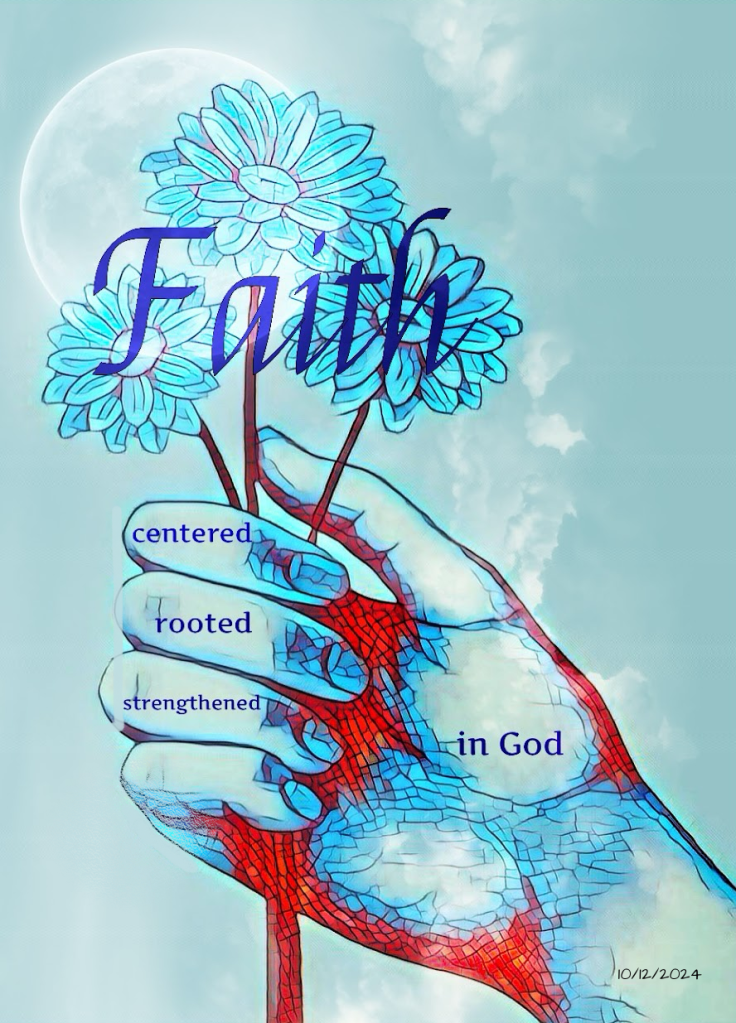
For through faith you are all children of God in Christ Jesus. For all of you who were baptized into Christ have clothed yourselves with Christ. There is neither Jew nor Greek, there is neither slave nor free person, there is not male and female; for you are all one in Christ Jesus. Galatians 3:26-28
The faith we share with other Christians makes us one in Christ. If someone has become “the other” for us, the integrity our faith is damaged in some way.
Today, in God’s Lavish Mercy: We pray to truly be clothed in Christ – to so espouse his Gospel that we live in charity and reverence for all Creation.
Thought: from St. Augustine
O Sacrament of Love! O sign of Unity! O bond of Charity! They who would have Life find here indeed a Life to live in and a Life to live by.
Jesus said to the crowd: “No one who lights a lamp conceals it with a vessel or sets it under a bed; rather, he places it on a lampstand so that those who enter may see the light. For there is nothing hidden that will not become visible, and nothing secret that will not be known and come to light. Take care, then, how you hear. To anyone who has, more will be given, and from the one who has not, even what he seems to have will be taken away.” Luke 8:16-18
Jesus indicates that the only way to spread light in the world is to do it together. Some have been given more, some less. But pooling all we have creates a Divine Fire illuminating a shadowy world.
Today, in God’s Lavish Mercy: We ask for the courage to recognize, claim, and offer our light in a world that longs for it. We ask for the humility and insight to encourage holy fire in others.
Poetry: I Understand This Light to Be My Home – Mai Der Vang, the author of Afterland (Graywolf Press, 2017), which recounts the Hmong exodus from Laos and the fate of thousands of refugees seeking asylum. The book received the Walt Whitman Award from the Academy of American Poets.
In the awareness, I am brought closer to my being from long before. In my awareness, there is only what I can take from the small spaces of
knowing, an earnest ascendance imparted by way of transmissions from the grid, a voice calls out unbroken below and above as the aura of faraway light.
There is a light that
shimmers so deep it never goes anywhere but to shimmer.
Light assumes its job is to shimmer, and so it is, but more than that, light is ancestral. Light is witness. Light is prehistory,
blueprint of vibrations shifting through all directions of time.
Light as hidden winter that leads to shadow as the growth. Light as first language of source. Light as both terrestrial and celestial. Light of long nights far up
in the sky, I stare to the heavens and weep for the stars whose light I have always known and understood to be my rooting.
I once shared a life with the name of this light as I know it in the stars who gave me
my body. As I know it in the frequencies of my footsteps,
as I hear it in the code of a landscape imprinted on my fingers, as I spirit my eyes open from the inside, as I know and understand this light to be kin.
Consider then the pain of leaving this light, of losing the stars to spaces
no longer lit by its truth. I am shaped in the spaces where the light does not reach, a need for what does not shimmer
but opening to the shadow to receive just as much light. I miss this light always.
Then more light.
Ever more light. Deficit of light to bring more light.
Template of light to bring more love.
That is my one true wish, as I know and understand
this light to be my home, as a knowing up there in the galaxy is me,
and I am up there in my bones built from stars.
Music: Dark Sky Island – Enya – a beautiful song in which she names some of the stars.
Do to others as you would have them do to you. For if you love those who love you, what credit is that to you? Even sinners love those who love them. And if you do good to those who do good to you, what credit is that to you? Even sinners do the same. If you lend money to those from whom you expect repayment, what credit is that to you? Even sinners lend to sinners, and get back the same amount. But rather, love your enemies and do good to them, and lend expecting nothing back; then your reward will be great and you will be children of the Most High, for he himself is kind to the ungrateful and the wicked. Be merciful, just as also your Father is merciful. Luke 6:31-36
“Even” can be a parsimonious word – as in “get even”, “even-steven”. In such phrases, “even” means we settle things without forgiveness or generosity. It means we get our due without considering the other’s need.
But Jesus says the Gospel heart is not about “evenness”. Rather it is weighted on the side of extravagant mercy, generosity, and forgiveness.
Today, in God’s Lavish Mercy: We pray for the courage to model our relationships with others on God’s incredible kindness to us.
But to take the Gospels seriously, to assume that they say what they mean and mean what they say, is the beginning of troubles. Those would-be literalists who yet argue that the Bible is unerring and unquestionable have not dealt with its contradictions, which of course it does contain, and the Gospels are not exempt. Some of Jesus’ instructions are burdensome not because they involve contradiction, but merely because they are so demanding.
The proposition that love, forgiveness and peaceableness are the only neighborly relationships that are acceptable to God is difficult for us weak and violent humans, but it is plain enough for any literalist. We must either accept it as an absolute or absolutely reject it. The same for the proposition that we are not permitted to choose our neighbors ahead of time or to limit neighborhood, as is plain from the parable of the Samaritan.
The same for the requirement that we must be perfect, like God, which seems as outrageous as the Buddhist vow to “save all sentient beings,” and perhaps is meant to measure and instruct us in the same way. It is, to say the least, unambiguous.
Brothers and sisters: Christ did not send me to baptize but to preach the Gospel, and not with the wisdom of human eloquence, so that the cross of Christ might not be emptied of its meaning.
The message of the cross is foolishness to those who are perishing, but to us who are being saved it is the power of God. 1 Corinthians 1:17-18
Paul writes that the meaning of the Cross depends on who you are. If you believe, it manifests God’s Power. If you do not believe, it signifies foolishness.
The Gospel and the Cross turn the realities of the world upside down. For those who have falsely believed that power exists in egotism, legalism, division, aggression, vengeance, and greed, Paul says, “No!”. These are only signs that you are perishing.
The power of the Cross is manifested in mercy, justice, community, peace, forgiveness and generosity. This is the path to salvation.
Today, in God’s Lavish Mercy: We ask for the courage to trust the contradictory wisdom of the Gospel, and to live a life that reveals the “foolish” power of the Cross.
Poetry: Jesus Is Nailed to the Cross – Malcolm Guite
See, as they strip the robe from off his back
And spread his arms and nail them to the cross,
The dark nails pierce him and the sky turns black,
And love is firmly fastened on to loss.
But here, a pure change happens.
On this tree, loss becomes gain, death opens into birth.
Here wounding heals and fastening makes free,

Earth breathes in heaven, heaven roots in earth.
And here we see the length, the breadth, the height,
Where love and hatred meet and love stays true,
Where sin meets grace and darkness turns to light,
We see what love can bear and be and do.
And here our Saviour calls us to his side,
His love is free, his arms are open wide.
Love your enemies and pray for those who persecute you, that you may be children of our Creator God, Who makes the sun rise on the bad and the good, and causes rain to fall on the just and the unjust. Matthew 5:44-45
It must have been so hard to hear and accept Jesus’s words in his Sermon on the Mount. These listening disciples had been raised on the Deuteronomic principle “An eye for an eye and a tooth for a tooth”. What could ever make them turn that principle inside out to do just the opposite of what they had always thought? What would make us turn from this kind of “justice”? After all, it’s even-steven, isn’t it?
In Jesus Christ, there is no even-steven. The Mercy of God is given to all of us without limits. It rains from the heart of God over all Creation. Jesus showed us that there is no place in Mercy for quid pro quo justice. If a disciple wants to love like Jesus, this precept is foundational.
Today, in God’s Lavish Mercy: Perhaps we are someplace where we can watch the rain today. If not we can remember how rain falls without distinction over everything within its embrace. So too does God’s Mercy fall on us moving us to be its agents in our world.
Enjoy the Peaceful Rain
Poetry: from The Merchant of Venice – William Shakespeare
The quality of mercy is not strained;
It droppeth as the gentle rain from heaven
Upon the place beneath. It is twice blest;
It blesseth him that gives and him that takes:
'T is mightiest in the mightiest; it becomes
The throned monarch better than his crown:
His sceptre shows the force of temporal power,
The attribute to awe and majesty,
Wherein doth sit the dread and fear of kings;
But mercy is above this sceptred sway;
It is enthronèd in the hearts of kings,
It is an attribute to God himself;
And earthly power doth then show likest God's
When mercy seasons justice.
The community of believers was of one heart and mind, and no one claimed that any of his possessions was his own, but they had everything in common. With great power the apostles bore witness to the resurrection of the Lord Jesus, and great favor was accorded them all.
Acts 4: 32-33
In this passage from Acts, community is noted as an essential aspect of life in Christ. We were not created to be alone. We are created to find God in the love of our sisters and brothers. That merciful and generous love, imitative of Jesus, makes us one with Him in the Trinity, that primordial Community of Generative Love.
Today, in God’s Lavish Mercy:
We pray to understand that our capacity for community deepens in relationship to our generous and merciful love for each person. As we widen our circle of mercy and caring mutuality, the face of God becomes clearer in our lives.
Poetry: When Someone Deeply Listens to You – John Fox
When someone deeply listens to you
it is like holding out a dented cup
you’ve had since childhood
and watching it fill up with
cold, fresh water.
When it balances on top of the brim,
you are understood.
When it overflows and touches your skin,
you are loved.
When someone deeply listens to you
the room where you stay
starts a new life
and the place where you wrote
your first poem
begins to glow in your mind’s eye.
It is as if gold has been discovered.
When someone deeply listens to you
your barefeet are on the earth
and a beloved land that seemed distant
is now at home within you.
Music: In Christ There Is No East or West – Choir and Congregation, St. Martin in the Fields, London
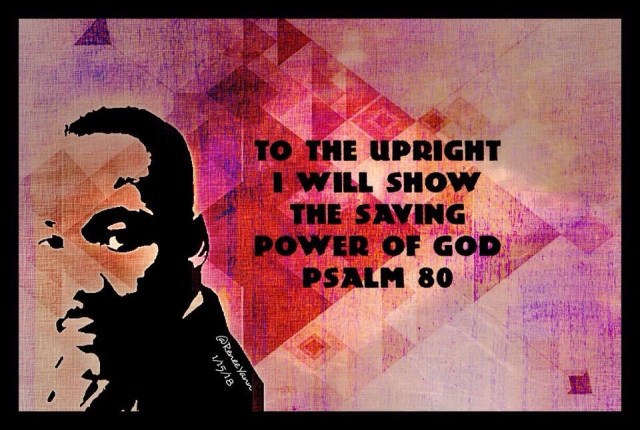
Today, in God’s Lavish Mercy, as we memorialize the life and legacy of Dr. Martin Luther King, Jr., our readings speak about leadership and its continuing call to renew the world in the image of its Creator.
But Samuel said: “Does the LORD so delight in burnt offerings and sacrifices as in obedience to the command of the LORD? Obedience is better than sacrifice, and submission than the fat of rams. For a sin like divination is rebellion, and presumption is the crime of idolatry. Because you have rejected the command of the LORD, he, too, has rejected you as ruler.”
1 Samuel 15:22-23
In our first reading, Samuel relays God’s displeasure to Saul who, though a conquering hero, has failed in humility and obedience before the Lord.
In the story, God has given a clear direction to Saul to obliterate Israel’s centuries-old enemy, the Amalekites. Instead Saul, after executing the masses, keeps the enemy king alive as a war trophy. He appropriates the cattle as personal spoil. He also sets up a shrine to commemorate the victory as his own.
God is not happy. When we profess to lead in God’s name we must act as God directs us. In order to understand God’s direction, we must cultivate an honest, just and merciful heart.
Martin Luther King was such a leader. By his faithful obedience to God’s inspiration, Martin, at the ultimate cost, turned the tides of history toward justice and freedom.
But the tides still need turning, because there will always be those who seek “war trophies”, and personal spoil, and domination for themselves. Our times are tortured by such selfish and failed leadership, just as all of history has been from ancient Israel until 1968 and until now.
Today, as we pray with Martin Luther King, great prophet and leader, we ask that selfless, merciful, and faith-impelled souls continue to hear the call to justice in our day. May Dr. King’s witness strengthen and inspire us.
Poetry: Devouring the Light – Cheryl Boyce-Taylor
The day they killed Martin
we could not return to New York City
our visiting senior class stuck in Huntsville
streets blazed with suffering in that small
Alabama town
in the dull shroud of morning
the whole world went crazy
devouring whatever light
that lit our half-cracked windows.
Music: Precious Lord, Take My Hand – Mahalia Jackson (Lyrics below)
Per Dr. King’s request, his good friend Mahalia Jackson sang his favorite hymn, “Take My Hand, Precious Lord”, though not as part of the morning funeral service but later that day at a second open-air service at Morehouse College.
Precious Lord, take my hand Lead me on, let me stand I’m tired, I’m weak, I’m lone Through the storm, through the night Lead me on to the light Take my hand precious Lord, lead me home
When my way grows drear precious Lord linger near When my light is almost gone Hear my cry, hear my call Hold my hand lest I fall Take my hand precious Lord, lead me home
When the darkness appears and the night draws near And the day is past and gone At the river I stand Guide my feet, hold my hand Take my hand precious Lord, lead me home
Precious Lord, take my hand Lead me on, let me stand I’m tired, I’m weak, I’m lone Through the storm, through the night Lead me on to the light Take my hand precious Lord, lead me home
Today, in God’s Lavish Mercy, to understand our first reading from Romans, we have to put ourselves back in time to sit beside Paul as he writes.
Paul was a devout Jew. Remember how, before his conversion, he felt called to persecute Jews who had become Christians? Now here he is writing and preaching the Christian message himself. Still he believes in his deepest heart that God has a particular affection for the Jews and wills their salvation. So Paul tries to explain how this will happen.
The explanation can sort of leave your head spinning. But essentially, Paul believes that salvation will be accomplished when all people, Gentile and Jew, repent from whatever is their unfaithfulness and receive God’s Mercy – that from all eternity, God’s “inscrutable” plan was to redeem us all, not just Israel. Paul still seems a little amazed by this revelation and tries to pound it home to his listeners:
Just as you once disobeyed God but have now received mercy because of their disobedience, so they have now disobeyed in order that, by virtue of the mercy shown to you, they too may now receive mercy. For God delivered all to disobedience, that he might have mercy upon all.
Romans 11:30-32
Paul’s apologia meant more to the listeners of his time than it probably does to us. But it is in the final verses of the passage that Paul captures an eternal truth that rings as true today as it did in early Christian times:
Oh, the depth of the riches and wisdom and knowledge of God! How inscrutable are his judgments and how unsearchable his ways!
For who has known the mind of the Lord or who has been his counselor? Or who has given him anything that he may be repaid?
For from him and through him and for him are all things. To God be glory forever. Amen.
Romans 11: 33-36
These magnificent lines remind all of us – Jew or Gentile, ancient or contemporary believer – that God is accomplishing the work of salvation in a depth of love beyond our understanding. Perhaps we spend moments of our lives wondering “why God lets things happen”, or “why God doesn’t intervene”.
Paul says we cannot answer those questions. God’s ways are infinitely beyond us, but nevertheless faithful and abiding. In our fidelity and hope, we see the unsearchable ways of God slowly unfold, moment by moment, in our lives and in our world.
The young, fiery Paul we first meet in Acts never expected his faith to be fulfilled outside the borders of Judaism. But our expectations and God’s inscrutable plan rarely align. That’s the wonder and mystery of the spiritual life! God will always surprise us, just as God surprised the deeply Judaic Paul into Christianity, even to the role of “Apostle to the Gentiles”!
I bet almost every one of us finds ourselves trying to “become holy” in a way we had not at first imagined. The challenges, opportunities, choices, responsibilities, and obstructions life presents take us down roads we did not envision. When Paul was thrown from his horse on the way to Damascus, his whole life plan was overthrown with him. And from that tailspin, the path to True Life opened up before him.
I’m going to spend some time in prayer thinking about my own life summersaults and how God has used them to lead me according to that “inscrutable plan”. Maybe you’d want to do the same.
Poetry: Light Shining Out of Darkness – William Cowper (1731-1800)
God moves in a mysterious way
His wonders to perform;
He plants His footsteps in the sea
And rides upon the storm.

Deep in unfathomable mines
Of never failing skill
He treasures up His bright designs
And works His sov’reign will.
Ye fearful saints, fresh courage take;
The clouds ye so much dread
Are big with mercy and shall break
In blessings on your head.
Judge not the Lord by feeble sense,
But trust Him for His grace;
Behind a frowning providence
He hides a smiling face.
His purposes will ripen fast, Unfolding every hour; The bud may have a bitter taste, But sweet will be the flow’r.
Blind unbelief is sure to err And scan His work in vain; God is His own interpreter, And He will make it plain.
Music: Who Has Known – John Foley, SJ
Oh, the depth of the riches of God And the breadth of the wisdom and knowledge of God For who has known the mind of God To Him be glory forever
A virgin will carry a child and give birth And His name shall be called Emmanuel For who has known the mind of God To Him be glory forever
The people in darkness have seen a great light For a child has been born, His dominion is wide For who has known the mind of God To Him be glory forever
Today, in God’s Lavish Mercy, as we read our scriptures for the day, we sense that both Jesus and Paul suffer heartbreak for those who resist the Gospel.
Brothers and sisters: I speak the truth in Christ, I do not lie; my conscience joins with the Holy Spirit in bearing me witness that I have great sorrow and constant anguish in my heart. For I could wish that I myself were accursed and cut off from Christ for the sake of my own people, my kindred according to the flesh.
Romans 9:1-3
Paul expresses his deep regret that his own people, the Israelites, resist the Messiah who is God’s final gift to them in a long line of unique blessings:
They are children of Israel; theirs the adoption, the glory, the covenants, the giving of the law, the worship, and the promises; theirs the patriarchs, and from them, according to the flesh, is the Christ, who is over all, God blessed forever. Amen.
Romans 9:4-5
In our Gospel, Jesus encounters a man with a withered hand. From the get-go, Jesus plans to heal the suffering man, but he decides to use the occasion to teach the Pharisees a lesson.
Jesus invites the scholars and Pharisees to move beyond the written Law and into the true practice of its spirit:
Jesus spoke to the scholars of the law and Pharisees in reply, asking, “Is it lawful to cure on the sabbath or not?” But they kept silent; so he took the man and, after he had healed him, dismissed him. Then he said to them “Who among you, if your son or ox falls into a cistern, would not immediately pull him out on the sabbath day?” But they were unable to answer his question.
Luke 14: 5-6
What Jesus asked was apparently too much for them. They were so encrusted in the worldly benefits the Law had brought them that they couldn’t challenge themselves to hear Jesus’s message. So they were silent – they gave no response to the divine invitation to life-giving change.
And to be fair to the Pharisees, Jesus’s invitation was a huge challenge. Their lives had become entirely dependent on a system that had lost its true meaning. The Law no longer led them to God but to themselves. They had lost the way through the woods, as you will see in Kipling’s poem below.
There are many levels on which we can pray with this passage. We are surely aware of the same kind of resistant silences in ourselves and in our world.
We may be caught in a sort of personal woods where we can’t make our way through to a life-giving choice or, like the Pharisees, to an inclusive, merciful understanding.
Or we may see this kind of entrapment happening in a beloved’s life.
Or we may see the atrophic effects of dead, unreviewed laws in our country, world, and Church. Failing to adapt laws that have lost their true spirit allows us to normalize outrageous behaviors based on manufactured”legality”. The image of a 16-year-old carrying an AK-47 down a neighborhood street, “legally” shooting unarmed protesters, comes to my mind!
All of these situations arise when we are entwined in a system that no longer gives life. The spirit and energy of the Gospel is the key to our un-entwining. Let’s pray for it in ourselves and in our very knotted world.
Poetry: The Way Through the Woods – Rudyard Kipling
They shut the road through the woods Seventy years ago. Weather and rain have undone it again, And now you would never know There was once a road through the woods Before they planted the trees. It is underneath the coppice and heath, And the thin anemones. Only the keeper sees That, where the ring-dove broods, And the badgers roll at ease, There was once a road through the woods.
Yet, if you enter the woods
Of a summer evening late,
When the night-air cools on the trout-ringed pools
Where the otter whistles his mate,
(They fear not men in the woods,
Because they see so few.)
You will hear the beat of a horse’s feet,
And the swish of a skirt in the dew,
Steadily cantering through
The misty solitudes,
As though they perfectly knew
The old lost road through the woods.
But there is no road through the woods.
Today, in God’s Lavish Mercy, get ready for a three-day cruise with Jonah and a radical journey down the Jericho road with the Good Samaritan.
The message of Jonah is clear: all people, even hated Ninevites, are children of God’s Mercy. Resisting that understanding can be catastrophic to our spiritual life.
Patricia Tull, Rhodes Professor Emerita of Old Testament at Louisville Seminary, summarizes the Book of Jonah like this:
A postexilic book, Jonah’s story is atypical for prophetic works. Not only is it a narrative about the prophet rather than his speeches, but it also rebuffs Jonah for his refusal to preach to foreign enemies. Jonah’s story portrays foreigners as more than ready to repent and turn to God. The book uses humor, hyperbole, and irony to make its parabolic point.
Our Gospel gives us one of the most beloved yet challenging parables of Jesus – who is our “neighbor”. The infinite dimensions within this parable continue to unfold for us as we deepen in our mercy spirituality.
God does not see anyone as a “foreigner”. Every human being lives with the breath of God. We are “neighbors” because we share that breath, that “neighborhood” of God’s boundless Love.
But, oh my God, how we have forgotten or rejected that common bond of reverence for one another! Just yesterday, one of our sisters brought up the subject of a recent hit-and-run accident in Philadelphia. It now seems to be the common practice to leave the scene of such an occurrence, abandoning the victim to his fatal circumstance. She wondered, incredulously, how anyone could be that callous.
Our Gospel parable describes that callousness. Notice that both the priest and the Levite pass the victim by “on the opposite side“. The phrase implies that if I can build a wall to make you invisible to me, I can more easily ignore your claim on my merciful neighborliness.
The Samaritan lived without those walls. He did not see a Jew, or a foreigner, or an expendable “other”. He saw a human being, like himself – a neighbor who was struggling to live.
The Good Samaritan (1880) by Aimé Morot
Jesus’ parable of the Good Samaritan is a clear example of the call of the Gospel to neighborliness. In the story, such a call is an inconvenient truth because it summons outside the comfortable community to find the neighbor among the not-well-regarded “others.”
Walter Brueggemann, Health Progress, January – February 2010
We don’t want to be like resistant Jonah, nor like the prejudicially blinded priest and Levite of our parable. But it is hard. The world conspires to separate us into the haves and the have-nots, the deserving and the undeserving, the winners and the losers, the sinners and the saints. Mercy not only resists but dismantles such walls. Do we have the courage to examine our own prejudices and to step across from “the opposite side” for the sake of our neighbor?
Poem: Neighbor – Iain Crichton Smith
Build me a bridge over the stream
to my neighbour’s house
where he is standing in dungarees
in the fresh morning.
O ring of snowdrops
spread wherever you want
and you also blackbird
sing across the fences.
My neighbor, if the rain falls on you,
let it fall on me also
from the same black cloud
that does not recognize gates.
Music: JJ Heller – Neighbor
Sometimes it's easier to jump to conclusions
Than walk across the street
It's like I'd rather fill the blanks with illusions
Than take the time to see
You are tryna close the back door of your car
You are balancing the groceries and a baby in your arms
You are more than just a sign in your front yard
You are my neighbor
I can get so lost in the mission
Of defending what I think
I've been surfing on a sea of opinions
But just behind the screen
You are grateful that the work day's finally done
You are stuck in miles of traffic, looking at your phone
You are tryin' to feel a little less alone
You are my neighbor
When the chasm between us feels so wide
That it's hard to imagine the other side
But we don't have to see things eye to eye
For me to love you like you are my neighbor
My neighbor
Oh, to fear the unfamiliar
Is the easy way to go
But I believe we are connected more than we might ever know
There's a light that shines on both the rich and poor
Looks beyond where we came from and who we voted for
'Til I can't see a stranger anymore
I see my neighbor
May my heart be an open door to my neighbor
You are my neighbor








 Lavish Mercy