Neighbor

Monday of the Twenty-seventh Week in Ordinary Time
October 9, 2023

Today’s Readings:

https://bible.usccb.org/bible/readings/100923.cfm


Today, in God’s Lavish Mercy, get ready for a three-day cruise with Jonah and a radical journey down the Jericho road with the Good Samaritan.

The message of Jonah is clear: all people, even hated Ninevites, are children of God’s Mercy. Resisting that understanding can be catastrophic to our spiritual life.


Patricia Tull, Rhodes Professor Emerita of Old Testament at Louisville Seminary, summarizes the Book of Jonah like this:

A postexilic book, Jonah’s story is atypical for prophetic works. Not only is it a narrative about the prophet rather than his speeches, but it also rebuffs Jonah for his refusal to preach to foreign enemies. Jonah’s story portrays foreigners as more than ready to repent and turn to God. The book uses humor, hyperbole, and irony to make its parabolic point.

Our Gospel gives us one of the most beloved yet challenging parables of Jesus – who is our “neighbor”. The infinite dimensions within this parable continue to unfold for us as we deepen in our mercy spirituality.

God does not see anyone as a “foreigner”. Every human being lives with the breath of God. We are “neighbors” because we share that breath, that “neighborhood” of God’s boundless Love.


But, oh my God, how we have forgotten or rejected that common bond of reverence for one another! Just yesterday, one of our sisters brought up the subject of a recent hit-and-run accident in Philadelphia. It now seems to be the common practice to leave the scene of such an occurrence, abandoning the victim to his fatal circumstance. She wondered, incredulously, how anyone could be that callous.


Our Gospel parable describes that callousness. Notice that both the priest and the Levite pass the victim by “on the opposite side“. The phrase implies that if I can build a wall to make you invisible to me, I can more easily ignore your claim on my merciful neighborliness.

The Samaritan lived without those walls. He did not see a Jew, or a foreigner, or an expendable “other”. He saw a human being, like himself – a neighbor who was struggling to live.

The Good Samaritan (1880) by Aimé Morot


Jesus’ parable of the Good Samaritan is a clear example of the call of the Gospel to neighborliness. In the story, such a call is an inconvenient truth because it summons outside the comfortable community to find the neighbor among the not-well-regarded “others.” 

Walter Brueggemann, Health Progress, January – February 2010

We don’t want to be like resistant Jonah, nor like the prejudicially blinded priest and Levite of our parable. But it is hard. The world conspires to separate us into the haves and the have-nots, the deserving and the undeserving, the winners and the losers, the sinners and the saints. Mercy not only resists but dismantles such walls. Do we have the courage to examine our own prejudices and to step across from “the opposite side” for the sake of our neighbor?


Poem: Neighbor – Iain Crichton Smith

Build me a bridge over the stream
to my neighbour’s house
where he is standing in dungarees
in the fresh morning.
O ring of snowdrops
spread wherever you want
and you also blackbird
sing across the fences.
My neighbor, if the rain falls on you,
let it fall on me also
from the same black cloud
that does not recognize gates.

Music: JJ Heller – Neighbor

Sometimes it's easier to jump to conclusions
Than walk across the street
It's like I'd rather fill the blanks with illusions
Than take the time to see
You are tryna close the back door of your car
You are balancing the groceries and a baby in your arms
You are more than just a sign in your front yard
You are my neighbor
I can get so lost in the mission
Of defending what I think
I've been surfing on a sea of opinions
But just behind the screen
You are grateful that the work day's finally done
You are stuck in miles of traffic, looking at your phone
You are tryin' to feel a little less alone
You are my neighbor
When the chasm between us feels so wide
That it's hard to imagine the other side
But we don't have to see things eye to eye
For me to love you like you are my neighbor
My neighbor
Oh, to fear the unfamiliar
Is the easy way to go
But I believe we are connected more than we might ever know
There's a light that shines on both the rich and poor
Looks beyond where we came from and who we voted for
'Til I can't see a stranger anymore
I see my neighbor
May my heart be an open door to my neighbor
You are my neighbor

What About “Strangers”?

Thursday of the Fifth Week of Easter
May 11, 2023

Today’s Readings:

https://bible.usccb.org/bible/readings/051123.cfm

Peter Preaches to Jews and Gentiles


Today, in God’s Lavish Mercy, the Apostles continue to deal with the assimilation of Gentiles into the faith community. Their struggle is one that continually challenges the human community throughout history.

Think about it. What’s it like when someone new comes into your established community – your family, parish, workplace, convent, social group, etc.? How did it feel when you met your potential in-laws, or teacher-partner, or new boss, new novices, or your betrothed’s questionable friends?

And, maybe more importantly, how did they feel bumping up against your already solidly established relationships and practices?


It’s no fun being the new guy or gal. It’s exciting maybe, but it’s also a little scary. And it’s certainly no fun feeling different or like a stranger in one’s new environment.

And, in a way, it’s no fun being the old guy or gal either. It can be challenging, even annoying, to have to realign our comfortable routines to incorporate a newbie. And when these routines are centuries old religious practices, oh baby, we have a problem!


This is the challenge the early Christian community faced as the established Jerusalem church spread out across Asia and the Mediterranean basin to bring the Gospel to the Gentiles. Through Peter’s leadership, they seem to have handled the issue very well:

“My brothers, you are well aware that from early days
God made his choice among you that through my mouth
the Gentiles would hear the word of the Gospel and believe.
And God, who knows the heart,
bore witness by granting them the Holy Spirit
just as he did us.

God made no distinction between us and them,
for by faith he purified their hearts.
Why, then, are you now putting God to the test
by placing on the shoulders of the disciples
a yoke that neither our ancestors nor we have been able to bear?


On the contrary, we believe that we are saved
through the grace of the Lord Jesus, in the same way as they.”


What powerful lessons to learn as we continue to build an inclusive and universal Church, and to deal with the many blocks inhibiting us: racism, xenophobia, sexism and heterosexism, to name a few. All of these are based on a negative pre-judgment whose purpose is to maintain control and power in a dominant group.

By the power of the Holy Spirit, Peter was able to let go of that need. Let’s ask him to help us and our Church.


Poetry: Song of Myself #48 – Walt Whitman

I have said that the soul is not more than the body,
And I have said that the body is not more than the soul,
And nothing, not God, is greater to one than one’s self is,
And whoever walks a furlong without sympathy walks to his own funeral drest in his shroud,
And I or you pocketless of a dime may purchase the pick of the earth,
And to glance with an eye or show a bean in its pod confounds the learning of all times,
And there is no trade or employment but the young man following it may become a hero,
And there is no object so soft but it makes a hub for the wheel’d universe,
And I say to any man or woman, Let your soul stand cool and composed before a million universes.
And I say to mankind, Be not curious about God,
For I who am curious about each am not curious about God,
(No array of terms can say how much I am at peace about God and about death.)
I hear and behold God in every object, yet understand God not in the least,
Nor do I understand who there can be more wonderful than myself.
Why should I wish to see God better than this day?
I see something of God each hour of the twenty-four, and each moment then,
In the faces of men and women I see God, and in my own face in the glass,
I find letters from God dropt in the street, and every one is sign’d by God’s name,
And I leave them where they are, for I know that wheresoe’er I go,
Others will punctually come for ever and ever.

Music: You Don’t Have to Be Like Me – RebbeSoul

A Circumcised Heart

Wednesday of the Fifth Week of Easter
May 10, 2023

Today’s Readings:

https://bible.usccb.org/bible/readings/051023.cfm

Today, in God’s Lavish Mercy, there’s a lot of clipping going on and being talked about.

In Acts, we read about the hubbub around circumcision of the Gentile Christians. Basically, early Christianity was an offshoot of Judaism. All the very earliest Christians were Jews. In many ways, they still thought with Jewish minds not new Christian ones.

The question of circumcision is one of their first wake-ups. Jews considered circumcision a sign of their covenant with God. Greeks on the other hand abhorred the practice. The Apostles were faced with the dilemma:

If our new faith is for all people, how will that change some of our practices?
Which pratices are essential to Christian life, and which are not?

As today’s reading ends, the Apostles are still sequestered on the issue. But the eventual resolution around circumcision proved to be a key factor in the cultural separation of Christianity from Judaism.


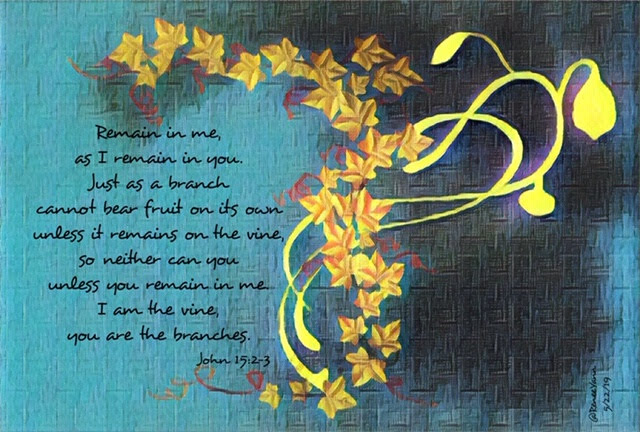
In our Gospel, Jesus talks about another kind of pruning, but the parallels are interesting.

A healthy and vigorous life in Christ is one that is “cultured” by God’s grace. That grace serves to cut away the unholy accretions that sometimes surface in our lives – sin, temptation, spiritual indifference, rampant self-interest, religious ennui……

Jesus said to his disciples:
“I am the true vine, and my Father is the vine grower.
He takes away every branch in me that does not bear fruit,
and everyone that does he prunes so that it bears more fruit.
You are already pruned because of the word that I spoke to you.

John 15: 1-3

God’s Word touches us through scripture, through spiritual teaching, and through our reverent assimilation of our life experiences. We must listen to our lives to hear God’s Word. There is never a moment when God is not speaking to us in love – and often to a completely new understanding of what it means to be in covenant with God.


The Apostles finally come to the decision that one does not become a disciple by physical circumcision but rather by a grafting of one’s heart to God’s own heart. May we, the Church, learn from that openness for our own times. May we become more aware of those assumptions which cut off whole segments of humanity, relegating them to the ecclesiastical sidelines.

I am the vine, you are the branches.
Whoever remains in me and I in him will bear much fruit,
because without me you can do nothing…

If you remain in me and my words remain in you,
ask for whatever you want and it will be done for you.
By this is my Father glorified,
that you bear much fruit and become my disciples.”

John 15: 5;7-8

Poetry: I Am the Vine – Malcolm Guite

How might it feel to be part of the vine?
Not just to see the vineyard from afar
Or even pluck the clusters, press the wine,
But to be grafted in, to feel the stir
Of inward sap that rises from our root,
Himself deep planted in the ground of Love,
To feel a leaf unfold a tender shoot,
As tendrils curled unfurl, as branches give
A little to the swelling of the grape,
In gradual perfection, round and full,
To bear within oneself the joy and hope
Of God’s good vintage, till it’s ripe and whole.
What might it mean to bide and to abide
In such rich love as makes the poor heart glad?


Music: Landscapes of the Heart – Gary Schmidt

The Noble Shepherd

Monday of the Fourth Week of Easter
May 1, 2023

Today’s Readings:

https://bible.usccb.org/bible/readings/050123.cfm

Today, in God’s Lavish Mercy, our Gospel invites us, once again, to pray in the company of the Good Shepherd. (The Greek phrase could better be translated as “The Noble Shepherd“)


Just a bit earlier in his sermon, Jesus delivered this blockbuster to the gathered crowd:

I came so that you might have life
and have it more abundantly.

John 10:10

I don’t know how those on the ancient hillside received this stunning announcement, but I know that I have heard and read it a thousand times with a dull and stupid heart.


We let ourselves get used to the scriptures. We hear the priest humdrumming the words while we entertain a tumble of distractions in our foggy heads. We pray the words in our quiet rooms while sleep nibbles away at their astounding meaning.

But here’s what our Gospel shouts to us this morning:

I am here to give you abundant life!
For heaven’s sake, let your heart and soul stand up,
open your arms, and embrace the gift I offer you.


Several deep lessons reside within today’s reading, but we might choose to focus on this:

I am the good shepherd,
and I know mine and mine know me,
just as the Father knows me and I know the Father;
and I will lay down my life for the sheep.

John 10: 11-12

Jesus is telling us
that he is our “good shepherd” for this reason:
because he knows and loves us with the same intensity
that he and the Father know and love each other.

In other words, Jesus loves us with a love that absorbs us into the heart of God. There, we are fed with that love and given an infinitely abundant life – a life that demands to be given and shared.


Jesus tells us that he will lay down his life for his sheep, because this is the nature of Divine Love — it is fully self-giving. The Creator gave everything for us in the gift of Jesus. Jesus gave everything for us in the Paschal Gift. We, recipients of these infinite gifts, are called to give everything for the sake of God’s love in the world.

Does this mean we all have to run out and try to be martyrs? Certainly not. It might be even harder to respond to this call with consistent dailyness than it would be to do so with martyrish abandon.


Our reading from Acts helps us understand what this divine love looks like in an ordinary life. It looks like openness to the Holy Spirit, willingness to change for the sake of others’ good, inclusion of all people in the loving community, actions that build unity and reverence for one another.


The Good Shepherd is a Giving Shepherd who teaches us that we have such an abundance of life in him that we are safe giving our small portion of life for others. We do not need to bury, fortify, protect, and squirrel away our life like misers and hoarders – because, in God, all that we give is continually replaced with even greater plentitude.

We do not have to be first, smartest, prettiest, richest, most powerful, always right or all the other perfectionisms we sometimes are deluded by.

What we have to be is kind, merciful, open, forgiving, honest, generous and humble. These are the true currencies of abundant life in Christ. With the amazing gift we have been given, we are called to allow God to “shepherd” through us in our own particular “sheepfold”.


In his transcendent love, Jesus laid his life down willingly for our sake, and that utter willingness allowed him to take it up again in glory. We might be invited to do a little “life-laying down” ourselves today. Can we find Christ’s invitation, promise, and power within that ordinariness?


The Good Shepherd by James Tissot


Poetry: On Generosity – Walter Brueggemann

On our own, we conclude:
there is not enough to go around
we are going to run short
of money
of love
of grades
of publications
of sex
of beer
of members
of years
of life
we should seize the day
seize our goods
seize our neighbours goods
because there is not enough to go around
and in the midst of our perceived deficit
you come
you come giving bread in the wilderness
you come giving children at the 11th hour
you come giving homes to exiles
you come giving futures to the shut down
you come giving easter joy to the dead
you come – fleshed in Jesus.
and we watch while
the blind receive their sight
the lame walk
the lepers are cleansed
the deaf hear
the dead are raised
the poor dance and sing
we watch
and we take food we did not grow and
life we did not invent and
future that is gift and gift and gift and
families and neighbours who sustain us
when we did not deserve it.
It dawns on us – late rather than soon-
that you “give food in due season
you open your hand
and satisfy the desire of every living thing.”
By your giving, break our cycles of imagined scarcity
override our presumed deficits
quiet our anxieties of lack
transform our perceptual field to see
the abundance………mercy upon mercy
blessing upon blessing.
Sink your generosity deep into our lives
that your muchness may expose our false lack
that endlessly receiving we may endlessly give
so that the world may be made Easter new,
without greedy lack, but only wonder,
without coercive need but only love,
without destructive greed but only praise
without aggression and invasiveness….
all things Easter new…..
all around us, toward us and
by us
all things Easter new.
Finish your creation, in wonder, love and praise. Amen.

Music: The Lonely Shepherd – written by James Last and played here by Louis Grosari

Choosing Goodness

Monday of the Thirty-second Week in Ordinary Time
November 7, 2022

Today’s Readings:

https://bible.usccb.org/bible/readings/110722.cfm

Today, in God’s Lavish Mercy, our readings raise and answer some powerful questions. How does faith inspire moral responsibility? What is the relationship between moral commitment and leadership? How do we measure a person’s “communal righteousness”?

Paul asks these questions with respect to bishops and presbyters, and the standards are stringent – extending even to the leader’s family.

… appoint presbyters in every town, as I directed you,
on condition that a man be blameless,
married only once, with believing children
who are not accused of licentiousness or rebelliousness

In our Gospel, Jesus is direct and practical about how morally good a leader needs to be:

Jesus said to his disciples,
“Things that cause sin will inevitably occur,
but woe to the one through whom they occur.
It would be better for him if a millstone were put around his neck
and he be thrown into the sea
than for him to cause one of these little ones to sin.

Choosing leaders, trusting them, moving forward with them to a chosen future is something we do not only in our faith communities, but also in the civic arena. Even though we try mightily to separate religion and politics, these will inevitably touch because they so significantly affect the human person.

I find it interesting that these readings permeate my thoughts and prayers as many of us in the United States prepare to vote tomorrow. How might my faith direct me to choose those candidates who lead toward inclusivity, peace, mutual charity, and care for the vulnerable?

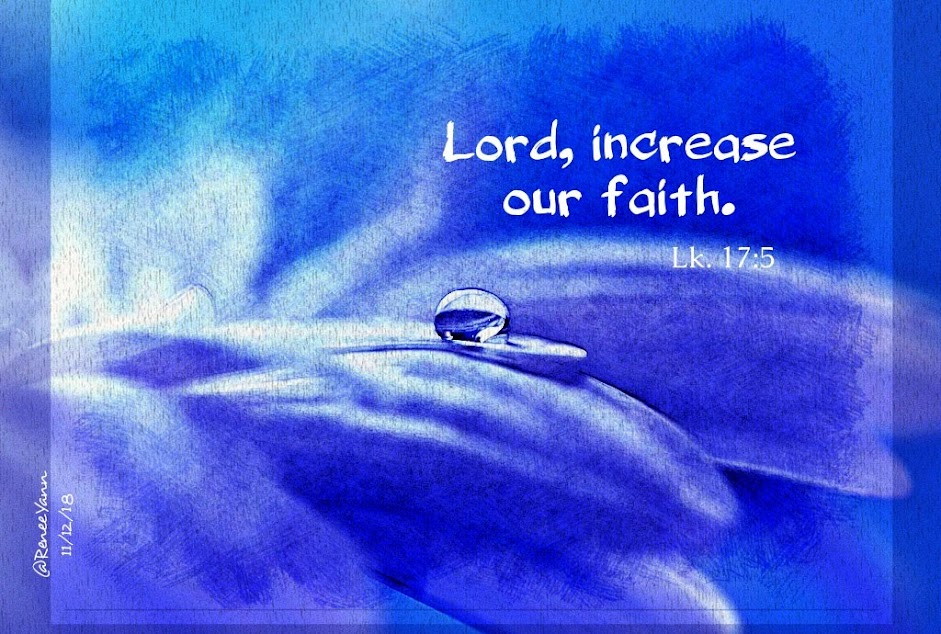
What I need as I ponder these questions is exactly what the disciples requested of Jesus. In our Gospel, Jesus instructs the disciples on sin, repentance and forgiveness — all of which we encounter within the struggling community of faith. Hearing him, the  disciples immediately realize what it is they most need to engage the challenges before them:

Lord, increase our faith!

Let us join their prayer today for unity and love in our faith and civic communities.


Thought: By voting, we help answer Pope France’s prayer:

I beg the Lord to grant us more politicians 
who are genuinely disturbed
by the state of society,
the people, the lives of the poor!

Joy of the Gospel (205)

 Renee Yann, RSM

Released from Hate

Monday of the Thirty-first Week in Ordinary Time
October 31, 2022

Today’s Readings:

https://bible.usccb.org/bible/readings/103122.cfm

Today, in God’s Lavish Mercy, what a beautiful prayer Paul spreads over his listeners. It is a prayer that calls all believers to live in love, peace, and reverence for one another:

Brothers and sisters:
If there is any encouragement in Christ,
any solace in love,
any participation in the Spirit,
any compassion and mercy,
complete my joy by being of the same mind, with the same love,
united in heart, thinking one thing.

Philippians 2:1-2

Reading this passage, I was immediately struck by the awareness of how much opposite messaging we receive in today’s world.

In the arenas of entertainment, politics, civic life, and – sad to say – even religion, we often hear a message contradictory to Paul’s. We hear civic and supposedly “religious” leaders tell their followers to attack, shun, fight, and even “hang” the other. Night after night on our TVs, we watch fictional characters act out the hate and crime that has become normalized in our culture. Our video games, music and movies are drowning in blood, hate and anger.

Sometimes, I am just astounded that we entertain ourselves with murder, war, rape and other outrages against human beings!

With the vicious attack on Paul Pelosi this week, as in so many other horrendous incidents of unbridled hate, we see a perpetrator sickened and abetted by the violent rhetoric our society has allowed. And perhaps even worse than the crime itself, we see political leaders not only minimizing the atrocity, but mocking the victim!


If St. Paul were here, what would he say?

  • where is the encouragement in Christ?
  • where is the solace in love?
  • where is the participation in the Spirit?
  • where is the compassion and mercy?

As a matter of fact, if St. Paul were here, I think he would wail in sadness!


In Luke’s Gospel, Jesus tells us what a society should look like when it respects God and God’s Creation. It should be impelled by the deepest respect and tenderness toward the self and the other:

When you hold a lunch or a dinner,
do not invite your friends or your brothers or sisters
or your relatives or your wealthy neighbors,
in case they may invite you back and you have repayment.
Rather, when you hold a banquet,
invite the poor, the crippled, the lame, the blind; 
blessed indeed will you be because of their inability to repay you.
For you will be repaid at the resurrection of the righteous.

Luke 14:12-14

Bottom line is this: a lot of people just don’t buy Paul’s or Jesus’s message. A lot of people would rather live for themselves to the expense of others.

But we’re not just “a lot of people”. We are Christ’s, and we must examine our speech, attitudes, choices and behaviors for anything that contradicts his message of love, mercy, inclusion, and mutual reverence.

The contradictions are subtle. Discovering and uprooting them takes honest and humble prayer. It requires a good look at how we entertain ourselves, how we confront those we disagree with, who we criticize and how we do it.


Several years ago, I was shocked when someone close to me announced, “I hate Obama!” I asked her why and she said, “I just do. I don’t need a reason!”

Where does all the hate in our culture come from? And, oh, how much more does it tell us about the haters than the ones hated! And of course, the essential question, “What can we do about it?”

Jesus made it simple. He told us to look around the “table” of our attitudes, behaviors and choices.

Who is welcome? Who is shunned? Who is embraced as a human being? Who is objectified and dispensed with as unimportant.

As in all solutions, we can begin with ourselves. Ridding ourselves of these contradictions requires that we listen to ourselves to see if, how, and why we ever use the word “hate”. Only then might we cleanse our hearts of its subtle poisons.


Prose: Two thoughts today

The enemy is fear.
We think it is hate,
but it is really fear.

Mahatma Gandhi

Who would I be,
and what power would be expressed in my life,
if I were not dominated by fear?

Paula D’Arcy

Music: At My Table – JJ Heller – a kinda fun video to watch!

Holy Civility

Friday of the Twenty-ninth Week in Ordinary Time
October 21, 2022

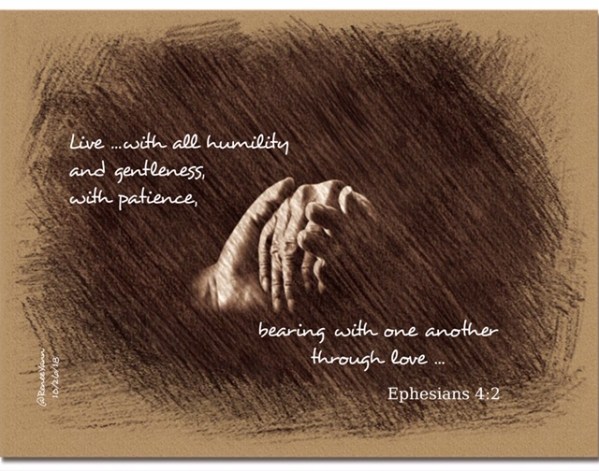
Today, in God’s Lavish Mercy, having blessed and reassured the Ephesian community of the power of their Baptism, Paul instructs them in how to live a Christian life. He says that their Baptism demands a life worthy of their call.

Eph 4_2 bear with

Do you feel called? In your daily life, do you recognize the demand to witness to a graced life in the face of a sometimes ungracious world?

Paul says that’s what it’s all about:

  • the humble, gentle, patient exercise of Christian love
  • the building of inclusive community through acts of peace
  • the embrace of one God Who claims all humanity as one people

Therefore, anything that suggests hate, aggression, pride or exclusion is not worthy of our Baptismal call.


I watched – or tried not to watch – a few political ads last night. I heard the vitriolic rhetoric before I could tap the mute button. I’m probably a bit of a political pollyanna, but I can’t help thinking back to election days when I was a kid. Election Day was fun back then. OK, maybe it was in the dark ages, but you could go to the polls with an ” I Like Ike” button and not be afraid of being shot.

  •  
  •  John J Mellon

My grandfather, known to the neighbors as “The Duke”, was the Republican committee man. He always dressed like a million dollars, but on that Tuesday he was a GQ prototype. Around at the local barbershop, where the voting machines sat unwatched, Grandpop offered coffee and doughnuts to everyone, no matter what button they wore or pushed. That night, if the Republicans lost, he didn’t go out and firebomb the neighbors houses. I really liked that world. Now though my heart keeps saying, “What has happened to us?”


And then I read Paul’s admonitions on Christian responsibility.

I urge you to live in a manner worthy of the call you have received,
with all humility and gentleness, with patience,
bearing with one another through love,
striving to preserve the unity of the spirit
through the bond of peace

Even if our culture’s rampant hostility makes us sad and angry, we must respond to it with Christian courage and peace-building action. We must not become like those who stun us with their indifference to life, humanity, morality and truth. And we must never make an appeal to religion as an excuse for loveless behavior.

In our Gospel, Jesus challenges his listeners in a similar way:

Why do you not know how to interpret the present time?
Why do you not judge for yourselves what is right?

Our times will challenge our Christian character. Will we pass the test?


Prose: from “The Art of Courage” by Dorothy Day

Love and ever more love is the only solution to every problem that comes up.
If we love each other enough, we will bear with each other’s faults and burdens.
If we love enough, we are going to light that fire in the hearts of others.
And it is love that will burn out the sins and hatreds that sadden us.
It is love that will make us want to do great things for each other.
No sacrifice and no suffering will then seem too much.
My prayer from day to day is that God will so enlarge my heart
that I will see you all, and live with you all, in his love.

Plough Magazine, February 21, 2017

Music: one Bread, One Body – John Foley, SJ

One Family – Like It or Not!

Monday of the Twenty-Seventh Week in Ordinary Time
October 3, 2022

Today’s Readings:

https://bible.usccb.org/bible/readings/100322.cfm

Today, in God’s Lavish Mercy, our Gospel gives us the parable of the Good Samaritan. It is a story in which we can all find ourselves, maybe changing roles in the changing circumstances of our lives.

IMG_6600

Have we ever been the robbers, the bullies, the outlaws who in some way used force or subterfuge to gain their own advantage? We don’t have to be a criminal to do this. We can do it by our prejudices, our preferential treatment, our gossip, our secrets and our cliques. We can do it by our uninformed or willful choices which deprive others of their needs and rights.

Have we ever been the Levite, the one who claims a special religious place by family heritage? Have we ever, like the Levite in the parable, bypassed someone because of her religion or ethnic origins – because she isn’t “like us”?

Have we ever been this pathetic priest who so completely misunderstands the role of minister – who ignores God’s suffering creature for fear of some imagined contamination?

Have we ever been the victim, the one set upon by the meanness of others, the one unable to heal himself from injury? Has the memory made us more like the Samaritan or like the robbers once we were healed?

And finally, have we ever been the Samaritan? Do we even want to be? Or do we think him foolish to have given his own time and treasure for a stranger?

This parable is a study in differences and how we respond to them. Some use differences to separate rather than enrich their world. They fail to understand that we all belong to each other and will live forever as one family in heaven. If we don’t learn to do it in this life, we won’t be part of it in the life to come.

Realizing this may change how we might have responded on that ancient road – or the road right now where we’re all just walking each other home.

Poetry: Vagrant – Mary Wickham, rsm

I am the mad one you will not shelter;
I am the beggar you will not own;
I am the ranter, the intemperate raver;
I am the self you hurl from home.
My passion frightens and dismays you,
I am garrulously obscene and wild.
My rage your own unleashes for view;
I am your willful, untameable child.
Reject, deny, revile, deride me-
until you embrace me I am bound;
my need will cry till I am free,
you are lost unless I am found.

Music: Take All the Lost Home ~ Joe Wise

Earthshine & Bling!

Twenty-fifth Sunday in Ordinary Time
September 18, 2022

Today’s Readings:

https://bible.usccb.org/bible/readings/091822.cfm

Today, in God’s Lavish Mercy, our readings make one thing very clear: we cannot serve both God and “mammon”.

The problem is that we have a hard time figuring out what mammon is. Experience tells us that it’s a lot more than just money, because there are people with money who do a good job serving God.

It seems to me that “mammon” is more the illusion that we are only our “possessions” — our money, house, car, looks, degrees, physical abilities — and that we (or anybody else) is nothing without them.

This misperception is so intrinsic to our inability to live the Gospel that it cripples our souls. The love of “mammon” becomes an overwhelming, incurable addiction that feeds on the well-being of our neighbor.

As our first reading tells us, living by this addiction invokes God’s eternal anger. Describing the abuse heaped upon the poor, God warns the abusers:

The LORD has sworn by the pride of Jacob:
Never will I forget a thing they have done!

Amos 8:7

Our Gospel tells us that we can’t have it both ways. We either live within the generosity and inclusivity of God, or we’re outside it:

No servant can serve two masters.
He will either hate one and love the other,

or be devoted to one and despise the other.

Luke 16:13

This is a challenging but fundamental teaching of the Gospel. It is essential that we consider how we live it.

Walter Bruggemann, in his book Money and Possessions says this:

Jesus said it … succinctly. You cannot serve God and mammon. You cannot serve God and do what you please with your money or your sex or your land. And then he says, “Don’t be anxious, because everything you need will be given to you.” But you must decide. Christians have a long history of trying to squeeze Jesus out of public life and reduce him to a private little Savior. But to do this is to ignore what the Bible really says. Jesus talks a great deal about the kingdom of God—and what he means by that is a public life reorganized toward neighborliness. . . .

Let’s have the courage to pray with that thought today. Although challenging, the question is rather simple: how do we use what we have to live a Gospel life, the essence of which Jesus stated like this:

Love God above all things

and your neighbor as yourself.

Mark 12:30-31


Poetry: Cullen in the Afterlife – P. K. Page

(This poet is new to me. She is a Canadian poet whose work is noted for its vibrant images. I liked this poem in which she imagines the experience of finding oneself in the afterlife. She notes the difficulty of embracing Love when hampered by “mammon” which she called “Earthshine”.

And how partake of such a gift when he
was handicapped by Earthshine—wore the stars,
badges and medals of privilege and success?
Desensitizers, brutalizers—all 
the tricks that mammon plays to make one sleep.


Cullen in the Afterlife – P. K. Page

He found it strange at first. A new dimension.  
One he had never guessed. The fourth? The fifth? 
How could he tell, who’d only known the third?
Something to do with eyesight, depth of field.
Perspective quite beyond him. Everything flat
or nearly flat. The vanishing point 
they’d tried to teach at school was out of sight
and out of mind. A blank.

Now, this diaphanous dimension—one
with neither up nor down, nor east nor west,
nor orienting star to give him north.
Even his name had left him. Strayed like a dog. 
Yet he was bathed in some unearthly light,
a delicate no-color that made his flesh
transparent, see-through, a Saran-Wrap self.
His body without substance and his mind
with nothing to think about—although intact—
was totally minus purpose. He must think.

Think of a Rubens, he said to himself. But where
Rubens had been there was a void, a vast
emptiness—no opulence. And then
Cézanne who broke all matter up—
made light of it, in fact. And mad Van Gogh
who, blinded by the light, cut off his ear.
Gone—that shadowy assembly—vanished, done. 
Gone without substance. Like himself. A shell.
Insensate in a flash. (What was that flash—
bereft of all but essence?) Was it death?
He wondered about the word, so filled with breath
yet breathless, breathless, breathless. A full stop.

“Divino Espirito Santo,” he had said
once in Brazil, “Soul of my very soul.”
He’d prayed in Portuguese, an easier tongue—
for newly agnostic Anglos—than his own,
burdened with shibboleths and past beliefs.
“Alma de minha alma”—liquid words
that made a calm within him. Where within?
Was there a word for it? Was it his heart?

Engulfed by love. Held in a healing beam
of love-light. Had he earned such love?
And how partake of such a gift when he
was handicapped by Earthshine—wore the stars,
badges and medals of privilege and success?
Desensitizers, brutalizers—all 
the tricks that mammon plays to make one sleep.
He must wake up. He must expose and strip
successive layers to find his soul again.
Where had the rubble come from? He was like
a junkyard—cluttered, filled with scrap iron, tin.
As dead as any metal not in use.
So he must start once more. He had begun
how many times? Faint glimmerings and dim
memories of pasts behind the past
recently lived—the animal pasts and vague
vegetable pasts—those climbing vines and fruits;
and mineral pasts (a slower pulse) the shine
of gold and silver and the gray of iron.
The “upward anguish.”
                                   What a rush of wings
above him as he thought the phrase and knew 
angels were overhead, and over them
a million suns and moons.

Music: a simple mantra, but powerful if we can live it: Love God, Love Neighbor by Dale Sechrest

A Gallery of Sinners!

Tuesday of the Twenty-third Week in Ordinary Time
September 6, 2022

Today’s Readings:

https://bible.usccb.org/bible/readings/090622.cfm

Today, in God’s Lavish Mercy, Corinthians might leave us thinking, “Wow, maybe I’m a sinner but I’m sure not as bad as those guys!”

Their Names Have Been Changed to Protect the Innocent 🙂

Paul generates quite a list of reprobates, doesn’t he!

Do not be deceived;
neither fornicators nor idolaters nor adulterers
nor boy prostitutes nor sodomites nor thieves
nor the greedy nor drunkards nor slanderers nor robbers
will inherit the Kingdom of God.

The list is so compelling that we might be blinded by it and miss the message that the reading has for us. And I think the message is this – what do Paul’s miscreants have in common?

They have violated and scorned
the sanctity of
RELATIONSHIP
which demands commitment, trust,
reverence and integrity.


When, in our prayer, we examine our conscience and honestly place before God the best we have done with our day, how does it look in terms of right-relationship?

How committed, honest, respectful and caring
have we been toward those God has given us
in the circle of our lives?

Paul’s catalogue of sinners use others for their own selfish purposes. There is no mutuality, responsibility or investment in one another’s good. And while our wrongdoings may not make Paul’s Most Wanted List, they will be characterized by the same failings.


The question Paul offers us is this: how reverent, honest, respectful, merciful and loving am I in each of my relationships – with God, myself, Creation, my immediate and larger world?
Or whom might I instead “write off” as fodder for my contempt, gossip, judgements, disregard, indifference or exclusion?

NAMASTE

Maybe we don’t mean to do these things, but I think we might be surprised if we really took a good look at ourselves — myself included.

In calling the  Corinthians to get it together, Paul is also calling me.


Poetry: When I Am Among the Trees – Mary Oliver

When I am among the trees,
especially the willows and the honey locust,
equally the beech, the oaks and the pines,
they give off such hints of gladness.
I would almost say that they save me, and daily.
I am so distant from the hope of myself,
in which I have goodness, and discernment,
and never hurry through the world
but walk slowly, and bow often.
Around me the trees stir in their leaves
and call out, “Stay awhile.”
The light flows from their branches.
And they call again, “It's simple,” they say,
“and you too have come
into the world to do this, to go easy, to be filled
with light, and to shine.”

Music: We Are All One –