David’s Keening

January 22, 2022

Today, in God’s Lavish Mercy, our readings center on the themes of grief, honor, and mercy.

In the passage from 2 Samuel, Saul has been killed in battle. The news is brought to David by a scheming Amalekite who (later verses reveal) hopes to profit from his enterprise. He has stripped Saul’s dead body of its kingly insignia, obsequiously depositing it at David’s feet. The messenger expects David’s vengeful rejoicing and a hefty reward.

Instead David, with reverence and honor appropriate to a future king, launches a deep public mourning for Saul and Jonathan. It is a bereavement necessary to both cleanse and heal the community’s heart from all the strife leading up to it.

David seized his garments and rent them, 
and all the men who were with him did likewise.
They mourned and wept and fasted until evening 
for Saul and his son Jonathan, 
and for the soldiers of the LORD of the clans of Israel, 
because they had fallen by the sword.

2 Samuel 1:11-12

David’s lament is profound; it is”splancha”, sprung from his innards, like the anguish Jesus felt for the suffering persons he encountered, as described in our Gospel.

A callous or indifferent heart cannot comprehend such pathos. Seeing it in Jesus, even his relatives thought him insane!

Jesus came with his disciples into the house.
Again the crowd gathered,
making it impossible for them even to eat.
When his relatives heard of this they set out to seize him, 
for they said, “He is out of his mind.” 

Mark 3:20-21

Our God is a God of boundless love
and impractical mercy.
David models a bit of that godliness.
Jesus is its complete Incarnation.

Poem:  David and Jonathan by Abraham Crowley, an English poet born in the City of London in 1618. He was one of the leading English poets of the 17th century.

Still to one end they both so justly drew,
As courteous Doves together yok'd would do.
No weight of Birth did on one side prevaile,
Two Twins less even lie in Natures Scale,
They mingled Fates, and both in each did share,
They both were Servants, they both Princes were.
If any Joy to one of them was sent;
It was most his, to whom it least was meant,
And fortunes malice betwixt both was crost,
For striking one, it wounded th'other most.
Never did Marriage such true Union find,
Or mens desires with so glad violence bind;
For there is still some tincture left of Sin,
And still the Sex will needs be stealing in.
Those joys are full of dross, and thicker farre
These, without matter, clear and liquid are.
Such sacred Love does he'avens bright Spirits fill,
Where Love is but to Understand and Will,
With swift and unseen Motions; such as We
Somewhat express in heightned Charitie.
O ye blest One! whose Love on earth became
So pure that still in Heav'en 'tis but the same
There now ye sit, and with mixt souls embrace,
Gazing upon great Loves mysterious Face,
And pity this base world where Friendship's made
A bait for sin, or else at best a Trade.

Music: Lascia Ch’io Pianga (Let Me Weep)- Georg Frideric Handel – a single piece of beautiful music today in two version, an aria and an instrumental interpretation.

Julia Lezhneva – soprano


Stjepan Hauser – cellist

Lascia ch’io pianga
la cruda sorte,
e che sospiri
la libertà.
Il duolo infranga
queste ritorte
de’ miei martiri
sol per pietà.

Let me weep
cruel fate,
and sigh for
liberty.

May sorrow break
these chains
Of my sufferings,
for pity’s sake.

Sunset for Saul

January 21, 2022
Memorial of Saint Agnes, Virgin and Martyr
Friday of the Second Week in Ordinary Time

Today, in God’s Lavish Mercy, our readings are full of drama and meaning enveloped in two of the greatest speeches of the Hebrew Scriptures – one from David, the other from Saul. The use of speeches to unfold the narrative is characteristic of the high points of Scripture. And these are two winners.

In the passage from Samuel, David spares Saul’s life even though Saul is in murderous pursuit of him. The result is the final dissolution of Saul’s kingship. It is a scene that could be right out of MGM! (Here is a video for kids featuring the moment. But I thought it was pretty cool. Maybe you will too.)

Is David noble or naïve? Is he magnanimous or stupid? Is he sincere or clever? Various scripture scholars interpret these passages in a host of ways. But as I pray this morning, I ask myself what it is that God might be saying to me through this passage.

Two things rise up:

  1. Above all else, David is motivated by a deep respect for God’s Will and Presence in his life. He doesn’t force God’s Will by seizing the kingship. David waits and listens for God’s intention.

David said to his men,
“The LORD forbid that I should do such a thing to my master,
the LORD’s anointed, as to lay a hand on him,
for he is the LORD’s anointed.”

    2.  David engages Saul directly and respectfully, perhaps in the hope of reaching a resolution of their issues. This honesty appears to motivate Saul to see himself and his situation clearly. It is a consummate act of reconciliation.

When David finished saying these things to Saul, Saul answered,
“Is that your voice, my son David?”
And Saul wept aloud.


Reverence and honesty rooted in
sincere love and respect for one another!
What a world we would live in
if each of us practiced these things unfailingly!

In our Gospel, Jesus calls his disciples to live in the world in just such a way – to bring healing and wholeness in the Name of Christ, for the sake of Love.

Our Alleluia Verse today captures the essence of Christ’s call to them —- and to us:

God was reconciling the world to himself in Christ,
and entrusting to us the message of that reconciliation.


Poetry: Saul And David by Anthony Hecht, 1923 – 2004, was an American poet. His work combined a deep interest in form with a passionate desire to confront the horrors of 20th century history, with the Second World War, in which he fought, and the Holocaust being recurrent themes in his work.

It was a villainous spirit, snub-nosed, foul
Of breath, thick-taloned and malevolent,
That squatted within him wheresoever he went
…….And possessed the soul of Saul.

There was no peace on pillow or on throne.
In dreams the toothless, dwarfed, and squinny-eyed
Started a joyful rumor that he had died
…….Unfriended and alone.

The doctors were confounded. In his distress, he
Put aside arrogant ways and condescended
To seek among the flocks where they were tended
…….By the youngest son of Jesse,

A shepherd boy, but goodly to look upon,
Unnoticed but God-favored, sturdy of limb
As Michelangelo later imagined him,
…….Comely even in his frown.

Shall a mere shepherd provide the cure of kings?
Heaven itself delights in ironies such
As this, in which a boy’s fingers would touch
…….Pythagorean strings

And by a modal artistry assemble
The very Sons of Morning, the ranked and choired
Heavens in sweet laudation of the Lord,
…….And make Saul cease to tremble.

Music: To Fill the World with Love sung by Richard Harris
(Lyrics below, but you will no doubt recall them from the fabulous film “Goodbye Mr. Chips”.)

In the morning of my life I shall look to the sunrise.
At a moment in my life when the world is new.
And the blessing I shall ask is that God will grant me,
To be brave and strong and true,
And to fill the world with love my whole life through.

(Chorus)
And to fill the world with love
And to fill the world with love my whole life through

In the noontime of my life I shall look to the sunshine,
At a moment in my life when the sky is blue.
And the blessing I shall ask shall remain unchanging.
To be brave and strong and true,
And to fill the world with love my whole life through

(Chorus)

In the evening of my life I shall look to the sunset,
At a moment in my life when the night is due.
And the question I shall ask only God can answer.
Was I brave and strong and true?
Did I fill the world with love my whole life through?

Faithful Heart

January 17, 2022
Monday of the Third Week in Ordinary Time
Memorial of Saint Anthony. Abbot

Today, in God’s Lavish Mercy, our readings help us understand the basic process for spiritual growth – the evolution from self-centered practice to God-centered faith.

The passages highlight three elements of a deeply faithful life:

Obedience – a listening heart
Discipline – a right heart
Freedom – a selfless heart

Obedience – The Listening Heart

In our first reading, Saul has fulfilled all God’s commands regarding the mission against the Amalekites – but he has still missed the point. Saul was given a divine mandate through Samuel to completely destroy the Amalekites. Instead, Saul kept the plunder, using some as a burnt sacrifice to God.

According to Samuel, Saul messed up big time. He had an unlistening heart. God didn’t want sacrifice, but rather a fully listening obedience.

But Samuel said:
            “Does the LORD so delight in burnt offerings and sacrifices
            as in obedience to the command of the LORD?
            Obedience is better than sacrifice,
                        and submission than the fat of rams.
            For a sin like divination is rebellion,
                        and presumption is the crime of idolatry.
            Because you have rejected the command of the LORD,
                        the LORD too, has rejected you as ruler.”

1 Samuel 15: 22-23

Discipline – The Right Heart

Our Responsorial Psalm continues the theme:

Why do you recite my statutes,
            and profess my covenant with your mouth,
Though you hate discipline
            and cast my words behind you?”…

The ones that offers praise as a sacrifice glorifies me;
            and to them that go the right way I will show the salvation of God

Psalm 50: 16-17;23

Freedom – The Selfless Heart

Mark’s Gospel complements the lessons of our first two readings. It paints a joyful picture of Jesus and his disciples. 

They are in the “salad days” of Christ’s earth-shaking ministry. Listening to Jesus, these disciples are in the Presence of a new and radical Truth. They fill their hearts and minds with its transformative power. Cherishing God’s Presence with them allows the disciples to release a inner love and generosity to fuel their ministry.

The nosy Pharisees, seeing all this joyful exuberance, question their unpenitential attitude:

The disciples of John and of the Pharisees were accustomed to fast.
People came to Jesus and objected,
“Why do the disciples of John and the disciples of the Pharisees fast,
 but your disciples do not fast?”

MARK 2:18

Does all this mean that there is never a time in the spiritual life for sackcloth, ashes and fasting? No – even Jesus didn’t say that:

Jesus answered the Pharisees,
“Can the wedding guests fast while the bridegroom is with them?
As long as they have the bridegroom with them they cannot fast.
But the days will come when the bridegroom is taken away from them,
and then they will fast on that day.

Mark 2:20

What I think it does mean is that a healthy spiritual life is centered on the Presence of God with us, not the absence. There are times when we should take stock of those “absences” and open them to repentance and healing. But then our spiritual energy should be turned to God in praise not toward our own penitential achievements.


Poetry: Flickering Mind – Denise Levertov

Lord, not you
it is I who am absent.
At first
belief was a joy I kept in secret,
stealing alone
into sacred places:
a quick glance, and away -- and back,
circling.
I have long since uttered your name
but now
I elude your presence.
I stop
to think about you, and my mind
at once
like a minnow darts away,
darts
into the shadows, into gleams that fret
unceasing over
the river's purling and passing.
Not for one second
will my self hold still, but wanders
anywhere,
everywhere it can turn.  Not you,
it is I am absent.
You are the stream, the fish, the light,
the pulsing shadow.
You the unchanging presence, in whom all
moves and changes.
How can I focus my flickering, perceive
at the fountain's heart
the sapphire I know is there?

Music: Sapphire Days – Anne Sweeten

Right Before Our Eyes!

January 16, 2022
Second Sunday in Ordinary Time

Today, in God’s Lavish Mercy, we read about Jesus’s first public miracle at Cana. It is a story that has always fascinated me, mostly because of what is left unsaid – what is written between the lines.

The Gospel begins by telling of a wedding and “the mother of Jesus was there”. The suggestion is that Mary had been staying at the wedding site and that she had a special role in the preparations. Perhaps she was the aunt or good friend of the bride or groom. Whatever the case, Mary seems to have had some unique responsibility for the ceremony’s success.

This responsibility motivates her to solicit Jesus’s help when she notices the wine is running out. Did she expect a miracle in return for her remark? We don’t know. Perhaps she just wanted Jesus and his young friends to run down to the local wine store for replenishments.

It was Jesus who decided to turn the request into an occasion for a miracle. Why? It seems like a frivolous miracle when there were sick to be cured and dead to be raised!

The final lines of this section might help answer that question:

Jesus did this as the beginning of his signs at Cana in Galilee
and so revealed his glory,
and his disciples began to believe in him.

John 2:11

Jesus decided to first reveal his glory at a wedding feast, a party, an ordinary celebration of life and love. The dramatic, life-saving miracles would come – demons grabbing pigs and diving headlong into the sea.

But this first one, the one his closest family and friends would especially remember, was all about joy, dancing, music, friendship – the divine strength of our shared and graced humanity.


Probably most of us don’t expect to encounter a really eye-popping miracle in our lives. But maybe in our challenges we, like Mary, could walk up behind Jesus and whisper, “This situation needs your touch”.

Oh, how Jesus might surprise us – by letting us pour out an everyday miracle right before our eyes! Let’s be aware today of the miracles we might take for granted – life, laughter, love, friendship, hope, courage, delight in nature ….


Poetry: The Gourd – Paul Laurence Dunbar
The poet suggests in these lines that it is in simplicity, and poverty of spirit, that life’s true miracles are revealed to us.

In the heavy earth the miner
Toiled and laboured day by day,
Wrenching from the miser mountain
Brilliant treasure where it lay.
And the artist worn and weary
Wrought with labour manifold
That the king might drink his nectar
From a goblet made of gold.

On the prince’s groaning table
Mid the silver gleaming bright
Mirroring the happy faces
Giving back the flaming light,
Shine the cups of priceless crystal
Chased with many a lovely line,
Glowing now with warmer colour,
Crimsoned by the ruby wine.

In a valley sweet with sunlight,
Fertile with the dew and rain,
Without miner’s daily labour,
Without artist’s nightly pain,
There there grows the cup I drink from,
Summer’s sweetness in it stored,
And my lips pronounce a blessing
As they touch an old brown gourd.

Why, the miracle at Cana
In the land of Galilee,
Tho’ it puzzles all the scholars,
Is no longer strange to me.
For the poorest and the humblest
Could a priceless wine afford,
If they’d only dip up water
With a sunlight-seasoned gourd.

So a health to my old comrade,
And a song of praise to sing
When he rests inviting kisses
In his place beside the spring.
Give the king his golden goblets,
Give the prince his crystal hoard;
But for me the sparkling water
From a brown and brimming gourd!


Music: Everyday Miracles ~ Sara Groves

A Soul’s Evolution

January 12, 2022
Wednesday of the First Week in Ordinary Time

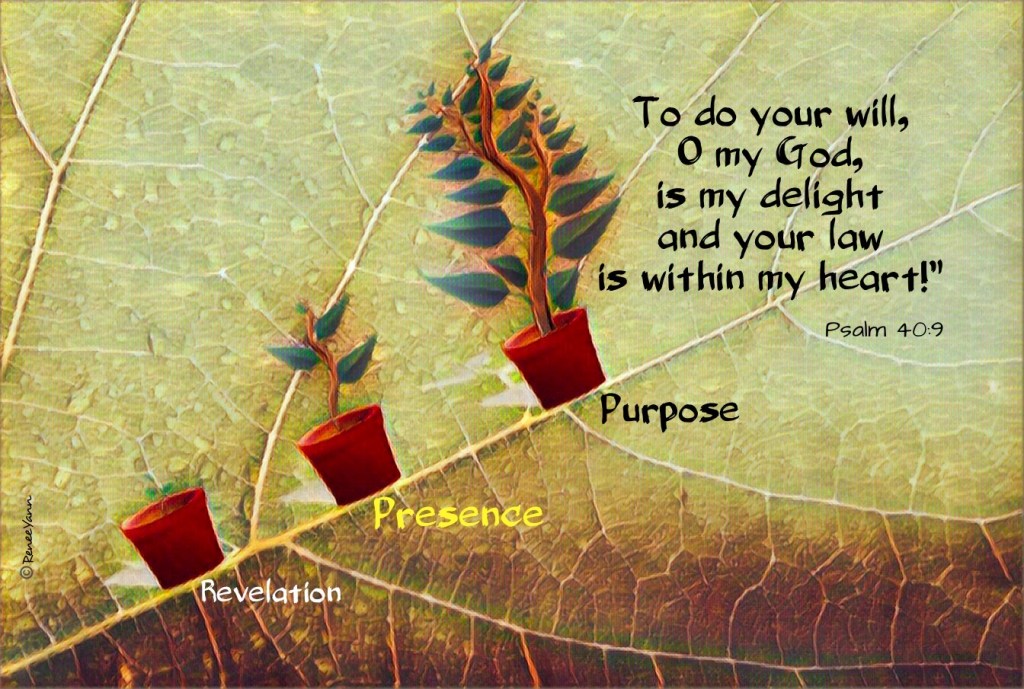
Today, in God’s Lavish Mercy, our readings lead us through an evolution of grace from:

Revelation
to
Presence
to
Purpose 

How simply charming yet powerful is the wonderful story of Samuel’s call! We can picture the tousled-hair boy sleeping near the Ark of the Covenant, youthfully unaware of his awesome surroundings.

God’s voice insists into Samuel’s unawareness, finally capturing his attention after four tries.

Oil painting on canvas, The Calling of Samuel by Sir Joshua Reynolds PRA (Plympton 1723 – London 1792), circa 1770-6. A half-length portrait of a young boy, turned to the left, gazing upwards, his right hand outstretched, wearing a loose brown cloak. Stormy sky.

Extraordinary Revelation 


From that moment, Samuel lives fully in the Presence of the Lord:

Samuel grew up, and the LORD was with him,
not permitting any word of his to be without effect.
Thus all Israel from Dan to Beersheba
came to know that Samuel was an accredited prophet of the LORD.

1 Samuel 3: 19-20
The Prophet Samuel – Claude Vignon

Extraordinary Presence


Mark’s Gospel narrates another call for us – the emerging call of Jesus and his mentoring of his disciples to share his sacred ministry:

Rising very early before dawn, 
he left and went off to a deserted place, where he prayed.
Simon and those who were with him pursued him
and on finding him said, “Everyone is looking for you.”
He told them, “Let us go on to the nearby villages
that I may preach there also.
For this purpose have I come.”
So he went into their synagogues, preaching and driving out demons 
throughout the whole of Galilee.

Mark 1: 35-39

Extraordinary Purpose


As we pray this reflection today, we may be just waking up as Samuel was. We may be slowly emerging from the desert of our sleep. Or we may be at a point in our spiritual lives where the Light is dawning on us for some other reason.

Wherever we are, let’s be aware that each “dawning” brings 

  • a new Revelation of grace
  • a deeper invitation to God’s Presence
  • a fresh call to engage God’s Purpose for our lives

Poetry: The Collar by George Herbert (1593 – 1633) a poet, orator, and priest of the Church of England. Herbert is considered one of the great metaphysical poets.
In this poem, he writes about the evolution of his desire to fully answer God’s call, symbolized in the priestly collar that he wore. The final lines remind me of Samuel’s call.

I struck the board, and cried, “No more; 

                         I will abroad! 

What? shall I ever sigh and pine? 

My lines and life are free, free as the road, 

Loose as the wind, as large as store. 

          Shall I be still in suit? 

Have I no harvest but a thorn 

To let me blood, and not restore 

What I have lost with cordial fruit? 

          Sure there was wine 

Before my sighs did dry it; there was corn 

    Before my tears did drown it. 

      Is the year only lost to me? 

          Have I no bays to crown it, 

No flowers, no garlands gay? All blasted? 

                  All wasted? 

Not so, my heart; but there is fruit, 

            And thou hast hands. 

Recover all thy sigh-blown age 

On double pleasures: leave thy cold dispute 

Of what is fit and not. Forsake thy cage, 

             Thy rope of sands, 

Which petty thoughts have made, and made to thee 

Good cable, to enforce and draw, 

          And be thy law, 

While thou didst wink and wouldst not see. 

          Away! take heed; 

          I will abroad. 

Call in thy death’s-head there; tie up thy fears; 

          He that forbears 

         To suit and serve his need 

          Deserves his load.” 

But as I raved and grew more fierce and wild 

          At every word, 

Methought I heard one calling, Child! 

          And I replied My Lord. 


Music: God’s Calling – George Melendez

I wonder if George Herbert could have appreciated this rap song😀

Blossoming Exultation!

January 11, 2022
Tuesday of the First Week in Ordinary Time

Ordinary Time 2022:
The extraordinary reality is that we have been given the gift of life!
Each day we are given a new portion of grace to deepen in God!
Let us focus our reflections on the “hidden extraordinary”
– a word, thought, or challenge in each day’s readings
that we might otherwise have taken for granted.
May God give us the graceful appreciation to unwrap these gifts!


Today, in God’s Lavish Mercy, we awaken to extraordinary gifts revealed in three words from our readings:

Downcast – Amazed – Exultant

In our first reading, Hannah’s story continues to unfold. And we feel for her, don’t we? The woman is desperate to bear life! Not only does she long for her own sweet child; she longs as well for restored standing in her neighborhood and family as one who is fertile not barren. This meant everything in Hannah’s community as fertility defined a woman’s importance.

Have you ever prayed like Hannah prays in this chapter? Has any need in your life ever so demanded God’s mercy? These are times that ask for our complete vulnerability before God’s Omnipotence.

In her bitterness she prayed to the LORD, weeping copiously,
and she made a vow, promising: “O LORD of hosts,
if you look with pity on the misery of your handmaid,
if you remember me and do not forget me,
if you give your handmaid a male child,
I will give him to the LORD for as long as he lives…

1 Samuel 1: 10-11
Vasili Petrovich Vereshchagin (1864)

Eli witnesses Hannah’s vulnerable prayer. He blesses her and hope cracks through her gloom:
She replied, “Think kindly of your maidservant,” and left.
She went to her quarters, ate and drank with her husband,
and no longer appeared downcast.

1 Samuel 1:18

Extraordinary Vulnerability!


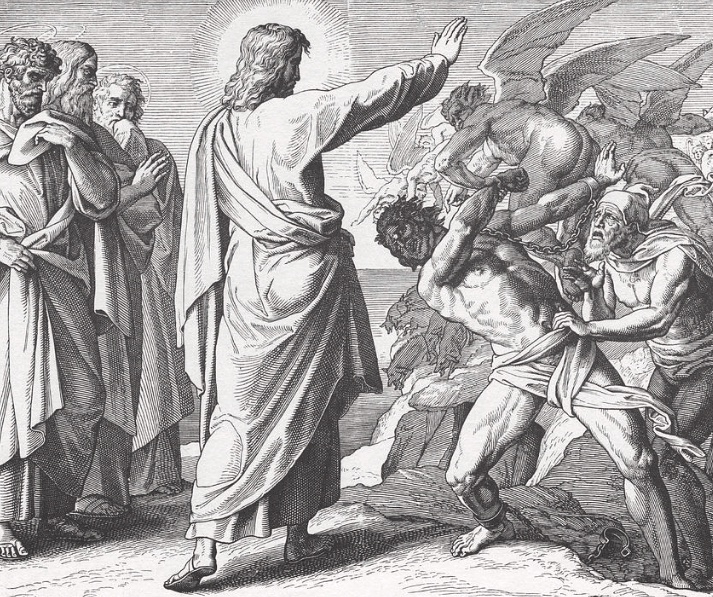
Jesus Casts Out Demons – Julius Schnorr von Carolsfeld

In the Gospel reading, Jesus is still very early in his ministry. He has come to the synagogue to teach and people are “astonished” to hear the depth of his authority. But their astonishment grows even more when Jesus successfully commands the unclean spirit to leave the tortured man.
All were amazed and asked one another,
“What is this?
A new teaching with authority.
He commands even the unclean spirits and they obey him.”

Mark 1:27

Can we let ourselves be constantly amazed at God’s Presence, Power, and Mercy in all Creation?


Extraordinary Holy Amazement!


Once again, our Responsorial Psalm offes a way to pray when our downcast desperation meets God’s amazing, transforming grace. It is the “Magnificat” of Hannah:

And Hannah prayed:

“My heart exults in the LORD,
my horn is exalted by my God.
I have swallowed up my enemies;
I rejoice in your victory.
There is no Holy One like the LORD;
there is no Rock like our God.
1 Samuel 2: 1-2

1 Samual 2: 1-2

Extraordinary Exultation!

Through our scripture-nourished prayer,
may we open the gifts of extraordinary vulnerability, extraordinary hope, and extraordinary exultation
wrapped in our own ordinary lives this day.

Poetry: Bare Tree – Anne Morrow Lindbergh

Already I have shed the leaves of youth,
stripped by the wind of time down to the truth
of winter branches. Linear and alone
I stand, a lens for lives beyond my own,
a frame through which another's fire may glow,
a harp on which another's passion, blow.
The pattern of my boughs, an open chart
spread on the sky, to others may impart
its leafless mysteries that I once prized,
before bare roots and branches equalized,
tendrils that tap the rain or twigs the sun
are all the same, shadow and substance one.
Now that my vulnerable leaves are cast aside,
there's nothing left to shield, nothing to hide.
Blow through me, Life, pared down at last to bone,
so fragile and so fearless have I grown!


Music: Listen to the Trees

The Beloved One

January 9, 2022
The Baptism of the Lord

Today, in God’s Lavish Mercy, we celebrate the Baptism of Jesus, that moment in time when Christ entered into his ministry, announced by the thundering voice of Divine Infinity.

Maybe you’re not like me in this, but I must confess to sometimes letting the scriptures become very ordinary and pedantic. These passages have been read at me in church, sometimes well, often poorly, for seven decades. They have been plastered on billboards, bumper stickers and Church marquees for just as long. All that mundane exposure has demystified some of the most amazing words ever written.


But just think about what today’s Gospel describes.

Think about the greatest prophet of both the Old and New Testament standing waist-deep in the Jordan, eyes locked on Christ.

Think about Jesus, perfectly communed with the Father, walking slowly past the bird-filled trees and bushes to a moment that had been waiting for Him since all eternity. Did not those works of the Creator’s hands sing in worship as he passed?

Think about the pulsing sky already filled with the Creator’s waiting breath, ready to burst with the proclamation of the Son – this Son who said “Yes” to the greatest act of love in history!

For a few moments this morning, let yourself be there. Be filled with nature’s orchestra. Be filled with the pulsing colors of God’s astonishing revelation. Be filled with the Baptist’s profound reverence. Be filled with Christ’s omnipotent freedom and joy.

Let us enter with gratitude and celebration into the Baptism of Jesus!

The Baptism Of Jesus is a painting by Jeff Haynie For purchase, see:https://fineartamerica.com/featured/the-baptism-of-jesus-jeff-haynie.html

Poetry: Jesus’ Baptism – Malcolm Guite

Beginning here we glimpse the Three-in-one;
The river runs, the clouds are torn apart,
The Father speaks, the Spirit and the Son
Reveal to us the single loving heart
That beats behind the being of all things
And calls and keeps and kindles us to light.
The dove descends, the spirit soars and sings
‘You are belovèd, you are my delight!’

In that quick light and life, as water spills
And streams around the Man like quickening rain,
The voice that made the universe reveals
The God in Man who makes it new again.
He calls us too, to step into that river
To die and rise and live and love forever.


Music: Jesus the Lord – Roc O’Connor

Refrain:
Jesus, Jesus
Let all creation bend the knee to the Lord.

  1. In Him we live, we move and have our being;
    In Him the Christ, In Him the King!
    Jesus the Lord.
  2. Though Son, He did not cling to Godliness,
    But emptied Himself, became a slave!
    Jesus the Lord.
  3. He lived obediently His Father’s will
    Accepting His death, death on a cross!
    Jesus the Lord!

Joy Complete

January 8, 2022
Saturday after Epiphany

Today, in God’s Lavish Mercy, our readings offer us a theme of CONFIDENCE with a dash of JOY.

John begins with the reassuring verse:

From the Latin root meaning “to have full trust”, confidence is a rare and beautiful blessing in our lives. How many people or things are you able to trust that deeply? Are you blessed with a true confidant in your life?

John tells us that this is the kind of relationship we can and should have with God.

He says that when we pray with this confidence, we trust whatever answer we receive to bring us grace and life.


Behold the Lamb of God – William Hatherell, from wiki gallery

In our Gospel, John the Baptist’s followers are having a little trouble with their confidence. They are unsettled by the appearance and rising popularity of Jesus. John says to trust what is happening. He had already told them that a greater One would come after him.

John’s ultimate response is worth repeating in prayer, “So this joy of mine has been made complete. He must increase; I must decrease.”

When Christ shines through us
without hindrance of our pride or fears,
how complete our joy will be,
how profoundly rooted our confidence!

Poetry: JOHN THE BAPTIST: THE PASSOVER (JOHN 1:35–39) by Irene Zimmerman, OSF

For years he’d preached the coming was at hand.
Now John saw Jesus walking on the strand.
“Behold the Lamb of God!” he called, and sent
his own disciples hurrying. They went,
filling Jesus’ footprints in the sand
faster than the water could. John stayed and poured
the river on the people and passed them over to his Lord.

Zimmerman, Irene. Incarnation (p. 42). Cowley Publications. Kindle Edition.

Music: Jesu, Joy of Our Desiring – J.S. Bach (interpreted by Daniel Kobialka)

The Miracle is Love

January 4, 2022
Memorial of Saint Elizabeth Ann Seton, Religious


Today, in God’s Lavish Mercy, our readings are full of surprises for Jesus’s new followers and for us.  

Jesus begins to reveal what his Presence among us is all about. The message is this: I am here for the poor, hungry, sick and abandoned:

The Lord has sent me to bring glad tidings to the poor
and to proclaim liberty to captives.

Luke 4:18

And Jesus wants us to be like him.


In our first reading, John makes that sound so simple:

Whoever is without love does not know God, for God is love.

1 John 4:8

Someone might read that line and think, “OK! I can do that! I love lots of people and things. I know how to love.” 

But then our Gospel suggests that maybe we, like the disciples, have a lot to learn about how God loves. Mark shows us that Jesus is living a new kind of love.


Imagine the situation. John the Baptist has been murdered. The new disciples are returning from their first “apostolic gig”. They, and probably Jesus, are shocked, saddened and tired. Jesus recognizes this and tells them:

“Come away by yourselves to a deserted place and rest a while.” 

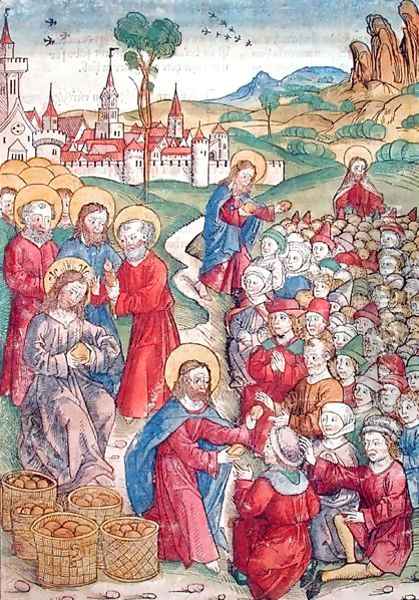
Multiplication of the Loaves – Michael Wolgemut

But instead the hungry crowds followed them, their needs intruding on the deserved and desired solitude. The disciples sound a little annoyed in their practicality:

By now it was already late and his disciples approached him and said,
“This is a deserted place and it is already very late. 
Dismiss them so that they can go 
to the surrounding farms and villages
and buy themselves something to eat.” 

Mark 6: 35-36

But when Jesus saw the crowd, his response was not annoyance or practicality.

When Jesus saw the vast crowd, his heart was moved with pity for them, for they were like sheep without a shepherd…

Mark 6:34

In the Greek translation, the word for “moved with pity” is “ἐσπλαγχνίσθη” (Esplanchnisthē) – “splancha”

“Splancha”, in my mind, says that the heart of Jesus ”rumbled with mercy”; that he was so shaken to his roots with compassion that he pulled heaven down in a miracle to feed these people who were hungry at every level of their being.

The crowds, and indeed the disciples, are surprised not just by the cataract of fish and bread. But they are even more deeply astounded at this astounding demonstration of how God loves – with impractical, unlimited, immediate, miraculous generosity!


The lesson for us? Just as the disciples were commissioned to distribute the basketsful of miracles, we are charged to carry God’s mercy in our time.

Through the grace of Baptism, we have it within us to be the agent of miracles – the power to let God love through us. As John encourages us:

Beloved, let us love one another,
    because love is of God;
    everyone who loves is begotten by God and knows God.

1 John 4:7

Poetry: Miracles by Robert William Service

Each time that I switch on the light
A Miracle it seems to me
That I should rediscover sight
And banish dark so utterly.
One moment I am bleakly blind,
The next–exultant life I find.
Below the sable of the sky
My eyelids double darkness make.
Sleep is divine, yet oh how I
Am glad with wonder to awake!
To welcome, glimmery and wan
The mighty Miracle of Dawn.
For I’ve mad moments when I seem,
With all the marvel of a child,
To dwell within a world of dream,
To sober fact unreconciled.
Each simple act has struck me thus–
Incredibly miraculous.
When everything I see and do
So magical can seem to me,
How vain it is to seek the True,
The riddle of Reality . . .
So let me with joy lyrical
Proclaim all Life a Miracle.


Music: Beloved, Let Us Love One Another – a perky encouragement for your prayer 🙂

Begin Again…

January 3, 2022
Monday after Epiphany

Today, in God’s Lavish Mercy, in this week after the Epiphany, we continue with John’s inspirational readings. They are intended to deepen us in love, truth and simplicity.

And we also have several Gospels this week that take us with Jesus as he begins his public ministry.


Today’s Gospel opens with a tinge of sadness. Jesus has just heard that John had been arrested. Reality dawns on them both that theirs will be no easy missionary journey. Wouldn’t it have been wonderful if these cousins could have teamed up, gone about preaching unhindered by the fears and bullying of the powerful?

But a free and easy story is not the one God chose to tell us, because our own stories are not always free and easy. Some, yes, more so than others. But all people suffer in some way and we all need a God who understands and shares that suffering.

So, “hearing that John had been arrested”, Jesus bravely begins. He goes to the Capernaum lakeshore where the common people gather to refresh themselves. He will find them hungry, confused, sinful, questioning, bereft, and battered. And he will begin by feeding and soothing them.


Where would Jesus begin with you? If you sat along that seashore in those first days, what would you lay before his tender mercy? Perhaps the need does not belong precisely to you, but to someone you love, someone who needs love in a harsh world.

Photo by Taryn Elliott on Pexels.com

Picture yourself there this morning. The sun begins to warm the salty edges of the sea. The crowd is large but quiet, as if they think themselves in church. Jesus looks out over all the gathered. But for one moment, his eyes meet yours, and that moment is enough to begin.


Poetry: To the Sea of Galilee – Benjamin Waugh (1839-1908)
(It’s not a great voice of literature, but I think this little poem is charming.)

O PEARL of seas! how fairly set, thou lovely Galilee!
Well may all waters of the world for beauty envy thee.

For more than beauty! On thy shores heaven’s purest feet have trod;
And in thy face, as now yon sun, was mirrored once my God.

He loved to walk with thee beside; He gazed into thy face; 5
Thy troubled moods He calmed for thee; thou seem’st His child of grace.

But yet why envy thee, fair sea, by Jesus favoured thus?
Far more than He hath favoured thee hath Jesus favoured us.

Not for thy waters Jesus came His precious work to do;
’Twas not to give thy troubles peace that Him from glory drew. 10

Thine was a brief, a passing joy, as transient as thy flowers;
Thy side He left, and went away—He never leaveth ours.

Yet, sea of seas, I envy thee, thou small, but greatest deep
For on thy bosom Jesus found the place where He might sleep.

His weary frame, His heavy heart were pillowed on thy breast. 15
As John on Him, so He on thee found place where He might rest.

Jesus, if thou, by work or wrong, should’st sad or weary be,
Come seek within my heart the place once found on Galilee.


Music: Lord, You Have Come to the Seashore