Today, in Mercy, we join Mary and the disciples as they deal with Christ’s death. No doubt, the range of emotions among them was as great as it would be among any group or family losing someone they dearly loved.
They had entered, with heart-wrenching drama, into a period of bereavement over the loss of Jesus. Doubt, hope, loss, fear, sadness and remembered joy vied for each of their hearts. They comforted one another and tried to understand each other’s handling of their terrible shared bereavement.
They did just what we all do as families, friends and communities when our beloved dies.
But ultimately, our particular bereavement belongs to us alone, woven from the many experiences we have had with the person who has died. These are personal and indescribable, as is the character of our pain and loss.
Do not be afraid of your bereavement. It is a gift of love.
Holy Saturday, like bereavement, is a time of infrangible silence. No matter how many “whys” we throw heavenward, no answer comes. It is a time to test what Love has meant to us and, even as it seems to leave us, how it will live in us.
As we pray today with the bereaved Mother and disciples, let us fold all our bereavements into their love. We already know the joyful end to the story, so let us pray today with honesty but also with unconquerable hope that we will live and love again.
Today, in God’s Lavish Mercy, we pray with Psalm 31, the prayer of one who will not be shaken from faith in God.
For all my foes I am an object of reproach, a laughingstock to my neighbors, and a dread to my friends; they who see me abroad flee from me. I am forgotten like the unremembered dead; I am like a dish that is broken. But my trust is in you, O LORD; I say, “You are my God. In your hands is my destiny; rescue me from the clutches of my enemies and my persecutors.”
Psalm 31: 12-13
What is there to say about the Good Friday journey of Jesus? It may be that we can only walk beside him in loving, heart-broken silence.
There are times in our lives when we will be called to walk like this beside others in loving and merciful ministry.
There may be times when others are called to walk with us in such a way.
Let these times inform our prayer today.
Good Friday is the time we gather strength and compassionate understanding from Jesus to help us, in his Name, be Mercy in the world.
Poetry: From “The Dream of the Rood”, one of the Christian poems in the corpus of Old English literature and an example of the genre of dream poetry. Like most Old English poetry, it is written in alliterative verse. Rood is from the Old English word rōd ‘pole’, or more specifically ‘crucifix’. Preserved in the 10th-century Vercelli Book, the poem may be as old as the 8th-century Ruthwell Cross, and is considered as one of the oldest works of Old English literature.
The Rood (cross of Christ) speaks:
“It was long past – I still remember it –
That I was cut down at the copse’s end,
Moved from my root. Strong enemies there took me,
Told me to hold aloft their criminals,
Made me a spectacle. Men carried me
Upon their shoulders, set me on a hill,
A host of enemies there fastened me.

“And then I saw the Lord of all mankind
Hasten with eager zeal that He might mount
Upon me. I durst not against God’s word
Bend down or break, when I saw tremble all
The surface of the earth. Although I might
Have struck down all the foes, yet stood I fast.

“Then the young hero (who was God almighty)
Got ready, resolute and strong in heart.
He climbed onto the lofty gallows-tree,
Bold in the sight of many watching men,
When He intended to redeem mankind.

I trembled as the warrior embraced me.
But still I dared not bend down to the earth,
Fall to the ground. Upright I had to stand.

“A rood I was raised up; and I held high
The noble King, the Lord of heaven above.
I dared not stoop. They pierced me with dark nails;
The scars can still be clearly seen on me,
The open wounds of malice. Yet might I
Not harm them. They reviled us both together.
I was made wet all over with the blood
Which poured out from his side, after He had
Sent forth His spirit. And I underwent
Full many a dire experience on that hill.

I saw the God of hosts stretched grimly out.
Darkness covered the Ruler’s corpse with clouds
His shining beauty; shadows passed across,
Black in the darkness. All creation wept,
Bewailed the King’s death; Christ was on the cross….

“Now you may understand, dear warrior,
That I have suffered deeds of wicked men
And grievous sorrows. Now the time has come
That far and wide on earth men honor me,
And all this great and glorious creation,
And to this beacon offers prayers. On me
The Son of God once suffered; therefore now
I tower mighty underneath the heavens,
And I may heal all those in awe of me.
Once I became the cruelest of tortures,
Most hateful to all nations, till the time
I opened the right way of life for men.”
Today, in God’s Lavish Mercy, we pray with Psalm 116 which Walter Bruggemann calls an example of “the performance of thanks”.
How shall I make a return to the LORD for all the good he has done for me? The cup of salvation I will take up, and I will call upon the name of the LORD.
Psalm 116: 12-13
There is a tone of solemn ritual woven through the psalm, just as there is throughout the Holy Thursday liturgies.
The time of waiting and wondering is over. Jesus chooses the Passover meal to formalize his understanding that the time has come to offer his life in an ultimate sacrifice of praise.
Before the feast of Passover, Jesus knew that his hour had come to pass from this world to the Father. He loved his own in the world and he loved them to the end.
John 13:1
The Last Supper by the nun Plautilla Nelli (1524–1588) of Florence Inscribed: Suor Plautilla · Orate Pro Pictora (Pray for the Paintress)
It is likely that, during his Last Supper, Jesus would have prayed, and possibly sung, Psalm 116 as part of the ancient Hallel, six thanksgiving prayers included in the Passover rites.
On our behalf, Jesus is about to enflesh in his own life the redemptive promise awaited through the ages. He is about to enact the Great Deliverance — far greater than that achieved in the Passover. By the power of his Paschal sacrifice, we are redeemed from death itself:
Return, my soul, to your rest; the LORD has been very good to you. For my soul has been freed from death, my eyes from tears, my feet from stumbling. I shall walk before the LORD in the land of the living
Psalm 116: 7-9
For me, Holy Thursday is the most solemnly beautiful and meaningful day of the Liturgical Year. There is so much to be found in the readings, especially as we peel back single phrases to hear their living power and love. There is so much to be learned at the side of Jesus as we pray with Him.
May we place ourselves beside Jesus at the holy table of his life. Feel him lay the gathering tensions down as he gathers his beloveds in the truth of this moment. It is time for him to give everything over in love. This is the moment of Holy Acquiescence, this is the moment of Eucharist.
With Jesus, let us pray for the loosening of any bonds which prevent us from giving our lives lovingly into God’s Will for us, from allowing Eucharist to be offered through our lives.
Dear to the eyes of the LORD is the death of his faithful ones. I am your servant, the child of your handmaid; you have loosed my bonds. To you will I offer sacrifice of thanksgiving, and I will call upon the name of the LORD. My vows to the LORD I will pay in the presence of all his people.
Psalm 116: 15-18
Prose: from Mass on the World, by Pierre Teilhard de Chardin
Since once again Lord I have neither bread nor wine nor altar,
I will raise myself beyond these symbols
up to the pure majesty of the real itself.
I, your priest, will make the whole earth my altar,
and on it I will offer you
all the labors and the sufferings of the world.
I will place on my paten Lord God
all the harvest to be won from your renewal.
Into my chalice, I shall pour all the sap
which is to be pressed out this day
from the earth’s fruits and from its sufferings.
All the things in the world
to which this day will bring increase;
all those that will diminish;
all those, too, that will die:
all of them, Lord, I try to gather into my arms
so as to hold them out to you in offering.
This is the material of my sacrifice,
the only material you desire.
The restless multitude, confused or orderly,
the immensity of which terrifies us,
this ocean of humanity,
the slow, monotonous wave-flows which trouble the hearts of even those whose faith is most firm.
My paten and my chalice are
the depths of a soul laid widely open
to all the forces which in a moment will rise up
from every corner of the earth
and converge upon the Spirit.
Grant me the remembrance and the mystic presence
of all those whom the light is now awakening to the new day.
Receive, O Lord, this all-embracing Host
which your whole creation, moved by your magnetism,
offers you at this dawn of a new day.Sanctus, Sanctus, Sanctus
Dominus Deus Sabaoth.
Pleni sunt cæli et terra gloria tua.
Hosanna in excelsis.
Music: Sanctus – Jessie Norman
(Get someplace where you can turn the sound up for this and let it blow you away. There are some exquisite soft notes, beginning and end, that you don’t want to miss. Wait for them.)
Today, in God’s Lavish Mercy, we pray with Psalm 71, a prayer of yielding and confident faith.
Often thought to be the prayer of an aging David, Psalm 71 recalls a long and steady relationship with God. Even as his youthful vigor wanes, the psalmist declares that his true strength rests in God’s faithfulness.
For you are my hope, O LORD; my trust, O God, from my youth. On you I depend from birth; from my mother’s womb you are my strength. My mouth shall declare your justice, day by day your salvation. O God, you have taught me from my youth, and till the present I proclaim your wondrous deeds.
Psalm 71: 15-17
King David as an Old Man – Rembrandt
David witnesses to a powerful faith, one that we all might cherish in our human diminishments. It is hard to lose things in our life – youth, health, relationships, reputation, enthusiasm, hope, direction, security. But all of us face at least some of these challenges at some time in our lives.
Judas Iscariot (right), retiring from the Last Supper, painting by Carl Bloch, late 19th century
In our Gospel today, Jesus acknowledges the loss of trust in a close disciple:
“Amen, amen, I say to you, one of you will betray me.” The disciples looked at one another, at a loss as to whom he meant.
John 13:21-22
That betrayal is a sign to Jesus that the great dream of his earthly ministry is coming to an ignominious close when even those dearest to him slip into betrayal and denial.
What is it that holds Jesus together, heart and soul riveted on the Father’s Will, as he moves through these heart-wrenching days.
Jesus is the living sacrament of complete obedience and union with God. Every choice of his life has brought him to a readiness for this final and supreme act of trusting love. Like the psalmist today, Jesus’s whole life proclaims:
I will always hope in you and add to all your praise. My mouth shall proclaim your just deeds, day after day your acts of deliverance, though I cannot number them all.i I will speak of the mighty works of the Lord; O GOD, I will tell of your singular justice. God, you have taught me from my youth; to this day I proclaim your wondrous deeds.
Psalm 71: 14-17
As we accompany Jesus today, let us pray this psalm with him, asking for an ever-deepening faith, hope, and love.
Poetry: Jesus Weeps – Malcolm Guite
Jesus comes near and he beholds the city
And looks on us with tears in his eyes,
And wells of mercy, streams of love and pity
Flow from the fountain whence all things arise.
He loved us into life and longs to gather
And meet with his beloved face to face
How often has he called, a careful mother,
And wept for our refusals of his grace,
Wept for a world that, weary with its weeping,
Benumbed and stumbling, turns the other way,
Fatigued compassion is already sleeping
Whilst her worst nightmares stalk the light of day.
But we might waken yet, and face those fears,
If we could see ourselves through Jesus’ tears.
Music: Long Ago – Michael Hoppé, Tom Wheater, Michael Tillman
Today, in God’s Lavish Mercy, we pray with Psalm 27 which is a cry for help from one who is confident of God’s care.
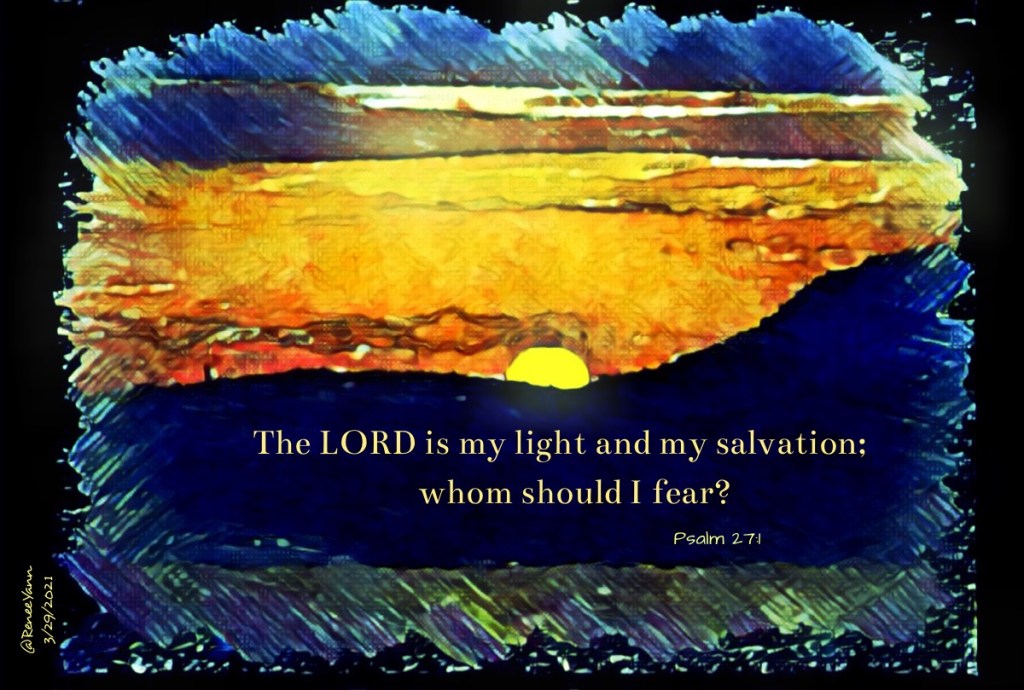
The LORD is my light and my salvation; whom should I fear? The LORD is my life’s refuge; of whom should I be afraid?
Psalm 27:1
Despite these verses, the psalmist obviously is afraid, otherwise why pray? As we begin Holy Week, we might imagine Jesus voicing such a prayer. Confident of the Father’s participation in his life, Jesus nevertheless must face daunting realities with courage – but not without fear.
We can learn so much from Jesus in this.
It is a very unusual, and perhaps non-existent, person who has no fears. We all fear something… maybe many things. It is human to fear that which we cannot see, control, or withstand. Even the one touting his great fearlessness is likely afraid of being seen as weak.
What Jesus teaches us is not to let our faith, love and hope be dominated by fear; rather, to engage our lives courageously with these three virtues despite our normal human fears. In so doing, we become the person God hopes for us to be, just as Jesus did.
Who would I be, and what power would be expressed in my life, if I were not dominated by fear?
Paula D’Arcy
The triumph is in resisting that domination, not in being fearless. Nelson Mandela has written, “I learned that courage was not the absence of fear, but the triumph over it. The brave man is not he who does not feel afraid, but he who conquers that fear.”
I think Jesus was afraid during these final days of his life, but he pushed through to the truth of God’s Will for his life. We can ask Jesus to help us in our fears by praying as he might have with Psalm 27:
You are my light and my salvation Whom then shall I fear?
You are the strength of my life of what shall I be afraid?
Trials, enemies, changes, difficulties— they rise up and they resolve
Therefore– I will trust you I will wait for you I will seek you.
transliteration of Psalm 27 by Christine Robinson
Poetry: from T.S. Eliot, Four Quartet, East Coker
I said to my soul, be still, and let the dark come upon you
Which shall be the darkness of God. As, in a theatre,
The lights are extinguished, for the scene to be changed
With a hollow rumble of wings, with a movement of darkness on darkness,
And we know that the hills and the trees, the distant panorama
And the bold imposing facade are all being rolled away--
Or as, when an underground train, in the tube, stops too long between stations
And the conversation rises and slowly fades into silence
And you see behind every face the mental emptiness deepen
Leaving only the growing terror of nothing to think about;
Or when, under ether, the mind is conscious but conscious of nothing--
I said to my soul, be still, and wait without hope
For hope would be hope for the wrong thing; wait without love,
For love would be love of the wrong thing; there is yet faith
But the faith and the love and the hope are all in the waiting.
Wait without thought, for you are not ready for thought:
So the darkness shall be the light, and the stillness the dancing.
Music: Be Still My Soul – Katharina Amalia Dorothea von Schlegel, born 1697
Today, in God’s Lavish Mercy, we pray a responsorial from the Book of Jeremiah:
The Lord will guard us, as a shepherd guards the flock.
The psalm today, with the first reading, brings assurance that God remains with us through suffering and will heal and make us whole again.
That reassurance is needed as we hear the Gospel’s tone darken. After the raising of Lazarus, the whole nation waits to see what will happen to Jesus as Passover nears.
I think, in some ways, impending doom is almost worse than doom itself. Picture the part in a movie where the attacker waits in the dark while the victim tiptoes into lurking danger.
That frightening music they always play! Sometimes the tension heightens to the point that I have to hit the mute or close my eyes!
Entry of Christ into Jerusalem, a 1617 oil painting by Flemish Baroque painter Anthony van Dyck
This is what all surrounding Jerusalem felt like in today’s Gospel. The dark edge of evil hangs in inevitable threat.
But for Jesus, who walked in the hidden light of the Father, the moment brought more than threatening shadows. It was time to fulfill an ancient promise. It was time to offer the greatest act of Love.
Hear the word of the LORD, O nations, proclaim it on distant isles, and say: He who scattered Israel, now gathers them together, he guards them as a shepherd his flock. The LORD shall ransom Jacob, he shall redeem him from the hand of his conqueror.
Jeremiah 31: 10-12
As Jesus went off alone to Ephraim to prepare his heart and soul for this ultimate fulfillment, perhaps a prayer from Jeremiah strengthened him, a remembered promise from Ezekiel focused him.
Let us pray with Jesus today as he asks the Father to “shepherd” him. With Jesus, may we find our own strengths and understandings in these ancient prophets.
Poetry: Redemption by George Herbert (1593-1633)who was a Welsh-born poet, orator, and priest of the Church of England. His poetry is associated with the writings of the metaphysical poets, and he is recognised as “one of the foremost British devotional lyricists.”
Having been tenant long to a rich lord,
    Not thriving, I resolvèd to be bold,
    And make a suit unto him, to afford
A new small-rented lease, and cancel th’ old.

In heaven at his manor I him sought;
    They told me there that he was lately gone
    About some land, which he had dearly bought
Long since on earth, to take possessiòn.

I straight returned, and knowing his great birth,
    Sought him accordingly in great resorts;
    In cities, theaters, gardens, parks, and courts;

At length I heard a ragged noise and mirth
    Of thieves and murderers; there I him espied,
    Who straight, Your suit is granted, said, and died.
Today, in God’s Lavish Mercy, we pray with the Book of Daniel both for our Responsorial Psalm and for our first reading.
As I read through today’s scripture passages, I immediately thought of my wonderful college Logic professor, Florence Fay. She was free-spirited, colorful, brilliant and clear. I loved her classes. It was Dr. Fay who implanted a love for syllogisms (if-then statements) in my young mind.
Today, multiple syllogisms popped out to me from our first reading and Gospel.
from Daniel:
If our God, whom we serve, can save us from the white-hot furnace and from your hands, O king, then may he save us!
from John:
But even if he will not, (then) know, O king, that we will not serve your god or worship the golden statue that you set up.
If you remain in my word, then you will truly be my disciples, and you will know the truth, and the truth will set you free.
If you were Abraham’s children, (then) you would be doing the works of Abraham. If God were your Father, (then) you would love me, for I came from God and am here; I did not come on my own, but he sent me.
I’ve prayed some pretty frantic “if-then” prayers at desperate times in my life. They sound like this: “Dear God, if You just get me out of this mess I made, then I promise to turn into a Saint!”
But, obviously, with such prayers, I didn’t get the sacred “logic” right. I think a lot of people don’t get it right, sometimes disastrously, as in: “If God had answered my prayer, then I would still go to church. But he didn’t, so I don’t.”
Daniel’s “Psalm” serves as a perfect instruction for how we must respond to God, no matter the outcome of our “if-then” moments. If we close ourselves to God’s presence even in our disappointments, we will never grow into God’s ever-new imagination for our lives.
Glory and praise for ever! Blessed are you, O Lord, the God of our fathers, praiseworthy and exalted above all forever; And blessed is your holy and glorious name, praiseworthy and exalted above all for all ages.
Poetry: If— by Rudyard Kipling 1865-1936
If you can keep your head when all about you Are losing theirs and blaming it on you; If you can trust yourself when all men doubt you, But make allowance for their doubting too;
If you can wait and not be tired by waiting, Or, being lied about, don’t deal in lies, Or, being hated, don’t give way to hating, And yet don’t look too good, nor talk too wise;
If you can dream—and not make dreams your master; If you can think—and not make thoughts your aim; If you can meet with triumph and disaster And treat those two impostors just the same;
If you can bear to hear the truth you’ve spoken Twisted by knaves to make a trap for fools, Or watch the things you gave your life to broken, And stoop and build ’em up with wornout tools;
If you can make one heap of all your winnings And risk it on one turn of pitch-and-toss, And lose, and start again at your beginnings And never breathe a word about your loss;
If you can force your heart and nerve and sinew To serve your turn long after they are gone, And so hold on when there is nothing in you Except the Will which says to them: “Hold on”;
If you can talk with crowds and keep your virtue, Or walk with kings—nor lose the common touch; If neither foes nor loving friends can hurt you; If all men count with you, but none too much;
If you can fill the unforgiving minute With sixty seconds’ worth of distance run— Yours is the Earth and everything that’s in it, And—which is more—you’ll be a Man, my son!
Today, in God’s Lavish Mercy, we pray with Psalm 102, the prayer of someone in the midst of suffering. The psalm is introduced with stark honesty:
The prayer of one afflicted and wasting away whose anguish is poured out before the LORD.
Psalm 102: 1
Psalm 102 speaks to those places in life’s journey where we experience intense, perhaps overwhelming suffering.
In our first reading, the Israelites suffer through what seems like a never-ending journey of homelessness. In our Gospel, Jesus begins his final journey toward his Passion and Death. These both were journeys with suffering as a constant companion
No one avoids suffering in some way. It is part of being human. Even our beloved Catherine McAuley left us this succinct maxim:
This is your life, joys and sorrow mingled, one succeeding the other.
Letter to Frances Warde (May 28, 1841)
The psalmist, in the midst of his suffering, calls out to God for a return of the promised joy.
O LORD, hear my prayer, and let my cry come to you. Hide not your face from me in the day of my distress. Incline your ear to me; in the day when I call, answer me speedily.
This prayer attests to the psalmist’s undaunted faith and to God’s unwavering fidelity.
This mutual faithfulness is where we all must stand in sorrow so that we may come, as Jesus did, to the fullness of Resurrection grace.
As we come closer to the profound mysteries of Holy Week, let us not only reverence our own joys and sorrows. Let us ask to enter more deeply into the experience of Jesus in this final unfolding of his life. May we deepen in the understanding that the suffering of Jesus is one with the suffering of our sisters and brothers.
Poetry: On Another’s Sorrow – William Blake
Can I see another's woe,
And not be in sorrow too?
Can I see another's grief,
And not seek for kind relief?

Can I see a falling tear,
And not feel my sorrow's share?
Can a father see his child
Weep, nor be with sorrow filled?

Can a mother sit and hear
An infant groan, an infant fear?
No, no!  never can it be!
Never, never can it be!

And can He who smiles on all
Hear the wren with sorrows small,
Hear the small bird's grief and care,
Hear the woes that infants bear --

And not sit beside the next,
Pouring pity in their breast,
And not sit the cradle near,
Weeping tear on infant's tear?

And not sit both night and day,
Wiping all our tears away?
Oh no! never can it be!
Never, never can it be!

He doth give his joy to all:
He becomes an infant small,
He becomes a man of woe,
He doth feel the sorrow too.

Think not thou canst sigh a sigh,
And thy Maker is not by:
Think not thou canst weep a tear,
And thy Maker is not near.

Oh He gives to us his joy,
That our grief He may destroy:
Till our grief is fled an gone
He doth sit by us and moan
Today, in God’s Lavish Mercy, we pray with our revered Psalm 23. This powerful prayer of confidence and hope fits well with today’s readings.
In the passage from Daniel, the innocent Susanna never wavers in her trust:
O eternal God, you know what is hidden and are aware of all things before they come to be: you know that they have testified falsely against me. Here I am about to die, though I have done none of the things with which these wicked men have charged me.” The Lord heard her prayer.
Daniel 13: 42-44
In our Gospel, the woman – though not innocent – stills finds refuge in Jesus’s mercy.
So he was left alone with the woman before him. Then Jesus straightened up and said to her, “Woman, where are they? Has no one condemned you?” She replied, “No one, sir.” Then Jesus said, “Neither do I condemn you. Go, and from now on do not sin any more.”
John 8: 9-11
Like these two women, we may find ourselves in a dark valley at times. Whether we are innocent or guilty in arriving there, God abides with us in mercy.
The key is to acknowledge our situation and to reach out to that Mercy. In that way, even though we encounter difficulty, as said in Psalm 23, we live in Light and not in shadow:
Only goodness and kindness follow me all the days of my life; And I shall dwell in the house of the LORD for years to come.
Psalm 23: 5-6
Poetry: Light by Rabindranath Tagore
Light, my light, the world-filling light, the eye-kissing light, heart-sweetening light!
Ah, the light dances, my darling, at the center of my life; the light strikes, my darling, the chords of my love; the sky opens, the wind runs wild, laughter passes over the earth.
The butterflies spread their sails on the sea of light. Lilies and jasmines surge up on the crest of the waves of light.
The light is shattered into gold on every cloud, my darling, and it scatters gems in profusion.
Mirth spreads from leaf to leaf, my darling, and gladness without measure. The heaven’s river has drowned its banks and the flood of joy is abroad.
Today, in God’s Lavish Mercy, we pray with Psalm 81, another call to listen to God’s Word in order to find the fullness of life:
If only my people would hear me, and Israel walk in my ways, I would feed them with the best of wheat, and with honey from the rock I would fill them.
But honestly, isn’t it hard to listen sometimes. Even the psalm suggests that there are such loud, distracting events in our lives that we sometimes can’t hear that Word:
In distress you called, and I rescued you. Unseen, I answered you in thunder; I tested you at the waters of Meribah. Hear, my people, and I will admonish you; O Israel, will you not hear me?
The psalm shows us that God’s deepest Word comes to us in thunder, in storm. It is a truth Jesus embraced on Calvary. It is a truth our lives will sometimes require of us.
This morning my prayer is filled with thoughts of my friend whose young daughter died last week. When even I, who never met Emily, can feel the overwhelming sadness of her untimely death, what unbearable storm must surround her parents! How can they hear the word of faith in the tumult?
Many years ago, I attended an evening event on the other side of my state. During the ceremony, a tornado touched down very nearby. After several frightening hours, I was able to travel back to my hotel, about five miles away.
But the roads were blocked with debris. The streets lights and signs had been blown down. And I was completely unfamiliar with the vicinity. I did eventually make it “home” to the hotel, but it wasn’t the same as I had left it. Part of the roof lay across the street. The window in my room had been fractured and boarded up.
For me, the memory is a parable about suffering. When the storm comes, we may pass through it, but we are not unchanged. Our world is not unchanged.
Jesus was not unchanged by Good Friday and Easter Sunday. By hearing God’s Word in the storm, Jesus was transformed. This is the legacy of faith Christ has given us in the Paschal Mystery. May it strengthen, heal, and transform us this Lent. May it comfort all those who so dearly love Emily.
Poetry: The Man Watching by Rainer Maria Rilke, Translated by Robert Bly
I can tell by the way the trees beat, after so many dull days, on my worried windowpanes that a storm is coming, and I hear the far-off fields say things I can’t bear without a friend, I can’t love without a sister.
The storm, the shifter of shapes, drives on across the woods and across time, and the world looks as if it had no age: the landscape, like a line in the psalm book, is seriousness and weight and eternity.
What we choose to fight is so tiny! What fights with us is so great. If only we would let ourselves be dominated as things do by some immense storm, we would become strong too, and not need names.
When we win it’s with small things, and the triumph itself makes us small. What is extraordinary and eternal does not want to be bent by us. I mean the Angel who appeared to the wrestlers of the Old Testament: when the wrestlers’ sinews grew long like metal strings, he felt them under his fingers like chords of deep music.
Whoever was beaten by this Angel (who often simply declined the fight) went away proud and strengthened and great from that harsh hand, that kneaded him as if to change his shape. Winning does not tempt that man. This is how he grows: by being defeated, decisively, by constantly greater beings.








 Lavish Mercy