Our Psalm: If…

Wednesday of the Fifth Week of Lent

March 23, 2021


Today, in God’s Lavish Mercy, we pray with the Book of Daniel both for our Responsorial Psalm and for our first reading. 


As I read through today’s scripture passages, I immediately thought of my wonderful college Logic professor, Florence Fay. She was free-spirited, colorful, brilliant and clear. I loved her classes. It was Dr. Fay who implanted a love for syllogisms (if-then statements) in my young mind.

Today, multiple syllogisms popped out to me from our first reading and Gospel.

from Daniel:

If our God, whom we serve,
can save us from the white-hot furnace
and from your hands, O king, then may he save us!


from John:

But even if he will not, (then) know, O king,
that we will not serve your god
or worship the golden statue that you set up.

If you remain in my word, then you will truly be my disciples,
and you will know the truth, and the truth will set you free.

If you were Abraham’s children,
(then) you would be doing the works of Abraham. 
If God were your Father, (then) you would love me,
for I came from God and am here;
I did not come on my own, but he sent me.


I’ve prayed some pretty frantic “if-then” prayers at desperate times in my life. They sound like this:
“Dear God, if You just get me out of this mess I made, then I promise to turn into a Saint!”

But, obviously, with such prayers, I didn’t get the sacred “logic” right.
I think a lot of people don’t get it right, sometimes disastrously, as in:
“If God had answered my prayer, then I would still go to church. But he didn’t, so I don’t.”


Daniel’s “Psalm” serves as a perfect instruction for how we must respond to God, no matter the outcome of our “if-then” moments. If we close ourselves to God’s presence even in our disappointments, we will never grow into God’s ever-new imagination for our lives.

Glory and praise for ever!
Blessed are you, O Lord, the God of our fathers,
    praiseworthy and exalted above all forever;
And blessed is your holy and glorious name,
    praiseworthy and exalted above all for all ages.


Poetry: If— by Rudyard Kipling 1865-1936

If you can keep your head when all about you
   Are losing theirs and blaming it on you;
If you can trust yourself when all men doubt you,
   But make allowance for their doubting too;

If you can wait and not be tired by waiting,
   Or, being lied about, don’t deal in lies,
Or, being hated, don’t give way to hating,
   And yet don’t look too good, nor talk too wise;

If you can dream—and not make dreams your master;
   If you can think—and not make thoughts your aim;
If you can meet with triumph and disaster
   And treat those two impostors just the same;

If you can bear to hear the truth you’ve spoken
   Twisted by knaves to make a trap for fools,
Or watch the things you gave your life to broken,
   And stoop and build ’em up with wornout tools;

If you can make one heap of all your winnings
   And risk it on one turn of pitch-and-toss,
And lose, and start again at your beginnings
   And never breathe a word about your loss;

If you can force your heart and nerve and sinew
   To serve your turn long after they are gone,
And so hold on when there is nothing in you
   Except the Will which says to them: “Hold on”;

If you can talk with crowds and keep your virtue,
   Or walk with kings—nor lose the common touch;
If neither foes nor loving friends can hurt you;
   If all men count with you, but none too much;

If you can fill the unforgiving minute
With sixty seconds’ worth of distance run—
   Yours is the Earth and everything that’s in it,
And—which is more—you’ll be a Man, my son!


Music: Even If – MercyMe

Psalm 102: Joys and Sorrows

Tuesday of the Fifth Week of Lent

Tuesday, March 23, 2021


Today, in God’s Lavish Mercy, we pray with Psalm 102, the prayer of someone in the midst of suffering. The psalm is introduced with stark honesty:

The prayer of one afflicted and wasting away 
whose anguish is poured out before the LORD.

Psalm 102: 1

Psalm 102 speaks to those places in life’s journey where we experience intense, perhaps overwhelming suffering.

In our first reading, the Israelites suffer through what seems like a never-ending journey of homelessness. In our Gospel, Jesus begins his final journey toward his Passion and Death. These both were journeys with suffering as a constant companion

No one avoids suffering in some way. It is part of being human. Even our beloved Catherine McAuley left us this succinct maxim:

This is your life, joys and sorrow mingled,
one succeeding the other.

Letter to Frances Warde (May 28, 1841)

The psalmist, in the midst of his suffering, calls out to God for a return of the promised joy.

O LORD, hear my prayer,
    and let my cry come to you.
Hide not your face from me
    in the day of my distress.
Incline your ear to me;
in the day when I call, answer me speedily.  


This prayer attests to the psalmist’s undaunted faith and to God’s unwavering fidelity.

This mutual faithfulness is where we all must stand in sorrow so that we may come, as Jesus did, to the fullness of Resurrection grace.

As we come closer to the profound mysteries of Holy Week, let us not only reverence our own joys and sorrows. Let us ask to enter more deeply into the experience of Jesus in this final unfolding of his life. May we deepen in the understanding that the suffering of Jesus is one with the suffering of our sisters and brothers.


Poetry: On Another’s Sorrow – William Blake 

Can I see another's woe,
And not be in sorrow too?
Can I see another's grief,
And not seek for kind relief?

Can I see a falling tear,
And not feel my sorrow's share?
Can a father see his child
Weep, nor be with sorrow filled?

Can a mother sit and hear
An infant groan, an infant fear?
No, no!  never can it be!
Never, never can it be!

And can He who smiles on all
Hear the wren with sorrows small,
Hear the small bird's grief and care,
Hear the woes that infants bear --

And not sit beside the next,
Pouring pity in their breast,
And not sit the cradle near,
Weeping tear on infant's tear?

And not sit both night and day,
Wiping all our tears away?
Oh no! never can it be!
Never, never can it be!

He doth give his joy to all:
He becomes an infant small,
He becomes a man of woe,
He doth feel the sorrow too.

Think not thou canst sigh a sigh,
And thy Maker is not by:
Think not thou canst weep a tear,
And thy Maker is not near.

Oh He gives to us his joy,
That our grief He may destroy:
Till our grief is fled an gone
He doth sit by us and moan

Music: You Raise Me Up – Josh Grogan

Psalm 23: Darkness to Light

Monday of the Fifth Week of Lent

Monday, March 22, 2021

Today, in God’s Lavish Mercy, we pray with our revered Psalm 23. This powerful prayer of confidence and hope fits well with today’s readings.

In the passage from Daniel, the innocent Susanna never wavers in her trust:

O eternal God, you know what is hidden
and are aware of all things before they come to be:
you know that they have testified falsely against me. 
Here I am about to die,
though I have done none of the things
with which these wicked men have charged me.”
The Lord heard her prayer.

Daniel 13: 42-44

In our Gospel, the woman – though not innocent – stills finds refuge in Jesus’s mercy.

So he was left alone with the woman before him.
Then Jesus straightened up and said to her,
“Woman, where are they?
Has no one condemned you?”
She replied, “No one, sir.”
Then Jesus said, “Neither do I condemn you.
Go, and from now on do not sin any more.”

John 8: 9-11

Like these two women, we may find ourselves in a dark valley at times. Whether we are innocent or guilty in arriving there, God abides with us in mercy. 

The key is to acknowledge our situation and to reach out to that Mercy. In that way, even though we encounter difficulty, as said in Psalm 23, we live in Light and not in shadow:

Only goodness and kindness follow me
all the days of my life;
And I shall dwell in the house of the LORD
for years to come.

Psalm 23: 5-6

Poetry: Light by Rabindranath Tagore

Light, my light, the world-filling light, 
the eye-kissing light, heart-sweetening light!

Ah, the light dances, my darling, at the center of my life; 
the light strikes, my darling, the chords of my love; 
the sky opens, the wind runs wild, laughter passes over the earth.

The butterflies spread their sails on the sea of light. 
Lilies and jasmines surge up on the crest of the waves of light.

The light is shattered into gold on every cloud, my darling, 
and it scatters gems in profusion.

Mirth spreads from leaf to leaf, my darling, 
and gladness without measure.
 The heaven’s river has drowned its banks 
and the flood of joy is abroad.


Psalm 81: Through the Storm

Friday of the Third Week of Lent

March 12, 2021


Today, in God’s Lavish Mercy, we pray with Psalm 81, another call to listen to God’s Word in order to find the fullness of life:

If only my people would hear me,
    and Israel walk in my ways,
I would feed them with the best of wheat,
    and with honey from the rock I would fill them.


But honestly, isn’t it hard to listen sometimes. Even the psalm suggests that there are such loud, distracting events in our lives that we sometimes can’t hear that Word:

In distress you called, and I rescued you.
 Unseen, I answered you in thunder;
    I tested you at the waters of Meribah.
Hear, my people, and I will admonish you;
    O Israel, will you not hear me?


The psalm shows us that God’s deepest Word
comes to us in thunder, in storm.
It is a truth Jesus embraced on Calvary.
It is a truth our lives will sometimes require of us.


This morning my prayer is filled with thoughts of my friend whose young daughter died last week. When even I, who never met Emily, can feel the overwhelming sadness of her untimely death, what unbearable storm must surround her parents! How can they hear the word of faith in the tumult?


Many years ago, I attended an evening event on the other side of my state. During the ceremony, a tornado touched down very nearby. After several frightening hours, I was able to travel back to my hotel, about five miles away.

But the roads were blocked with debris. The streets lights and signs had been blown down. And I was completely unfamiliar with the vicinity. I did eventually make it “home” to the hotel, but it wasn’t the same as I had left it. Part of the roof lay across the street. The window in my room had been fractured and boarded up.

For me, the memory is a parable about suffering. When the storm comes, we may pass through it, but we are not unchanged. Our world is not unchanged.

Jesus was not unchanged by Good Friday and Easter Sunday. By hearing God’s Word in the storm, Jesus was transformed. This is the legacy of faith Christ has given us in the Paschal Mystery. May it strengthen, heal, and transform us this Lent. May it comfort all those who so dearly love Emily.


Poetry: The Man Watching  by Rainer Maria Rilke, Translated by Robert Bly

I can tell by the way the trees beat, after
so many dull days, on my worried windowpanes
that a storm is coming,
and I hear the far-off fields say things
I can’t bear without a friend,
I can’t love without a sister.

The storm, the shifter of shapes, drives on 
across the woods and across time,
and the world looks as if it had no age:
the landscape, like a line in the psalm book, 
is seriousness and weight and eternity.

What we choose to fight is so tiny! 
What fights with us is so great. 
If only we would let ourselves be dominated
as things do by some immense storm, 
we would become strong too, and not need names.

When we win it’s with small things, 
and the triumph itself makes us small. 
What is extraordinary and eternal
does not want to be bent by us. 
I mean the Angel who appeared
to the wrestlers of the Old Testament:
when the wrestlers’ sinews 
grew long like metal strings, 
he felt them under his fingers 
like chords of deep music.

Whoever was beaten by this Angel 
(who often simply declined the fight) 
went away proud and strengthened
and great from that harsh hand, 
that kneaded him as if to change his shape. 
Winning does not tempt that man. 
This is how he grows: by being defeated, decisively, 
by constantly greater beings.


Music: Moonlight Sonata in a Thunderstorm 

Psalm 105: Tell the Story

Friday of the Second Week of Lent

March 5, 2021


Today, in God’s Lavish Mercy, we pray with Psalm 105. Together with our other readings, the psalm allows us to participate in Israel’s great family storytelling.

Give thanks to the LORD, invoke God’s name;
make known among the peoples God’s deeds!
Sing praise to the Lord, play music;
proclaim all the Lord’s wondrous deeds!

Psalm 105: 1-2

Psalm 105 is one of two historical psalms. (The other is Psalm 78.) Its verses summarize an amazing catalogue of God’s faithfulness to Israel and invites the listeners to grateful praise and unfettered hope.


Today’s particular passage is chosen because it recounts the same incidents as our first reading – the story of Joseph. And Joseph’s story prefigures Jesus’s own story which he offers in parable form in today’s Gospel.

When the LORD called down a famine on the land
    and ruined the crop that sustained them,
He sent a man before them,
    Joseph, sold as a slave.

Psalm 105: 16-17

For us, the telling and re-telling
of relationship stories
is an important human rubric,
practiced at
crowded Thanksgiving tables,
at relaxed summer reunions,
and at our inevitable bereavements.


Eventually, with enough retellings, a story becomes part of our family or friendship canon. Thence forward, it gains new dimension. Just like the canon of the Mass, whose formula becomes beautifully rote to us, the story now may be endlessly repeated without being exhausted. In its retelling, it always reveals something new and confirms something old.

Seek out the LORD and the Lord’s might;
constantly seek God’s face.
Recall the wondrous deeds God has done
for you and your beloved ones

Psalm 105: 4-5

In fact, such a story becomes a kind of sacrament, carrying within it the mysterious and unwordable blessings of what it means to live, love, die, and believe. 

Each human story is, in some form, a re-enactment of Christ’s life, death, and Resurrection. The faith, courage, humor, pathos, genius and serendipity of our lives carry the graces to make us holy, to make us Love as Jesus was Love.

When we gratefully retell the history of those graces – as Psalm 105 does today – we practice a powerful ritual of faith. By such liturgy, we are invited to the same grateful praise and unfettered hope as we meet in Psalm 105.

The LORD, is our God
whose judgments reach through all the earth.
Who remembers forever the covenant,
the word commanded for a thousand generations.

Psalm 105: 8-9

Poetry: The Storyteller – Mike Jones

I’m a teller of tales, a spinner of yarns,
A weaver of dreams and a liar.
I’ll teach you some stories to tell to your friends,
While sitting at home by the fire.
You may not believe everything that I say
But there’s one thing I’ll tell you that’s true
For my stories were given as presents to me
And now they are my gifts to you.

My stories are as old as the mountains and rivers
That flow through the land they were born in
They were told in the homes of peasants in rags
And kings with fine clothes adorning.
There’s no need for silver or gold in great store
For a tale becomes richer with telling
And as long as each listener has a pair of good ears
It matters not where they are dwelling.

A story well told can lift up your hearts
And help you forget all your sorrows
It can give you the strength and the courage to stand
And face all your troubles tomorrow.
For there’s wisdom and wit, beauty and charm
There’s laughter and sometimes there’s tears
But when the story is over and the spell it is broken
You’ll find that there’s nothing to fear

My stories were learned in my grandparent’s home
Where their grandparents also had heard them
They were given as payment by travelling folk
For a warm place to lay down their burdens
My stories are ageless, they never grow old
With each telling they are born anew
And when my story is ended, I’ll still be alive
In the tales that I’ve given to you.

Music: The Story I’ll Tell – Morgan Harper Nichols 

Psalm 31: The Plot

Wednesday of the Second Week of Lent

March 3, 2021

Today, in God’s Lavish Mercy, we pray with Psalm 31 which expresses a pleading reflective of our first powerful reading from Jeremiah.

Come, let us contrive a plot against Jeremiah.
… let us destroy him by his own tongue;
let us carefully note his every word.

Jeremiah 18:18

This verse (18:18) is the pivotal turning point where everything goes south for Jeremiah. The Israelite power structure really didn’t want to hear what Jeremiah was telling them. He pins their troubles – the destruction the Temple and Babylonian Captivity – on one thing: their faithlessness to the Covenant with Yahweh.


Jeremiah is an archetype of the condemned prophet whom we meet in Jesus. Today’s Gospel reveals the same pivotal turning point for Jesus:

We are going up to Jerusalem,
and the Son of Man will be handed over to the chief priests
and the scribes,
and they will condemn him to death,
and hand him over to the Gentiles
to be mocked and scourged and crucified,
and he will be raised on the third day.

Matthew 20:18-19

They told the Truth – that we must continually discern God’s Word for our lives, always seeking love, mercy and justice. Few had the courage to listen. Most chose sinful resistance.

The suffering prophet has only one recourse when “hearing the whispers of the crowd, that frighten me from every side, as they consult together against me, plotting to take my life.” Psalm 31:14

That recourse is complete and trusting surrender to God. Psalm 31 reveals this surrender in a verse Jesus ultimately prays from the Cross:

Into your hands I commend my spirit;
    you will redeem me, O LORD, O faithful God.

Psalm 31:6

Lent calls us to the message of Jeremiah and Jesus – to examine our lives in light of love, mercy and justice. Let us pray in the spirit of Jesus today to be open to Truth in our own lives and to build Truth in our communities.


Poetry: The Paradox by Paul Laurence Dunbar
The poem carries a tone similar to sorrowful Jeremiah’s poetry.

I am the mother of sorrows,
I am the ender of grief;
I am the bud and the blossom,
I am the late-falling leaf.

I am thy priest and thy poet,
I am thy serf and thy king;
I cure the tears of the heartsick,
When I come near they shall sing.

White are my hands as the snowdrop;
Swart are my fingers as clay;
Dark is my frown as the midnight,
Fair is my brow as the day.

Battle and war are my minions,
Doing my will as divine;
I am the calmer of passions,
Peace is a nursling of mine.

Speak to me gently or curse me,
Seek me or fly from my sight;
I am thy fool in the morning,
Thou art my slave in the night.

Down to the grave will I take thee,
Out from the noise of the strife;
Then shalt thou see me and know me–
Death, then, no longer, but life.

Then shalt thou sing at my coming.
Kiss me with passionate breath,
Clasp me and smile to have thought me
Aught save the foeman of Death.

Come to me, brother, when weary,
Come when thy lonely heart swells;
I ‘ll guide thy footsteps and lead thee
Down where the Dream Woman dwells.

Music: Symphony No.1 – Jeremiah by Leonard Bernstein 

Summary: an excellent introduction to this symphony

Entire Symphony:

Psalm 116: Listen!

Second Sunday of Lent

February 28, 2021


Today, in God’s Lavish Mercy, we pray with Psalm 116 which Pope John Paul II called “A Prayer of Thanksgiving to the Lord”.

Praying the psalm today, in the context of our other Sunday readings, leads us deeper into the nature of that “thanksgiving” and its relationship to sacrifice.

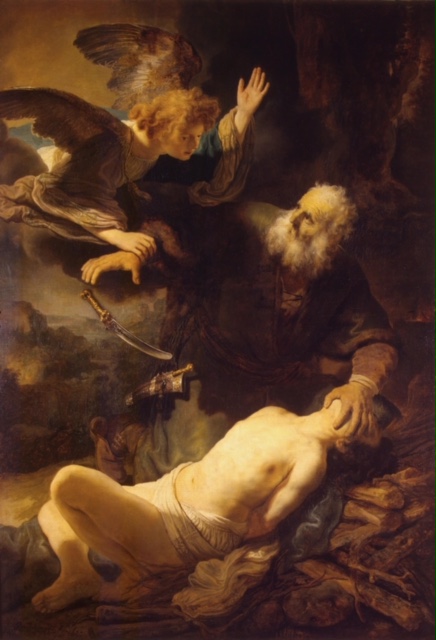
Abraham and Isaac by Rembrandt

In our first reading, we meet Abraham, full of thanks that God reconsidered the command to sacrifice his dear son.


But then our second reading expresses thanks that God was willing to sacrifice his own Son for our sakes.

The Transfiguration by Titian

Finally, our Gospel takes us to the Transfiguration where that Son who will be sacrificed is revealed in his true glory.

What is the thread binding these readings? I think it can be found in this Gospel verse:

This is my beloved Son.  
Listen to him.

True listening is obedience. The words come from the same root: obedience = listen to,” from ob “to” + audire “listen, hear”.

  • Abraham listens, no matter how hard, and finally hears God’s real command to love.
  • Jesus listens to the Will of the Father even through his suffering, and is led to Resurrection.
  • We, like Peter, James and John, are called to listen to Jesus who will transfigure our perceptions about what life is really calling us to.

In each case, intent “obedience” allows the listener to hear and see beneath circumstances to the deeper Grace beyond appearances. Deep spiritual listening transfigures us!

This is the whole point of the spiritual life. Our lives are so much more than mere circumstances or appearance. Our psalm calls us to believe this even in difficulty:

I believed, even when I said,
    “I am greatly afflicted.”
Precious in the eyes of the LORD
    is the death of his faithful ones.

Psalm 116:10

When we do this, we are freed to engage our lives at the level of God’s Will which is always for our good, which is always from Love. The long tradition of faith, learned from our forbearers, assures us of this:

O LORD, I am your servant;
    I am your servant, the child of your faithful ones;
    you have loosed my bonds.
To you will I offer sacrifice of thanksgiving,
    and I will call upon the name of the LORD.

Psalm 116:16-17

Some of us go through life continually angry, frustrated, or overwhelmed by our challenges. Others, experiencing similar or even greater challenges, reflect a spirit of joy, peace, and gratitude. Why is that? I think today’s readings give us a big clue. Let’s listen to them!


Poetry: Story of Isaac, written and chanted by the bard Leonard Cohen who also wrote the currently popular “Hallelujah “.


Music: Psalm 116: Steve Green

Lyrics

I love the Lord, He heard my voice
He heard my voice. He heard my voice
He heard my cry for mercy
Because He has turned His ear to me
I will call (I will call)
I will call on the Lord for as long as I live

I love the Lord, He heard my voice
He heard my voice. He heard my voice
He heard my cry
I love the Lord, He heard my voice
He heard my voice. He heard my voice
He heard my cry for mercy

Psalm 23: The Shepherd

Feast of the Chair of Saint Peter, Apostle

February 22, 2021


Today, in God’s Lavish Mercy, on this Feast of St. Peter we pray with Psalm 23 – the Good Shepherd.

The LORD is my shepherd; I shall not want.
    In verdant pastures I am given repose;
Beside restful waters the Lord leads me;
    refreshing my soul.

Psalm 23

The history and devotion intrinsic to this feast can inspire us to pray especially today for our dear Pope Francis who carries Peter’s grace and burden in our time. He carries, in Primacy, the charge reflected in our first reading:

Tend the flock of God in your midst,
overseeing not by constraint but willingly,
as God would have it, not for shameful profit but eagerly.
Do not lord it over those assigned to you,
but be examples to the flock.
And when the chief Shepherd is revealed,
you will receive the unfading crown of glory.


Pope Francis faces resistances just as Peter did. There are always forces within a community who pull its energy in contradictory directions. When rooted in love and reverent dialogue, that counteraction can generate growth. But when born of selfishness and obstinance, such opposition poisons the whole Body.

Francis needs our prayer. The Church needs our prayer. According to Teresa of Avila, Saint and Doctor of the Church, that prayer should be scriptural:

All the troubles of the Church,
all the evils in the world,
flow from this source:
that human beings do not
by clear and sound knowledge
and serious consideration
penetrate into the truths
of Sacred Scripture.

St. Teresa of Avila

Today, Psalm 23 inspires our prayer for our Pope:

Even in the dark valley
    may you fear no evil; for you are at God’s side
Whose rod and staff
    give you courage.
May God spread graces before you
    in the sight of your troubles;
and anoint your head with oil;
    your cup overflowing.
May goodness and kindness follow you
    all the days of your life;
May you dwell in the LORD’s sanctuary
    for all your days.


Poetry: When I was a boy … (Da ich ein Knabe war …) – Friedrich Hölderlin

Pope Francis’s favorite poet is said to be the German writer Friedrich Hölderlin. Perhaps Francis, composer of the lyrical Laudato Sí and Fratelli Tutti, loves this rhapsodic poem.

When I was a boy
Often a god would save me
From the shouts and blows of men;
I played safely and well
With the flowers of the fields
And the winds of heaven
Played with me.

As you make happy
The hearts of plants
When they extend to you
Their delicate tendrils,
So you make my heart happy,
Father Sun, and like Endymion
I was your favorite,
Holy Moon!

All true and neighborly gods!
If only you knew
How much I loved you then!
True, at that time, I didn’t
Know your names, and you
Never bothered to name me, like men
Who only pretend to know one another.

Yet I know you better
Than I’ve ever known anyone,
I understood the silence of the upper air,
But I’ve never understood the words of men.
I was raised by the sounds
Of the rustling grove
And learned to love
Among the flowers.
I grew up in the arms of the gods.

Music: Psalm 23 with Bach’s Sheep May Safely Graze

Psalm 25: Grace through Prisms

First Sunday of Lent

February 21, 2021

Today, in God’s Lavish Mercy, we pray with Psalm 25, a prayer full of humility, thanksgiving, and hope.

Your ways, O LORD, make known to me;
    teach me your paths,
Guide me in your truth and teach me,
    for you are God my savior.

Psalm 25: 4-5

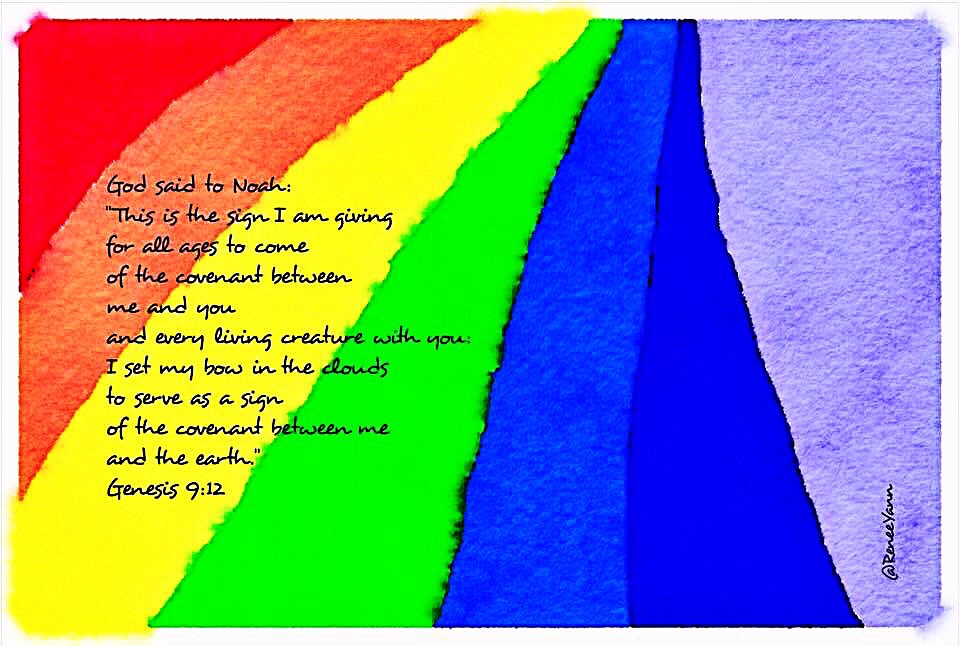
Genesis 9:12

On this First Sunday of Lent, the psalm is set between the wonderful Noah story, its interpretation by Peter, and the proclamation of Christ’s redemptive mission.

Like Noah, humankind has come through the storm of an ages-long messianic longing. Jesus is the Rainbow rising out of that darkness. His Light passes into us through the prismed waters of our Baptism. Indeed, as our Psalm declares:

Good and upright is the LORD,
    showing sinners the way.
God guides the humble to justice,
    and teaches the humble the godly way.

Psalm 25: 8-9

When our psalmist first begins to pray, the light within seems shadowed and the vibrancy of his soul perhaps fractured. At times, we have felt the same way. 

But the psalmist’s sincere and humble prayer catches God’s Light, allowing the passage from shadows to to the full rainbow of Mercy. May it be so for all of us as well as we journey with Jesus through Lent.

Poetry: on a separate post today due to its length — but so worth the time to read and savor.


Music: Rainbow by Robert Plant – Let God sing this song to you, perhaps the way God sang in Noah’s heart when he was delivered from the flood.

I found a lucky charm
I dressed it up with love
I crossed the Seven Seas to you
Will it be enough?

And I will be a rainbow
Oh, now your storm is gone
And I will bring the song for you
And I will carry on
Ooh Ooh Ooh
Ooh Ooh Ooh

I'm reachin' for the stars
In the sky above
Oh, I will bring their beauty home
The colors of my love

And I will be a rainbow
Now your storm is gone
And I will bring my song to you
And I will carry on
(Hummed interlude)

Love is enough
Though the world be a wind
And the woods have no voice but the voice of complaining

My hands shall not tremble, my feet shall not falter
The voyage shall not weary, the fish shall not alter
Hmm, It's rainbow, oh it's rainbow
Oh, can't you see the eyes are the eyes of a lover

Pocket full of hearts
A world that's filled with love
A love that carries all before
The passion and the flood

I lie beneath the rainbow
Now your tears have gone
And I will sing my song for you
And I will carry on
(Repeated interlude)

Psalm 50: Love Bears Sacrifice

Monday of the Sixth Week in Ordinary Time

February 15, 2021


Today, in God’s Lavish Mercy, we pray with Psalm 50, set as a scene from a court proceeding. That seems rather appropriate after watching the impeachment proceedings, doesn’t it!

Psalm 50 is written to evoke the imagery of trial in which God calls all Creation as witnesses.

God the LORD has spoken and summoned the earth,
    from the rising of the sun to its setting.

Psalm 50: 1

God expresses displeasure to the people about two specific things.

  1. The substance of their sacrifices:

Offer praise as your sacrifice to God;
fulfill your vows to the Most High.
Then call on me on the day of distress;
I will rescue you, and you shall honor me.

Psalm 50: 15-16

2. Their blatant hypocrisy:

But to the wicked God says:
“Why do you recite my commandments
and profess my covenant with your mouth?
You hate discipline;
you cast my words behind you!

Psalm 50: 17-18

in judgement, God requires a conversion in the people:

Now understand this, you who forget God,
lest I start ripping apart and there be no rescuer.

Psalm 50:23

The psalm’s imagery was no doubt effective for its first listeners because they, like us, had witnessed many a court proceeding that was all about “law” but very little about justice. They recognized hypocrisy clothed in pretense, even in themselves.

God, on the other hand speaks clearly about truth and justice:

Those who offer praise as a sacrifice honor me;
I will let him whose way is steadfast
look upon the salvation of God.

Psalm 50: 24

Praise is the prayer of a humble, aware, truthful, and obedient spirit. Our Gospel verse instructs us that we learn how to offer a sacrifice of praise by living in the pattern of Jesus:

I am the way and the truth and the life, says the Lord;
no one comes to the Father except through me.

John 14:6

Poetry: Praise Song for the Day by ELIZABETH ALEXANDER

A Poem for Barack Obama’s Presidential Inauguration
Each day we go about our business,
walking past each other, catching each other’s
eyes or not, about to speak or speaking.

All about us is noise. All about us is
noise and bramble, thorn and din, each
one of our ancestors on our tongues.

Someone is stitching up a hem, darning
a hole in a uniform, patching a tire,
repairing the things in need of repair.

Someone is trying to make music somewhere,
with a pair of wooden spoons on an oil drum,
with cello, boom box, harmonica, voice.

A woman and her son wait for the bus.
A farmer considers the changing sky.
A teacher says, Take out your pencils. Begin.

We encounter each other in words, words
spiny or smooth, whispered or declaimed,
words to consider, reconsider.

We cross dirt roads and highways that mark
the will of some one and then others, who said
I need to see what’s on the other side.

I know there’s something better down the road.
We need to find a place where we are safe.
We walk into that which we cannot yet see.

Say it plain: that many have died for this day.
Sing the names of the dead who brought us here,
who laid the train tracks, raised the bridges,

picked the cotton and the lettuce, built
brick by brick the glittering edifices
hey would then keep clean and work inside of.

Praise song for struggle, praise song for the day.
Praise song for every hand-lettered sign,
the figuring-it-out at kitchen tables.

Some live by love thy neighbor as thyself,
others by first do no harm or take no more
than you need. What if the mightiest word is love?

Love beyond marital, filial, national,
love that casts a widening pool of light,
love with no need to pre-empt grievance.

In today’s sharp sparkle, this winter air,
any thing can be made, any sentence begun.
On the brink, on the brim, on the cusp,

praise song for walking forward in that light.

Music: Total Praise – Richard Smallwood

I just love this hymn and this choir!

Lord, I will lift my eyes to the hills
Knowing my help is coming from You
Your peace You give me in time of the storm
You are the source of my strength
You are the strength of my life
I lift my hands in total praise to You
You are the source of my strength
You are the strength of my life
I lift my hands in total praise to You
Amen, Amen, Amen, Amen
You are the source of my strength
You are the strength of my life
I lift my hands in total praise to You
Amen, Amen, Amen, Amen