Psalm 110:Through Paul’s Lens

Wednesday of the Third Week in Ordinary Time

January 27, 2021


Today, in God’s Lavish Mercy, we pray with Psalm 110, but through the lens of our first reading from Hebrews.

We have prayed with this psalm a few times recently, exploring its links to priesthood, ministry, and good old Melchizedek. When I saw it again this morning, I was at little exhausted by it. Then I read Hebrews and got a new perspective on Psalm 110.

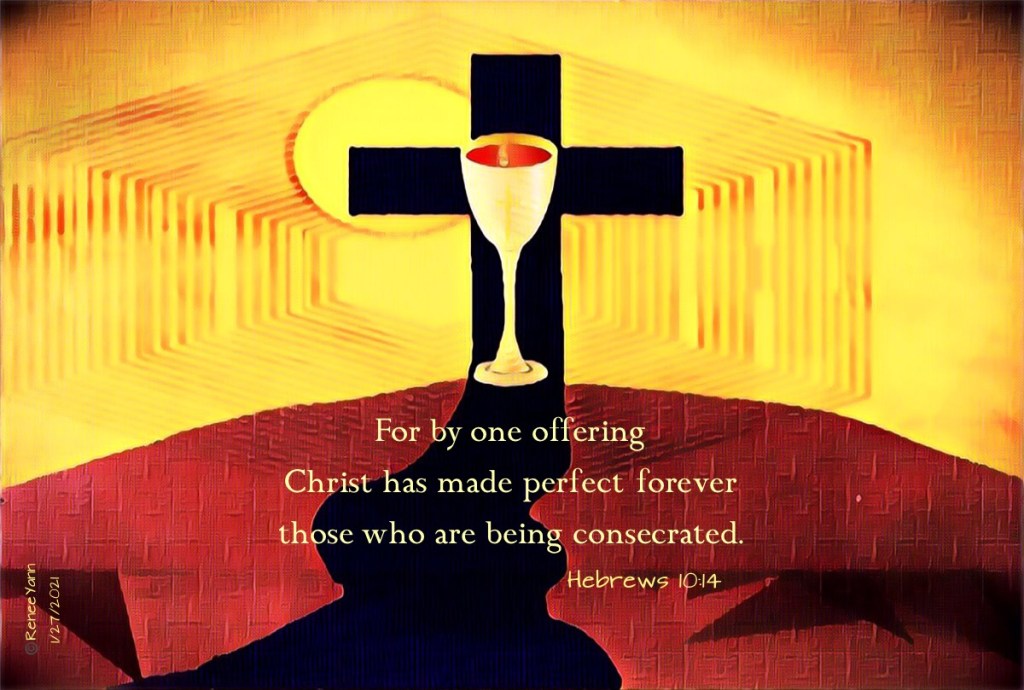
For by one offering Christ has made perfect forever 
those who are being consecrated.
The Holy Spirit also testifies to us, for after saying:
    This is the covenant I will establish with them
        after those days, says the Lord:
    “I will put my laws in their hearts,
        and I will write them upon their minds,”

Hebrews 10:14-16

This passage from Hebrews is a testament to Jesus Christ, the ultimate High Priest, the Complete Melchizedek. That which Christ sanctifies or consecrates is us – his Body, the Church.
This consecration places in our hearts the covenant once spoken of by Jeremiah:

See, days are coming says the LORD—
when I will make a new covenant with the house of Israel and the house of Judah.
It will not be like the covenant I made with their ancestors
the day I took them by the hand to lead them out of the land of Egypt.
They broke my covenant, though I was their master.
But this is the covenant I will make with the house of Israel after those days.
I will place my law within them, and write it upon their hearts;
I will be their God, and they shall be my people.

Jeremiah 31:31-33

Praying with Psalm 110 in this light, I give thanks for the Covenant expressed in my own life:

  • for my Baptism into Christ,
  • for the grace to witness to Christ’s law of love
  • for my inclusion into Christ’s ongoing ministry through the Holy Spirit

Poetry: The Covenant Prayer of John Wesley (1703–1791)

I am no longer my own, but thine.
Put me to what thou wilt, rank me with whom thou wilt.
Put me to doing, put me to suffering.
Let me be employed for thee or laid aside for thee,
exalted for thee or brought low for thee.
Let me be full, let me be empty.
Let me have all things, let me have nothing.
I freely and heartily yield all things to thy pleasure and disposal.
And now, O glorious and blessed God, Father, Son and Holy Spirit,
thou art mine, and I am thine.
So be it.
And the covenant which I have made on earth,
let it be ratified in heaven.
Amen.

Music: A New and Living Way – Michael Card

Year after year there the priest would stand
 An offering of blood held out in in his hand
 Before the curtain there he would stand in fright
 It hung there to hold in the holy ~ to keep in the light
 
A new and living way
 Through the curtain that was torn
 The climax of the cross
 The moment our hope was born
 By a new and living way
 
 And when time was full another Priest came to save
 He would offer forgiveness for He was the Offering He gave
 From the sacrifice ~ from that dark disgrace
 Came the power to make anywhere a Most Holy Place
 
 A new and living way
 Through the curtain that was torn
 The climax of the cross

Psalm 25: Let Your Word Teach Me

Third Sunday in Ordinary Time 

Sunday of the Word of God

January 24, 2021


Today, in God’s Lavish Mercy, we pray with Psalm 25, a simple, heartfelt plea to learn God’s ways and to be blessed by that learning.

Your ways, O LORD, make known to me;
    teach me your paths,
Guide me in your truth and teach me,
    for you are God my savior.

Psalm 25: 4-5

The psalmist’s prayer is so fitting
for this special Sunday
which is dedicated as the
“Sunday of the Word of God”.

Pope Francis called for this commemoration with his Apostolic Letter “Aperuit illis”. The Latin words come from Luke 24:45, referring to Jesus’s post-Resurrection appearance to his confused disciples.

Then he opened their minds
to understand the scriptures.

While they were still speaking about this, he stood in their midst and said to them, “Peace be with you.” But they were startled and terrified and thought that they were seeing a ghost.
Then he said to them, “Why are you troubled? And why do questions arise in your hearts?
Look at my hands and my feet, that it is I myself. Touch me and see, because a ghost does not have flesh and bones as you can see I have.” And as he said this, he showed them his hands and his feet.

While they were still incredulous for joy and were amazed, he asked them, “Have you anything here to eat?” They gave him a piece of baked fish; he took it and ate it in front of them.
He said to them, “These are my words that I spoke to you while I was still with you, that everything written about me in the law of Moses and in the prophets and psalms must be fulfilled.”
Then he opened their minds to understand the scriptures.

Luke 24: 36-45

The Pope’s letter institutes the annual observance
of the 3rd Sunday of Ordinary Time
as “Sunday of the Word of God”,
devoted to the celebration, study and
dissemination of the Word of God.

Pope Francis wrote this:

A profound bond links sacred Scripture and the faith of believers. Since faith comes from hearing, and what is heard is based on the word of Christ (cf. Rom 10:17), believers are bound to listen attentively to the word of the Lord, both in the celebration of the liturgy and in their personal prayer and reflection.

Aperuit Illis, 7

If you are reading this blog, you already seek an ever deeper, more loving relationship with God through sacred scripture. But with our Infinite God, there is always more.

Let us use today’s Psalm 25 to reflect on and reaffirm that core relationship in our lives. Let’s re-examine the dedicated time we give to scriptural prayer and “lectio divina” to make it more intentional, quiet, and consistent.


For a good explanation of lectio divina, see the Transforming Center’s website:


In the spirit of Psalm 25, we pray to always be held in God’s merciful attention, and to hold God in ours through prayer and desire.

Remember that your compassion, O LORD,
    and your love are from of old.
In your kindness remember me,
    because of your goodness, O LORD.

Psalm 25: 6-7

These are two books that I love, and have mentioned before, to help deepen our scriptural prayer:

Too Deep for Words – Thelma Hall

The Flowing Grace of Now – Macrina Wiederkehr – (Kindle edition on sale now for just $2.99)


Poetry: The Opening of Eyes – David Whyte

That day I saw beneath dark clouds 
the passing light over the water
and I heard the voice of the world speak out,
I knew then, as I had before
life is no passing memory of what has been
nor the remaining pages in a great book
waiting to be read.
It is the opening of eyes long closed.
It is the vision of far off things
seen for the silence they hold.
It is the heart after years
of secret conversing
speaking out loud in the clear air.
It is Moses in the desert
fallen to his knees before the lit bush.
It is the man throwing away his shoes
as if to enter heaven
and finding himself astonished,
opened at last,
fallen in love with solid ground.

Music: Word of God Speak – MercyMe 

Psalm 47: Imagining God

Saturday of the Second Week in Ordinary Time

January 23, 2021


Today, in God’s Lavish Mercy, we pray with Psalm 47 which describes God as a King ascending to the throne amid shouts of joy.

God mounts the throne amid shouts of joy;
the LORD, amid trumpet blasts.
Sing praise to God, sing praise;
sing praise to our king, sing praise.

Psalm 47: 6-7

This description reminds me of a pageant like the recent inauguration, where fanfare horns announce the President’s arrival. For the psalmist, the horn might have been a shofar.

It’s a beautiful and triumphant way to imagine what God might be like. But that’s all it is – an image, a product of human imagination. Like the psalmist, we all engage in that creative effort – we picture God. We draw God out of the media stored in our own hearts and spirits.


The freedom we have to imagine God can be both a blessing and a curse. As a blessing, it has allowed us to create tender, triumphant, and splendid constructs of an otherwise unimaginable Love. As a curse, it has given us the power to distort God’s image for our own selfish ends.


It is an awesome power. Even the great Saint Augustine struggled with it:

Augustine by Philippe de Champaigne

What art Thou then, my God? 
Most highest, most good, 
most potent, most omnipotent; 
most merciful and most just; 
most hidden and most present; 
most beautiful and most strong, 
standing firm and elusive, 
unchangeable and all-changing; 
never new, never old; 
ever working, ever at rest; 
gathering in and [yet] lacking nothing; 
supporting, filling, and sheltering;
creating, nourishing, and maturing; 
seeking and [yet] having all things. 
And what have I now said,

my God, my life, my holy joy? 
or what says anyone who speaks of Thee? 
And woe to the one who keeps silent about you, 
since many babble on and say nothing.


Praying with Psalm 47, I consider my own “photo album” of the Holy One. I talk with God about those pictures. I ask to know and love God more clearly, so that, made in God’s image, I may more honestly reflect it.

God has given us the ultimate self-portrait in the Person of Jesus who is:

… the image of the unseen God,
the firstborn over all creation.

Colossians 1: 15

Poetry: from Paul’s letter to the Philippians 

Have among yourselves the same attitude
that is also yours in Christ Jesus,
Who, though he was in the form of God,
did not regard equality with God something to be grasped.
Rather, he emptied himself,
taking the form of a slave,
coming in human likeness;
and found human in appearance,
he humbled himself,
becoming obedient to death, even death on a cross.
Because of this, God greatly exalted him
and bestowed on him the name
that is above every name,
that at the name of Jesus
every knee should bend,
of those in heaven and on earth and under the earth,
and every tongue confess that
Jesus Christ is Lord,
to the glory of God the Father.

Philippians 2: 6-11

Music: Philippians Hymn – John Michael Talbot

Psalm 110: A Chasuble of Justice

Monday of the Second Week in Ordinary Time

January 18, 2021


Today, in God’s Lavish Mercy, we pray with Psalm 110 where we are re-introduced to Melchizedek, the first priest mentioned in Genesis 14.


Yours is princely power in the day of your birth, in holy splendor;
    before the daystar, like the dew, I have begotten you.”
The LORD has sworn, and will not repent:
    “You are a priest forever, according to the order of Melchizedek.”

Psalm 110: 3-4

And our two readings today show us Jesus, the one High Priest, through whom we are fully redeemed.

In the days when he was in the Flesh,
Jesus offered prayers and supplications with loud cries and tears
to the one who was able to save him from death,
and he was heard because of his reverence.
Son though he was, he learned obedience from what he suffered;
and when he was made perfect,
he became the source of eternal salvation for all who obey him.

Hebrews 5: 7-9

It is so appropriate to consider the meaning of priesthood as we commemorate the life of Rev. Dr. Martin Luther King. In the image of Christ, Dr. King wore a chasuble of justice for our time.

A priest is one :

  • who is set apart
  • who mediates the Divine
  • who bears witness
  • who ministers
  • who offers sacrifice
  • who transforms through prophetic hope

As a Catholic priest vests with the chasuble for Mass, this prayer is said:

Domine, qui dixisti:
Jugum meum suave est et onus meum leve:
fac, ut istud portare sic valeam,
quod consequar tuam gratiam.

Lord, you have said:
My yoke is sweet and my burden is light.
Grant that I may carry your yoke well
so as to obtain your grace.

Indeed, Martin Luther King “carried the yoke well”
to obtain the grace of justice for all of us.


Poetry: two poems in which the poet, Margaret Walker, uses the persona of Amos the Prophet to describe Martin Luther King. One poem is written before, and one after, Dr. King’s assassination.

Amos, 1963 – Margaret Walker – 1914-1997

Amos is a Shepherd of suffering sheep;
A pastor preaching in the depths of Alabama
Preaching social justice to the Southland
Preaching to the poor a new gospel of love
With the words of a god and the dreams of a man
Amos is our loving Shepherd of the sheep
Crying out to the stricken land
“You have sold the righteous for silver
And the poor for a pair of shoes.
My God is a mighty avenger
And He shall come with His rod in His hand.”
Preaching to the persecuted and the disinherited millions
Preaching love and justice to the solid southern land
Amos is a Prophet with a vision of brotherly love
With a vision and a dream of the red hills of Georgia
“When Justice shall roll down like water
And righteousness like a mighty stream.”
Amos is our Shepherd standing in the Shadow of our God
Tending his flocks all over the hills of Albany
And the seething streets of Selma and of bitter Birmingham.

Amos (Postscript, 1968)

From Montgomery to Memphis he marches
He stands on the threshold of tomorrow
He breaks the bars of iron and they remove the signs
He opens the gates of our prisons.
He speaks to the captive hearts of America
He bares raw their conscience
He is a man of peace for the people
Amos is a Prophet of the Lord
Amos speaks through Eternity
The glorious Word of the Lord!

Music: American Dream – Bobby Womack

Psalm 40: God’s Whisper

Second Sunday in Ordinary Time

January 17, 2021


Today, in God’s Lavish Mercy, we pray with Psalm 40, the prayer of one at home with God:

I delight to do your will, my God;
your law is in my inner being!

Psalm 40:9

We are reminded that we find this kind of peace by believing and listening to our experience:

Throughout our readings today, God leans over heaven’s edge to whisper into human experience.


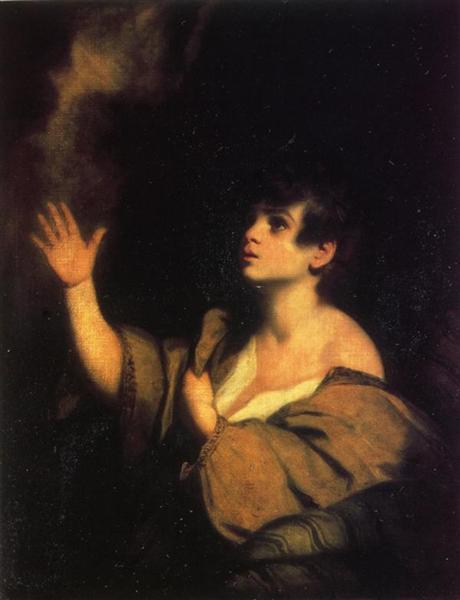
Samuel’s Call by Joshua Reynolds

In our first reading, that whisper comes in a sacred call to a listening Samuel:

When Samuel went to sleep in his place,
the LORD came and revealed his presence,
calling out as before, “Samuel, Samuel!”
Samuel answered, “Speak, for your servant is listening.”

1 Samuel 3: 9-10

In our second reading, Paul reminds us that the
Whispering Spirit is already resident within us:


Do you not know that your body
is a temple of the Holy Spirit within you,
whom you have from God, 
and that you are not your own?

1 Corinthians 6: 19

In our Gospel, Jesus – the Word, the Divine Whisper – invites us to come to him, to see his power with us in our ordinary lives.

The two disciples said to Jesus,
“Rabbi, where do you live?”
He said to them, “Come, and you will see.”

John 1: 39

Praying with Psalm 40 can turn our hearts
to listening for God’s voice
under and within our experiences. 

  • It can wake us up, as Samuel was awakened.
  • It can attune us to the melody deep within our hearts.
  • It can reiterate God’s invitation to live our lives so fully in the Beloved’s Presence that, even without a sound, we know each other’s thoughts.

Poetry: from Whispers of the Beloved by Rumi

Do you know what the music is saying?
“Come follow me and you will find the way.
Your mistakes can also lead you to the Truth.
When you ask, the answer will be given.”

Music: All Praise to Him – Sovereign Grace Music

Psalm 105: Wondrous Deeds

Wednesday of the First Week in Ordinary Time

January 13, 2021

Today, in God’s Lavish Mercy, we pray with Psalm 105 celebrating God’s covenanted faithfulness to us.

Give thanks to the LORD, invoke God’s name;
    make known among the nations God’s deeds.
Sing, sing God’s praise,
    proclaim all God’s wondrous deeds.
(because…) The Lord remembers the covenant for ever.

Psalm 105: 1-2, 8

We certainly can spend some time in prayer today remembering God’s faithfulness to us personally. A grateful review of our life journey can always offer new insights into God’s love and generosity.

But more specifically, our psalm calls us to plumb the two readings which it connects.

  • Hebrews reminds us that God’s love is so extreme that God took Flesh in Jesus to teach us, in terms we could understand, the degree of God’s love.
  • In Mark, we see the early expression of that love, as Jesus reveals his healing power to the wretchedly suffering crowds.

In these readings, we learn that God’s promise endures to each generation:

God remembers the covenant forever
    which was made binding for a thousand generations– 
Which was entered into with Abraham
    and by God’s oath to Isaac.

Psalm 105: 8

In Chronos Time, this enduring covenant was enfleshed in Jesus. It continues in Kairos Time through each person’s Baptism into Christ through the Holy Spirit.

In other words,
we are the agents of God’s covenant with the world. Our lives must enflesh God’s Mercy for our times.

In his letter to Titus, Paul puts this clearly:

But when the kindness and love of God our Savior appeared, we were saved not because of righteous things we had done, but because of God’s mercy. God saved us through the washing of rebirth and renewal by the Holy Spirit, poured out on us generously through Jesus Christ our Savior, so that, having been justified by God’s grace, we might become heirs having the hope of eternal life.  

Titus 3: 4-7

May the message of these readings free us,
inspire us, and impel us
to a grace-filled response.


Poetry: Grace by Jill Peláez Baumgartner

Is it the transparency
and lift of air?
Is it release
as when the pebble
flings out of the slingshot
or the tethered dog
suddenly is without lead?

Or is it more like standing
on a dark beach
at midnight,
the surf loud
with its own revolution,
the horizon invisible,
the entire world the threat
of rushing water?

No one who swims 
at night in the ocean
feels weightless
embracing armfuls of water
against the ballast
of the waves’ fight.

Swimming:
toward the shore lights
or out into the vast bed
of the sea's white fires?

Music: Confitemini Domino – Psalm 105 – Orlando di Lasso (first published in 1562)

Confitemini Domino et invocate nomen ejus,

annuntiate inter gentes opera ejus,

cantate ei et psallite ei.

Narrate omnia mirabilia ejus,

laudamini in nomine sancto ejus,

laetetur cor quaerentium Dominum.

Give glory to the Lord, and call upon his name,

declare his deeds among the Gentiles,

sing to him, yea sing praises to him.

Relate all his wondrous works,

Glory ye in his holy name,

let the heart of them rejoice that seek the Lord.

Psalm 97: Ordinary?

Monday of the First Week in Ordinary Time

January 11,2021


Today, in God’s Lavish Mercy, we pray with Psalm 97 which reminds us that, as Jesus begins his earthly ministry, he is accompanied by the unseen powers of heaven.

The heavens proclaim his justice,
and all peoples see his glory.
Let all his angels worship him.

Psalm 97: 6-7

The psalm is reflective of the glorious passage from our first reading describing the Divinity of Jesus:

The Son of God is…
the refulgence of God’s glory, 
the very imprint of God’s being,
who sustains all things by his mighty word.
When he had accomplished purification from sins, 
he took his seat at the right hand of the Majesty on high,
as far superior to the angels
as the name he has inherited is more excellent than theirs.

Hebrews 1: 3-4

These seem perfect readings to begin a season described as “Ordinary Time” because they remind us that the power of Jesus Christ is far from ordinary.

And our days do not feel like ordinary times, do they? They are both fraught with threat and charged with hope.

They are times belabored by pandemic struggle, political vitriol, climate dissolution, global strife and systemic oppression.

But they are also times bristling with breakthrough discovery, civic renewal, social consciousness, communal courage and spiritual awakening.


Just as in our Gospel on this first day of “Ordinary Time”, Jesus asks his disciples to “Come”, dream extraordinary dreams with him, so he asks us. 

He asks us to believe
that there are unseen angels attending us.
 
He asks us to remember that we, like him,
are made in the refulgent image of God.


He calls us, like Simon and Andrew, to believe
that our “ordinary time” is actually the “time of fulfillment”:

This is the time of fulfillment.
The Kingdom of God is at hand.
Repent, and believe in the Gospel.

Mark 1:15

Poetry: Maya Angelou – Touched by an Angel

We, unaccustomed to courage,
exiles from delight,
live coiled in shells of loneliness
until love leaves its high holy temple
and comes into our sight
to liberate us into life.

Love arrives
and in its train come ecstasies
old memories of pleasure
ancient histories of pain.
Yet if we are bold,
love strikes away the chains of fear
from our souls.

We are weaned from our timidity
In the flush of love's light
we dare be brave
And suddenly we see
that love costs all we are
and will ever be.
Yet it is only love
which sets us free.

Music: Ordinary Time – Marie Bellet

There will come a day for quiet kitchen mornings
Lunches with the girls, book clubs in the afternoon
There will come a day for chintz flowers on my sofa
Just the perfect lipstick, matching purse and shoes.

There will come a day without constant interruption
Confusing all my senses, my reason and my rhyme
But for now I trip on the backpacks in the hallway
Scrub the crayon from the walls that mark this ordinary time.

There will come a day for uneventful dinners
When no one drops their fork or spills their milk upon the floor
There will come a day, I’ll be wiser, I’ll be thinner
I will finish conversations before running out the door.

Well, isn’t that the way it is for all those happy women
Who smile at me from magazines there in the checkout line?
What about the tired, the simple and forgotten?
Blessed be the ordinary here in ordinary time.

He said “Who will feed my sheep?
Who will heed their cry?”
I said “I am vain and weak
But surely I will try.

You know everything
And You know that I’m
Just an ordinary woman 
here in ordinary time”.

There will come a day when everything is order
And I will be the queen of everything I see
But how my heart will leap to find one backpack in the hallway
With the promise of a face, and a story just for me.

So may I never yearn for those cocktail conversations
Clever observations made for fashionable minds
May I finally learn to be happy and have patience
With the constant changing rhythm of this ordinary time,
The constant changing rhythm of this ordinary time.

Psalm 29: Holy Splendor

The Baptism of the Lord

January 10, 2021
We celebrate the Baptism of Jesus in the River Jordan by John the Baptist. The Christmas season, which celebrates the revelation of God through Christ, closes with this liturgy. Jesus’ Baptism begins his public ministry.

Today, in God’s Lavish Mercy, we pray with Psalm 29 in which the psalmist invites the pray-ers to find the power of God in the storm.

One can picture a small group huddled onshore as thunder ripples across the sea. The psalmist says not to focus on the storm itself, but:

  • to see the Power Who creates it
  • to find more than meteorological meaning in the experience
  • to be soaked not only in rain, but in grace.

Give to the LORD, you children of God,
give to the LORD glory and might;
Give to the LORD the glory due God’s name.
Bow down before the LORD’s holy splendor!

Psalm 29: 1-2

The psalmist invites the community to be sanctified by nature’s manifestation of God’s power.


As I wrote earlier this week, “This short post-Epiphany season is all about “manifestation” – how Jesus begins to show us the face of God-become-flesh.” Today’s Baptism of Jesus marks the glorious culmination of these manifestations.

I have always loved this feast. I imagine it as a moment in time when everything changes – when the Timeless Trinity steps through our human perceptions to fully reveal Itself in light, color, and sound. It is a quantum moment when, time suspended, Omnipotence speaks.

The voice of the LORD is over the waters,
    the LORD, over vast waters.
The voice of the LORD is mighty;
    the voice of the LORD is majestic.

Psalm 29: 3-4

In an earlier blog, I offer a reflection on these thoughts. It contains a beautiful picture which I received the artist’s permission to share. I hope you can take time to read it again.


Our lives, too, are filled with potential manifestations of God’s power, with invitations to be bathed in God’s grace. As we pray today, let us allow our psalm to lower the barriers that keep us from hearing God’s voice in our own experiences.


Poetry: God Speaks by Rainer Marie Rilke

God speaks to each of us as God makes us,
then walks with us silently out of the night.
These are the words we dimly hear:
You, sent out beyond your recall,
go to the limits of your longing.
Embody me.
Flare up like a flame
and make big shadows I can move in.
Let everything happen to you: beauty and terror.
Just keep going. No feeling is final.
Don’t let yourself lose me.
Nearby is the country they call life.
You will know it by its seriousness.
Give me your hand.

Music: “Christ unser Herr zum Jordan kam” BWV 684 – “Christ our Lord came to the Jordan”) is a hymn by Martin Luther written in 1541. It has been set in many musical compositions, including cantatas and chorale preludes by Johann Sebastian Bach

Organist: Cecilia Yae-Jin Lee, Seoul Catholic Singers (On Youtube, there are several more prestigious organists playing this piece on magnificent organs. But I thought this young woman was extremely impressive rendering it on a rather simple instrument.)

Christ, unser Herr, zum Jordan kam
Nach seines Vaters Willen,
Von Sanct Johann’s die Taufe nahm,
Sein Werk und Amt zu ‘rfüllen.
Da wollt’ er stiften uns ein Bad,
Zu waschen uns von Sünden,
Ersäufen auch den bittern Tod
Durch sein selbst Blut und Wunden,
Es galt ein neues Leben.

Christ our Lord came to the Jordan
in accordance with his father’s will,
he received baptism from Saint John,
to fulfil his work and ministry.
By this he wanted to establish for us a bath
to wash us from our sins,
to drown also bitter death
through his own blood and wounds.
This meant a new life.

Psalm 72: Governed with Mercy

Memorial of Saint John Neumann, Bishop

January 5, 2021

Today, in God’s Lavish Mercy, we pray with Psalm 72 which will be familiar to us because it is used six times throughout the Advent and Christmas seasons.

O God, with your judgment endow the king,
and with your justice, the king’s son;
He shall govern your people with justice
and your afflicted ones with judgment.

Psalm 72: 1-2

This short post-Epiphany season is all about “manifestation” – how Jesus begins to show us the face of God-become-flesh.

The core message, conveyed to us in the daily progressive reading of 1 John, is that God is Love.


Our Gospel today, the feeding of the 5000, shows how that Love is expressed – merciful action for those in need.

Our psalm, written a thousand years before Christ, exults in the expectation of such a merciful Messiah:


The mountains shall yield peace for the people,
and the hills justice.
He shall defend the afflicted among the people,
save the children of the poor.
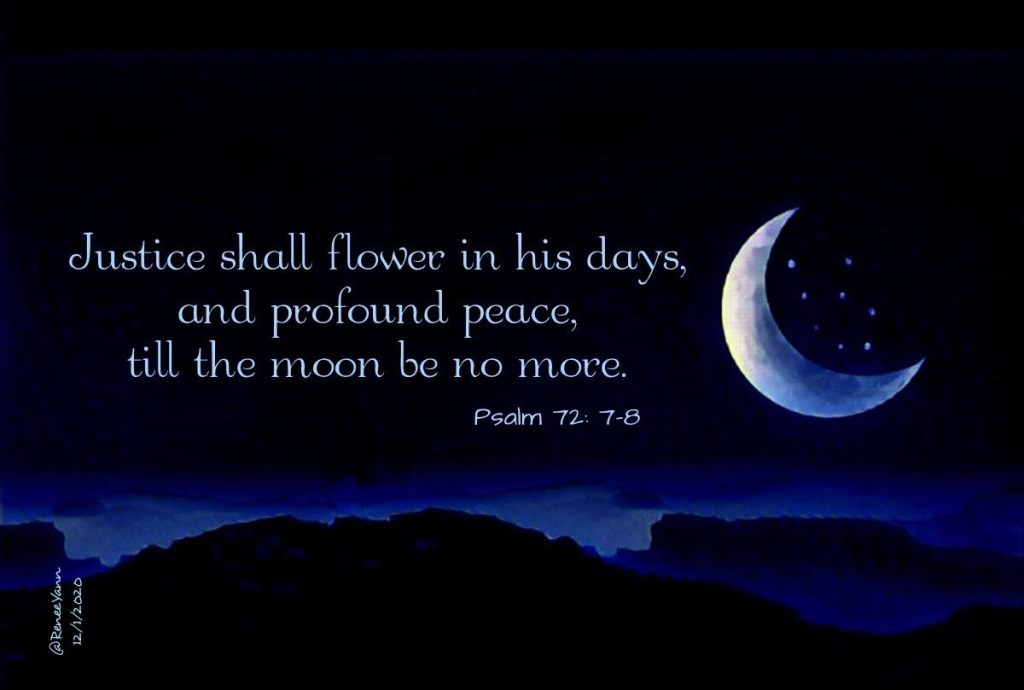
Justice shall flower in his days,
and profound peace, till the moon be no more.
May he rule from sea to sea,
and from the River to the ends of the earth.

Let us begin once again, in this new year,
to soak in the words and images
describing this longed-for and loving Savior.


Poetry: When Little Was Enough – Irene Zimmerman, OSF

(LUKE 9:10–17)

“Send the people away from this deserted place
to find food and lodgings,” the twelve urged Jesus,
“for the day is advanced and it is almost evening.”

Jesus looked at the crowd (there were about five thousand)
and looked at his disciples, still excited and tired
from their first mission journey.

What had they learned from the villagers of Galilee
who shared bread and sheltered them from cold night winds?
What had they learned of human coldness on the way?

He remembered the pain in his mother’s voice
as she told of his birth night when they found no room
in all of Bethlehem, House of Bread.

“You give them something to eat!” he said.

“We have only five loaves and two fish!” they protested.
“How can we feed so many with so little?”
He understood their incredulity.

They had yet to learn that a little was enough
when it was all they had—
that God could turn these very stones to bread.

“Have the crowd sit down in groups of fifty,” he said.
Jesus took the food and looked up to heaven.
He blessed it, broke it, gave it to the disciples
to distribute to the new-formed churches.

Afterwards, when everyone was satisfied,
the twelve filled twelve baskets of bread left over—
as faith stirred like yeast within them.


Music: Justice Shall Flourish – Rory Cooney

The Word

The Seventh Day in the Octave of Christmas

December 31, 2020

Today, in God’s Lavish Mercy, we pray with Psalm 96, which set the tone for us to more deeply appreciate our beautiful Gospel today on this New Year’s Eve.

The LORD comes,
comes to align the earth in Grace.
The LORD shall tender the world
with merciful justice
and the peoples with divine constancy.

Psalm 96: 13

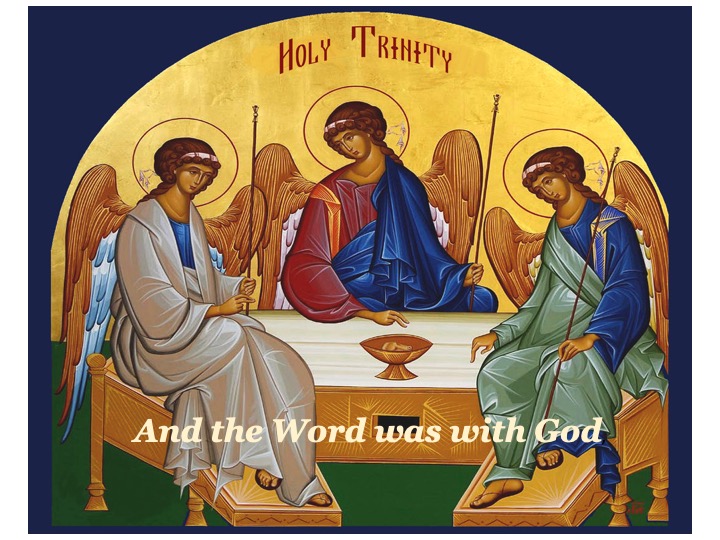
Who is this Lord Who comes,
comes to each of us and all of us?

I think no one describes this mysterious, yet enfleshed, God more beautifully that the writer of John’s Gospel and Epistles.

For our prayer, let’s savor that beauty from today’s Gospel.

Click the little white triangle in the grey bar above to hear some lovely accompanying music
as you slowly move through the slides below by pressing the right arrow on the slide.

Poetry: a prayer from Hildegard of Bingen (1098–1179 – O Eternal Lord 

Dear Friends, perhaps we might pray Hildegard’s prayer for one another as we leave this painful year and move toward New Hope.

O eternal Lord,
it is pleasing to you
to burn in that same fire of love,
like that from which our bodies are born,
and from which you begot your Son
in the first dawn before all of Creation.
So consider this need which falls upon us,
and relieve us of it for the sake of your Son,
and lead us in joyous prosperity.