We Set our Psalm Aside

Today, in God’s Lavish Mercy, I must put our Psalm in the background and refer to an earlier post for this Feast.

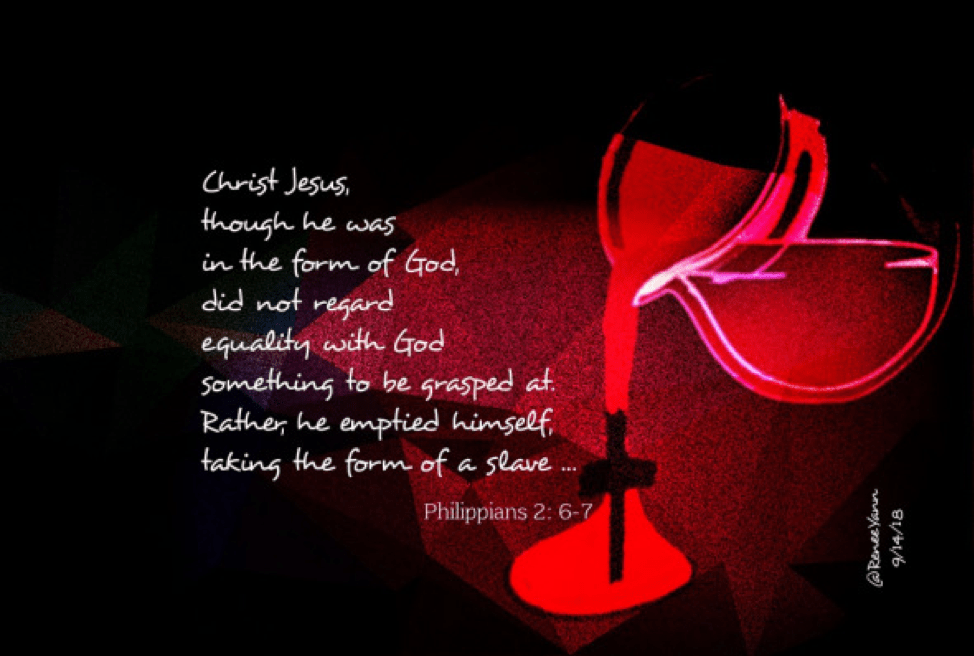
On this Feast of the Exaltation of the Holy Cross, our readings include the sublime Philippians Canticle.

To me, this is the most beautiful passage in the Bible – so beautiful that nothing else needs to be said about it.

As we read it lovingly and prayerfully today, may we take all the suffering of the world to Christ’s outstretched arms – even our own small or large heartaches and longings.

Poetry: God’s Love for Us – Julian of Norwich (1342-1416)

The love of God most High for our soul
is so wonderful that it surpasses all
knowledge. No created being can fully know
the greatness, the sweetness, the
tenderness, of the love that our Maker has
for us. By his Grace and help therefore let
us in spirit stand in awe and gaze, eternally
marvelling at the supreme, surpassing,
single-minded, incalculable love that God,
Who is all goodness, has for us.

from Revelations of Divine Love

Music: Philippians Canticle ~ John Michael Talbot

And if there be therefore any consolation
And if there be therefore any comfort in his love
And if there be therefore any fellowship in spirit
If any tender mercies and compassion

We will fulfill His joy
And we will be like-minded
We will fulfill His joy
We can dwell in one accord
And nothing will be done
Through striving or vainglory
We will esteem all others better than ourselves

This is the mind of Jesus
This is the mind of Our Lord
And if we follow Him
Then we must be like-minded
In all humility
We will offer up our love

Though in the form of God
He required no reputation
Though in the form of God
He required nothing but to serve
And in the form of God
He required only to be human
And worthy to receive
Required only to give

Psalm 145: Mercy Makes Us Sing

Tuesday of the Twenty-second Week in Ordinary Time

September 1, 2020

2018 reflection on Corinthians 

Today, in God’s Lavish Mercy, we pray with Psalm 145, a consoling hymn of confidence in God’s Mercy.

And, my dears, all I really want to say to you is, “September 1st! God bless us! We have made it this far in these times (as one gifted friend calls them, “these quantum weird times”.)

And, certainly, we pray in profound companionship with all those who suffer because of this pandemic. But at the same time we are so grateful for all who have, so far, been delivered from its grasp!

So hooray for us, and hooray for God! Let’s pick up our hope, energy and faith by drinking in the beauty of Psalm 145. Together, in faith, we CAN make it to a vaccine time- a time to forget,  AND to remember all that might transform and bless us from these days…

… because God is MERCY,
and there is some gift for all of us
even in shadow

The LORD is gracious and merciful,
slow to anger and of great kindness.
The LORD is good to all
and compassionate toward all his works.


Jesus meets the demon in today’s Gospel, a demon who is no match for Uncreated Grace. By the power of our Baptism, let us draw that Grace into our spirits, into our world today as we pray. 

And let us be at once both astonished and confident in the power of God’s Word to heal even the immense darkness of our world.

Jesus went down to Capernaum, a town of Galilee.
He taught them on the sabbath,
and they were astonished at his teaching
because he spoke with authority.


Poetry: The Fountain – Denise Levertov

Don’t say, don’t say there is no water
to solace the dryness at our hearts.
I have seen

the fountain springing out of the rock wall
and you drinking there. And I too
before your eyes

found footholds and climbed
to drink the cool water.

The woman of that place, shading her eyes,
frowned as she watched—but not because
she grudged the water,

only because she was waiting
to see we drank our fill and were
refreshed.

Don’t say, don’t say there is no water.
That fountain is there among its scalloped
green and gray stones,

it is still there and always there
with its quiet song and strange power
to spring in us,
up and out through the rock.

A Second Poem for the month’s beginning: September by Deborah Landau
Some of us might also find ourselves somewhere  in this wistful poem. I just like it. Thought some of you might too. 🤗

Dazzling emptiness of the black green end of summer no one
running in the yard pulse pulse the absence.

Leave them not to the empty yards.

They resembled a family. Long quiet hours. Sometimes
one was angry sometimes someone called her "wife"
someone's hair receding.

An uptick in the hormone canopy embodied a restlessness
and oh what to do with it.

(How she arrived in a hush in a looking away and not looking.)
It had been some time since richness intangible
and then they made a whole coat of it.

Meanwhile August moved toward its impervious finale.

A mood by the river. Gone. One lucid rush carrying them along.

Borderless and open the days go on—

Music: I Will Praise Your Name – Marty Hagen and David Haas

Antiphon: | will praise your name, my King and my God.
1. I will give you glory, my God and King, and I will bless your name forever.
Every day I will bless and praise your name forever.
2. The Lord is full of grace and mercy. He is kind and slow to anger.
He is good in all His works and full of compassion.
3. Let all your works give you thanks, O Lord, and let all the faithful bless you.
Let them speak of your might, O Lord, the glory of your kingdom.
4. The Lord is faithful in all His words, and always near. His name is holy.He lifts up all those who fall. He raises up the lowly.

Psalm 119: Divine Thread

Monday of the Twenty-second Week in Ordinary Time

August 31, 2020


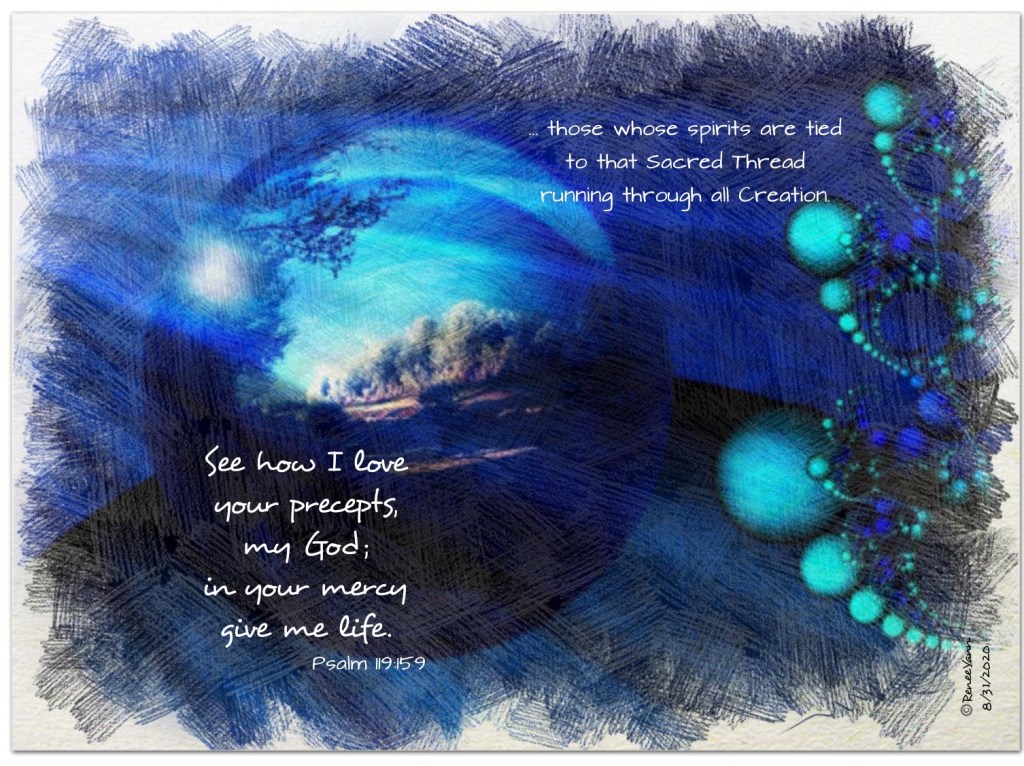
Today, in God’s Lavish Mercy, we pray with Psalm 119, a song of the wisdom that comes from holiness.

Your command has made me wiser than my enemies,
for it is ever with me.
I have more understanding than all my teachers
when your decrees are my meditation.
I have more discernment than the elders,
because I observe your precepts.

Psalm 119: 97-98

And we’ve all met them, haven’t we – those grounded, simple, wise and joyful people whose spirits are tied to that Sacred Thread running through all Creation. These blessed souls may be young or old, schooled or not. No matter – they shine with the reflection of Wisdom Itself.

Paul humbly claims such wisdom in our first reading. It is not a worldly persuasiveness, but rather a demonstration of truth and power grounded in the Spirit.

… my message and my proclamation
were not with persuasive words of wisdom,
but with a demonstration of spirit and power,
so that your faith might rest not on human wisdom
but on the power of God.

1 Corinthians 2: 4-5

In our Gospel, Jesus chooses his hometown synagogue to announce that he is the fulfillment of Isaiah’s prophecy, the Spirit and Wisdom of God:

The Spirit of the Lord is upon me,
because he has anointed me
to bring glad tidings to the poor.
He has sent me to proclaim liberty to captives
and recovery of sight to the blind,
to let the oppressed go free,
and to proclaim a year acceptable to the Lord.

Luke 4: 18-19 (Isaiah 61: 1-2)

Jesus is the Incarnation of Wisdom, the Divine Spirit that surpasses all human understanding.

Many turned away from Jesus at this proclamation. May we never be among them.

From every evil way I withhold my feet,
that I may keep your words.
From your ordinances I turn not away,
for you have instructed me.

Psalm 119: 101-102

Poetry: Wisdom by Rumi

I have one small drop of knowing in my soul. 
Let it dissolve in Your ocean.


Music: Be Thou My Vision – Eden’s Bridge ( On the video, you can drop the menu you down using the little arrowhead on the right under the picture. The Irish and English lyrics will then be displayed.)

Psalm 145: Praise Under the Figs

Feast of Saint Bartholomew, Apostle

August 24, 2020


Today, in God’s Lavish Mercy, on this Feast of St. Bartholomew, we pray with Psalm 145. And what a perfect choice!

Your friends make known, O Lord, 
the glorious splendor of your Kingdom.

As our Gospel today indicates, many believe that Bartholomew is the same person as Nathaniel – in fact Nathaniel bar Talmai, (Talmai meaning “farmer”, or “son of the furrows”).

Praying with Psalm 145, I picture Nathaniel leaning back into his ancient fig tree, his fingers burrowing into the fertile earth around him. What might have been his deep thoughts as he dissolved into the fig tree’s generous shade?

Knowing Psalm 145 by heart, perhaps Nathaniel prayed it in his own very personal words:

Make me your loyal friend, O Lord.
I see your glory in all Creation.
Let me help others see that glory,
see themselves as a precious part of You.

Maybe Nathaniel had retreated to that tree because the noise around him didn’t hold an answer to his longing. He needed silence to remember that God will always find a way to bring our holy desires to fruition – just like the nearly sweet, unripe figs dancing just over Nathaniel’s pondering head:

The LORD is just in all his ways
and holy in all his works.
The LORD is near to all who call upon him,
to all who call upon him in truth.

Psalm 145:17

Nathaniel found his truth, his answer that day. It walked right up to him in the form of his buddy Philip:

Philip found Nathanael and told him,
“We have found the one about whom Moses wrote in the law,
and also the prophets, Jesus son of Joseph, from Nazareth.”

John 1:45

Nathaniel, perhaps his head and belly still full of figs, takes a little while to get the full picture. But when he does, he gets it completely, unreservedly, and forever:

Rabbi, you are the Son of God;
you are the King of Israel….

John1:49

You are the One we pray for in our psalms. 
You are the One we have waited for.


The beautiful thing for Nathaniel is that Jesus was waiting for him too.

Before Philip called you, I saw you under the fig tree.

John 1:48

We’re all under some kind of shadow at times, longing to hear the invitation of God. The story of Nathaniel assures us that the call will come through our hopeful prayer and deep desire for God’s glory.

Let all your works give you thanks, O LORD,
and let your faithful ones bless you.
Let them discourse of the glory of your Kingdom
and speak of your might.


Poetry:  Joy and Peace in Believing by William Cowper, an English poet and hymnodist. One of the most popular poets of his time, Cowper changed the direction of 18th century nature poetry by writing of everyday life and scenes of the English countryside.

Sometimes a light surprises
The Christian while he sings;
It is the Lord who rises
With healing on His wings;
When comforts are declining,
He grants the soul again
A season of clear shining,
To cheer it after rain.

In holy contemplation
We sweetly then pursue
The theme of God's salvation,
And find it ever new;
Set free from present sorrow,
We cheerfully can say,
E'en let the unknown to-morrow
Bring with it what it may!

It can bring with it nothing,
But He will bear us through;
Who gives the lilies clothing,
Will clothe His people too;
Beneath the spreading heavens
No creature but is fed;
And He who feeds the ravens
Will give His children bread.
Though vine nor fig tree neither
Their wonted fruit shall bear,

Though all the field should wither,
Nor flocks nor herds be there:
Yet God the same abiding,
His praise shall tune my voice;
For, while in Him confiding,
I cannot but rejoice.

Music: Yet Will I Praise Thee – Kent Henry

Psalm 67: Bless Us All!

Twentieth Sunday in Ordinary Time
August 16, 2020

Today, in Mercy, we read the story of the Canaanite woman whom Jesus first meets with a sarcastic banter. The banter however serves to expose some of the alienating prejudices of Jesus’s time which he then dissolves in a sweeping act of mercy and inclusion. His actions signify a new culture of divine justice offered to all people. The reading challenges us to confront our own prejudices and any limitations we place on who belongs to the Kingdom of God.

from this Sunday’s Reflection – 2017

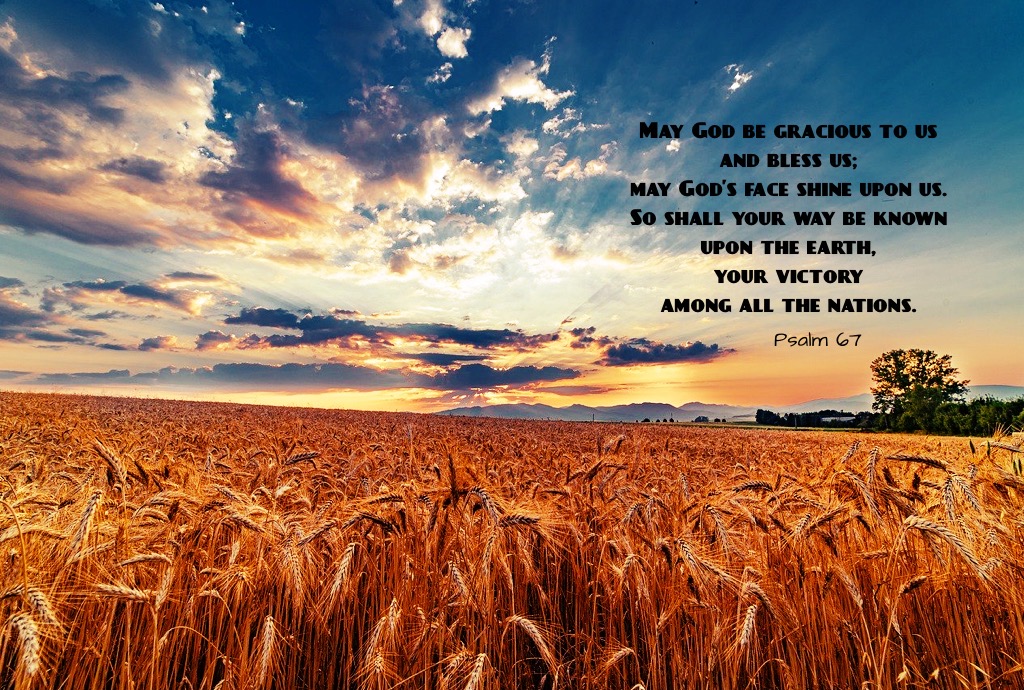
Today, in God’s Lavish Mercy, we pray with Psalm 67, a call to God for universal blessing on all Creation. Written to invoke a benediction on the land’s harvest, the Psalm blossoms into a generous prayer for the whole world to bask in God’s abundance.

May the nations be glad and rejoice;
for you judge the peoples with fairness,
you guide the nations upon the earth.

What if we prayed like that for all our brothers and sisters worldwide! What if we acted toward them with a justice that would make their abundance possible as well as our own! This is the Gospel mandate Jesus entrusted to us.

Psalm 67 shows the maturing of a nation from its own legitimate self-interests into its responsibility within all Creation.


In the USA, as our pre-election political awareness heightens, let’s learn from Psalm 67. Let’s broadly educate ourselves to the fundamental moral issues underlying various partisan platforms. 

For a religious person, voting is hard. There are profound moral issues on all sides of the question. A single issue approach does not work. An adamant stance on a single issue is the easy but inadequate approach. 


Even Jesus, in today’s Gospel, can be moved to a new way of thinking. The outcast Canaanite woman prevails on Jesus to broaden his kingdom. He opens his heart to another way of bringing mercy to all those longing for it.


Voting is a moral act. How we choose demonstrates the God we believe in.


May the peoples praise you, God;
may ALL the peoples praise you!


Poetry: Selah by Honoreé Fannane Jeffers

“The past few weeks were very hopeful for me, as an African-American. I saw images of young Black people out in the streets protesting, to make this country a better place. As an older person who stayed inside while these young folks put their bodies on the line, I wanted to celebrate them. I wrote this poem as a spiritual exaltation of Black faith, that our hoped-for change for our country is coming.”

Honoreé Fanonne Jeffers

Selah
after Margaret Walker’s “For My People”


The Lord clings to my hands
             after a night of shouting. 
                           The Lord stands on my roof 
             & sleeps in my bed. 
Sings the darkened, Egun tunnel— 
             cooks my food in abundance, 
                           though I was once foolish 
             & wished for an emptied stomach. 
The Lord drapes me with rolls of fat 
             & plaits my hair with sanity. 
                           Gives me air, 
             music from unremembered fever. 
This air
                            oh that i may give air to my people 
                            oh interruption of murder 
                                         the welcome Selah
The Lord is a green, Tubman escape. 
             A street buzzing with concern, 
                           minds discarding answers. 
             Black feet on a centuries-long journey.
The Lord is the dead one scratching my face, 
             pinching me in dreams. 
                           The screaming of the little girl that I was, 
             the rocking of the little girl that I was— 
the sweet hush of her healing. 
             Her syllables 
                           skipping on homesick pink. 
             I pray to my God of confused love, 
a toe touching blood 
             & swimming through Moses-water. 
                           A cloth & wise rocking. 
             An eventual Passover, 
outlined skeletons will sing 
             this day of air 
                           for my people—
                                         oh the roar of God 
                                         oh our prophesied walking

Music: Charles Ives – Psalm 67

Psalm 69: Answer Me, O Lord

Memorial of Saint Ignatius of Loyola, Priest

July 31, 2020


Today, in God’s Lavish Mercy, we pray with Psalm 69, a heart-felt lament whose verses are often paralleled with the sufferings of Jesus.

I have become an outcast to my brothers,
a stranger to my mother’s sons,
Because zeal for your house consumes me,
and the insults of those who blaspheme you fall upon me.

Psalm 69: 9

Christ did not please Himself; but as it is written,
“The reproaches of those who reproached You fell on Me”.

Roman 15: 3

Praying with Psalm 69 this morning, and in the light of both our first reading and Gospel, I am aware of how God’s prophets suffer to proclaim mercy, justice, and truth.

Jeremiah suffered in the hope and conviction that God imagined a future of justice for all God’s people. He stood in the midst of the Temple worshippers and condemned their pretense of righteousness.

Jesus stood at the center of his hometown synagogue to proclaim that the long hoped-for redemption had come. But like Jeremiah’s listeners, Jesus’s neighbors also turned on him.

In our own lifetimes, we see the persecution and hatred which is leveled at modern prophets who call the world to justice and mercy. Even within our own Church, we see how Pope Francis is vilified by those whose privileged excesses are threatened by his charity.


As I write this reflection, our country celebrates the life of one of its noblest prophets, the sainted John Lewis. In the image of all the great Justice Witnesses, John endured incredible suffering for the sake of people’s dignity and freedom. He was able to do so because, like Jeremiah and Jesus, he didn’t look inward at his wounds. He looked outward for the redemption of others … the prize of justice:

Never give up, never give in, never give out. 
Keep the faith, and keep your eyes on the prize. 
Together, we can redeem the soul of America.

John Lewis

Let us pray today that the voices of true prophets may be heard and heeded. In this age when technology and social media can quickly disseminate vitriol, hatred, and conspiracy, let us pray for discerning hearts and courageous wills.

But I pray to you, O LORD,
for the time of your favor, O God!
In your great kindness answer me
with your constant help.

Psalm 69; 14

Poetry: Prophet by Carl Dennis

Prophet
You'll never be much of a prophet if, when the call comes
To preach to Nineveh, you flee on the ship for Tarshish
That Jonah fled on, afraid like him of the people's outrage
Were they to hear the edict that in thirty days
Their city in all its glory will be overthrown.

The sea storm that harried Jonah won't harry you.
No big fish will be waiting to swallow you whole
And keep you down in the dark till your mood
Shifts from fear to thankfulness and you want to serve.
No. You'll land safe at Tarshish and learn the language
And get a job in a countinghouse by the harbor
And marry and raise a family you can be proud of
In a neighborhood not too rowdy for comfort.

If you're going to be a prophet, you must listen the first time.
Setting off at sunrise, you can't be disheartened
If you arrive at Nineveh long past midnight,
On foot, your donkey having run off with your baggage.
You'll have to settle for a room in the cheapest hotel
And toss all night on the lice-ridden mattress
That Jonah is spared. In the space of three sentences
He jumps from his donkey, speaks out, and is heeded, while you,

Preaching next day in the rain on a noisy corner,
Are likely to be ignored, outshouted by old-clothes dealers
And fishwives, mocked by schoolboys for your accent.
And then it's a week in jail for disturbing the peace.
There you'll have time, as you sit in a dungeon
Darker than a whale's belly, to ask if the trip
Is a big mistake, the heavenly voice mere mood,

The mission a fancy. Jonah's biggest complaint
Is that God, when the people repent and ask forgiveness,
Is glad to forgive them and cancels the doomsday
Specified in the prophecy, leaving his prophet
To look like a fool. So God takes time to explain
How it's wrong to want a city like this one to burn,
How a prophet's supposed to redeem the future,
Not predict it. But you'll be left with the question
Why your city's been spared when nobody's different,

Nobody in the soup kitchen you open,
Though one or two of the hungriest
May be grateful enough for the soup to listen
When you talk about turning their lives around.
It will be hard to believe these are the saving remnant
Kin to the ten just men that would have sufficed
To save Gomorrah if Abraham could have found them.

You'll have to tell them frankly you can't explain
Why Nineveh is still standing though you hope to learn
At the feet of a prophet who for all you know
May be turning his donkey toward Nineveh even now.
[from Practical Gods (2001)

Music: Lord, in Your Great Love – Orchard Enterprises

Psalm 95: The Real Voice

Monday of the Sixteenth Week in Ordinary Time

July 20, 2020

From this liturgical date in 2016:  

Monday, July 18, 2016: Today, in Mercy, we pray to do as the prophet Micah says. As our intense political season begins, we pray that our leaders – and we citizens – may do right, show real goodness, and find the courage to be humble. May we have the insight to shun a democracy built on values opposite to these. May God bless and inspire all who would lead us and may God bless and heal our country.


Today, in God’s Lavish Mercy, we will pray with Psalm 95, our Alleluia Verse. Today’s Responsorial is Psalm 50, which we have reflected on twice recently.

The verse from Psalm 95 is an often repeated one, and presents us with a clear ultimatum:

But how do we do that?
How do we hear God’s voice?
How do we avoid a hardened heart?


When I was a little girl, I loved to read the stories of the saints. I was particularly impressed by the life of the brave St. Joan of Arc, not only because she got to ride a horse, but because she heard heavenly voices. I thought it was very nice of God to tell Joan exactly what to do to be holy.

I waited a few years, probably from age six to nine, for God – or at least St. Michael, my parish patron – to speak to me. You know, just in case God had anything important for me to do, like take a small army over to New Jersey or something like that.

When I was 9 or 10, I fell in love with Jimmy Danvers and put my saint books in my bottom drawer. I still listened for God, but started not to expect an audible conversation.


What I failed to realize at that young age was that the conversation had already begun. I thought about God, prayed and tried to be a pretty good person. I went to Mass every day since 5th grade. I began to serve others in the way I thought Jesus would want to do it. With the help of my parents and teachers, I had made the choice to invite God’s heart into my heart.

Finally, I came to understand that God was speaking to me, and to everyone else, all the time. My job was to keep my heart’s ear open, softened, by my choices for Love.


Prayer is the communication of the soul with God. 
God is love, and love is goodness giving itself away. 
It is a fullness of being 
that does not want to remain enclosed in itself, 
but rather to share itself with others.

Saint Edith Stein

When we do this, each day brings us deeper and deeper into the Silent Word Who breathes forth the story of our lives. That sacred breath takes as many forms as there are creatures. Joan of Arc was one holy form. So am I. So are you.


Literature:  from Saint Joan by George Bernard Shaw

Charles VII:  Oh, your voices, your voices. Why don’t the voices come to me? I am king, not you!

Joan: They do come to you, but you do not hear them. You have not sat in the field in the evening listening for them. When the angelus rings, you cross yourself and have done with it. But if you prayed from your heart and listened to the thrilling of the bells in the air after they stopped ringing, you would hear the voices as well as I do.


Music: Holy Ground – John Michael Talbot

Verse 1
This is holy ground
We’re standing on holy ground
For the Lord is present
And where He is is holy
This is holy ground
We’re standing on holy ground
For the Lord is present
And where He is is holy

Verse 2
These are holy hands
He’s given us holy hands
He works through these hands
And so these hands are holy
These are holy hands
He’s given us holy hands
He works through these hands
And so these hands are holy

Verse 3
These are holy lips
He’s given us holy lips
He speaks through these lips
And so these lips are holy
These are holy lips
He’s given us holy lips
He speaks through these lips
And so these lips are holy

Psalm 93: Nestle in God’s Robe

Memorial of Saint Benedict, Abbot

July 11, 2020

Today, in God’s Lavish Mercy, we pray with Psalm 93, the first of the royal psalms (93-99) which praise God as King.

As we pray with today’s verses, we can easily feel the psalmist stretching for a description of God Who is, of course, indescribable. Never having seen God, we can only imagine the Divine Being in human terms. This writer imagines God as a King beyond even the greatness of human kings, and it is a beautiful image:

The LORD is king, in splendor robed;
robed is the LORD and girt about with strength.


Like the psalmist, we may tend to paint God in the colors of those who have had greatest influence in our lives

  • those with power over us, like parents and teachers
  • those who have loved us, or failed to
  • those in positions of success, and strength

Because all human models are flawed in some way, this tendency can give us a blurry, if not distorted picture of God.


Jesus came to correct our perspective.


A beautiful extra hymn for today. Just love this one.

Jesus showed us that, while we live on this earth, the glory of God is a hidden glory. It is robed in the suffering of the poor and abandoned. Its splendor is in the innocence of children. Its strength is in the hope of the sick and weak. Its beauty shines out to us in the vulnerability of our sisters and brothers.


In today’s Gospel, Jesus gives us the tender image of God as One who cherishes every hair on our heads. As we pray today, we might let that gentle God reach down and caress any pain, exhaustion or fear, like a Mother brushing her child’s hair. Just be with God Who knows our needs. Be cradled in the splendrous robe.


Poetry:  God’s True Cloak – Rainer Maria Rilke

We must not portray you in king’s robes,
you drifting mist that brought forth the morning.
Once again from the old paintboxes
we take the same gold for scepter and crown
that has disguised you through the ages.
Piously we produce our images of you
till they stand around you like a thousand walls.
And when our hearts would simply open,
our fervent hands hide you.

Music: George Frideric Handel – Chandos Anthem, #4/ Psalm 93 – O Sing Unto the Lord

Psalm 145: Through the Generations

Monday of the Fourteenth Week in Ordinary Time

July 6, 2020

Today, in God’s Lavish Mercy, we again pray with Psalm 145 – different verses. The great tenderness in today’s other readings is reflected in the choice of these particular psalm lines.

Our first reading is God’s tender love song to Israel spoken through the prophet Hosea. Our Gospel recounts several acts of tenderness as Jesus ministers to the suffering people he meets.


Psalm 145 reminds us that if we look back over our lives, and even farther back over our ancestors’ lives, we too will discover God’s continual love and mercy to us.

Generation after generation praises your works
and proclaims your might.
They speak of the splendor of your glorious majesty
and tell of your wondrous works.


Many ancestral blessings have been passed on to us – in skills, attitudes, physical strengths – but most importantly, in faith. We probably believe because someone before us taught us how.

There is no greater gift we can give to our children, and to all our beloveds, than to encourage their faith. Let’s take that to heart today as we pray. And let’s thank God for our own story and heritage of faith we have been given.


Poetry: Faith is the Pierless Bridge by Emily Dickinson, who appeared as more a dismissive critic of faith than a proponent. Yet, like many of us who bother to talk about a particular topic, she proved it to be more important to her than she professed.

Faith — is the Pierless Bridge
Supporting what We see
Unto the Scene that We do not —
Too slender for the eye
It bears the Soul as bold
As it were rocked in Steel
With Arms of Steel at either side —
It joins — behind the Veil
To what, could We presume
The Bridge would cease to be
To Our far, vacillating Feet
A first Necessity.

Music: In Every Age – Janèt Sullivan Whitaker

Psalm 117: Praise the Lord

Feast of Saint Thomas, Apostle

July 3, 2020

One of my favorite past reflections on faith vs. doubt – for this Feast of Saint Thomas


Today, in God’s Lavish Mercy, we pray with Psalm 117 which is the shortest of all the Psalms. But 117, also called the Laudate Dominum, still packs a huge spiritual punch.

The psalm is called a “doxology” which simply means it is a short prayer of praise, the type we often add at the end of longer prayers. We are very familiar with the following doxology:

Glory be to the Father, and to the Son, and to the Holy Spirit.
As it was in the beginning, is now, and ever shall be
,
world without end. Amen


Psalm 117 follows the same pattern in that it has two complementary parts.

The first invites us to praise God:
Praise the LORD, all you nations;
glorify God, all you peoples!

The second tells us why God deserves our praise:
For steadfast is God’s kindness for us,
and the fidelity of the LORD endures forever.

Notable about Psalm 117 is the fact that this Old Testament invitation to praise goes out “to ALL nations”. Scholars interpret this as pointing to the fulfillment, in Jesus, of God’s promise that Abraham would be the father in faith of many nations. Psalm 117 is a treasured and often repeated prayer throughout the Judea-Christian traditions.


Practicing this pattern of prayer can enrich our personal prayer life as well. I like to pray like this as soon as I wake each morning. Glancing out my window, I might say,

“I praise You in the sunrise, my Beautiful Creator.
Thank you for the gift of my life.”

Beginning the day with our own “doxology” gives us a head start on living joyfully and gratefully in the Presence of God for our next circuit of the sun.


Poetry: Morning Poem – Mary Oliver

Every morning 
the world 
is created. 
Under the orange
sticks of the sun 
the heaped 
ashes of the night 
turn into leaves again
and fasten themselves to the high branches— 
and the ponds appear 
like black cloth 
on which are painted islands
of summer lilies. 
If it is your nature 
to be happy 
you will swim away along the soft trails
for hours, your imagination 
alighting everywhere. 
And if your spirit 
carries within it
the thorn 
that is heavier than lead— 
if it's all you can do 
to keep on trudging—
there is still 
somewhere deep within you 
a beast shouting that the earth 
is exactly what it wanted—
each pond with its blazing lilies 
is a prayer heard and answered 
lavishly, 
every morning,
whether or not 
you have ever dared to be happy, 
whether or not 
you have ever dared to pray

Music: Laudate Dominum – Mozart, sung by Barbara Hendricks