Today, in God’s Lavish Mercy, we stand at the edge of the final deep dive into Christmas.
Tomorrow, we will begin the magnificent O Antiphons with their rich and repeated invitation for God, not only to enter, but to take up residence our lives. We hear the hint of those invitations in today’s Responsorial Psalm:
Alleluia, alleluia. Come, Lord, bring us your peace that we may rejoice before you with a perfect heart.
It’s a perfect prayer for these last few days before Christmas, because so many of us get caught up in a contradictory kind of frenzy of shopping, gifts, parties, decorating, cooking, wrapping, buying…. and on, and on, and on.
The hyperactivity doesn’t leave a lot of space for peace and the perfection of our hearts to welcome the Savior.
This lovely poem by Geoffrey Brown has always helped focus me on the peace-making of my heart so that I could welcome Grace as it comes to me.
The Heart Cave
I must remember
To go down to the heart cave
& sweep it clean; make it warm
with a fire on the hearth,
& candles in their niches,
the pictures on the walls
       glowing with a quiet light.
       I must remember
To go down to the heart cave
       & make the bed
with the quilt from home,
strew
the rushes on the floor
hang
lavender and sage
         from the corners.
         I must go down
        To the heart cave & be there
         when You come.
Isaiah, with a powerful “how-to”, reminds us that we are all called to this spiritual readying:
Thus says the LORD: Observe what is right, do what is just, for my salvation is about to come, my justice, about to be revealed. Happy is the one who does this, whoever holds fast to it: Keeping the sabbath without profaning it, keeping one’s hand from doing any evil
As a last reminder before our journey through the O Antiphons, Isaiah coaches us in inclusivity – assuring us that all people are welcome in the arms of the One Who is to come:
Let not the foreigners say, when they would join themselves to the LORD, “The LORD will surely exclude me from the people.” The foreigners who join themselves to the LORD, ministering to and Loving the name of the LORD, and becoming God’s servants– All who keep the sabbath free from profanation and hold to my covenant, Them I will bring to my holy mountain and make joyful in my house of prayer …
Music: Rorate Caeli – sung by Harpa Dei
“Rorate caeli” (Drop down, ye heavens) are the opening words of Isaiah 45:8. The text is frequently sung to plainsong at Mass and in the Divine Office during Advent where it gives expression to the longings of Patriarchs and Prophets, and symbolically of the Church, for the coming of the Messiah.
Today, in God’s Lavish Mercy, through the lyricism of Isaiah, God proclaims his majesty and omnipotence. But as awesome as that Power is, it descends over us in the gentlest form – justice and salvation like morning dew and springtime blossoms:
Let justice descend, O heavens, like dew from above, like gentle rain let the skies drop it down. Let the earth open and salvation bud forth; let justice also spring up! I, the LORD, have created this.
Isaiah 45:8
Our God invites us all into that gentle embrace, asking us to deepen our hearts in faith and worship:
Turn to me and be safe, all you ends of the earth, for I am God; there is no other! By myself I swear, uttering my just decree and my unalterable word: To me every knee shall bend; by me every tongue shall swear, Saying, “Only in the LORD are just deeds and power.
Isaiah 45:22-24
Our Gospel is a repeat of this past Sunday’s, only this time told by Luke instead of Matthew. It again reminds us of what this just and gentle reign of God will look like:
“Go and tell John what you have seen and heard: the blind regain their sight, the lame walk, lepers are cleansed, the deaf hear, the dead are raised, the poor have the good news proclaimed to them. And blessed is the one who takes no offense at me.”
Luke 7:22-23
Praying in these twilight days of Advent, let’s ask to be drenched in gentle Justice and life-giving Mercy so that we may be living signs of the One Who is to come on Christmas.
Poetry: Annunciation – Scott Cairns – a wonderful poet. Read about him here:
Deep within the clay, and O my people very deep within the wholly earthen compound of our kind arrives of one clear, star-illumined evening a spark igniting once again the tinder of our lately banked noetic fire. She burns but she is not consumed. The dew lights gently, suffusing the pure fleece. The wall comes down. And—do you feel the pulse?—we all become the kindled kindred of a King whose birth thereafter bears to all a bright nativity.
Today, in God’s Lavish Mercy, Isaiah once again promises light despite the darkness, understanding despite the emptiness, life despite the devastating hold of poverty.
Thus says the Lord GOD: But a very little while, and Lebanon shall be changed into an orchard, and the orchard be regarded as a forest! On that day the deaf shall hear the words of a book; And out of gloom and darkness, the eyes of the blind shall see. The lowly will ever find joy in the LORD, and the poor rejoice in the Holy One of Israel.
Isaiah 29:18-19
Isaiah’s promises shone a beacon of hope to the oppressed people of his time. As I pray with his words today, I am deeply aware of the oppressions of our own time and the people who suffer under them.
Over the course of these days, I am praying with a delegation of people currently in Central America to remember, bless, learn from, and bear witness to the lives of four martyrs.
The Roses in December delegation marks the 42nd anniversary of the martyrdom of four U.S. women religious. On December 2, 1980, members of the U.S.-trained-Salvadoran National Guard raped and killed lay worker Jean Donovan, Maryknoll Sisters Ita Ford, MM, and Maura Clarke, MM, and Ursuline Sister Dorothy Kazel, OSU. The women had been accompanying the Salvadoran people displaced by war and poverty. Their witness cost them their lives. Their deaths shook the world and were emblematic of the violence suffered by the Salvadoran people and the power of accompaniment.
These women lived with the kind of hope and faith Isaiah describes. It is an active faith necessary in all times because, sadly, in all times there will be brutal and inhuman oppression of the vulnerable by the powerful. These woman chose to stand for the Gospel instead.
During an earlier anniversary of the Roses in December event, social justice activist Jean Stolkan asked the question, “What do these women call us to today?” Jean served in El Salvador herself and has continued to advocate for human rights and social justice. Jean is currently Social Justice Coordinator for the Sisters of Mercy of the Americas. She offered these insights in answer to her question:
The challenges we face today are different from the challenges we faced when the four church women died. They call for new perspectives and new structures, new vision and new social movements to adequately respond to the need for justice for present and future generations.
Today our hearts go out to the peoples of El Salvador and Honduras, Guatemala and Mexico, as they struggle with basic issues of survival and rebuilding of their lives after so many disasters: hurricanes and earthquakes, but also violence and poverty. We pray for an outpouring of compassion and solidarity, that we may continue to address in systemic ways the underlying human failings – structural poverty, racism, violation of human rights, destruction of the environment – that these and other natural and human disasters unmask with such brutal clarity.
Please join your own prayer today for a new flowering of social justice, respect for human rights, and a mutual reverence for our common home as we remember these valiant Gospel women.
Poetry: El Salvador – Javier Zamora
( Poet Javier Zamora was born in the small El Salvadoran coastal fishing town of La Herradura and immigrated to the United States at the age of nine, joining his parents in California. He earned a BA at the University of California-Berkeley and an MFA at New York University and was a 2016-2018 Wallace Stegner Fellow at Stanford University.)
Salvador, if I return on a summer day, so humid my thumb
will clean your beard of  salt, and if  I touch your volcanic face,

kiss your pumice breath, please don’t let cops say: he’s gangster.
Don’t let gangsters say: he’s wrong barrio. Your barrios

stain you with pollen, red liquid pollen. Every day cops
and gangsters pick at you with their metallic beaks,

and presidents, guilty. Dad swears he’ll never return,
Mom wants to see her mom, and in the news:

every day black bags, more and more of us leave. Parents say:
don’t go; you have tattoos. It’s the law; you don’t know

what law means there. ¿But what do they know? We don’t
have greencards. Grandparents say: nothing happens here.

Cousin says: here, it’s worse. Don’t come, you could be    ...
Stupid Salvador, you see our black bags,

our empty homes, our fear to say: the war has never stopped,
and still you lie and say: I’m fine, I’m fine,

but if  I don’t brush Abuelita’s hair, wash her pots and pans,
I cry. Like tonight, when I wish you made it

easier to love you, Salvador. Make it easier
to never have to risk our lives.
Music: El Salvador – Peter, Paul and Mary
“El Salvador” is a 1982 protest song about United States involvement in the Salvadoran Civil War, written by Noel Paul Stookey and performed by Peter, Paul and Mary. The song originally appeared on the 1986 album No Easy Walk To Freedom.
There’s a sunny little country south of Mexico Where the winds are gentle and the waters flow But breezes aren’t the only things that blow in El Salvador
If you took the little lady for a moonlight drive Odds are still good you’d come back alive But everyone is innocent until they arrive in El Salvador
If the rebels take a bus on the grand highway The government destroys a village miles away The man on the radio says: “now, we’ll play South of the Border”
And in the morning the natives say “We’re happy you have lived another day Last night a thousand more passed away in El Salvador” Ooh, ooh, ooh, ooh Ooh, ooh, ooh, ooh, ooh, ooh, ooh
There’s a television crew here from ABC Filming Rio Lempe and the refugees Calling murdered children: “The Tragedy of El Salvador”
Before the government camera twenty feet away Another man is asking for continued aid Food and medicine and hand grenades for El Salvador
There’s a thump, a rumble, and the buildings sway A soldier fires the acid spray The public address system starts to play: “South of the Border”
You run for cover and hide your eyes You hear the screams from paradise They’ve fallen further than you realize in El Salvador La la la, la la la la La la la, la la la la la Ooh, ooh ooh ooh ooh
Just like Poland is protected by her Russian friends The junta is assisted by Americans And if sixty million dollars seems too much to spend in El Salvador
They say for half a billion they could do it right Bomb all day and burn all night Until there’s not a living thing upright in El Salvador
And they’ll continue training troops in the USA And watch the nuns that got away And teach the military bands to play: “South of the Border”
Killed the people to set them free Who put this price on their liberty Don’t you think it’s time to leave El Salvador? Oh, oh oh oh oh Oh oh oh oh oh, oh oh, oh oh oh oh oh
Today, in God’s Lavish Mercy, our readings carry the full flavor of the “end times” warnings, those repeated annually as we move closer to Advent (which is only two weeks away!) When I was a kid, these readings scared me. And now, even as an elder, I’m not particularly in love with them!
But, nevertheless, you gotta’ love Malachi! What a powerful poet! His message of impending judgement and necessary repentance definitely hits the mark.
Lo, the day is coming, blazing like an oven, when all the proud and all evildoers will be stubble…
Malachi 3:19
Wow! Really? Depending on where we stand in our moral life, our reaction to this announcement might range from:
“Good! Go get ‘em, God!”
to
“Oh, dear God, I hope it’s not me!!!”.
Nobody wants to be “stubble” when the final fires blaze. So how can we avoid that? Paul resets us on the right track, from both “cheer” and “fear” to commitment. He instructs his readers to do their job, living and honest simple lives. He says something like this:
Listen! You must imitate your teachers in Christ. Live with integrity, justice and generous mercy. Navigate the world with these as your compass. Then you will welcome the end times.
In Luke’s Gospel, Jesus offers an equally dire prediction of the end times. When we read the list of disasters and betrayals Jesus describes, we must admit that every one of them occurs somewhere in our world everyday. In essence, we already live in the “end times”, trying to welcome and foster Divine Grace in our piece of the universe.
Today’s readings are an alarm clock. They call us to recognize the geopolitical world we live in as the emerging Realm of God, and to do our part to bring that realm to full realization.
It is likely impossible to communicate God’s vision for the world in the language of politics. Scripture offers us the transcendent gift of the eloquent prophets Malachi and Jesus describing not only their own times but ours as well.
Walter Brueggemann says this:
The prophet’s task is to imagine the world as though Yahweh, the God of Israel and the creator of heaven and earth, were a real character and a lively agent in the life of the world. I believe that such a claim, then and now, has to be articulated poetically in order not to be co-opted by political absolutism or theological orthodoxy.
Our readings today give us this poetic vision and challenge. Read them with great longing to hear God’s voice for our times. The world so sorely needs the answer that will blossom by the perseverance of our lives.
Poetry: A Song on the End of the World – Czeslaw Milosz
Czeslaw Milosz ranks among the most respected figures in 20th-century Polish literature, as well as one of the most respected contemporary poets in the world: he was awarded the Nobel Prize for Literature in 1980.
On the day the world ends
A bee circles a clover,
A fisherman mends a glimmering net.
Happy porpoises jump in the sea,
By the rainspout young sparrows are playing
And the snake is gold-skinned as it should always be.

On the day the world ends
Women walk through the fields under their umbrellas,
A drunkard grows sleepy at the edge of a lawn,
Vegetable peddlers shout in the street
And a yellow-sailed boat comes nearer the island,
The voice of a violin lasts in the air
And leads into a starry night.

And those who expected lightning and thunder
Are disappointed.
And those who expected signs and archangels’ trumps
Do not believe it is happening now.
As long as the sun and the moon are above,
As long as the bumblebee visits a rose,
As long as rosy infants are born
No one believes it is happening now.

Only a white-haired old man, who would be a prophet
Yet is not a prophet, for he’s much too busy,
Repeats while he binds his tomatoes:
There will be no other end of the world,
There will be no other end of the world.
Warsaw, 1944
Music: Let Justice Roll – video of the Salvation Army
Today, in God’s Lavish Mercy, our first reading shows Paul shepherding in the very early days of Christianity. His ministry throughout the Mediterranean basin guided early Christians as the Church planted its first harvest.
Paul lets us know that this ministry of leadership is not easy – that he relies on the good will of the communities he serves:
You were, of course, concerned about me but lacked an opportunity. Not that I say this because of need, for I have learned, in whatever situation I find myself, to be self-sufficient.
Paul seems to refer specifically to material help, but certainly he values even more the spiritual and moral loyalty of his followers.
In our Gospel, Jesus offers us a sermonette that can, at first, seem a little confusing. His tone, as he speaks to a group of Pharisees, is somewhat ironic. But his bottomline message is this: loyalty to God, not to material things.
The thread running through all these passages? The work of the Church needs both our spiritual and material loyalty to thrive – whether in Paul’s time, or Christ’s, or our own.
The Pharisees pretended such loyalty, but Jesus challenged them:
You justify yourselves in the sight of others, but God knows your hearts …
A sobering challenge against which to measure ourselves!
Poetry: All Your Secrets – Omar Khayyam
All thy secrets are known to the wisdom of Heaven
God knows them hair by hair and vein by vein.
I admit that by power of hypocrisy you may be able
to deceive men, but what will you do before Him who
knows your misdeeds one by one in every detail?
Music: Thank You for Giving to the Lord – Ray Boltz
Alleluia, alleluia. The word of God is living and effective, able to discern reflections and thoughts of the heart.
Today, in God’s Lavish Mercy, Jesus and Paul both get downright serious about true spiritual discernment — in other words,
“Stop the bull(ony)!
The passage from Thessalonians indicates that “conspiracy theories” are not just a sick modern phenomenon. Apparently some religious charlatans were trying to delude the neophyte Christian community with threats about the end of the world. Paul is adamant in his advice:
Do not to be shaken out of your minds suddenly, or to be alarmed either by a “spirit,” or by an oral statement, or by a letter allegedly from us to the effect that the day of the Lord is at hand. Let no one deceive you in any way.
2 Thessolians 2:2
Jesus “woes” the Pharisees once again for a similar type of deluding behavior. For their own advancement, they impose minute religious entanglements which block the true purpose of the law:
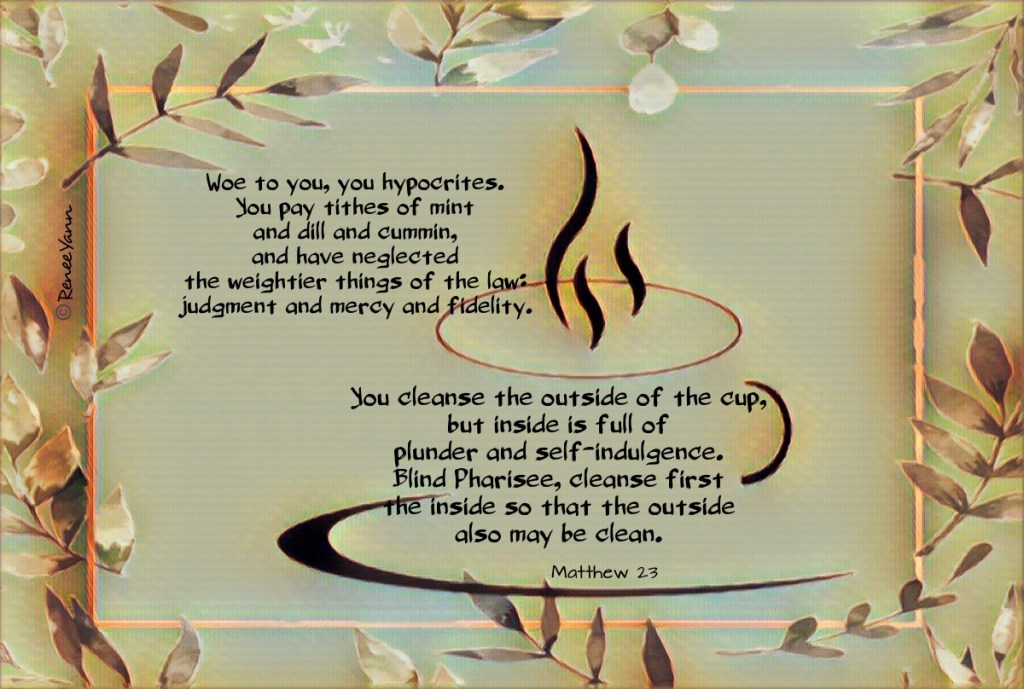
Woe to you, scribes and Pharisees, you hypocrites. You pay tithes of mint and dill and cummin, and have neglected the weightier things of the law: judgment and mercy and fidelity. But these you should have done, without neglecting the others.
Matthew 23:23
Jesus employs a great image to correct such delusions:
You cleanse the outside of cup and dish, but inside they are full of plunder and self-indulgence. Blind Pharisee, cleanse first the inside of the cup, so that the outside also may be clean.
Matthew 23:25
In matters of faith, always look inside the cup for “justice, mercy and fidelity”. If instead you find “plunder and self-indulgences”, you can be sure it is not the word of God.
Alleluia, alleluia. The word of God is living and effective, able to discern reflections and thoughts of the heart.
Poetry: A Cup Story – Author Unknown
You are holding a cup of coffee when
someone comes along and accidentally bumps you
and shakes your arm,
making you spill coffee everywhere.
Why did you spill the coffee?
Because someone bumped into you, right?
Wrong answer.
You spilled the coffee because coffee was in the cup.
If tea had been in it, you would have spilled tea.
Whatever is inside the cup is what will come out.
Therefore, when life comes along and shakes you,
whatever is inside of you will come out.
So each of us has to ask ourselves..... what's in my cup?
When life gets bumpy, what spills over?
Joy, gratefulness, peace, and humility?
Or anger, bitterness, harsh words, and reactions?
We choose what's in our cup!
Today, in God’s Lavish Mercy, we receive a perfect encouragement from Isaiah:
Walter Brueggemann calls Isaiah 65 “a glorious artistic achievement”. Indeed, these images confirm his statement:
a new heavens and a new earth;
constant rejoicing and happiness
people will be a delight
no weeping or crying;
long life for all
everyone with a home
enough for all to eat
As we pray with this passage today, we may experience a longing for a return to our beautiful, safe world – a world before pandemic, a world before the specter of WW III. In today’s violent and besieged environment, we all pray from a place of anxiety, loss, constraint, or some degree of suffering.
Isaiah’s community prayed from the same place. All the beautiful images were a promise not yet realized. The prophetic poetry of Isaiah is a call to courageous hope, not a description of current circumstances.
Faith invites us, even as we experience a bittersweet longing, to trust that God is with us, teaching us and leading us deeper into the Divine Understanding. Even as circumstances turn our world upside down, God will guide the falling pieces to a blessed place if we commit to find God in the tumbling.
I don’t think many of us would deny that the world has needed fixing for a long, long time. The systems we have built leave many in deficit throughout the world, and we have failed to address the wound.
War, pandemic, forced migration of the poor, climate catastrophe all have laid that failure bare.
As we pray for resolutions to these sufferings, may we be opened to an irrevocable awareness of our common humanity and responsibility for one another.
Only by such an outcome will we move closer to Isaiah’s peaceful Kingdom. Only by our courage to embrace it, can God fulfill the Promise in us.
Poetry: by Emily Dickinson
I many times thought Peace had come When Peace was far away — As Wrecked Men — deem they sight the Land — At Centre of the Sea —
And struggle slacker — but to prove As hopelessly as I — How many the fictitious Shores — Before the Harbor lie —
Today, in God’s Lavish Mercy, two disciples of Jesus are our teachers. James advises us on what to do. Beloved Peter, as so often is the case, shows us what not to do.
James tells us to show no partiality. He makes clear that he is talking about impartiality toward those who are materially poor. It’s a maxim that Jesus gave us time and again in the Gospel.
James reminds us that Jesus is not just impartial toward those who are poor, he actually has a preferential love for them. So Jesus was partial to the poor, right? Hmm!
Yes, I think that’s right. In order to balance our human inclination to the richest, best, strongest, etc., Jesus teaches us to go all out in the other direction.
It’s like this great cartoon that popped up on Facebook a while ago:
Our Gospel picks up the theme.
Because of his great love for the poor and his passion for mercy, Jesus tells his followers that suffering is coming. Peter doesn’t like hearing that. Can you see Peter take Jesus aside and say, “Listen, Jesus, negative talk is going to hurt your campaign. You’re God! You can just zap suffering out of your life!”
Jesus responds to Peter definitively: “Get thee behind me, Satan!”
James Tissot: Get Thee Behind me, Satan
Wow! That must have stung! But that’s how important it was to Jesus that his followers understood his mission: to preach Mercy to the poor, sick, and broken by sharing and transforming their experience.
Jesus wants us to understand that too.
Prose: from St. Oscar Romero
It is no honor for the Church
to be on good terms with the powerful.
The honor of the Church consists in this,
that the poor feel at home in her,
that she fulfils her mission on earth,
that she challenges everyone,
the rich as well,
to repent and work out their salvation,
but starting from the world of the poor,
for they, they alone are the ones who are blessed.
Today, in God’s Lavish Mercy, our readings burst with lessons for our faith. We might center our prayer on these three dynamic elements:
Power Praise Perseverance
Power
In our first reading, Israel is in the midst of a profound power shift. Until this time, Israel has thrived in “covenantal localism” which released possibility and initiative within the broad community. But now, perhaps stressed by the Philistine threat, the elders lobby for the establishment of a kingship – a centralization of power, wealth, land control, and local self-determination. ( based on Walter Brueggemann: First and Second Samuel: Interpretation: A Bible Commentary for Teaching and Preaching)
The Elders Ask Samuel for a King
Samuel isn’t happy with the elders’ suggestion and, apparently, neither is God. Samuel tells the elders so in a passionate speech against regalism. He pronounces that when the king has usurped all their rights, God will not deliver them as they once were delivered from a similar bondage in Egypt:
When this takes place, you will complain against the king whom you have chosen, but on that day the LORD will not answer you.
1 Samuel 8:18
The lesson for us is that the use and organization of power must always be for the sake of communal justice and well-being. Fostering these universal goods is the perpetual struggle of nations and institutions. As part of any community, we are called advocate for a just distribution of power for all people.
Praise Our Responsorial Psalm counsels that in all such human interactions, our focus must be on God and God’s Will for universal wholeness and peace – a peace evidenced in justice, joy, and praise.
Blessed the people who know the joyful shout; in the light of your countenance, O LORD, they walk. At your name they rejoice all the day, and through your justice they are exalted.
Psalm 89:16-17
Perseverance
Mark’s story of the cure of a paralyzed man demonstrates the power of faithful perseverance. This man’s community – his friends – persist until he fully benefits from God’s desire for his wholeness.
Unable to get near Jesus because of the crowd, they opened up the roof above him. After they had broken through, they let down the mat on which the paralytic was lying. When Jesus saw their faith, he said to him, “Child, your sins are forgiven.”
Mark 2:4-5
Such is our responsibility to pursue our own wholeness and the wholeness of our global community.
Poetry: Ozymandias – Percy Bysshe Shelley
(The poem explores the fate of history and the ravages of time: even the greatest men and the empires they forge are impermanent, their legacies fated to decay into oblivion. (Wikipedia)
I met a traveller from an antique land
Who said: ‘Two vast and trunkless legs of stone
Stand in the desert. Near them, on the sand,
Half sunk, a shattered visage lies, whose frown,
And wrinkled lip, and sneer of cold command,
Tell that its sculptor well those passions read
Which yet survive, stamped on these lifeless things,
The hand that mocked them and the heart that fed:
And on the pedestal these words appear:
“My name is Ozymandias, king of kings:
Look on my works, ye Mighty, and despair!
”Nothing beside remains. Round the decay
Of that colossal wreck, boundless and bare
The lone and level sands stretch far away.’
Music: Aria – composed by Friedrich Gulda, played by Tomoko Inoue

















 Lavish Mercy