The Chandelier

Monday of the Twenty-second Week in Ordinary Time

September 2, 2019

Click here for readings

Today, in Mercy,  our scriptures may lead us to think about where we have come from and where we are going.

Indeed, we tell you this, on the word of the Lord,
that we who are alive, who are left until the coming of the Lord,
will surely not precede those who have fallen asleep.

My reflection on this passage will be rather personal today. I hope you don’t mind.

As I write, I am blessed to be sitting in a beautiful breeze at our community’s vacation house. It couldn’t be a more lovely day.

1 Th4_17 chandelier

While I pray about these scriptures, a simple chandelier over our dining room table sways in the soft wind. Under its corona, I can’t help remembering all the friends who, over many years, have shared a meal and enjoyed past summer days here.

What an indescribable blessing it is to live in community with holy, joyful and loving women! 

Many of them, over these present days, drop in for a cup of home made soup or a glass of wine. We love one another, and we are entwined in each other’s journey to God. We inspire one another by our radical embrace of the Gospel, and our longing to give even more for God. What a comforting, sturdy, and supportive fabric we weave to enfold one another!

The chandelier rhythmically dances, like a fragrant censor over a sacred table. I remember with immense gratitude those beloved Sisters, now gone, who have blessed my life here at this refreshing seaside. Their names surround me in a grateful litany: Kitty, Marie, Fidelis, Jodi, Maureen, Suzanne, Ronnie, Janet, Giovanni, Mary Joan …

Others too who have sat at this table – not Sisters only, but family in faith, love and ministry bless me as I let the Holy Spirit of the waning summer waft over me.

We have shared crabs and meatballs, tears and laughter, prayer and politics, movies and ball games, hope and a holy, honest ember that warms the soul.

My dear Sisters, as you read this, you will have your own Sea Isle litanies to pray. Are we not indescribably blessed in one another!

Others of you, my dear readers, you will let you own loving list write itself across your heart as you pray.

A family is an eternal line between God and the generations, clear and stable.

A community is a wider path, rich in differences and, because of them, profound in its gifts.

In an interesting reversal, this holiday has come to be more about leisure than labor. And it is at leisure where we are most easily blessed by the joy, sincerity, trust and love of our families, friends, and communities.

Let us thank God for them today, remembering the past, cherishing the present, trusting the future.

Happy Labor Day!

Music: Sea Breeze – Keiko Matsui 

Beautiful God Within

Memorial of Saint Augustine, Bishop and Doctor of the Church

August 28, 2019

Click here for readings

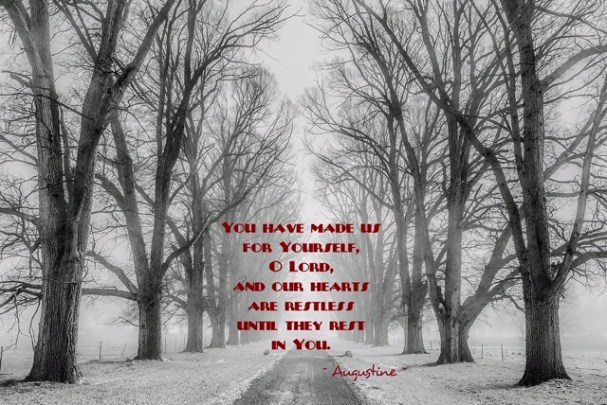
Today, in Mercy, celebrate the Feast of St. Augustine who gave us such beautiful quotes as these:

late have i loved

These quotes reflect a clarity of soul Augustine pursued all his life. He was a brilliant philosopher, intellectual, and poet. His early spiritual practice struggled for years to break through the shell of philosophy into the heart of true faith.

made us for yourself

Eventually, through the prayers of his mother Monica and the gentle guidance of St. Ambrose, Augustine’s searching soul found God as reflected in today’s choice for a Responsorial Psalm:

Lord, you have searched me and known me;
you understand everything I do;
you are closer to me than my thoughts.
You see through my selfishness and weakness,
into my inmost self. 

There is not one corner of my mind
that you do not know completely.
You are present before me, behind me,
and you hold me in the palm of your hand. 

Such knowledge is too awesome to grasp:
so deep that I cannot fathom it.
Where can I go from your spirit?
Where can I flee from your presence? 

If I take the wings of the morning and fly to the ends of the sea,
even there your hand will guide me
and your spirit will give me strength.

~  A Book of Psalms by Stephen Mitchell

Some of us , no matter how hard we try, have a tortuous path to spiritual peace. Augustine is a saint because he never abandoned that path.

Paul’s Thessalonians seemed to have had an easier way:

And for this reason we too give thanks to God unceasingly,
that, in receiving the word of God from hearing us,
you received it not as the word of men, but as it truly is, the word of God,
which is now at work in you who believe.

Jesus, in Matthew’s Gospel continues his tirade against those who only appear to seek that path to spiritual sincerity and whole-heartedness:

Woe to you, scribes and Pharisees, you hypocrites.
You are like whitewashed tombs, which appear beautiful on the outside,
but inside are full of dead men’s bones and every kind of filth.
Even so, on the outside you appear righteous,
but inside you are filled with hypocrisy and evildoing.

The etymological root of the word “hypocrisy” is to “under decide” – a kind of half-heartedness, a falsely comfortable pretense, a neither “here nor there” attitude that safeguards our worldly advantage but paralyzes us on the path to holiness.

Augustine lived in that limbo for a long time. He came late to true Beauty, Love and Clarity. Oh, but what a transformation!

What does he want to teach us today?

Music: Late Have I Loved You – Len Sroka

Wherever … with Love

Friday of the Twentieth Week in Ordinary Time

August 23, 2019

Click here for readings

Today, in Mercy, I thank God that we have gotten to the Book of Ruth. The wars and subterfuges of the Judges we’re sorely testing me!😂 But the beautiful story of Ruth and Naomi, familiar and beloved, offers us a more spontaneous inspiration for prayer.

Naomi’s husband and only two sons have died. Her only remaining family are her two daughters-in-law, Ruth and Orpha. Naomi, resigning herself to a lonely death, urges these two young women to return to their kinsmen and begin new lives. Orpha acquiesces. 

Naomi RuthJPG
Ruth Swearing Allegiance to Naomi by Jans Victor (1619-1676)

But Ruth abides. Together, she and her mother-in-law return to Bethlehem, Naomi’s homeland. There, by her humble and steadfast work to support Naomi, Ruth attracts the love and admiration of Boaz, whom she eventually marries.

On the surface, and appropriately, we may read the story to be about Naomi and Ruth, their response to devastating bereavement, and their ultimate, fruitful devotion to each other.

However, on a deeper level, we may see Naomi as a symbol of suffering and need, and Ruth as an icon of God. In that manner of reading:

  • God suffers our diminishments with us
  • God refuses to abandon us 
  • God accompanies us to a new understanding of ourselves
  • God works to feed our poverty of mind, heart and spirit
  • God brings our brokenness to wholeness by loving fidelity to us

What a different kind of message from Judges the Book of Ruth brings us – a tender and merciful God more like the God of the Gospel. Although the author of the Book of Ruth is unknown, some think – because of the tone and characters – that it was written by a woman. I like that thought.

May our prayer today take us to the place where God abides with us in any suffering or spiritual longing we hold. May God’s faithful companionship heal and transform us. May God’s song of fidelity thrill, delight and sustain us. May we return it with generosity and joy.

Music: Covenant Song – Rory Cooney and Gary Daigle (Lyrics below)

Wherever you go, I will follow, Wherever you live is my home.
Though days be of blessing or sorrow, though house be of canvas or stone,
Though Eden be lost to the past, though mountains before us be vast,
Wherever you go, I am with you. I never will leave you alone.

Whatever you dream, I am with you, when stars call your name in the night
Though shadows and mist cloud the future,
together we bear there a light.
Like Abram and Sarah we stand, with only a promise in hand.
But lead where you dream: I will follow. To dream with you is my delight.

And though you should fall, you will find me, when no other friend can you claim,
when foes beat you down or betray you, and others desert you in shame.
When home and dreams aren’t enough, and you run away from my love,
I’ll raise you from where you have fallen. Faithful to you is my name.

Wherever you die, I will be there to sing you to sleep with a psalm,
to soothe you with tales our journey, your fears and your doubts I will calm.
We’ll live when journeys are done forever in mem’ry as one.
And we will be buried together, and awaken to greet a new dawn.

Wherever you go, I will follow. Behold! The horizon shines clear.
The possible gleams like a city: together we’ve nothing to fear.
So speak with words bold and true the message my heart speaks to you.
You won’t be alone, I have promised. Wherever you go, I am here.

Bearer of Hope

Nineteenth Sunday in Ordinary Time

August 11, 2019

Click here for readings

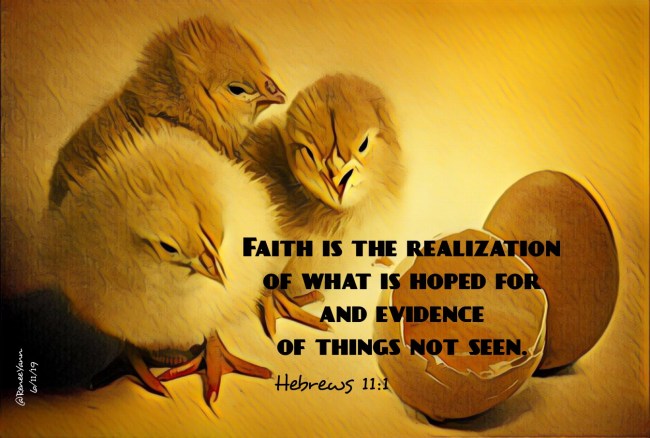
Hebrews11_1 Fith_hope

Today, in Mercy, we have a few slightly complex readings. But, as with all Sunday lectionary choices, they are strung together by a single theme. 

Upon first reading, we might think that theme is FAITH since the word is mentioned at least eight times. And, indeed, “faith” is the foundation of these readings – the faith of Abraham, Isaac, Jacob, the Desert Jews, the disciples, and the new Christian community. 

It is the testimony of this ancient and enduring faith that encourages us to be ready, as Jesus says in today’s Gospel:

Do not be afraid any longer, little flock,
for your Father is pleased to give you the kingdom.

This phrase of Jesus reveals another, deeper, theme: courageous hope.

How awesome that God, in covenant with God’s People, could keep alive – for 400 years- the hope of salvation! How miraculous that these ordinary farmers, milkmaids, herdsman, and shepherds could sustain their hope through numerous generations!

Today’s readings are sending us this message:


Be courageous!
You are the Bearer of Hope
to this generation!


It may seem in our world, and in our individual lives, that God tarries beyond tolerance in answering our hope – for peace, civility, equality, security, goodness.  But we must remember that with God there is no time. God is already responding within the long fidelity of our hope. (Our clocks and Apple watches just are obscuring our view. 😉)

That faithful hope creates the space for charity. And charity is the human face of Divine Love already Abiding.

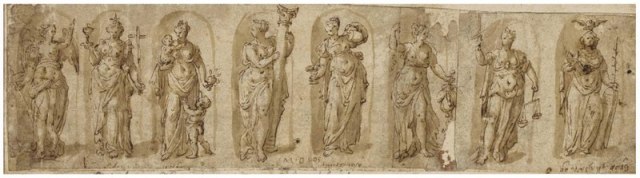
Faith, Hope, and Charity – the theological virtues (Remember that from your Baltimore Catechism?). 

Virtues
The Theological and Cardinal Virtues with Wisdom: Hope, Faith, Charity, Fortitude, Temperance, Liberality, Justice and Sapientia by Maarten de Vos (1532-1603)

These virtues are the foundation of the spiritual life. Contemporary theology ties these irrevocably to the virtue of justice – the seeking of right relationship in all Creation.

Anselm Min, Professor of Religion at Claremont Graduate University, has edited a powerful book on this subject. (Unfortunately, now out print and thus hugely expensive). One reviewer of the book, Lameck Banda, Professor at Justo Mwale University in Lusaka, Zambia, offers this insight into Min’s collection:

“The running thread throughout this book is that, whichever way the contemporary culture may seek to view and treat faith, hope, and love, the ultimate goal of these virtues is to radically and comprehensively address issues which tend to undermine the agenda of justice.”

That summary in itself gave me a lot to think and pray about. I hope it inspires you as well. God bless your Sunday!

Rohr

Music: Hymn of Hope from The Secret Garden by Rolf Lovland

Let the Light In

Friday of the Eighteenth Week in Ordinary Time

August 9, 2019

Click here for readings

Today, in Mercy, we have the first of a few readings from the Book of Deuteronomy. In today’s passage, Moses gives the first of three speeches to the community. These speeches are a sort of manifesto a family patriarch might give before he dies, framing the family history and code to direct coming generations.

Ps77 crack


Dad


The reading falls on a most appropriate day for me.
Today would be my Dad’s 104th birthday.
The occasion invites me to recount all the blessings
given to him, me, and our family.


When we, as people of faith, step back from our lives in reverence, we realize God’s immense goodness to us. Moses encourages his people to do just such stepping back:

Ask now of the days of old, before your time,
ever since God created man upon the earth;
ask from one end of the sky to the other:
Did anything so great ever happen before?

We might ask ourselves the same thing. 

  • How has God been with me and my family through our lifetimes, and through the generations that preceded us?
  • In both our lights and darknesses, how has God continually called us to relationship?
  • How have we revealed God’s voice to one another by our love, honesty, support, patient accompaniment, generous correction and forgiveness?
  • How have these gifts to one another allowed us to become gifts to the larger world?
  • What am I passing on to the next generation of the fidelity and sacrifice which has blessed me?

When I think of my Dad, there are so many symbols that show how he answered those questions with his life. They aren’t big manifestos like those of Moses. Instead: 

  • a frayed prayer book that I watched him finger daily
  • an old receipt for my bicycle bought in incremental payments he could barely afford
  • his sincere distress one Assumption Day when he had forgotten to go to Mass
  • his steadfast attempt to work even when illness weakened him and his humble trust in God when that weakness appeared to triumph
  • a treasured conversation about his hope for heaven
  • the appreciation now, in my maturity, of his thousand quiet acts of faith and love

All of us might spend some time in gratitude for the legacy of faith and love we have received. No family is perfect, and the grace may come to us in clarity or in disguise. But it comes. 

There are fractures and tears in every family. There were some even in Moses’ “family” and Moses himself! And we cannot magically heal them all. But God asks us to remember that God abides with us even in any fragmentation. Just as the poet Leonard Cohen sings:

There is a crack in everything.
That’s how the light gets in.

Click here to listen to Cohen’s moving song

If what we remember in our family history are weaknesses, how have they made us stronger? If what we remember are strengths, how have they made us more generous? In either case, how have we heard God’s voice in our story? How have we let the Light in?

As Moses tells his people:

This is why you must now know, and fix in your heart,
that the LORD is God
in the heavens above and on earth below,

and that there is no other.

Music: As for Me and My House – Promise Keepers

Who Do You See in the Mirror?

Eighteenth Sunday in Ordinary Time

August 4, 2019

Click here for reading

Today, in Mercy, our readings focus on “vanity” – its threats and remedies.

Often, we think of vanity as a physical emotion – that Narcissistic self-absorption that keeps us in front of a mirror for inordinate amounts of time. Our culture promotes this kind of vanity by working endlessly to convince us that without certain products we are “not enough” on our own. 

mirror statue

Historically, this kind of rhetoric was directed primarily toward women, spawning a nearly $500 billion global cosmetic market! But men are catching up! The men’s market is forecasted to reach nearly $30 billion by 2023.

Several years ago, while flying home from a business trip, I was seated across from two young women. As we approached home, the one nearest me, began to prepare for landing. She initiated an elaborate cosmetic ritual that involved no fewer than ten brushes plus an array of tubes and compacts. At first, it struck me really funny. Then I realized how very sad it was.

This maturing child was no more than eighteen. She was naturally beautiful with the vigor of youth. But she had obviously spent a lot of money and time not believing in her natural beauty.

Society considers vanity as a kind of pride and pomposity. I think just the opposite. I think vanity is really fear, self-dissatisfaction, anxiety and pain because something has convinced us that we are inadequate.

Vanity damages souls as well as bodies. It makes us behave in greedy, self-absorbed and careless ways toward our neighbors. It makes us pretend we are more than we think we are. It saps us of the strength to be generous, trusting and hopeful.

Paul, in his letter to the Colossians, tells us to get over this kind of vanity:

Put to death, then, the parts of you that are earthly:
immorality, impurity, passion, evil desire,
and the greed that is idolatry.
Stop lying to one another,

since you have taken off the old self with its practices
and have put on the new self,
which is being renewed, for knowledge,
in the image of its creator. 

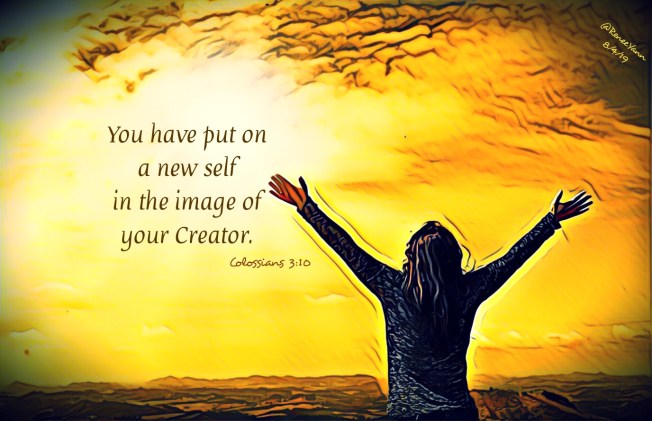
Col3_10 new image

What if that sweet girl on Flight 419 had been able to look in her mirror and see the image of her Creator? What if we could all do that? How might we spend our time and money differently if we were convinced of how beautiful we are to God?

Music: How Could Anyone Ever Tell You – Shaina Nell

I have added two versions of this beautiful song. Let God sing it to you in your prayer today.


Radical Joy

Memorial of Saint Ignatius of Loyola, Priest

Ignatius
by Francisco de Zubarán (1598–1664)

July 31, 2019

Click here for readings


Today, in Mercy, Exodus tells us:

Exodus34_29 Radiant

Obviously, I haven’t met Moses personally. 😂 But I have met many wonderful human beings who have reflected a similar radiance.

It is a mirrored glory that comes from friendship with God. 

It glows in the innocence of children and the layered wisdom of the elderly. It blazes in those seeking social justice and in those silently, unwaveringly praying for it. It lights the hope of the living and the dying. It is that mysterious, unquenchable candle shining in both joy and sorrow. Its other holy names are Faith, Hope and Love.

 No one need tell us. We know when we are in the presence of such Light. It needs no words.

Rumi radiant

Today, let’s pray for the blessing of this Radiance all over our shadowed world. Let’s pray for it to shine within us.

Music: Radiant God – Hannah Ford

Unconditional Love

Tuesday of the Seventeenth Week in Ordinary Time

July 30, 2019

Click here for readings

Today, in Mercy, we consider God’s unconditional love.

God and Moses and the People have been through it. The trail of complaints, the golden calf, the shattered tablets – these are relational dramas to the extreme! Exodus is definitely soap opera material! Does it feel a little bit like your life, or your family’s, or the families you read about in the news?

Ex34_9 Life

Life is indeed a drama! And our relationship with God is highlighted and shadowed with its twists and turns. For that reason, today’s passage offers us so much comfort and confidence. Even after all that has happened, God reveals himself to Moses like this:

The LORD, the LORD, a merciful and gracious God,
slow to anger and rich in kindness and fidelity,
continuing his kindness for a thousand generations.

Moses is so moved by this new knowledge of God’s unconditional love, that he welcomes God as part of their community:

If I find favor with you, O LORD,
do come along in our company.
This is indeed a stiff-necked people;
yet pardon our wickedness and sins,

and receive us as your own.

We are invited by this reading to open ourselves to that same unconditional love, to thank God for journeying with us through life’s convolutions. Stiff-necked at times, repentant at others, we are always God’s beloved.

As we negotiate the intricacies of our life today, we might trustingly say like Moses:

Lord, do come along in my company.

Music: Outrageous Grace – Godfrey Birtill

Our Story is God’s Story

Saturday of the Sixteenth Week in Ordinary Time

July 27, 2019

Click here for readings

Today, in Mercy, our Exodus reading describes momentous events in Israel’s life.

tabletsJPG

God has just invited Moses and several others up the mountain for a Divine conflab.  Moses returns to the people to announce “all the words and ordinances of the Lord”.The People receive these words wholeheartedly:

“We will do everything that the LORD has told us.”

Thus, a community of persons is formed with God at its heart.

Moses then engages the community in a series of formal rituals to highlight the significance and permanence of this deeper step in relationship with God.


The passage contains multiple points for our prayerful consideration.

The community of Israel is not unlike our own faith communities, those that gather in specific religious houses, or those we share in the universal community of all Creation. We are Catholics, Lutherans, Jews, Hindus, Muslims, Sikhs sharing a story of God in our particular religious traditions. We are also all children of the same God sharing that experience in our Common Home of Creation.

Just as with the ancient Israelites, God communicates and relates with us through the experiences of our lives. In our communities, that Divine Word is interpreted, codified, ritualized, and responded to. These actions create a story which is alive, deepening with each new generation, and still always rooted in the long history of promise and grace.

Today’s reading contains many elements of story and ritual which we can recognize in our own faith practice: written and announced word, altar or worship place, sacrifice or offering to God, acts of covenant, and celebratory meals.

Exodus24_3 sinai

These are the human ways in which we access relationship with God. These are the ways in which we keep our faith vital. We strengthen our faith by one another’s stories of love, mercy and hope. We commit to a shared law of love, not legalism – a heart-law which calls us to be life for one another, just as God is Life for us. In community, we reveal the face of God within ourselves.

For those of us who share the practice of a Eucharistic faith, the parallels in today’s reading call us to deeper awareness of how God becomes present in our lives.

May all of us – of whatever spirituality – who share life in God’s continuing Creation, obediently hear the command to cherish every human being as a revelation of God, as a critical and precious part of my own faith story – a part for whom I share the responsibility for life.

Music: Song of the Body of Christ – David Haas (Lyrics below)

Song of the Body of Christ
Refrain: We come to share our story. We come to break the bread.
We come to know our rising from the dead.
1. We come as your people. We come as your own.
United with each other, love finds a home.
2. We are called to heal the broken, to be hope for the poor.
We are called to feed the hungry at our door.
3. Bread of life and cup of promise, In this meal we all are one.
In our dying and our rising, may your kingdom come.
4. You will lead and we shall follow.
ou will be the breath of life; living water, we are thirsting for your light.

Trust and Fears

Saturday of the Fourteenth Week in Ordinary Time

July 13, 2019

Click here for readings

Today, in Mercy, our readings are an interplay of trust and fear, just like most of our lives are.

Related image

The TV character Adrian Monk is the exaggerated personification of our human fears. You name it, he’s afraid of it. Most of us aren’t that bad off, thank God. But we all have fears at times, and maybe life-long ones.

We might entertain conquerable anxieties like fear of water, or public speaking, or heights. These limits to our courage can be stretched by lessons and practice. 

But the deeper fears, like those central to today’s readings, are radically existential and perhaps never fully conquerable. These might include fear of meaninglessness, loneliness, diminishment, and death.

Joseph’s brothers handle their doubts by straight-talking with him. They trust his assurances. Joseph addresses his concerns about burial by pressing a promise from these same brothers.

Mt10_sparrow

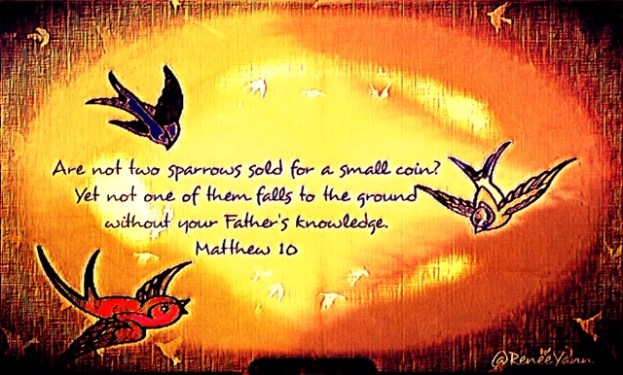
In our Gospel, Jesus tells us how to deal with our deepest worries and fears. He assures us that no one or nothing can break the insoluble bond of love God has for us. He promises that we will endure eternally within this love. He reminds us that, ultimately, this is the only thing that matters.

The image of the free and unfettered sparrow shows us how God wants us to live and enjoy our creaturehood. The image of a loving God, brushing our hair and counting every one of them, may inspire us to deeper trust as we pray today.

You may be familiar with the trusting phrase attributed to Julian of Norwich:

“All shall be well,
and all manner of thing shall be well.”


Actually, it was Jesus who spoke the word to her in a vision:

“But Jesus, who in this vision informed me of all that is needed by me, answered with these words and said: ‘It is true that sin is cause of all this pain, but all shall be well, and all shall be well, and all manner of thing shall be well.’

“These words were said most tenderly, showing no manner of blame to me nor to any who shall be saved.”


Indeed, we will meet the results of sin and darkness in the world and in ourselves. Julian grew to understand that, in God’s love, we are saved from that darkness:


And from the time that [the vision] was shown, I desired often to know what our Lord’s meaning was. And fifteen years and more afterward I was answered in my spiritual understanding, thus: ‘Would you know your Lord’s meaning in this thing? Know it well, love was his meaning. Who showed it to you? Love. What did he show you? Love. Why did he show it? For love. Keep yourself therein and you shall know and understand more in the same. But you shall never know nor understand any other thing, forever.’  

    Thus I was taught that love was our Lord’s meaning. And I saw quite clearly in this and in all, that before God made us, he loved us, which love was never slaked nor ever shall be. And in this love he has done all his work, and in this love he has made all things profitable to us. And in this love our life is everlasting. In our creation we had a beginning. But the love wherein he made us was in him with no beginning. And all this shall be seen in God without end … 


Music: All Shall Be Well – Kathleen Deignan (Lyrics below)

All shall be well and all manner of thing shall be well.

Receive the gift of healing
from the well of tears;
be washed anew
by grief and sorrowing.

Receive the gift of healing
from our mother Earth,
her deep and dark
and secret verdancy.

Receive the gift of healing
from the shaman’s touch:
the wounded healer’s power
to revive.

Receive the gift of healing
in the arms of love,
embraced in passion
and compassioning.