Obviously, I haven’t met Moses personally. 😂 But I have met many wonderful human beings who have reflected a similar radiance.
It is a mirrored glory that comes from friendship with God.
It glows in the innocence of children and the layered wisdom of the elderly. It blazes in those seeking social justice and in those silently, unwaveringly praying for it. It lights the hope of the living and the dying. It is that mysterious, unquenchable candle shining in both joy and sorrow. Its other holy names are Faith, Hope and Love.
No one need tell us. We know when we are in the presence of such Light. It needs no words.
Today, let’s pray for the blessing of this Radiance all over our shadowed world. Let’s pray for it to shine within us.
Today, in Mercy, we consider God’s unconditional love.
God and Moses and the People have been through it. The trail of complaints, the golden calf, the shattered tablets – these are relational dramas to the extreme! Exodus is definitely soap opera material! Does it feel a little bit like your life, or your family’s, or the families you read about in the news?
Life is indeed a drama! And our relationship with God is highlighted and shadowed with its twists and turns. For that reason, today’s passage offers us so much comfort and confidence. Even after all that has happened, God reveals himself to Moses like this:
The LORD, the LORD, a merciful and gracious God, slow to anger and rich in kindness and fidelity, continuing his kindness for a thousand generations.
Moses is so moved by this new knowledge of God’s unconditional love, that he welcomes God as part of their community:
If I find favor with you, O LORD, do come along in our company. This is indeed a stiff-necked people; yet pardon our wickedness and sins, and receive us as your own.
We are invited by this reading to open ourselves to that same unconditional love, to thank God for journeying with us through life’s convolutions. Stiff-necked at times, repentant at others, we are always God’s beloved.
As we negotiate the intricacies of our life today, we might trustingly say like Moses:
Today, in Mercy, our Exodus reading describes momentous events in Israel’s life.
God has just invited Moses and several others up the mountain for a Divine conflab. Moses returns to the people to announce “all the words and ordinances of the Lord”.The People receive these words wholeheartedly:
“We will do everything that the LORD has told us.”
Thus, a community of persons is formed with God at its heart.
Moses then engages the community in a series of formal rituals to highlight the significance and permanence of this deeper step in relationship with God.
The passage contains multiple points for our prayerful consideration.
The community of Israel is not unlike our own faith communities, those that gather in specific religious houses, or those we share in the universal community of all Creation. We are Catholics, Lutherans, Jews, Hindus, Muslims, Sikhs sharing a story of God in our particular religious traditions. We are also all children of the same God sharing that experience in our Common Home of Creation.
Just as with the ancient Israelites, God communicates and relates with us through the experiences of our lives. In our communities, that Divine Word is interpreted, codified, ritualized, and responded to. These actions create a story which is alive, deepening with each new generation, and still always rooted in the long history of promise and grace.
Today’s reading contains many elements of story and ritual which we can recognize in our own faith practice: written and announced word, altar or worship place, sacrifice or offering to God, acts of covenant, and celebratory meals.
These are the human ways in which we access relationship with God. These are the ways in which we keep our faith vital. We strengthen our faith by one another’s stories of love, mercy and hope. We commit to a shared law of love, not legalism – a heart-law which calls us to be life for one another, just as God is Life for us. In community, we reveal the face of God within ourselves.
For those of us who share the practice of a Eucharistic faith, the parallels in today’s reading call us to deeper awareness of how God becomes present in our lives.
May all of us – of whatever spirituality – who share life in God’s continuing Creation, obediently hear the command to cherish every human being as a revelation of God, as a critical and precious part of my own faith story – a part for whom I share the responsibility for life.
Music: Song of the Body of Christ – David Haas (Lyrics below)
Today, in Mercy, our readings are an interplay of trust and fear, just like most of our lives are.
The TV character Adrian Monk is the exaggerated personification of our human fears. You name it, he’s afraid of it. Most of us aren’t that bad off, thank God. But we all have fears at times, and maybe life-long ones.
We might entertain conquerable anxieties like fear of water, or public speaking, or heights. These limits to our courage can be stretched by lessons and practice.
But the deeper fears, like those central to today’s readings, are radically existential and perhaps never fully conquerable. These might include fear of meaninglessness, loneliness, diminishment, and death.
Joseph’s brothers handle their doubts by straight-talking with him. They trust his assurances. Joseph addresses his concerns about burial by pressing a promise from these same brothers.
In our Gospel, Jesus tells us how to deal with our deepest worries and fears. He assures us that no one or nothing can break the insoluble bond of love God has for us. He promises that we will endure eternally within this love. He reminds us that, ultimately, this is the only thing that matters.
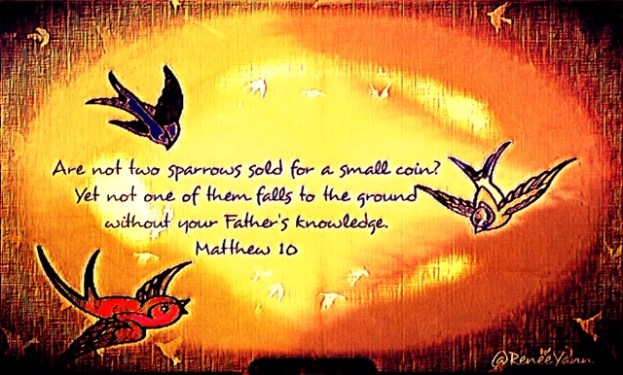
The image of the free and unfettered sparrow shows us how God wants us to live and enjoy our creaturehood. The image of a loving God, brushing our hair and counting every one of them, may inspire us to deeper trust as we pray today.
You may be familiar with the trusting phrase attributed to Julian of Norwich:
“All shall be well,
and all manner of thing shall be well.”
Actually, it was Jesus who spoke the word to her in a vision:
“But Jesus, who in this vision informed me of all that is needed by me, answered with these words and said: ‘It is true that sin is cause of all this pain, but all shall be well, and all shall be well, and all manner of thing shall be well.’
“These words were said most tenderly, showing no manner of blame to me nor to any who shall be saved.”
Indeed, we will meet the results of sin and darkness in the world and in ourselves. Julian grew to understand that, in God’s love, we are saved from that darkness:
And from the time that [the vision] was shown, I desired often to know what our Lord’s meaning was. And fifteen years and more afterward I was answered in my spiritual understanding, thus: ‘Would you know your Lord’s meaning in this thing? Know it well, love was his meaning. Who showed it to you? Love. What did he show you? Love. Why did he show it? For love. Keep yourself therein and you shall know and understand more in the same. But you shall never know nor understand any other thing, forever.’
Thus I was taught that love was our Lord’s meaning. And I saw quite clearly in this and in all, that before God made us, he loved us, which love was never slaked nor ever shall be. And in this love he has done all his work, and in this love he has made all things profitable to us. And in this love our life is everlasting. In our creation we had a beginning. But the love wherein he made us was in him with no beginning. And all this shall be seen in God without end …
Music: All Shall Be Well – Kathleen Deignan (Lyrics below)
All shall be well and all manner of thing shall be well.
Receive the gift of healing
from the well of tears;
be washed anew
by grief and sorrowing.
Receive the gift of healing
from our mother Earth,
her deep and dark
and secret verdancy.
Receive the gift of healing
from the shaman’s touch:
the wounded healer’s power
to revive.
Receive the gift of healing
in the arms of love,
embraced in passion
and compassioning.
Today, in Mercy, we read about a family reunion of biblical proportions!After many years, Joseph – long-thought dead- is reunited with his grieving father, deceitful half-siblings, and beloved younger brother. Wow!
For better or worse, “Family” is a powerful force in every one of our lives. It both nurtures and siphons us; both exalts and critiques us; frees us and binds us.
In many ways, family makes us who we are – by blood and genes – but more importantly by the hope and promise it places in us.This was the case with Joseph, the great hope of his father Jacob and the misunderstood threat to his jealous brothers.
Today’s reading shows us a family who has made it through their devastating conflicts, not by their own effort, but by the abiding promise of God.
So many fractured families wish they could tell the same story of redeeming wholeness! What were the openings in this family’s brokenness that allowed God to enter and heal?
As so often in our human story, God comes dressed in ordinary clothes.God wears the garments of our grief, repentance, forgiveness, hope and longing. He is disguised in our memories, cherished or painful. He peeks through our unresolved regrets, and dances in our acts of kindness, patience, and understanding.
We reach through to touch this God of Hope by our smallest mercy, our offered reconciling word, our tendered apology for a slight grown bigger with the years. And sometimes, we must simply let go of that which is unreconcilable, of those human hurts that can’t be healed because of time’s passage or unreachable hearts.
We let this God of Promise live in our families by honestly loving one another, supporting one another, thanking one another, and anticipating one another’s needs.
Being a strong family takes courage and sacrifice – something Joseph’s brothers were lucky to learn, however late. Let us pray in hope and thanksgiving for our own families – and for all families —that God may give us that kind of self-sacrificing courage. Let us pray especially for young families, in today’s very inhospitable world, that they may grow strong in God’s and each other’s love.
Today, in Mercy, our journey through Genesis leads us into the thick of the Joseph narrative. This is a long and intricate story, covering thirteen chapters in Genesis. The drama is rich in theological and psychological themes. Even outside the Bible, its scenes would stand the test of literary craftsmanship. Today’s reading offers us just one example.
Joseph’s Bloodstained Coat by Ford Maddox Brown
We enter the story a little later in the action. Joseph, the favored son of Jacob and thus hated by his jealous brothers, has been sold by them to a band of Midianite merchants. Ending up as a slave In Egypt, Joseph, by means of a series of dreams, saves the Egyptians from a terrible famine. He is greatly honored for this, becoming almost the equal of the grateful Pharaoh.
During the widespread famine, Joseph’s treacherous brothers come to Egypt seeking grain. He recognizes them although they are unaware of who he is. After leading them through a series of trials, Joseph ultimately forgives and reconciles with them. He brings his whole family to live in Egypt, protected by the aura of his unexpected prosperity.
One of the many suggestions for our prayer today might center on the inevitable dramas within families and communities fueled by favoritism, jealousy, even treachery. But reading Joseph’s story, we must consider these inevitabilities in the long-term light of God’s abiding grace, the power of forgiveness, and God’s will to give us new life even as we stand in our concupiscent ashes.
At times in our own life story, we may act as, or be impacted by, behaviors like those of doting Jacob, the envious brothers, or entitled Joseph. We might find ourselves entangled in a drama to rival this dysfunctional family of Jacob! Our prayer leads us to ask, “How were they ultimately delivered to freedom, restored to love?”
The controlling, underlying theme of the Joseph narrative is that our hidden God remains with us in all of life’s roller coaster episodes. This God longs to grace us with the redemptive powers of repentance, forgiveness, hope, renewal and generosity. These graces can heal our bruised human story, letting it announce the saving power of God if we but open our hopes, choices, and dreams to it.
Music: Any Dream Will Do – from Joseph and the Amazing, Technicolor Dreamcoat, Andrew Lloyd Weber
Today, in Mercy, we celebrate the feast of the Sacred Heart, a day of deep devotion and gratitude for God’s lavish mercy to us.
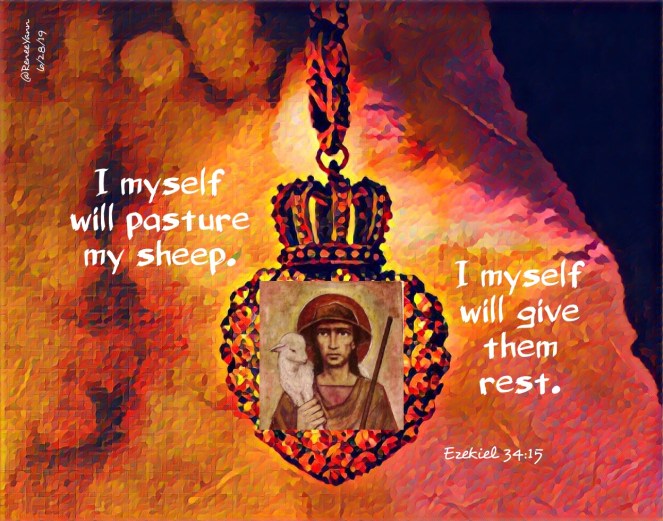
All of our readings today suggest the image of a good shepherd caring for his sheep. This metaphor, perhaps more meaningful for the agrarian society in which these scriptures were written, still retains for us the imagery of tenderness, attentive responsibility, strength, protection, and vigilant presence.
Our first reading comes from Ezekiel whose ministry occurred in Babylon during the second captivity there. God calls Ezekiel to prophesy against Israel’s leaders who have forgotten their defenseless sheep, who have fed themselves instead of their flock. Today’s particular verses have God speaking, taking over the shepherding duties, because the human “shepherds” (kings and priests) have so badly failed their sheep.
The Lord makes clear who will be the beneficiaries of his tenderness:
The lost I will seek out, the strayed I will bring back, the injured I will bind up, the sick I will heal, but the sleek and the strong I will destroy, shepherding them rightly.
As I prayed with this passage, I was struck by the awareness of how some things never change. The parallels to our Church and society are painfully evident. Immorally self-indulgent “pastors” and self-serving, indifferent leaders still plague their “flocks”. The poor and weak are still abandoned by those they had depended on.
Our reading from Romans and Matthew raise before us the model of Jesus Christ, the Good Shepherd who both renders us infinite compassion, and teaches us how to dispense it as his disciples. We are invited to become one with the sacred, compassionate Heart of Jesus, being healed ourselves to become healers.
Take my yoke upon you, says the Lord, and learn from me,
for I am meek and humble of heart.
Our world aches for this healing. Let us pray together today for God to inspire and energize us to be Mercy for our world.
Music: Sweet Heart of Jesus – sung by the Irish soprano Maureen Hegarty
(I know this hymn is tinged with a bit of the old, sentimental spirituality. Still, I have loved it from my long-ago youth and it touches me deeply. I hope it will touch you as well.❤️ Lyrics below.)
Sweet Heart of Jesus!
Fount of love and mercy,
Today we come,
thy blessings to implore;
Oh touch our hearts, so
cold and so ungrateful,
And make them Lord,
Thine own for evermore.
Sweet Heart of Jesus!
We implore
Oh, make us love Thee
more and more.
Sweet Heart of Jesus!
Make us know and love thee.
Unfold to us
the treasures of thy grace.
That so our hearts, from
things of earth uplifted,
May long alone
to gaze upon Thy face.
Today, in Mercy, Jesus puts the whole spiritual life in a nutshell:
When I was a kid (and maybe even now), one of my favorite cartoon characters was Uncle Scrooge McDuck.
I was amazed to think that someone could accumulate all that money, and fascinated to see that all he wanted to do was sit on it!
Both Uncle Scrooge and Jesus pose some deep questions to us today.
How much do we really need to make us happy?
Will having it actually make us happy in the long run?
Where does our happiness come from, if we have happiness at all?
We have seen the theme in a hundred books and movies – poor little rich boy or girl starving for love. We all seem to realize that true wealth comes from love. But do we live and choose by that understanding?
Possessions can distract us from what is truly essential for our soul. Greed and selfishness can kill the Spirit within us.
Our coöptation by materialism and greediness doesn’t have to rise to the level of Scrooge’s mounted millions. So often a miserly heart is crippled by things much more complex than money. We can be sinfully stingy with:
our attention to those deemed unimportant
our kindness to those struggling with life
our forgiveness to the unappreciative
our presuppositions about what belongs to whom
The following parable has always shaken me down at the root of my assumed entitlements:
A young woman was waiting to catch a flight in the boarding area of the airport. Given that her wait was going to be several hours she decided to buy a book to read along with a packet of cookies to enjoy. She sat down in an armchair in the VIP room of the airport to relax and read her book in peace.
Beside the armchair where the packet of cookies lay, a man was seated next to her reading his magazine. When the woman reached into the packet of cookies to take the first cookie, the man next to her also took one. She was irritated but said nothing. “What nerve this man has!” she thought. For each cookie she took the man also took a cookie.
She was infuriated but didn’t want to cause a scene. When only one cookie remained she thought to herself, “what will this horrible man do now?” The man reached down and broke the cookie into even halves and handed one half to her. It was more than she could handle! She grabbed her things in a huff, refused the half, and stormed off to the boarding area.
When she got onto her seat on the plane she reached into her purse to get her reading glasses and, to her surprise, her packet of cookies was sitting there untouched and unopened.
We might wish to spend some prayer time considering the application of this story to our own attitudes.
Today, in Mercy, both Jesus and Paul teach us about the true meaning of charity and community.
Throughout his journey among the Gentile Christians, Paul conducts a collection for the poor of the Jerusalem Church.
Galatians 2:9-10
James, Cephas, and John, those esteemed as pillars, gave me and Barnabas the right hand of fellowship when they recognized the grace given to me. They agreed that we should go to the Gentiles, and they to the circumcised. All they asked was that we should continue to remember the poor, the very thing I had been eager to do all along.
Romans 15:25-26
Now, however, I am on my way to Jerusalem in the service of the Lord’s people there. For Macedonia and Achaia were pleased to make a contribution for the poor among the Lord’s people in Jerusalem.
In today’s passage, Paul encourages the Corinthians to contribute by holding up to them the generosity of the churches of Macedonia. Great strategy, eh?
In our Gospel, Jesus shows how deep our generosity, hospitality, mercy, forgiveness,and love should be: boundless. He gives such a reasonable argument:
For if you love those who love you,
what recompense will you have? Do not the tax collectors do the same?
Jesus tells us that we must far exceed the tax collectors, that we must be “perfect as our Heavenly Father is perfect” – perfected, whole, and completed by Mercy and Love.
For Paul, this meant embracing both the Jewish and Gentile Christians as one community.
For Jesus, it means loving all Creation as God Loves.
Beloved friends, what does it mean for us?
Music: In Perfect Charity – Randall deBruyn (Lyrics below)
Verse 1
O most high and glorious God, Cast your light into the darkness of my heart. Give me right faith, and certain hope, And perfect, perfect charity. Give me true insight, Lord, and wisdom, That I may always live within your ever holy will, Lord may your light within me burn, Shining out in perfect charity.
Verse 2
O most high and glorious God, Open wide the door that leads me to your love. Give me your firm, yet gentle strength; May I live that perfect charity. Lord, may your peace be ever in me, That I may always seek to serve your children here on earth; That I may find my home in you, And live in perfect charity.
Verse 3
Then most high and thankful praise I will sing unto the glory of your name: To Father, Son, and Spirit bright, Living Presence, Perfect Charity. Praise to the Love that shines in splendour, That lights the pathways of my heart, And brings me close to you. O Holy One, Invite me in, where you live in perfect charity.
Today in Mercy, we experience both Paul and Jesus praying for their followers. They each use similar words.
Paul: And now I commend you to God and to that gracious word of his that can build you up and give you the inheritance among all who are consecrated.
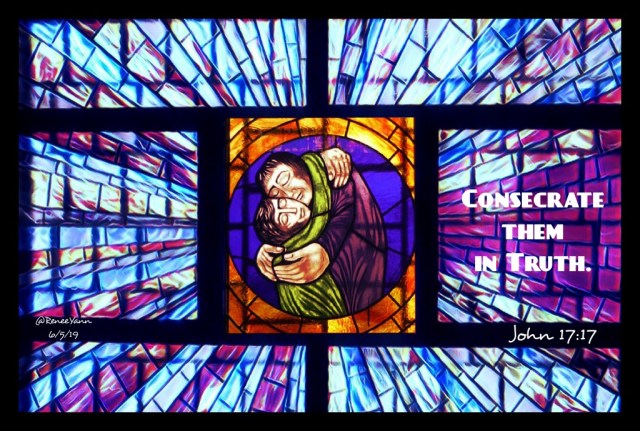
Jesus: Consecrate them in the truth. Your word is truth. As you sent me into the world, so I sent them into the world. And I consecrate myself for them, so that they also may be consecrated in truth.
Do you pray for others? To protect those you love? To change those who are bound in Spirit? To alleviate those who suffer? To awaken those that are caught in the vortex of selfishness or self-destruction? To increase the blessings of the generous?
Perhaps the greatest prayer we can offer for another is one like that of Paul and Jesus – a plea for the other to stand Blessed in the Truth of who they are in God — CONSECRATED by their Creaturehood, their Baptism, their faith, and their infinite power for Life in the Holy Spirit.
Today, we might pray like this for our Beloveds, and for those we might like to love better; for those who are unloved, and those unaware of how much they are loved.











 Lavish Mercy