Good Friday of the Lord’s Passion

April 2, 2021

Today, in God’s Lavish Mercy, we pray with Psalm 31, the prayer of one who will not be shaken from faith in God.

For all my foes I am an object of reproach,
    a laughingstock to my neighbors, and a dread to my friends;
    they who see me abroad flee from me.
I am forgotten like the unremembered dead;
    I am like a dish that is broken.
But my trust is in you, O LORD;
    I say, “You are my God.
In your hands is my destiny; rescue me
    from the clutches of my enemies and my persecutors.”

Psalm 31: 12-13

What is there to say about the Good Friday journey of Jesus? It may be that we can only walk beside him in loving, heart-broken silence.

There are times in our lives when we will be called to walk like this beside others in loving and merciful ministry.

There may be times when others are called to walk with us in such a way.

Let these times inform our prayer today.

Good Friday is the time we gather strength and compassionate understanding from Jesus to help us, in his Name, be Mercy in the world.


Poetry: From “The Dream of the Rood”, one of the Christian poems in the corpus of Old English literature and an example of the genre of dream poetry. Like most Old English poetry, it is written in alliterative verse. Rood is from the Old English word rōd ‘pole’, or more specifically ‘crucifix’. Preserved in the 10th-century Vercelli Book, the poem may be as old as the 8th-century Ruthwell Cross, and is considered as one of the oldest works of Old English literature.

The Rood (cross of Christ) speaks:

“It was long past – I still remember it – 
That I was cut down at the copse’s end,
Moved from my root. Strong enemies there took me,
Told me to hold aloft their criminals,
Made me a spectacle. Men carried me
Upon their shoulders, set me on a hill,
A host of enemies there fastened me.

“And then I saw the Lord of all mankind
Hasten with eager zeal that He might mount
Upon me. I durst not against God’s word
Bend down or break, when I saw tremble all
The surface of the earth. Although I might
Have struck down all the foes, yet stood I fast.

“Then the young hero (who was God almighty)
Got ready, resolute and strong in heart.
He climbed onto the lofty gallows-tree,
Bold in the sight of many watching men,
When He intended to redeem mankind.

I trembled as the warrior embraced me.
But still I dared not bend down to the earth,
Fall to the ground. Upright I had to stand.

“A rood I was raised up; and I held high 
The noble King, the Lord of heaven above.
I dared not stoop. They pierced me with dark nails;
The scars can still be clearly seen on me,
The open wounds of malice. Yet might I
Not harm them. They reviled us both together.
I was made wet all over with the blood
Which poured out from his side, after He had 
Sent forth His spirit. And I underwent
Full many a dire experience on that hill.

I saw the God of hosts stretched grimly out.
Darkness covered the Ruler’s corpse with clouds
His shining beauty; shadows passed across,
Black in the darkness. All creation wept,
Bewailed the King’s death; Christ was on the cross….

“Now you may understand, dear warrior,
That I have suffered deeds of wicked men
And grievous sorrows. Now the time has come
That far and wide on earth men honor me,
And all this great and glorious creation,
And to this beacon offers prayers. On me
The Son of God once suffered; therefore now
I tower mighty underneath the heavens,
And I may heal all those in awe of me.
Once I became the cruelest of tortures,
Most hateful to all nations, till the time
I opened the right way of life for men.”

Music: Pie Jesu – Michael Hoppé

Psalm 23: Darkness to Light

Monday of the Fifth Week of Lent

Monday, March 22, 2021

Today, in God’s Lavish Mercy, we pray with our revered Psalm 23. This powerful prayer of confidence and hope fits well with today’s readings.

In the passage from Daniel, the innocent Susanna never wavers in her trust:

O eternal God, you know what is hidden
and are aware of all things before they come to be:
you know that they have testified falsely against me. 
Here I am about to die,
though I have done none of the things
with which these wicked men have charged me.”
The Lord heard her prayer.

Daniel 13: 42-44

In our Gospel, the woman – though not innocent – stills finds refuge in Jesus’s mercy.

So he was left alone with the woman before him.
Then Jesus straightened up and said to her,
“Woman, where are they?
Has no one condemned you?”
She replied, “No one, sir.”
Then Jesus said, “Neither do I condemn you.
Go, and from now on do not sin any more.”

John 8: 9-11

Like these two women, we may find ourselves in a dark valley at times. Whether we are innocent or guilty in arriving there, God abides with us in mercy. 

The key is to acknowledge our situation and to reach out to that Mercy. In that way, even though we encounter difficulty, as said in Psalm 23, we live in Light and not in shadow:

Only goodness and kindness follow me
all the days of my life;
And I shall dwell in the house of the LORD
for years to come.

Psalm 23: 5-6

Poetry: Light by Rabindranath Tagore

Light, my light, the world-filling light, 
the eye-kissing light, heart-sweetening light!

Ah, the light dances, my darling, at the center of my life; 
the light strikes, my darling, the chords of my love; 
the sky opens, the wind runs wild, laughter passes over the earth.

The butterflies spread their sails on the sea of light. 
Lilies and jasmines surge up on the crest of the waves of light.

The light is shattered into gold on every cloud, my darling, 
and it scatters gems in profusion.

Mirth spreads from leaf to leaf, my darling, 
and gladness without measure.
 The heaven’s river has drowned its banks 
and the flood of joy is abroad.


Psalm 51: I Desire Mercy

Saturday of the Third Week of Lent

March 13, 2021


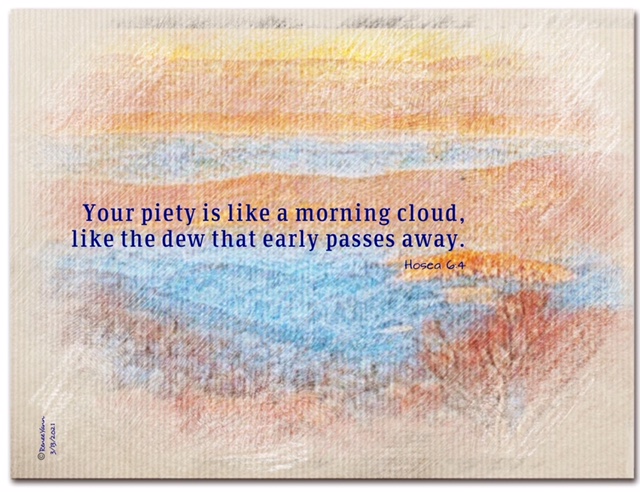
Hosea’s Warning

Today, in God’s Lavish Mercy, we pray with Psalm 51 which, together with our other readings, tests the depths and sincerity of our prayer.

A clean heart create for me, God;
renew within me a steadfast spirit.

Psalm 51:12

Our readings today put this consideration before us:

What is prayer really,
and what is the quality of my prayer?


Hosea tells us

For it is love that I desire, not sacrifice,
    and knowledge of God rather than burnt offerings.


Luke tells us

For everyone who exalts himself will be humbled,
and the one who humbles himself will be exalted.


And our psalm tells us

For you are not pleased with sacrifices;
    should I offer a burnt offering, you would not accept it.
My sacrifice, O God, is a contrite spirit;
    a heart contrite and humbled, O God, you will not spurn.


To sum up our readings, here’s what prayer is NOT:

  • It is not a roll call of our sacrifices and righteousness.
  • It is not fasting, or paying tithes, or even keeping the commandments.

Then what is it?


Prayer is an intimate exchange with God
with whom we are humble, honest,
open, generous and grateful
– with Whom we are safe, confident and in love.

Prayer is our response to God
who desires our merciful hearts.
… so
Let us Pray.

Poetry: A Prayer from Teresa of Avila 

May today there be peace within.
May you trust God that you are exactly where you are meant to be.
May you not forget the infinite possibilities that are born of faith.
May you use those gifts that you have received, 
and pass on the love that has been given to you.
May you be content knowing you are a child of God.
Let this presence settle into your bones, 
and allow your soul the freedom to sing, dance, praise and love.
It is there for each and every one of us.

Music: Peaceful Moments – Regi Stone

Psalm 25: Remember me?

Tuesday of the Third Week of Lent

March 9, 2021


Today, in God’s Lavish Mercy, we pray with Psalm 25, a gentle call for God’s attention:

The tone of this very human prayer is this: “Pay attention to me, God!”
Think of a toddler peppering her parent – “Mommy, look! Daddy, watch!

That’s what Psalm 25 is – a peppering of God.🤗


It’s not exactly that we feel forgotten by God. We know that can never happen, right? But we want God to put aside everything that might be occupying the Divine Attention, turn around and focus on us, listen intently to our prayer.


Remember that your compassion, O LORD,
    and your kindness are from of old.
In your kindness remember me,
    because of your goodness, O LORD.


Praying with Psalm 25 might lead us to realize that it is not God who must remember, or pay attention. It is us! In our need, we must recall God’s long faithfulness to us and therefore TRUST that God is with us – always – in any current circumstance. We must pray to discover God present there.

Your ways, O LORD, make known to me;
    teach me your paths,
Guide me in your truth and teach me,
    for you are God my savior.


Poetry: Psalm 25 – Trust by Christine Robinson

I put my trust in you, O God, as best as I am able. 
   May I be strong. May I not be afraid
May all who open their hearts
  hear your voice and know your love.

Lead me, teach me, help me to trust.
You are gracious to us, O God
You guide us, you forgive our clumsy ways
You help us prosper.

When I am sad and anxious
  I school my heart to trust
I act with integrity and uprightness
  And hope to feel your touch in my heart.
May it be so for all the peoples of the earth
  Who call you by many names.

Music: Two selections today

  1. To You O Lord – Marty Haugen

2. For lovers of Bach, like me, you might enjoy this:

Psalm 25 – Nach dir, Herr, verlanget mich, BWV 150 (For Thee, O Lord, I Long. Thought to be the earliest extant Cantata by Johann Sebastian Bach)

Here is a link to a great Bach website where I found some of my material for today.

Psalm 103: #BeLike

Saturday of the Second Week of Lent

March 6, 2021


Today, in God’s Lavish Mercy, we pray with Psalm 103, an effusive canticle on God’s unbounded Mercy.

Bless the LORD, O my soul;
    and all my being, bless his holy name.
Bless the LORD, O my soul,
    and forget not all his benefits.
He pardons all your iniquities,
    he heals all your ills.
He redeems your life from destruction,
    he crowns you with kindness and compassion.

Psalm 103:1-4

A sufficient prayer today would be to thank God for our experiences of this overflowing mercy. But our Gospel tells us there is more to it. There is a response required of us.


If you’re into social media like Facebook or Twitter, you may have noticed the popular meme “BeLike”.  (A meme is an idea, behavior, or style that becomes a fad and spreads by means of imitation from person to person within a culture, often carrying a symbolic meaning.) Here is an example of the  #BeLike meme posted by the NJ State Police.


If our psalmist and evangelist were writing a meme for today’s readings, it might look like this:


That’s the message.
I’m spending my prayer time with just that today.


Poetry: The Prodigal’s Mother Speaks to God by Allison Frank

When he returned a second time,
the straps of his sandals broken,
his robe stained with wine,

it was not as easy to forgive.

By then his father
was long gone himself,
leaving me with my other son, the sullen one
whose anger is the instrument he tunes
from good morning on.

I know.

There’s no room for a man
in the womb.

But when I saw my youngest coming from far off,
so small he seemed, a kid
unsteady on its legs.

She-goat
what will you do? I thought,
remembering when he learned to walk.

Shape shifter! It’s like looking through water—
the heat bends, it blurs everything: brush, precipice.

A shambles between us.

Music: Father, I Have Sinned – Eugene O’Reilly

Psalm 1: Don’t Sit There!

Thursday of the Second Week of Lent

March 4, 2021


Today, in God’s Lavish Mercy, we pray with Psalm 1. We’ve prayed with it several times, but today a particular word and verse struck me.

“Insolent” — I’ll bet it’s a word you seldom, if ever, said out loud. The last time I think I heard it  was when my sixth grade teacher caught me smoking in the girls’ lav. I didn’t know what the word meant, but I knew it wasn’t good.

Even etymologists are uncertain of the origin of the word, but it has come to define one who is contemptuous of rightful authority.


Despite its current infrequent use, the Bible likes the word and uses it at least 23 times to instruct our spiritual life.

Psalm 1 declares that even hobnobbing with the insolent is a bad idea. Insolence rubs off on us if we’re not careful. You know, “birds of a feather” and all that.


And isn’t it true? Haven’t you run into one or two cliques of contemptuous, snidely belligerent people in your lifetime who feed on one another’s insolence?

Those are the kind of folks Psalm 1 is talking about. We meet them everywhere – school, church, work, socially. They are the ones gossiping, passing judgment, stereotyping, slandering … Perhaps we’ve even joined them at times 🥲

In their worst form, they are the ones in the white hoods, carrying the burning torches, pushing kids into cages. We should pray for them because, as our psalmist suggests, they have been emptied of their souls:


… they are like chaff which the wind drives away.

Psalm 1:4


It’s been a long time since sixth grade and, even if I still don’t know the etymology of the word, I’ve come to understand what severe insolence does to a soul.

I don’t want to harbor even an ounce of it. Reflecting on Psalm 1 today, that is my heartfelt prayer.


Poetry: Know Yourself –   Meister Eckert

A human being has so many skins inside, 
covering the depths of the heart. 
We know so many things, 
but we don’t know ourselves! 
Why, thirty or forty skins or hides, 
as thick and hard as an ox’s or bear’s, 
cover the soul. 
Go into your own ground 
and learn to know yourself there.

Music: Grace Is – Paul Avgerinos 

Psalm 50: Clean It Up!

Tuesday of the Second Week of Lent

March 2, 2021


Today, in God’s Lavish Mercy, we pray with Psalm 50 which Wikipedia describes as “a prophetic imagining of God’s judgement on the Israelites”.


It’s a rainy day here, after a foggy yesterday. A cheery psalm this morning would have been nice…. but, well it’s Lent.

Why do you recite my statutes,
    and profess my covenant with your mouth,
Though you hate discipline
    and cast my words behind you?

Psalm 50: 16-17

The psalm is a divine rebuke. It shouts, “Wake up! You’re missing the point!”

Psalm 50 calls us to examine the failures in love that we might bury under routine. It demands that we look under the surface of our daily practice for the depths of grace and transformation that we might be overlooking.


We can get pretty comfortable with our beliefs, our judgements, our attitudes, our habits. Left unexamined, these can deteriorate into prejudices and indifferences, into bigotry and self-righteousness, into betrayals of mercy.

Today’s Gospel gives us a perfect description of what happens to us when we fail to discern the “hardening of our spiritual arteries”. We get Pharisaical! Here’s what Jesus says about pharisees:

… they preach but they do not practice.
They tie up heavy burdens hard to carry
and lay them on people’s shoulders,
but they will not lift a finger to move them.
All their works are performed to be seen.
They widen their phylacteries and lengthen their tassels.
They love places of honor at banquets, seats of honor in synagogues,
greetings in marketplaces, and the salutation ‘Rabbi.’

Matthew 23:4-7

Let’s learn humble, contrite self-examination by sincerely praying Psalm 50:

Those who offer praise as a sacrifice glorify me;
    and to those who go the right way 
    I will show the salvation of God.

Psalm 50: 23

Our first reading from Isaiah sums it up:

Wash yourselves clean!
Put away your misdeeds from before my eyes;
    cease doing evil; learn to do good.
Make justice your aim: redress the wronged,
    hear the orphan’s plea, defend the widow.

Isaiah 1:16-17

Poetry: God must give us a renewed mind (from Vale Millies) by Hadewijch. She was mystic of the 13th century
English version by Mother Columba Hart, Original Language Dutch

God must give us a renewed mind
     For nobler and freer love,
To make us so new in our life
     That Love may bless us
And renew, with new taste,
     Those to whom she can give new fulness;
Love is the new and powerful recompense
     Of those whose life renews itself for Love alone.
— Ay, vale, vale, millies — (farewell, farewell, a million times)
     That renewing of new Love
— Si dixero, non satis est — (If I can speak, it is not enough)
     Which renewal will newly experience.


Music: Psalm 50

Psalm 130: The Depths

Friday of the First Week of Lent

February 26, 2021


Today, in God’s Lavish Mercy, we pray with Psalm 130, the De Profundis. This is a transformative prayer whose power we may not fully realize.

Have you ever been disappointed with God? Have you ever let God know it in your prayer? 

Psalm 130 is the psalmist’s complaint to God that things are as bad as they can get and God doesn’t appear to care. It is a plea – even a demand- for God to pay attention and do something. (See my poem, sent a little later, called “These Things”.)

Out of the depths I cry to you, O LORD;
    LORD, hear my voice!
Let your ears be attentive
    to my voice in supplication.


But Psalm 130 is not just a private complaint. As well as being a penitential psalm, 130 is marked as a “Psalm of Ascent”. This means that it was sung by the community as they went to the Temple to worship.

Psalm 130 carries the tone of a national or global lament. It has the feeling of a deeply bruised people bearing a desperate hope mixed with some bewilderment. It is a feeling we all recognize.

Remembrance of Lives Lost to Covid 19

Yesterday in my neighborhood, we had our first hint of spring weather. On a short walk, I met a few people whose winter-weary eyes, above their masks, held a spark of resurrection hope.

With distribution of COVID vaccines, hope for deliverance from the pandemic surfaces like a tentative bud. We are starting the slow ascent from the depths we have all shared. We are on our way to the temple of thanksgiving and praise.


But Psalm 130 reminds that, on that ascent, fully voicing our lament is imperative for true healing. In reference to the pandemic, and to any other devastation we face in life, we must be honest with God about our fear, confusion, sadness, hopelessness, and shaken faith … about our disappointment in God, our splintered expectations which need healing.

If you, O LORD, mark iniquities,
    LORD, who can stand?

It is only by asking God how these things – whatever they might be – could be allowed to happen to us, or to any of God’s beloved, that we will open ourselves to the Divine answer – a mystery too deep for words.

I trust you, LORD;
    my soul trusts in your word.
My soul waits for you
    more than sentinels wait for the dawn.
    Let me wait for the LORD.

Such prayer heals, leading us to a deeper, truer relationship with God.

For with the LORD is kindness
    and plenteous redemption;
And the Lord will redeem Israel
    from all their suffering and sin.

Poetry: Spring – Mary Oliver

Somewhere
a black bear
has just risen from sleep
and is staring

down the mountain.
All night
in the brisk and shallow restlessness
of early spring

I think of her,
her four black fists
flicking the gravel,
her tongue

like a red fire
touching the grass,
the cold water.
There is only one question:

how to love this world.
I think of her 
rising
like a black and leafy ledge

to sharpen her claws against 
the silence
of the trees.
Whatever else

my life is
with its poems
and its music
and its cities,

it is also this dazzling darkness
coming 
down the mountain,
breathing and tasting;

all day I think of her –
her white teeth,
her wordlessness, 
her perfect love.

Music: Pié Jesu – Michael Hoppé

Psalm 138: Favors Received

Thursday of the First Week of Lent

February 25, 2021


Today, in God’s Lavish Mercy, we pray with Psalm 138, an ardent thanksgiving for favors received.

Lord, on the day I called for help,
you answered me.

Psalm 138:3
Queen Esther by Andrea del Castagno – 15th C.

The psalm today reflects back to our first reading from the Book of Esther. The “favor received” in that story is a monumental one: saving the Jewish people from extinction. This deliverance is commemorated on the Jewish Feast of Purim which, coincidental to our liturgical reading, is celebrated this year on February 25th.


 Reflecting on “favors received”, we might be moved to thank God for the blessings in our lives. Some blessings are evident from the get-go. But some come initially wrapped in challenge, worry, even anguish:

Queen Esther, seized with mortal anguish,
had recourse to the LORD.
She lay prostrate upon the ground, together with her handmaids, 
from morning until evening, and said:
“God of Abraham, God of Isaac, and God of Jacob, blessed are you. 
Help me, who am alone and have no help but you,
for I am taking my life in my hand.

Esther C: 12-16

What is it that changes these darknesses into Light? Psalm 138 offers us this clue:

When I called, you answered me;
    you built up strength within me.
    Your right hand saves me.
The LORD will complete what he has done for me;
    your kindness, O LORD, endures forever;
    forsake not the work of your hands.

Psalm 138: 3,7-8

Certainly a positive outcome to our prayer, like Esther’s, allows us to see a blessing. But what about the times when the outcome disappoints or even devastates us?

The answer has something to do with spiritual “strength”, with a long faith like Esther’s. She puts her hope in the Lord and waits for the answer to unfold even at the risk of her life.

Trusting God like this means that we believe in God’s bigger picture for us and for all that we love. 

  • It means that, by faith, we live partly in the eternal world we cannot yet see. 
  • It means that the quintessential things of our heart and soul exist beyond time, in the unbounded love of God.
  • It means that we trust God to complete all things in lavish mercy.

The LORD is with me to the end.
LORD, your Mercy endures forever.
Never forsake the work of your hands!

Psalm 138: 7-8

That kind of faith won’t just pop up when we are in trouble. It has to be ingrained – the very fabric of our lives, knitted there by the prayerful surrender of our daily lives to God’s amazing Grace.


Poetry: Rock of My Salvation BY MORDECAI BEN ISAAC
TRANSLATED BY SOLOMON SOLIS-COHEN

Mighty, praised beyond compare,
Rock of my salvation,
Build again my house of prayer,
For Thy habitation!
Offering and libation, shall a ransomed nation
Joyful bring
There, and sing
Psalms of Dedication!

Woe was mine in Egypt-land,
(Tyrant kings enslaved me);
Till Thy mighty, out-stretched Hand
From oppression saved me.
Pharaoh, rash pursuing, vowed my swift undoing—
Soon, his host
That proud boast
’Neath the waves was rueing!

To Thy Holy Hill, the way
Madest Thou clear before me;
With false gods I went astray—
Foes to exile bore me.
Torn from all I cherished, almost had I perished—
Babylon fell,
   Ze-ru-ba-bel
Badest Thou to restore me!

Then the vengeful Haman wrought
Subtly, to betray me;
In his snare himself he caught—
He that plann’d to slay me.
(Hauled from Esther’s palace; hanged on his own gallows!)
Seal and ring
Persia’s king
Gave Thy servant zealous.

When the brave Asmonéans broke
Javan’s chain in sunder,
Through the holy oil, Thy folk
Didst Thou show a wonder—
Ever full remained the vessel unprofanèd;
These eight days,
Lights and praise,
Therefore were ordainèd.

Lord, Thy Holy Arm make bare,
Speed my restoration;
Be my martyr’s blood Thy care—
Judge each guilty nation.
Long is my probation; sore my tribulation—
Bid, from Heaven,
Thy shepherds seven
Haste to my salvation!

Music: Rock of My Salvation – Maranatha Music

Psalm 25: Grace through Prisms

First Sunday of Lent

February 21, 2021

Today, in God’s Lavish Mercy, we pray with Psalm 25, a prayer full of humility, thanksgiving, and hope.

Your ways, O LORD, make known to me;
    teach me your paths,
Guide me in your truth and teach me,
    for you are God my savior.

Psalm 25: 4-5

Genesis 9:12

On this First Sunday of Lent, the psalm is set between the wonderful Noah story, its interpretation by Peter, and the proclamation of Christ’s redemptive mission.

Like Noah, humankind has come through the storm of an ages-long messianic longing. Jesus is the Rainbow rising out of that darkness. His Light passes into us through the prismed waters of our Baptism. Indeed, as our Psalm declares:

Good and upright is the LORD,
    showing sinners the way.
God guides the humble to justice,
    and teaches the humble the godly way.

Psalm 25: 8-9

When our psalmist first begins to pray, the light within seems shadowed and the vibrancy of his soul perhaps fractured. At times, we have felt the same way. 

But the psalmist’s sincere and humble prayer catches God’s Light, allowing the passage from shadows to to the full rainbow of Mercy. May it be so for all of us as well as we journey with Jesus through Lent.

Poetry: on a separate post today due to its length — but so worth the time to read and savor.


Music: Rainbow by Robert Plant – Let God sing this song to you, perhaps the way God sang in Noah’s heart when he was delivered from the flood.

I found a lucky charm
I dressed it up with love
I crossed the Seven Seas to you
Will it be enough?

And I will be a rainbow
Oh, now your storm is gone
And I will bring the song for you
And I will carry on
Ooh Ooh Ooh
Ooh Ooh Ooh

I'm reachin' for the stars
In the sky above
Oh, I will bring their beauty home
The colors of my love

And I will be a rainbow
Now your storm is gone
And I will bring my song to you
And I will carry on
(Hummed interlude)

Love is enough
Though the world be a wind
And the woods have no voice but the voice of complaining

My hands shall not tremble, my feet shall not falter
The voyage shall not weary, the fish shall not alter
Hmm, It's rainbow, oh it's rainbow
Oh, can't you see the eyes are the eyes of a lover

Pocket full of hearts
A world that's filled with love
A love that carries all before
The passion and the flood

I lie beneath the rainbow
Now your tears have gone
And I will sing my song for you
And I will carry on
(Repeated interlude)