Psalm 51: In Accord with Your Merciful Love

Friday after Ash Wednesday

February 19, 2021


Today, in God’s Lavish Mercy, we pray with Psalm 51, that magnificent penitential psalm which is one of only seven among the 150. The psalm, set between two readings that do with fasting, suggests that what we should “fast” from is sin.

Some interpreters attribute the psalm to David, deeply repentant after his treacherous acts toward Uriah and Bathsheba. Others say that this was a subsequent assignation because the psalm so fit the incident.


Whatever the case, Psalm 51 gives of us a picture of someone profoundly aware of failure in faithfulness to God – not just a sin against another human being, but against God.

For I acknowledge my offense,
    and my sin is before me always:
“Against you only have I sinned,
    and done what is evil in your sight.”

Psalm 51:5-6

Still, coupled with this aching repentance
is the absolute conviction
of God’s superseding Mercy.

Have mercy on me, O God, in your goodness;
    in the greatness of your compassion wipe out my offense.
Thoroughly wash me from my guilt
    and of my sin cleanse me.

Psalm 51: 3-4

The psalmist has a large, lyrical notion in mind:
that God should take the scattered, chaotic, failed self that he is,
and out of it form a new, restored self.
The movement from failed self to restored self
is a gift asked of God in confidence.

Walter Brueggemann: From Whom No Secrets Are Hid


Praying with this psalm, the symbol of an arrow came to mind. You might have noticed the symbol recently on Valentines Day, used to describe the power of love to engage the heart.



But if the arrow is broken, how will it be made whole again?

Lord, you will open my lips;
and my mouth will proclaim your praise.
For you do not desire sacrifice or I would give it;
a burnt offering you would not accept.
My sacrifice, O God, is a contrite spirit;
a contrite, humbled heart, O God, you will not scorn.

Psalm 51:17-19

On this Lenten journey,
may we bring contrite hearts
– our “broken arrows” – 
to God,
asking to recognize our failures in love
and to repent sincerely of them.


Poetry: Possible Answers to Prayer by Scott Cairns

Your petitions—though they continue to bear
just the one signature—have been duly recorded.
Your anxieties—despite their constant,
relatively narrow scope and inadvertent
entertainment value—nonetheless serve
to bring your person vividly to mind.
Your repentance—all but obscured beneath
a burgeoning, yellow fog of frankly more
conspicuous resentment—is sufficient.
Your intermittent concern for the sick,
the suffering, the needy poor is sometimes
recognizable to me, if not to them.
Your angers, your zeal, your lipsmackingly
righteous indignation toward the many
whose habits and sympathies offend you—         
these must burn away before you’ll apprehend
how near I am, with what fervor I adore
precisely these, the several who rouse your passions.

Music: Broken Arrow – Let God turn your whole world around in this song by Rod Stewart

Who else is gonna bring you a broken arrow
Who else is gonna bring you a bottle of rain
There he goes moving across the water
There he goes turning my whole world around

Do you feel what I feel
Can we make it so that's part of the deal
I gotta hold you in these arms of steel
Lay your heart on the line this time

I want to breathe when you breathe
When you whisper like that hot summer breeze
Count the beads of sweat that cover me
Didn't you show me a sign this time

Who else is gonna bring you a broken arrow
Who else is gonna bring you a bottle of rain
There he goes moving across the water
There he goes turning my whole world around, around

Do you feel what I feel
Ah can you see what I see
Can you cut behind the mystery
I will meet you by the witness tree
Leave the whole world behind

I want to come when you call
I'll get to you if I have to crawl
They can't hold me with these iron walls
We got mountains to climb, to climb

Who else is gonna bring you a broken arrow
Who else is gonna bring you a bottle of rain
There he goes moving across the water
There he goes turning my whole world around
Turning my whole world around


Psalm 29: Holy Attire

Tuesday of the Sixth Week in Ordinary Time

February 16, 2021


Today, in God’s Lavish Mercy, we pray with Psalm 29 which describes the settling of peace over an ended storm.

The voice of the LORD is over the waters,
    the LORD, over vast waters.
The voice of the LORD is mighty;
    the voice of the LORD is majestic. 

Psalm 29:3

This gift of peace invites the psalmist to give glory to the Lord, and to do so in a celebratory manner:

Give to the LORD the glory due his name;
    adore the LORD in holy attire. 

Psalm 29:4

Reading this little verse this morning, I was reminded of my novitiate days.  What a profound joy and thrill it was for me to receive the habit of the Sisters of Mercy. I count myself fortunate to have entered just in time to wear the original habit – just for fourteen months before we adopted a modified style.

Each morning as we dressed, we said a specific prayer over each component of the habit. The prayers were beautiful and served to orient us to the duties and blessings of the day.


Psalm 29 reminds us to give thanks for our blessings – and our challenges – as we begin and end each day. But it specifically says that we should clothe ourselves in “holy attire” as we pray. In his letter to the Colossians, Paul describes such attire:

Therefore, as the elect of God, holy and beloved, 
clothe yourselves with heartfelt mercy, 
Kindness, humility, gentleness, and patience. 
Bear with one another 
and forgive any complaint
you may have against another. 
Forgive as the Lord has forgiven you. 
And over all these virtues put on love, 
which is the bond of perfect unity. 
Let the peace of Christ rule in your hearts, 
for to this you were called as members of one body. 
And be thankful.

Colossians 3:12-15

Poem: She Walks in Beauty by Lord Byron

May we walk, attired in the beauty of God’s Grace and peace.

She walks in beauty, like the night 
Of cloudless climes and starry skies; 
And all that’s best of dark and bright 
Meet in her aspect and her eyes; 
Thus mellowed to that tender light 
Which heaven to gaudy day denies. 

One shade the more, one ray the less, 
Had half impaired the nameless grace 
Which waves in every raven tress, 
Or softly lightens o’er her face; 
Where thoughts serenely sweet express, 
How pure, how dear their dwelling-place. 

And on that cheek, and o’er that brow, 
So soft, so calm, yet eloquent, 
The smiles that win, the tints that glow, 
But tell of days in goodness spent, 
A mind at peace with all below, 
A heart whose love is innocent!

Music: Because You Are Chosen – John Michael Talbot

Because you are chosen
Called to be holy
Because you are the Lord’s beloved
You must clothe yourself with kindness
With heartfelt mercy
In the meekness of humility
So bear you now with one another
And forgive as the Lord’s forgiven you
Over all these virtues
Bind them all together
In the Love of our Lord Jesus
Over all these virtues
Bind them all together
In the Love of our Lord Jesus
Over all these virtues
Bind them all together
In the Love of our Lord Jesus.

Psalm 32: Forgiveness

Friday of the Fifth Week in Ordinary Time

February 12, 2021

Today, in God’s Lavish Mercy, we pray with Psalm 32, a classic penitential psalm.

It is an uncomplicated description of repentance and forgiveness which, nevertheless, discloses profound insights into the human spirit.

Blessed is the one whose fault is taken away,
    whose sin is covered.
Blessed the one to whom the LORD imputes not guilt,
    in whose spirit there is no guile. 

Psalm 32:1-2

This relational sequence of confession and forgiveness is probed in depth in Psalm 32 (where) the speaker describes his silence and his consequent bodily disability (vv. 3–4). One can observe in the psalm an inchoate theory of repression that became definitive for Sigmund Freud. Repression immobilizes, says the psalmist! The abrupt move in verse 5 concerns the process of making his sin known, saying it aloud, confessing it.

It is confession that makes forgiveness possible. It is denial that precludes assurance and that immobilizes the perpetrator.

Walter Brueggemann, From Whom No Secrets Are Hid

Praying with Psalm 32 this morning reminded me of a story I wrote a few years ago.

The Earring

Young Emma, skewered by indecision, had stared into her mother’s jewelry box. She had always loved those silver earrings, a gift to her mother from her grandmother—an heirloom now, a treasure beyond price. She wanted so to wear them on this special date, but they were “hands off” and she knew it. Still, her mother at work and unaware of her desire, Emma had succumbed to temptation.

The dance had been wonderful, a whirlwind of such delight that Emma had not noticed when her left earring had brushed against her partner’s shoulder, tumbling hopelessly under the dancers’ trampling feet. Only at evening’s end, approaching her front door exhausted and dreamy, had she reached up to unclip the precious gems.

Her mother sat waiting for her in the soft lamplight, having already noticed the earrings missing from her dresser. Awaiting retribution, Emma knelt beside her mother and confessed the further sacrilege of loss. But her mother simply cupped Emma’s tearful face in her hands, whispering, “You are my jewel. Of course I forgive you.”  Though accustomed to her mother’s kindness, this act of compassion astonished Emma, filling her with an indescribable, transformative gratitude.

As we pray Psalm 32, there may be a great forgiveness we are thankful for, or just the small kindnesses that allow us to rise each morning with joy and hope. Perhaps there is a memory of compassion, like Emma’s, that we treasure—one that in turn has made us kinder and more honest.

But maybe, on the other hand, there is a “lost earring”, never acknowledged. With time, that unacknowledgement burrows deeper into the spirit restricting our capacity to love.

Psalm 32 reminds us that God is our Mother waiting in the lamplight to cup our face with love, to receive our joyful thanks for divine mercies. 

For this shall every faithful soul pray to you 
    in time of stress.
Though deep waters overflow,
    they shall not reach us. 

Psalm 32:6

Like Emma, we may be astonished at the graciousness that has been given to us. We may respond by pouring out our thanks to God in a silent act of prayer.

May we also have the courage to become like our merciful God, anticipating the other’s need for our forgiveness. May we seek the strength not to harbor injury, but too release it to make room for further grace in our hearts.


Poetry: FIRST FORGIVENESS - Irene Zimmerman
The usually mild evening breeze
became a wailing wind
when the gates clanged shut behind them. 
They shivered despite their leathery clothes
as they searched for the fragrant blossoms
they’d grown accustomed to sleep on,
but found only serpentine coils
that bit and drew blood from their hands. It was Eve who discovered the cave.
When she emerged, she saw Adam
standing uncertainly at the entrance. A river of fire flooded her face
as she remembered his blaming words—
“The woman you gave me,
she gave me fruit from the tree,
and I ate.”

“Spend the night wherever you choose,”
she told him bitterly.
“You needn’t stay with me.” Long afterwards, when even the moon’s
cold light had left the entrance
and she’d made up a word
for the hot rain running from her eyes,
she sensed Adam near her in the dark. His breath shivered on her face.
“Eve,” he moaned,
“I’m sorry. Forgive me.” In the darkness between them
the unfamiliar words
waited, quivering.
She understood their meaning
when she touched his tears.

Music: Father, I Have Sinned – Eugene O’Reilly

Our story above was about a “prodigal daughter”. Our music is about a “prodigal son”.

Psalm 147: Brokenhearted?

Fifth Sunday in Ordinary Time

Sunday, February 7, 2021


Today, in God’s Lavish Mercy, we pray with Psalm 147 which invites us to:

Praise the LORD, for he is good;
    sing praise to our God, Who is gracious;
    Whom it is fitting to praise.

It is a psalm for the left-brained who, like Job in our first reading, might need some explanation about just why we should praise when life seems so unpraiseworthy at times!

Job spoke, saying:
Is not man’s life on earth a drudgery?
    Are not his days those of hirelings?
He is a slave who longs for the shade,
    a hireling who waits for his wages.
So I have been assigned months of misery,
    and troubled nights have been allotted to me.

Job 7: 1-4

Job, like many of us when we suffer, feels crushed under life’s burdens. However, an extended reading of the Book of Job reveals that humility and repentance allow Job to “see God”, and to rediscover the richness and flavor of his life.

Calling us to the same kind of awareness, Psalm 147 presents a series of reasons for praising God, including God’s continual attention to the city of Jerusalem, to brokenhearted and injured individuals, to the cosmos, and to nature.

For me, the most moving of these reasons comes in verse 3:

The Lord heals the brokenhearted
    and binds up their wounds.
The Lord tells the number of the stars;
    calling each by name.


This is a beautiful picture of our infinitely compassionate God who is able to recognize our broken-heartedness. 

This loving God, who knows the stars by name, knows us as well. We, like Job, begin to heal within the divine lullaby God patiently sings over our broken hearts.

Jesus is that Healing Song, the Word hummed over the world by the merciful Creator. In today’s Gospel, we see that Melody poured out over the suffering:

When it was evening, after sunset,
they brought to him all who were ill or possessed by demons.
The whole town was gathered at the door.
He cured many who were sick with various diseases,
and he drove out many demons,
not permitting them to speak because they knew him.

Mark 1: 32-34

As we pray today,

let us hear God’s song of mercy
being sung over all Creation.
Let us rest our own brokenness
there in its compassionate chords.
Let us bring the world’s pain to our prayer.

Poetry: A Cure Of Souls by Denise Levertov

The pastor
of grief and dreams
guides his flock towards
the next field
with all his care.
He has heard
the bell tolling
but the sheep
are hungry and need
the grass, today and
every day. Beautiful
his patience, his long
shadow, the rippling
sound of the flocks moving
along the valley.

Music: God Heals My Broken Heart – Patty Felker

If Job were singing his sadness today, it might sound like this song.

Psalm 105: Wondrous Deeds

Wednesday of the First Week in Ordinary Time

January 13, 2021

Today, in God’s Lavish Mercy, we pray with Psalm 105 celebrating God’s covenanted faithfulness to us.

Give thanks to the LORD, invoke God’s name;
    make known among the nations God’s deeds.
Sing, sing God’s praise,
    proclaim all God’s wondrous deeds.
(because…) The Lord remembers the covenant for ever.

Psalm 105: 1-2, 8

We certainly can spend some time in prayer today remembering God’s faithfulness to us personally. A grateful review of our life journey can always offer new insights into God’s love and generosity.

But more specifically, our psalm calls us to plumb the two readings which it connects.

  • Hebrews reminds us that God’s love is so extreme that God took Flesh in Jesus to teach us, in terms we could understand, the degree of God’s love.
  • In Mark, we see the early expression of that love, as Jesus reveals his healing power to the wretchedly suffering crowds.

In these readings, we learn that God’s promise endures to each generation:

God remembers the covenant forever
    which was made binding for a thousand generations– 
Which was entered into with Abraham
    and by God’s oath to Isaac.

Psalm 105: 8

In Chronos Time, this enduring covenant was enfleshed in Jesus. It continues in Kairos Time through each person’s Baptism into Christ through the Holy Spirit.

In other words,
we are the agents of God’s covenant with the world. Our lives must enflesh God’s Mercy for our times.

In his letter to Titus, Paul puts this clearly:

But when the kindness and love of God our Savior appeared, we were saved not because of righteous things we had done, but because of God’s mercy. God saved us through the washing of rebirth and renewal by the Holy Spirit, poured out on us generously through Jesus Christ our Savior, so that, having been justified by God’s grace, we might become heirs having the hope of eternal life.  

Titus 3: 4-7

May the message of these readings free us,
inspire us, and impel us
to a grace-filled response.


Poetry: Grace by Jill Peláez Baumgartner

Is it the transparency
and lift of air?
Is it release
as when the pebble
flings out of the slingshot
or the tethered dog
suddenly is without lead?

Or is it more like standing
on a dark beach
at midnight,
the surf loud
with its own revolution,
the horizon invisible,
the entire world the threat
of rushing water?

No one who swims 
at night in the ocean
feels weightless
embracing armfuls of water
against the ballast
of the waves’ fight.

Swimming:
toward the shore lights
or out into the vast bed
of the sea's white fires?

Music: Confitemini Domino – Psalm 105 – Orlando di Lasso (first published in 1562)

Confitemini Domino et invocate nomen ejus,

annuntiate inter gentes opera ejus,

cantate ei et psallite ei.

Narrate omnia mirabilia ejus,

laudamini in nomine sancto ejus,

laetetur cor quaerentium Dominum.

Give glory to the Lord, and call upon his name,

declare his deeds among the Gentiles,

sing to him, yea sing praises to him.

Relate all his wondrous works,

Glory ye in his holy name,

let the heart of them rejoice that seek the Lord.

Psalm 147: Lightning Strike

Friday after Epiphany

January 8, 2021

Today, in God’s Lavish Mercy, we pray with Psalm 147.

I began my prayer this morning still unsettled by the events at the U.S. Capitol building. Then I considered that it was still the Octave of the Epiphany, and realized that some epiphanies come by stormy lightning and not by starlight.


My first attempts at prayer seemed to bounce off the psalm’s formulaic words like sleet off a tin roof. The psalm did not yield to my need for naming and healing my anger and pain – the lightning’s wounds.

Asking to find God’s voice in the psalm, I finally came to see it as Israel’s prayer once it had been healed – just like I needed to be healed, just like our country needed to be.


The psalm revealed the steps to such healing …
the steps I, and we as a nation, might take to wholeness.
We heal:

by acknowledging God in humility and praise:
Glorify the LORD, O Jerusalem;
    praise your God, O Zion.


by strengthening an inclusive community:
For God has strengthened the bars of your gates;


by reverencing every family and neighbor:
God has blessed your children within you.


by building an infrastructure of peace:
God has granted peace in your borders


by assuring life’s basic needs for all:
With the best of wheat God fills you


by cherishing the Earth we share:
God sends forth the command to the earth;
    swiftly runs God’s word!

We heal, ultimately,
by acknowledging the unique gift
of God’s loving relationship
with us and every other creature.

If we truly live within that acknowledgment,
we become people of truth and mercy –
People of God.


Poetry: from A Book of Psalms – Stephen Mitchell closes Psalm 147 with this transliteration:

You rejoice in a pure heart 
and in those who let you shine through them...
You send your wisdom to their minds; 
your light runs faster than a thought.
Above all others they are blessed, 
because they can hear you speak
(though your love speaks in all people, 
in the silence of every heart).

Music: Heal Our Nation – Heartbeat

Psalm 27: Can We Love Like This?

Wednesday after Epiphany

January 6, 2021

Today, in God’s Lavish Mercy, as we once again pray with Psalm 27, we do so in the light of our seminal first reading from John:

God is love, 
and when we remain in love 
we remain in God 
and God in us.

1 John 4:16

How can we love like that?

Psalm 27 tells us how God does it:

For the Lord rescues the poor who cry out,
and the afflicted who have no other help.
The Lord has pity for the lowly and the poor;
and saves the lives of the poor.

Psalm 27: 12-13

Our psalm gives us the measure for love in our lives. Who are the suffering ones in the circle of our experience? How are we widening that circle to offer loving mercy with greater energy and fidelity?


The Spiritual and Corporal Works of Mercy can be our guide as we seek to stretch our love in ever-widening circles.

The Corporal Works of Mercy

To feed the hungry
To give water to the thirsty
To clothe the naked
To shelter the homeless
To visit the sick
To visit the imprisoned, and ransom the captive
To bury the dead


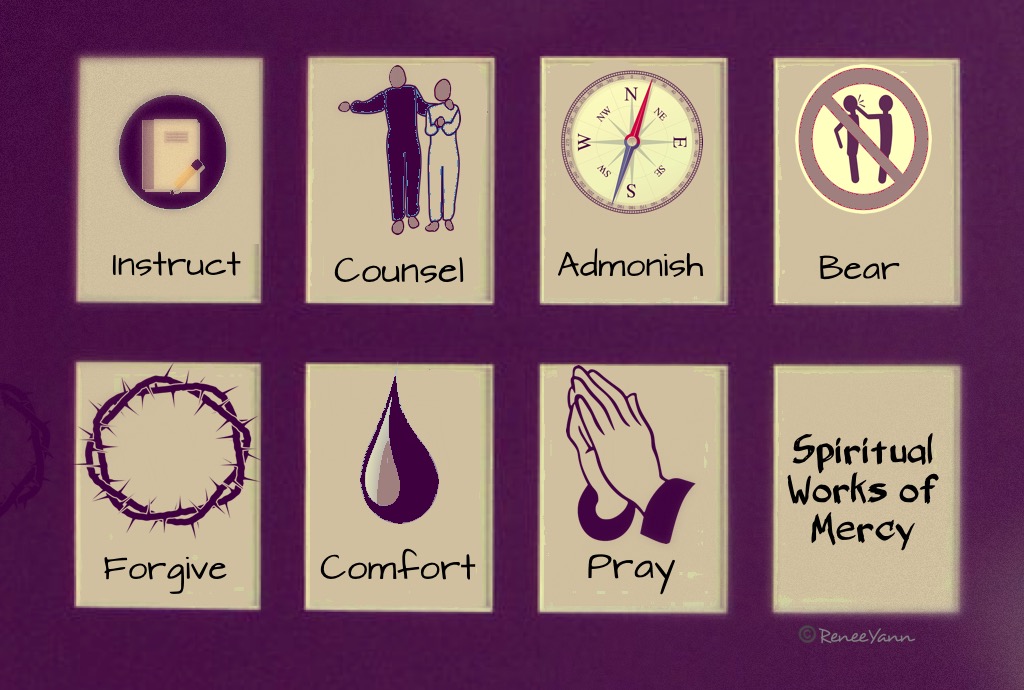
The Spiritual Works of Mercy

To instruct the ignorant.
To counsel the doubtful.
To admonish sinners.
To bear patiently those who wrong us.
To forgive offenses.
To comfort the afflicted.
To pray for the living and the dead.


Poetry: Widening Circles – Rainer Maria Rilke

I live my life in widening circles
that reach out across the world.
I may not complete this last one
but I give myself to it.
I circle around God, around the primordial tower.
I’ve been circling for thousands of years
and I still don’t know: am I a falcon,
a storm, or a great song?

Music: The Mercy Song – Paul Alexander

Psalm 72: Governed with Mercy

Memorial of Saint John Neumann, Bishop

January 5, 2021

Today, in God’s Lavish Mercy, we pray with Psalm 72 which will be familiar to us because it is used six times throughout the Advent and Christmas seasons.

O God, with your judgment endow the king,
and with your justice, the king’s son;
He shall govern your people with justice
and your afflicted ones with judgment.

Psalm 72: 1-2

This short post-Epiphany season is all about “manifestation” – how Jesus begins to show us the face of God-become-flesh.

The core message, conveyed to us in the daily progressive reading of 1 John, is that God is Love.


Our Gospel today, the feeding of the 5000, shows how that Love is expressed – merciful action for those in need.

Our psalm, written a thousand years before Christ, exults in the expectation of such a merciful Messiah:


The mountains shall yield peace for the people,
and the hills justice.
He shall defend the afflicted among the people,
save the children of the poor.
Justice shall flower in his days,
and profound peace, till the moon be no more.
May he rule from sea to sea,
and from the River to the ends of the earth.

Let us begin once again, in this new year,
to soak in the words and images
describing this longed-for and loving Savior.


Poetry: When Little Was Enough – Irene Zimmerman, OSF

(LUKE 9:10–17)

“Send the people away from this deserted place
to find food and lodgings,” the twelve urged Jesus,
“for the day is advanced and it is almost evening.”

Jesus looked at the crowd (there were about five thousand)
and looked at his disciples, still excited and tired
from their first mission journey.

What had they learned from the villagers of Galilee
who shared bread and sheltered them from cold night winds?
What had they learned of human coldness on the way?

He remembered the pain in his mother’s voice
as she told of his birth night when they found no room
in all of Bethlehem, House of Bread.

“You give them something to eat!” he said.

“We have only five loaves and two fish!” they protested.
“How can we feed so many with so little?”
He understood their incredulity.

They had yet to learn that a little was enough
when it was all they had—
that God could turn these very stones to bread.

“Have the crowd sit down in groups of fifty,” he said.
Jesus took the food and looked up to heaven.
He blessed it, broke it, gave it to the disciples
to distribute to the new-formed churches.

Afterwards, when everyone was satisfied,
the twelve filled twelve baskets of bread left over—
as faith stirred like yeast within them.


Music: Justice Shall Flourish – Rory Cooney

Psalm 2: A Political World

Memorial of Saint Elizabeth Ann Seton, religious

January 4, 2021

Today, in God’s Lavish Mercy, we pray with Psalm 2. The prayer seems a fitting reminder to all of us, and especially US citizens, as our new political season opens.

And now, O rulers, give heed;
take warning, you rulers of the earth.
Serve the LORD with fear, and rejoice before God;
with trembling rejoice…
Blessed are all who take refuge in God!


Although I was relieved to lessen my political attention after the November election, I realize that we always have a moral imperative both to pray for our leaders and to measure their efforts, and our own, against the standards of social justice. 

Click right triangle above to hear how Handel felt about it as he uses Psalm 2 in his Messiah.
Why do the nations so furiously rage together,
and who do the people imagine a vain thing?
The kings of the earth rise up,
and the rulers take counsel together against the Lord,
and against His Anointed.
George Frederic Handel: Messiah 
Psalm 2: 1-2

The interplay of politics and morality is on-going, and its energy rises once again with this month’s seating of the new Congress and inauguration of President Biden.

The U.S. and the world has been given stark lessons under the tenure of the exiting president. Some have learned from these experiences. Some have allowed their ignorances to be confirmed.

It has not been easy. We live in an age when truth and morality have been rendered elastic – seemingly malleable to multiple alternative narratives.


Another verse of Psalm 2 from Handel’s Messiah
Let us break their bonds asunder, and cast away their yokes from us.
(Psalm 2:3)

Psalm 2 reminds us of the one true narrative:
we are all creatures of God
charged to live in harmony
with one another and with the Creator.

Seen in a political light, we are a long way from achieving that charge. 

Our elected leaders have an almost impossible job to guide this fractured nation closer to our moral hope. But our prayer, and our sincere contribution to the effort, can make a huge difference in the result.

Despite any partisan leanings, can we pledge that contribution?


Poetry: The Paths of Love and Justice – Christine Robinson

Why are the nations in an uproar?
Why do the peoples mutter and threaten?
Why do the rich plot with the powerful?
They are rebelling against the demands of Love and Justice.
God laughs, cries, and says with anger:
I have set my Love in your hearts and my Justice in your minds.
You are my children and I have given you the universe
your lives, and the tasks of your days.
Be wise
Be warned
Stick to the paths of Love and Justice.
Your restless hearts will find me there.


Music: Justice and Mercy – Matt Redman

Psalm 34: The Reason

Tuesday of the Third Week of Advent

December 15, 2020


Today, in God’s Lavish Mercy, we pray with Psalm 34.

When I read its refrain, my mind was triggered into a kind of “Jeopardy-like” exchange with God:

Answer: This is the reason God sent his Son,
and continues to redeem the world in us.

Question : What is “The Lord hears the cry of the poor”.

Psalm 34 reiterates a fundamental fact so often overshadowed by our highly secularized “Christmas unconsciousness”. The psalm refocuses us by consistently using words like this:

  • Let my soul glory in the LORD;
    the lowly will hear me and be glad.
  • When the poor one called out, the LORD heard,
    and from all his distress he saved him.
  • When the just cry out, the LORD hears them,
    and from all their distress he rescues them.
  • The LORD is close to the brokenhearted;
    and those who are crushed in spirit he saves.

Christmas is God’s response to the unrelenting cry of the poor. If we want to truly honor and celebrate Christmas, we must allow that merciful and healing response to flow through us.

How and where do I hear the cry of the poor?
How do I respond?

Poetry: Blessed Are the Poor in Spirit Alice Walker (born February 9, 1944) is an American novelist, story writer, poet and social activist. In 1982, she wrote the novel The Color Purple for which she won the National Book Award hardcover fiction, and the Pulitzer Prize for Fiction.

Did you ever understand this? 
If my spirit was poor, how could I enter heaven? 
Was I depressed? 
Understanding editing,
I see how a comma, removed or inserted
with careful plan,
can change everything.
I was reminded of this
when a poor young man
in Tunisia
desperate to live
and humiliated for trying
set himself ablaze; 
I felt uncomfortably warm
as if scalded by his shame.
I do not have to sell vegetables from a cart as he did
or live in narrow rooms too small for spacious thought; 
and, at this late date,
I do not worry that someone will
remove every single opportunity
for me to thrive.
Still, I am connected to, inseparable from,
this young man.
Blessed are the poor, in spirit, for theirs is the kingdom of heaven.
Jesus. (Commas restored) .
Jesus was as usual talking about solidarity: about how we join with others
and, in spirit, feel the world, and suffering, the same as them.
This is the kingdom of owning the other as self, the self as other; 
that transforms grief into
peace and delight.
I, and you, might enter the heaven
of right here
through this door.
In this spirit, knowing we are blessed,
we might remain poor 

Music: The Lord Hears the Cry of the Poor – John Foley, SJ