Psalm 105: Wondrous Deeds

Wednesday of the First Week in Ordinary Time

January 13, 2021

Today, in God’s Lavish Mercy, we pray with Psalm 105 celebrating God’s covenanted faithfulness to us.

Give thanks to the LORD, invoke God’s name;
    make known among the nations God’s deeds.
Sing, sing God’s praise,
    proclaim all God’s wondrous deeds.
(because…) The Lord remembers the covenant for ever.
Psalm 105: 1-2, 8

We certainly can spend some time in prayer today remembering God’s faithfulness to us personally. A grateful review of our life journey can always offer new insights into God’s love and generosity.

But more specifically, our psalm calls us to plumb the two readings which it connects.

  • Hebrews reminds us that God’s love is so extreme that God took Flesh in Jesus to teach us, in terms we could understand, the degree of God’s love.
  • In Mark, we see the early expression of that love, as Jesus reveals his healing power to the wretchedly suffering crowds.

In these readings, we learn that God’s promise endures to each generation:

God remembers the covenant forever
    which was made binding for a thousand generations– 
Which was entered into with Abraham
    and by God’s oath to Isaac.

Psalm 105: 8

In Chronos Time, this enduring covenant was enfleshed in Jesus. It continues in Kairos Time through each person’s Baptism into Christ through the Holy Spirit.

In other words,
we are the agents of God’s covenant with the world. Our lives must enflesh God’s Mercy for our times.

In his letter to Titus, Paul puts this clearly:

But when the kindness and love of God our Savior appeared, we were saved not because of righteous things we had done, but because of God’s mercy. God saved us through the washing of rebirth and renewal by the Holy Spirit, poured out on us generously through Jesus Christ our Savior, so that, having been justified by God’s grace, we might become heirs having the hope of eternal life.  

Titus 3: 4-7

May the message of these readings free us,
inspire us, and impel us
to a grace-filled response.


Poetry: Grace by Jill Peláez Baumgartner

Is it the transparency
and lift of air?
Is it release
as when the pebble
flings out of the slingshot
or the tethered dog
suddenly is without lead?

Or is it more like standing
on a dark beach
at midnight,
the surf loud
with its own revolution,
the horizon invisible,
the entire world the threat
of rushing water?

No one who swims 
at night in the ocean
feels weightless
embracing armfuls of water
against the ballast
of the waves’ fight.

Swimming:
toward the shore lights
or out into the vast bed
of the sea's white fires?

Music: Confitemini Domino – Psalm 105 – Orlando di Lasso (first published in 1562)

Confitemini Domino et invocate nomen ejus,

annuntiate inter gentes opera ejus,

cantate ei et psallite ei.

Narrate omnia mirabilia ejus,

laudamini in nomine sancto ejus,

laetetur cor quaerentium Dominum.

Give glory to the Lord, and call upon his name,

declare his deeds among the Gentiles,

sing to him, yea sing praises to him.

Relate all his wondrous works,

Glory ye in his holy name,

let the heart of them rejoice that seek the Lord.
Psalm 8: What Are We?

Tuesday of the First Week in Ordinary Time

January 12, 2021

Today, in God’s Lavish Mercy, we pray with Psalm 8, a brief, beautiful, and highly personal hymn to an awesome Creator.

Charles Spurgeon, celebrated 19th century Baptist preacher, calls this psalm “the song of the Astronomer”, as gazing at the heavens inspires the psalmist to meditate on God’s creation and the human person’s place in it. 

The core of Psalm 8 asks a question:
What are we that you are mindful of us,
we humans that you care for us?

Psalm 8:5-6

Indeed, what are we, who are we? It is a question which each of us spends a lifetime answering.

If you were asked to introduce yourself to a total stranger, how would you begin?

  • With your name, expressing your unique identity?
  • Any group to which you belong?
  • Or where you’re from?
  • What you life work is?
  • Where you fit in society, to whom you are related?
  • How you have been defined by your accomplishments?

For example, might the self-introduction sound something like this:

Any similarity to persons living or dead is purely unintentional 🙂

Hi, I’m Mary Smith.
I’m a dentist, born and raised in Schenectady.
I wrote the book, “How Gumdrops Ruin Kid’s Teeth”.
You may have heard of my great-grandfather and his brother,
the cough drop magnates.


Psalm 8 suggests a whole other way of self-definition:

Hi, I’m Mary, a child of God, 
part of an infinite universe 
that spills from God’s creative love.
 
I am in awe of our Creator
who loves and cares for me,
who has ennobled me in grace.
I try to let all my actions give God praise.

I take seriously my role
in cherishing all Creation.
As I do this,
my own divinely-given nature is revealed
and made available to God 
for the transformation of the world.

I will sing of your majesty above the heavens
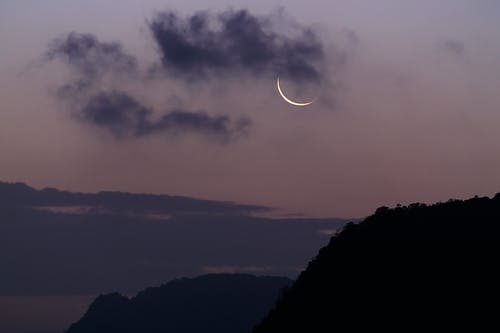
When I see your heavens, the work of your fingers, the moon and stars that you set in plac
e.

What are we that you are mindful of us,
that you care for us?
Yet you have made us little less than angels
crowned us with glory and honor.


You have given us rule over the works of your hands, put all things at our feet:
O LORD, our Lord,
how awesome is your name through all the earth!


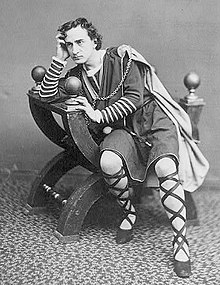
Poetry (well really prose): from Hamlet by William Shakespeare 

Shakespeare uses Psalm 8 as his reference point for Hamlet’s monologue.
Hamlet is saying that although humans may appear to think and act “nobly” they are essentially “dust”. Hamlet is expressing his melancholy to his old friends over the difference between the best that men aspire to be, and how they actually behave; the great divide that depresses him. (Spark Notes)

I offer the passage to say that Hamlet has become disillusioned, lost his awareness of his own awesome identity in God. Don’t be like Hamlet.

Hamlet, played by Edwin Booth – c.1870 (source: wikipedia)
I have of late—but wherefore I know not—lost all my mirth, 
forgone all custom of exercises, 
and indeed it goes so heavily with my disposition 
that this goodly frame, the earth, seems to me a sterile promontory; 
this most excellent canopy, the air—look you, 
this brave o'erhanging firmament, 
this majestical roof fretted with golden fire—
why, it appears no other thing to me 
than a foul and pestilent congregation of vapors. 
What a piece of work is a man! 
How noble in reason, how infinite in faculty! 
In form and moving how express and admirable! 
In action how like an angel, 
in apprehension how like a god! 
The beauty of the world. 
The paragon of animals. 
And yet, to me, what is this quintessence of dust? 
Man delights not me. 
No, nor woman neither, 
though by your smiling you seem to say so.

Music: Domine, Deus Noster (Psalm 8) by Marc-Antoine Charpentier 

Psalm 97: Ordinary?

Monday of the First Week in Ordinary Time

January 11,2021


Today, in God’s Lavish Mercy, we pray with Psalm 97 which reminds us that, as Jesus begins his earthly ministry, he is accompanied by the unseen powers of heaven.

The heavens proclaim his justice,
and all peoples see his glory.
Let all his angels worship him.

Psalm 97: 6-7

The psalm is reflective of the glorious passage from our first reading describing the Divinity of Jesus:

The Son of God is…
the refulgence of God’s glory, 
the very imprint of God’s being,
who sustains all things by his mighty word.
When he had accomplished purification from sins, 
he took his seat at the right hand of the Majesty on high,
as far superior to the angels
as the name he has inherited is more excellent than theirs.

Hebrews 1: 3-4

These seem perfect readings to begin a season described as “Ordinary Time” because they remind us that the power of Jesus Christ is far from ordinary.

And our days do not feel like ordinary times, do they? They are both fraught with threat and charged with hope.

They are times belabored by pandemic struggle, political vitriol, climate dissolution, global strife and systemic oppression.

But they are also times bristling with breakthrough discovery, civic renewal, social consciousness, communal courage and spiritual awakening.


Just as in our Gospel on this first day of “Ordinary Time”, Jesus asks his disciples to “Come”, dream extraordinary dreams with him, so he asks us. 

He asks us to believe
that there are unseen angels attending us.
 
He asks us to remember that we, like him,
are made in the refulgent image of God.


He calls us, like Simon and Andrew, to believe
that our “ordinary time” is actually the “time of fulfillment”:

This is the time of fulfillment.
The Kingdom of God is at hand.
Repent, and believe in the Gospel.

Mark 1:15

Poetry: Maya Angelou – Touched by an Angel

We, unaccustomed to courage,
exiles from delight,
live coiled in shells of loneliness
until love leaves its high holy temple
and comes into our sight
to liberate us into life.

Love arrives
and in its train come ecstasies
old memories of pleasure
ancient histories of pain.
Yet if we are bold,
love strikes away the chains of fear
from our souls.

We are weaned from our timidity
In the flush of love's light
we dare be brave
And suddenly we see
that love costs all we are
and will ever be.
Yet it is only love
which sets us free.

Music: Ordinary Time – Marie Bellet

There will come a day for quiet kitchen mornings
Lunches with the girls, book clubs in the afternoon
There will come a day for chintz flowers on my sofa
Just the perfect lipstick, matching purse and shoes.

There will come a day without constant interruption
Confusing all my senses, my reason and my rhyme
But for now I trip on the backpacks in the hallway
Scrub the crayon from the walls that mark this ordinary time.

There will come a day for uneventful dinners
When no one drops their fork or spills their milk upon the floor
There will come a day, I’ll be wiser, I’ll be thinner
I will finish conversations before running out the door.

Well, isn’t that the way it is for all those happy women
Who smile at me from magazines there in the checkout line?
What about the tired, the simple and forgotten?
Blessed be the ordinary here in ordinary time.

He said “Who will feed my sheep?
Who will heed their cry?”
I said “I am vain and weak
But surely I will try.

You know everything
And You know that I’m
Just an ordinary woman 
here in ordinary time”.

There will come a day when everything is order
And I will be the queen of everything I see
But how my heart will leap to find one backpack in the hallway
With the promise of a face, and a story just for me.

So may I never yearn for those cocktail conversations
Clever observations made for fashionable minds
May I finally learn to be happy and have patience
With the constant changing rhythm of this ordinary time,
The constant changing rhythm of this ordinary time.

Psalm 95: Advent’s Threshold

Saturday of the Thirty-fourth Week in Ordinary Time

November 28, 2020


Today, in God’s Lavish Mercy, we pray with Psalm 95. As we pray its laudatory verses, we are invited to stand on the very threshold of Advent.

Come, let us sing joyfully to the LORD;
let us acclaim the Rock of our salvation.
Let us come into the Lord’s presence with thanksgiving;
let us joyfully sing psalms to our God.


Even though the pre-dawn sky seems essentially unchanged, we can sense the First Light waiting to spring over the horizon. And, oh, how we long for it! How we need it to illuminate the shadows of this pandemic year, to warm the long cold of separation and loss, to fill the stunned silence of our hearts with a new rising song!

For the LORD is a great God,
and a great king above all gods;
God holds the depths of the earth,
and the tops of the mountains
like jewels in a loving hand.
God made and owns the sea
and the dry land, forming them from the Divine Imagination!


We join the whole Church as we pray today’s psalm refrain:

We ask God to prepare Advent’s doors in our hearts and spirits. It is time to be renewed in faith, hope, and love. Over the coming season, God will guide us to that longed-for Light. 

So for this last pre-Advent day:

Come, let us bow down in worship;
let us kneel before the LORD who made us,
who is our God,
and we are the people Love shepherds, 
the flock Love guides.


Poetry: Advent Credo by Allan Boesak

It is not true that creation and the human family are doomed to destruction and loss—
This is true: For God so loved the world that He gave his only begotten Son, that whoever believes in Him shall not perish but have everlasting life;

It is not true that we must accept inhumanity and discrimination, hunger and poverty, death and destruction—
This is true: I have come that they may have life, and that abundantly.

It is not true that violence and hatred should have the last word, and that war and destruction rule forever—
This is true: Unto us a child is born, unto us a Son is given, and the government shall be upon his shoulder, his name shall be called wonderful councilor, mighty God, the Everlasting, the Prince of peace.

It is not true that we are simply victims of the powers of evil who seek to rule the world—
This is true: To me is given authority in heaven and on earth, and lo I am with you, even until the end of the world.

It is not true that we have to wait for those who are specially gifted, who are the prophets of the Church before we can be peacemakers—
This is true: I will pour out my spirit on all flesh and your sons and daughters shall prophesy, your young men shall see visions and your old men shall have dreams.

It is not true that our hopes for liberation of humankind, of justice, of human dignity of peace are not meant for this earth and for this history—
This is true: The hour comes, and it is now, that the true worshipers shall worship God in spirit and in truth.

So let us enter Advent in hope, even hope against hope. Let us see visions of love and peace and justice. Let us affirm with humility, with joy, with faith, with courage: Jesus Christ—the life of the world.

From Walking on Thorns, by Allan Boesak, Eerdmans, 2004.

Music: Threshold – Adam Hurst

Psalm 84: Dwell in God’s Heart

Friday of the Thirty-fourth Week in Ordinary Time

November 27, 2020


Today, in God’s Lavish Mercy, we pray with Psalm 84, a praise and pilgrimage hymn. 

It is a perfect prayer for us if we have any small sense of alienation, loss, or confusion in our own pilgrimage.

And, honestly, who doesn’t!?

Even in the best of times, life can be a twist! And in pandemic times, politically charged times, economically shaky times??? Never a better time to say, “God help us!”


But Psalm 84 orients us. It announces what the journey is really about … the desire to find a resting place in God. Once we realize that, the road slowly straightens with the power of faith.

In Psalm 84, the pilgrim’s heart, hungry for God, sets out on the spiritual journey.

My soul yearns and pines 
for the courts of the LORD.
My heart and my flesh
cry out for the living God.

There can be a deep trust in our journeying heart because “even the sparrow” finds a home in God’s tender care.

Even the sparrow finds a home,
and the swallow a nest
in which she puts her young–
Your altars, O LORD of hosts,
my king and my God!


The secret, though, is constancy.:

  • We pilgrims must stay with the essence of our journey – the deep desire for God.
  • We must listen to scripture’s “directions” about where God dwells – with the poor, humble, and merciful.
  • We must not let the flashy road signs of the “Me Culture” distract us.


“The Narcissism Epidemic,”
by psychologists Jean M. Twenge and W. Keith Campbell
studies the increase of narcissism or “me-ism” in our culture.
Here’s an excerpt:

Although these seem like a random collection of current trends, all are rooted in a single underlying shift in the American psychology: the relentless rise of narcissism in our culture. Not only are there more narcissists than ever, but non-narcissistic people are seduced by the increasing emphasis on material wealth, physical appearance, celebrity worship, and attention seeking. Standards have shifted, sucking otherwise humble people into the vortex of granite countertops, tricked-out MySpace pages, and plastic surgery. A popular dance track repeats the words “money, success, fame, glamour” over and over, declaring that all other values have “either been discredited or destroyed.”


Let’s pray today for “staying power”. We have been given the grace to seek God in our lives. Let’s dwell in that seeking, moving from strength to strength in any twists life tosses in front of us.

Blessed they who dwell in your house!
continually they praise you.
Blessed are we whose strength you are!
They go from strength to strength.


Poetry: The Journey – Tagore

The morning sea of silence broke into ripples of bird songs; 
and the flowers were all merry by the roadside;
and the wealth of gold was scattered through the rift of the clouds
while we busily went on our way and paid no heed.

We sang no glad songs nor played;
we went not to the village for barter;
we spoke not a word nor smiled;
we lingered not on the way.

We quickened our pace more and more as the time sped by.
The sun rose to the mid sky and doves cooed in the shade. 
Withered leaves danced and whirled in the hot air of noon.

The shepherd boy drowsed and dreamed in the shadow of the banyan tree, 
and I laid myself down by the water
and stretched my tired limbs on the grass.

My companions laughed at me in scorn;
they held their heads high and hurried on;
they never looked back nor rested;
they vanished in the distant blue haze.
They crossed many meadows and hills,
and passed through strange, far-away countries.

All honor to you, heroic host of the interminable path!
Mockery and reproach pricked me to rise, 
but found no response in me.

I gave myself up for lost
in the depth of a glad humiliation
—in the shadow of a dim delight.

The repose of the sun-embroidered green gloom 
slowly spread over my heart.
I forgot for what I had traveled,
and I surrendered my mind without struggle 
to the maze of shadows and songs.

At last, when I woke from my slumber and opened my eyes, 
I saw thee standing by me, flooding my sleep with thy smile. 
How I had feared that the path was long and wearisome, 
and the struggle to reach thee was hard!

Music: How Lovely Is Your Dwelling Place – Jesuit Music

Psalm 98: Joy!

Wednesday of the Thirty-fourth Week in Ordinary Time

November 25, 2020


Today, in God’s Lavish Mercy, we pray with Psalm 98. If it sounds familiar as you read it today, no wonder. It looks like Mr.98 might have peeked and copied from Ms. 96 whose verses we read yesterday!🤗

Still, there are some new lovely thoughts to consider this morning as we pray just one month from Christmas. The psalm’s melodic, celebratory tone offers a welcome contrast to the other two rather daunting readings today.

Psalm 98 describes God’s redemption of Israel and the rejoicing that will ensue. It also features many expressions and instruments of music and song. The psalm’s exultant and joyful character inspired Sir Isaac Watts, in 1719, to compose an interpretation we all love: Joy to World. Watts’s poem was set to the music of George Frideric Handel.

Although this glorious song is normally preserved for Christmas, it describes the condition of grace we actually live within every day. Christ already has come into time, already has been born in our hearts.

Our liturgical year is a commemoration and celebration of a salvation already achieved.

So let’s have a bit of early Christmas today. Let’s reach for the full joy of our “Christing” by praying Psalm 98 as Isaac Watts prayed it.

Joy to the World; the Lord is come!
Let earth receive her King!
Let ev'ry heart prepare Him room,
And Heaven and nature sing.

Joy to the earth, the Savior reigns!
Let men their songs employ;
While fields & floods, rocks, hills & plains
Repeat the sounding joy.

No more let sins and sorrows grow,
Nor thorns infest the ground;
He comes to make his blessings flow
Far as the curse is found.

He rules the world with truth and grace,
And makes the nations prove
The glories of His righteousness,
And wonders of His love.

Today is a good day, as we are about to begin our Advent journey this Sunday, to remind ourselves of exactly where that journey takes us – to the humble center of our hearts where, in every moment, God desires to take flesh for the world.


Poetry: Into the Darkest Hour by Madeleine L’Engle

It was a time like this,
War & tumult of war,
a horror in the air.

Hungry yawned the abyss-
and yet there came the star
and the child most wonderfully there.

It was time like this
of fear & lust for power,
license & greed and blight-

and yet the Prince of bliss
came into the darkest hour
in quiet & silent light.

And in a time like this
how celebrate his birth
when all things fall apart?

Ah! Wonderful it is
with no room on the earth
the stable is our heart.

Music: John Rutter – The Falcon – first movement based on Psalm 98

Psalm 96: The Lord’s Triumphant Coming

Memorial of Saint Andrew Dung-Lac, Priest, and Companions, Martyrs

November 24, 2020


Today, in God’s Lavish Mercy, we pray with Psalm 96, a royal psalm praising God as the King of all Creation.

The psalm’s first verses, not included in today’s passage, call us to sing and dance before the King.

Sing to the LORD a new song;
sing to the LORD, all the earth.

Sing to the LORD, bless his name;
proclaim his salvation day after day.

Tell his glory among the nations;
among all peoples, his marvelous deeds.

Psalm 96: 1-3

We might pray this psalm with deep consciousness of our place in Creation, in the divine handiwork of this generous King. We have been given life alongside a panoply of beautiful creatures in order that we might, together, sing God’s song.

We sing in a choir of evening stars and morning sunrises, beside choristers of great redwoods and lofty mountains. We join in the prayerful music of the rainbow of animal and human voices rising to praise God.

A dear friend posted this yesterday. I thought it was delightful.

Let the heavens be glad and the earth rejoice;
let the sea and what fills it resound;
let the plains be joyful and all that is in them!
Then shall all the trees of the forest exult.

Psalm 96: 11-12

As we continue to draw down the curtain on the final days of this liturgical year, the daily readings draw our attention to the end of time – when all God’s created munificence will be finally gathered to the Eternal Presence.

Once, on a retreat with the Wernersville Jesuits, I went to their recreation room and played a 33 1⁄3 rpm record (yes, it was that long ago!). It was Wagner’s triumphant Ride of the Valkyries. You can listen to the music by clicking below.

The music engaged my spirit and no words were needed for my prayer. I imagined a Glorious Light rising over time’s darkness, a rider on the Dawn’s steed. 

I pictured us all coming to that Light in waves of praise, one order of creation after the other, over the hills of time and into a merciful, eternal Brilliance.

Each wave rose out of any darkness, pain, or death that might have  hindered them. They broke on to God’s merciful shore and were embraced in Light.

…. the meanest souls of history first, bowing repentant before God’s forgiveness. Then one wave after another, finally coming to the most innocent, the poor and the humble. These heroes of the Beatitudes marched triumphant, their places beside God already prepared, their faces already redeemed by God’s justice

The Lord comes to rule the earth.
to rule the world with justice 
and the peoples with constancy.

Psalm 96:13

The prayer of imagination can open the heart in a way far beyond words. It does take time to place ourselves in the quiet peace that welcomes such prayer. But I think it is so worth it. Our psalm might be inviting us to that kind of prayer today.


Reflective Reading: Prayer of Imagination for Anna the Prophetess
from Twelve Women of the Chalice – Leddy Hammock and Sue K. Riley

Now, in this moment I close my outer eyes 
and look within with my inner eyes.
I see a vision of wonder,
for I am the daughter of the vision of God,
of the tribe of the blessed ones,
a soul under grace.

I judge not by appearances.
I believe in God’s promises.
I fast from shadows and I live on light.
From my youth, I have served at the temple,
a vessel to a holy purpose.

Prayer is the temple where I dwell
Here I behold the image of the Lord.

I close my eyes and behold that image,
the eyes of the Infinite beholding me
all through the ages,
so tenderly gazing with love and compassion,
enfolding me.

Prayer is the temple where I dwell.
Here, I behold the image of the Lord.

The thoughts held in mind 
are mirrored in kind all around me,
reflecting through all that I see.

Now, I behold with inner vision
the wonders that will be in the fullness of time.
The dreams of all my days and nights
are incensed in the inner sanctum.

My thoughts of truth are flowers on the altar of light.
In the presence of the Holy of Holies,
I keep the high watch.
Gifted with the inner sight,
I see beyond the present.

I am an old, old soul, yet ageless in eternity.
Though outer eyes may seem to dim with time,
the inner eyes are crystal clear.

Though outer vision may seem obscured by time and place,
or clouded by the sorrows and the slavery of sense,
another world’s revealed so clear.
And what I see will be.

My thoughts are giving form,
And held in mind, shall reproduce in kind.
O Lord, I take a long loving look at the real.
I prophesy.

Christ is here.
I have seen the Lord, Thine image, 
and held that image to my own heart.
I am the Spirit of Imagination.
I am Anna, the prophetess, woman of power.

We Shall Behold God

November 22, 2020

Today, in Mercy, we celebrate The Solemnity of Christ the King.

For some, the lofty, politically-tinged title might obscure the rich devotion offered by this feast. The title “king” carries with it suggestions of exaggerated power, wealth and dominance not compatible with our Gospel perception of Jesus.

We may be more comfortable with images of Christ as infant, brother, shepherd, lamb, vine, gate, way, truth, life…

But what all these images point out is that our ability to comprehend the fullness of Christ is severely limited by our humanity. We usually choose a specific image based on our circumstances and spiritual needs.

Pope Pius XI promoted the concept of Christ the King in his 1925 encyclical Quas Primas, in response to growing international secularism and nationalism. His intent was not to compare Christ to the challenged world leaders of the time. It was to raise the perceptions of all people to the lessons of Divine Leadership: mercy, justice, inclusivity, and peace.

Oh, how we could benefit from the same understanding today! 

In this age with its culture of continual war, the human pain it causes, refugee crises, climate devastation, wealth distortion and indifference to the poor, how our hearts long for just, wise and loving leadership!

In his encyclical, Pius XI wrote:

Christ the King reigns “in the human hearts,” both by reason of the keenness of his intellect and the extent of his knowledge, and also because he is very truth, and it is from him that truth must be obediently received by all humanity. He reigns, too, in our wills, for in him the human will was perfectly and entirely obedient to the Holy Will of God, and further by his grace and inspiration he so subjects our free-will as to incite us to the most noble endeavors. He is King of hearts, too, by reason of his “charity which exceedeth all knowledge.”

— Quas primas, §7[4]

Let’s pray for these virtues for all who are charged with any form of power or leadership:

  • keen spiritual intellect
  • deep heart’s knowledge
  • uncompromising truth
  • obedience to grace
  • holy inspiration 
  • noble character
  • and surpassing charity for all Creation

May Christ the King truly live and reign among us. May we behold the “sweet light in His eyes”!

Music: We Shall Behold Him – offered in American Sign Language by Kayla Seymour; sung by Sandi Patty

Psalm 144: My Mercy!

Memorial of the Presentation of the Blessed Virgin Mary

Saturday, November 21, 2020

From 2018 Post:
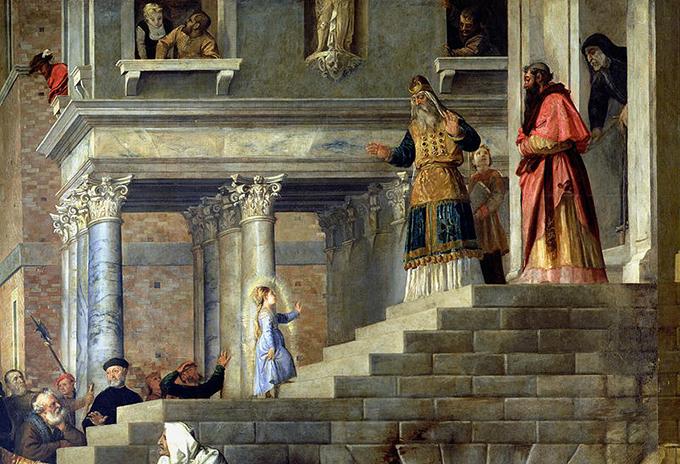
We celebrate the Memorial of the Presentation of the Blessed Virgin Mary.  This feast memorializes a story not present in Scripture. We know of it only from apocryphal writings, those considered of unsubstantiated origin. It tells of Mary’s dedication in the Temple at the age of three. Some versions say she remained there until the age of twelve, thus giving her life fully to God even from youth.

On the day of the Presentation of the Blessed Virgin Mary, “we celebrate that dedication of herself which Mary made to God from her very childhood under the inspiration of the Holy Spirit who filled her with grace … .” (Liturgy of the Hours)


Today, in God’s Lavish Mercy, on Mary’s holy feast, we pray with Psalm 144, a song attributed to David as he thanks God for his war victories.

Blessed be the LORD, my rock,
who trains my hands for battle, my fingers for war.

How strange that the Church would use this psalm to celebrate gentle Mary as we commemorate her Presentation in the Temple. The traditional story, not included in scripture, is that Mary’s grateful parents brought her, at age three, to be dedicated to God.

The Presentation of Mary by Titian

Psalm 144 reminds us, as we pray with Mary today, that life can be filled with daunting challenges. It can even, at times, seem like a war. Pope Francis has described our times as beset by a “culture of death’:

It is difficult both to recognize and to contradict the overwhelming barrage of selfish, materialistic messaging our culture throws at us. It really is an ongoing battle.

But it is a battle we face not with weapons of violence. We stand up, like Mary, by the power of the God in whom we trust.

My mercy and my fortress,
my stronghold, my deliverer,
My shield, in whom I trust,
who rallies strength around me.


We pray with Mary:

  • to discern the path of grace for our lives 
  • to turn our whole lives over to God, 
  • to become a portal for God to enter our world

We pray for the courage to be God’s new song of hope for our times.

O God, I will sing a new song to you;
with a ten stringed lyre I will chant your praise,
You who give victory to your beloved,
and deliver us from the grasp of evil.


Poem: To the Immaculate Virgin, On a Winter Night – Thomas Merton

Lady, the night is falling and the dark
Steals all the blood from the scarred west.
The stars come out and freeze my heart
With drops of untouchable music, frail as ice
And bitter as the new year's cross.

Where in the world has any voice
Prayed to you, Lady, for the peace that's in your power?
In a day of blood and many beatings
I see the governments rise up, behind the steel horizon,
And take their weapons and begin to kill.

Where in the world has any city trusted you?
Out where the soldiers camp the guns begin to thump
And another winter time comes down
To seal our years in ice.
The last train cries out
And runs in terror from this farmer's valley
Where all the little birds are dead.

The roads are white, the fields are mute
There are no voices in the wood
And trees make gallows up against the sharp-eyed stars.
Oh where will Christ be killed again
In the land of these dead men?

Lady, the night has got us by the heart
And the whole world is tumbling down.
Words turn to ice in my dry throat
Praying for a land without prayer,

Walking to you on water all winter
In a year that wants more war.

Music: Blessed Be the Lord, My Rock – by Abbie Betinis sung by St. Pius X Choir, Atlanta, Georgia

Blessed be the Lord, my rock and my fortress, 

  my stronghold, my deliverer, 

  My shield and he in whom I take refuge. 

We are like breath, 

  our days are like a passing shadow. 

Bow thy heav’ns, O Lord, 

  come down! 

Stretch forth thy hand from on high, 

  rescue me, deliver me. 

I will sing a new song to thee, O God. 

– Psalm 144

Psalm 119: Promises, Promises

Friday of the Thirty-third Week in Ordinary Time

November 20, 2020


Today, in God’s Lavish Mercy, we pray once again with our longest Psalm 119. 

This morning, we take one little morsel from its long string of reflections :


The word “promise” can evoke a range of responses from us. Indeed, they are sweet as the psalmist says. But they can also be elusive, ephemeral, and easily broken. I know I’ve have made a few promises in my lifetime that have fizzled away unfulfilled. Haven’t you?

On the other hand, there are some promises, kept, that have rooted and defined my life. These, made in the bud, have blossomed in a long, tendered fidelity. They have dug the deep roots of trust for the essential relationships of my life with God, beloved neighbor, and all Creation.


Such vital promises can be made and kept when we act in the image of God, the loving and faithful Promiser described in Psalm 119:

Your word, LORD, stands forever;
it is firm as the heavens.
Through all generations your truth endures;
fixed to stand firm like the earth.

Psalm 119: 89 – 90

Like the psalmist, we pray:

  • to be imitators of God who is always faithful.
  • to be promise-keepers in response to the trust God has placed in us by the gift of our creation.
  • to meditate on, and understand in our hearts, the divine order of God’s immutable Law of Love

Poetry: Psalm 119 – Christine Robinson

Dear God, The seed of your love is deep within
every molecule of the universe, and it abides through time.
The laws of the cosmos serve your purpose to the end.
If I remember this, I can abide all manner of trouble.
If I delight in this, it gives me life.
I belong to you to my very core.
Holding firm to that knowledge, I can live my life in love.
All things will come to and end.
And in the end all will be One
My mind is filled with your Way
Making me wise like a teacher or an elder.
Mastering my life in your way gives me purpose.
Many times I use it to guide my steps.
My mouth waters and my heart softens to consider your Way.

Music: God Hath Not Promised – Annie Johnson Flint

This charming 19th century hymn captures the faithful spirit of it composer whose life, though beset by suffering, radiated faith and joy.