Psalm 115: Not To Us

Tuesday of the Fourteenth Week in Ordinary Time

July 7, 2020

Today, in God’s Lavish Mercy, we pray with Psalm 115. The first verse, not included in today’s passage, is perhaps the most familiar:

Not to us, LORD, not to us
but to your name give glory
because of your mercy and faithfulness.

This verse sets the tone for the whole psalm by establishing that it is only in humility that we will experience God’s faithful mercy.


The psalm sections offered today show how hard it is to keep humble attention on God in a world full of idols. While the psalmist mocked these idolatrous gods and their worshippers, his descriptions indicate the significant space they occupy in his own imagination.

There are lots of distracting “gods” in our world too. As a matter of fact, it is sometimes difficult to find the real God because our culture cloaks God in its own distorting devices. 

For example, we encounter ideologies which promote a “god” who:

  • loves America more than other nations
  • loves white people more than black and brown people
  • loves war as long as we are the victors
  • loves my prosperity over other people’s justice
  • tolerates, or even blesses, violence for the sake of superiority
  • isolates, stereotypes, and discriminates over who deserves blessings

Some of these idolatries work to convince us that we are more important to God if we are white, rich, male, heterosexual, healthy, armed, not too old, and American – because these deifications paint their “god” with those strokes.

The more we match up with this “god” – the molten image of a greedy, elitist, militaristic culture – the more we tend to take glory to ourselves. And the more others might legitimately question, “Where is their God?”.

This becomes all the more disorienting when influencers who benefit from such misguided idolatry and fundamentalism use them to promote themselves and their personal and political agendas.


Psalm 115 says, “Stop that!”.


Our Gospel shows us what God is really like — Jesus, who:

  • sought out those suffering
  • loved the poor and abandoned
  • was moved with pity for others’ pain
  • taught, proclaimed and healed in the name of God’s Mercy

Living in the light of this merciful God both humbles and exalts us so that we may wholeheartedly proclaim by our lives:

Not to us, LORD, not to us
but to your name give glory

because of your mercy and faithfulness.

Non nobis, Domine, non nobis ; 
sed nomini tuo da gloriam,
super misericordia tua et veritate tua.


Poetry: Non Nobis Domine! – Rudyard Kipling
(Written for “The Pageant of Parliament,” 1934)

NON nobis Domine!—
    Not unto us, O Lord!
The Praise or Glory be
    Of any deed or word;
For in Thy Judgment lies
    To crown or bring to nought
All knowledge or device
    That Man has reached or wrought.
And we confess our blame—
    How all too high we hold
That noise which men call Fame,
    That dross which men call Gold.
For these we undergo
    Our hot and godless days,
But in our hearts we know
    Not unto us the Praise.
O Power by Whom we live—
    Creator, Judge, and Friend,
Upholdingly forgive
    Nor fail us at the end:
But grant us well to see
    In all our piteous ways—
Non nobis Domine!—
    Not unto us the Praise

Music: Non Nobis Domine

Psalm 145: Through the Generations

Monday of the Fourteenth Week in Ordinary Time

July 6, 2020

Today, in God’s Lavish Mercy, we again pray with Psalm 145 – different verses. The great tenderness in today’s other readings is reflected in the choice of these particular psalm lines.

Our first reading is God’s tender love song to Israel spoken through the prophet Hosea. Our Gospel recounts several acts of tenderness as Jesus ministers to the suffering people he meets.


Psalm 145 reminds us that if we look back over our lives, and even farther back over our ancestors’ lives, we too will discover God’s continual love and mercy to us.

Generation after generation praises your works
and proclaims your might.
They speak of the splendor of your glorious majesty
and tell of your wondrous works.


Many ancestral blessings have been passed on to us – in skills, attitudes, physical strengths – but most importantly, in faith. We probably believe because someone before us taught us how.

There is no greater gift we can give to our children, and to all our beloveds, than to encourage their faith. Let’s take that to heart today as we pray. And let’s thank God for our own story and heritage of faith we have been given.


Poetry: Faith is the Pierless Bridge by Emily Dickinson, who appeared as more a dismissive critic of faith than a proponent. Yet, like many of us who bother to talk about a particular topic, she proved it to be more important to her than she professed.

Faith — is the Pierless Bridge
Supporting what We see
Unto the Scene that We do not —
Too slender for the eye
It bears the Soul as bold
As it were rocked in Steel
With Arms of Steel at either side —
It joins — behind the Veil
To what, could We presume
The Bridge would cease to be
To Our far, vacillating Feet
A first Necessity.

Music: In Every Age – Janèt Sullivan Whitaker

Psalm 117: Praise the Lord

Feast of Saint Thomas, Apostle

July 3, 2020

One of my favorite past reflections on faith vs. doubt – for this Feast of Saint Thomas


Today, in God’s Lavish Mercy, we pray with Psalm 117 which is the shortest of all the Psalms. But 117, also called the Laudate Dominum, still packs a huge spiritual punch.

The psalm is called a “doxology” which simply means it is a short prayer of praise, the type we often add at the end of longer prayers. We are very familiar with the following doxology:

Glory be to the Father, and to the Son, and to the Holy Spirit.
As it was in the beginning, is now, and ever shall be
,
world without end. Amen


Psalm 117 follows the same pattern in that it has two complementary parts.

The first invites us to praise God:
Praise the LORD, all you nations;
glorify God, all you peoples!

The second tells us why God deserves our praise:
For steadfast is God’s kindness for us,
and the fidelity of the LORD endures forever.

Notable about Psalm 117 is the fact that this Old Testament invitation to praise goes out “to ALL nations”. Scholars interpret this as pointing to the fulfillment, in Jesus, of God’s promise that Abraham would be the father in faith of many nations. Psalm 117 is a treasured and often repeated prayer throughout the Judea-Christian traditions.


Practicing this pattern of prayer can enrich our personal prayer life as well. I like to pray like this as soon as I wake each morning. Glancing out my window, I might say,

“I praise You in the sunrise, my Beautiful Creator.
Thank you for the gift of my life.”

Beginning the day with our own “doxology” gives us a head start on living joyfully and gratefully in the Presence of God for our next circuit of the sun.


Poetry: Morning Poem – Mary Oliver

Every morning 
the world 
is created. 
Under the orange
sticks of the sun 
the heaped 
ashes of the night 
turn into leaves again
and fasten themselves to the high branches— 
and the ponds appear 
like black cloth 
on which are painted islands
of summer lilies. 
If it is your nature 
to be happy 
you will swim away along the soft trails
for hours, your imagination 
alighting everywhere. 
And if your spirit 
carries within it
the thorn 
that is heavier than lead— 
if it's all you can do 
to keep on trudging—
there is still 
somewhere deep within you 
a beast shouting that the earth 
is exactly what it wanted—
each pond with its blazing lilies 
is a prayer heard and answered 
lavishly, 
every morning,
whether or not 
you have ever dared to be happy, 
whether or not 
you have ever dared to pray

Music: Laudate Dominum – Mozart, sung by Barbara Hendricks

Psalm 19: God’s Perfect Law

Thursday of the Thirteenth Week in Ordinary Time

July 2, 2020


Previous Prayer on Today’s Readings
June 30, 2016: Today, in Mercy, we pray in praise of God’s laws which hold the sun and moon in place, and make night and day turn softly into each other. We pray to love God’s law in our own hearts, respecting life in all its stages and expressions. May we see our own life as a marvelous manifestation of God’s divine balance, and may we so honor its risings and settings.


Today, in God’s Lavish Mercy, we pray with Psalm 19. The entire psalm opens with a familiar hymn to the Beauty of God’s Creation. and closes with a meditation on the beauty of God’s Law. Today’s verses focus on the psalm’s second half, lauding God’s flawless law. 

In both cadence and meaning, Psalm 19 is a song of balance. It dances back and forth between the immutable elegance of God’s Law and the perfection it offers to those who pursue it.

The concept of “law” might not immediately engender spiritual enthusiasm in our hearts. In our modern culture, the word “law” has become removed from the biblical sense of “justice”. 

In modern parlance, “law” is a set proclamations we may or may not agree with. The validity of this “law” depends on the morality of those who make it.

But law and justice in scripture are meant to be reflections of God’s perfection . They are the means to attaining right-balance in our lives, and in all Creation, according the God’s desire for us.

In fact, living a true biblical dimension of law and justice may require us, at times, to live outside a cultural sense of these words.  This happens when we protest “unjust laws” – a phrase whose seeming contradiction shows us just how difficult living justly might be.


How do we stay sharply and accurately aware of those contradictions so that we may discern a life of true Godly justice and right-balance in a culture that has become confused and calloused?

Psalm 19 is a good guide. Trusting its advice, we will find the virtues that lead to joy and peace.

Any “law” which does not lead to these blessings needs to be examined in the light of this beautiful psalm.


Poetry: God’s Grandeur– In Gerard Manley Hopkins’s exquisite poem, we see the magnificence of nature juxtaposed with human fragility.

The world is charged with the grandeur of God.
    It will flame out, like shining from shook foil;
    It gathers to a greatness, like the ooze of oil
Crushed. Why do men then now not reck his rod?
Generations have trod, have trod, have trod;
    And all is seared with trade; bleared, smeared with toil;
    And wears man's smudge and shares man's smell: the soil
Is bare now, nor can foot feel, being shod.


And for all this, nature is never spent;
    There lives the dearest freshness deep down things;
And though the last lights off the black West went
    Oh, morning, at the brown brink eastward, springs —
Because the Holy Ghost over the bent
    World broods with warm breast and with ah! bright wings.

Music: More Precious Than Gold – Acappella


They are more precious than gold 
Sweeter than the honey 
They are more precious than gold 
And the honey comb 

The laws of the Lord are perfect 
Reviving the soul, reviving the soul 
Reviving the soul 

They are more precious than gold 
Sweeter than the honey 
They are more precious than gold 
And the honey comb 

They make wise the simple 
They give joy to the heart 
Light to the eyes 
Enduring forever 
Righteous altogether 
They bring great reward 

The laws of the Lord are perfect 
Reviving the soul, reviving the soul 
Reviving the soul 

May the words of my mouth 
And the meditation of my heart 
Be pleasing in your sight 
O Lord my rock 
My rock and my redeemer 
O Lord, my rock and my redeemer 

The laws of the Lord are perfect 
Reviving the soul, reviving the soul 
Reviving the soul 
They are more precious than gold Sweeter than the honey 
They are more precious than gold 
And the honey comb

Psalm 50: God Doesn’t Do “Fake”

Wednesday of the Thirteenth Week in Ordinary Time

July 1, 2020

I don’t have a past reflection on today’s readings. But here is a good one from Joe Zaborowski at Creighton University.

Today, in God’s Lavish Mercy, we pray with Psalm 50 which is set up like a court proceeding in which God is both prosecutor and judge of the Israelite community.

Hear, my people, and I will speak;
Israel, I will testify against you;
God, your God, am I.

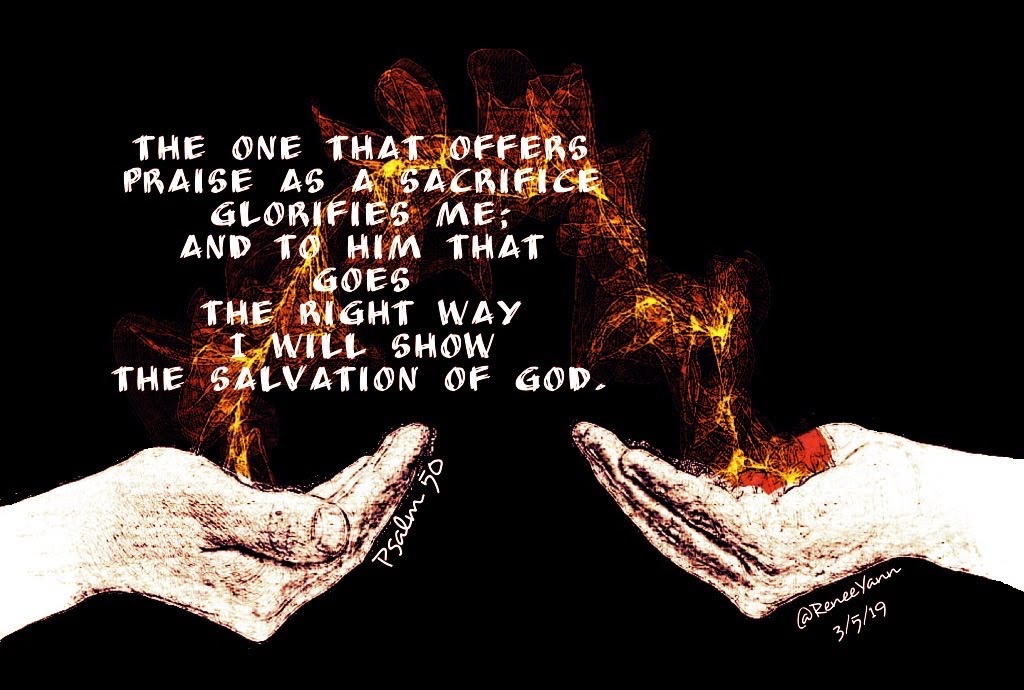
Today’s section, one of two orations, explains God’s dissatisfaction with the display of sacrifices empty of any real commitment to God’s service. In other words, God tells the people that all their fiery and bloody rituals are fake and useless to him.

One might picture the high priests standing dumbfounded at this announcement. 


What! I worked hard on this sacrifice… made sure it was perfect. All the bells and whistles! And You’re still not satisfied??? What do You want from me then?


It reminds me of a married couple. One cooks a beautiful meal for the other but the love between them has faded. As they eat, there is no caring conversation and no joy in each other. They finish perfunctorily in a fog of empty words. They retreat to their separate distractions, waiting to repeat the charade the next day.

In Psalm 50, God says he doesn’t want to be loved like that.
So what does God want then?

Our reading from Amos today offers the thread of an answer which is woven through the rest of Psalm 50:

But if you would offer me burnt offerings,
then let justice surge like water,
and goodness like an unfailing stream.

God wants our sincere love expressed in goodness and actions for justice.

Just like that beautiful dinner, rituals have meaning only as celebrations of faithful and demonstrated love. Sounds like 1 Corinthians 13, doesn’t it?

The parallels to our own lives are obvious and don’t need my elucidation. Let’s just think about how God might answer us if we ask in prayer, “What is it that You really want from me?”.

Poetry: Rabindranath Tagore, from Gitanjali

I am only waiting for Love 
to give myself up at last into his hands.

That is why it is so late 
and why I have been guilty of such omissions.
They come with their laws and their codes to bind me fast; 
but I evade them ever, 

for I am only waiting for Love 
to give myself up at last into his hands.

People blame me and call me heedless; 
I doubt not they are right in their blame.
The market day is over 
and work is all done for the busy. 
Those who came to call me in vain 
have gone back in anger. 

I am only waiting for Love 
to give myself up at last into his hands.

Music: Proof of Your Love – King and Country

Psalm 5: You Are God’s Flute

Tuesday of the Thirteenth Week in Ordinary Time

June 30, 2020

A Brief Prayer on Today’s Gospel from 2016
Today, in Mercy, we pray for all those tossed on a stormy sea, like Christ’s disciples. For all who are alone, in darkness or full of fear. There is no storm through which God cannot come to us. May we always trust that God is taking us to a new grace beyond the storm.


Today, in God’s Lavish Mercy, we pray with Psalm 5, the first one of several to mention “the Name of God” as a theme.  The psalm, a morning prayer to be “accompanied by a flute”, is a mix of lament and exaltation – like many of our own morning prayers, no doubt.

At dawn I bring my plea expectantly before you.
For you, O God, delight not in wickedness;

the evil one does not remain with you;
the arrogant may not stand in your sight.


Now, first off in the morning, we’re probably not going to talk to God about wickedness, evil, and arrogance unless we went to bed pretty upset the night before. The psalmist apparently has “slept on” his troubles without complete resolution.

We had a dear, wise Directress of Postulants who, on many an evening, patiently listened to our various vocational waverings. We were young. Just like the disciples in Matthew’s boat, we really weren’t as sure of our calls as we would like to have been. Sister Inez’s repeated advice soothed a lot of our growing pains, “Just give it to God and get a good night’s sleep. Things will be clearer in the morning.” And they always were.


As the psalmist prays this morning prayer, things clear as well. After a brief diatribe, the prayer realizes:

But I, through the abundance of your mercy,
will enter into your house.
I will bow down toward your holy sanctuary

in awe of your greatness.


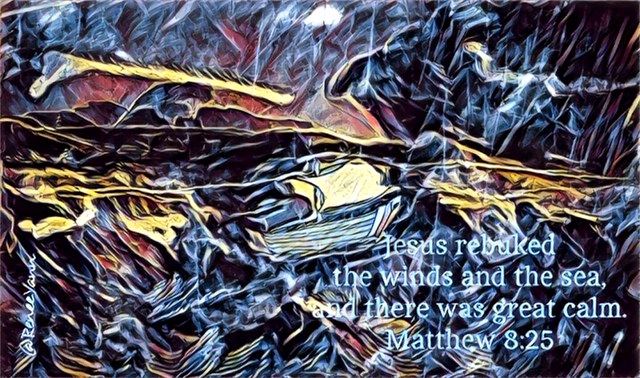
Psalm 5 beautifully complements today’s Gospel. Jesus is in the storm-tossed boat peacefully “sleeping on it”. The disciples, on the other hand, cannot just “give” their terror over to God. When they wake Jesus, terrified, he gently reprimands them, “O ye of little faith”.

Jesus wants them and us, to realizes what the psalmist realizes in verse 12:

All who trust in God will be glad
and forever shout for joy.
God protects them 
and their lives are a melody
to God’s beloved Name


Poetry: A Hole in a Flute ~ Hafiz

I am a hole in a flute
that the Christ's breath moves through; 
listen to this music.

I am the concert 
from the mouth of every creature 
singing with the myriad chorus.

I am a hole in a flute 
that the Christ's breath moves through; 
listen to this music.

Music: The Edge of Night by a group called “Siyotanka” which is actually the Lakota name for this type of flute.

Psalm 34: Praying with Angels

Solemnity of Saints Peter and Paul, Apostles

June 29, 2020

Today, in God’s Lavish Mercy, on this special feast, we pray with Psalm 34.  

David sings. Sheep listens.

This psalm has the most delightful introduction:

Of David, when he feigned madness before the King, who drove him out and he went away.

The Psalm refers to a time when young David was fleeing from Saul who was jealous of David’s impending takeover as king. David seeks harbor with King Achish, but later realizes that was a mistake. Fearing the King, David pretends for be insane in order to be dismissed as harmless.


Serious as the situation is, picturing it makes me smile. Have you ever wanted to get away from someone who had hijacked you into a one-sided conversation? You might pretend you had an appointment, or medical necessity, or anything just to get away.


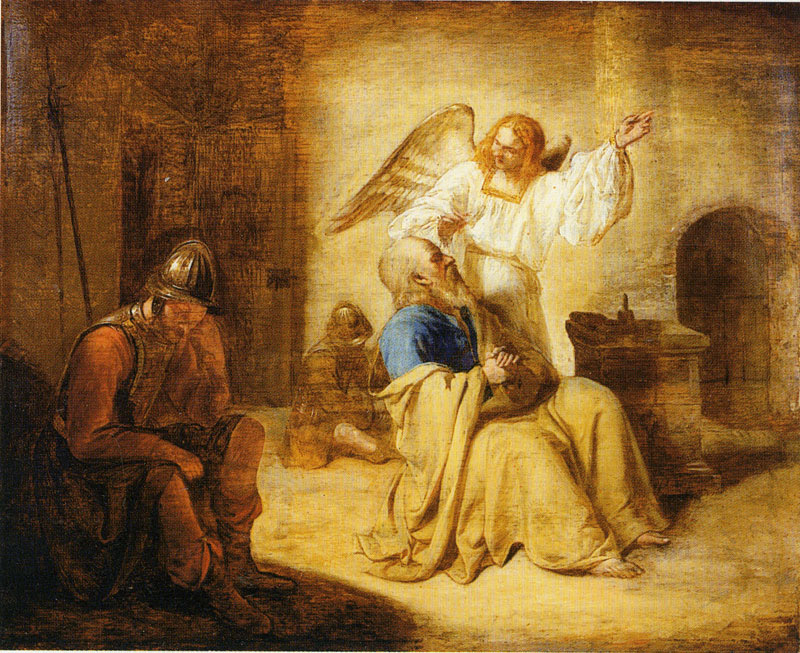
Liberation of Saint Peter from Prison by Pieter de Hooch

Peter, in our first reading, doesn’t need pretense to escape the wrathful imprisonment of King Herod. All he needs is the angel which God has sent him.

Thus, Psalm 34 is a most appropriate choice for the Feast of Sts. Peter and Paul. It is the first psalm in which an angel is mentioned and here, as in Acts, she is a rescuer.

The angel of the LORD encamps
around those who fear the LORD, and delivers them.

Taste and see how good the LORD is;
blessed the one who takes refuge in God.


I’ll be honest, I neglect my angels. I believe in them. I trust them. But basically I forget about them unless I’m scared out of my mind about something. In those situations, I call out loudly to them to make sure their “encampment” around me is still intact!

I think it would be a lot better to get to know our angels, and let them get to know us. Inviting them to accompany us in prayer might be a good way to start. And, of course, remember that prayer so many of our parents taught us. We never grow too “mature” to whisper it at night. Maybe even Peter said something like it in that dark prison long ago.

Angel of God, my guardian dear,
to whom God’s love commits me here,
Ever this night be at my side
to light, to guard, to rule, to guide.
Amen


St. Peter And The Angel
 - Denise Levertov

Delivered out of raw continual pain,
smell of darkness, groans of those others
to whom he was chained--

unchained, and led
past the sleepers,
door after door silently opening--
out!
     And along a long street's
majestic emptiness under the moon:

one hand on the angel's shoulder, one
feeling the air before him,
eyes open but fixed...

And not till he saw the angel had left him,
alone and free to resume
the ecstatic, dangerous, wearisome roads of
what he had still to do,
not till then did he recognize
this was no dream. More frightening
than arrest, than being chained to his warders:
he could hear his own footsteps suddenly.
Had the angel's feet
made any sound? He could not recall.
No one had missed him, no one was in pursuit.
He himself must be
the key, now, to the next door,
the next terrors of freedom and joy. 

Music:  Gloria in Excelcis Deo – J.S. Bach
(I thought one of the angels’ greatest hits, first recorded over the hills of Bethlehem, might be appropriate today)

Psalm 74: Listen to me!

Saturday of the Twelfth Week in Ordinary Time

June 27, 2020

Today, in God’s Lavish Mercy, we pray with Psalm 74 which complements Psalm 79 in the intensity of its lament. It too reflects the devastation of Israel at the destruction of the Temple and, with it, a whole way of life.

Praying these psalms doesn’t make for a light and happy morning! There is no dawning sunrise or birdsong woven through these verses. To tell the truth, I’d be inclined to avoid 47 if I could.

To deepen the umbra, our first reading comes from the Book of Lamentations, five anguished poems of wrenching bereavement.


But what these doleful songs remind me of this morning is that there is profound misery in the world, even if – thank God – I am not experiencing it personally. There are people who need my prayers, my awareness of their suffering, my attention, and my action for their easement. I am reminded that even if I am filled with contentment, these suffering people are irrevocably connected to me.

Psalm 74 reminds me that God needs instruments to heal the misery of the world. I am called – as you are – to be one of them. In small or large ways, in global or very personal efforts, we are the means by which God answers this plea:

Look to your covenant, Lord,
for the hiding places in the land and the plains are full of violence.
May the humble not retire in confusion;
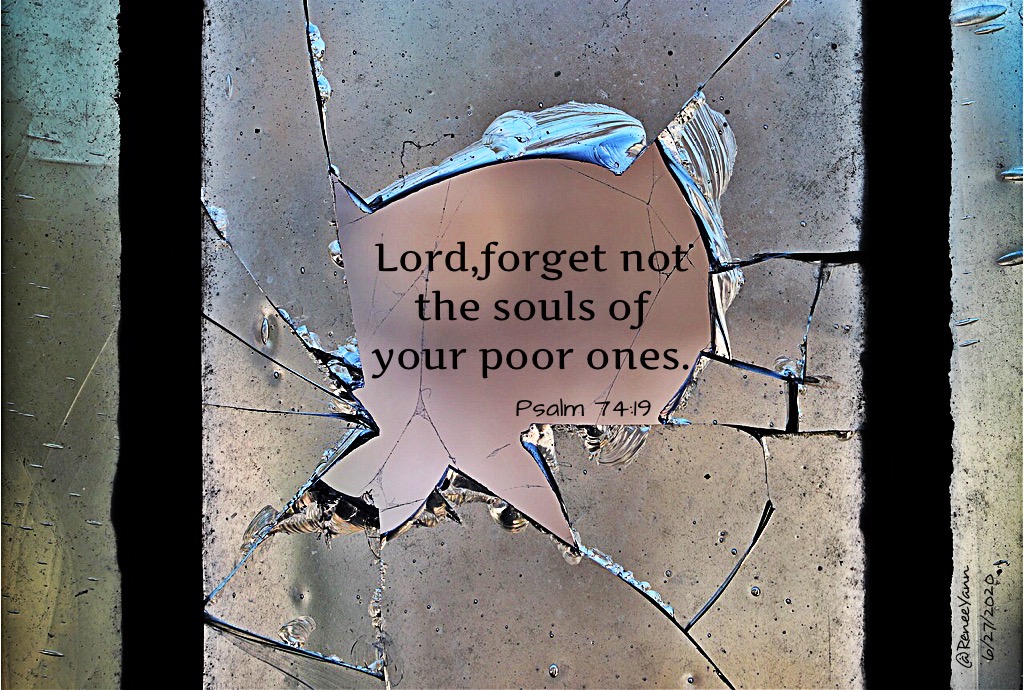
may the afflicted and the poor praise your name.

In this verse, the psalmist asks God to look at his world’s suffering, believing that if God only sees, God will heal.

The psalm calls us to look too…

  • to not be impervious to the pain right before us nor at a distance from us
  • to hear the cry under appearances
  • to become a safe “hiding place” for those fleeing violence in its many forms – from bullying to genocide
  • to be Mercy in the world

Poetry: The poem today is Quaking Conversation by Lenelle Moïse. It looks at the world’s darkness through the tragedy of the earthquake in Haiti. The poem is a modern Psalm 74, asking the reader to “sit down” and listen to its pain.

Quaking Conversation

i want to talk about haiti.
how the earth had to break
the island’s spine to wake
the world up to her screaming.
how this post-earthquake crisis
is not natural
or supernatural.

i want to talk about disasters.
how men make them
with embargoes, exploitation,
stigma, sabotage, scalding
debt and cold shoulders.
talk centuries
of political corruption
so commonplace
it's lukewarm, tap.

talk january 1, 1804
and how it shed life.
talk 1937
and how it bled death.
talk 1964.  1986.  1991.  2004.  2008.
how history is the word
that makes today
uneven, possible.
talk new orleans,
palestine, sri lanka,
the bronx and other points
or connection.
talk resilience and miracles.

how haitian elders sing in time
to their grumbling bellies
and stubborn hearts.
how after weeks under the rubble,
a baby is pulled out,
awake, dehydrated, adorable, telling
stories with old-soul eyes.
how many more are still
buried, breathing, praying and waiting?
intact despite the veil of fear and dust
coating their bruised faces?

i want to talk about our irreversible dead.
the artists, the activists, the spiritual leaders,
the family members, the friends, the merchants
the outcasts, the cons.
all of them, my newest ancestors,
all of them, hovering now,
watching our collective response,
keeping score, making bets.

i want to talk about money.
how one man's recession might be
another man's unachievable reality.
how unfair that is.
how i see a haitian woman’s face
every time i look down at a hot meal,
slip into my bed, take a sip of water,
show mercy to a mirror.
how if my parents had made different
decisions three decades ago,
it could have been my arm
sticking out of a mass grave

i want to talk about gratitude.
i want to talk about compassion.
i want to talk about respect.
how even the desperate deserve it.
how haitians sometimes greet each other
with the two words “honor”
and “respect.”
how we all should follow suit.
try every time you hear the word “victim,”
you think “honor.”
try every time you hear the tag “john doe,”
you shout “respect!”
because my people have names.
because my people have nerve.
because my people are
your people in disguise

i want to talk about haiti.
i always talk about haiti.
my mouth quaking with her love,
complexity, honor and respect.
come sit, come stand, come
cry with me. talk.
there’s much to say.
walk. much more to do.

Musi: God of the Poor – Graham Kendrick

Psalm 79: Song Sung Blue

Thursday of the Twelfth Week in Ordinary Time

June 25, 2020

Today, in God’s Lavish Mercy, we pray with Psalm 79, a Lament Psalm so sorrowful that Brueggemann calls it one of the ”Sad Songs of Zion”.

So what’s going on in Psalm 79? 

Israel is heartbroken. They had thought they were uniquely special to God, that preference being symbolized by their magnificent Temple in Jerusalem. When the Temple was ravaged, as described in today’s first reading from Kings, the community is bereft.

The psalm demonstrates the prayer’s transformation from initial angry sadness to restored faith in God. Israel has allowed its perception of God to become institutionalized in a symbol, a building. But faithful reflection moves them to realize that God is beyond institutionalization. Through their lament, they return their hearts to the true Name of God – “I am Who am”.

Help us, O God our savior,
because of the glory of your name;
Deliver us and pardon our sins
for your name’s sake.


I think we, too, try to domesticate God into bricks and mortar, customs, national symbols, people, rules, and all kinds of other potential idols. When those things crack or crumble, as all things might, we experience a devastation like that found in Psalm 79.

  • Some of us felt that way when the clerical sex abuse scandal was revealed.
  • Some of us felt that way on 9/11, or because of the pandemic
  • Some of us experience this lament when systems we trusted turn corrupt: law enforcement, medicine, religion, government.

Because we can’t see God face-to-face, we often paint that face on representations of power in our lives. That’s what Israel did with the Temple.

When those symbols prove untrustworthy, we might use it as an excuse to stop seeking God’s true and loving Face. Let’s learn from the Psalms how to persist in faith until we finally do see God face-to-face.


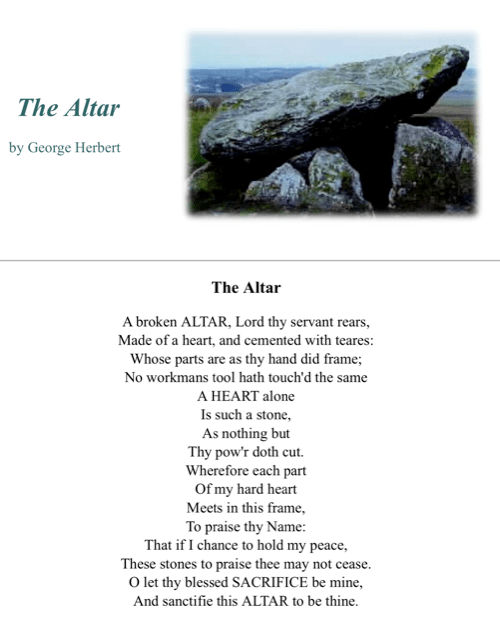
Early 17th century poet George Herbert captures the idea, I think.

Music: Shackles – by the group Mary, Mary – the song is kind of a modern Psalm 79, a movement from lament, through painful experience, to praise. Suggestion: Get up and move with it!

Psalm 139: God of Our Secrets

Solemnity of the Nativity of Saint John the Baptist

June 24; 2020

Psalm 139 (stained glass window by Ted Felen)

Today, in God’s Lavish Mercy, on the great feast of John the Baptist, we pray with Psalm 139, the prayer of awed gratitude.

June 24th is a pivotal date in my life. It became so in 1966 on the day I was first professed as a Sister of Mercy. Our then Mother General, who chose our Profession date, had deep devotion to John, and often spoke to us wide-eyed novices about his holiness.


In one such lecture, she solemnly pronounced the core of his sanctity – how he considered himself in relation to his cousin Jesus:

He must increase and I must decrease. 

Mother Bernard told us that this was the key to the spiritual life: let God grow in you as self recedes.


It was a beautiful lesson but a hard one to swallow. We were a gaggle of 20-somethings fired up to find our adulthoods. We were all about growing – making our statement in the world! 

Learning to discover, rely on, and magnify the hidden omnipresence of God within would – at least for some of us – takes a lifetime, just as it probably should.


Psalm 139 is a prayer that can lead us to God’s powerful secrets in our hearts, ready to be unfolded as the years pass. These treasures include:

  • that we are made of earth and stars and must find vigor in harmony with them
  • that we are woven of both the dances and the dyings of our mothers, fathers, and ancestors – each a mysterious blessing
  • that as we live our lives, it is God living within us
  • that God knows, loves, and redeems everything about us

June 24, 1966 came clothed in noontime sun and trumpet blasts all those years ago – shouting youth, hope, and a good deal of ambition.

The date’s passing iterations have gently mellowed the song God sings to me. Now it goes something like this:


Autumn Colors – Zamfir

Today, the date’s rising carries the sustained melody of a gentle pan flute. Within its breathy music, I cherish the gift of years, how intimately accompanied and tenderly cared for I have been … even from my mother’s womb until now.

May each of us today – in whatever season and sound of the journey – pray with our hidden, ever-present God who cherishes our being.


Called to Become
From Edwina Gateley, There Was No Path So I Trod One (1996, 2013)

You are called to become
A perfect creation.
No one is called to become
Who you are called to be.
It does not matter
How short or tall
Or thick-set or slow
You may be.
It does not matter
Whether you sparkle with life
Or are as silent as a still pool.
Whether you sing your song aloud
Or weep alone in darkness.
It does not matter
Whether you feel loved and admired
Or unloved and alone
For you are called to become
A perfect creation.
No one's shadow
Should cloud your becoming.
No one's light
Should dispel your spark.
For the Lord delights in you.
Jealously looks upon you
And encourages with gentle joy
Every movement of the Spirit
Within you.
Unique and loved you stand.
Beautiful or stunted in your growth
But never without hope and life.
For you are called to become
A perfect creation.
This becoming may be
Gentle or harsh.
Subtle or violent.
But it never ceases.
Never pauses or hesitates.
Only is—
Creative force—
Calling you
Calling you to become
A perfect creation.

Music: If I Take the Wings of Morning – John Rutter