Psalm 128: Blessing

Wednesday of the Twenty-first Week in Ordinary Time

August 26, 2020

Today, in God’s Lavish Mercy, we pray with Psalm 128 which describes what it means to be blessed by God. The psalm has only six verses, and when we read the whole thing, we get a picture of a man with a happy home, he and his family peacefully enjoying the labor of his hands.

The psalmist’s vision is very simple, and it is through that simplicity that blessing comes.

When our lives, our needs, our desires become too complex or cluttered, it is hard for blessing to reach us. We lose our capacity to experience the simple treasures of our lives when we become dulled by excess or the desire for it.

Psalm 128 offers some greats clues on how to deepen our gift of simplicity:

  • Take time to let yourself be awed by God – in nature, in good people, in the wonders of your own life.
  • Imitate that beauty and reverence in your actions.

Blessed are all who fear (are awed) the LORD,
and who walk in God’s ways.


  • Work to build up the gifts of Creation.
  • Let your own labors magnify God’s generosity to all of us

What your hands provide you will enjoy;
you will be blessed and prosper


  • Seek a community who sustain your life, (for some a traditional family, for others a different pattern)
  • Reverence and appreciate them, and encourage new life for that community.

Your wife will be like a fruitful vine
within your home,
Your children like young olive plants
around your table.


Our consumeristic, power-hungry, and materialistic culture can confuse us about what is truly precious – what is truly BLESSING. Psalm 128 is reminding us of the TRUTH. Let’s listen.

In many homes and communities, members bless each other as they retire in the evening. I love to think of “Good night, God bless you” wrapping around the earth as it turns toward the western stars. 

Tonight, as we offer that accustomed benediction, let’s be very conscious of the the graceful simplicity we wish for our beloveds. And let us stretch to wish that blessing out over the whole world as we ourselves hope for peaceful rest.


Poetry: blessings the boats by Lucille Clifton

(at St. Mary’s)


may the tide
that is entering even now
the lip of our understanding
carry you out
beyond the face of fear
may you kiss
the wind then turn from it
certain that it will
love your back        may you
open your eyes to water
water waving forever
and may you in your innocence
sail through this to that

Music: Sabbath Prayer from Fiddler on the Roof

May the Lord protect and defend you.
May He always shield you from shame.
May you come to be
In Israel a shining name.
May you be like Ruth and like Esther.
May you be deserving of praise.
Strengthen them, Oh Lord,
And keep them from the strangers’ ways.
May God bless you and grant you long lives.
(May the Lord fulfill our Sabbath prayer for you.)
May God make you good mothers and wives.
(May He send you husbands who will care for you.)
May the Lord protect and defend you.
May the Lord preserve you from pain.
Favor them, Oh Lord, with happiness and peace.
Oh, hear our Sabbath prayer.
Psalm 145: Praise Under the Figs

Feast of Saint Bartholomew, Apostle

August 24, 2020


Today, in God’s Lavish Mercy, on this Feast of St. Bartholomew, we pray with Psalm 145. And what a perfect choice!

Your friends make known, O Lord, 
the glorious splendor of your Kingdom.

As our Gospel today indicates, many believe that Bartholomew is the same person as Nathaniel – in fact Nathaniel bar Talmai, (Talmai meaning “farmer”, or “son of the furrows”).

Praying with Psalm 145, I picture Nathaniel leaning back into his ancient fig tree, his fingers burrowing into the fertile earth around him. What might have been his deep thoughts as he dissolved into the fig tree’s generous shade?

Knowing Psalm 145 by heart, perhaps Nathaniel prayed it in his own very personal words:

Make me your loyal friend, O Lord.
I see your glory in all Creation.
Let me help others see that glory,
see themselves as a precious part of You.

Maybe Nathaniel had retreated to that tree because the noise around him didn’t hold an answer to his longing. He needed silence to remember that God will always find a way to bring our holy desires to fruition – just like the nearly sweet, unripe figs dancing just over Nathaniel’s pondering head:

The LORD is just in all his ways
and holy in all his works.
The LORD is near to all who call upon him,
to all who call upon him in truth.

Psalm 145:17

Nathaniel found his truth, his answer that day. It walked right up to him in the form of his buddy Philip:

Philip found Nathanael and told him,
“We have found the one about whom Moses wrote in the law,
and also the prophets, Jesus son of Joseph, from Nazareth.”

John 1:45

Nathaniel, perhaps his head and belly still full of figs, takes a little while to get the full picture. But when he does, he gets it completely, unreservedly, and forever:

Rabbi, you are the Son of God;
you are the King of Israel….

John1:49

You are the One we pray for in our psalms. 
You are the One we have waited for.


The beautiful thing for Nathaniel is that Jesus was waiting for him too.

Before Philip called you, I saw you under the fig tree.

John 1:48

We’re all under some kind of shadow at times, longing to hear the invitation of God. The story of Nathaniel assures us that the call will come through our hopeful prayer and deep desire for God’s glory.

Let all your works give you thanks, O LORD,
and let your faithful ones bless you.
Let them discourse of the glory of your Kingdom
and speak of your might.


Poetry:  Joy and Peace in Believing by William Cowper, an English poet and hymnodist. One of the most popular poets of his time, Cowper changed the direction of 18th century nature poetry by writing of everyday life and scenes of the English countryside.

Sometimes a light surprises
The Christian while he sings;
It is the Lord who rises
With healing on His wings;
When comforts are declining,
He grants the soul again
A season of clear shining,
To cheer it after rain.

In holy contemplation
We sweetly then pursue
The theme of God's salvation,
And find it ever new;
Set free from present sorrow,
We cheerfully can say,
E'en let the unknown to-morrow
Bring with it what it may!

It can bring with it nothing,
But He will bear us through;
Who gives the lilies clothing,
Will clothe His people too;
Beneath the spreading heavens
No creature but is fed;
And He who feeds the ravens
Will give His children bread.
Though vine nor fig tree neither
Their wonted fruit shall bear,

Though all the field should wither,
Nor flocks nor herds be there:
Yet God the same abiding,
His praise shall tune my voice;
For, while in Him confiding,
I cannot but rejoice.

Music: Yet Will I Praise Thee – Kent Henry

Psalm 138: Sing with the Angels

Twenty-first Sunday in Ordinary Time

August 23, 2020

From 21st Sunday – 2017:
Today, in Mercy, we pray with the second reading, one of the magnificent Pauline hymns. The words wrap us in awed and humble worship of the mysterious majesty of God revealed to us in Christ. May we find it today in our own worship and prayer. To God be glory forever.
( An extra: Yes, a Christmas song again … but so beautiful an interpretation of our second reading.)

Today, in God’s Lavish Mercy, we pray with Psalm 138, a hymn of thanksgiving and hope.  

As usual with the Sunday readings, a common cord ties the passages together. The obvious one today is how God entrusts power to us for the establishment of God’s milieu in Creation.

Psalm 138 carries, as well, a more subtle but infinitely important thread: the heart of that power is always Divine Kindness – Mercy.  This fact is what generates our deep gratitude.

I will give thanks to your name,
because of your kindness and your truth:
When I called, you answered me;
you built up strength within me.


So power, to be like God’s Power, must always be exercised in kindness. What would the world be like if only that were true! What would our own daily lives be like?

Every one of us has tremendous power whether we realize it or not. Sometimes it is physical or positional power. But more often, it is the power of:
our words or our silence
our acknowledgment or indifference
our presence or absence
our support or our resistance.


We choose how to use our power –
either for or against,
either with or over others.


Psalm 138 tells us how God chooses to use power.

LORD, you are exalted, yet the lowly you see,
and the proud you know from afar.
Your kindness, O LORD, endures forever;
forsake not the work of your hands.

Our exalted and powerful God is kind, merciful. God loves the humble and lowly, but keeps distance from the proud, from those who lord it over others. This is the infinite wisdom and power of God and the mysteriously sacred way by which we are redeemed.

Psalm 138, just as our reading from Romans, is a song of amazed joy for God’s unsearchable wisdom and mercy.


Poem: Kindness – Naomi Shihab Nye


Before you know what kindness really is
you must lose things,
feel the future dissolve in a moment
like salt in a weakened broth.
What you held in your hand,
what you counted and carefully saved,
all this must go so you know
how desolate the landscape can be
between the regions of kindness.
How you ride and ride
thinking the bus will never stop,
the passengers eating maize and chicken
will stare out the window forever.


Before you learn the tender gravity of kindness
you must travel where the Indian in a white poncho
lies dead by the side of the road.
You must see how this could be you,
how he too was someone
who journeyed through the night with plans
and the simple breath that kept him alive.


Before you know kindness as the deepest thing inside,
you must know sorrow as the other deepest thing.
You must wake up with sorrow.
You must speak to it till your voice
catches the thread of all sorrows
and you see the size of the cloth.


Then it is only kindness that makes sense anymore,
only kindness that ties your shoes
and sends you out into the day to gaze at bread,
only kindness that raises its head
from the crowd of the world to say
It is I you have been looking for,
and then goes with you everywhere
like a shadow or a friend.

Music: The Fragrance of Christ – sung by Alma de Rojas

Refrain: Lord, may our prayer rise like incense in your sight.
May this place be filled with the fragrance of Christ.

1. I will thank you, Lord, with all of my heart.
You have heard the words of my mouth.
In the presence of the angels, I will bless you.
I will adore before your holy temple.

2. I will thank you, Lord, for your faithfulness and love,
beyond all my hopes and dreams.
On the day that I called, you answered; you gave life to the strength of my soul.

3. All who live on earth shall give you thanks
when they hear the words of your voice, and all shall sing of your ways:
“How great is the glory of God!”

Psalm 85: Listen!

Memorial of the Queenship of the Blessed Virgin Mary

August 22, 2020

by Bartolome Murillo

Indeed, Mary herself was a song of hope to God, sung for us and for all generations. That passionate song opened her heart to receive the Word and to carry its redeeming power to each of us.

She was the greatest prophet of all time who not only proclaimed God but enfleshed him.

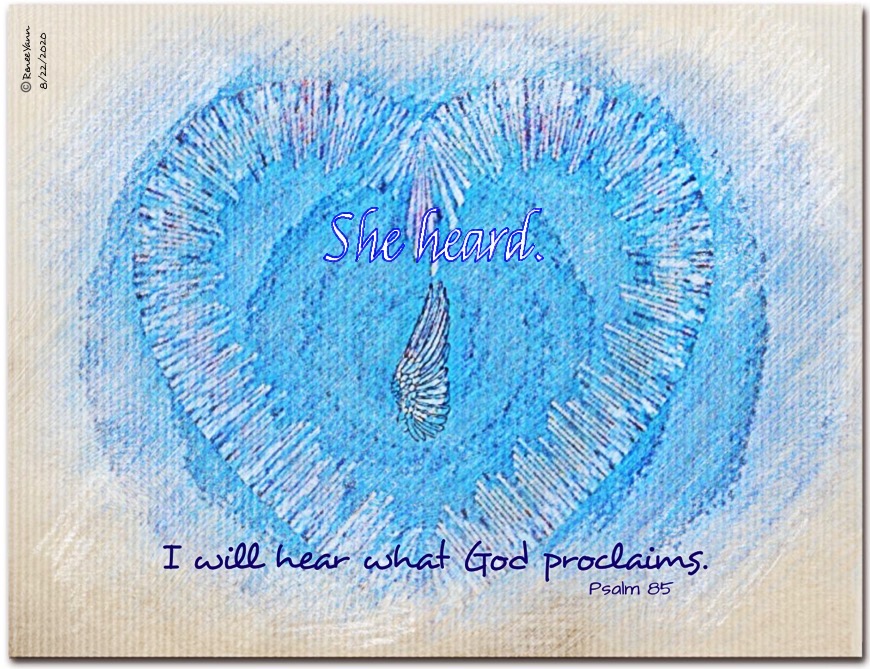
I will hear what God proclaims;
the LORD– Who proclaims peace.
Near indeed is salvation to those who fear God,
glory dwelling in our land.

As we pray to Mary today, let us ask for listening hearts and hope-filled spirits. Let us ask to enflesh love and hope in our lives in imitation of her. Let us ask to believe as she did:

The LORD himself will give his benefits;
our land shall yield its increase.
Justice shall walk before him, 
and salvation, along the way of his steps.


Poetry: Annunciation – Denise Levertov


Annunciation
_________________________________________
‘Hail, space for the uncontained God’
From the Agathistos Hymn, Greece, 6th century
_________________________________________
We know the scene: the room, variously furnished, 
almost always a lectern, a book; always
the tall lily.
       Arrived on solemn grandeur of great wings,
the angelic ambassador, standing or hovering,
whom she acknowledges, a guest.

But we are told of meek obedience. No one mentions
courage.
       The engendering Spirit
did not enter her without consent.
         God waited.

She was free
to accept or to refuse, choice
integral to humanness.
                 ____________________
Aren’t there annunciations
of one sort or another
in most lives?

         Some unwillingly
undertake great destinies,
enact them in sullen pride,
uncomprehending.
More often
those moments
      when roads of light and storm
      open from darkness in a man or woman,
are turned away from

in dread, in a wave of weakness, in despair
and with relief.
Ordinary lives continue.
                                 God does not smite them.
But the gates close, the pathway vanishes.
                  ____________________

She had been a child who played, ate, slept
like any other child–but unlike others,
wept only for pity, laughed
in joy not triumph.
Compassion and intelligence
fused in her, indivisible.

Called to a destiny more momentous
than any in all of Time,
she did not quail,
  only asked
a simple, ‘How can this be?’
and gravely, courteously,
took to heart the angel’s reply,
the astounding ministry she was offered:

to bear in her womb
Infinite weight and lightness; to carry
in hidden, finite inwardness,
nine months of Eternity; to contain
in slender vase of being,
the sum of power–
in narrow flesh,
the sum of light 

                     Then bring to birth,
push out into air, a Man-child
needing, like any other,
milk and love–

but who was God.

This was the moment no one speaks of,
when she could still refuse.

A breath unbreathed,
                                Spirit,
                                          suspended,
                                                            waiting.
                  ____________________

She did not cry, ‘I cannot. I am not worthy,’
Nor, ‘I have not the strength.’
She did not submit with gritted teeth,
                                                       raging, coerced.
Bravest of all humans,
                                  consent illumined her.
The room filled with its light,
the lily glowed in it,
                               and the iridescent wings.
Consent,
              courage unparalleled,
opened her utterly.

Music: Tota Pulchra Es, Maria

Psalm 107: Lost Then Found

Memorial of Saint Pius X, Pope

August 21, 2020

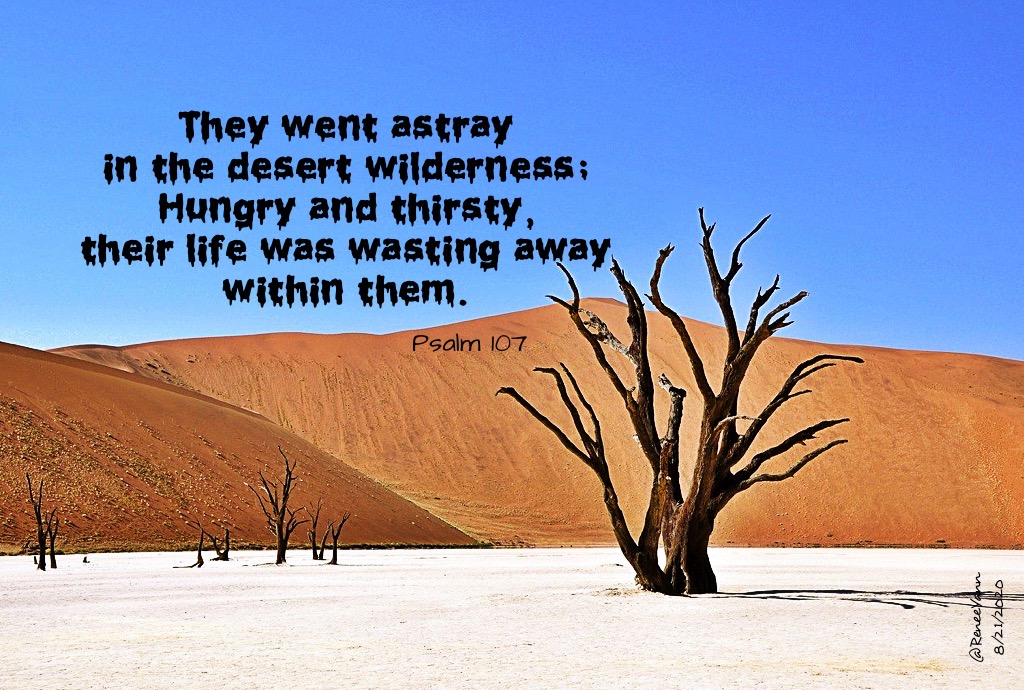
Today, in God’s Lavish Mercy, we pray with Psalm 107, a chant of gratitude to God’s Mercy from the lost who have been found.

There are all kinds of “lost”. 

There are small “losts” like when I misinterpret my GPS and keep hearing “Recalculating route…”. 

Then there are huge “losts” like when a beloved dies and our life’s anchor breaks.

This morning’s psalm and reading are speaking of a particular kind of “lost”, one that comes from wandering away from Love, for whatever reason that happens to us.


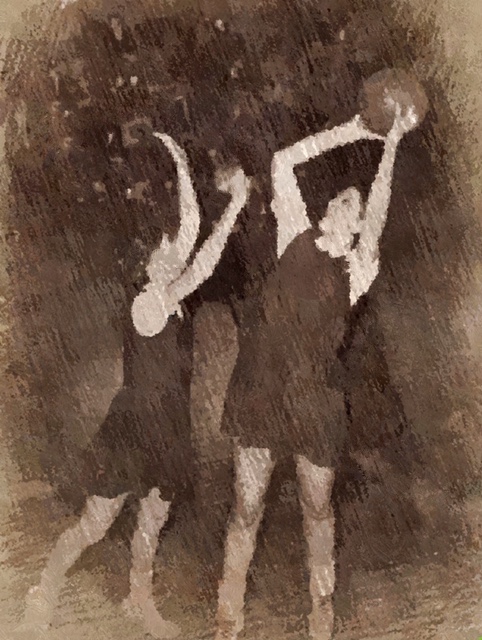
As I pray these readings, the face of a good high school friend comes to mind. Judy was a super basketball player. Everything about her was vigor, coordination, and that all-American beauty that needed no makeup to impress anybody.

After graduation, I went into the silence of the pre-Vatican II convent and Judy disappeared into her future. When our five-year reunion rolled around, I looked forward to reconnecting with her.

When I saw her, my heart broke. She was a shadow of herself, emaciated, listless, and lightless. She silently shouted a refrain like today’s verse from Ezekiel:

Our bones are dried up,
our hope is lost, and we are cut off.

We were both twenty-three years old. I was just beginning to grow into my hopes. Judy was already divorced, alone, and the mother of a father-starved child.

That kind of “lost” feels almost irredeemable. 


But Psalm 107 assures us that, in faith, no loss, no alienation is irredeemable.

They cried to the LORD in their distress;
from their straits God rescued them.
And led them by a direct way
to the healing of community.


Judy and I stayed in touch for a few years. Despite her troubles, she kept faith. That was the key.

She did the hard work to find herself again with the help of family, friends, counselors, and a supportive faith community. Eventually, she remarried and was happy the last time I saw her before she moved to the west coast.


This morning, I see such apparent parallels between Israel’s and Judy’s story. That helps me look back over my own life for the same, perhaps not so dramatic, parallels and to be grateful for the many times God found me.

Let them give thanks for God’s Mercy
and wondrous deeds to us,
Because God has satisfied the longing soul
and filled the hungry heart with good things.


Photo by Markus Spiske on Pexels.com

Poetry: Lost – Carl Sandburg

Desolate and lone 
All night long on the lake 
Where fog trails and mist creeps, 
The whistle of a boat 
Calls and cries unendingly, 
Like some lost child 
In tears and trouble 
Hunting the harbor’s breast 
And the harbor’s eyes. 


Music: Amazing Grace – Sean Clive

Psalm 51: Begin Again

Memorial of Saint Bernard, Abbot and Doctor of the Church

August 20, 2020

Today, in God’s Lavish Mercy, we pray with Psalm 51 in which God promises refreshment to our parched and hardened hearts.


Let’s talk about “parched”. Early in the pandemic, a dear friend gifted us with a vigorous basil plant. A practical culinary addition to our meager garden, it really was so much more. It became a symbol of hope over these pandemic days that can be cloudy in more than meteorological terms!

I have taken good care of the plant. But last week! I got distracted by something., something so important I have forgotten what it was! In my distraction, my little basil became parched.


Our souls become parched too, often because we let ourselves become distracted from their care. Like beautiful plants, our spirits have to be tended daily, nurtured with prayer, silence, gratitude and charity.

Psalm 51 reminds me that God is patient with our “distractions”. God will refresh and renew even the most neglected garden.

Give me back the joy of your salvation,
and a willing spirit sustain in me.


Our first reading from Ezekiel offers a further encouragement that anything gnarled or hardened in our hearts can be resurrected by God’s Mercy.

I will sprinkle clean water upon you
to cleanse you from all your impurities,
and from all your idols I will cleanse you.
I will give you a new heart and place a new spirit within you,
taking from your bodies your stony hearts


Poetry: Houseplants in Winter by Eamon Grennan

Their survival seems an open question:
I make a mess of watering, prune
without discretion, grieve over the leaf
whose borders burn and curl. Their
fresh petals a perpetual surprise – 
minute coral hearts, magnesium stars. 

I've lined them up on the table
I work and eat at, facing the small window
that faces almost south, placing myself
under the pale sway of their silence.
They play their deaths and resurrections out
in our cramped common quarters.

I gave the rose-geranium too much water:
its roots grew bog-black, sodden, and
nothing could keep its sweetness
in our lives. The jade, for all its
early promise and parakeet-green shoots,
won't root: it bows its leathery heads. 

The rest seem busy getting by. Removed
to the margins of our noisy mealtimes
when my children visit, they grow used
to the smell of bread frying in goosefat
for breakfast, small talk, the after-
dinner pungency of a peeled tangerine.

The speechless life they lead is Greek
to me: when live flowers rise
out of dead heads, I reckon it's as much,
for the moment, as I need to know.
The light that falls on them
strikes me too, till I feel as rooted

as I'll ever be in this home
from home. Look at us, they seem to say,
flourishing under straitened circumstances:
you see we make do with your handfuls
of earth, your cups of water, these daily
visitations of winter light that cast our
impeccable shadows on your razed page.

Music: Psalm 51 – Shuv Creative
from their website: This worship video sung in Biblical Hebrew directly from the Scriptures is a powerful tool to open the heart for repentance.

Psalm 23: Ahh!

Wednesday of the Twentieth Week in Ordinary Time

August 19, 2020


Today, in God’s Lavish Mercy, we pray with the iconic Psalm 23, the Good Shepherd. Let’s savor it today as we nestle into God’s merciful embrace.

(I liked praying with this transliteration by Christine Robinson.)

I am a child of God
I have everything I need.
This beautiful earth feeds my body.
You feed my soul.
You guide me in the ways of Life,
for You are Life.
And though I will walk through dark places, 
and eventually to death,
I need never be afraid.
For You are with me always,
   In You I can find comfort.
With Your help, I can face whatever comes.
   My joy overflows.
Your goodness and blessing will be with me
   Every day of my life -- and forever.

Poetry: Let Your God Love You – Edwina Gateley

Be silent.
Be still.
Alone.
Empty
Before your God.
Say nothing.
Ask nothing.
Be silent.
Be still.
Let your God look upon you.
That is all.
God knows.
God understands.
God loves you
With an enormous love,
And only wants
To look upon you
With that love.
Quiet.
Still.
Be.
Let your God—
Love you.

Music: Shepherd Me, O God – Marty Haugen

Hot Potato Psalm

Tuesday of the Twentieth Week in Ordinary Time

August 18, 2020


Today, in God’s Lavish Mercy, we pray with a little more Deuteronomy. Coupled once again with Ezekiel’s excoriations and with the Gospel warnings, today’s Responsorial Psalm is a hot potato!

To tell you the truth, I’ve pretty much had enough of it, but I trust there’s a treasure buried in its hard words.

You will come to appreciate the full force & magnetic beauty of Deuteronomy only as you read its pages….Nothing in literature matches the majesty of its eloquence. Nothing in the Old Testament has any more powerful appeal for the spiritual life. No book in all the Word of God pictures better the life that is lived according to God’s will & the blessings showered upon the soul who comes into the richness & fullness of spiritual living along the rugged pathway of simple obedience…If you want a taste of heaven on earth, become familiar with Deuteronomy.

Henrietta Mears in her book “What the Bible Is All About” (over 3 million copies sold)

Taken together, today’s passages remind me that it is so easy to get full of ourselves and our comforts, ultimately forgetting our dependence on God.

Ezekiel gives this divine judgement to the people:

By your wisdom and your intelligence
you have made riches for yourself;
You have put gold and silver
into your treasuries.
By your great wisdom applied to your trading
you have heaped up your riches;
your heart has grown haughty from your riches–
therefore thus says the Lord GOD:
Because you have thought yourself
to have the mind of a god,
Therefore I will bring against you
foreigners, the most barbarous of nations.


Deuteronomy 32 warns us:

You were unmindful of the Rock that begot you,
you forgot the God who gave you birth.
The LORD saw and was filled with loathing,
provoked by his sons and daughters.


And in our Gospel, Jesus gives us that classic zing which makes all of us wonder if we’re sleek enough to be saved:

Again I say to you,
it is easier for a camel to pass through the eye of a needle
than for one who is rich to enter the Kingdom of God


I don’t think we need a road map to find the message in these readings. God wants to be our one, true God. The love of wealth, power, and self obscures that Truth. It can even fool us into thinking that we are like gods in control of our lives.

The corrective, as our Alleluia Verse indicates, is to imitate Jesus:

Jesus Christ became poor although he was rich
So that by his poverty you might become rich as he is.


Poetry: Salvation by Stephen Dunn

Finally, I gave up on obeisance,
and refused to welcome
either retribution or the tease
of sunny days. As for the can’t-be-
seen, the sum-of-all-details,
the One—oh, when it came
to salvation I was only sure
I needed to be spared
someone else’s version of it.
The small prayers I devised
had in them the hard sounds
of split and frost.
I wanted them to speak
as if it made sense to speak
to what isn’t there
in the beaconless dark.
I wanted them to startle
by how little they asked.

Music: My Own Little World – Matthew West

Moses’ Psalm: Light and Dark

Monday of the Twentieth Week in Ordinary Time

August 17, 2020

Today, in God’s Lavish Mercy, we pray once again with Deuteronomy 32, the Psalm of Moses. Today’s verses describe an angry God who decides to take vengeance a faithless people. 

To pray with these verses is not easy. Taken in isolation, they paint a God who contradicts our larger experience of mercy and tenderness. But the Psalm, like the jarring first reading from Ezekiel, has a lesson for us.

Ezekiel from Biblical Images by James Padgett

In that reading, Ezekiel suffers the sudden death of his beloved wife. The experience opens his prophetic spirit to more fully understand God’s relationship with Israel. He allows his life to be a witness for the people that God expects their repentance and faithfulness.

Like many Old Testament readings, these portray God by way of human analogy because that is the only context we have available to us. Therefore, the temptation when reading these passages might be to think of God solely in human terms playing tit-for-tat with us when we stray from the Law. But God is infinitely greater than any capacity we, or the scripture writers, have to describe Divinity.


The narrative provided by this prophetic book is not one of comfort; its merciless accusations and its violent imagery do not make it an easy scroll to swallow (Ezek 2:8–3:3). While much of Ezekiel’s language, imagery, and reasoning will appear foreign to modern readers, his narrative would have been clearly intelligible to his contemporaries—even though presumably it would have been hard to accept. The exile, according to this narrative, is both inevitable and deserved; it is portrayed as God’s judgement for the constant and complete failure of God’s people.

At the same time, it is not God’s last word. While resisting both optimism and despair, Ezekiel offers a narrative that sheds light on his present and arrives at an original, if peculiar, imagination of hope, founded solely on theological conviction.

Janina M. Hiebel – Hope in Exile: In Conversation with Ezekiel

So then, what might we take from today’s dark readings? For me, it is this:

God is always Light.
It is we who get caught in darkness.


God does speak to us in our circumstances, as God did to Ezekiel and Moses. By faithful prayer and sincere desire, we can deepen in our love and understanding of God through every experience of our lives, even the painful ones. When we live with that kind of faith and hope, our lives witness to God’s fidelity and love.


Poetry: two offerings today

Motto – Bertold Brecht

In the dark times 
Will there also be singing? 
Yes, there will also be singing.
About the dark times.

Light – Alice Jones

The morning when I first notice
the leaves starting to color,
early orange, and back-lit,
I think how rapture doesn't
vanish, merely fades into
the background, waits for those
moment between moments.

I think this and the door pens,
the street takes on its glistening
look, Bay fog lifting, patches of sun
on sycamore -- yellow sea.
I am in again, and swimming.

Music: Lavender Shadows – Michael Hoppé

Psalm 67: Bless Us All!

Twentieth Sunday in Ordinary Time
August 16, 2020

Today, in Mercy, we read the story of the Canaanite woman whom Jesus first meets with a sarcastic banter. The banter however serves to expose some of the alienating prejudices of Jesus’s time which he then dissolves in a sweeping act of mercy and inclusion. His actions signify a new culture of divine justice offered to all people. The reading challenges us to confront our own prejudices and any limitations we place on who belongs to the Kingdom of God.

from this Sunday’s Reflection – 2017

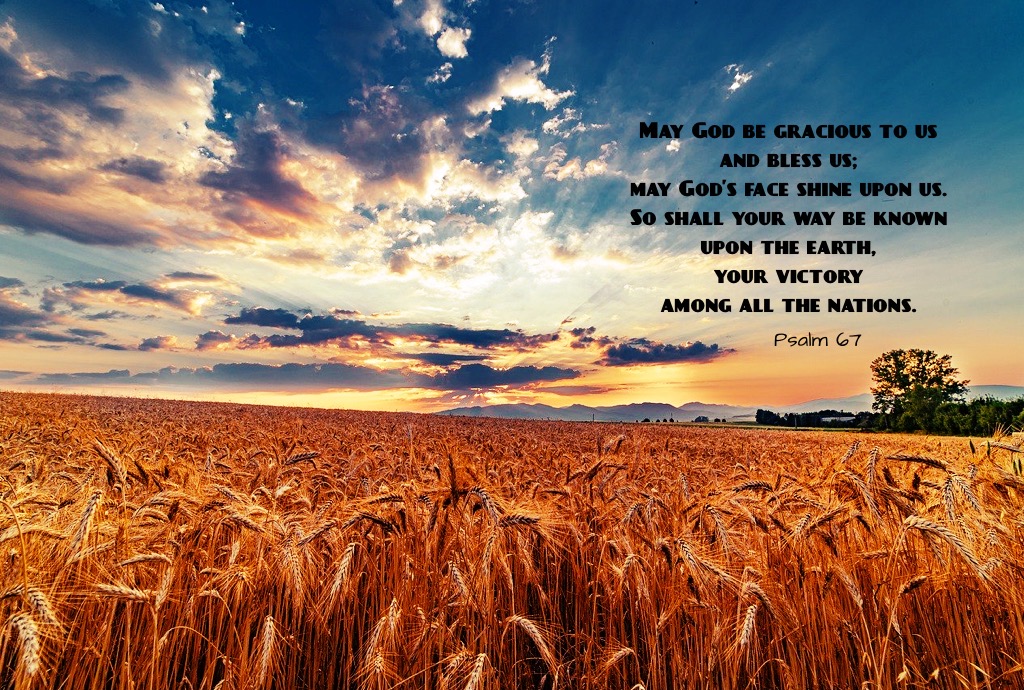
Today, in God’s Lavish Mercy, we pray with Psalm 67, a call to God for universal blessing on all Creation. Written to invoke a benediction on the land’s harvest, the Psalm blossoms into a generous prayer for the whole world to bask in God’s abundance.

May the nations be glad and rejoice;
for you judge the peoples with fairness,
you guide the nations upon the earth.

What if we prayed like that for all our brothers and sisters worldwide! What if we acted toward them with a justice that would make their abundance possible as well as our own! This is the Gospel mandate Jesus entrusted to us.

Psalm 67 shows the maturing of a nation from its own legitimate self-interests into its responsibility within all Creation.


In the USA, as our pre-election political awareness heightens, let’s learn from Psalm 67. Let’s broadly educate ourselves to the fundamental moral issues underlying various partisan platforms. 

For a religious person, voting is hard. There are profound moral issues on all sides of the question. A single issue approach does not work. An adamant stance on a single issue is the easy but inadequate approach. 


Even Jesus, in today’s Gospel, can be moved to a new way of thinking. The outcast Canaanite woman prevails on Jesus to broaden his kingdom. He opens his heart to another way of bringing mercy to all those longing for it.


Voting is a moral act. How we choose demonstrates the God we believe in.


May the peoples praise you, God;
may ALL the peoples praise you!


Poetry: Selah by Honoreé Fannane Jeffers

“The past few weeks were very hopeful for me, as an African-American. I saw images of young Black people out in the streets protesting, to make this country a better place. As an older person who stayed inside while these young folks put their bodies on the line, I wanted to celebrate them. I wrote this poem as a spiritual exaltation of Black faith, that our hoped-for change for our country is coming.”

Honoreé Fanonne Jeffers

Selah
after Margaret Walker’s “For My People”


The Lord clings to my hands
             after a night of shouting. 
                           The Lord stands on my roof 
             & sleeps in my bed. 
Sings the darkened, Egun tunnel— 
             cooks my food in abundance, 
                           though I was once foolish 
             & wished for an emptied stomach. 
The Lord drapes me with rolls of fat 
             & plaits my hair with sanity. 
                           Gives me air, 
             music from unremembered fever. 
This air
                            oh that i may give air to my people 
                            oh interruption of murder 
                                         the welcome Selah
The Lord is a green, Tubman escape. 
             A street buzzing with concern, 
                           minds discarding answers. 
             Black feet on a centuries-long journey.
The Lord is the dead one scratching my face, 
             pinching me in dreams. 
                           The screaming of the little girl that I was, 
             the rocking of the little girl that I was— 
the sweet hush of her healing. 
             Her syllables 
                           skipping on homesick pink. 
             I pray to my God of confused love, 
a toe touching blood 
             & swimming through Moses-water. 
                           A cloth & wise rocking. 
             An eventual Passover, 
outlined skeletons will sing 
             this day of air 
                           for my people—
                                         oh the roar of God 
                                         oh our prophesied walking

Music: Charles Ives – Psalm 67