Psalm 48: You’re Upheld

Memorial of Saint Kateri Tekakwitha, Virgin

July 14, 2020


From 2016 

Today in Mercy, on this feast of St. Kateri, we pray for the grace to love others while still wisely discerning their words. May we listen, and allow our spirits to be formed, only by those words that reflect the love of God, respect for all God’s creation, and compassion toward all people. May we consistently eliminate from our life all words of hate, prejudice, indifference, and disrespect for ourselves and others.


Today, in God’s Lavish Mercy, we pray with Psalm 48 which describes God’s greatness, especially as enshrined in the magnificent Holy City. Even enemy kings were so stunned by the city’s splendor that they fled before attacking, trembling in their stirrups.

I like to think about that trembling. When we were the youngest of nuns, about three months out of high school, we learned to say the Little Office of the Virgin Mary. This psalm was part of the Office and contained my favorite line:

Quaking seizes them there;
anguish, like a woman’s in labor,
As though a wind from the east
were shattering ships of Tarshish.

Go ahead. You try saying it! It struck a few of us funny and gave us “church giggles”. Ever had them?

We were young. Everything was so new, and a little funny to us. It would take years of praying before God’s awesome magnificence – revealed in the long unfolding of life – to understand that “Tarshish” kind of soul-shaking.


But those years also have proven true the exultant refrain of today’s Responsorial:

God upholds his city for ever.

My dears, we are God’s beloved City. Let’s look back today at God’s merciful upholding of our lives through our many “Tarshishes” (dare you to say that one 😂)

We praise and thank you, Awesome Mercy!


Poem: Tyre – by Bayard Taylor who was an American poet, literary critic, translator, travel author, and diplomat. Taylor was born on January 11, 1825, in Kenneth Square in Chester County, PA. For my readers from other parts of the world, that’s about 30 minutes from where I live.❤️

A wonderful poem, not necessarily religious. But it is so beautifully crafted and will certainly help you imagine those “ships of Tarshish”.

THE wild and windy morning is lit with lurid fire;
The thundering surf of ocean beats on the rocks of Tyre, -- 
Beats on the fallen columns and round the headland roars, 
And hurls its foamy volume along the hollow shores,
And calls with hungry clamor, that speaks its long desire: 
‘Where are the ships of Tarshish, the mighty ships of Tyre?'


Within her cunning harbor, choked with invading sand,
No galleys bring their freightage, the spoils of every land, 
And like a prostrate forest, when autumn gales have blown, 
Her colonnades of granite lie shattered and o'erthrown; 
And from the reef the pharos no longer flings its fire,
To beacon home from Tarshish the lordly ships of Tyre.


Where is thy rod of empire, once mighty on the waves, --
Thou that thyself exalted, till Kings became thy slaves?
Thou that didst speak to nations, and saw thy will obeyed, --
Whose favor made them joyful, whose anger sore afraid, --
Who laid'st thy deep foundations, and thought them strong and sure, 
And boasted midst the waters, Shall I not aye endure?


Where is the wealth of ages that heaped thy princely mart? 
The pomp of purple trappings; the gems of Syrian art;
The silken goats of Kedar; Sabæa's spicy store;
The tributes of the islands thy squadrons homeward bore, 
When in thy gates triumphant they entered from the sea 
With sound of horn and sackbut, of harp and psaltery?


Howl, howl, ye ships of Tarshish! the glory is laid waste: 
There is no habitation; the mansions are defaced.
No mariners of Sidon unfurl your mighty sails;
No workmen fell the fir-trees that grow in Shenir's vales 
And Bashan's oaks that boasted a thousand years of sun, 
Or hew the masts of cedar on frosty Lebanon.


Rise, thou forgotten harlot! take up thy harp and sing: 
Call the rebellious islands to own their ancient king:
Bare to the spray thy bosom, and with thy hair unbound, 
Sit on the piles of ruins, thou throneless and discrowned!


There mix thy voice of wailing with the thunders of the sea, 
And sing thy songs of sorrow, that thou remembered be!
Though silent and forgotten, yet Nature still laments
The pomp and power departed, the lost magnificence:
The hills were proud to see thee, and they are sadder now; 
The sea was proud to bear thee, and wears a troubled brow, 
And evermore the surges chant forth their vain desire: 
‘Where are the ships of Tarshish, the mighty ships of Tyre?'

Music: I Will Carry You – Sean Clive
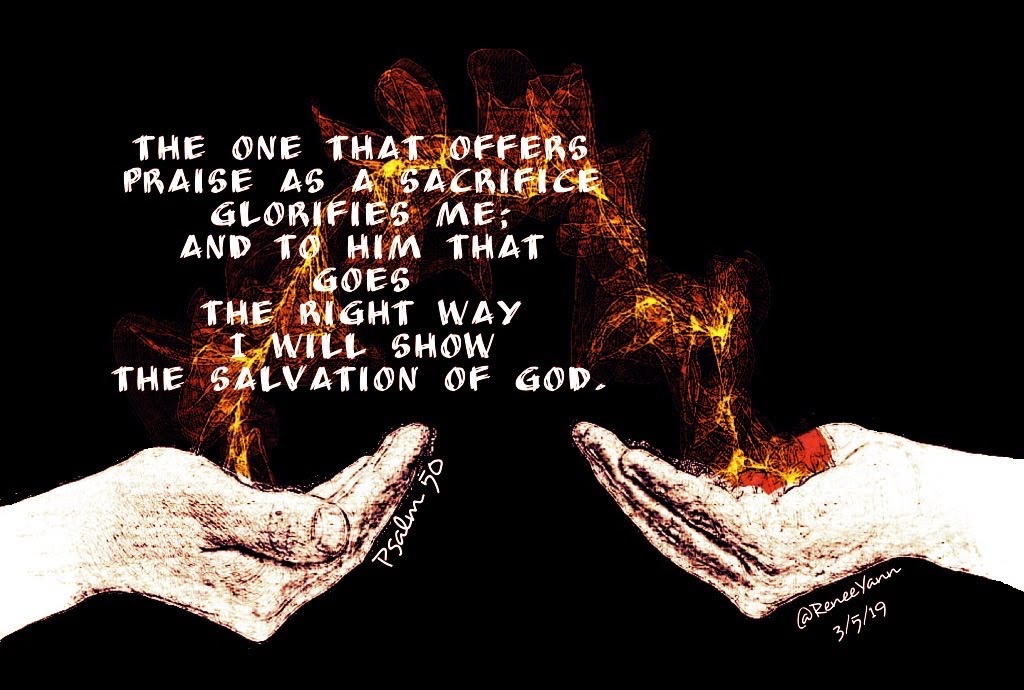
Psalm 50 Redux: Sacrifice of Praise

Monday of the Fifteenth Week in Ordinary Time

July 13, 2020

I have no past reflection on today’s readings since in 2016 they came on the Feast of Our Lady of Mt. Carmel, and in 2018 on the Feast of St. Benedict – both of whom I chose to highlight on those days. So here is a reflection from the Creighton University archives:


Today, in God’s Lavish Mercy, we pray again with Psalm 50. Today’s passage is what I call the “empty words” section where God leaves no doubt about what does and does not please him.

Why do you recite my statutes,
and profess my covenant with your mouth,
Though you hate discipline
and cast my words behind you?


We all know people who talk a good game about religion but they’re mean, selfish, and miserable to be around (present company excluded of course 🙄) And we all know people who actually distort religion to promote themselves while debasing and marginalizing others.

In Psalm 50, God says, “Cut it out!”. God doesn’t want burnt offerings or empty words. God wants “a sacrifice of praise”. So what exactly might that mean?


Walter Brueggemann, in talking about the similar Psalm 51, describes a sacrifice of praise like this:

It must be an intimate, yielding act of trustful submission of “spirit and heart,” not “sacrifice and burnt offerings”. The speaker (psalmist), now situated in glad praise, can imagine an intimacy and communion in which contact between God and self is available and in which the distinction between the two parties is clear and acknowledged—God in splendor, the self in “brokenness”.


When we pray from a humble understanding such as Bruggemann describes, our souls open to God’s love for us and for all Creation. We move from being the center of an insecure, self-absorbed universe to seeing ourselves in inextricable communion with all Life whose Center and Source is Love itself.

The one that offers praise as a sacrifice glorifies me;
and to the one who goes the right way I will show the salvation of God.


Poetry: one of mine today.

Praise
is the place
where I am lost
in You,
the exchange 
that
has only 
You speaking
without sound, with nothing
but my awed
silence.

Music: Alvin Slaughter – Sacrifice of Praise

Lord I lift a song of worship
For Your glory and Your grace
Let my heart reveal all my words fail to say
Lord receive this sacrifice of praise
(Repeat)
On the mountains, in the valley
As I wait in my secret place
I will trust,trust in the name of the Lord
Now receive this sacrifice of praise
You're my shield You're my shelter
From the storm and from the rain
Cover me beneath the shadow of Your wings
Lord receive this sacrifice of praise
Hallelujah hallelujah
Hallelujah to Your name
For all You've done
You are and evermore will be
Lord receive this sacrifice of praise
Of praise
Of praise----

Psalm 93: Nestle in God’s Robe

Memorial of Saint Benedict, Abbot

July 11, 2020

Today, in God’s Lavish Mercy, we pray with Psalm 93, the first of the royal psalms (93-99) which praise God as King.

As we pray with today’s verses, we can easily feel the psalmist stretching for a description of God Who is, of course, indescribable. Never having seen God, we can only imagine the Divine Being in human terms. This writer imagines God as a King beyond even the greatness of human kings, and it is a beautiful image:

The LORD is king, in splendor robed;
robed is the LORD and girt about with strength.


Like the psalmist, we may tend to paint God in the colors of those who have had greatest influence in our lives

  • those with power over us, like parents and teachers
  • those who have loved us, or failed to
  • those in positions of success, and strength

Because all human models are flawed in some way, this tendency can give us a blurry, if not distorted picture of God.


Jesus came to correct our perspective.


A beautiful extra hymn for today. Just love this one.

Jesus showed us that, while we live on this earth, the glory of God is a hidden glory. It is robed in the suffering of the poor and abandoned. Its splendor is in the innocence of children. Its strength is in the hope of the sick and weak. Its beauty shines out to us in the vulnerability of our sisters and brothers.


In today’s Gospel, Jesus gives us the tender image of God as One who cherishes every hair on our heads. As we pray today, we might let that gentle God reach down and caress any pain, exhaustion or fear, like a Mother brushing her child’s hair. Just be with God Who knows our needs. Be cradled in the splendrous robe.


Poetry:  God’s True Cloak – Rainer Maria Rilke

We must not portray you in king’s robes,
you drifting mist that brought forth the morning.
Once again from the old paintboxes
we take the same gold for scepter and crown
that has disguised you through the ages.
Piously we produce our images of you
till they stand around you like a thousand walls.
And when our hearts would simply open,
our fervent hands hide you.

Music: George Frideric Handel – Chandos Anthem, #4/ Psalm 93 – O Sing Unto the Lord

Psalm 51: Secret Heart

Friday of the Fourteenth Week in Ordinary Time

July 10, 2020

Today, in God’s Lavish Mercy, we pray with Psalm 51, a deeply moving plea for a pure heart and a right spirit. Psalm 51 is a penitential psalm known by its Latin name, Miserere (Have Mercy). You, dear readers, may remember a reflection on this beautiful psalm from just about a month ago.


As I prayed with Psalm 51 today, I asked myself how my spirit has been doing in the intervening month. May I challenge you all with the same question?

Corona time is not easy on the Spirit. Confinement, uncertainty, suffering and loss have impacted all of us in some way. Restrictions away from friends, family, and community deplete us. Social unrest and political lunacy unsettle us.

On the other hand, some of us have been able to embrace this time as a long retreat from “the way things were”. It has been a time of washing our hearts down to their bare muscle. We have sat in the quiet with questions like “What is it that I most love,  most trust, most need, most believe in, most hope for?”.


It is such an appropriate time to pray Psalm 51, to be with God in our “secret heart” – that place where no one else ever hears our rawest thoughts and purest prayers:

  • to acknowledge any sin or guilt we carry
  • to name our desire for healing and clarity
  • to listen to the whispering of Wisdom within us
  • to find our strength by finding our rootedness in God
  • to reclaim joy even in the midst of difficulty
  • to make our heart at home in praise
  • to be righted by Mercy

Let’s pray with and for one another as we cherish this Psalm.


Poetry: The Place Where We Are Right – Yehuda Amichai

From the place where we are right
Flowers will never grow
In the spring.
The place where we are right
Is hard and trampled
Like a yard.
But doubts and loves
Dig up the world
Like a mole, a plow.
And a whisper will be heard in the place
Where the ruined
House once stood.

Music: Wisdom in the Secret Heart – Shane and Shane

Psalm 80: Restore Us!

Thursday of the Fourteenth Week in Ordinary Time

July 9, 2020

Today, in God’s Lavish Mercy, we pray with Psalm 80, a powerful song poem written by a desperate and suffering poet.

Psalm 80 seems to have been written as a plea for deliverance of the northern kingdom of Israel just before the Assyrian armies conquered it. The psalmist pleads with God to remember God’s earlier kindness and to restore Israel’s wholeness.

Once again, O LORD of hosts,
look down from heaven, and see:
Take care of this vine,
and protect what your right hand has planted,
the son of man whom you yourself made strong.


When I read this psalm, I hear something like the plea of a confused child, asking a parent: 

  • What happened to upset things? 
  • I thought you loved me? 
  • Why am I so afraid now? 
  • Why are you so unconcerned about my fear?
  • Please remember and give me back your love and blessings.
  • Please make things all right again.

It is a prayer not unlike my own in this time of pandemic, profound loss, and moral confusion. There is so much to be mourned in these painful times, and yet so much to be learned. This video, shared with me by a dear Franciscan friend, captures both the mourning and the hope within these past months:


As we experience the continued spread of COVID 19, coupled with confused leadership and astounding popular ignorance, a plea like the psalmist’s might arise in our own hearts.

Much about our lives on and with the Earth has been broken. Let us pray from our brokenness today. May Creation be restored to its sacred vitality. May our human family be renewed with transformed integrity and reverence for Creation and for one another.


Poetry: I Am the Vine – Malcolm Guite

How might it feel to be part of the vine?
Not just to see the vineyard from afar
Or even pluck the clusters, press the wine,
But to be grafted in, to feel the stir
Of inward sap that rises from our root,
Himself deep planted in the ground of Love,
To feel a leaf unfold a tender shoot,
As tendrils curled unfurl, as branches give
A little to the swelling of the grape,
In gradual perfection, round and full,
To bear within oneself the joy and hope
Of God’s good vintage, till it’s ripe and whole.
What might it mean to bide and to abide
In such rich love as makes the poor heart glad?


Music: You Are the Vine- Divine Hymns

Psalm 105: Seek God’s Face

Wednesday of the Fourteenth Week in Ordinary Time

July 8, 2020

Today, in God’s Lavish Mercy, we pray with Psalm 105:2-7, a hymn to God’s omnipotent fidelity. The same hymn, with minor variations, appears in the First Book of Chronicles where it is attributed to David after the Ark of the Covenant, which had been lost during battle, was brought home to the tabernacle.


Psalm 105 is also a companion piece to Psalm 106, the first recounting God’s wondrous mercies; the second lamenting Israel’s ungrateful response.

Our passage today is really a call to remember God’s goodness to us and to our communities.

Look to the LORD who is Strength;
seek to serve God constantly.
Remember the wondrous deeds God has wrought,
the signs, and the judgments God has spoken.

The second line here is very important. If we do remember, we will “seek to serve”, to respond by being at one (obedient) to God’s hope for us.


As we pray today, we might want to take a walk down memory lane with God, noticing all the blessings of our lives.  We might pay particular attention to the things we once resisted which eventually proved to be disguised benedictions.

Our psalm response today reminds us that God is in everything, even those dark places where God waits to lead us through. We pray for the spiritual insight to look for God in all things.


Poetry: The light shouts in your tree-top, and the face – Rainer Maria Rilke

The light shouts in your tree-top, and the face
of all things becomes radiant and vain;
only at dusk do they find you again.
The twilight hour, the tenderness of space,
lays on a thousand heads a thousand hands,
and strangeness grows devout where they have lain.
With this gentlest of gestures you would hold
the world, thus only and not otherwise.
You lean from out its skies to capture earth,
and feel it underneath your mantle’s folds.
You have so mild a way of being.
They
who name you loudly when they come to pray
forget your nearness. From your hands that tower
above us, mountainously, lo, there soars,
to give the law whereby our senses live,
dark-browed, your wordless power.

Music: Remember Mercy – The Many

Psalm 115: Not To Us

Tuesday of the Fourteenth Week in Ordinary Time

July 7, 2020

Today, in God’s Lavish Mercy, we pray with Psalm 115. The first verse, not included in today’s passage, is perhaps the most familiar:

Not to us, LORD, not to us
but to your name give glory
because of your mercy and faithfulness.

This verse sets the tone for the whole psalm by establishing that it is only in humility that we will experience God’s faithful mercy.


The psalm sections offered today show how hard it is to keep humble attention on God in a world full of idols. While the psalmist mocked these idolatrous gods and their worshippers, his descriptions indicate the significant space they occupy in his own imagination.

There are lots of distracting “gods” in our world too. As a matter of fact, it is sometimes difficult to find the real God because our culture cloaks God in its own distorting devices. 

For example, we encounter ideologies which promote a “god” who:

  • loves America more than other nations
  • loves white people more than black and brown people
  • loves war as long as we are the victors
  • loves my prosperity over other people’s justice
  • tolerates, or even blesses, violence for the sake of superiority
  • isolates, stereotypes, and discriminates over who deserves blessings

Some of these idolatries work to convince us that we are more important to God if we are white, rich, male, heterosexual, healthy, armed, not too old, and American – because these deifications paint their “god” with those strokes.

The more we match up with this “god” – the molten image of a greedy, elitist, militaristic culture – the more we tend to take glory to ourselves. And the more others might legitimately question, “Where is their God?”.

This becomes all the more disorienting when influencers who benefit from such misguided idolatry and fundamentalism use them to promote themselves and their personal and political agendas.


Psalm 115 says, “Stop that!”.


Our Gospel shows us what God is really like — Jesus, who:

  • sought out those suffering
  • loved the poor and abandoned
  • was moved with pity for others’ pain
  • taught, proclaimed and healed in the name of God’s Mercy

Living in the light of this merciful God both humbles and exalts us so that we may wholeheartedly proclaim by our lives:

Not to us, LORD, not to us
but to your name give glory

because of your mercy and faithfulness.

Non nobis, Domine, non nobis ; 
sed nomini tuo da gloriam,
super misericordia tua et veritate tua.


Poetry: Non Nobis Domine! – Rudyard Kipling
(Written for “The Pageant of Parliament,” 1934)

NON nobis Domine!—
    Not unto us, O Lord!
The Praise or Glory be
    Of any deed or word;
For in Thy Judgment lies
    To crown or bring to nought
All knowledge or device
    That Man has reached or wrought.
And we confess our blame—
    How all too high we hold
That noise which men call Fame,
    That dross which men call Gold.
For these we undergo
    Our hot and godless days,
But in our hearts we know
    Not unto us the Praise.
O Power by Whom we live—
    Creator, Judge, and Friend,
Upholdingly forgive
    Nor fail us at the end:
But grant us well to see
    In all our piteous ways—
Non nobis Domine!—
    Not unto us the Praise

Music: Non Nobis Domine

Psalm 145: Through the Generations

Monday of the Fourteenth Week in Ordinary Time

July 6, 2020

Today, in God’s Lavish Mercy, we again pray with Psalm 145 – different verses. The great tenderness in today’s other readings is reflected in the choice of these particular psalm lines.

Our first reading is God’s tender love song to Israel spoken through the prophet Hosea. Our Gospel recounts several acts of tenderness as Jesus ministers to the suffering people he meets.


Psalm 145 reminds us that if we look back over our lives, and even farther back over our ancestors’ lives, we too will discover God’s continual love and mercy to us.

Generation after generation praises your works
and proclaims your might.
They speak of the splendor of your glorious majesty
and tell of your wondrous works.


Many ancestral blessings have been passed on to us – in skills, attitudes, physical strengths – but most importantly, in faith. We probably believe because someone before us taught us how.

There is no greater gift we can give to our children, and to all our beloveds, than to encourage their faith. Let’s take that to heart today as we pray. And let’s thank God for our own story and heritage of faith we have been given.


Poetry: Faith is the Pierless Bridge by Emily Dickinson, who appeared as more a dismissive critic of faith than a proponent. Yet, like many of us who bother to talk about a particular topic, she proved it to be more important to her than she professed.

Faith — is the Pierless Bridge
Supporting what We see
Unto the Scene that We do not —
Too slender for the eye
It bears the Soul as bold
As it were rocked in Steel
With Arms of Steel at either side —
It joins — behind the Veil
To what, could We presume
The Bridge would cease to be
To Our far, vacillating Feet
A first Necessity.

Music: In Every Age – Janèt Sullivan Whitaker

Psalm 145: Is All Right with the World?

Fourteenth Sunday in Ordinary Time

July 5, 2020


From 2017: Today, in Mercy, we  ask God to bless our country and all its people – to give us the grace to live in justice, peace and mutuality; to give us the insight to elect decent leaders who will forge these values; to give us the courage to model these values among nations; to teach us to use our freedom humbly, responsibly and mercifully.

Today, in God’s Lavish Mercy, we pray with Psalm 145, a hymn psalm which is the last numerically to mention David in its origin.

The psalm is one of equilibrium and gratitude where the one praying is at peace within God’s generous fidelity.  By observing nature’s magnificent permanence, the psalmist both praises God and assures himself that things will be alright in the world.

Let all your works give you thanks, O LORD,
and let your faithful ones bless you.
Let them discourse of the glory of your kingdom
and speak of your might.


Reading the psalm today, I thought of Robert Browning’s famous verses from his poetic drama Pippa Passes:

The year's at the spring
And day's at the morn;
Morning's at seven;
The hill-side's dew-pearled;
The lark's on the wing;
The snail's on the thorn:
God's in his heaven—
All's right with the world!
— from Act I: Morning

The verse, though it has endured, was considered naïve when published, due to an undercurrent of civil unrest in England and the rest of Europe. Times were not as peachy as the poem pretended.


With only a superficial glance, one might tend to feel similarly about Psalm 145. Times were tough for the Israelites, as many of the Psalms make clear. These lamenting psalms often ask for deliverance, and all kinds of retribution on enemies.

Psalm 145, and some other hymns, do not. They convey a sense of contentment with the status quo. We might ask ourselves, “Did the same people compose both these kinds of songs? Did this literature, in fact, arise out of the same national experience?


I think these are perfect questions as we, in the United States, continue to celebrate Fourth of July weekend. As we pray for our country, and for the world of which we are part, contrapuntal feelings surely enter our prayer.

  • a deep love of country countered with as deep a concern for its civic health and morality
  • an appreciation for our foremothers and fathers balanced with an awareness of their failures and limitations
  • a pride in our history tinged with shame and regret for its sins
  • a desire to honor civil servants and leaders tested by a realistic concern about their values and agenda
  • a profound gratitude for our national blessings pained by the realization that not all Americans share equitably in them

As is often the case, praying the psalm offers some guidance for our questions. Our third verse in today’s responsorial selection recognizes where God’s faithful generosity wants to be focused. Despite any personal equanimity, there are those who are falling. There are among us those who are bowed down:

The LORD is faithful in all his words
and holy in all his works.
The LORD lifts up all who are falling
and raises up all who are bowed down.

A nation – an earthly community – which sees and attends to those who are so burdened will be blessed by God with the same justice and balance that renders “all right in the heavens”.

Music: The Eyes of All Wait Upon Thee – Syracuse University Singers

Psalm 85: The Kiss

Saturday of the Thirteenth Week in Ordinary Time

July 4, 2020

Today, in God’s Lavish Mercy, we pray with Psalm 85, a testament to hope for the future. Couldn’t we all use a dose of the right now?

Glancing through Twitter last night, I came across a tweet asking for prayers because the writer had “begun to lose hope in the future”. I thought of and prayed for that person this morning when I read Psalm 85, a song of unmitigated hope and trust.


Despite the destruction of the Temple and their exile into Babylonian captivity, the Israelites remained convinced that God had promised them a future of blessedness.

I will hear what God proclaims;
the LORD–for he proclaims peace to his people.

Near indeed is his salvation to those who fear him,
glory dwelling in our land.

Trusting in God’s fidelity, they are freed to imagine and wait for that future’s slow and mysterious fulfillment. Note the future tense of the verbs in these verses:

Mercy and truth shall meet;
justice and peace shall kiss.
Truth shall spring out of the earth,
and justice shall look down from heaven.

Early 16th C. depiction of the Four Daughters of God: Mercy, Truth, Justice, and Peace (Angel in the middle)

The Israelites trusted God’s desire and will for their good. They so strongly believed in a blessed future that they were able to access it even in the midst of a disappointing present.

By faith, we too enter the timelessness of God’s love, finding – even in life’s challenges – the path to joy and peace. The “shalls” in the above verse are achieved through our belief in, and action for them. This is the power of the covenant between God and us.


Our faithful lives invite: 

  • God’s kiss of justice and peace
  • God’s springing forth in truth
  • God’s gaze of justice and mercy over Creation

God and we walk beside one another on the way to a sacred future where the journey is also the destination.

The LORD himself will give his benefits;
our land shall yield its increase.
Justice shall walk before him,
and salvation, along the way of his steps.


May we be given
the grace to believe
that we already live
within the wholeness of God.
May our life be
a hopeful and joyful witness
to that wholeness.


Poetry: Grace – Wendell Berry

Even though written as an autumn poem, these verses fit today’s reflection. Wendell Berry’s thoughts grace evoke a sense of hope and patience.

The woods is shining this morning.
Red, gold and green, the leaves
lie on the ground, or fall,
or hang full of light in the air still.
Perfect in its rise and in its fall, it takes
the place it has been coming to forever.
It has not hastened here, or lagged.
See how surely it has sought itself,
its roots passing lordly through the earth.
See how without confusion it is
all that it is, and how flawless
its grace is. Running or walking, the way
is the same. Be still. Be still.
“He moves your bones, and the way is clear.”

Music:  Mercy Like Rain, written by Rory Cooney, sung here by Alma deRojas

Let me taste your mercy like rain on my face;
here in my life, show me your peace.
Let us see with our own eyes your day breaking bright.
Come, O Morning; come, O Light!
 
What God has spoken I will declare:
Peace to the people of God everywhere.
God's saving presence is close at hand:
glory as near as our land!
 
Here faithful love and truth will embrace;
here peace and justice will come face to face.
God's truth shall water the earth like a spring,
while  justice will bend down and sing.
 
God will keep the promise indeed;
our land will yield the food that we need.
Justice shall walk before you that day,
clearing a path, preparing your way.
 
Let me taste your mercy like rain on my face;
here in my life,  show me your peace.
Let us see with our own eyes your day breaking bright.
Come, O Morning; come, O Light!