Psalm 50 Redux: Sacrifice of Praise

Monday of the Fifteenth Week in Ordinary Time

July 13, 2020

I have no past reflection on today’s readings since in 2016 they came on the Feast of Our Lady of Mt. Carmel, and in 2018 on the Feast of St. Benedict – both of whom I chose to highlight on those days. So here is a reflection from the Creighton University archives:


Today, in God’s Lavish Mercy, we pray again with Psalm 50. Today’s passage is what I call the “empty words” section where God leaves no doubt about what does and does not please him.

Why do you recite my statutes,
and profess my covenant with your mouth,
Though you hate discipline
and cast my words behind you?


We all know people who talk a good game about religion but they’re mean, selfish, and miserable to be around (present company excluded of course 🙄) And we all know people who actually distort religion to promote themselves while debasing and marginalizing others.

In Psalm 50, God says, “Cut it out!”. God doesn’t want burnt offerings or empty words. God wants “a sacrifice of praise”. So what exactly might that mean?


Walter Brueggemann, in talking about the similar Psalm 51, describes a sacrifice of praise like this:

It must be an intimate, yielding act of trustful submission of “spirit and heart,” not “sacrifice and burnt offerings”. The speaker (psalmist), now situated in glad praise, can imagine an intimacy and communion in which contact between God and self is available and in which the distinction between the two parties is clear and acknowledged—God in splendor, the self in “brokenness”.

When we pray from a humble understanding such as Bruggemann describes, our souls open to God’s love for us and for all Creation. We move from being the center of an insecure, self-absorbed universe to seeing ourselves in inextricable communion with all Life whose Center and Source is Love itself.

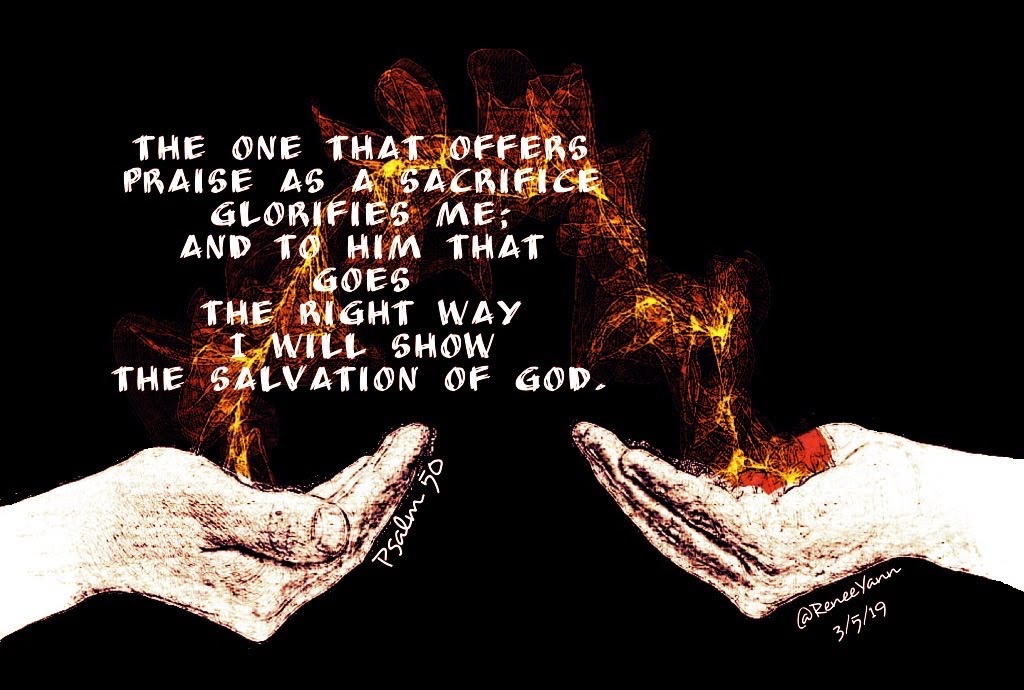
The one that offers praise as a sacrifice glorifies me;
and to the one who goes the right way I will show the salvation of God.


Poetry: one of mine today.

Praise
is the place
where I am lost
in You,
the exchange 
that
has only 
You speaking
without sound, with nothing
but my awed
silence.

Music: Alvin Slaughter – Sacrifice of Praise

Lord I lift a song of worship
For Your glory and Your grace
Let my heart reveal all my words fail to say
Lord receive this sacrifice of praise
(Repeat)
On the mountains, in the valley
As I wait in my secret place
I will trust,trust in the name of the Lord
Now receive this sacrifice of praise
You're my shield You're my shelter
From the storm and from the rain
Cover me beneath the shadow of Your wings
Lord receive this sacrifice of praise
Hallelujah hallelujah
Hallelujah to Your name
For all You've done
You are and evermore will be
Lord receive this sacrifice of praise
Of praise
Of praise----

Psalm 65: Word-Seed

Fifteenth Sunday in Ordinary Time
July 12, 2020

From 2017:

Today, in Mercy, we pray with the powerful and mysterious readings of today’s liturgy. They tell us that God breathes eternal inspiration into us and all Creation. The gift, like seed, is intended to bear fruit that is returned to God in love and praise. By participating in that return, we become children of God. May the seed of God’s Word fall on good ground in our spirits.

Today, in God’s Lavish Mercy, we pray with Psalm 65, a song poem probably written to celebrate the harvest season. The psalm describes an abundantly fruitful earth, filled with life and produce.

Though humans labor for these blessings, God is the bounty’s true agent. The power of that agency is found in the array of words used to describe God’s actions.

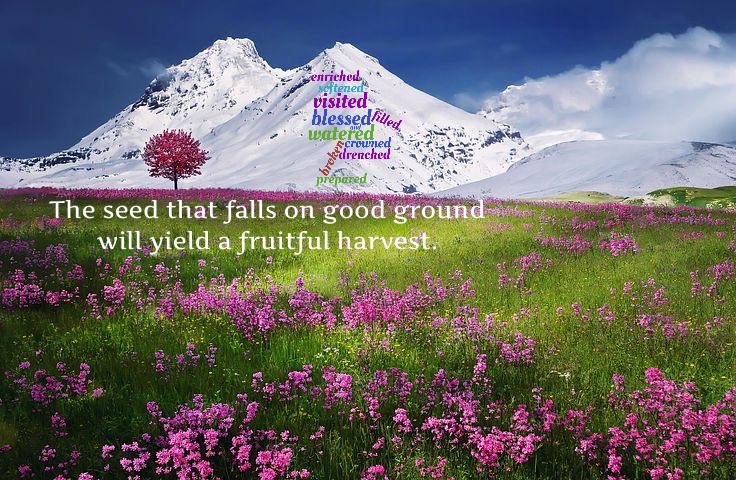
God has: 

  • visited 
    • watered
      • enriched
        • filled
          • prepared
  • drenched
    • broken up
      • softened
        • blessed and
          • crowned

What is it that has drawn all this intervention from God? Our readings tell us. It is the Word-Seed which is God’s own life.

Just as from the heavens
the rain and snow come down….
so shall my Word be. (Isaiah 55)
For creation awaits with eager expectation
the revealing Word of the children of God… (Romans 8)
The seed sown on rich soil
is the one who hears the Word and understands it,
who indeed bears fruit and 
yields a hundred or sixty or thirtyfold. (Matthew 13)

By our dedicated prayer with scripture and trusted spiritual reading, the Word works on our spirits just as the psalm describes.  Our understanding, too, is visited, watered, enriched, filled, prepared, drenched, broken up, softened and ultimately blessed and crowned.

As we pray with Psalm 65 today, we can picture David looking out from hilltop over the abundance of his fields. His heart is filled with awe and praise for God’s generosity.

We all want to live in a spiritual landscape akin to the psalm’s bountiful picture. Inviting God’s Word, in humility, gratitude, and awe is a true path to such blessing.


Poetry: A Word Is Dead – Emily Dickinson


Music: Aria by Secret Garden

Psalm 93: Nestle in God’s Robe

Memorial of Saint Benedict, Abbot

July 11, 2020

Today, in God’s Lavish Mercy, we pray with Psalm 93, the first of the royal psalms (93-99) which praise God as King.

As we pray with today’s verses, we can easily feel the psalmist stretching for a description of God Who is, of course, indescribable. Never having seen God, we can only imagine the Divine Being in human terms. This writer imagines God as a King beyond even the greatness of human kings, and it is a beautiful image:

The LORD is king, in splendor robed;
robed is the LORD and girt about with strength.


Like the psalmist, we may tend to paint God in the colors of those who have had greatest influence in our lives

  • those with power over us, like parents and teachers
  • those who have loved us, or failed to
  • those in positions of success, and strength

Because all human models are flawed in some way, this tendency can give us a blurry, if not distorted picture of God.


Jesus came to correct our perspective.


A beautiful extra hymn for today. Just love this one.

Jesus showed us that, while we live on this earth, the glory of God is a hidden glory. It is robed in the suffering of the poor and abandoned. Its splendor is in the innocence of children. Its strength is in the hope of the sick and weak. Its beauty shines out to us in the vulnerability of our sisters and brothers.


In today’s Gospel, Jesus gives us the tender image of God as One who cherishes every hair on our heads. As we pray today, we might let that gentle God reach down and caress any pain, exhaustion or fear, like a Mother brushing her child’s hair. Just be with God Who knows our needs. Be cradled in the splendrous robe.


Poetry:  God’s True Cloak – Rainer Maria Rilke

We must not portray you in king’s robes,
you drifting mist that brought forth the morning.
Once again from the old paintboxes
we take the same gold for scepter and crown
that has disguised you through the ages.
Piously we produce our images of you
till they stand around you like a thousand walls.
And when our hearts would simply open,
our fervent hands hide you.

Music: George Frideric Handel – Chandos Anthem, #4/ Psalm 93 – O Sing Unto the Lord

Psalm 51: Secret Heart

Friday of the Fourteenth Week in Ordinary Time

July 10, 2020

Today, in God’s Lavish Mercy, we pray with Psalm 51, a deeply moving plea for a pure heart and a right spirit. Psalm 51 is a penitential psalm known by its Latin name, Miserere (Have Mercy). You, dear readers, may remember a reflection on this beautiful psalm from just about a month ago.


As I prayed with Psalm 51 today, I asked myself how my spirit has been doing in the intervening month. May I challenge you all with the same question?

Corona time is not easy on the Spirit. Confinement, uncertainty, suffering and loss have impacted all of us in some way. Restrictions away from friends, family, and community deplete us. Social unrest and political lunacy unsettle us.

On the other hand, some of us have been able to embrace this time as a long retreat from “the way things were”. It has been a time of washing our hearts down to their bare muscle. We have sat in the quiet with questions like “What is it that I most love,  most trust, most need, most believe in, most hope for?”.


It is such an appropriate time to pray Psalm 51, to be with God in our “secret heart” – that place where no one else ever hears our rawest thoughts and purest prayers:

  • to acknowledge any sin or guilt we carry
  • to name our desire for healing and clarity
  • to listen to the whispering of Wisdom within us
  • to find our strength by finding our rootedness in God
  • to reclaim joy even in the midst of difficulty
  • to make our heart at home in praise
  • to be righted by Mercy

Let’s pray with and for one another as we cherish this Psalm.


Poetry: The Place Where We Are Right – Yehuda Amichai

From the place where we are right
Flowers will never grow
In the spring.
The place where we are right
Is hard and trampled
Like a yard.
But doubts and loves
Dig up the world
Like a mole, a plow.
And a whisper will be heard in the place
Where the ruined
House once stood.

Music: Wisdom in the Secret Heart – Shane and Shane

Psalm 80: Restore Us!

Thursday of the Fourteenth Week in Ordinary Time

July 9, 2020

Today, in God’s Lavish Mercy, we pray with Psalm 80, a powerful song poem written by a desperate and suffering poet.

Psalm 80 seems to have been written as a plea for deliverance of the northern kingdom of Israel just before the Assyrian armies conquered it. The psalmist pleads with God to remember God’s earlier kindness and to restore Israel’s wholeness.

Once again, O LORD of hosts,
look down from heaven, and see:
Take care of this vine,
and protect what your right hand has planted,
the son of man whom you yourself made strong.


When I read this psalm, I hear something like the plea of a confused child, asking a parent: 

  • What happened to upset things? 
  • I thought you loved me? 
  • Why am I so afraid now? 
  • Why are you so unconcerned about my fear?
  • Please remember and give me back your love and blessings.
  • Please make things all right again.

It is a prayer not unlike my own in this time of pandemic, profound loss, and moral confusion. There is so much to be mourned in these painful times, and yet so much to be learned. This video, shared with me by a dear Franciscan friend, captures both the mourning and the hope within these past months:


As we experience the continued spread of COVID 19, coupled with confused leadership and astounding popular ignorance, a plea like the psalmist’s might arise in our own hearts.

Much about our lives on and with the Earth has been broken. Let us pray from our brokenness today. May Creation be restored to its sacred vitality. May our human family be renewed with transformed integrity and reverence for Creation and for one another.


Poetry: I Am the Vine – Malcolm Guite

How might it feel to be part of the vine?
Not just to see the vineyard from afar
Or even pluck the clusters, press the wine,
But to be grafted in, to feel the stir
Of inward sap that rises from our root,
Himself deep planted in the ground of Love,
To feel a leaf unfold a tender shoot,
As tendrils curled unfurl, as branches give
A little to the swelling of the grape,
In gradual perfection, round and full,
To bear within oneself the joy and hope
Of God’s good vintage, till it’s ripe and whole.
What might it mean to bide and to abide
In such rich love as makes the poor heart glad?


Music: You Are the Vine- Divine Hymns

Psalm 105: Seek God’s Face

Wednesday of the Fourteenth Week in Ordinary Time

July 8, 2020

Today, in God’s Lavish Mercy, we pray with Psalm 105:2-7, a hymn to God’s omnipotent fidelity. The same hymn, with minor variations, appears in the First Book of Chronicles where it is attributed to David after the Ark of the Covenant, which had been lost during battle, was brought home to the tabernacle.


Psalm 105 is also a companion piece to Psalm 106, the first recounting God’s wondrous mercies; the second lamenting Israel’s ungrateful response.

Our passage today is really a call to remember God’s goodness to us and to our communities.

Look to the LORD who is Strength;
seek to serve God constantly.
Remember the wondrous deeds God has wrought,
the signs, and the judgments God has spoken.

The second line here is very important. If we do remember, we will “seek to serve”, to respond by being at one (obedient) to God’s hope for us.


As we pray today, we might want to take a walk down memory lane with God, noticing all the blessings of our lives.  We might pay particular attention to the things we once resisted which eventually proved to be disguised benedictions.

Our psalm response today reminds us that God is in everything, even those dark places where God waits to lead us through. We pray for the spiritual insight to look for God in all things.


Poetry: The light shouts in your tree-top, and the face – Rainer Maria Rilke

The light shouts in your tree-top, and the face
of all things becomes radiant and vain;
only at dusk do they find you again.
The twilight hour, the tenderness of space,
lays on a thousand heads a thousand hands,
and strangeness grows devout where they have lain.
With this gentlest of gestures you would hold
the world, thus only and not otherwise.
You lean from out its skies to capture earth,
and feel it underneath your mantle’s folds.
You have so mild a way of being.
They
who name you loudly when they come to pray
forget your nearness. From your hands that tower
above us, mountainously, lo, there soars,
to give the law whereby our senses live,
dark-browed, your wordless power.

Music: Remember Mercy – The Many

Psalm 145: Is All Right with the World?

Fourteenth Sunday in Ordinary Time

July 5, 2020


From 2017: Today, in Mercy, we  ask God to bless our country and all its people – to give us the grace to live in justice, peace and mutuality; to give us the insight to elect decent leaders who will forge these values; to give us the courage to model these values among nations; to teach us to use our freedom humbly, responsibly and mercifully.

Today, in God’s Lavish Mercy, we pray with Psalm 145, a hymn psalm which is the last numerically to mention David in its origin.

The psalm is one of equilibrium and gratitude where the one praying is at peace within God’s generous fidelity.  By observing nature’s magnificent permanence, the psalmist both praises God and assures himself that things will be alright in the world.

Let all your works give you thanks, O LORD,
and let your faithful ones bless you.
Let them discourse of the glory of your kingdom
and speak of your might.


Reading the psalm today, I thought of Robert Browning’s famous verses from his poetic drama Pippa Passes:

The year's at the spring
And day's at the morn;
Morning's at seven;
The hill-side's dew-pearled;
The lark's on the wing;
The snail's on the thorn:
God's in his heaven—
All's right with the world!
— from Act I: Morning

The verse, though it has endured, was considered naïve when published, due to an undercurrent of civil unrest in England and the rest of Europe. Times were not as peachy as the poem pretended.


With only a superficial glance, one might tend to feel similarly about Psalm 145. Times were tough for the Israelites, as many of the Psalms make clear. These lamenting psalms often ask for deliverance, and all kinds of retribution on enemies.

Psalm 145, and some other hymns, do not. They convey a sense of contentment with the status quo. We might ask ourselves, “Did the same people compose both these kinds of songs? Did this literature, in fact, arise out of the same national experience?


I think these are perfect questions as we, in the United States, continue to celebrate Fourth of July weekend. As we pray for our country, and for the world of which we are part, contrapuntal feelings surely enter our prayer.

  • a deep love of country countered with as deep a concern for its civic health and morality
  • an appreciation for our foremothers and fathers balanced with an awareness of their failures and limitations
  • a pride in our history tinged with shame and regret for its sins
  • a desire to honor civil servants and leaders tested by a realistic concern about their values and agenda
  • a profound gratitude for our national blessings pained by the realization that not all Americans share equitably in them

As is often the case, praying the psalm offers some guidance for our questions. Our third verse in today’s responsorial selection recognizes where God’s faithful generosity wants to be focused. Despite any personal equanimity, there are those who are falling. There are among us those who are bowed down:

The LORD is faithful in all his words
and holy in all his works.
The LORD lifts up all who are falling
and raises up all who are bowed down.

A nation – an earthly community – which sees and attends to those who are so burdened will be blessed by God with the same justice and balance that renders “all right in the heavens”.

Music: The Eyes of All Wait Upon Thee – Syracuse University Singers

Psalm 117: Praise the Lord

Feast of Saint Thomas, Apostle

July 3, 2020

One of my favorite past reflections on faith vs. doubt – for this Feast of Saint Thomas


Today, in God’s Lavish Mercy, we pray with Psalm 117 which is the shortest of all the Psalms. But 117, also called the Laudate Dominum, still packs a huge spiritual punch.

The psalm is called a “doxology” which simply means it is a short prayer of praise, the type we often add at the end of longer prayers. We are very familiar with the following doxology:

Glory be to the Father, and to the Son, and to the Holy Spirit.
As it was in the beginning, is now, and ever shall be
,
world without end. Amen


Psalm 117 follows the same pattern in that it has two complementary parts.

The first invites us to praise God:
Praise the LORD, all you nations;
glorify God, all you peoples!

The second tells us why God deserves our praise:
For steadfast is God’s kindness for us,
and the fidelity of the LORD endures forever.

Notable about Psalm 117 is the fact that this Old Testament invitation to praise goes out “to ALL nations”. Scholars interpret this as pointing to the fulfillment, in Jesus, of God’s promise that Abraham would be the father in faith of many nations. Psalm 117 is a treasured and often repeated prayer throughout the Judea-Christian traditions.


Practicing this pattern of prayer can enrich our personal prayer life as well. I like to pray like this as soon as I wake each morning. Glancing out my window, I might say,

“I praise You in the sunrise, my Beautiful Creator.
Thank you for the gift of my life.”

Beginning the day with our own “doxology” gives us a head start on living joyfully and gratefully in the Presence of God for our next circuit of the sun.


Poetry: Morning Poem – Mary Oliver

Every morning 
the world 
is created. 
Under the orange
sticks of the sun 
the heaped 
ashes of the night 
turn into leaves again
and fasten themselves to the high branches— 
and the ponds appear 
like black cloth 
on which are painted islands
of summer lilies. 
If it is your nature 
to be happy 
you will swim away along the soft trails
for hours, your imagination 
alighting everywhere. 
And if your spirit 
carries within it
the thorn 
that is heavier than lead— 
if it's all you can do 
to keep on trudging—
there is still 
somewhere deep within you 
a beast shouting that the earth 
is exactly what it wanted—
each pond with its blazing lilies 
is a prayer heard and answered 
lavishly, 
every morning,
whether or not 
you have ever dared to be happy, 
whether or not 
you have ever dared to pray

Music: Laudate Dominum – Mozart, sung by Barbara Hendricks

Psalm 50: God Doesn’t Do “Fake”

Wednesday of the Thirteenth Week in Ordinary Time

July 1, 2020

I don’t have a past reflection on today’s readings. But here is a good one from Joe Zaborowski at Creighton University.

Today, in God’s Lavish Mercy, we pray with Psalm 50 which is set up like a court proceeding in which God is both prosecutor and judge of the Israelite community.

Hear, my people, and I will speak;
Israel, I will testify against you;
God, your God, am I.

Today’s section, one of two orations, explains God’s dissatisfaction with the display of sacrifices empty of any real commitment to God’s service. In other words, God tells the people that all their fiery and bloody rituals are fake and useless to him.

One might picture the high priests standing dumbfounded at this announcement. 


What! I worked hard on this sacrifice… made sure it was perfect. All the bells and whistles! And You’re still not satisfied??? What do You want from me then?


It reminds me of a married couple. One cooks a beautiful meal for the other but the love between them has faded. As they eat, there is no caring conversation and no joy in each other. They finish perfunctorily in a fog of empty words. They retreat to their separate distractions, waiting to repeat the charade the next day.

In Psalm 50, God says he doesn’t want to be loved like that.
So what does God want then?

Our reading from Amos today offers the thread of an answer which is woven through the rest of Psalm 50:

But if you would offer me burnt offerings,
then let justice surge like water,
and goodness like an unfailing stream.

God wants our sincere love expressed in goodness and actions for justice.

Just like that beautiful dinner, rituals have meaning only as celebrations of faithful and demonstrated love. Sounds like 1 Corinthians 13, doesn’t it?

The parallels to our own lives are obvious and don’t need my elucidation. Let’s just think about how God might answer us if we ask in prayer, “What is it that You really want from me?”.

Poetry: Rabindranath Tagore, from Gitanjali

I am only waiting for Love 
to give myself up at last into his hands.

That is why it is so late 
and why I have been guilty of such omissions.
They come with their laws and their codes to bind me fast; 
but I evade them ever, 

for I am only waiting for Love 
to give myself up at last into his hands.

People blame me and call me heedless; 
I doubt not they are right in their blame.
The market day is over 
and work is all done for the busy. 
Those who came to call me in vain 
have gone back in anger. 

I am only waiting for Love 
to give myself up at last into his hands.

Music: Proof of Your Love – King and Country

Psalm 5: You Are God’s Flute

Tuesday of the Thirteenth Week in Ordinary Time

June 30, 2020

A Brief Prayer on Today’s Gospel from 2016
Today, in Mercy, we pray for all those tossed on a stormy sea, like Christ’s disciples. For all who are alone, in darkness or full of fear. There is no storm through which God cannot come to us. May we always trust that God is taking us to a new grace beyond the storm.


Today, in God’s Lavish Mercy, we pray with Psalm 5, the first one of several to mention “the Name of God” as a theme.  The psalm, a morning prayer to be “accompanied by a flute”, is a mix of lament and exaltation – like many of our own morning prayers, no doubt.

At dawn I bring my plea expectantly before you.
For you, O God, delight not in wickedness;

the evil one does not remain with you;
the arrogant may not stand in your sight.


Now, first off in the morning, we’re probably not going to talk to God about wickedness, evil, and arrogance unless we went to bed pretty upset the night before. The psalmist apparently has “slept on” his troubles without complete resolution.

We had a dear, wise Directress of Postulants who, on many an evening, patiently listened to our various vocational waverings. We were young. Just like the disciples in Matthew’s boat, we really weren’t as sure of our calls as we would like to have been. Sister Inez’s repeated advice soothed a lot of our growing pains, “Just give it to God and get a good night’s sleep. Things will be clearer in the morning.” And they always were.


As the psalmist prays this morning prayer, things clear as well. After a brief diatribe, the prayer realizes:

But I, through the abundance of your mercy,
will enter into your house.
I will bow down toward your holy sanctuary

in awe of your greatness.


Psalm 5 beautifully complements today’s Gospel. Jesus is in the storm-tossed boat peacefully “sleeping on it”. The disciples, on the other hand, cannot just “give” their terror over to God. When they wake Jesus, terrified, he gently reprimands them, “O ye of little faith”.

Jesus wants them and us, to realizes what the psalmist realizes in verse 12:

All who trust in God will be glad
and forever shout for joy.
God protects them 
and their lives are a melody
to God’s beloved Name


Poetry: A Hole in a Flute ~ Hafiz

I am a hole in a flute
that the Christ's breath moves through; 
listen to this music.

I am the concert 
from the mouth of every creature 
singing with the myriad chorus.

I am a hole in a flute 
that the Christ's breath moves through; 
listen to this music.

Music: The Edge of Night by a group called “Siyotanka” which is actually the Lakota name for this type of flute.