Once, in a half-hidden glen in Waller Mill Park in Williamsburg, Virginia, I stood in a silence so complete, I could hear nothing but God humming. Even the birds had stopped to listen. If you can, take the time to find a spot like this in your life. Wait there long enough to lose the noise of your own anxieties. Wait for Love and Lavish Mercy to sing with you.
Every Riven Thing ~ Christian Wiman
God goes, belonging to every riven thing he’s made
sing his being simply by being
the thing it is:
stone and tree and sky,
man who sees and sings and wonders why
God goes. Belonging, to every riven thing he’s made,
means a storm of peace.
Think of the atoms inside the stone.
Think of the man who sits alone
trying to will himself into a stillness where
God goes belonging. To every riven thing he’s made
there is given one shade
shaped exactly to the thing itself:
under the tree a darker tree;
under the man the only man to see
God goes belonging to every riven thing. He’s made
the things that bring him near,
made the mind that makes him go.
A part of what man knows,
apart from what man knows,
God goes belonging to every riven thing he’s made.
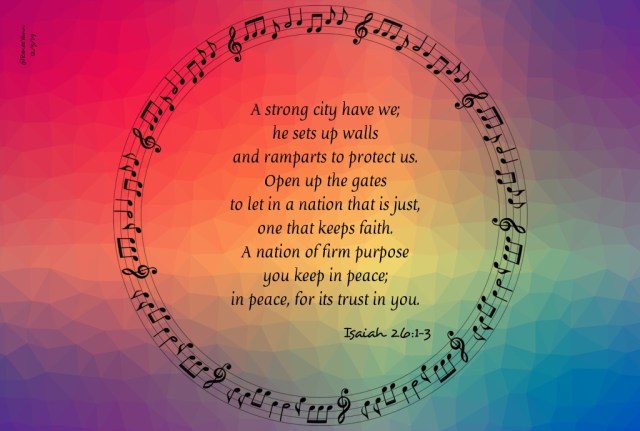
Today, in Mercy, Isaiah promises the people that they will sing a song in the land of Judah.It will be a song that celebrates confidence in God, justice, enduring faith, peace and trust.
Do you ever sing to God when your heart is filled like that? I don’t mean Church-singing or words somebody else wrote.
I mean that sweet, indecipherable whisper a mother breathes over her child, or the mix of a hundred half-remembered melodies we hum when we are lost in the fullness of our lives.
And I don’t just mean the happy songs.
I mean the songs of loss and longing, awe and wonderment at life’s astounding turns. I mean even the sounds of silence when the refrain within us cannot be spoken.
When your heart is really stuck, unable to find the words to express the depth of your joy, longing or sorrow, try singing to God like that. So many times, I have done this while out on a solitary walk, or sitting by the water’s edge, or even driving on an open road. Sometimes, God even sings back!😉
(In a second post today, I will share a lovely poem which reminds me of a special prayer time in nature.)
Isaiah’s people were able to sing their song because they held on to faith and acted in justice. In our Gospel, Jesus tells us that this must be the way of our prayer too. He says that simply saying, “Lord, Lord” won’t cut it!
Real prayer is not just words. It is a life given to hearing God’s Word and acting on it. Real prayer is about always singing our lives in rhythm with the infinite, merciful melody of God.
Today, in Mercy, our first reading sets us out on nearly two weeks of passages from Isaiah. The passionate hope of Isaiah’s writing, as well as its literary elegance, can reach into our hearts and powerfully renew us.
For these reasons, “Isaiah’s Vision” is among the most beloved and influential books of the Bible. The book has so influenced Christianity that it often is referred to as “The Fifth Gospel”.
We begin today with a passage that captures Isaiah’s prophecy for the restoration of Israel after the Assyrian and Babylonian decimation. You might think, “So what! That was ancient history and my life is now. What can Isaiah say to me?”
But that is the magic of Isaiah! He is a prophet and a magnificent poet. What he says for “then” can be lifted out of time and wrapped in “now”. In the transformation of prayer, Isaiah can be laid in revelation over our world, our times … my life.
On this second day of Advent, as we faithfully seek to find God in our deep-heart, what do today’s lines say to us:
Is there a “branch” of hope in us that we pray will blossom?
Is there a holy confidence we may have lost for a while that we hunger to have returned?
Is there a barren field in our world or our lives that longs to be brought to life?
Do we pray for the graceful restoration of our Church, our world, our country, our families, our own hearts?
Do we long for signs of God’s Presence in our lives – not smoking clouds and flaming fire necessarily – but the joyful peace and freedom that would bless and comfort us?
Isaiah today is about assuring us in these longings. He says:
For over all, the LORD’s glory will be shelter and protection: shade from the parching heat of day, refuge and cover from the storm and rain.
In our Advent prayer,
we open our spirits to that Promise!
Music: Beautiful Zion- sung by Mormon Tabernacle Choir
Lyrics
1. Beautiful Zion, built above;
Beautiful city that I love;
Beautiful gates of pearly white;
Beautiful temple—God its light;
He who was slain on Calvary
Opens those pearly gates for me.
Zion, Zion, lovely Zion;
Beautiful Zion;
Zion, city of our God!
2. Beautiful heav’n, where all is light;
Beautiful angels clothed in white;
Beautiful strains that never tire;
Beautiful harps thru all the choir;
There shall I join the chorus sweet,
Worshiping at the Savior’s feet.
Zion, Zion, lovely Zion;
Beautiful Zion;
Zion, city of our God!
3. Beautiful crowns on ev’ry brow;
Beautiful palms the conq’rors show;
Beautiful robes the ransomed wear;
Beautiful all who enter there;
Thither I press with eager feet;
There shall my rest be long and sweet.
Zion, Zion, lovely Zion;
Beautiful Zion;
Text: George Gill, 1820–1880
Music: Joseph G. Fones, 1828–1906
Today, in Mercy, let us continue to bask in the deep gratitude of our hearts for God’s tremendous love for us.
I wrote this reflection for the Sisters of Mercy blog several years ago. They republished it yesterday for Thanksgiving Day. Some of you may not have had the chance to read it. I would be honored if you did.:
“Remember” is a word with a great depth of meaning. Most usually we think of it as a calling to mind. But it can also be thought of as kind of reconstructing – a restoring of the “members” to their rightful place in the whole.
Paul uses the word “members” in this way when he talks about the Body of the Church:
For just as the body is one and has many members, and all the members of the body, though many, are one body, so it is with Christ. For in one Spirit we were all baptized into one body—Jews or Greeks, slaves or free—and all were made to drink of one Spirit. 1 Corinthians 12: 12-13
When we pray a prayer of “remembering”, we consciously bring into the circle of eternal life all those whom time has hidden from us. We affirm the faith that, in Christ, death has already been conquered for all of us. In prayer, we lift the human veil that separates us from those who have died. We “remember” the Resurrected Body of Christ living in, and uniting, all of us beyond time.
The feast of Holy Souls is a day to give thanks for all those whose physical or spiritual DNA lives in us. It is a time to bless what is good and forgive what was lacking. It is a day to connect the generations by telling the stories that have graced us, passing into the next generation’s hands the unbroken line of salvation history.
Today, we pray with and for all the holy souls who have touched our lives, even from a distance. May they, and we, be continually “remembered” into God’s eternal heart.
Today, in Mercy, our readings encourage us never to weary in our faith and prayer.
Look at Moses in our first reading! He keeps his hands raised in supplication throughout the entire battle, albeit with a little help from his friends.
This is a good reminder for us of the gift and importance of a praying community. There are times in every life when we need someone to hold us up in prayer.
In our second reading, Paul counsels Timothy never to grow weary in the pursuit of his ministry.
I charge you in the presence of God and of Christ Jesus, … proclaim the word; be persistent whether it is convenient or inconvenient…
And in our Gospel, Jesus tells the parable of the importune widow, who kept after the judge until she got the answer she wanted. Luke includes this information:
Jesus told his disciples a parable about the necessity for them to pray always without becoming weary.
If a dishonest judge can be moved by persistence to grant justice, how much more will God do so for those God loves?
The point? Not that if we bug God, we’ll get what we want. Rather it is to remind us to stay in steadfast relationship with God who is always revealing the path of grace and wholeness to us.
So let’s take a clue from Moses. Let’s keep our hands up in faithful praise to God through all the blessings and challenges of our lives. By doing so, we will receive peace far beyond our persistent questions and concerns.
Total Praise – Richard Smallwood, sung by the Brooklyn Tabernacle Choir
I have particularly loved this hymn from the first time I heard it sung by our wonderful Keystone Mercy Choir in my former workplace. The music itself is soul-shaking, but what most deeply moved my spirit was the faith of the singers, my beautiful workplace community. This video has the same effect on me – the faith of the singers and the audience is inspiring! (Lyrics below)
Lord, I will lift mine eyes to the hills
Knowing my health is coming from You
Your peace You give me in times of the storm
You are the source of my strength, Hallelujah
And You are the strength of my life, yes You are
I lift my hands in total praise to You
Lord, I will lift mine eyes to the hills
Knowing my health is coming from You
Your peace, You give me in times of the storm
You are the source of my strength
You are the strength of my life
I lift my hands in total praise to You
You are the source of my strength
You are the strength of my life
I lift my hands in total praise to
Amen, Amen, Amen, Amen
You are the source of my strength
You are the strength of my life
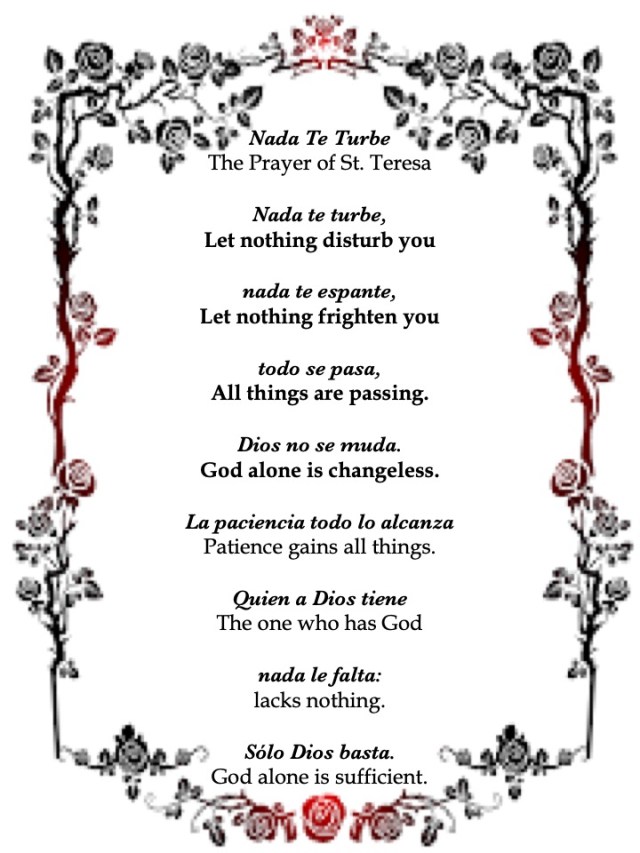
Today, in Mercy, we celebrate the feast of the great Saint Teresa of Avila.
Teresawas a Spanish noblewoman who became a Carmelite nun, mystic, religious reformer, author, theologian, and one of the 36 Doctors of the Church.
(Until 1970, no woman had been named a Doctor in the Church, but since then four women have been designated: Saints Teresa of Àvila, Catherine of Siena, Therese of the Child Jesus, and Hildegard of Bingen)
Our reading today from Romans is a good one for Teresa’s feast. In it, Paul expresses his complete trust in and devotion to the Gospel of Jesus Christ. By this, Paul means more than the written words of Matthew, Mark, Luke and John. He means the entire gift of the Incarnation, Life, Passion, Death and Resurrection, continuing among us in the indwelling Holy Spirit.
Teresa understood and lived this same trust and devotion. She said:
Christ has no body now, but yours. No hands, no feet on earth, but yours. Yours are the eyes through which Christ looks compassion into the world. Yours are the feet with which Christ walks to do good. Yours are the hands with which Christ blesses the world.
Like Paul, Teresa was not ashamed to proclaim and live the Gospel. May these two strong and amazing saints help us to do the same.
Music: Christ Has No Body Now But Yours – David Ogden
Today, in Mercy, two significant themes in our readings are gift-giving and gratitude.
In our first reading Naaman, a pretty hot-shot Syrian commander, is a leper. He takes the advice of a captured Israel slave girl who encourages Naaman to seek a cure from Elisa the prophet.
As Naaman approaches, Elisha sends wordto rinse in the Jordan. Naaman, who is obviously accustomed to personalized subservience, is not happy with Elisha’s absentee advice. Angry, Naaman sets out for home. But his servants encourage him to cool down and to act on Elisha’s instructions.
Naaman receives the cure and he promises, half-heartedly, to from henceforth worship Yahweh. He then asks what he can pay for the gift of the cure. Elisha responds that there is no payment .
Notice: Naaman never says “Thank you”. Instead, he wants to pay, to owe nothing for the immense gift he has received. He doesn’t want to be beholden, even to God.
Elisha, in so many words, tells Naaman: What I was blessed to convey to you comes from God. The power is God’s. I am the instrument. You can’t buy or own it. I can’t sell it. It’s God’s – freely given.
Paul repeats the theme to Timothy: the Word of God is not chained. God’s power, grace, and healing are given freely. We cannot earn them buy, them, control them, or ever thank God enough for them. But we should try.
In our Gospel, only one cured leper – a Samaritan – has the sense and humility to try to thank Jesus. Born of his faith, that gratitude saves him.
God is Infinite Gift. God’s love pours over us spontaneously and continually to bring us to wholeness. God can’t help loving us and hoping for our completeness in grace.
May we be delivered from any speck of entitlement, indifference, arrogance, or ingratitude in the face of such Goodness!
(Some of you may recognize this reflection as a “recycle”, but I think it may be worth another read.)
Today, in Mercy,Jesus teaches his disciples how to pray. His prayer is simple and direct, like talking to your Dad over a morning cup of coffee.
What about us? How do we pray?
Our first learned prayers are a lot like Jesus’s simple Our Father. We praise God, giving thanks, and asking for what we need.
Then we grow up and get sophisticated. We may begin to “say” or read prayers rather than use our own words. While such a practice can deepen our understanding of prayer, it places a layer between us and our conversation with God.
Sometimes others lead our prayer in the community of faith. This too can enrich us as we are inspired by a shared faith. But it is a little like trying to have a private conversation in an elevator.
Just as Jesus often went off in solitude to pray, this kind of prayer is our most intimate time with God – a time when God allows us to know God and ourselves in a deeper way. This sacred time alone with God may be spent in words, song, or the silence that speaks beyond words.
It is a time to be with the Beloved as we would our dearest, most faithful companion. We rest in the field of our experiences, letting them flow over God’s heart in tenderness. We listen with the ear of absolute trust to the secrets God tells us in the quiet.
Today, in Mercy, our readings suggest that there are many different ways to pray – to acknowledge and respond to God’s Presence in our lives, to deepen in relationship with God.
Jonah has just finished his prayer of thanksgiving for deliverance from the chaos. This prayer is transformative. Jonah is different – open to God’s call – after it. The Ninivites, after hearing only one day of Jonah’s preaching, respond by acts of fasting and mortification . Their king, when he hears of their actions, himself formalizes a drastic national atonement. The repentant prayer of the Ninivite Kingdom is also transformative. They turn from their evil ways and open their hearts to God’s sovereignty.
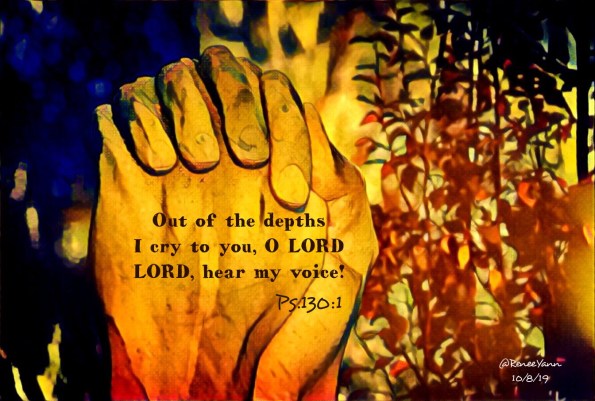
Our Responsorial Psalm 130, a treasured and classic song of lament, shows us the transformative power of this kind of prayer. The one praying from the depths of her heart:
names her suffering
weeps with God because of it
begs deliverance
in the begging, relinquishes the outcome to God
receives peace in the relinquishment
is transformed by that peace and offers praise
Our Gospel offers us another classic example of types of prayer, that of contemplation and that of service. In the story, Mary is affirmed for her singular attention to the presence of Christ – her contemplative prayer. Martha, on the other hand, pays attention to Christ by her service. Some have interpreted Martha’s as a lesser form of prayer. However, Macrina Weirdekehr, in her new book “The Flowing Grace of Now”, gives us this powerful insight into Martha’s prayer:
“Mary’s listening annoys Martha, who is busy serving. Yet if the full truth be known, Martha was also sitting at the feet of the teacher. She is sitting at the feet of service. Later, after dinner was served, with Jesus gone and Mary retired for the evening, I envision Martha finally sitting down by herself, and listening to the experience of the evening. As she reviewed the evening and her lament in the midst of her service, perhaps she began to realize that all of this was part of the wisdom offered by the school of life. We learn by contemplating our daily struggles.”
(I so highly recommend this deeply beautiful book available from:











 Lavish Mercy