Precious

Monday of the Eighth Week in Ordinary Time
May 27, 2024

Today’s Readings:

https://bible.usccb.org/bible/readings/052724.cfm


Blessed be the God and Father of our Lord Jesus Christ,
who in great mercy gave us a new birth to a living hope
through the resurrection of Jesus Christ from the dead,
to an inheritance that is imperishable, undefiled, and unfading,
kept in heaven for you
who by the power of God are safeguarded through faith,
to a salvation that is ready to be revealed in the final time.
In this you rejoice, although now for a little while
you may have to suffer through various trials,
so that the genuineness of your faith,
more precious than gold that is perishable even though tested by fire,
may prove to be for praise, glory, and honor
at the revelation of Jesus Christ.
1 Peter 1:3-7


In this beautiful instruction from Peter, we find:

  • an exuberant rejoicing in God
  • an invitation to inextinguishable hope
  • a realistic appraisal of Christian life
  • a testament to the precious gift of faith.

Today, in God’s Lavish Mercy:

What is most precious to you in your life? And is your faith more precious than that? Peter gives us reason to answer “Yes”. Let’s pray with that today.


Prose: from C.S. Lewis, Mere Christianity, ch. 12

Now faith, in the sense in which I am here using the word, is the art of holding onto things your reason has once accepted, in spite of your changing moods. For moods will change, whatever view your reason takes. I know that by experience. Now that I am a Christian, I do have moods in which the whole thing looks very improbable; but when I was an atheist, I had moods in which Christianity looked terribly probable. This rebellion of your moods against your real self is going to come anyway. That is why faith is such a necessary virtue; unless you teach your moods “where they get off” you can never be either a sound Christian or even a sound atheist, but just a creature dithering to and fro, with its beliefs really dependent on the weather and the state of its digestion. Consequently one must train the habit of faith.
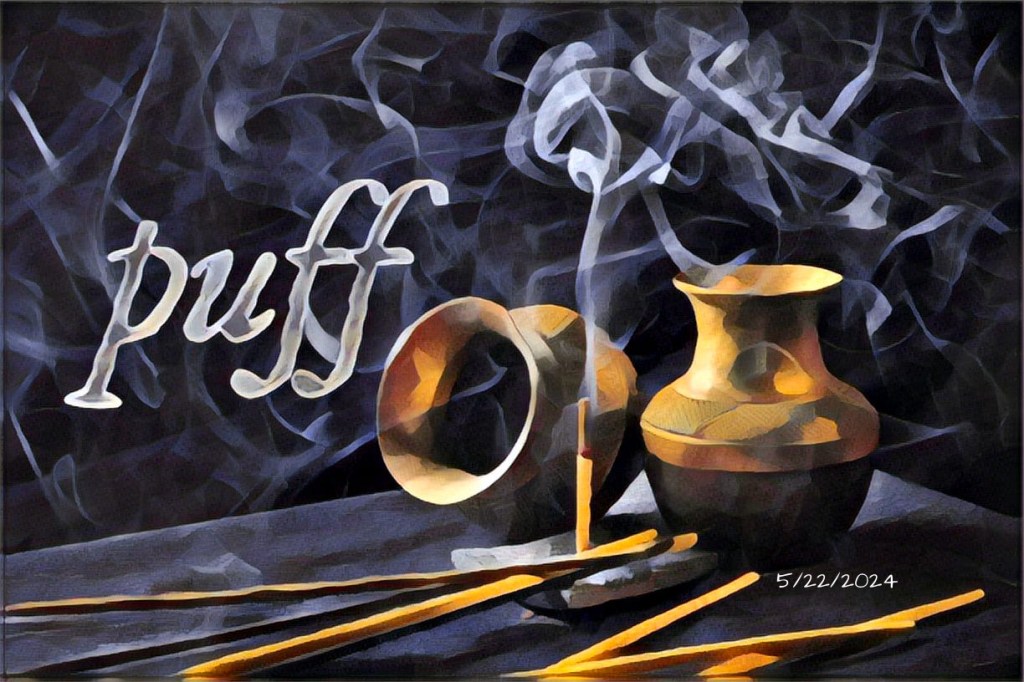

Puff…

Wednesday of the Seventh Week in Ordinary Time
May 22. 2024

Today’s Readings:

https://bible.usccb.org/bible/readings/052224.cfm


You have no idea what your life will be like tomorrow.
You are a puff of smoke that appears briefly and then disappears.
Instead you should say,
“If the Lord wills it, we shall live to do this or that.”
James 4:13-15


From the passages of these few days, it appears that James was a “no-nonsense”, fire and brimstone preacher. Instructing against pride and boastfulness, he forcefully reminds his listeners that they have no control over their lives. The only thing they can control is their commitment to God, and their openness to God’s Will.

Today, in God’s Lavish Mercy:
We pray in faith and trust to our God who loves us beyond our comprehension. Indeed, we do not know what tomorrow – or even this afternoon – will bring. But we ask for the strength and joy to receive our lives with hope and fidelity.


Poetry: by Joy Harjo

To pray you open your whole self

To sky, to earth, to sun, to moon

To one whole voice that is you

And know there is more

That you can't see, can't hear

Can't know except in moments

Steadily growing, and in languages

That aren't always sound but other

Circles of motion.

Music: Be Thou My Vision –
The text is based on a Middle Irish poem most attributed to Dallán Forgaill, an early Christian Irish poet born in 530 AD. Since the early 20th century, the text has been sung to an Irish folk tune, known in church hymnals as ‘Slane’.

Will

Thursday of the Seventh Week of Easter
May 16, 2024

Today’s Readings:

https://bible.usccb.org/bible/readings/051624.cfm


Lifting up his eyes to heaven, Jesus prayed saying:
“I pray not only for these,
but also for those who will believe in me through their word,
so that they may all be one,
as you, Father, are in me and I in you,
that they also may be in us,
that the world may believe that you sent me.
John 17:20-21


Over several Gospel readings, we have been blessed to pray with the prayers of Jesus. Just before today’s passage, Jesus has consecrated those sitting around him who are his friends. In today’s extraordinary moment, Jesus blesses us – and all those down through the ages – who will to believe in Him.

Of course, faith is a gift we cannot acquire through our own effort. The consolation of faith, the feeling of faith, is something that sometimes evaded even the greatest saints. St. John of the Cross writes extensively about the “dark night of the soul” during which he had no emotional awareness of faith. At times, St. Thérèse of the Child Jesus, Mother Theresa and even Jesus himself suffered a sense of isolation from God:

Jesus cried out in a loud voice,
“Eli, Eli, lema sabachthani?” which means,
“My God, my God, why have you forsaken me?”

Matthew 27:46

Today, in God’s Lavish Mercy:

Even when we find ourselves in a spiritual desert, we still can will to believe by opening our heart and experience to the grace God offers us – by our trust, our perseverance in prayer, and our patience with our own uncertainty.

Spiritual darkness, received as a gift, can reveal an otherwise undiscovered dimension of God’s Love for us.


Poetry: The Uses of Sorrow – Mary Oliver

Someone I loved once gave me
a box full of darkness.

It took me years to understand
that this, too, was a gift.

Music: One Dark Night – John Michael Talbot

In this beautiful music, Talbot recants lines based on the Song of Songs and the writings of St. John of the Cross – poetic imagery that strives to describe encounter with God.

One dark night
Fired with love’s urgent longings
Ah, the sheer grace
In the darkness
I went out unseen
My house being all now still

In the darkness
Secured by love’s secret ladder
Disguised
Oh, the sheer grace
In the darkness
And in my concealment
My house being all now still

On that glad night
In the secret, for no one saw me
Nor did I see any other thing at all
With no other light to guide me
Than the light burning in my heart

And this light guided me
More surely than the light of the noon
To where he lay waiting for me
Waiting for me
Him I knew so well
In a place where no one else appeared

Oh guiding night
A light more lovely than the dawn
A night that has united
Ever now
The Lover now with his beloved
Transforming two now into one

Upon my flowering breast
There he lay sleeping
Which I kept for him alone
And I embraced him
And I caressed him
In a breeze blowing from the forest

And when this breeze blew in from the forest
Blowing back our hair
He wounded my soul
With his gentle hand
Suspending all my senses

I abandoned, forgetting myself
Laying my face on my Beloved
All things ceasing, I went out from myself
To leave cares
Forgotten with the lilies of the field

Suffering

Good Friday of the Lord’s Passion
March 29, 2024

Today’s Readings:

https://bible.usccb.org/bible/readings/032924.cfm


Who would believe what we have heard?
To whom has the arm of the LORD been revealed?
He grew up like a sapling before him,
like a shoot from the parched earth;
there was in him no stately bearing to make us look at him,
nor appearance that would attract us to him.
He was spurned and avoided by people,
a man of suffering, accustomed to infirmity,
one of those from whom people hide their faces,
spurned, and we held him in no esteem.

Yet it was our infirmities that he bore,
our sufferings that he endured,
while we thought of him as stricken,
as one smitten by God and afflicted.

Isaiah 53:1-4

Good Friday: when we stand awestruck before an Infinite Power Who chooses to suffer for the sake of Love.

We can neither comprehend such Love nor explain it. Before it, the words “why”, “how”, and “if” dissipate in futility. Such Love simply is, has always been, and will always be – Creator, Redeemer, and Holy Spirit.

Today, in God’s Lavish Mercy:
Let us kneel in humble gratitude before this Infinite Love. By our own sufferings, may we learn a holy obedience – an ability to hear the heart of God crying in our world. May we tender God’s heart, broken over the willful selfishness of humankind. May we give ourselves to its healing.


Adoramus Te, Christe,
et benedicimus tibi,
quia per sanctam crucem tuam
redemisti mundum.
Qui passus es pro nobis,
Domine, Domine, miserere nobis
We adore Thee, O Christ,
and we bless Thee,
who by Thy Holy Cross
hast redeemed the world.
Thou, who hast suffered death for us,
O Lord, O Lord, have mercy on us.

Flint

Wednesday of Holy Week
March 27, 2024

Today’s Readings:

https://bible.usccb.org/bible/readings/032724.cfm


The Lord GOD is my help,
therefore I am not disgraced;
I have set my face like flint,
knowing that I shall not be put to shame.
He is near who upholds my right;
if anyone wishes to oppose me,
let us appear together.
Who disputes my right?
Let him confront me.
See, the Lord GOD is my help;
who will prove me wrong?

Isaiah 50: 7-8

Have you had moments in your life when you’ve said to yourself, “This is it. Like it or not, face the music.”?

Some of these times are unhappy, even scary. Some of them are just overwhelming. But they are times when we realize we have no choice but to go forward – that the time has come for whatever the life-changing reality is before us.

Jesus is at such a moment. All the energies of his life have now converged to this confrontational moment where he fully discovers his Oneness with the Father and Holy Spirit.

Today, in God’s Lavish Mercy:

We examine our own lives, and the shared life we live in the global community. How might the pattern of Jesus’s life, particularly in these critical moments, teach us the way to holiness and wholeness?


Poetry: from Philippians 2

I have always found this passage from Philippians to speak so much more than the printed words which carry it.

Let each of you look not only to your own interests, 
but also to the interests of others.
Have this mind among yourselves,
which was in Christ Jesus, who,
though he was in the form of God,
did not consider equality with God
something thing to be grasped at,
but emptied himself,
taking the form of a servant,
being born in human likeness.
And being found in human form,
he humbled himself and became obedient unto death,
even death on a cross.
Therefore God has highly exalted him
and bestowed on him the name
which is above every other name,
so that at Jesus' Name, every knee should bend,
in heaven and on earth and under the earth,
and every tongue proclaim
to the glory of God the Father,
that Jesus Christ is Lord.

Music: Philippians Canticle – John Michael Talbot

As we begin Holy Week…

Holy Week and Eastertide

Holy Week and Eastertide are times of sacred journey for Christians. We walk with Christ into the true and deepest dimensions of our lives.

All life is about journey and passage. At some time in each of our lives, we are passing:

  • from emptiness to abundance
  • from loneliness to love
  • from exhaustion to renewal
  • from anxiety to peace
  • from burden to freedom
  • from confusion to understanding
  • from bitterness to forgiveness
  • from pain to healing
  • from mourning to remembrance

The great Feasts of Holy Week and Easter, and the reflective weeks that follow, assure us that God accompanies us in all our journeys from darkness to light. The sacredness of these days invites us to quietly name whatever darkness surrounds us and our global family, and to reach through it to the hand of God. Like a parent leading a child in from the storm, the God of Easter longs to bring our hearts home to fullness and joy.

During these coming weeks, I will continue offering reflections centered on a single word, since many of you have expressed to me an appreciation for this approach. In the archives listed on the right of the blog, you can access more extensive reflections for each day of the liturgical cycle, accumulated over the past six years.

As we begin these sacred days, let’s pray for one another. And let us pray particularly for those whose current lives are closely patterned on the sufferings of Christ that, with Him, they may be strengthened with Easter hope and courage.

Whisperings

Friday of the Fifth Week of Lent
March 22, 2024

Today’s Readings:

https://bible.usccb.org/bible/readings/032224.cfm


I hear the whisperings of many:
“Terror on every side!
Denounce! let us denounce him!”
All those who were my friends
are on the watch for any misstep of mine.

Jeremiah 20:10

Oh, the deadly power of a fragile whisper! Its insidious influence seeps into souls, germinates, and grows into fictional suggestions, untested prejudices, and effective shunning by the “in” set.

Whispers are the emanations of fear – we may fear what is different, what we cannot control, what challenges us, what actually exposes pretense in us.

Jeremiah and Jesus encountered the ugly entanglement of such whispers. But they were not trapped because they believed.

Today, in God’s Lavish Mercy:
We pray their prayer for ourselves and for all who suffer the persecution of “whisperings”.

The LORD is with me, like a mighty champion:
my persecutors will stumble, they will not triumph.
O LORD of hosts, you who test the just,
who probe mind and heart,
Let me witness the recompense you take on them,
for to You I have entrusted my cause.


Poetry: A Word – Emily Dickinson

A word is dead
When it is said,
Some say.
I say it just
Begins to live
That day.

Music: from Handel’s Messiah: He trusted in God that He would deliver him

Cloak

Friday of the Second Week of Lent
March 1, 2024

Today’s Readings:

https://bible.usccb.org/bible/readings/030124.cfm


Israel loved Joseph best of all his sons,
for he was the child of his old age;
and he had made him a beautiful long cloak.
When his brothers saw that their father loved him best of all his sons,
they hated him so much that they would not even greet him.

Genesis 37: 3-4

Joseph, beloved of his father Jacob, wore a multi-colored expression of his father’s love. Because others were jealous of this love, Joseph, the innocent one, was persecuted. Nevertheless, he endured and eventually forgave his brothers, giving them the means for a new life.

Joseph is a prototype of Jesus, the Beloved Son who displayed his Father’s love by his life of mercy. Jesus, Supreme Innocence, was persecuted too, endured death, forgave his persecutors, and gave us new life.

Today, in God’s Lavish Mercy:

In my prayer, I ask myself what patterns of Joseph and Jesus do I see in my world? Where do I see Innocence suffering? Where do I see mercy offered rather than persecution? Where do I see the need for acknowledgement and forgiveness?

Where do I see these things in my wider world and in myself? My awareness and response is the way I walk with Christ this Lent.


Poetry: Joseph’s Coat – George Herbert (1593-1633), English poet, orator, priest, and venerated Saint of the Church of England.

Herbert’s poem suggests that through the “joyes” and “griefs” of life, one finds sanctification only through God’s love and mercy. His imagery references Joseph’s downfall at the hands of his brothers and restoration through God’s design

Wounded I sing, tormented I indite,
Thrown down I fall into a bed, and rest:
Sorrow hath chang’d its note: such is his will,
Who changeth all things, as him pleaseth best.
For well he knows, if but one grief and smart
Among my many had his full career,
Sure it would carrie with it ev’n my heart,
And both would runne untill they found a biere
To fetch the bodie; both being due to grief.
But he hath spoil’d the race; and giv’n to anguish
One of Joyes coats, ticing it with relief
To linger in me, and together languish.
I live to shew his power, who once did bring
My joyes to weep, and now my griefs to sing.

Music: Coat of Many Colors – Brandon Lake

Cup

Wednesday of the Second Week of Lent
February 28, 2024

Today’s Readings:

https://bible.usccb.org/bible/readings/022824.cfm


Then the mother of the sons of Zebedee approached Jesus with her sons
and asked …
“Command that these two sons of mine sit,
one at your right and the other at your left, in your kingdom.”
Jesus said in reply,
“You do not know what you are asking.
Can you drink the chalice that I am going to drink?”
They said to him, “We can.”
He replied,
“My chalice you will indeed drink,
but to sit at my right and at my left,
this is not mine to give
but is for those for whom it has been prepared by my Father.”

Mark 10:20-23

In our Gospel, Jesus makes it clear that the path to heavenly glory is bound by a spiritual discipline that, in this contrary world, will cause us suffering. The cup is that chasm in life where we must choose peace over violence, generosity over selfishness, mercy over judgment, truth over deception, love over indifference. There will be resistance, both within us and around us, when we make such choices.

Today, in God’s Lavish Mercy:

Let’s be honest with ourselves as we answer Jesus’s question:
“Can you drink the cup that I will drink?”
Let’s pray for the grace to drink that cup as it comes to us in the particularities of our own lives.
Let’s ask for the spiritual confidence and understanding that the cup – our cup – leads to eternal life.


Poetry: Can You Drink the Cup? – by Scott Surrency, O.F.M. Cap. (2015)

I found this poem on the website https://thejesuitpost.org/2015/10/can-you-drink-the-cup/

Can you drink the cup?
Drink, not survey or analyze,
ponder or scrutinize –
from a distance.
But drink – imbibe, ingest,
take into you so that it becomes a piece of your inmost self.
And not with cautious sips
that barely moisten your lips,
but with audacious drafts
that spill down your chin and onto your chest.
(Forget decorum – reserve would give offense.)
Can you drink the cup?
The cup of rejection and opposition,
betrayal and regret.
Like vinegar and gall,
pungent and tart,
making you wince and recoil.
But not only that – for the cup is deceptively deep –
there are hopes and joys in there, too,
like thrilling champagne with bubbles
that tickle your nose on New Year’s Eve,
and fleeting moments of almost – almost – sheer ecstasy
that last as long as an eye-blink, or a champagne bubble,
but mysteriously satisfy and sustain.
Can you drink the cup?
Yes, you — with your insecurities,
visible and invisible.
You with the doubts that nibble around the edges
and the ones that devour in one great big gulp.
You with your impetuous starts and youth-like bursts of love and devotion.
You with your giving up too soon – or too late – and being tyrannically hard on yourself.
You with your Yes, but’s and I’m sorry’s – again.
Yes, you – but with my grace.
Can you drink the cup?
Can I drink the cup?
Yes.

Music: We Will Drink the Cup

We will drink the cup.
We will win the fight.
We will stand against the darkness of the night.
We will run the race
And see God’s face,
And build the Kingdom of love.

Do not fear for I am with you.
Be still and know that I am God.

You will run and not grow weary,
For I your God will be your strength.
Refrain

We are the Church, we are the Body.
We are God’s great work of art.

And build the Kingdom of love.

Trust not Fear

Memorial of Saint Cecilia, Virgin and Martyr
Wednesday of the Thirty-third Week in Ordinary Time
November 22, 2023

Today’s Readings:

https://bible.usccb.org/bible/readings/112223.cfm


Today, in God’s Lavish Mercy, our two readings are dramatically intense. 

Who can read the story of the Maccabean Martyrs without a mix of horror, empathy, and astonishment?

It happened that seven brothers with their mother were arrested
and tortured with whips and scourges by the king,
to force them to eat pork in violation of God’s law.
Most admirable and worthy of everlasting remembrance was the mother,
who saw her seven sons perish in a single day,
yet bore it courageously because of her hope in the Lord.

2 Maccabees 7: 1;20

And don’t we all feel a pang of pity for the poor, fearful servant who hid his talent in a handkerchief much to the King’s displeasure?

‘Sir, here is your gold coin;
I kept it stored away in a handkerchief,
for I was afraid of you, because you are a demanding man;
you take up what you did not lay down
and you harvest what you did not plant.’
He said to him,
‘With your own words I shall condemn you,
you wicked servant.
You knew I was a demanding man,
taking up what I did not lay down
and harvesting what I did not plant;
why did you not put my money in a bank?

Luke 19:20-23

The two stories paint a contrasting picture of courageous faith against fearful subservience. The difference between the actors lies in their capacity, or lack thereof, to look beyond themselves toward eternal life.

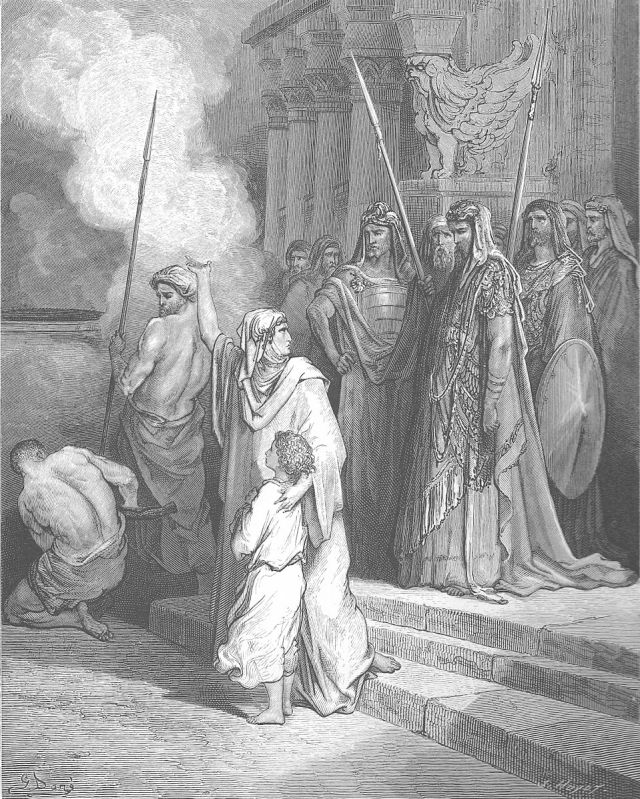
The Courage of a Mother – Gustave Doré

Mother Maccabee bolsters her sons with her faith in a life beyond their current circumstances:

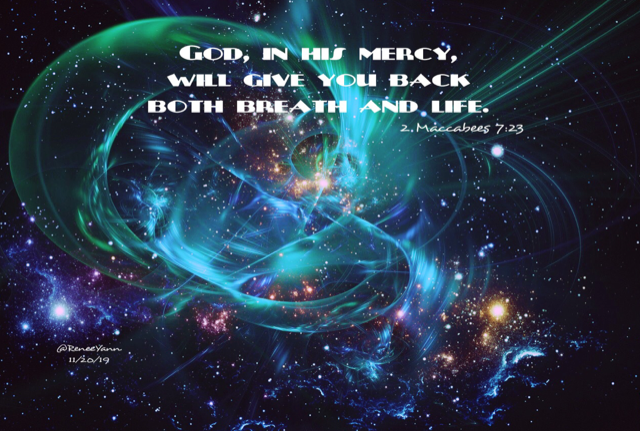
… the Creator of the universe
who shapes each man’s beginning,
as he brings about the origin of everything,
he, in his mercy,
will give you back both breath and life,
because you now disregard yourselves
for the sake of his law.


The poor soul in Jesus’s parable doesn’t have that faith and vision. His perception of God, represented by the King, is one of only harsh judgment. His fear causes him to bury not only his talent, but also his openness to the possibilities of grace and transformed relationship with God.


Jesus told his parable because indeed the Kingdom was at hand. He and his disciples were near Jerusalem where the Passion, Death and Resurrection events would begin.

He wants his followers to realize the challenging gift they have been given in their call to be his disciples. He wants them to see that it is now on them to magnify his message courageously and generously until he returns to perfect the Kingdom.

He wants us to understand that too.


Poetry – John Milton, Sonnet 19

Milton (1608- 1674) is widely considered one of the preeminent writers of the English language. By 1652, Milton had become totally blind and had to dictate his verse. He appears to wonder, in this sonnet, how his God-given talent for writing will be enhanced now that he is “light denied”. He looks to another parable for his answer – the Parable of the Workers. Even those who only stood and waited were rewarded.

When I consider how my light is spent,
Ere half my days, in this dark world and wide,
And that one Talent which is death to hide
Lodged with me useless, though my Soul more bent
To serve therewith my Maker, and present
My true account, lest he returning chide;
“Doth God exact day-labor, light denied?”
I fondly ask. But patience, to prevent
That murmur, soon replies, “God doth not need
Either man’s work or his own gifts; who best
Bear his mild yoke, they serve him best. His state
Is Kingly. Thousands at his bidding speed
And post o’er Land and Ocean without rest:
They also serve who only stand and wait.”

Music:   Be Not Afraid – written by Bob Dufford, SJ, sung here by Cat Jahnke