The Indescribable Gift

Thursday of the Tenth Week in Ordinary
June 15, 2023

Today’s Reading:

https://bible.usccb.org/bible/readings/061523.cfm
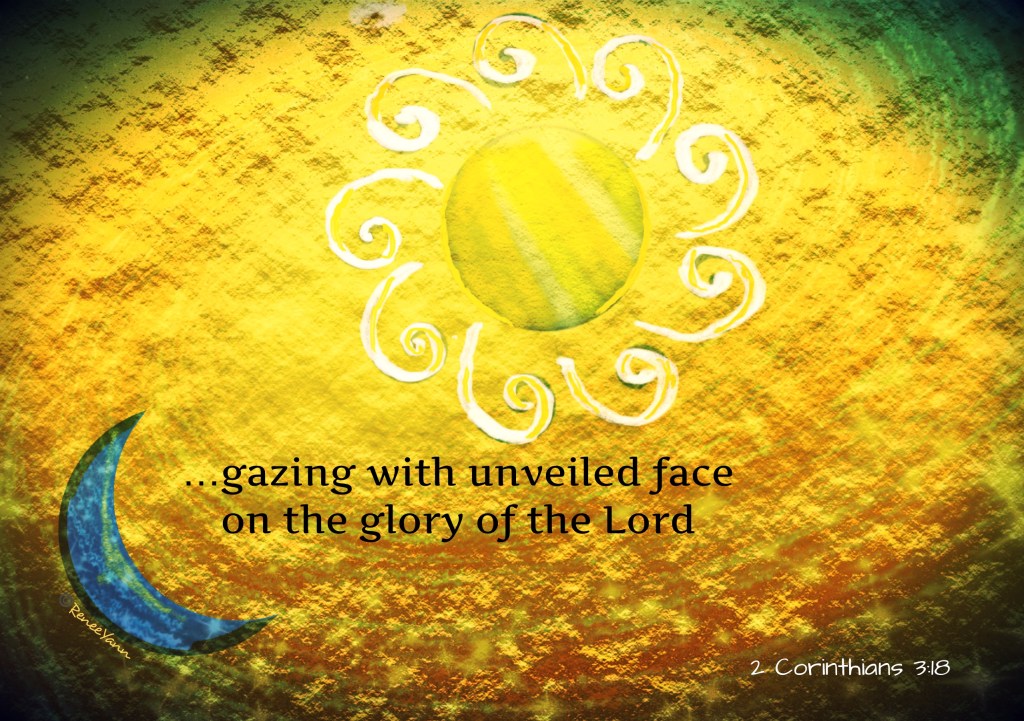

Today, in God’s Lavish Mercy, our readings offer us insight into spiritual clarity.

For sure I, like all of you reading this blog, want to know God more deeply.
Moses did.
The people of the Hebrew Scriptures did.
But Paul tells us in our first reading that they didn’t have the advantage – the “indescribable gift” – that we have: Jesus, the Incarnate Word of God.

To this day, whenever Moses is read,
a veil lies over the hearts of the children of Israel,
but whenever a person turns to the Lord the veil is removed.
Now the Lord is the Spirit and where the Spirit of the Lord is,
there is freedom.

2 Corinthians 3:15-17

Paul says that despite this gift, some of us, blinded by “the god of this age” may remain in darkness:

And even though our Gospel is veiled,
it is veiled for those who are perishing,
in whose case the god of this age
has blinded the minds of the unbelievers,

2 Corinthians 4:3-4

Paul compares this blocked vision to a veil covering our eyes and distancing us from the fullness of God.

It’s a great image! Don’t we unconsciously cover our eyes when we don’t want to see what’s really going on? Don’t we cast our own glance downward to obscure our eyes when we are unsure of ourselves or, maybe, telling a white lie?


This morning, when I read about Paul’s “veil”, I remembered a funny but instructive incident from my childhood. I was about seven years old and had been sent to my room for some egregious infraction of household law. Convinced of my innocence and righteousness, I pouted there until Mom called me downstairs for dinner.

Still angry, I didn’t want to go, so I decided not to “face” my family at the dinner table. Probably, deep in my heart, I knew I had been wrong but didn’t yet have the freedom to “face” myself. So, employing a pair of Mom’s old sunglasses and Grandpop’s handkerchief, I appeared at the dinner table like this – “veiled”. (Believe me, it was no fun trying to eat my mashed potatoes that way!)


I am a long, long way from that bratty little girl now. But there are still places in my life where I want to reach for the hanky and the glasses because I’m not ready for God’s overwhelming grace offered to me in every life circumstance. So often, I am still convinced that I see the darkness that I see, rather than the Mystery within it inviting me to Light..

For God who said, “Let light shine out of darkness”,
has shone in our hearts to bring to light
the knowledge of the glory of God
on the face of Jesus Christ.

1 Corinthians 4:6

Back when I was seven years old, it was Uncle Joe who teased me, with a gentle love, out of my peevishness. Maybe God is trying to do that for you, for me, today. What do you think?

(Uncle Joe and me, about 35 years after the described incident.)


Poetry: from Rumi

Your thoughts are a veil 
on the face of the Moon.

That Moon is your heart,
and those thoughts cover your heart.

So let them go,
just let them fall into the water.

Music: Heaven’s Window – Peter Kater – you will hear a gentle call to Agnus Dei, Jesus Lamb of God as the music lifts the veil to heaven. Just relax and let the music lift you too.

Choose to Believe

Saturday of the Twenty-fourth Week in Ordinary Time
September 17, 2022

Today’s Readings:

https://bible.usccb.org/bible/readings/091722.cfm

Today, in God’s Lavish Mercy, Paul strongly confronts the doubts of the Corinthian community regarding the Resurrection.

Someone may say, “How are the dead raised? 
With what kind of body will they come back?”
You fool!

1 Corinthians 15:35

Remember that these post-Resurrection Christians had expected an immediate Parousia, or end of time. They thought that with the completion of Christ’s redemptive act, that was it! Time for heaven for all us believers. Yippee!

Well, not so fast!

When Parousia didn’t happen, the people grew a little confounded. They began to awaken to  the hard lesson  that redemption is not time-bound, but continues in the timeless gift of grace given to new generations. It is up to us to work through our own lives to become one with the Pascal Mystery of Christ.

In the miracle of God’s eternity, each of us has the chance to engage the power of Christ’s Passion, Death and Resurrection by the faithful living of our own lives – no matter if we have lived in the first or the twenty-first century. 


God doesn’t do “time” and doesn’t have a calendar.

But still I feel for those struggling Corinthians! It’s hard to believe sometimes, don’t you agree? It’s hard to wade through the sometimes tumultuous unfolding of our lives and history to find God.

When I taught eighth graders many years ago, one intelligent young girl asked me this question:

What if everything you believe is wrong? 
Was the way you live your life worth it?

It was a powerful question and it has stayed with me for half a century. I continue to ask myself versions of the same question especially when I can’t find God in the circumstances of my life or world – when children are sick, or old people suffer, or human beings dreadfully hurt one another – and I have no answers.

Like the early Corinthians, I ask God, “Where are You? I thought your Resurrection healed all this? I thought You had redeemed our suffering world! 


Paul and Jesus, in our readings today, give us images to help us mature in a long and lasting faith that doesn’t answer but receives these questions with trust and hope.

What you sow is not brought to life unless it dies.
And what you sow is not the body that is to be
but a bare kernel of wheat, perhaps, or of some other kind.

So also is the resurrection of the dead.
It is sown corruptible; it is raised incorruptible.
It is sown dishonorable; it is raised glorious.
It is sown weak; it is raised powerful.
It is sown a natural body; it is raised a spiritual body.
If there is a natural body, there is also a spiritual one.

1 Corinthians 15

By faith, the power of Christ’s Resurrection has been sown in us like a seed. Because we are creatures of time, that power needs time to root itself in every aspect of our lives – our choices, actions, our very nature.

Jesus tells us that God is sowing the seeds of the Resurrection in our lives. Our job is simply provide good soil by choosing to believe and act on God’s Word.

“This is the meaning of the parable. 
The seed is the word of God.
Those on the path are the ones who have heard,
but the Devil comes and takes away the word from their hearts
that they may not believe and be saved.
Those on rocky ground are the ones who, when they hear,
receive the word with joy, but they have no root;
they believe only for a time and fall away in time of temptation.
As for the seed that fell among thorns,
they are the ones who have heard, but as they go along,
they are choked by the anxieties and riches and pleasures of life, 
and they fail to produce mature fruit.
But as for the seed that fell on rich soil,
they are the ones who, when they have heard the word,
embrace it with a generous and good heart,
and bear fruit through perseverance.”

Luke 8:5-11

Poetry: Flickering Mind – Denise Levertov

Lord, not you
it is I who am absent.
At first
belief was a joy I kept in secret,
stealing alone
into sacred places:
a quick glance, and away -- and back,
circling.
I have long since uttered your name
but now
I elude your presence.
I stop
to think about you, and my mind
at once
like a minnow darts away,
darts
into the shadows, into gleams that fret
unceasing over
the river's purling and passing.
Not for one second
will my self hold still, but wanders
anywhere,
everywhere it can turn.  Not you,
it is I am absent.
You are the stream, the fish, the light,
the pulsing shadow.
You the unchanging presence, in whom all
moves and changes.
How can I focus my flickering, perceive
at the fountain's heart
the sapphire I know is there?

Music: Out of Time – Liz Story

Alleluia: Be Love!

June 9, 2022
Thursday of the Tenth Week in Ordinary Time

Today, in God’s Lavish Mercy, our Alleluia Verse holds the complete essence of Jesus’s life. If there ever was glorious “nutshell”, this is it:

Alleluia, alleluia.
I give you a new commandment:
love one another as I have loved you. (Jn. 13:34)

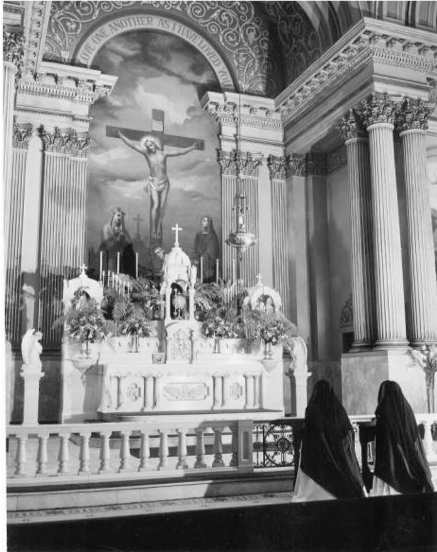
Our motherhouse chapel is breathtakingly beautiful. Thinking of it as a “chapel”, people who first walk through its doors are astounded at itscathedral-like dimensions. I know I certainly was as a wonder-struck eighteen-year-old on my first visit.

Our Chapel in the 1950s

For the next almost three years, I often sat in my little pew pondering the chapel’s central mural — and especially the words framing it.

The words are an invitation and a command. The painting beneath is the whole instruction on Love… “…love as I have loved you.”

After those initial years, I chose those precious words for the motto to be engraved on my ring. I have prayed ever since that it might someday be engraved on my heart. In a culture that can so misunderstand the nature of love, I always appreciate the chance to visit that altar or to look at that ring.

May we have the courage to be
“Alleluia Lovers”
in this love-hungry world!

Poetry: from one of the greatest poets, Paul in his letter to the Corinthians

If I speak in the tongues in human or angelic tongue 
but have not love,
I am a noisy gong or a clanging cymbal.
And if I have prophetic powers, and understand all mysteries and all knowledge,
and if I have all faith, so as to remove mountains,
but have not love,
I am nothing.
If I give away all I have,
and if I deliver up my body to be burned,
but have not love,
I gain nothing.
Love is patient and kind; 
love does not envy or boast;
it is not arrogant or rude.
It does not insist on its own way;
it is not irritable or resentful;
it does not rejoice at wrongdoing,
but rejoices with the truth.
Love bears all things,
believes all things,
hopes all things,
endures all things.
Love never ends. 
As for prophecies, they will pass away;
as for tongues, they will cease;
as for knowledge, it will pass away.
For we know in part and we prophesy in part,
but when the perfect comes, the partial will pass away.
When I was a child, I spoke like a child,
I thought like a child, I reasoned like a child.
When I grew up, I gave up childish ways.
For now we see in a mirror dimly, but then face to face.
Now I know in part; then I shall know fully,
even as I have been fully known.
So now faith, hope, and love abide, these three; 
but the greatest of these is love.

Music: Love Never Ends – by The Corner Room

Three Holy Secrets

February 13, 2022
Sixth Sunday in Ordinary Time

Today, in God’s Lavish Mercy, hidden in our readings, are three challenges:

Where do we place our FAITH?
How do we fire our HOPE?
How do we LOVE?


In our Jeremiah reading, an unfortunate person has placed faith in an untrustworthy “friend”, and the results – typical of Jeremiah – are dire. But the prophet goes on to say that the one who puts trust and faith in the Lord will flourish like a tree near running water.

In the reading from Corinthians, Paul has some strong words about hope:

If for this life only we have hoped in Christ,
we are the most pitiable people of all.

1 Corinthians 15:19

That sentence is powerful! It can be a life-long meditation.

In other words, where is our hope focused? Do we hope for comfort, success, healing, peace only for this earthly life? If so, we are missing the point, Paul says. Our one true hope is to be united with God in eternal life and our choices should lead to that fulfillment.


In our Gospel, Jesus shows us how to love by placing before us the “least ones” whom he loves best. We too are to love and comfort those who are poor, hungry, bereaved and despised by the heartless.


Today’s readings invite us to look at our life. Is it blossoming with joy, grace and spiritual vitality? Or are we struggling with all the doubts, worries, dramas and depression that come from a self-absorbed life?

Maybe, like me, you sometimes look at a person carrying great difficulty in their lives and wonder at their joy. How can they maintain that trust and joy in the midst of their challenges? These readings offer an answer. They have put their faith and hope in the right place. They have learned to love like God loves.


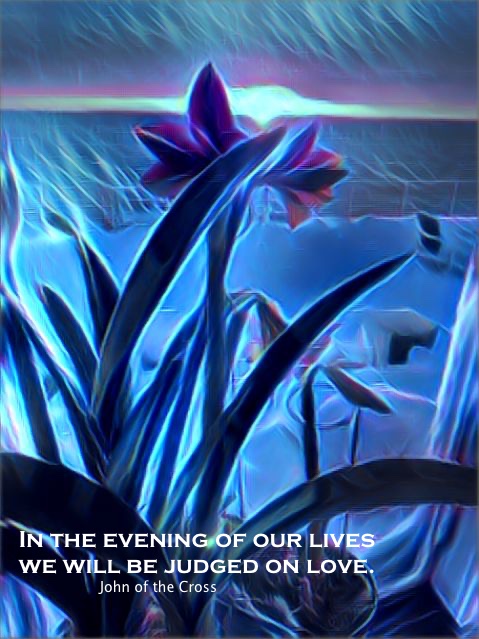
St. John of the Cross

Poetry: Bernard of Clairvaux, On the Song of Songs, vol. 4, 83.2.4.

I love because I love:
I love that I may love…
Love is the only one of the motions of the soul,
of its senses and affections,
in which the creature can respond to its Creator,
even if not as an equal,
and repay God’s favor in some similar way …


Music: Faith, Hope and Love ~ David Ogden ( Lyrics below)

Faith, hope, and love: let these remain among you.
Faith, hope, and love: the greatest of these is love.

The love of Christ has gathered us together; let us rejoice and be glad in him.
Let us fear and love the living God, and love each other from the depths of the heart.

When we are together, we should not be divided in mind;
Let there be an end to bitterness and quarrels, and in our midst be Christ our God.

In company with the blessed, may we see your face in glory,
pure and unbounded joy for ever and ever.

I give you a new commandment, love one another as I have loved you.
Faith, hope, and love, let these remain among you.
Faith, hope and love; the greatest of these is love.

Psalm 24: Vanity, Vanity

Memorial of Saint Gregory the Great, Pope and Doctor of the Church

Thursday, September 3, 2020


Today, in God’s Lavish Mercy, we pray with Psalm 24 which encourages us to be sinless, pure of heart, and humble. And that’s hard!

Who can ascend the mountain of the LORD?
or who may stand in his holy place?
He whose hands are sinless, whose heart is clean,
who desires not what is vain.


Do you remember the song “You’re So Vain”? Here is a reminder.

The song expresses a common understanding of the word “vanity”:

excessive pride in or admiration of one’s own appearance or achievement


We all know people who seem to think they’re hot stuff. Maybe we’re even one of them! But I think that often a person behaving vainly really is quite unsure of himself.

The apparent vanity is a veneer to hide the emptiness inside. It is a veiled fear that, rather than being “all that”, one is really “not enough”.

The word vanity comes from the Latin root vanus which means empty – not “empty” with a readiness to be filled. Instead it connotes an emptiness that rattles with accumulated pretenses and falsehoods. It is a place of loud but lonely echoes.


Paul addresses this kind of emptiness when he writes to the Corinthians. He tells them not to get caught up in the contest of human vanity because we already are sufficient in God’s love and grace. Everything important is already ours in Christ, in God.

So let no one boast about human beings, for everything belongs to you,
Paul or Apollos or Cephas,
or the world or life or death,
or the present or the future:
all belong to you, and you to Christ, and Christ to God.


Psalm 24 assures us that to participate in this blessing, to be embraced by God’s favor only this is sufficient:

Who can stand in God’s holy place?
The clean of hand and pure of heart,
who have not given their soul to useless things,
to what is vain.
They will receive blessings from the LORD,
and justice from their saving God.


Poetry: Vanity by George Herbert

The fleet astronomer can bore 
And thread the spheres with his quick-piercing mind: 
He views their stations, walks from door to door, 
         Surveys, as if he had designed 
To make a purchase there; he sees their dances, 
                   And knoweth long before 
Both their full-eyes aspècts, and secret glances. 
         
         The nimble diver with his side 
Cuts through the working waves, that he may fetch 
His dearly-earnèd pearl, which God did hide 
         On purpose from the venturous wretch; 
That he might save his life, and also hers 
                   Who with excessive pride 
Her own destruction and his danger wears. 
         
         The subtle chymic can divest 
And strip the creature naked, till he find 
The callow principles within their nest: 
         There he imparts to them his mind, 
Admitted to their bed-chamber, before 
                   They appear trim and dressed 
To ordinary suitors at the door. 
         
       What hath not man sought out and found, 
But his dear God? who yet his glorious law 
Embosoms in us, mellowing the ground 
         With showers and frosts, with love and awe, 
So that we need not say, “Where’s this command?” 
                   Poor man, thou searchest round 
To find out death, but missest life at hand.

Song: As We Seek Your Face – Divine Hymns

Shine!

Fifth Sunday in Ordinary Time

February 9, 2020

Click here for readings

Today, in Mercy, our readings are threaded on a theme of light, justice, and healing.

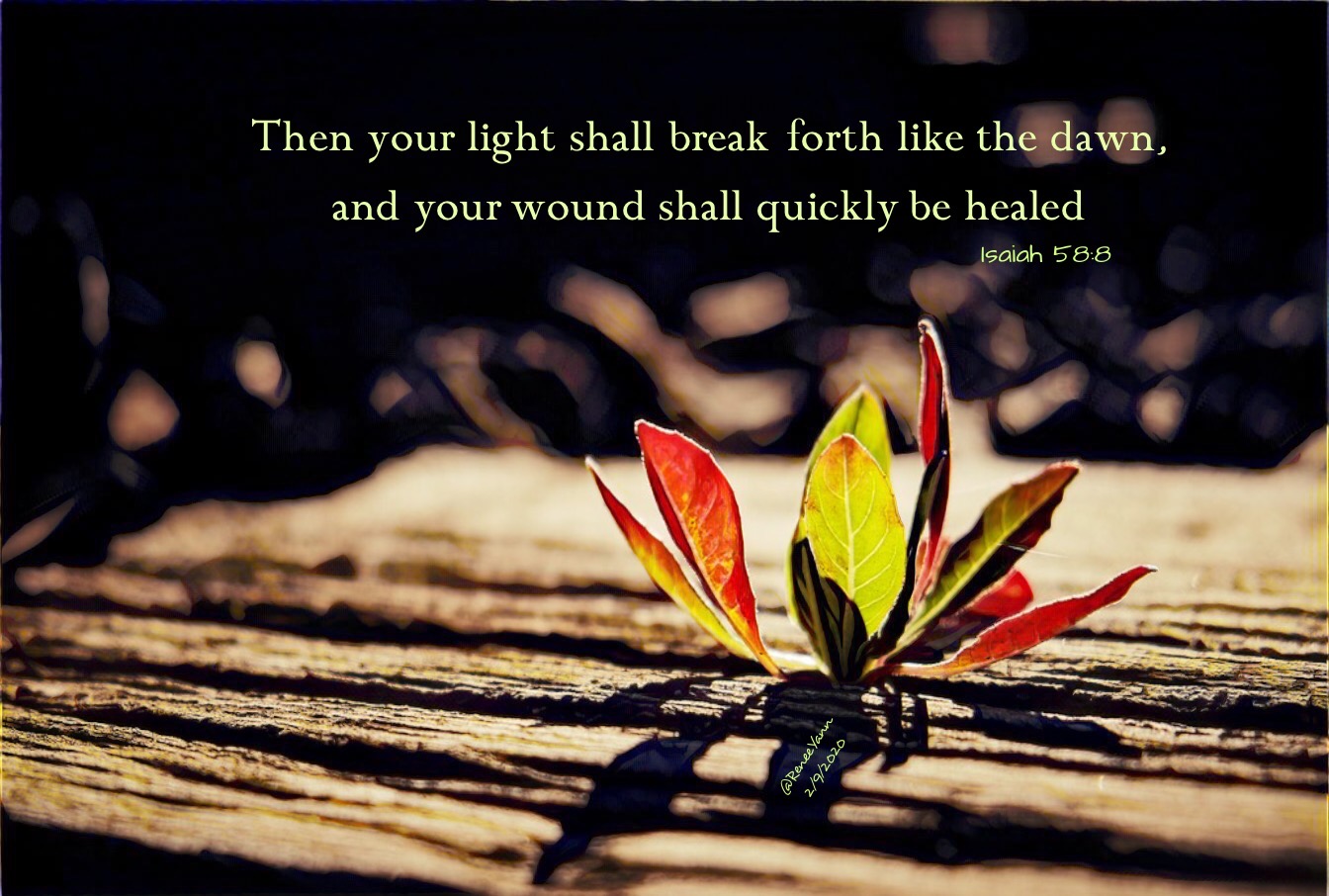
Is58_8wound

Isaiah writes to a formerly exiled community trying to restore itself after returning to Jerusalem. Tensions, meanness, and dissatisfactions tear at the community. Focus on religious rituals becomes excessive while communitarian practices are ignored.

It is a sad and fractious time for Israel.

Isaiah tells them they are missing the whole point.  The path to healing their national soul is not through empty religious words and practices.

If you remove from your midst
oppression, false accusation and malicious speech;
if you bestow your bread on the hungry
and satisfy the afflicted;
then light shall rise for you in the darkness,
and the gloom shall become for you like midday.


In our second reading, Paul writes to the Corinthian community similarly disturbed. He reminds the Corinthians that he came to build Christian community among them humbly and open to the Holy Spirit. Like Isaiah in the first reading, Paul now reminds his community not to miss the point:

I came to you in weakness …
so that your faith might rest
not on human wisdom

but on the power of God.


Jesus tells his disciples to let that power of God shine in them by virtue of their good deeds — the very same deeds Isaiah recommends to his listeners:

Share your bread with the hungry,
shelter the oppressed and the homeless;
clothe the naked when you see them,
and do not turn your back on your own.


In sum, our readings caution us that failures in charity and mercy wound us, both as individuals and as a community. Meanness kills – not only its object, but its subject as well.

When we remove all meanness from our actions, the Light shines, healing all our wounds.

Music:  Let Your Light Shine – Mike Balhoff and Darryl Ducote

A New Day Awaits

Sunday, March 31, 2019

Click here for readings

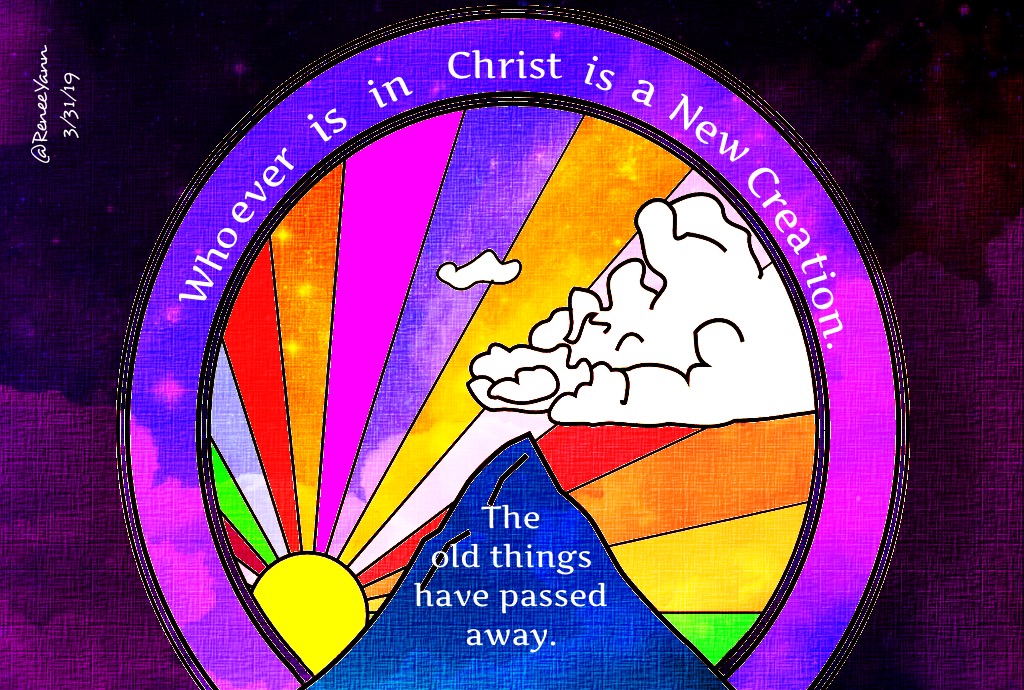
1 Cor new creation

Today, in Mercy,  halfway through Lent, we see in our readings glimpses of new life.

The captivity in Egypt had been TOUGH on Israel. During those many decades, they had appeared to be abandoned and forgotten by God.  It was a harsh reckoning for them … hard to be forgotten. Even then, when they thought they had found freedom, they still wandered for forty years in the desert.

But now Israel stands at a new horizon.  Moses has died and Joshua has become Israel’s leader.  God tells him that it is a new day:

“Today I have removed the reproach of Egypt from you.”

In our second reading, Paul tells us:

Whoever is in Christ is a new creation:
the old things have passed away;
behold, new things have come.

And in our revered Gospel story of the Prodigal Son, Jesus tells us:

This beloved child of mine was dead, and has come to life again;
was lost, and has been found.

All of these passages speak to us in our Lenten journey, and in our Life journey.  We have experienced our own “Egypts”, times when we felt disconnected, even abandoned, by God.  We have sometimes felt we were journeying aimlessly toward an unknown goal. We have at times wandered, like the prodigal son, from the path of God’s love. We have darknesses in our memories that still long for Light.

This poem from Mary Oliver might capture the feeling for us:

Someone I loved once gave me
a box full of darkness.
It took me years to understand
that this, too, was a gift.
~ Mary Oliver ~

In today’s readings, God is reminding us that the Light awaits us. Forgiveness, reconciliation, new energy and grace are the gifts of Easter – the gifts where we must keep our eyes focused as we journey.

So let us do as e.e.cummings encourages us in this poem:

Let It Go – e.e. cummings

let it go – the
smashed word broken
open vow or
the oath cracked length
wise – let it go it
was sworn to
go

let them go – the
truthful liars and
the false fair friends
and the boths and
neithers – you must let them go they
were born
to go

let all go – the
big small middling
tall bigger really
the biggest and all
things – let all go
dear

so comes love


Music: Remember Not the Things of the Past – Bob Hurd
(Lyrics below)

Remember not the things of the past;
now I do something new,
do you not see it?
Now I do something new, says the Lord.

In our distress God has grasped us by the hand,
opened a path in the sea, and we shall pass over,
we shall pass over, free at last.

In our parched land of hypocrisy and hate,
God makes a river spring forth,
a river of mercy, truth and compassion; come and drink.

And who among us is sinless in God’s sight?
Then who will cast the first stone, when he who was sinless
carried our failings to the cross?

Pressing ahead, letting go what lies behind,
may we be found in the Lord, and sharing his dying,
share in his rising from the dead.

Got Troubles? Try These!

Sunday, February  17, 2019

Click here for readings

Today, in Mercy, hidden in our readings, are three challenges.

Where do we put our

faith

and

hope

How do we

love

?


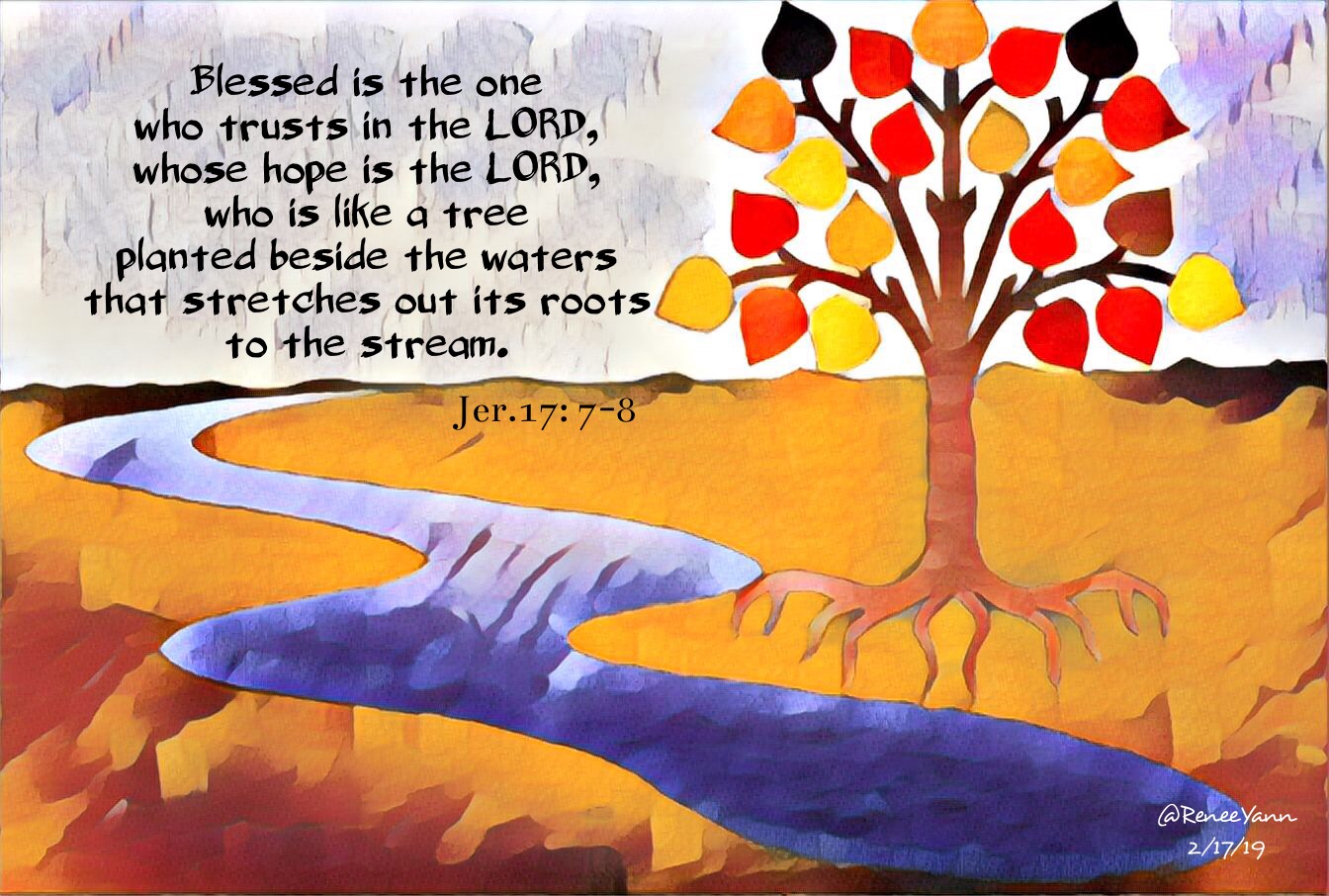
In our Jeremiah reading, an unfortunate person has placed faith in an untrustworthy “friend”, and the results – typical of Jeremiah – are dire. But the prophet goes on to say that the one who puts trust and faith in the Lord will flourish like a tree near running water.

Jer17_7 tree

In the reading from Corinthians, Paul has some strong words about hope:

If for this life only we have hoped in Christ,
we are the most pitiable people of all.

That sentence is powerful! It can be a life-long meditation.

In other words, where is our hope focused? Do we hope for comfort, success, healing, peace only for this earthly life? If so, we are missing the point, Paul says. Our one true hope is to be united with God in eternal life and our choices should lead to that fulfillment.

In our Gospel, Jesus shows us how to love by placing before us the “least ones” whom he loves best. We too are to love and comfort those who are poor, hungry, bereaved and despised by the heartless.

Today’s readings invite us to look at our life. Is it blossoming with joy, grace and spiritual vitality? Or are we struggling with all the doubts, worries, dramas and depression that come from a self-absorbed life?

Maybe, like me, you sometimes look at a person carrying great difficulty in their lives and wonder at their joy. How can they maintain that trust and joy in the midst of their challenges? These readings offer an answer. They have put their faith and hope in the right place. They have learned to love like God.

Music: Faith, Hope and Love ~ David Ogden ( Lyrics below.)

Faith, hope, and love: let these remain among you.
Faith, hope, and love: the greatest of these is love.

The love of Christ has gathered us together; let us rejoice and be glad in him.
Let us fear and love the living God, and love each other from the depths of the heart.

When we are together, we should not be divided in mind;
Let there be an end to bitterness and quarrels, and in our midst be Christ our God.

In company with the blessed, may we see your face in glory,
pure and unbounded joy for ever and ever.

I give you a new commandment, love one another as I have loved you.
Faith, hope, and love, let these remain among you.
Faith, hope and love; the greatest of these is love.