Praying with the Prophets

Saturday of the Second Week of Advent
December 16, 2023

Today’s Readings:

https://bible.usccb.org/bible/readings/121623.cfm


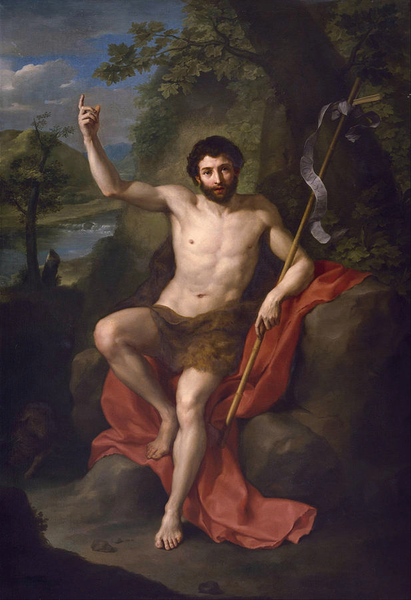
Today, in God’s Lavish Mercy, we think about John the Baptist. For several days in this middle part of Advent, our Gospel makes reference to John, the Precursor of the Messiah.

411px-Saint_John_The_Baptist_Preaching_In_The_Wilderness_by_Anton_Raphael
John the Baptist by Anton Raphael Mengs

Faithful Jews had an expectation that there would be a Messiah, and that a fiery Precursor would announce him. They identified this forerunner with the prophet Elijah, based on writings like today’s from Sirach:

How awesome are you, Elijah, in your wondrous deeds!
Whose glory is equal to yours?
You were taken aloft in a whirlwind of fire,
in a chariot with fiery horses.
You were destined, it is written, in time to come
to put an end to wrath before the day of the LORD…
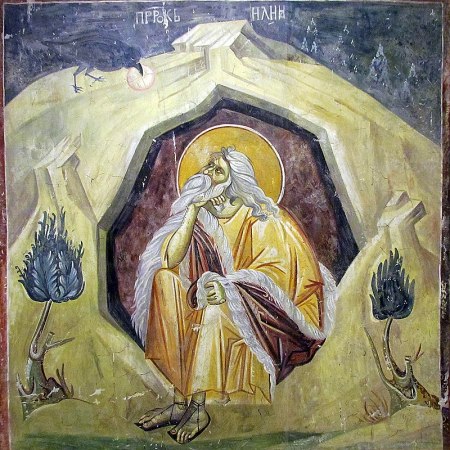
800px-Elijah,_a_prophet_and_a_miracle_worker
Elijah, a prophet and a miracle worker, Gračanica monastery

In our Gospel, Jesus indicates that John the Baptist is the new Elijah, preparing the way for Jesus’s ministry.

As they were coming down from the mountain,
the disciples asked Jesus,
“Why do the scribes say that Elijah must come first?”
He said in reply, “Elijah will indeed come and restore all things;
but I tell you that Elijah has already come,
and they did not recognize him but did to him whatever they pleased.
So also will the Son of Man suffer at their hands.”
Then the disciples understood
that he was speaking to them of John the Baptist.

Matthew 17: 9-13

As we pray today with these two greatest prophets, we might examine our own readiness to receive God’s revealing grace in our lives:

  • What is it in my life that prepares me to receive God in my heart?
  • What inspires me “prepare the way of the Lord” in the many “worlds” that I touch?
  • Am I attuned to God’s “announcements”, those quiet inklings that tell me God is trying to make something new in my life?

Jesus says that Elijah “has already come” but has been rejected by the people.

  • Are there habits and choices in my life that make it hard for God to get through to me?
  • Maybe God is sending an “Elijah”or “Baptist” my way today. Will I recognize that Precursor? Will I be open to the message?

Poetry: The Cup of Eliyahu – Marge Piercy

Eliyahu is a masculine Hebrew given name and surname of biblical origin. It means “My God is Yahweh” and derives from the prophet Elijah who, according to the Bible, lived during the reign of King Ahab (9th century BC).

In life you had a temper.
Your sarcasm was a whetted knife.
Sometimes you shuddered with fear
but you made yourself act no matter
how few stood with you.
Open the door for Eliyahu
that he may come in.
Now you return to us
in rough times, out of smoke
and dust that swirls blinding us.
You come in vision, you come
in lightning on blackness.
Open the door for Eliyahu
that he may come in.
In every generation you return
speaking what few want to hear
words that burn us, that cut
us loose so we rise and go again
over the sharp rocks upward.
Open the door for Eliyahu
that he may come in.
You come as a wild man,
as a homeless sidewalk orator,
you come as a woman taking the bima,
you come in prayer and song,
you come in a fierce rant.
Open the door for Eliyahu
that she may come in.
Prophecy is not a gift, but
sometimes a curse, Jonah
refusing. It is dangerous
to be right, to be righteous.
To stand against the wall of might.
Open the door for Eliyahu
that he may come in.
There are moments for each
of us when you summon, when
you call the whirlwind, when you
shake us like a rattle: then we
too must become you and rise.
Open the door for Eliyahu
that we may come in.

Music: Days of Elijah – Robin Mark

The commentary in the Worship & Song Leader’s Edition contains a good summary of this hymn’s text: “This is a song of victory and of hope, of God’s triumph forever over death and of Christ’s eternal reign. It also calls believers to stand fast, even in the face of troubles, and to witness to the promised coming of Christ.”

The Prophets Speak

Saturday of the Second Week of Advent
December 10, 2022

Today’s Readings:

https://bible.usccb.org/bible/readings/121022.cfm

Mk 1_Prepare copy

Today, in God’s Lavish Mercy, our Gospel places us with Jesus, as he descends the mountain after the Transfiguration.

He speaks about two great prophets – Elijah and John the Baptist:

  • Elijah – the fiery reformer who “turned back hearts” to the day of the Lord
  • John – who cried out in the desert, “Prepare the way of the Lord!”

 In those days,
    like a fire there appeared the prophet Elijah
        whose words were as a flaming furnace.
    Their staff of bread he shattered,
        in his zeal he reduced them to straits;
    By the Lord’s word he shut up the heavens
        and three times brought down fire.
    How awesome are you, Elijah, in your wondrous deeds!

Sirach 48:1-4

Jesus said, “Elijah will indeed come and restore all things;
but I tell you that Elijah has already come,
and they did not recognize him but did to him whatever they pleased. 
So also will the Son of Man suffer at their hands.”
Then the disciples understood
that he was speaking to them of John the Baptist.

Matthew 17:10-13

These prophets open the door to our final approach to Christmas – our last few days to heed their advice and ready our hearts for the awesome, yet humble, coming of Christ.

  • Is there anything in my heart that needs to be turned back to God — any energy, dedication or insight that has shifted from God’s Way to my own selfish way?
  • Is there anything I must prepare so that my life is ready to receive Christ?

These are the questions Elijah and John offer us today…


Poetry: john – Lucille Clifton – (1936 – 2010), a winner of the National Book Award for Poetry, was discovered as a poet by Langston Hughes. Hughes published Clifton’s poetry in his highly influential anthology, The Poetry of the Negro (1970). A prolific and widely respected poet, Lucille Clifton’s work emphasizes endurance and strength through adversity, focusing particularly on African-American experience and family life. 

somebody coming in blackness
like a star
and the world be a great bush
on his head
and his eyes be fire
in the city
and his mouth be true as time

he be calling the people brother
even in the prison
even in the jail

i’m just only a baptist preacher
somebody bigger than me coming
in blackness like a star

Music: Prepare the Way, O Zion – Fernando Ortega (Lyrics below)

Prepare the way O Zion
Your Christ is drawing near
Let every hill and valley
A level way appear
Greet One who comes in glory
Foretold in sacred story

Chorus:
O blest is Christ that came
In God’s most holy name
Christ brings God’s rule O Zion
He comes from heaven above
His rule is peace and freedom
And justice truth and love
Lift high your praise resounding
For grace and joy abounding

Fling wide your gates, O Zion
Your Savior’s rule embrace
And tidings of salvation
Proclaim in every place
All lands will bow rejoicing
Their adoration voicing

Wake (Me) Up, Lord!

Today, in God’s Lavish Mercy, we pray with Psalm 80 which calls upon God to “rouse” – to wake up, to look toward us from heaven, and to take care of us. Perhaps the psalm calls us to wake too????

O shepherd of Israel, hearken,
From your throne upon the cherubim, shine forth.
Rouse your power.
Once again, O LORD of hosts,
    look down from heaven, and see;
Take care of this vine,
    and protect what your right hand has planted
    the we whom you yourself made strong.

Psalm 80: 2-3;15-16

Our Gospel places us with Jesus, as he descends the mountain after the Transfiguration.

He speaks about two great prophets – Elijah and John the Baptist:

  • Elijah – the fiery reformer who “turned back hearts” to the day of the Lord
  • John – who cried out in the desert, “Prepare the way of the Lord!”

These prophets open the door to our final approach to Christmas – our last few days to heed their advice and ready our hearts for the awesome, yet humble, coming of Christ.

  • Is there anything in my heart that needs to be turned back to God — any energy, dedication or insight that has shifted from God’s Way to my own selfish way?
  • Is there anything I must prepare so that my life is ready to receive Christ?

These are the questions Elijah and John offer us today.. Praying Psalm 80, we might ask that God care for us and show us the way to the Christmas Light.


Poetry: The God We Hardly Knew – Saint Oscar Romero

No one can celebrate
a genuine Christmas
without being truly poor.

The self-sufficient, the proud, those who,
because they have everything,
look down on others,
those who have no need
even of God – for them there will be no Christmas.

Only the poor, the hungry, those who need
someone to come on their behalf,
will have that someone.
That someone is God.
Emmanuel. God-with-us.
Without poverty of spirit
there can be no abundance of God.


Music: Prepare the Way, O Zion – Fernando Ortega (Lyrics below)

Prepare the way O Zion
Your Christ is drawing near
Let every hill and valley
A level way appear
Greet One who comes in glory
Foretold in sacred story

Chorus:
O blest is Christ that came
In God’s most holy name
Christ brings God’s rule O Zion
He comes from heaven above
His rule is peace and freedom
And justice truth and love
Lift high your praise resounding
For grace and joy abounding

Fling wide your gates, O Zion
Your Savior’s rule embrace
And tidings of salvation
Proclaim in every place
All lands will bow rejoicing
Their adoration voicing

Fear Not

Today, in God’s Lavish Mercy, we pray with Psalm 146 which tells us just how very much God loves those whom no-one else appears to love.

Hallelujah!
Praise the Lord, O my soul!
I will praise the Lord as long as I live;
I will sing praise to my God while I have my being.
Put not your trust in rulers, nor in any child of earth,
for there is no help in them.
When they breathe their last, they return to earth,
and in that day their thoughts perish.
Happy are they who have the God of Jacob for their help!
For their hope is in the Lord their God,
who made heaven and earth, the seas,
and all that is in them;
who keeps promises for ever;
who gives justice to those who are oppressed,
food to those who hunger
and sets the prisoners free.
The Lord opens the eyes of the blind!
The Lord lifts up those who are bowed down
and loves the righteous.
The Lord cares for the stranger
and sustains the orphan and widow,
but frustrates the way of the wicked.
The Lord shall reign for ever,
your God, O Zion, throughout all generations.
Hallelujah!


In our readings this Sunday, we learn lessons from widows – those whose place in biblical times was uncertain and frightening. Without a husband, a woman experienced diminished standing in the legal, financial and political life of the community. 

She was often dependent on charity, and was deemed fortunate to capture a bit of good will from those in better circumstances. 

There are several examples of widows being blessed by miracles, because they were among those most in need of them.

In today’s first reading and in the Gospel, we meet two widows displaying amazing charity and character strength.  The widow of Zarephath steadfastly prepares for death because she has nothing left to live on. When Elijah asks to share in her last few cornmeal cakes, she does not hesitate to feed him.

In our Gospel, it is significant that, just across the road from the well-stocked treasury, a nearly penniless widow gives her last coins to the poor.


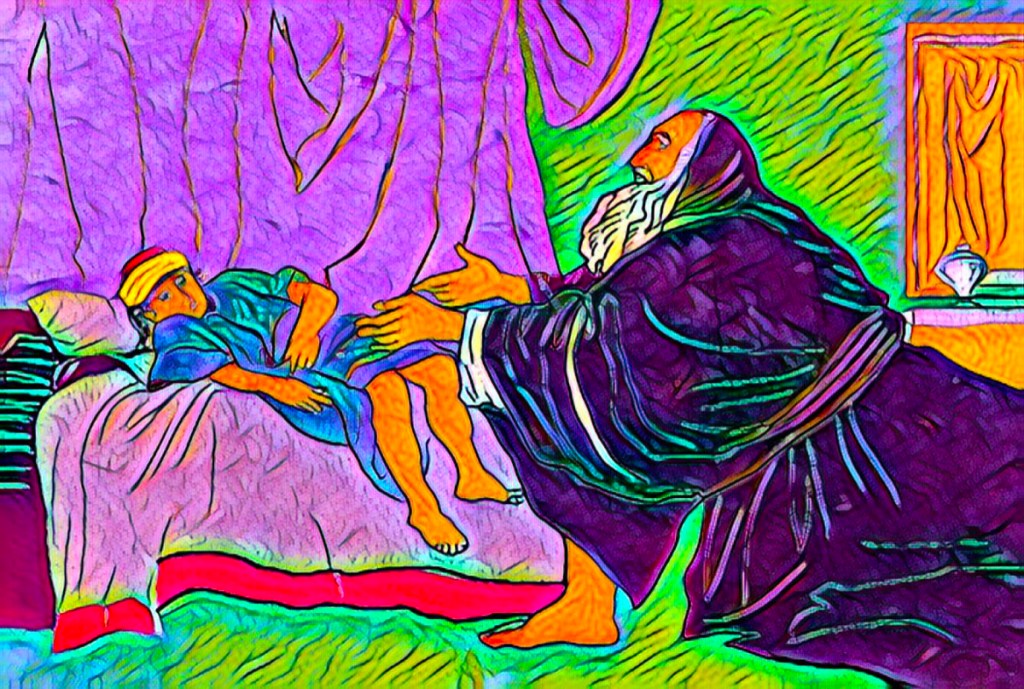
Elijah and the Widow’s Boy

In Elijah’s account, we learn the outcome of the widow’s generosity.  She reaps an abundant reward in perpetual flour and oil to sustain her and her son.

We never learn what happens to Jesus’s widow. We are left to imagine that, in some way, her selflessness is rewarded.


It is so hard to give it all to God, especially if we feel we have little left for ourselves.  It is hard to give our love when we feel empty-hearted.  It is hard to give care when we feel unappreciated.  It is hard to assist others when we ourselves are exhausted. It is hard to do good if no one, not even God, seems to notice.

But God does notice.  Like Jesus on that long-ago afternoon, God is watching as we empty our coffers in service and care for the poor, sick, troubled and lost.

What we have to give may be small — a single corn cake or two little coins. It is the act of giving it that is large — and will make our hearts large by the choice.


Poetry: The Widow of Zarephath by Sister Lou Ella Hickman, I.W.B.S, a member of the Sisters of the Incarnate Word and Blessed Sacrament of Corpus Christi, Texas. Her most recent collection of poetry is titled “she: robed and wordless“, available through press53

https://www.press53.com/lou-ella-hickman

i was like a small bird
            pecking near a gate
            when i went in search of twigs—
            a bit of wood for a fire

so after one last meal
my son and i could die…
then a man asked for water—

                        a bit of bread
                        now i, a small bird,
                        found more than twigs
                       because i too, like ravens, fed him


Music with Visuals: The Widow of Zarephath

Nineteenth Sunday in Ordinary Time

Sunday, August 8, 2021

Today, in God’s Lavish Mercy, our readings capture the essence of life in God through Christ.

The first reading from Kings tells how Elijah, after eating the food God had provided him, was able to endure the long journey to God’s mountain. There, the sweetest whisper carried to Elijah the voice of God!


In today’s Gospel passage, Jesus makes clear that no one makes that journey into the heart of God unless God calls us. But Jesus says that the invitation is given to all who believe. He says that, just as with Elijah, the Father gives us food – Jesus himself – the bread of life.


The second reading from Ephesians says that we have already “been sealed for the day of redemption through the Holy Spirit.” Paul says that, given this amazing gift, we have only one job:

So be imitators of God, as beloved children,
and live in love,
as Christ loved us and handed himself over for us
as a sacrificial offering to God for a fragrant aroma.

We are so accustomed to hearing these astounding passages that we may miss how astounding they really are. But Macrina Wiederkehr says:

When Jesus’ words begin to sound naive
to our 21st century minds,
let us look through the words,
in between the words,
underneath for a deeper truth.

Macrina Wiederkehr, OSB

Pierre Teilhard de Chardin, the great Jesuit mystical theologian, upon reading these passages, saw the mystery of the Body of Christ. He saw our call to be the heart of Christ in the world. He saw Christ’s promise to become one with us in Eucharist. He saw that, through this Infinite Love played out in our ordinary lives, God continues to redeem Creation.

In each soul,
God loves and partly saves
the whole world which that soul sums up
in an incommunicable and particular way.

The Divine Milieu

Poetry: Love after Love by Derek Walcott

The time will come when with elation
you will greet yourself arriving at your own door, in your own mirror
and each will smile at the other’s welcome
and say, sit here, eat.
You will love again the stranger who was your self

Give wine, give bread.
Give back your heart to itself,
to the stranger who has loved you all your life
whom you ignored for another
who knows you by heart

Take down the love letters from the bookshelf,
the photographs, the desperate notes,
peel your own image from the mirror.
Sit. Feast on your life.


Music: Quintessence – Spencer Brewer

May this lovely instrumental piece help take us to a deeply prayerful place as we contemplate God’s gift in Jesus.

Days of Elijah

Memorial of Saint John of the Cross, Priest and Doctor of the Church

December 14, 2019

Click here for readings

Today, in Mercy, we think about John the Baptist. For several days in this middle part of Advent, our Gospel makes reference to John, the Precursor of the Messiah.

411px-Saint_John_The_Baptist_Preaching_In_The_Wilderness_by_Anton_Raphael
John the Baptist by Anton Raphael Mengs – looking a lot better than he probably really looked!!!!

Faithful Jews had an expectation that there would be a Messiah, and that a fiery Precursor would announce him. They identified this forerunner with the prophet Elijah, based on writings like today’s from Sirach:

How awesome are you, Elijah, in your wondrous deeds!
Whose glory is equal to yours?
You were taken aloft in a whirlwind of fire,
in a chariot with fiery horses.
You were destined, it is written, in time to come
to put an end to wrath before the day of the LORD…

800px-Elijah,_a_prophet_and_a_miracle_worker
Elijah, a prophet and a miracle worker, Gračanica monastery


In our Gospel, Jesus indicates that John the Baptist is the new Elijah, preparing the way for Jesus’s ministry.

Scripture scholars can get pretty bundled up in trying to explicate the meanings around Elijah and his return. For the purpose of our prayer, I find it helpful to take another approach.

  • What is it in my life that prepares me to receive God in my heart?
  • What inspires me “prepare the way of the Lord” in the worlds that I touch?
  • Do I pay attention to God’s “announcements”, those quiet inklings that tell me God is trying to make something new in my life?

Jesus says that Elijah “has already come” but has been rejected by the people.

  • Are there habits and choices in my life that make it hard for God to get through to me?
  • Maybe God is sending an “Elijah”or “Baptist” my way today. Will I recognize that Precursor? Will I be open to the message?

Music: Days of Elijah – Robin Mark. 

The commentary in the Worship & Song Leader’s Edition contains a good summary of this hymn’s text: “This is a song of victory and of hope, of God’s triumph forever over death and of Christ’s eternal reign. It also calls believers to stand fast, even in the face of troubles, and to witness to the promised coming of Christ.”
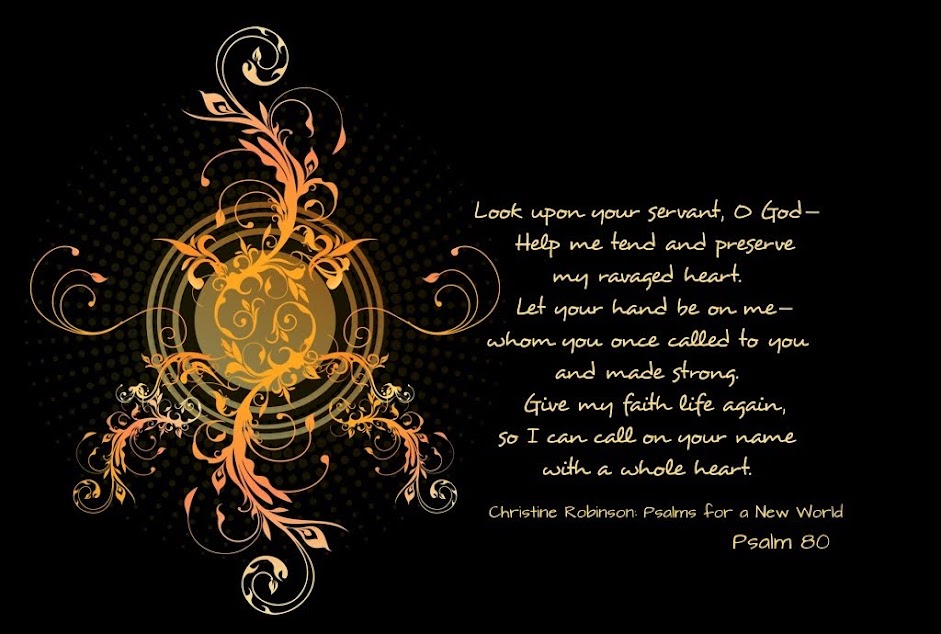
 

The Yoke, Indeed, Is On Us!

Thirteenth Sunday in Ordinary Time

June 30, 2019

Click here for readings

Today, in Mercy, the symbols of yokes and plows shout out across our readings. Again, we are dealing with metaphors not in everyday usage for most of us. But those listening to Elijah, Paul, and Jesus absorbed the symbolism easily.

Gal5_yoke

The yoke has connotations of subservience and toiling; in some ancient cultures it was traditional to force a vanquished enemy to pass beneath a symbolic yoke of Spears or swords.The yoke may be a metaphor for something oppressive or burdensome, such as feudalism or totalitarianism. (Wikipedia)

The writer of Kings has fiery Elijah engaged in one of his several highly dramatic episodes. What a scene, right? But what is the point for us?

The point is the same in all three readings: yoke=commitment. Each of our writers is talking about a further understanding of the word “yoke” —a freely chosen commitment made, by grace, for Love.

Sometimes, as in Kings, we need to break an enslavement in order to commit to something life-giving, such as Elisha’s call to follow Elijah.

Other times, as in Galatians, we must remind ourselves of the freedom and power we have chosen by breaking the old yokes that bound us.

In our Gospel, Jesus acknowledges the cost of a commitment to his Way. He has already told us in Matthew 11:

Take my yoke upon you and learn from me,
for I am gentle and humble in heart,
and you will find rest for your souls.

Today, in Luke, Jesus doubles down on his invitation /challenge to follow him:

No one who sets a hand to the plow
and looks to what was left behind
is fit for the kingdom of God.

The question left for our prayer today? Is my heart fully yoked to the heart Christ? Is my hand firmly grasping the plow?

Music: My Yoke is Easy – Dennis Jernigan

Fired by Love

Wednesday, June 13, 2018

Readings: http://www.usccb.org/bible/readings/061318.cfm

Ps 25 6_13_18

Today, in Mercy, when reading the passage about Elijah and the prophets of Baal, I was reminded of the Irving Berlin song, “Anything You Can Do, I Can Do Better”. In the reading, Elijah tests and even taunts Baal’s 450 prophets in a contest to prove whose God is true. Of course, Elijah wins in a stunning blast of fire. It is a religious exercise of “eradicate and supplant”.

The Gospel reading carries a similar theme.  Jesus’ followers seem to conclude that, because he is teaching something new, he is nullifying the customary Hebrew teachings. But Jesus says that, to the contrary, He is here to fulfill the Law, not to abolish it.

Religion, like any entrenched practice, tends over time to suffer the ill effects of institutionalization. Our rituals and devotions may become lifeless; our scriptures become rote. The power of our sacraments may be carelessly invoked and distractedly attended. A chasm grows between what we profess and what we live. We may become frozen. Sometimes, it might seem best to set the whole thing aflame and start all over again, like Elijah.

But Jesus challenges to us to go deeper than “practice”. Mere practice can easily become empty. Jesus shows us in his life what a fulfilled faith looks like. It is a faith expressed in service, sacrifice and inclusive mercy. It is a faith that, when brought to the pulpit and altar, carries the lives of those we love and serve. It is a faith, like the Psalmist’s, that listens for God’s direction deep in the experiences of life. It is a faith, not in contradiction to Law, but beyond it. It is a faith fired – transformed – by Love.

Music: Living Spirit, Holy Fire ~ David Haas