Two Kinds of Silence

Tuesday of the Fifteenth Week in Ordinary Time
July 18, 2023

Today’s Readings:

https://bible.usccb.org/bible/readings/071823.cfm

Today, in God’s Lavish Mercy, silence plays a role in both our readings, but they are silences that differ profoundly from each other.
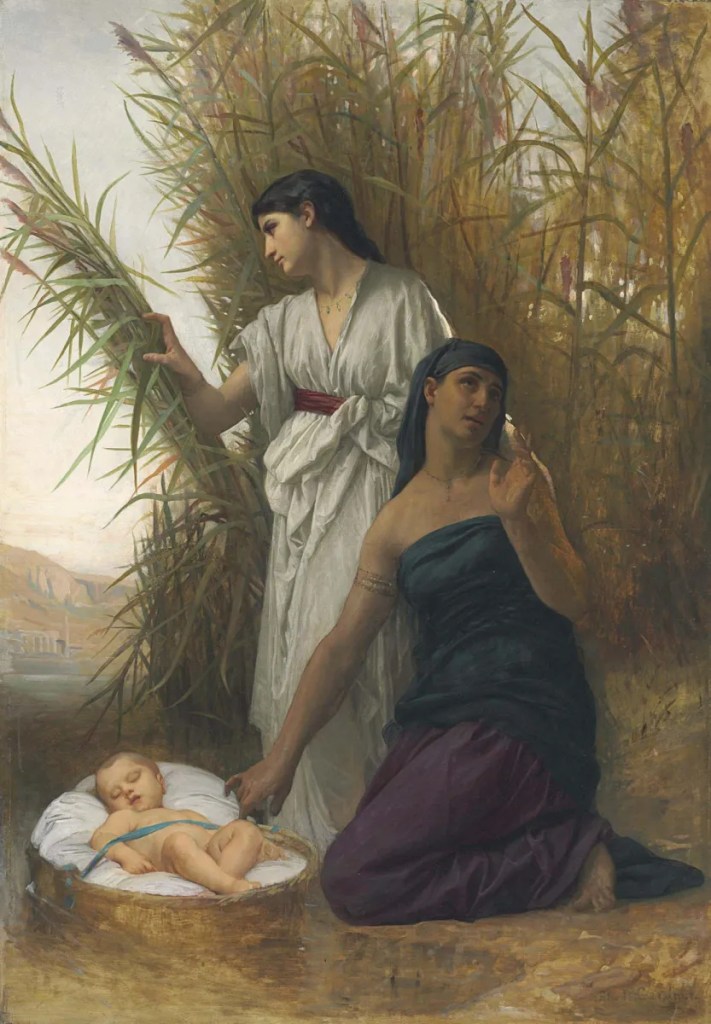
Moses in the Bulrushes – by Elizabeth Jane Gardner


In Exodus, we see the power of silent resistance to turn the tide of history. It is the resistance of righteousness.

Pharaoh, out of fear, has ordered all Hebrew boy babies drowned at birth. But Moses’s mother (Jochebed), aided by his sister (Miriam), silently resists.

A certain man of the house of Levi married a Levite woman,
who conceived and bore a son.
Seeing that he was a goodly child, she hid him for three months.
When she could hide him no longer, she took a papyrus basket,
daubed it with bitumen and pitch,
and putting the child in it,
placed it among the reeds on the river bank.
His sister stationed herself at a distance
to find out what would happen to him.

Her resistance, though silent, was nonetheless active. Look at all the intricate steps she took to assure the success of her plot.


The resistance cited in Matthew is of a different nature entirely. It reflects a hard heart not a determined heart. It is the resistance of indifference.

Christ Preaching at Capernaum – by Maurycy Gottlieb


Capernaum had become Jesus’s own home town. He had moved there as a young adult in order to begin his ministry after his own neighborhood had rejected him. But despite Jesus’s miracles and witness, Capernaum resisted the call of the Gospel:

Jesus began to reproach the towns
where most of his mighty deeds had been done,
since they had not repented.

And as for you, Capernaum:

Will you be exalted to heaven?
You will go down to the netherworld.

For if the mighty deeds done in your midst had been done in Sodom,
it would have remained until this day.
But I tell you, it will be more tolerable
for the land of Sodom on the day of judgment than for you.


We might find ourselves anywhere in these stories. We all experience resistances within, around, and toward us – sometimes for good reasons, sometimes not. We just have to fill in the blank to imagine all the resistances we are capable of:

I tend to resist ______________________________.

What did you come up with? Maybe some of these?

  • change
  • work
  • quiet
  • commitment
  • injustice
  • direction
  • strangers
  • programming
  • affection
  • cronyism, and on and on and on……

Jesus wanted to break through the negative resistance of his dearest communities.

Jocebed and her courageous women companions used positive resistance to break through abusive domination.

In our spiritual lives, we must, by prayer and informed reflection, lower our resistance to God’s transforming Word.

We must, at the same time, assume our role in resisting the injustice and violence of our times. Like Jocebed, we might consider our precious world and its peoples as if they were our own children, threatened by fear-blinded tyranny. In that case, what determined steps would we be willing to take to preserve its sacred life?


Poetry: Rosa Parks by Nikki Giovanni

This is for the Pullman Porters who organized when people said
they couldn’t. And carried the Pittsburgh Courier and the Chicago
Defender to the Black Americans in the South so they would
know they were not alone. This is for the Pullman Porters who
helped Thurgood Marshall go south and come back north to fight
the fight that resulted in Brown v. Board of Education because
even though Kansas is west and even though Topeka is the birth-
place of Gwendolyn Brooks, who wrote the powerful “The
Chicago Defender Sends a Man to Little Rock,” it was the
Pullman Porters who whispered to the traveling men both
the Blues Men and the “Race” Men so that they both would
know what was going on. This is for the Pullman Porters who
smiled as if they were happy and laughed like they were tickled
when some folks were around and who silently rejoiced in 1954
when the Supreme Court announced its 9—0 decision that “sepa-
rate is inherently unequal.” This is for the Pullman Porters who
smiled and welcomed a fourteen-year-old boy onto their train in
1955. They noticed his slight limp that he tried to disguise with a
doo-wop walk; they noticed his stutter and probably understood
why his mother wanted him out of Chicago during the summer
when school was out. Fourteen-year-old Black boys with limps
and stutters are apt to try to prove themselves in dangerous ways
when mothers aren’t around to look after them. So this is for the
Pullman Porters who looked over that fourteen-year-old while
the train rolled the reverse of the Blues Highway from Chicago to
St. Louis to Memphis to Mississippi. This is for the men who kept
him safe; and if Emmett Till had been able to stay on a train all
summer he would have maybe grown a bit of a paunch, certainly
lost his hair, probably have worn bifocals and bounced his grand-
children on his knee telling them about his summer riding the
rails. But he had to get off the train. And ended up in Money,
Mississippi. And was horribly, brutally, inexcusably, and unac-
ceptably murdered. This is for the Pullman Porters who, when the
sheriff was trying to get the body secretly buried, got Emmett’s
body on the northbound train, got his body home to Chicago,
where his mother said: I want the world to see what they did
to my boy. And this is for all the mothers who cried. And this is
for all the people who said Never Again. And this is about Rosa
Parks whose feet were not so tired, it had been, after all, an ordi-
nary day, until the bus driver gave her the opportunity to make
history. This is about Mrs. Rosa Parks from Tuskegee, Alabama,
who was also the field secretary of the NAACP. This is about the
moment Rosa Parks shouldered her cross, put her worldly goods
aside, was willing to sacrifice her life, so that that young man in
Money, Mississippi, who had been so well protected by the
Pullman Porters, would not have died in vain. When Mrs. Parks
said “NO” a passionate movement was begun. No longer would
there be a reliance on the law; there was a higher law. When Mrs.
Parks brought that light of hers to expose the evil of the system,
the sun came and rested on her shoulders bringing the heat and
the light of truth. Others would follow Mrs. Parks. Four young
men in Greensboro, North Carolina, would also say No. Great
voices would be raised singing the praises of God and exhorting
us “to forgive those who trespass against us.” But it was the
Pullman Porters who safely got Emmett to his granduncle and it
was Mrs. Rosa Parks who could not stand that death. And in not
being able to stand it. She sat back down.


Music: Soften My Heart, Lord – Maranatha Singers
Leaving Fear Behind

Monday of the Fifteenth Week in Ordinary Time
July 17, 2023

Today’s Readings:

https://bible.usccb.org/bible/readings/071723.cfm


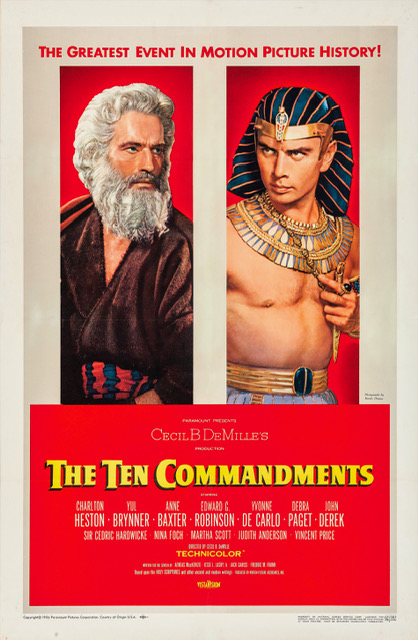
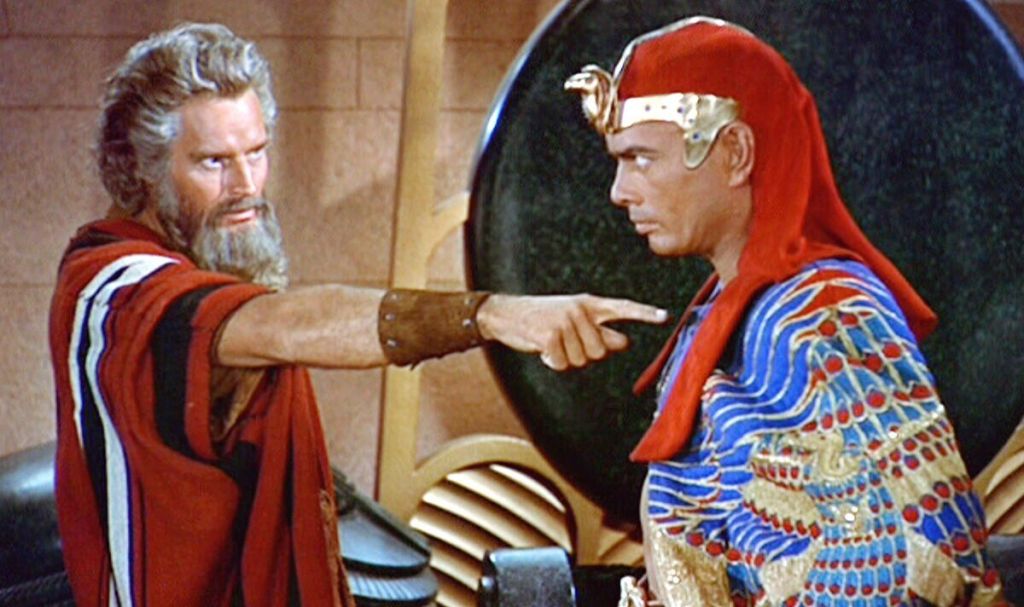
Today, in God’s Lavish Mercy, as we continue with Matthew, we begin a nearly three-week engagement with the Book of Exodus. Our companion along the way will be Moses (and, on occasion, Charlton Heston).

The Book of Exodus, a literary masterpiece, has profoundly influenced religion and culture for over 3000 years. Finally written down about 300 years before Christ, it is a gathering of the rich oral traditions and salvation history of the Judea-Christian faith. A total of forty chapters, the Book can be divided into two key parts: the liberation from Egyptian enslavement and the formation of a new, life-giving Covenant with God.

The Book’s enduring influence can be ascribed to these two themes. They reflect the universal life cycles in all of nature and in each one of our lives. The totality of human culture as well as our individual biographies are stories of breaking forth from whatever binds us into the call and promise of fuller life.


Today’s chapter is an introduction or bridge from the time of Joseph, (when Israel thrived in Egypt), to just before the emergence of Moses, (when Israel suffered in Egypt).

A new king, who knew nothing of Joseph, came to power in Egypt.
He said to his subjects, “Look how numerous and powerful
the people of the children of Israel are growing, more so than we ourselves!
Come, let us deal shrewdly with them to stop their increase;
otherwise, in time of war they too may join our enemies
to fight against us, and so leave our country.”

Accordingly, taskmasters were set over the children of Israel
to oppress them with forced labor.

Exodus 1:8-11

The theme of suffering also anchors our passage from Matthew:

Jesus said to his Apostles:
“Do not think that I have come to bring peace upon the earth.
I have come to bring not peace but the sword.

Matthew 10:34

The suffering imposed upon both “the children of Israel” and true disciples of Jesus generates from the same source – fear:

  • Pharaoh is afraid of what he will lose should the growing Israelite community turn on him.
  • The fear of losing one’s life in Christ inhibits the heart from true discipleship.

As we pray and study these next few weeks with the Book of Exodus, we may be moved to consider the fears both within and around us that prevent us from growing to fuller life.

Our world is full of the fears that induce violence and retribution. Our own spirits may be restrained with the fear of what we might lose by falling deeper into a Gospel life.


Our journey through Exodus offers us a time to consider and examine the fears we perceive. These fears may not necessarily be big spiritual impediments. They may be as simple as the fear of not being right, first, liked, included, or successful. But those very simple fears, left moldering in our hearts, are the seeds of the isolation, domination, and dissolution we see so rampant in our current culture.

Praying with Exodus, may we ask for courage to name and expose our personal and societal fears to God’s healing grace. We might begin with this thought from Paula D’Arcy:

Who would I be,
and what power would be expressed in my life,
if I were not dominated by fear?

Israel finally answered that question by coming into Covenant with God and Community with one another. The path is much the same for us in our lives.


Poetry: Immortality by Lisel Mueller

In Sleeping Beauty’s castle
the clock strikes one hundred years
and the girl in the tower returns to the world.
So do the servants in the kitchen,
who don’t even rub their eyes.
The cook’s right hand, lifted
an exact century ago,
completes its downward arc
to the kitchen boy’s left ear;
the boy’s tensed vocal cords
finally let go
the trapped, enduring whimper,
and the fly, arrested mid-plunge
above the strawberry pie
fulfills its abiding mission
and dives into the sweet, red glaze.
As a child I had a book
with a picture of that scene.
I was too young to notice
how fear persists, and how
the anger that causes fear persists,
that its trajectory can’t be changed
or broken, only interrupted.
My attention was on the fly:
that this slight body
with its transparent wings
and life-span of one human day
still craved its particular share
of sweetness, a century later.


Music: Fear is a Liar by Zach Williams – in this song, Williams images God as Fire, a Fire upon Whom we can cast our fears for a return of Love.

God Has Always Been in Love with Us!

Eleventh Sunday in Ordinary Time
January 18, 2023

Today’s Readings:

https://bible.usccb.org/bible/readings/061823.cfm


Today, in God’s Lavish Mercy, our beautiful readings this Sunday paint the picture of a God Who is eternally in love with us.

The writer of Exodus twenty-five hundred years ago knew this.

Then the LORD called to Moses and said,
“Thus shall you say to the house of Jacob;
tell the Israelites:
You have seen for yourselves how I treated the Egyptians
and how I bore you up on eagle wings
and brought you here to myself.
Therefore, if you hearken to my voice and keep my covenant,
you shall be my special possession,
dearer to me than all other people
,
though all the earth is mine.

Exodus 19:3-5

Yes, God is eternally in love with us. Paul knew this when he wrote to the Romans about a half-century after Jesus lived on earth.

For Christ, while we were still helpless,
yet died at the appointed time for the ungodly.
Indeed, only with difficulty does one die for a just person,
though perhaps for a good person one might even find courage to die.
But God proves his love for us in that
while we were still sinners Christ died for us
.

Romans 5:6-8

And Matthew knew that God is eternally in love with us when he recorded this memory of his beloved Jesus:

At the sight of the crowds, Jesus’ heart was moved with pity for them
because they were troubled and abandoned,
like sheep without a shepherd.
….
Jesus sent out these twelve after instructing them thus,
“Do not go into pagan territory or enter a Samaritan town.
Go rather to the lost sheep of the house of Israel.
As you go, make this proclamation: ‘The kingdom of heaven is at hand.’
Cure the sick, raise the dead, cleanse lepers, drive out demons.

Matthew 9:36; 10:5-8

If God has loved us this long and this much, isn’t it time for us to really love God back?

In the above situations, and in our own lives, all that God ever asks for is faithfulness – through ups and downs, through ins and outs – God longs for our unwavering relationship.

A deep loving relationship like that requires our complete attention toward the Beloved.

How’re you doing with that?

It’s a question I’ll be asking myself – and God – in my prayer today.


Poetry: from Love’s Fire: Re-Creations of Rumi by Andrew Harvey

It is He who suffers his absence in me 
Who through me cries out to himself.
Love’s most strange, most holy mystery--
We are intimate beyond belief.

Music: The Everlasting Love of God – Matt Boswell and Matt Papa

Tuesday of the Sixteenth Week in Ordinary Time

Tuesday, July 20, 2021

(Since today’s readings are so similar to yesterday’s, I decided to offer this reflection from 2019. I hope you like it.)

Today, in God’s Lavish Mercy, we read that triumphant Exodus passage in which the Israelites pass through the walled-up waters of the Red Sea. The images and exultations abound!

Here are the obvious ones:

  • Sea (the agent of delivery/salvation)
  • Wind (the grace of change)
  • Chariots (the inevitable challenges/obstacles)
  • Night (the mystery in which faith operates)
  • Fiery Cloud/The Lord’s Glance (God’s intervention)
  • Song (humble acknowledgement and thanksgiving)

Just as the newborn is carried through the birth canal on the waters of life, so too God’s neonate people finally begin the fullness of life promised to Abraham. God accomplishes this great “delivery” by a masterful intertwining of omnipotence, human choices, and natural phenomena. The result is breathtaking!


Just as it is in our lives!

Like any great Bible story, this one invites us to find ourselves somewhere within it. At the least, we are all making a sometimes treacherous passage through life. And at particular times, maybe even now, the threats may be intense.

At times, we stand at the edge of intimidating seas, wondering how we will make it to the other side. But if we reflect on our history, we must acknowledge that – with prayer and patience – the parting wind does come. Those “chariots” at our heels become mired in our resilience, hope and trust in God.

Even through the dark night of faith,
the Bright Mystery speaks to us.

In moments of astounding though quiet grace, we catch the glance of God. And we sing in thanksgiving.

The glory of this magnificent reading is captured in the Exultet, sung at the Easter Vigil.


Exult, let them exult, the hosts of heaven,
exult, let Angel ministers of God exult,
let the trumpet of salvation
sound aloud our mighty King's triumph!

Be glad, let earth be glad, as glory floods her,
ablaze with light from her eternal King,
let all corners of the earth be glad,
knowing an end to gloom and darkness.

Rejoice, let Mother Church also rejoice,
arrayed with the lightning of his glory,
let this holy building shake with joy,
filled with the mighty voices of the peoples.

(Therefore, dearest friends,
standing in the awesome glory of this holy light,
invoke with me, I ask you,
the mercy of God almighty,
that he, who has been pleased to number me,
though unworthy, among the Levites,
may pour into me his light unshadowed,
that I may sing this candle's perfect praises.)

(V. The Lord be with you.
R. And with your spirit.)
V. Lift up your hearts.
R. We lift them up to the Lord.
V. Let us give thanks to the Lord our God.
R. It is right and just.

 
It is truly right and just, with ardent love of mind and heart
and with devoted service of our voice,
to acclaim our God invisible, the almighty Father,
and Jesus Christ, our Lord, his Son, his Only Begotten.

Who for our sake paid Adam's debt to the eternal Father,
and, pouring out his own dear Blood,
wiped clean the record of our ancient sinfulness.

These, then, are the feasts of Passover,
in which is slain the Lamb, the one true Lamb,
whose Blood anoints the doorposts of believers.

This is the night,
when once you led our forebears, Israel's children,
from slavery in Egypt
and made them pass dry-shod through the Red Sea.

This is the night
that with a pillar of fire
banished the darkness of sin.

This is the night
that even now, throughout the world,
sets Christian believers apart from worldly vices
and from the gloom of sin,
leading them to grace
and joining them to his holy ones.

This is the night,
when Christ broke the prison-bars of death
and rose victorious from the underworld.

Our birth would have been no gain,
had we not been redeemed.

O wonder of your humble care for us!
O love, O charity beyond all telling,
to ransom a slave you gave away your Son!
O truly necessary sin of Adam,
destroyed completely by the Death of Christ!
O happy fault
that earned so great, so glorious a Redeemer!

O truly blessed night,
worthy alone to know the time and hour
when Christ rose from the underworld!

This is the night
of which it is written:
The night shall be as bright as day,
dazzling is the night for me,
and full of gladness.

The sanctifying power of this night
dispels wickedness, washes faults away,
restores innocence to the fallen, and joy to mourners,
drives out hatred, fosters concord, and brings down the mighty.  
On this, your night of grace, O holy Father,
accept this candle, a solemn offering,
the work of bees and of your servants’ hands,
an evening sacrifice of praise,
this gift from your most holy Church.

But now we know the praises of this pillar,
which glowing fire ignites for God's honor,
a fire into many flames divided,
yet never dimmed by sharing of its light,
for it is fed by melting wax,
drawn out by mother bees
to build a torch so precious.

O truly blessed night,
when things of heaven are wed to those of earth,
and divine to the human.

Therefore, O Lord,
we pray you that this candle,
hallowed to the honor of your name,
may persevere undimmed,
to overcome the darkness of this night.

Receive it as a pleasing fragrance,
and let it mingle with the lights of heaven.

May this flame be found still burning
by the Morning Star:
the one Morning Star who never sets,
Christ your Son,
who, coming back from death's domain,
has shed his peaceful light on humanity,
and lives and reigns for ever and ever.

R. Amen.

Monday of the Sixteenth Week in Ordinary Time

June 19, 2021

Today, in God’s Lavish Mercy, we pray with a selection from Exodus which you will probably recognize from the Easter Vigil on Holy Saturday night. It describes one of the most astounding displays of power in the Hebrew Scriptures.

by Frederick Arthur Bridgman

Stand with the author on the other side of the Red Sea and feel the pounding exultation:

I will sing to the LORD who is gloriously triumphant;
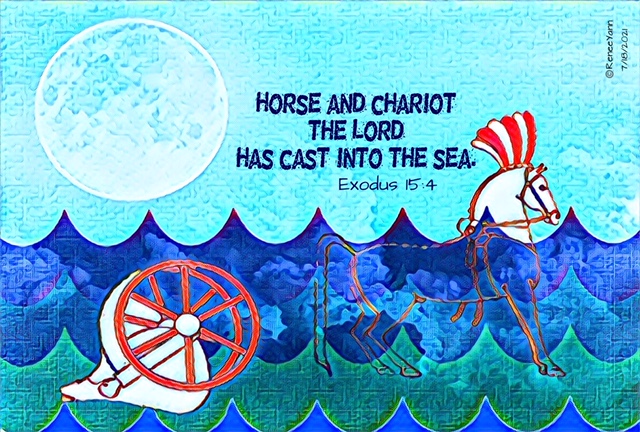
horse and chariot casting into the sea.
My strength and my courage is the LORD,
who has been my savior.
my God, whom I praise;
the God of my father, whom I extol.

It is a beautifully cadenced victory chant, and I have always loved hearing it at the vigil as we celebrate our deliverance from death through Christ’s Resurrection.


Imagine those “chariots and charioteers”, ancient symbols of power and oppression!

So Pharaoh made his chariots ready and mustered his soldiers
six hundred first-class chariots
and all the other chariots of Egypt, with warriors on them all.

Exodus 14: 6-7

What chance did the unarmed, rag tag horde of fleeing Israelites hold against such power?

The power they held was this –
faith in God’s promise
and obedience to its unfolding
in their lives.

It wasn’t easy for them! Moses had to bolster them in their fear and hesitation.

But Moses answered the people,
“Fear not! Stand your ground,
and you will see the victory the LORD will win for you today.
For these Egyptians whom you see today you will never see again.
The LORD will fight for you; you have only to keep still.”

Exodus 14: 13-14

Within these readings, the parallels to our own lives are abundant. If not now, at least at some time, we will have overwhelming forces pursue us. We will be afraid. Our faith will be tested. We will doubt.

If we can “be still”, bolstering our trust in prayer, God will reveal our particular deliverance. It may not look like what we imagined, nor exactly fit what we might have prayed for.

But in trusting prayer, the flood waters of grace release and resurrect us from all that threatens our souls.

The flood waters covered them,
they sank into the depths like a stone.
Your right hand, O LORD, magnificent in power,
your right hand, O LORD, has shattered the enemy.

Exodus 15: 5-6

Poetry: I think the psalm is its own poem today.😉


Music: Horse and Chariot – let these kids wake up our faith today!

Memorial of Saint Bonaventure

Thursday, July 15, 2021

Today, in God’s Lavish Mercy, we pray with Psalm 105 which depicts a “Remembering God” who calls us to respond as a “Remembering People”.

“Forever” is a word whose true meaning can be found only in an Eternal God. In Exodus, and in our Psalm 105, we see God inviting us to that fullness.

Our first reading recounts the Abrahamic covenant renewed with Moses. God, flaming out of a bush, tells Moses that God sticks by agreements.

God spoke further to Moses,
“Thus shall you say to the children of Israel:
The LORD, the God of your fathers,
the God of Abraham, the God of Isaac, the God of Jacob,
has sent me to you.
    “This is my name forever;
        this my title for all generations.

Exodus 3:15

(I don’t know about you, but I’ve flashbacking all week to to Cecil B. DeMille’s 1956 classic, The Ten Commandments.)


Our psalm reinforces the Exodus commitment:

God remembers forever the covenant 
    made binding for a thousand generations
    entered into with Abraham
    and by the oath to Isaac.

Psalm 105: 8-9

Our brief but beautiful Gospel shows us what God’s promise looks like in the tender person of Jesus:

Jesus said:
“Come to me, all you who labor and are burdened,
and I will give you rest.
Take my yoke upon you and learn from me,
for I am meek and humble of heart;
and you will find rest for yourselves.
For my yoke is easy, and my burden light.”

Matthew 11: 28-30

Throughout the ages,
God’s reiterated fidelity
calls us to obedience – that “heart-listening”
which hears the invitation to Love.

Poetry: Everything That Was Broken – Mary Oliver

Everything that was broken has
forgotten its brokenness. I live
now in a sky-house, through every
window the sun. Also your presence.
Our touching, our stories. Earthy
and holy both. How can this be, but
it is. Every day has something in
it whose name is Forever.

Music; Forever – Edelis

Midnight Miracle

Saturday of the Thirty-second Week in Ordinary Time

November 16, 2019

Click here for readings

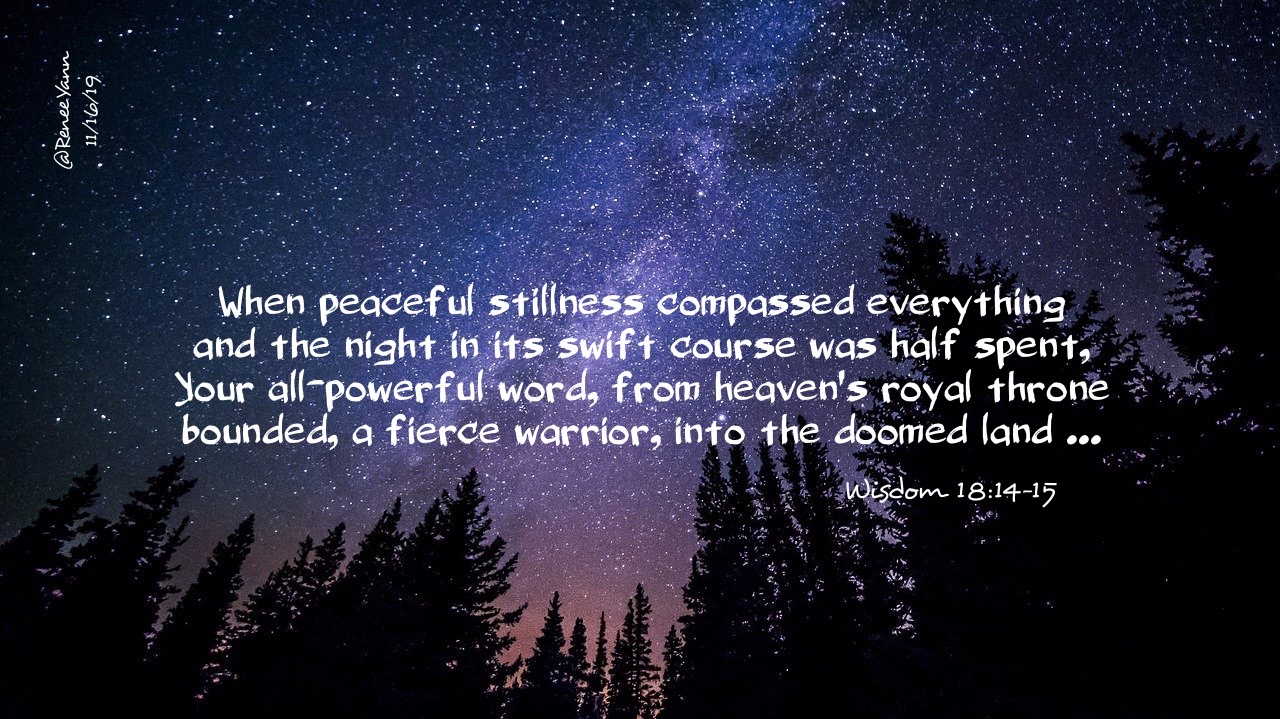
Today, in Mercy, we are blessed with some of the most gloriously imaginative images in Scripture:

wis18_midnight

Although the passage is a poetic recounting of the Exodus experience, it always makes me think of Christmas. 

  • Midnight on a starry night
  • Peaceful stillness over the earth
  • The all-powerful Word transformed 
  • Appearing among us like a comet in our darkness
  • Hope renewed for an otherwise doomed land

Praying with the passage this morning, I realize that my “Christmas lens” on the reading is right on target.

The Christmas event begins our Exodus story, a story completed in the Passion, Death and Resurrection of Christ.

Just as the God of Moses reached into ancient Israel’s life to free them, transform them and make them God’s People, so God reaches into our lives. God does this not only on Christmas, but in every moment of our experience.

As our media and consumer culture bombards us, all too early, with all the secularized images of Christmas, let today’s verses bring us back to the true startling grace of our own Christ/Exodus stories:

We are not alone in the midnights of our lives.
Listen underneath all the distractions
to the, at first, softly emerging sound of Love
humming under all things.
Watch for the small lights of heaven
longing to break into our human darkness.
Give yourself to their Light.

No matter where we are in our lives right now,
no matter the joy or pain of our present circumstances,
God wants to use these realities to be with us
and to teach us Love.
Let us invite God
into our willingness
to learn that Love,

to become that Love.


Music: Winter Cold Night – John Foley, SJ

Lyrics below (yes, it is an Advent/ Christmas song. But it fits so perfectly. Please forgive me if I am rushing the season too.🤗)

Dark, dark, the winter cold night. Lu-lee-lay.
Hope is hard to come by. Lu-lee-lay.
Hard, hard, the journey tonight. Lu—lee-lay.
Star, guide, hope, hide our poor, winter cold night.

And on earth, peace, good will among men.

Lean, lean, the livin’ tonight. Lu-lee-lay.
Star seems darker sometimes. Lu-lee-lay.
Unto you is born this day a Savior.
Pain, yes, in the bornin’ tonight. Lu lee—lay.
Star, guide, hope, hide our poor, winter cold night.

Dwelling Place for God

Memorial of Saint Alphonsus Liguori, Bishop and Doctor of the Church

August 1, 2019

Click here for today’s readings

Today, in Mercy, we finish our several weeks’ journey through Exodus. Like all great books, this one closes with a powerful final chapter – one that assures us that the story has not ended.

Have you ever read a book that you wish would never end? Of course, they all do – but bits of some live in us forever.

fav books

With sacred scripture, the Living Word remains with us by inspiring us to live out its spirit in our lives. That Holy Word bonds with the Spirit already dwelling within us through our Creation and Baptism.

Psalm 84_Ark

For the Exodus community, this Indwelling was given visible expression in the tabernacle Moses built. God chose to fill that tabernacle with Abiding Presence.

Each one of us, and every human being, is a dwelling place of God’s love and hope for us. We are tabernacles of God’s Spirit, breathed into us in an act of divine desire for us to be God’s eternal beloved.

Pretty overwhelming, isn’t it! 

So much so that, just as for the Israelites, our vision of God’s Presence is often clouded by the frenzy of our lives. It is only when we still our souls in worship that we recognize God living with and within us!

Music: This Alone – Tim Manion, SJ ( Photos are The Abbey of Mont-Saint-Michel / Normandy, in the Manche department in France.)

https://www.youtube.com/watch?v=I6CRroqCv5k&feature=youtu.be

Radical Joy

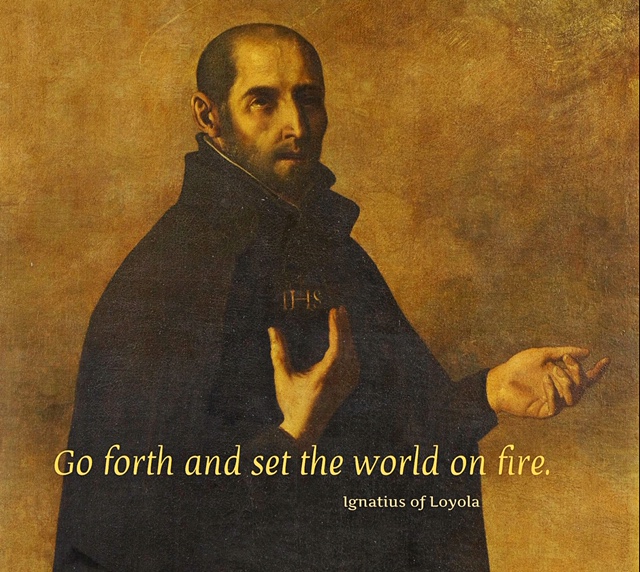
Memorial of Saint Ignatius of Loyola, Priest

Ignatius
by Francisco de Zubarán (1598–1664)

July 31, 2019

Click here for readings


Today, in Mercy, Exodus tells us:

Exodus34_29 Radiant

Obviously, I haven’t met Moses personally. 😂 But I have met many wonderful human beings who have reflected a similar radiance.

It is a mirrored glory that comes from friendship with God. 

It glows in the innocence of children and the layered wisdom of the elderly. It blazes in those seeking social justice and in those silently, unwaveringly praying for it. It lights the hope of the living and the dying. It is that mysterious, unquenchable candle shining in both joy and sorrow. Its other holy names are Faith, Hope and Love.

 No one need tell us. We know when we are in the presence of such Light. It needs no words.

Rumi radiant

Today, let’s pray for the blessing of this Radiance all over our shadowed world. Let’s pray for it to shine within us.

Music: Radiant God – Hannah Ford

Unconditional Love

Tuesday of the Seventeenth Week in Ordinary Time

July 30, 2019

Click here for readings

Today, in Mercy, we consider God’s unconditional love.

God and Moses and the People have been through it. The trail of complaints, the golden calf, the shattered tablets – these are relational dramas to the extreme! Exodus is definitely soap opera material! Does it feel a little bit like your life, or your family’s, or the families you read about in the news?

Ex34_9 Life

Life is indeed a drama! And our relationship with God is highlighted and shadowed with its twists and turns. For that reason, today’s passage offers us so much comfort and confidence. Even after all that has happened, God reveals himself to Moses like this:

The LORD, the LORD, a merciful and gracious God,
slow to anger and rich in kindness and fidelity,
continuing his kindness for a thousand generations.

Moses is so moved by this new knowledge of God’s unconditional love, that he welcomes God as part of their community:

If I find favor with you, O LORD,
do come along in our company.
This is indeed a stiff-necked people;
yet pardon our wickedness and sins,

and receive us as your own.

We are invited by this reading to open ourselves to that same unconditional love, to thank God for journeying with us through life’s convolutions. Stiff-necked at times, repentant at others, we are always God’s beloved.

As we negotiate the intricacies of our life today, we might trustingly say like Moses:

Lord, do come along in my company.

Music: Outrageous Grace – Godfrey Birtill