Two Kinds of Silence

Tuesday of the Fifteenth Week in Ordinary Time
July 18, 2023

Today’s Readings:

https://bible.usccb.org/bible/readings/071823.cfm

Today, in God’s Lavish Mercy, silence plays a role in both our readings, but they are silences that differ profoundly from each other.
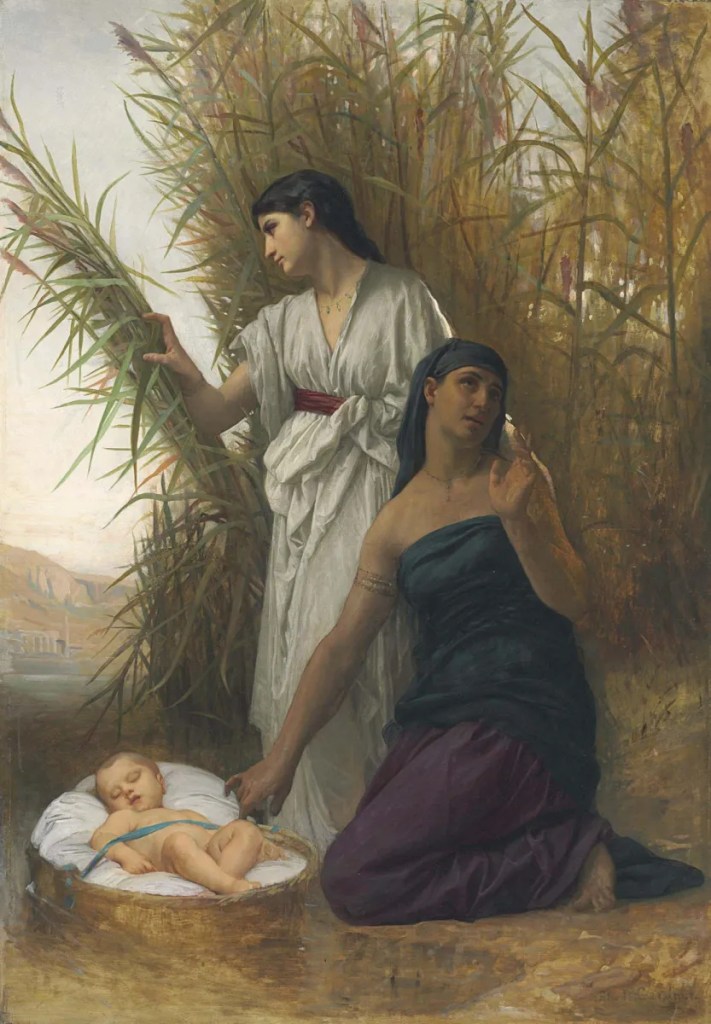
Moses in the Bulrushes – by Elizabeth Jane Gardner


In Exodus, we see the power of silent resistance to turn the tide of history. It is the resistance of righteousness.

Pharaoh, out of fear, has ordered all Hebrew boy babies drowned at birth. But Moses’s mother (Jochebed), aided by his sister (Miriam), silently resists.

A certain man of the house of Levi married a Levite woman,
who conceived and bore a son.
Seeing that he was a goodly child, she hid him for three months.
When she could hide him no longer, she took a papyrus basket,
daubed it with bitumen and pitch,
and putting the child in it,
placed it among the reeds on the river bank.
His sister stationed herself at a distance
to find out what would happen to him.

Her resistance, though silent, was nonetheless active. Look at all the intricate steps she took to assure the success of her plot.


The resistance cited in Matthew is of a different nature entirely. It reflects a hard heart not a determined heart. It is the resistance of indifference.

Christ Preaching at Capernaum – by Maurycy Gottlieb


Capernaum had become Jesus’s own home town. He had moved there as a young adult in order to begin his ministry after his own neighborhood had rejected him. But despite Jesus’s miracles and witness, Capernaum resisted the call of the Gospel:

Jesus began to reproach the towns
where most of his mighty deeds had been done,
since they had not repented.

And as for you, Capernaum:

Will you be exalted to heaven?
You will go down to the netherworld.

For if the mighty deeds done in your midst had been done in Sodom,
it would have remained until this day.
But I tell you, it will be more tolerable
for the land of Sodom on the day of judgment than for you.


We might find ourselves anywhere in these stories. We all experience resistances within, around, and toward us – sometimes for good reasons, sometimes not. We just have to fill in the blank to imagine all the resistances we are capable of:

I tend to resist ______________________________.

What did you come up with? Maybe some of these?

  • change
  • work
  • quiet
  • commitment
  • injustice
  • direction
  • strangers
  • programming
  • affection
  • cronyism, and on and on and on……

Jesus wanted to break through the negative resistance of his dearest communities.

Jocebed and her courageous women companions used positive resistance to break through abusive domination.

In our spiritual lives, we must, by prayer and informed reflection, lower our resistance to God’s transforming Word.

We must, at the same time, assume our role in resisting the injustice and violence of our times. Like Jocebed, we might consider our precious world and its peoples as if they were our own children, threatened by fear-blinded tyranny. In that case, what determined steps would we be willing to take to preserve its sacred life?


Poetry: Rosa Parks by Nikki Giovanni

This is for the Pullman Porters who organized when people said
they couldn’t. And carried the Pittsburgh Courier and the Chicago
Defender to the Black Americans in the South so they would
know they were not alone. This is for the Pullman Porters who
helped Thurgood Marshall go south and come back north to fight
the fight that resulted in Brown v. Board of Education because
even though Kansas is west and even though Topeka is the birth-
place of Gwendolyn Brooks, who wrote the powerful “The
Chicago Defender Sends a Man to Little Rock,” it was the
Pullman Porters who whispered to the traveling men both
the Blues Men and the “Race” Men so that they both would
know what was going on. This is for the Pullman Porters who
smiled as if they were happy and laughed like they were tickled
when some folks were around and who silently rejoiced in 1954
when the Supreme Court announced its 9—0 decision that “sepa-
rate is inherently unequal.” This is for the Pullman Porters who
smiled and welcomed a fourteen-year-old boy onto their train in
1955. They noticed his slight limp that he tried to disguise with a
doo-wop walk; they noticed his stutter and probably understood
why his mother wanted him out of Chicago during the summer
when school was out. Fourteen-year-old Black boys with limps
and stutters are apt to try to prove themselves in dangerous ways
when mothers aren’t around to look after them. So this is for the
Pullman Porters who looked over that fourteen-year-old while
the train rolled the reverse of the Blues Highway from Chicago to
St. Louis to Memphis to Mississippi. This is for the men who kept
him safe; and if Emmett Till had been able to stay on a train all
summer he would have maybe grown a bit of a paunch, certainly
lost his hair, probably have worn bifocals and bounced his grand-
children on his knee telling them about his summer riding the
rails. But he had to get off the train. And ended up in Money,
Mississippi. And was horribly, brutally, inexcusably, and unac-
ceptably murdered. This is for the Pullman Porters who, when the
sheriff was trying to get the body secretly buried, got Emmett’s
body on the northbound train, got his body home to Chicago,
where his mother said: I want the world to see what they did
to my boy. And this is for all the mothers who cried. And this is
for all the people who said Never Again. And this is about Rosa
Parks whose feet were not so tired, it had been, after all, an ordi-
nary day, until the bus driver gave her the opportunity to make
history. This is about Mrs. Rosa Parks from Tuskegee, Alabama,
who was also the field secretary of the NAACP. This is about the
moment Rosa Parks shouldered her cross, put her worldly goods
aside, was willing to sacrifice her life, so that that young man in
Money, Mississippi, who had been so well protected by the
Pullman Porters, would not have died in vain. When Mrs. Parks
said “NO” a passionate movement was begun. No longer would
there be a reliance on the law; there was a higher law. When Mrs.
Parks brought that light of hers to expose the evil of the system,
the sun came and rested on her shoulders bringing the heat and
the light of truth. Others would follow Mrs. Parks. Four young
men in Greensboro, North Carolina, would also say No. Great
voices would be raised singing the praises of God and exhorting
us “to forgive those who trespass against us.” But it was the
Pullman Porters who safely got Emmett to his granduncle and it
was Mrs. Rosa Parks who could not stand that death. And in not
being able to stand it. She sat back down.


Music: Soften My Heart, Lord – Maranatha Singers

Leaving Fear Behind

Monday of the Fifteenth Week in Ordinary Time
July 17, 2023

Today’s Readings:

https://bible.usccb.org/bible/readings/071723.cfm


Today, in God’s Lavish Mercy, as we continue with Matthew, we begin a nearly three-week engagement with the Book of Exodus. Our companion along the way will be Moses (and, on occasion, Charlton Heston).

The Book of Exodus, a literary masterpiece, has profoundly influenced religion and culture for over 3000 years. Finally written down about 300 years before Christ, it is a gathering of the rich oral traditions and salvation history of the Judea-Christian faith. A total of forty chapters, the Book can be divided into two key parts: the liberation from Egyptian enslavement and the formation of a new, life-giving Covenant with God.

The Book’s enduring influence can be ascribed to these two themes. They reflect the universal life cycles in all of nature and in each one of our lives. The totality of human culture as well as our individual biographies are stories of breaking forth from whatever binds us into the call and promise of fuller life.


Today’s chapter is an introduction or bridge from the time of Joseph, (when Israel thrived in Egypt), to just before the emergence of Moses, (when Israel suffered in Egypt).

A new king, who knew nothing of Joseph, came to power in Egypt.
He said to his subjects, “Look how numerous and powerful
the people of the children of Israel are growing, more so than we ourselves!
Come, let us deal shrewdly with them to stop their increase;
otherwise, in time of war they too may join our enemies
to fight against us, and so leave our country.”

Accordingly, taskmasters were set over the children of Israel
to oppress them with forced labor.

Exodus 1:8-11

The theme of suffering also anchors our passage from Matthew:

Jesus said to his Apostles:
“Do not think that I have come to bring peace upon the earth.
I have come to bring not peace but the sword.

Matthew 10:34

The suffering imposed upon both “the children of Israel” and true disciples of Jesus generates from the same source – fear:

  • Pharaoh is afraid of what he will lose should the growing Israelite community turn on him.
  • The fear of losing one’s life in Christ inhibits the heart from true discipleship.

As we pray and study these next few weeks with the Book of Exodus, we may be moved to consider the fears both within and around us that prevent us from growing to fuller life.

Our world is full of the fears that induce violence and retribution. Our own spirits may be restrained with the fear of what we might lose by falling deeper into a Gospel life.


Our journey through Exodus offers us a time to consider and examine the fears we perceive. These fears may not necessarily be big spiritual impediments. They may be as simple as the fear of not being right, first, liked, included, or successful. But those very simple fears, left moldering in our hearts, are the seeds of the isolation, domination, and dissolution we see so rampant in our current culture.

Praying with Exodus, may we ask for courage to name and expose our personal and societal fears to God’s healing grace. We might begin with this thought from Paula D’Arcy:

Who would I be,
and what power would be expressed in my life,
if I were not dominated by fear?

Israel finally answered that question by coming into Covenant with God and Community with one another. The path is much the same for us in our lives.


Poetry: Immortality by Lisel Mueller

In Sleeping Beauty’s castle
the clock strikes one hundred years
and the girl in the tower returns to the world.
So do the servants in the kitchen,
who don’t even rub their eyes.
The cook’s right hand, lifted
an exact century ago,
completes its downward arc
to the kitchen boy’s left ear;
the boy’s tensed vocal cords
finally let go
the trapped, enduring whimper,
and the fly, arrested mid-plunge
above the strawberry pie
fulfills its abiding mission
and dives into the sweet, red glaze.
As a child I had a book
with a picture of that scene.
I was too young to notice
how fear persists, and how
the anger that causes fear persists,
that its trajectory can’t be changed
or broken, only interrupted.
My attention was on the fly:
that this slight body
with its transparent wings
and life-span of one human day
still craved its particular share
of sweetness, a century later.


Music: Fear is a Liar by Zach Williams – in this song, Williams images God as Fire, a Fire upon Whom we can cast our fears for a return of Love.

God Has Always Been in Love with Us!

Eleventh Sunday in Ordinary Time
January 18, 2023

Today’s Readings:

https://bible.usccb.org/bible/readings/061823.cfm


Today, in God’s Lavish Mercy, our beautiful readings this Sunday paint the picture of a God Who is eternally in love with us.

The writer of Exodus twenty-five hundred years ago knew this.

Then the LORD called to Moses and said,
“Thus shall you say to the house of Jacob;
tell the Israelites:
You have seen for yourselves how I treated the Egyptians
and how I bore you up on eagle wings
and brought you here to myself.
Therefore, if you hearken to my voice and keep my covenant,
you shall be my special possession,
dearer to me than all other people
,
though all the earth is mine.

Exodus 19:3-5

Yes, God is eternally in love with us. Paul knew this when he wrote to the Romans about a half-century after Jesus lived on earth.

For Christ, while we were still helpless,
yet died at the appointed time for the ungodly.
Indeed, only with difficulty does one die for a just person,
though perhaps for a good person one might even find courage to die.
But God proves his love for us in that
while we were still sinners Christ died for us
.

Romans 5:6-8

And Matthew knew that God is eternally in love with us when he recorded this memory of his beloved Jesus:

At the sight of the crowds, Jesus’ heart was moved with pity for them
because they were troubled and abandoned,
like sheep without a shepherd.
….
Jesus sent out these twelve after instructing them thus,
“Do not go into pagan territory or enter a Samaritan town.
Go rather to the lost sheep of the house of Israel.
As you go, make this proclamation: ‘The kingdom of heaven is at hand.’
Cure the sick, raise the dead, cleanse lepers, drive out demons.

Matthew 9:36; 10:5-8

If God has loved us this long and this much, isn’t it time for us to really love God back?

In the above situations, and in our own lives, all that God ever asks for is faithfulness – through ups and downs, through ins and outs – God longs for our unwavering relationship.

A deep loving relationship like that requires our complete attention toward the Beloved.

How’re you doing with that?

It’s a question I’ll be asking myself – and God – in my prayer today.


Poetry: from Love’s Fire: Re-Creations of Rumi by Andrew Harvey

It is He who suffers his absence in me 
Who through me cries out to himself.
Love’s most strange, most holy mystery--
We are intimate beyond belief.

Music: The Everlasting Love of God – Matt Boswell and Matt Papa