Our Story is God’s Story

Saturday of the Sixteenth Week in Ordinary Time

July 27, 2019

Click here for readings

Today, in Mercy, our Exodus reading describes momentous events in Israel’s life.

tabletsJPG

God has just invited Moses and several others up the mountain for a Divine conflab.  Moses returns to the people to announce “all the words and ordinances of the Lord”.The People receive these words wholeheartedly:

“We will do everything that the LORD has told us.”

Thus, a community of persons is formed with God at its heart.

Moses then engages the community in a series of formal rituals to highlight the significance and permanence of this deeper step in relationship with God.


The passage contains multiple points for our prayerful consideration.

The community of Israel is not unlike our own faith communities, those that gather in specific religious houses, or those we share in the universal community of all Creation. We are Catholics, Lutherans, Jews, Hindus, Muslims, Sikhs sharing a story of God in our particular religious traditions. We are also all children of the same God sharing that experience in our Common Home of Creation.

Just as with the ancient Israelites, God communicates and relates with us through the experiences of our lives. In our communities, that Divine Word is interpreted, codified, ritualized, and responded to. These actions create a story which is alive, deepening with each new generation, and still always rooted in the long history of promise and grace.

Today’s reading contains many elements of story and ritual which we can recognize in our own faith practice: written and announced word, altar or worship place, sacrifice or offering to God, acts of covenant, and celebratory meals.

Exodus24_3 sinai

These are the human ways in which we access relationship with God. These are the ways in which we keep our faith vital. We strengthen our faith by one another’s stories of love, mercy and hope. We commit to a shared law of love, not legalism – a heart-law which calls us to be life for one another, just as God is Life for us. In community, we reveal the face of God within ourselves.

For those of us who share the practice of a Eucharistic faith, the parallels in today’s reading call us to deeper awareness of how God becomes present in our lives.

May all of us – of whatever spirituality – who share life in God’s continuing Creation, obediently hear the command to cherish every human being as a revelation of God, as a critical and precious part of my own faith story – a part for whom I share the responsibility for life.

Music: Song of the Body of Christ – David Haas (Lyrics below)

Song of the Body of Christ
Refrain: We come to share our story. We come to break the bread.
We come to know our rising from the dead.
1. We come as your people. We come as your own.
United with each other, love finds a home.
2. We are called to heal the broken, to be hope for the poor.
We are called to feed the hungry at our door.
3. Bread of life and cup of promise, In this meal we all are one.
In our dying and our rising, may your kingdom come.
4. You will lead and we shall follow.
ou will be the breath of life; living water, we are thirsting for your light.
It’s Raining Bread!

Wednesday of the Sixteenth Week in Ordinary Time

July 24, 2019

Click here for readings

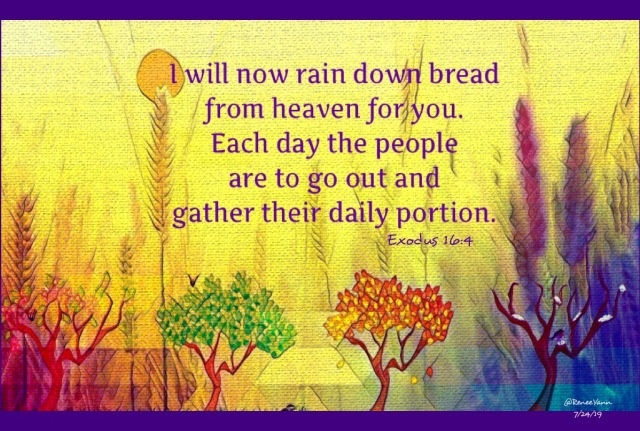
Today, in Mercy, our readings are all about food in the many forms and senses of that word.

Exodus16_4

The Israelites have been in the desert for a while.  The burden of travel is beginning to weigh upon them.  Food is short, tempers even shorter.  Things seem so bad that, in a fit of stupendous forgetfulness, they tell Moses they were better off as slaves in Egypt.

Moses asks God to intervene, which God does with the gifts of manna and quail.

The folks in today’s reading remind me a lot of people I know — even myself.  Haven’t we all heard, and maybe uttered, the complaint that things were so much better in “the old days”.  Haven’t we critiqued a challenging situation with the unhelpful assessment, “Well, it’s not like it used to be!”

But the God of Exodus is so patient, as is Moses.  God doesn’t become angry with the complainers. Instead God promises to take care of them and to stay with them forever on their journey. God makes good on this word by initiating the naturally occurring phenomena of morning manna and migrating quail so that the community is fed.

Some areas to focus on as we pray with this passage:

God does not deliver the Israelites immediately to their destination. Life is a journey, not an arrival.

God intervenes to meet their needs, but through ordinary occurrences rather than miracles. God uses manna and quail, surprising but nonetheless naturally occurring events in the Sinai desert.

God expects the Israelites to interact with grace, to recognize that God is about the continuing work of Creation and Covenant, even within the natural circumstances of our lives.

For us, the profound reminder that God accompanies us in drought and abundance, in joy and sorrow, in wilderness and stability; that God is listening under our hungers; that God is sustaining us in graces we may be slow to recognize.

Music: Panis Angelicus – Luciano Pavarotti

Panis angelicus
fit panis hominum;
Dat panis caelicus
figuris terminum:
O res mirabilis!
manducat Dominum
Pauper, servus, et humilis. 

Te trina Deitas
unaque poscimus:
Sic nos tu visita,
sicut te colimus;
Per tuas semitas
duc nos quo tendimus,
Ad lucem quam inhabitas.
Amen.

Bread of Angels,
made the bread of men;
The Bread of heaven
puts an end to all symbols:
A thing wonderful!
The Lord becomes our food:
poor, a servant, and humble.

We beseech Thee,
Godhead One in Three
That Thou wilt visit us,
as we worship Thee,
lead us through Thy ways,
We who wish to reach the light
in which Thou dwellest.
Amen.

Exultet!

Tuesday of the Sixteenth Week in Ordinary Time

July 23, 2019

Click here for readings

Ex15_1chariots

Today, in Mercy, we read that triumphant Exodus passage in which the Israelites pass through the walled-up waters of the Red Sea. The images and exultations abound!

Here are the obvious ones:

  • Sea (the agent of delivery/salvation)
  • Wind (the grace of change)
  • Chariots (the inevitable challenges/obstacles)
  • Night (the mystery in which faith operates)
  • Fiery Cloud/The Lord’s Glance (God’s intervention)
  • Song (humble acknowledgement and thanksgiving)

Just as the newborn is carried through the birth canal on the waters of life, so too God’s neonate people finally begin the fullness of life promised to Abraham. God accomplishes this great “delivery” by a masterful intertwining of omnipotence, human choices, and natural phenomena. The result is breathtaking!

Just as it is in our lives!

Like any great Bible story, this one invites us to find ourselves somewhere within it. At the least, we are all making a sometimes treacherous passage through life. And at particular times, maybe even now, the threats may be intense.


At times, we stand at the edge of intimidating seas, wondering how we will make it to the other side. But if we reflect on our history, we must acknowledge that – with prayer and patience – the parting wind does come. Those “chariots” at our heels become mired in our resilience, hope and trust in God. Even through the dark night of faith, the Bright Mystery speaks to us. In moments of astounding though quiet grace, we catch the glance of God. And we sing in thanksgiving.


The glory of this magnificent reading is captured in the Exultet, sung at the Easter Vigil. You may wish to pray with it today. (sung Latin version in interesting article below)

English text

Exult, let them exult, the hosts of heaven,

exult, let Angel ministers of God exult,

let the trumpet of salvation

sound aloud our mighty King’s triumph!

Be glad, let earth be glad, as glory floods her,

ablaze with light from her eternal King,

let all corners of the earth be glad,

knowing an end to gloom and darkness.

Rejoice, let Mother Church also rejoice,

arrayed with the lightning of his glory,

let this holy building shake with joy,

filled with the mighty voices of the peoples.

(Therefore, dearest friends,

standing in the awesome glory of this holy light,

invoke with me, I ask you,

the mercy of God almighty,

that he, who has been pleased to number me,

though unworthy, among the Levites,

may pour into me his light unshadowed,

that I may sing this candle’s perfect praises).

(Deacon: The Lord be with you.

People: And with your spirit.)

Deacon: Lift up your hearts.

People: We lift them up to the Lord.

Deacon: Let us give thanks to the Lord our God.

People: It is right and just. 

It is truly right and just,

with ardent love of mind and heart

and with devoted service of our voice,

to acclaim our God invisible, the almighty Father,

and Jesus Christ, our Lord, his Son, his Only Begotten.

Who for our sake paid Adam’s debt to the eternal Father,

and, pouring out his own dear Blood,

wiped clean the record of our ancient sinfulness.

These, then, are the feasts of Passover,

in which is slain the Lamb, the one true Lamb,

whose Blood anoints the doorposts of believers.

This is the night,

when once you led our forebears, Israel’s children,

from slavery in Egypt

and made them pass dry-shod through the Red Sea.

This is the night

that with a pillar of fire

banished the darkness of sin.

This is the night

that even now throughout the world,

sets Christian believers apart from worldly vices

and from the gloom of sin,

leading them to grace

and joining them to his holy ones.

This is the night

when Christ broke the prison-bars of death

and rose victorious from the underworld.

Our birth would have been no gain,

had we not been redeemed.

O wonder of your humble care for us!

O love, O charity beyond all telling,

to ransom a slave you gave away your Son!

O truly necessary sin of Adam,

destroyed completely by the Death of Christ!

O Happy Fault

that earned for us so great, so glorious a Redeemer!

O truly blessed night,

worthy alone to know the time and hour

when Christ rose from the underworld!

This is the night

of which it is written:

The night shall be as bright as day,

dazzling is the night for me, and full of gladness.

The sanctifying power of this night

dispels wickedness, washes faults away,

restores innocence to the fallen, and joy to mourners,

drives out hatred, fosters concord, and brings down the mighty.

On this, your night of grace, O holy Father,

accept this candle, a solemn offering,

the work of bees and of your servants’ hands,

an evening sacrifice of praise,

this gift from your most holy Church.

But now we know the praises of this pillar,

which glowing fire ignites for God’s honour,

a fire into many flames divided,

yet never dimmed by sharing of its light,

for it is fed by melting wax,

drawn out by mother bees

to build a torch so precious.

O truly blessed night,

when things of heaven are wed to those of earth,

and divine to the human.

Therefore, O Lord,

we pray you that this candle,

hallowed to the honour of your name,

may persevere undimmed,

to overcome the darkness of this night.

Receive it as a pleasing fragrance,

and let it mingle with the lights of heaven.

May this flame be found still burning

by the Morning Star:

the one Morning Star who never sets,

Christ your Son,

who, coming back from death’s domain,

has shed his peaceful light on humanity,

and lives and reigns for ever and ever.

Amen.

Click here for Latin version and article

Vigil

Saturday of the Fifteenth Week in Ordinary Time

July 20, 2019

Click here for readings

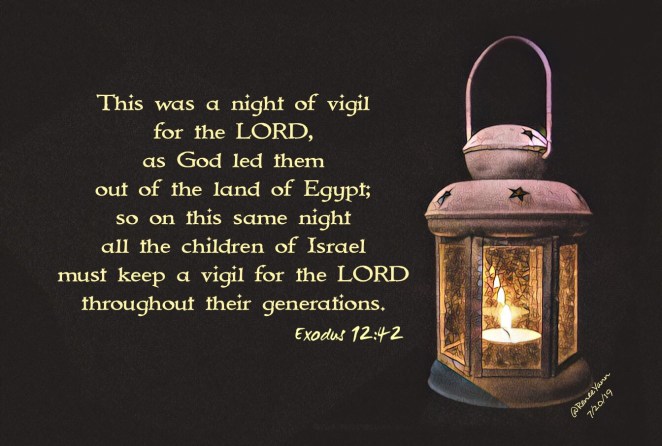
Today, in Mercy, we keep vigil with the “Children of Israel” as they begin the great Exodus.

Ex12_42 Vigil

Even the youngest of us understands what it means to “keep vigil”. Toddlers, on Christmas Eve, keep vigil for the sound of Santa’s footsteps on the roof.

Throughout our lives, the kinds of vigils we keep deepen in meaning. Any given night holds an array of vigil-keepers:

  • A nervous student pulls an all-nighter before a big exam.
  • An anxious parent watches over a feverish child.
  • A faith-filled soul sits in pre-dawn prayer.
  • A vigilant elder prays quietly at the death bed of a long-beloved.

As families and communities, we wait together for each other’s lives.

  • Together, we expect the births of each generation’s babies.
  • We wait and hope for college acceptances and new jobs.
  • We wait for test results of all kinds.
  • We wait to listen to one another’s stories of success or disappointment.
  • We wait and prepare for the dawning of great feasts like Christmas and Easter

When we keep vigil, we live in expectation of something or someone coming to us. But there is another important aspect to every vigil.

As we wait, something is also happening within us.
In the deep quiet of our waiting, we are transformed.

Thomas Merton, monk of Gethsemane, was assigned to keep a particular type of vigil at the abbey. It was called “fire watch”, a night-long lookout to ensure that no fire erupted in the old wooden buildings as the other monks slept.  Merton writes about that watch at the end of his book The Sign of Jonas:

The fire watch is an examination of conscience in which your task as watchman suddenly appears in its true light:  a pretext devised by God to isolate you, and to search your soul with lamps and questions, in the heart of darkness.
“Fire Watch, July 4, 1952”

Today, as we pray with Israel’s Passover vigil, let us consider our own vigils – current or past. Beyond their apparent meaning, to what secret transformation might God be inviting us? What is happening deep in our soul as we watch far out to the horizon of our hope?

Music: Firewatch – Chris Remo

The Bloody Lintel

Friday of the Fifteenth Week in Ordinary Time

July 19, 2019

Click here for readings

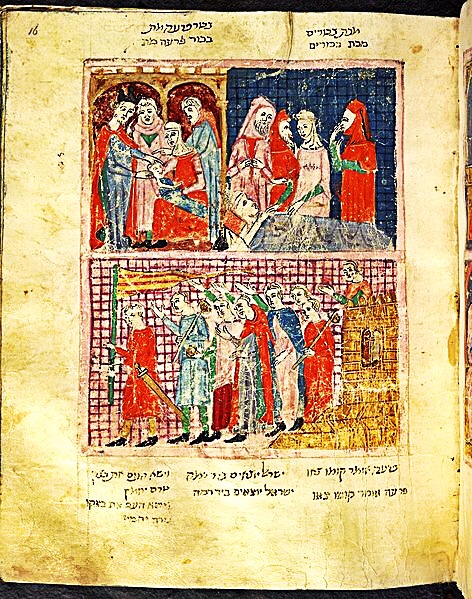
Today, in Mercy, we begin a series of texts about the Passover. These readings are so richly symbolic, not only for our personal prayer, but also for our sacramental understanding. Today’s passage addresses the acquisition and sacrifice of the Passover lamb.

plague
Scenes from Exodus. Full-page miniature, upper register: the tenth plague: the death of the first-born including Pharaoh’s son, lower register: the Israelites leaving Egypt. From the Haggadah for Passover (14thC.)

Maybe for you, as for me, this is one of first Bible stories you recall from childhood. I remember how the drama built as my teacher read this story – all these wide-eyed kindergarteners hanging on her every word.

God was done with Pharaoh who had already ignored nine – yes NINE – plagues! Now the Egyptians’ first-born would be taken from them in a heavenly massacre! It was terrible to imagine. But even worse to consider was how the innocent Israelites would be spared from the dreaded visitation!

Even as a little pre-schooler, I already knew that we sometimes get in situations that only God can get us out of.  What I have begun to learn in my maturity is that – rather than get us out of such circumstances –  God chooses to pass through these life experiences WITH us.

An image we might consider in our prayer today:  these lintels were marked in BLOOD. The visiting angel could have as easily read a charcoal mark on the door, or a colored slab of paint. But the deliverance was secured by blood.

lintel

When devastating loss, sorrow or confusion comes to our door, how does our faith deliver us to the Promise of joy and peace? 

It cannot be by some hastily obtained symbol or sign, or borrowed prayer. Our faith must already be rooted deep down in our veins, our arteries, our heart, our blood. That rooting shall not be moved, no matter the circumstance. That rooting ties us to the God of Life. That rooting allows us to discover God even in our chaos.

As we pray today, under the lintel post of our faith, let us be mindful that these magnificent passages prefigure the Holy Lamb of God, Jesus, who saves us from every kind of death. May we ask for the grace to deepen our Eucharistic and Paschal faith so that we may fully trust God in our own Passovers.

Music: Agnis Dei – Michael Hoppé

The Name

Thursday of the Fifteenth Week in Ordinary Time

July 18, 2010

Click here for readings

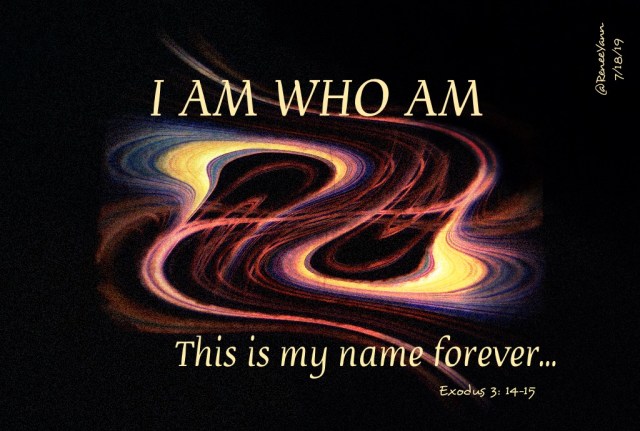
Today, in Mercy, God reveals God’s Name to Moses.

Ex3_14

Names are so important, aren’t they? Parents among you will remember how you labored over a name for each of your unborn children. Names carry roots to our history and hopes for our future. They suggest a shape for us to grow into and a way for us to be in the world.

In relationships, the giving of our name is a gift and an invitation. It is the first step in a mutual journey that may stop at the end of the encounter, or grow and blossom for years to come.

When God gives God’s name to Moses, it is all these things plus a Promise to abide forever in relationship. God hands Moses the key to call on God’s faithfulness forever. And God risks the hope that Moses will respond with fidelity and courage.

In prayer, and in our acts of mercy over a lifetime, God ever more deeply reveals the Holy Name to us. God promises to abide through our life with us and asks us to abide with Him. God risks that we will love, reverence, and respond to that amazing invitation with each successive moment and into eternity.

Today, in prayer, let us just rest in the Names we love to call God. Let us listen to the Love with which God names us.

Music:  Names of God – Laurell Hubick

The Burning Bush

Wednesday of the Fifteenth Week in Ordinary Time

July 17, 2019

Click here for readings

Today, in Mercy, we read about a “theophany” – a visible manifestation to humankind of God. Not your everyday occurrence, right? Well, let’s think about that.

Ex3_4 bush

In today’s passage from Exodus, Moses, self-exiled from Egypt because he murdered an abusive slave master, is shepherding his father-in-law’s flock through the desert. (Good practice for what will face him for the next forty years!) He’s basically out in the middle of nowhere, mindlessly daydreaming as the sheep dogs do most of the work.

All of a sudden, in the still, quiet spaciousness, a lonely bush combusts right in front of him! Theophany! God wants his attention.


For most of us, there are no burning bushes.
So what does God do when God wants our attention?


Just this morning, another Sister and I were praying in our quiet living room. In the stillness, I heard her very softly say, “Praise God”. She had noticed the clear, blue sky and gently swaying leaves outside our window. She had become instantly aware of how blessed she was by such beauty and life.

A theophany? I think so. And there are scores of them flowing past us daily if we can just open the inner heart to see them; if we can just pause to be grateful within their presence; if we can just acknowledge them by a simple prayer and wait to hear their message.

Some “theophanies” come gently like my friend’s this morning. Some come in an unexpected, and perhaps unwanted, explosion that disrupts our lives. But in each of their guises, they carry a God Who wants to speak with us. May we listen.

Music: jazzing it up today
Echoes from the Burning Bush – The Cathedral Singers

Moses stood on holy ground
Far from God descended down
Set the roadside bush on fire (bush on fire)

Then the Lord did there explain
Through His servant should remain
All the echoes from the bush on fire (the bush on fire)

Oh the echoes from the bush (I hear those lovely echoes from the burning bush)
How they thrill my soul (how they thrill my soul)
Oh the echoes from the bush (I hear those thrilling echoes from the burning bush)
Point me to the Lord (point me to the Lord)

I no more am doubting, but with joy I’m shouting
With no thought of shame to blush (no shame to blush)
This my song shall ever be, words that are so sweet to me
Echoes from the burning bush (the burning bush)

God sent down His only Son
Just to ransom everyone
By the echoes from the fire (from the fire)

God of every earthly land
Would not pick nor choose a man
For His blood will save us from the fire (eternal fire)

Journey through Exodus

Memorial of Saint Bonaventure, Bishop and Doctor of the Church

July 15, 2019

Click here for readings

Today, in Mercy, we begin a three-week journey through the Book of Exodus. The word “journey” is used purposefully because the Book not only narrates a journey in history, it invites us to move with it into a deeper spiritual freedom within ourselves.

It also impresses me that these weeks of reading come to us during a time when the world witnesses oppressed peoples exiting their ravished homelands in search of a sustainable life. Our prayerful reading of these Exodus passages may bring us deeper understanding, compassion, and advocacy courage for these struggling sisters and brothers.

In today’s introduction to Exodus, the narrator provides a transition from the closing of Genesis to the new situation in Egypt. Many years have passed. Favored Joseph is long dead. A “new king”, never named perhaps from contempt of his evilness, “knows nothing” of Joseph. If we don’t care enough to “know” another, we can never care enough to respect and foster their life.

Ex1_10_oppress

This Pharaoh’s sole preoccupation is to preserve Egyptian dominance . He was a man driven by irrational fears. To allay those fears, he was willing to suppress the life of a people who had lived peacefully in Egypt for hundreds of years. 

The Pharaoh begins by objectifying the Israelites as potential enemies and terrorists.

He orders their containment and oppression, moving them to encampments. Ironically, these encampment cities had originally been built, at Joseph’s direction, to contain surplus grain before the famine so that Egypt would not starve!

Still, the Israelites thrive and grow. They are the children of God’s Promise. This growth further threatens Pharaoh, spinning him into more desperate and ineffective attempts to retain domination. His systemic oppression doesn’t work. His fears – and his projection of them on to the Egyptian populace – consume both him and his people.


As the oppressors dehumanize others and violate their rights, they themselves also become dehumanized. … Once a situation of violence and oppression has been established, it engenders an entire way of life and behavior for those caught up in it—oppressor and oppressed alike. Both are submerged in the situation, and both bear the marks of oppression.
PAULO FREIRE, Pedagogy of the Oppressed, pp. 43-44)


Today’s readings offer us so much to consider in terms of a culture of domination versus one of right relationship. These balances and imbalances occur in exchanges as small as a word between two people, or as large as a policy between two nations. The parallels to our current world are painfully obvious. There may be parallels in our personal relationships as well that we might place into the power of prayer.

May we have eyes to see, a heart to care, and the courage to act – both personally and globally.

Music:  Hymn to Our Alien God – Maryknoll Father’s and Brothers

(Background music is the hymn “Eternal Father, Strong to Save” by William Whiting

https://www.youtube.com/watch?v=ZvwZ8NUH7m4&feature=youtu.be

The Name

Easter Wednesday, April 24, 2019

Click here for readings

Acts3_6

Today, in Mercy, our passage from Acts describes a sacred practice of the early Church – the invocation of the Name of Jesus as a source of spiritual power.

Peter said, “I have neither silver nor gold,
but what I do have I give you:
in the name of Jesus Christ the Nazorean, rise and walk.”

These first Christians were so invested in the Gospel of Jesus Christ that they claimed the right to act in his Name. They also clearly believed that they had no power themselves, but only in that blessed Name.

To call someone by their given name is an act of familiarity, if not intimacy. For those closest to us, we often have nicknames or pet names, conveying a unique understanding of each other.

Calling God by name is an act of both intimacy and worship. In the book of Exodus, God takes the first step in that deeper friendship:

God also said to Moses, “I am the Lord.
I appeared to Abraham, to Isaac and to Jacob
as God Almighty,
but by my name “the Lord”
I did not make myself fully known to them.

With the Incarnation of Jesus, God took the ultimate step in loving friendship with us. To help us understand the nature of this friendship, Jesus gives himself some “nicknames” throughout the Gospel:

  • Good Shepherd
  • Lamb of God
  • the Vine
  • the Way, the Truth, the Life
  • the Bread of Life
  • the Light of the World

Each of these names helps us to enter more deeply into the infinite love God has for us.

Do you have a special name for God? Sometimes, early in the morning when First Light touches my window, I pray with that Name. I ask my Bright God to light my life and the lives of those I love this day. At night, that same window is full of Sweet Darkness, a Name I call God as I ask that we all find a peaceful, protected sleep.

We might also ask if God has a special name for us. At different moments and moods of your life, does God speak to you with a personal, loving “nickname”? If you haven’t heard it yet, why not ask God to whisper it to you in your next prayer?

Music: Jesus the Lord – Roc O’Connor, SJ

Jesus, Jesus
Let all creation bend the knee to the Lord.

1. In Him we live, we move and have our being;
In Him the Christ, In Him the King!
Jesus the Lord.

2. Though Son, He did not cling to Godliness,
But emptied Himself, became a slave!
Jesus the Lord.

3. He lived obediently His Father’s will
Accepting His death, death on a cross!
Jesus the Lord.