A Dynamic Faith

Wednesday of the Third Week of Easter
April 26, 2023

Today’s Readings:

https://bible.usccb.org/bible/readings/042623.cfm

Today, in God’s Lavish Mercy, our readings allow us to experience the dynamic nature of faith, as it was experienced in the early Church.And it wasn’t always pretty!

The Stoning of St. Stephen – Rembrandt

Acts tells us of a rising violence toward the Christians, especially those considered “Hellenistic Jews”. There was prejudice against them among the Pharisees even before these Jews converted to Christianity. They were “outsiders “:

The Hellenistic Jews are those who speak mainly Greek, and formerly lived outside of Judea and Galilee. But they had settled in Jerusalem — retired, as it were, to the homeland. Nevertheless, they still have affinities with lands of the Jewish dispersion from which they came. The Hebraic Jews are those who speak mainly Aramaic, and were born in Jerusalem or Judea.

Michael Morrison, PhD, professor of Biblical Studies at Grace Communion Seminary


Stephen, the first Christian martyr, was a Hellenist, as was Philip mentioned today as the first Christian missionary. He is a different Philip from the Apostle who remained in Jerusalem according to the passage.

As I picture the forces at work in the early Church, I am reminded of the ocean, ever-changing in its flow from peace to storm, yet ever-constant in its tides.

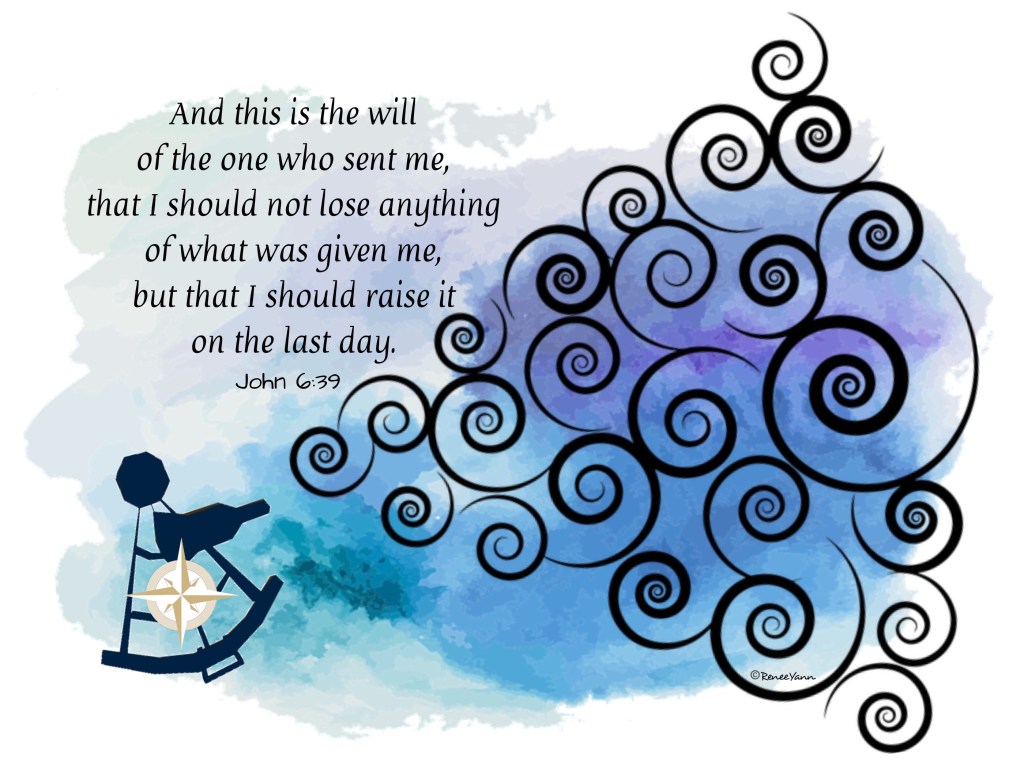
Faith is the anchor holding us steady in the waves, the sextant pointing us toward Christ’s Promise. As our Gospel says:

And this is the will of the one who sent me,
that I should not lose anything of what he gave me,
but that I should raise it on the last day.
For this is the will of my Father,
that everyone who sees the Son and believes in him
may have eternal life,
and I shall raise him on the last day.

John 6: 39-40

Stephen had this vital and tenacious faith, and died for it. Philip had it and shared it. The Apostles had it and held it steady for the rest of us.

How is the vital and dynamic faith living in me? How deeply do I believe and live the Promise? Let’s ask God today to strengthen our faith and to keep our focus on the Promise of eternal life.


Poetry: In Whom We Live and Move and Have Our Being – Denise Levertov 

Birds afloat in air's current,
sacred breath?  No, not breath of God,
it seems, but God
the air enveloping the whole
globe of being.
It's we who breathe, in, out, in, in the sacred,
leaves astir, our wings
rising, ruffled -- but only the saints
take flight.  We cower
in cliff-crevice or edge out gingerly
on branches close to the nest.  The wind
marks the passage of holy ones riding
that ocean of air.  Slowly their wake
reaches us, rocks us.
But storms or still,
numb or poised in attention,
we inhale, exhale, inhale,
encompassed, encompassed.

Music: The Promise – Marc Enfroy

Alleluia: For the Sake of Righteousness

Saturday of the Seventeenth Week in Ordinary Time
July 30, 2022

Today’s Readings:

https://bible.usccb.org/bible/readings/073022.cfm

Alleluia, alleluia.
Blessed are they who are persecuted
for the sake of righteousness
for theirs is the Kingdom of heaven.

( Dear Friends, I have just come home from the funeral of one of our Sisters – a beloved, holy, humble human being – full of love, generosity and joy. I would love to offer today’s reflection based on the power of her Home-Going Ceremony. But I need more time to let that brew in my heart. So, since I am running quite late, I am offering an edited reflection from two years ago for today’s reflection. But, trust me, you will be hearing soon about the miracle of Sister Margery Lowry.)


Today, in God’s Lavish Mercy, Jeremiah and John the Baptist are living out the meaning.of Psalm 69.

Each of these great prophets has been ensnared by the civic evil of their times, personified in Old Testament princes and New Testament Herod and Herodias. The power structure surrounding each prophet stood in direct contradiction to their witness to God’s Word. Those structures, when confronted with a sacred truth, tried to overwhelm the messenger, like quicksand swallows an innocent traveler.

Rescue me out of the mire; may I not sink!
may I be rescued from my foes,
and from the watery depths.
Let not the flood-waters overwhelm me,
nor the abyss swallow me up,
nor the pit close its mouth over me.


Psalm 69 raises to our prayer the reality that such struggles continue in our time. We live in a wonderful but still sinful world where every person decides, everyday, where he or she will stand in the contest between good and evil.

The decision is sometimes very clear. At other times, the waters are so muddied with lies, propaganda, greed, fear, bias. and unexamined privilege that we feel mired in confusion or resistance.

But I am afflicted and in pain;
let your saving help, O God, protect me.
I will praise the name of God in song,
and I will glorify him with thanksgiving.

Psalm 69 throws us a rescue line in today’s final verse:

See, you lowly ones, and be glad;
you who seek God, may your hearts revive!
For the LORD hears the poor,
and his own who are in bonds God spurns not.

The steady path to truth lies with those who seek God among the humble and poor. The humble are the ones through whom the Lord speaks. They are God’s own. Jeremiah and the Baptist understood this truth and preached it by their lives.

We might examine our lives today in the light of their witness and the message of this challenging psalm.


Poetry:  Beginners – Denise Levertov

‘From too much love of living,
Hope and desire set free,
Even the weariest river
Winds somewhere to the sea—‘


But we have only begun
to love the earth.
We have only begun
to imagine the fullness of life.
How could we tire of hope?
—so much is in bud.
How can desire fail?
—we have only begun
to imagine justice and mercy,
only begun to envision
how it might be
to live as siblings with beast and flower,
not as oppressors.
Surely our river
cannot already be hastening
into the sea of nonbeing?
Surely it cannot
drag, in the silt,
all that is innocent?
Not yet, not yet—
there is too much broken
that must be mended,
too much hurt we have done to each other
that cannot yet be forgiven.
We have only begun to know
the power that is in us if we would join
our solitudes in the communion of struggle.
So much is unfolding that must
complete its gesture,
so much is in bud.

Music:  The Cry of the Poor – John Foley, SJ

Alleluia: Full of Grace

Memorial of the Immaculate Heart of the Blessed Virgin Mary
June 25, 2022

Today’s Readings:

https://bible.usccb.org/bible/readings/062522.cfm

Today, in God’s Lavish Mercy, we pray with Mary, blessed mother of Jesus, and thus of us all who have been born anew in him.

Alleluia, alleluia.
Blessed is the Virgin Mary
who kept the word of God
and pondered it in her heart.

What can this beautiful mother teach us, she who kept and pondered the very Word of God?

In order to grow fully in to God’s heart and will, this holy woman held the Word – the way the dough holds yeast to allow its own transformation.

So that she might blossom into the fullness of her own beauty, she caressed faith’s slow-forming bud in the dark protection of her prayer.


Like all of us, Mary was not divine. She was not supernatural. She was an ordinary, good woman who loved God with extraordinary passion.

She spent her days clearing her heart-space of any clutter that would keep her from God. And slowly, that Divine Presence ripened and revealed itself in the flash of an angel wing and the soundless message that would transform all time.


We too, in our particular ways, are asked to allow God the space to imagine Divinity into flesh through our human experience.

Mary believed that God could and would do such a miracle for love of us. She let the Truth of Jesus live, not only in Him, but in her own mother’s life.

This generous mother then became the first disciple, keeping company with Jesus through his Passion, Death and Resurrection

Indeed, we have much to learn from her.


Poetry: Annunciation – Denise Levertov

We know the scene: the room, variously furnished,

almost always a lectern, a book; always
the tall lily.
Arrived on solemn grandeur of great wings,
the angelic ambassador, standing or hovering,
whom she acknowledges, a guest.

But we are told of meek obedience. No one mentions
courage.
The engendering Spirit
did not enter her without consent.
God waited.

She was free
to accept or to refuse, choice
integral to humanness.

____________________________

Aren’t there annunciations
of one sort or another
in most lives?
Some unwillingly
undertake great destinies,
enact them in sullen pride,
uncomprehending.
More often
those moments
when roads of light and storm
open from darkness in a man or woman,
are turned away from
in dread, in a wave of weakness, in despair
and with relief.
Ordinary lives continue.
God does not smite them.
But the gates close, the pathway vanishes.

______________________________

She had been a child who played, ate, slept
like any other child – but unlike others,
wept only for pity, laughed
in joy not triumph.
Compassion and intelligence
fused in her, indivisible.

Called to a destiny more momentous
than any in all of Time,
she did not quail,
only asked
a simple, ‘How can this be?’
and gravely, courteously,
took to heart the angel’s reply,
perceiving instantly
the astounding ministry she was offered:

to bear in her womb
Infinite weight and lightness; to carry
in hidden, finite inwardness,
nine months of Eternity; to contain
in slender vase of being,
the sum of power –
in narrow flesh,
the sum of light.
Then bring to birth,
push out into air, a Man-child
needing, like any other,
milk and love –

but who was God.

This was the moment no one speaks of,
when she could still refuse.

A breath unbreathed,
                                Spirit,
                                          suspended,
                                                            waiting.

______________________________

She did not cry, ‘I cannot. I am not worthy,’
Nor, ‘I have not the strength.’
She did not submit with gritted teeth,
                                                       raging, coerced.
Bravest of all humans,
                                  consent illumined her.
The room filled with its light,
the lily glowed in it,
                               and the iridescent wings.
Consent,
              courage unparalleled,
opened her utterly.


Music: Two versions of the magnificent “Ave Maria”.

Ave Maria – Franz Schubert – sung by Ms. Jessye Norman, in German as written by Schubert.

( I had the immense privilege and pleasure of meeting and working with the great Jessye Norman when I chaired a UNCF event in Philadelphia many years ago. She, in her own way, was a bit “divine”!)

Ave Maria – Charles Gounod – sung by Ms. Jessye Norman in Latin, as written

Faithful Heart

January 17, 2022
Monday of the Third Week in Ordinary Time
Memorial of Saint Anthony. Abbot

Today, in God’s Lavish Mercy, our readings help us understand the basic process for spiritual growth – the evolution from self-centered practice to God-centered faith.

The passages highlight three elements of a deeply faithful life:

Obedience – a listening heart
Discipline – a right heart
Freedom – a selfless heart

Obedience – The Listening Heart

In our first reading, Saul has fulfilled all God’s commands regarding the mission against the Amalekites – but he has still missed the point. Saul was given a divine mandate through Samuel to completely destroy the Amalekites. Instead, Saul kept the plunder, using some as a burnt sacrifice to God.

According to Samuel, Saul messed up big time. He had an unlistening heart. God didn’t want sacrifice, but rather a fully listening obedience.

But Samuel said:
            “Does the LORD so delight in burnt offerings and sacrifices
            as in obedience to the command of the LORD?
            Obedience is better than sacrifice,
                        and submission than the fat of rams.
            For a sin like divination is rebellion,
                        and presumption is the crime of idolatry.
            Because you have rejected the command of the LORD,
                        the LORD too, has rejected you as ruler.”

1 Samuel 15: 22-23

Discipline – The Right Heart

Our Responsorial Psalm continues the theme:

Why do you recite my statutes,
            and profess my covenant with your mouth,
Though you hate discipline
            and cast my words behind you?”…

The ones that offers praise as a sacrifice glorifies me;
            and to them that go the right way I will show the salvation of God

Psalm 50: 16-17;23

Freedom – The Selfless Heart

Mark’s Gospel complements the lessons of our first two readings. It paints a joyful picture of Jesus and his disciples. 

They are in the “salad days” of Christ’s earth-shaking ministry. Listening to Jesus, these disciples are in the Presence of a new and radical Truth. They fill their hearts and minds with its transformative power. Cherishing God’s Presence with them allows the disciples to release a inner love and generosity to fuel their ministry.

The nosy Pharisees, seeing all this joyful exuberance, question their unpenitential attitude:

The disciples of John and of the Pharisees were accustomed to fast.
People came to Jesus and objected,
“Why do the disciples of John and the disciples of the Pharisees fast,
 but your disciples do not fast?”

MARK 2:18

Does all this mean that there is never a time in the spiritual life for sackcloth, ashes and fasting? No – even Jesus didn’t say that:

Jesus answered the Pharisees,
“Can the wedding guests fast while the bridegroom is with them?
As long as they have the bridegroom with them they cannot fast.
But the days will come when the bridegroom is taken away from them,
and then they will fast on that day.

Mark 2:20

What I think it does mean is that a healthy spiritual life is centered on the Presence of God with us, not the absence. There are times when we should take stock of those “absences” and open them to repentance and healing. But then our spiritual energy should be turned to God in praise not toward our own penitential achievements.


Poetry: Flickering Mind – Denise Levertov

Lord, not you
it is I who am absent.
At first
belief was a joy I kept in secret,
stealing alone
into sacred places:
a quick glance, and away -- and back,
circling.
I have long since uttered your name
but now
I elude your presence.
I stop
to think about you, and my mind
at once
like a minnow darts away,
darts
into the shadows, into gleams that fret
unceasing over
the river's purling and passing.
Not for one second
will my self hold still, but wanders
anywhere,
everywhere it can turn.  Not you,
it is I am absent.
You are the stream, the fish, the light,
the pulsing shadow.
You the unchanging presence, in whom all
moves and changes.
How can I focus my flickering, perceive
at the fountain's heart
the sapphire I know is there?

Music: Sapphire Days – Anne Sweeten

Memorial of Saint Augustine

Saturday, August 28, 2021

Today, in God’s Lavish Mercy, we pray with Psalm 98, the scripture which inspired “Joy to the World”.

Psalm 98 describes God’s redemption of Israel and the jubilation that will ensue. In other words, it is a song of “rejoicing in the future tense”. When the community sang it for their great occasions, they had not yet seen the Savior. But their profound faith allowed them to celebrate in spirit what they believed would be accomplished – as the psalm’s concluding verse asserts:

In righteousness shall God judge the world
and the peoples with equity.

Psalm 98:8

We too are called to let our lives sing to the Lord in hope and confidence because we know that what we believe is true. That kind of faith in action is called “witness”. And we, my dears, in ALL circumstances of our lives, are charged to be WITNESSES!


  • Like the seas who sing in either still or storm
  • Like rivers who clap in ebb or the neap
  • Like the mountains who sing in all seasons


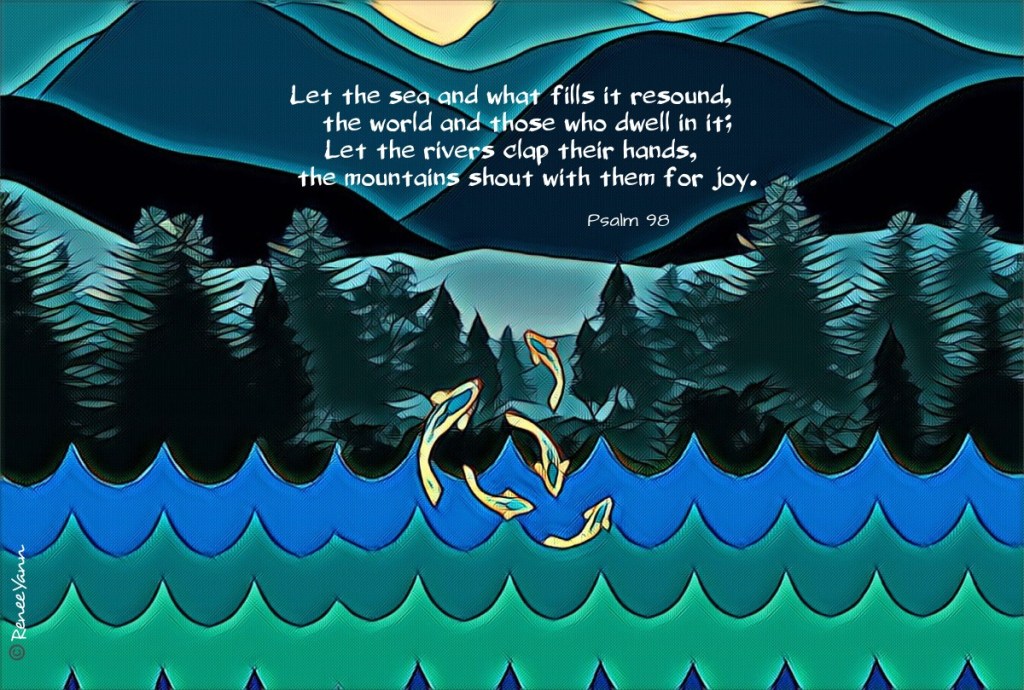
Let the sea and what fills it resound,
    the world and those who dwell in it;
Let the rivers clap their hands,
    the mountains shout with them for joy.

Psalm 98:7-8
  • Like our hearts that believe even through life’s intermingled joys and sorrows

This is your life,
joys and sorrow mingled,
one succeeding the other.

Catherine McAuley: Letter to Frances Warde (May 28, 1841)

Poetry: Flickering Mind – Denise Levertov

Lord, not you
it is I who am absent.
At first
belief was a joy I kept in secret,
stealing alone
into sacred places:
a quick glance, and away -- and back,
circling.
I have long since uttered your name
but now
I elude your presence.
I stop
to think about you, and my mind
at once
like a minnow darts away,
darts
into the shadows, into gleams that fret
unceasing over
the river's purling and passing.
Not for one second
will my self hold still, but wanders
anywhere,
everywhere it can turn.  Not you,
it is I am absent.
You are the stream, the fish, the light,
the pulsing shadow.
You the unchanging presence, in whom all
moves and changes.
How can I focus my flickering, perceive
at the fountain's heart
the sapphire I know is there?

Music: Let Your Heart Sing – Young Oceans

Wednesday of the Fourteenth Week in Ordinary Time

Wednesday, July 7, 2021

Today, in God’s Lavish Mercy, we pray with Psalm 33 in which the psalmist is clearly awestruck by both the power and the mercy of God. It is a prayer of radical awareness that God is Creator and we are creature.

According to Walter Brueggemann,
Psalm 33 describes Yahweh
as the settled sovereign, securely in control,
who need only speak
to have the command fulfilled.

The psalm has two divisions. In part one, the community is called to praise God because God deserves it.

Rejoice, you righteous, in the LORD;
praise from the upright is fitting.

Give thanks to the LORD on the harp;
on the ten-stringed lyre offer praise.

Sing to God a new song;
skillfully play with joyful chant.

For the LORD’s word is upright;
and works are trustworthy.

Psalm 33: 1-4

In part two, that praise is articulated by recounting God’s caring intervention in the community’s experience.

From heaven the LORD looks down
and observes the children of Adam,

From that dwelling place surveying
all who dwell on earth.

The One who fashioned together their hearts
and who knows all their works.

Psalm 33: 13-15

Psalm 33 can be summarized in this way:

Because Yahweh rules with righteousness, justice, and unfailing love,
we must worship Yahweh with songs and praise
and by rejecting all false sources of salvation.

Lynn Jost, Professor of Biblical and Religious Studies – Tabor College, Kansas

Praying Psalm 33 reminds me that one can never demand mercy. We cannot require the other to hold us in continual compassion. We can only hope and be grateful.

Mercy is the gift of a heart moved beyond itself by love and tenderness. Such outpouring is the very nature of God in whose image we are created.

Thus for God, and for us, to be unmerciful is to be unnatural. In Psalm 33, we pray not only to receive mercy, but to become mercy.


Psalm 33 closes with a plea for our hearts to be deepened in their affinity to God, to mirror God by our patience, joy, hope, and mercy.

Our soul waits for the LORD,
Who is our help and shield.

For in God our hearts rejoice;
in God’s holy name we trust.

May your mercy, LORD, be upon us;
as we put our hope in you.

Psalm 33: 20-22

Poetry: To Live in the Mercy of God BY DENISE LEVERTOV

To lie back under the tallest
oldest trees. How far the stems
rise, rise
               before ribs of shelter
                                           open!
To live in the mercy of God. The complete
sentence too adequate, has no give.
Awe, not comfort. Stone, elbows of
stony wood beneath lenient
moss bed.
And awe suddenly
passing beyond itself. Becomes
a form of comfort.
                      Becomes the steady
air you glide on, arms
stretched like the wings of flying foxes.
To hear the multiple silence
of trees, the rainy
forest depths of their listening.
To float, upheld,
                as salt water
                would hold you,
                                        once you dared.
                  .
To live in the mercy of God.
To feel vibrate the enraptured
waterfall flinging itself
unabating down and down
                              to clenched fists of rock.
Swiftness of plunge,
hour after year after century,
                                                   O or Ah
uninterrupted, voice
many-stranded.
                              To breathe
spray. The smoke of it.
                              Arcs
of steelwhite foam, glissades
of fugitive jade barely perceptible. Such passion—
rage or joy?
                              Thus, not mild, not temperate,
God’s love for the world. Vast
flood of mercy
                      flung on resistance.

Music: As you listen to David Arkenstone’s instrumental, you may want to remember Shakespeare’s famous description of mercy. See below the music.

Saturday of the Eleventh Week in Ordinary Time

Saturday, June 19, 2021

Today, in God’s Lavish Mercy, we pray with Psalm 34 once again. With its two accompanying readings, the psalm hits me right between the eyes with this awareness:

Those of us trying to live in God’s presence, the world isn’t going to help us. We will be in contradiction to many, if not most, popular values. Our choices may be questioned, if not ridiculed. Our values may be explained away. Our integrity may be challenged. 

What’s it like to live a faith-based life in today’s culture? The image that comes to my mind is that of trying to play soccer with a square ball! 

Paul felt the dissonance:

But the Lord said to me, “My grace is sufficient for you,
for power is made perfect in weakness.”
So I will rather boast most gladly of my weaknesses,
in order that the power of Christ may dwell with me.
Therefore, I am content with weaknesses, insults,
hardships, persecutions, and constraints,
for the sake of Christ …


Jesus put the contradiction in a nutshell for us:

No one can serve two masters.
You will either hate one and love the other,
or be devoted to one and despise the other.
You cannot serve God and mammon.


So we need to figure out our “mammon” and vanquish it. We need to make the choice that Paul, the psalmist, and Jesus made. Let’s pray on it today.


Poetry: Contraband – Denise Levertov

The tree of knowledge was the tree of reason.
That’s why the taste of it
drove us from Eden. That fruit
was meant to be dried and milled to a fine powder
for use a pinch at a time, a condiment.
God had probably planned to tell us later
about this new pleasure.
                                   We stuffed our mouths full of it,
gorged on but and if and how and again
but, knowing no better.
It’s toxic in large quantities; fumes
swirled in our heads and around us
to form a dense cloud that hardened to steel,
a wall between us and God, Who was Paradise.
Not that God is unreasonable – but reason
in such excess was tyranny
and locked us into its own limits, a polished cell
reflecting our own faces. God lives
on the other side of that mirror,
but through the slit where the barrier doesn’t
quite touch ground, manages still
to squeeze in – as filtered light,
splinters of fire, a strain of music heard
then lost, then heard again.


Music: I Choose You Now – Rend Collective

Psalm 37: The Problem of Evil

Friday of the Third Week in Ordinary Time

January 29, 2021


from today’s first reading

Today, in God’s Lavish Mercy, we pray with Psalm 37 which some interpret as a response to the problem of evil. The Hebrew scriptures often express this problem as a question: why do the wicked prosper and the good suffer? 

The valiant one whose steps are guided by the LORD,
who will delight in his way,
May stumble, but he will never fall,
for the LORD holds his hand.

Psalm 37: 23-24

I think many of us see the evil in the world and are saddened, stunned, and confused by it. We share the disillusionment posed in Rabbi Harold Kushner’s classic book, “When Bad Things Happen to Good People”.

I don’t know about you, but I even have gotten angry with God over the question. When I ministered as hospice chaplain, there were many nights I spent in tearful, protesting astonishment at God’s so-called “Will”.

I have a dear and abundantly faithful friend who swears she will tell God off when she gets to heaven. Ever been like her?😉

Over the years I’ve come to understand that, well actually, we just don’t understand. I have also come to trust that God mysteriously abides with us in our suffering, drawing us ever deeper into that ineffable mystery.

Psalm 37 encourages that trust, and its ensuant behavior, within our own lives:

Trust in the LORD and do good,
    that you may dwell in the land and be fed in security.
Take delight in the LORD,
    and he will grant you your heart’s requests.
Commit to the LORD your way;
    trust in him, and he will act.
He will make justice dawn for you like the light;
    bright as the noonday shall be your vindication. 

Psalm 37: 3-6

Psalm 37 acknowledges that, though we trust, our trust is often tested by what we see in the world.

The salvation of the just is from the LORD;
    who is their refuge in time of distress.
And the LORD helps them and delivers them;
    the Lord delivers them from the wicked and saves them,
    because they take refuge in God.

Psalm 37: 39-40

Perhaps for our prayer today, we would like to test our hearts against this trust, given the circumstances and awarenesses of our own lives. Where is it that we “take refuge” when “bad things happen”?


Poetry: “Talking to Grief” by Denise Levertov

Ah, grief, I should not treat you
like a homeless dog
who comes to the back door
for a crust, for a meatless bone.
I should trust you.

I should coax you
into the house and give you
your own corner,
a worn mat to lie on,
your own water dish.

You think I don’t know you’ve been living
under my porch.
You long for your real place to be readied
before winter comes. You need
your name,
your collar and tag. You need
the right to warn off intruders,
to consider my house your own
and me your person
and yourself
my own dog.

Music: You Want It Darker – by Leonard Cohen who was a Canadian singer-songwriter, poet, and novelist. His work explored religion, politics, isolation, depression, sexuality, loss, death and romantic relationships. Many will be familiar with his highly popularized and beautifully haunting song


Cohen invokes in the song what seem to be phrases from the story of the “binding of Isaac” in Genesis 22, when God commanded Abraham to slaughter his beloved son, Isaac. The Hebrew word Hineni, which means “Here I am,” is repeated thrice in the “You Want It Darker” song and in Genesis 22 (vs. 1, 7, 11). …

“Hineni” resonates with obedient readiness. It is what a faithful Jew says to God when summoned and called, even in the face of the “valley of the shadow of death.” But Cohen is not so willing to embrace this word in the face of such deep darkness. Indeed, he “wants out” if thus is how the Dealer deals. He will not simply submit without protest against death, without shouting out from within the dark mystery that enfolds humanity.

Dr. Tom Neal – Academic Dean and Professor of Spiritual Theology, Notre Dame Seminary, New Orleans, LA

Psalm 144: War and Peace

Thursday of the Thirtieth Week in Ordinary Time

October 29, 2020


Today, in God’s Lavish Mercy, we pray with Psalm 144, a royal psalm of David in which he celebrates victory and its ensuing peace.

Blessed be the LORD, my rock,
who trains my hands for battle, my fingers for war.

Psalm 144:1

While, at first blush, the psalm seems to extol war as a means to achieve power, its message is really quite the opposite. 

It is only through reliance on God and faithfulness to God’s law that we find right-balance and peace – in our world, our community, and ourselves 

My mercy and my fortress,
my stronghold, my deliverer,
my shield, in whom I trust …

Psalm 144:2

Historically, our world religions have had a vexing relationship with war, often espousing it to advance questionable agendas. Only now is the Catholic Church beginning to re-evaluate what is referred to as the “Just War Theory”.

For a good explanation of this theory, click on the link below


However, in Fratelli Titti, Pope Francis declares:

War can easily be chosen by invoking all sorts of allegedly humanitarian, defensive or precautionary excuses, and even resorting to the manipulation of information. In recent decades, every single war has been ostensibly “justified”. The Catechism of the Catholic Church speaks of the possibility of legitimate defence by means of military force, which involves demonstrating that certain “rigorous conditions of moral legitimacy” have been met. Yet it is easy to fall into an overly broad interpretation of this potential right. In this way, some would also wrongly justify even “preventive” attacks or acts of war that can hardly avoid entailing “evils and disorders graver than the evil to be eliminated”. At issue is whether the development of nuclear, chemical and have granted war an uncontrollable destructive power over great numbers of innocent civilians. The truth is that “never has humanity had such power over itself, yet nothing ensures that it will be used wisely”. We can no longer think of war as a solution, because its risks will probably always be greater than its supposed benefits. In view of this, it is very difficult nowadays to invoke the rational criteria elaborated in earlier centuries to speak of the possibility of a “just war”. Never again war!

As we pray with this psalm today, we might echo its last verse and pray a prayer like this for all people, for our fratelli tutti…:

May there be no breach in the walls,
no exile, no outcry in our streets.
Blessed the people so fortunate;
blessed the people whose God is the LORD.

Psalm 144:14-15

Poem: Misnomer by Denise Levertov

They speak of the art of war,
but the arts 
draw their light from the soul’s well, 
and warfare 
dries up the soul and draws its power 
from a dark and burning wasteland. 
When Leonardo 
set his genius to devising 
machines of destruction he was not 
acting in the service of art, 
he was suspending 
the life of art 
over an abyss, 
as if one were to hold 
a living child out of an airplane window 
at thirty thousand feet.

Music: Where Have All the Flowers Gone

Psalm 33:Love’s Design

Memorial of Saint Augustine, Bishop and Doctor of the Church

August 28, 2020


Today, in God’s Lavish Mercy, we pray with Psalm 33, a song of praise calling the people to rejoice in God’s justice and kindness.

In its attitude of trust and freedom, the Psalm might remind us of Robert Browning’s verse:

God’s in his heaven. All’s right with the world.

But neither in the psalmist’s time, nor in Browning’s, was everything really “all right” with the world. Things are never really “all right” with the world. There is always war, crime, hunger, disease, natural disasters, and a slew of other troubles brewing somewhere.

So how can the psalmist or any other preacher invite us to trust, believe, and rejoice like this?

Exult, you just, in the LORD;
praise from the upright is fitting.
Give thanks to the LORD on the harp;
with the ten-stringed lyre chant his praises.


Keywords in this verse give us a clue: those who are just and upright will see the pattern of God’s mercy which lies deeper than the troubles of this world. They will trust and be comforted by God’s transcendent faithfulness to us in all things. Their faith and joy in the face of suffering will confound the faithless.


Calling us to the full meaning of Christ’s sacrificial love, Paul reiterates this mysteriously contradictory truth in our first reading :

For the foolishness of God is wiser than human wisdom,
and the weakness of God is stronger than human strength.

For Christians, the Cross is the ultimate symbol of this profound wisdom and strength. It is a mystery too deep for our understanding, but by faith we may slowly become immersed in its Truth.


The message of the cross is foolishness to those who are perishing, 
but to us who are being saved it is the power of God.

1 Corinthians 18

As we pray with Psalm 33 today, let us be aware of the cause of our joy – a holy joy deeply rooted in God, trusting God’s Will for our salvation in the pattern of Jesus Christ.


For upright is the word of the LORD,
and all God’s works are trustworthy.
The LORD loves justice and right;
of the kindness of the Lord the earth is full.


Poetry: Primary Wonder – Denise Levertov

Days pass when I forget the mystery.
Problems insoluble and problems offering
their own ignored solutions
jostle for my attention, they crowd its antechamber
along with a host of diversions, my courtiers, wearing
their colored clothes; cap and bells.
                                                        And then
once more the quiet mystery
is present to me, the throng’s clamor
recedes: the mystery
that there is anything, anything at all,
let alone cosmos, joy, memory, everything,
rather than void: and that, O Lord,
Creator, Hallowed One, You still,
hour by hour sustain it.

Music: Your Cross Changes Everything – Matt Redman