Word

Sunday, January 27, 2019

Click here for readings

Today, in Mercy, our readings focus on Scripture as the revealed Word of God.

lk1_scroll word

Ezra, from our first passage, lived almost 500 years before Christ during the Babylonian captivity, a time when much of the population of Judea was deported to what is modern day Iraq. When the Persian King Cyrus the Great conquered Babylon, the Jews were permitted to return to Judea.

During the sixty-year enslavement, many Jews lost touch with their culture, language and religion. Our reading describes Ezra’s efforts to restore the Jewish character of the community by reintroducing them to the Torah. He has to read to them, translating the Hebrew for those who no longer speak it.

In a gesture foretelling the liberating ministry of Jesus, Ezra unrolls the scroll – symbolic of bringing to light that which has been hidden or buried.

In our Gospel, Jesus too unrolls the scroll. In doing so, Jesus reveals the heart of faith which had been buried within the Law. Jesus preaches in a new “language” – the language of God’s all-inclusive mercy, forgiveness, and love.

For us who believe, the holy scriptures are a Living Word which, through thoughtful prayer, will continually reveal God’s heart to us. It is worth our time and attention to become friends with these sacred messages.

Many of you, dear readers, will be familiar with the ancient prayer practice of “lectio divina”. In her book “Too Deep for Words”, Sister Thelma Hall describes the practice:

… a wholistic way of prayer which disposes, opens, and “in-forms” us for the gift of contemplation God waits to give, by leading us to a place with him at our deepest center … It begins this movement by introducing us to the power of the Word of God in scripture to speak to the most intimate depths of our hearts …

Sister Thelma Hall’s Book, a classic, is available on Amazon for those who might enjoy exploring Lectio Divina. I highly recommend it. My copy, nearly 30 years old, is beginning to show its age, but then again, so am I! 😂 I would never part with it. 

Click here for Amazon

Music:  Word of God Speak ~ Mercy Me

In Remembrance

mom seaside

Go on…

Now, my mother done her dying,
I come back again to my own life
that I had taken off,
the way you take a coat off
and hang it on a hook behind the door
when seasons change,
sometimes forgetting where it is
until you feel the cold again.

When word that she was ill
fell like a wounded bird
into time’s tranquil pool,
I just ignored the cold.
I walked out into night
to take her hand as she
left quickly for its distant edge.

Through four cold months, we pulled
stars down to light that edge,
blue-hot stars we’d fired
in long years of love.

Family, friends and names that
dozed like dormant flowers in a field
flew up in such a rush of love
around us that November turned to May.

Then, one icy day in January,
I cleared our sidewalk of a heavy snow,
in brief, staccatoed intervals,
lest leaving her too long, the
fragile thread would break
without my benediction.

It was Tuesday, I remember,
but time was caught behind
a wall of silence.  It moved
at half-speed.  Within its womb
that birthed my mother to another life,
I was timeless, still, unborn again.

When my mother died, she did it
just as I had left my life
four months before, with
love and not a glance behind,
no brief regret to do
what faith required her to do.

She drew that thin last breath
from air we shared, as my cheek
laid tenderly on hers, I whispered,
“Go on … and I love you.”

Music: Halleluia – Leonard Chen – played here by:
Violin: Leonardo Barcellos: Cello: Daniel Enache; Guitar: Leonardo Barcellos

Fan the Love into Flame

SATURDAY, JANUARY 26, 2019

Click here for readings

Today, in Mercy, we have the beautiful letter from Paul to Timothy, filled with tenderness, encouragement, hope and the sweet suggestion of loving memories.

2 tim1_6 fan to flame

When we travel life’s road, what an indescribable blessing to have even one companion who loves us the way Paul loved Timothy — to care for our whole life,  our whole soul, and our whole “forever”.

In his letter, Paul reveals that Timothy has been immensely blessed with such love.  Timothy’s mother and grandmother, Eunice and Lois have already – for many years –  tendered Timothy in the faith.

In this lovely letter, Paul notes that he prays for Timothy daily.

Do we pray for those who have blessed us and loved us in our lives? Do we tell them so, if they are living? Do we thank and remember them if they have gone home to God?

Paul closes this part of his letter with such beautiful words to Timothy:

For this reason,
I remind you to stir into flame
the gift of God that you have
through the laying on of my hands.

Many people have rested their hands on your spirit, on your heart.  Be filled with love and gratitude for them today and everyday. For those who have done otherwise, forgive them and let them go.

I remember in a special way today my mother who died on this date thirty-one years ago.  In a separate email, I share a poem I wrote after Mom’s death.  It is a little sad in tone, but it may touch and help some of you, my readers, who are experiencing grief.

Stay with your grief, beloveds, long enough to find the blessing within it.

Some meditative music: for your remembering prayerJames Last – Coulin

The WHOLE World

Friday, January 25, 2019

Click here for readings

Today, in Mercy,  Acts paints a detailed picture of Saul’s conversion and call on the road to Damascus. It’s a colorful and dramatic account befitting the biography of the  great “Apostle to the Gentiles”.

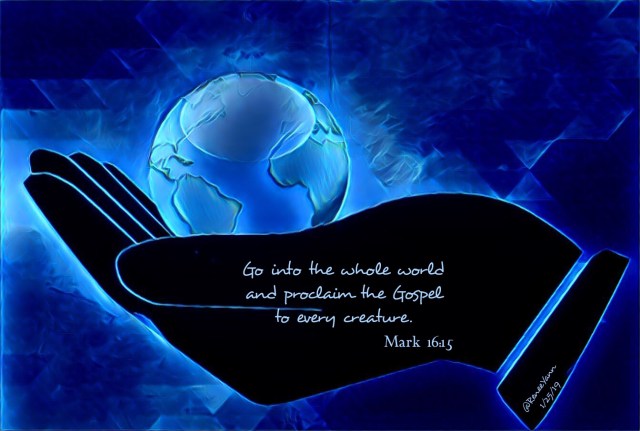
mk16_15 whole world

Think about this. Almost all the very first Christians (and Christ himself) were Jews. Early Christian ritual grew out of Jewish ritual. In the immediate post-Resurrection period, there were few, of any, Gentile Christians.

This is one of the reasons Paul is such a big deal. As a Roman citizen and a devout Jew, he lived with a foot in two worlds, as opposed to the Jewish fishermen who composed the original Twelve. They were local guys with minimal exposure to the non-Jewish world.

When the original Twelve (eventually Eleven) heard Jesus’s Apostolic Commission, “Go out to all the world and tell the Good News…”, they may have felt that world was confined to Israel’s borders! Paul, the post-Resurrection Apostle, demonstrated otherwise.


Paul traveled over 10,000 miles proclaiming the gospel of Jesus Christ. His journeys on land and sea took him primarily through present day Israel, Syria, Turkey, and Greece.
(from Loyola Press. See website for great summary of Paul’s journeys.

Click here for Paul’s Journeys 


How encompassing is our vision of “the whole world”, that world which hungers for the message, mercy and love of Christ?

Our Gospel today impels us with the same apostolic call as these early disciples. God’s love and fullness of life belong to all. What can I do to make that a greater reality?

Music:  Facing a Task Unfinished-~ Lyrics:Frank Houghton. Performed by the Gettys 

Heyday Jesus

Thursday, January 24, 2019

Click here for readings

Today, in Mercy, Mark’s Gospel portrays Jesus in his “heyday”. 

heydayjpg

It is early in his ministry. Word is spreading about his teaching and his miracles. He is the “hot ticket” in any town he visits. But what was Jesus thinking in the midst of all the hubbub?

We get a few good hints in our Gospel.

  • Jesus withdrew toward the sea
  • He wanted a boat ready lest the crowd would crush him
  • He warned the unclean spirits not to make him known

These phrases suggest that Jesus was a bit overwhelmed by the furor. No doubt he realizes that his identity and message go far beyond the show of miracles. Can the “fandom” of these early crowds be converted to deep and committed discipleship?

This reading might incline me to consider my own faith. 

Do I love and follow just the “heyday Jesus” – the One who is powerful over the demons and deaths I fear?

Or have I learned to love and follow the deeper Jesus, the One who suffers and dies for justice, goodness and love – the One Who lives in the poor?

One way to answer these questions is to ask ourselves where we find Jesus in our daily lives.

Is he confined to our Bible, our church, our prayerbooks and our moral judgments?

Or is our faith deep enough to see and love him in the suffering face of humanity – perhaps where it is inconvenient, costly and sometimes unsettling to find him? 

Music: God of the Poor ~ Graham Kendrick

Jesus Breaks Through

Wednesday, January 23, 2019

Click here for readings

Today, in Mercy,  the writer of Hebrews continues to shine light on the superior  “priesthood” of Jesus Christ – that aspect of Christ’s ministry that breaks heaven open for us and reinstates us as God’s children.

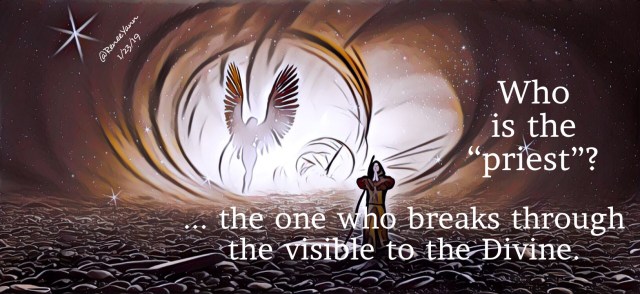
heb2 priest

Hebrews calls Christ a priest “according to the order of Melchizedek” – an order above and beyond the priesthood of Aaron and Levi.

Although there are a few references to Melchizedek in scripture, only one narrative refers to him:

After Abram returned from defeating Kedorlaomer and the kings allied with him, the king of Sodom came out to meet him in the Valley of Shaveh (that is, the King’s Valley).
Then Melchizedek king of Salem brought out bread and wine. He was priest of God Most High, and he blessed Abram, saying,
“Blessed be Abram by God Most High,
    Creator of heaven and earth.
And praise be to God Most High,
    who delivered your enemies into your hand.”
Then Abram gave him a tenth of everything.
Genesis 14:17-20

Melchizedek, whose priesthood preceded even Abraham, is offered in Hebrews as a prototype of Jesus who fulfills and perfects the Old Testament promises.

Does this matter to us modern day Christians who can barely say “Melchizedek “, let alone spell it? And if it does matter, how?

An answer may be revealed in our Gospel today. 

In it, Jesus challenges the old, Pharisaical, law-bound way of thinking. As the new and perfect “priest”, Jesus breaks that way of thinking with the transformation of love. 

  • This man with the withered hand is more important than the law. 
  • This act of healing and wholeness is more important than ritual adherence. 
  • The priesthood of Jesus is the breakthrough revelation of what God really desires – mercy, not sacrifice.

Music: Love Broke Thru ~ Toby Mac

To Life!

Tuesday, January 22, 2019

Click here for readings

Today, in Mercy, our passage from Hebrews is a strong encouragement for its readers to stay faithful to the hope that has been given us through our call.

eph1_17 call
from today’s Responsorial Psalm

Paul traces the evolution of that call by reminding his readers of Abraham who trusted God’s promise and patiently waited for its fulfillment. Paul says that God not only promised Abraham, God swore an oath to bless and multiply Abraham’s life.

This promise and oath of God’s faithful covenant is the root of our Christian hope, and the “anchor” of our life.

Green Rope

On this day, when the Church prays for the protection of unborn children, let us be conscious that the “right to life” extends beyond the womb, from “cradle to grave”.

Let us pray to honor and reverence all life and all Creation – those who are troubled, poor, sick, different from us, homeless and seeking refuge. Let us pray for political and economic systems that protect both unborn and born children, resident and refugee, privileged and marginalized … nourishing their right to life, freedom and the happiness of well-being.

Beloveds, let us give thanks for the life and faith we have been given, and let us share it generously.

Music: You Are Life ~ Hillsong Worship

Jesus, Humble Priest

Monday, January 21, 2019

Click here for readings

Today, in Mercy, our reading from Hebrews describes Jesus as the perfect high priest.  Through the Father’s call, Jesus took on our imperfect nature and transformed it by his life, death and Resurrection. In the Eucharist, Jesus left us a living memorial of this transformation so that we might participate in its saving mystery.

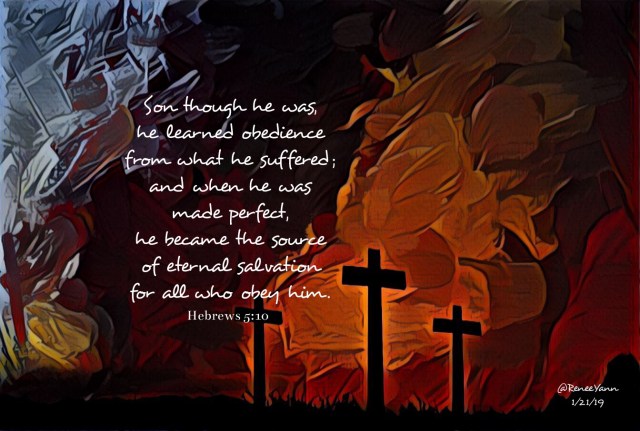
heb5_10 priest

Paul’s “perfected priest” is patient because his own weakness humbles him. He does not take honor upon himself, but receives it humbly from God.

Jesus, the model of this priesthood, 

… in the days when he was in the Flesh,
… offered prayers and supplications with loud cries and tears
to the one who was able to save him from death,
and he was heard because of his reverence.

The perfection of Christ’s priesthood was accomplished through suffering and obedience. This is how Jesus teaches us to live in reverence and humble service.

As I read and pray with this scriptural understanding of priesthood, I pray for our Church. The catastrophic scandals involving our priests and leaders have deeply shaken the faith of many Catholics, including my own.

Many of us are frustrated by the continued refusal of our Church to open itself to new models of priestly service which are grounded in mutuality, inclusivity and simplicity.

The accretions of institutionalization, hierarchical camouflage, and sexist rationale have mitigated the Church’s credibility to touch the lives of ordinary people, especially our emerging adults.

In our Gospel, Jesus talks about an old cloak that needs a patch to make it whole again. He talks about new wine that must be captured and preserved in new wine skins. For me, he is talking about our Church which must be continually renewed and transformed. 

May our present suffering and confusion be transformed by our humble obedience to God’s call – just as the high priest of our first reading was perfected.

Let us pray today for our good Pope, bishops, theologians and spiritual leaders – and for the whole People of God – that we may hear and respond.

Music: Even Death on a Cross ~ Jason Silver

There is No Wine

Sunday, January 20, 2019

Readings: http://www.usccb.org/bible/readings/012019.cfm

Today, in Mercy, we read about Jesus’s first public miracle at Cana. It is a story that has always fascinated me, mostly because of what is left unsaid – what is written between the lines.

jn2_1 can

The Gospel begins by telling of a wedding and “the mother of Jesus was there”. The suggestion is that Mary had been staying at the wedding site and that she had a special role in the preparations. Perhaps she was the aunt or good friend of the bride or groom. Whatever the case, Mary seems to have had some unique responsibility for the ceremony’s success.

This responsibility motivates her to solicit Jesus’s help when she notices the wine is running out. Did she expect a miracle in return for her remark? We don’t know. Perhaps she just wanted Jesus and his young friends to run down to the local wine store for replenishments.

It was Jesus who decided to turn the request into an occasion for a miracle. Why? It seems like a frivolous miracle when there were sick to be cured and dead to be raised!

The final lines of this pericope might help answer that question

Jesus did this as the beginning of his signs at Cana in Galilee
and so revealed his glory,
and his disciples began to believe in him.

Jesus decided to first reveal his glory at a wedding feast, a party, an ordinary celebration of life and love. The dramatic, life-saving miracles would come – demons grabbing pigs and diving headlong into the sea.

But this first one, the one his closest family and friends would especially remember, was all about joy, dancing, music, friendship – the divine strength of our shared and graced humanity.

Probably most of us don’t expect to encounter a really eye-popping miracle in our lives. But maybe in our challenges we, like Mary, could walk up behind Jesus and whisper, “This situation needs your touch”.

Oh, how Jesus might surprise us!

Music: Everyday Miracles ~ Sara Groves