Our Story is God’s Story

Saturday of the Sixteenth Week in Ordinary Time

July 27, 2019

Click here for readings

Today, in Mercy, our Exodus reading describes momentous events in Israel’s life.

tabletsJPG

God has just invited Moses and several others up the mountain for a Divine conflab.  Moses returns to the people to announce “all the words and ordinances of the Lord”.The People receive these words wholeheartedly:

“We will do everything that the LORD has told us.”

Thus, a community of persons is formed with God at its heart.

Moses then engages the community in a series of formal rituals to highlight the significance and permanence of this deeper step in relationship with God.


The passage contains multiple points for our prayerful consideration.

The community of Israel is not unlike our own faith communities, those that gather in specific religious houses, or those we share in the universal community of all Creation. We are Catholics, Lutherans, Jews, Hindus, Muslims, Sikhs sharing a story of God in our particular religious traditions. We are also all children of the same God sharing that experience in our Common Home of Creation.

Just as with the ancient Israelites, God communicates and relates with us through the experiences of our lives. In our communities, that Divine Word is interpreted, codified, ritualized, and responded to. These actions create a story which is alive, deepening with each new generation, and still always rooted in the long history of promise and grace.

Today’s reading contains many elements of story and ritual which we can recognize in our own faith practice: written and announced word, altar or worship place, sacrifice or offering to God, acts of covenant, and celebratory meals.

Exodus24_3 sinai

These are the human ways in which we access relationship with God. These are the ways in which we keep our faith vital. We strengthen our faith by one another’s stories of love, mercy and hope. We commit to a shared law of love, not legalism – a heart-law which calls us to be life for one another, just as God is Life for us. In community, we reveal the face of God within ourselves.

For those of us who share the practice of a Eucharistic faith, the parallels in today’s reading call us to deeper awareness of how God becomes present in our lives.

May all of us – of whatever spirituality – who share life in God’s continuing Creation, obediently hear the command to cherish every human being as a revelation of God, as a critical and precious part of my own faith story – a part for whom I share the responsibility for life.

Music: Song of the Body of Christ – David Haas (Lyrics below)

Song of the Body of Christ
Refrain: We come to share our story. We come to break the bread.
We come to know our rising from the dead.
1. We come as your people. We come as your own.
United with each other, love finds a home.
2. We are called to heal the broken, to be hope for the poor.
We are called to feed the hungry at our door.
3. Bread of life and cup of promise, In this meal we all are one.
In our dying and our rising, may your kingdom come.
4. You will lead and we shall follow.
ou will be the breath of life; living water, we are thirsting for your light.
Be the Neighbor!

Fifteenth Sunday in Ordinary Time

July 14, 2019

Click here for readings

Today, in Mercy, dear friends, we have heard this Gospel from our youth. Even those without faith know the story.

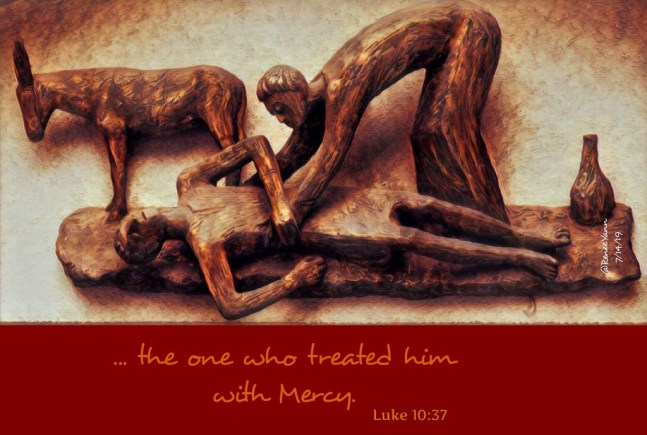
Lk10_37 Samaritan

Let us deeply examine our daily lives today as we pray.

What more is there to say? This is what I hear in my prayer today:

Always be the neighbor.
Just do it.
This is Mercy.

do it1JPG

Music: I Will Love You, Lord! – Dale Sechrest

This wonderful mantra! Let yourself sing it!

The Ultimate Gift

The Solemnity of the Most Holy Body and Blood of Christ

Sunday, June 23, 2019

Click here for readings

Today, in Mercy, we celebrate a glorious feast, one through which we can trace the continuing evolution of Eucharistic theology.

CorpusJPG

Some of us will remember celebrating the Feast of Corpus Christi, perhaps as children. The Host, carried in a beautiful monstrance, was processed through the neighborhood, bringing blessing to all who gathered.

process
Where did they get all those men!!!!

While a rare occurrence today, and considered by some a saccharine expression of devotionalism, the practice was intended to convey a central belief of our faith. It is a belief whose theology continues to evolve and deepen with the passing years:

In the gift of Eucharist,
Jesus Christ has made us
one Body with Him.
We are One Body in Christ.


A significant step in the evolution of this theology occured with the issuing of the encyclical MYSTICI CORPORIS CHRISTI ( Pope Pius XII, 1943). In this letter, we see a theology beginning to unfold to include not only Christ’s presence on the altar and in the Host, but in the very lives of the faithful.

The Sacrament of the Eucharist is itself a striking and wonderful figure of the unity of the Church, if we consider how in the bread to be consecrated many grains go to form one whole,and that in it the very Author of supernatural grace is given to us, so that through Him we may receive the spirit of charity in which we are bidden to live now no longer our own life but the life of Christ, and to love the Redeemer Himself in all the members of His social Body.


In his encyclical, ECCLESIA DE EUCHARISTIA (2003), Pope John Paul II, expands this teaching:

By the gift of the Holy Spirit at Pentecost the Church was born and set out upon the pathways of the world, yet a decisive moment in her taking shape was certainly the institution of the Eucharist in the Upper Room. Her foundation and wellspring is the whole Triduum paschale, but this is as it were gathered up, foreshadowed and “concentrated’ for ever in the gift of the Eucharist. In this gift Jesus Christ entrusted to his Church the perennial making present of the paschal mystery. With it he brought about a mysterious “oneness in time” between that Triduum and the passage of the centuries.


The infinite mystery of God’s relationship with us in Jesus Christ continues to call us to deeper understanding of our relationship with one another. Let us pray today for greater love and fuller surrender of our hearts to this awesome, self-emptying mystery.

At the heart of the Christian faith shines an open table without exclusion, where Christ is the chef, the host, and the food of life. The broken bread and the pouring wine manifests the Divine attitude to welcome especially the ones who are brokenhearted, neglected, rejected and crushed. And we are transformed into the body and blood of boundless and creative love, incorporated into the same divine DNA as everyone else – regardless of species, ethnicity, religion, gender, nationality, appearance, or social class. (Ivan Nicolleto)

(Brother Ivan Nicoletto, a Benedictine Camaldolese monk,  author and retreat director residing at Incarnation Monastery in Berkeley. He wrote Journey of Faith, Journey of the Universe. The Lectionary and the New Cosmology, published by Liturgical Press in 2015.)

Music: Somos El Cuerpo de Cristo- Jaime Cortez, Bob Hurd
(Lyrics below)

Somos el cuerpo de Cristo.
We are the body of Christ.
Hemos oído el llamado;
we’ve answered “Yes” to the call of the Lord.

Somos el cuerpo de Cristo.
We are the body of Christ.
Traemos su santo mensaje.
We come to bring the God’s News to the world.

Que nuestras acciones reflejen justicia;
Somos el cuerpo de Cristo.
Stopping abuse and relieving the hungry,
We are the body of Christ.

Vamos al mundo a cuidar su rebaño.
Somos el cuerpo de Cristo.
Serving each other we build up the kingdom;
We are the body of Christ.

The Jealousy of God

Thursday of the Eleventh Week in Ordinary Time

June 20, 2019

Click here for readings

Today, in Mercy, we continue to read from Paul’s ardent letter to the Corinthians.

2 Cor 11_2

Second Corinthians gives us Paul, preaching at his passionate height. Paul loves the Corinthian community. I think the city’s personality was a good bit like his own. 

A dynamic cosmopolitan center, Corinth is situated on the southern side of an isthmus between two gulfs. This geography predisposed the site to become an active shipping center, highly populated with merchants and travelers from all over the known world.  

An informative article on preachingsource.com quotes Leon Morris, noted New Testament scholar, in describing the city as “intellectually alert, materially prosperous, and morally corrupt.”

Click here for article

This population would present just the kind of challenge to motivate Paul. His intellectual acuity, familiarity with prosperity, and repented moral challenges made him the perfect evangelist for this morally hungry community.

And he is highly successful in giving them the Gospel.

It is after he departs to continue the mission elsewhere that problems arise. New preachers come behind him, distorting the core message of the Cross and Resurrection. In today’s letter, Paul begs his beloved community not too be wooed by this diluted preaching.

Today’s Church is not immune from such dilution. Some preachers bend the Holy Word to fit their own agendas. We have, for example, the errancy of the “prosperity gospel”, the divisiveness of strident tradionalism, and the distortions of a flawed fundamentalism which equates faith with nationalism, ethnic supremacy, and economic domination.

When Paul speaks of loving the Corinthian community with the “jealousy” of God, he fore-echoes Pope Francis in his first Apostolic Exhortation, “Evangelii Gaudium”, (The Joy of the Gospel). Here are a few compelling excerpts for our prayer today as we consider what the Gospel means to us:

  • “The Gospel, radiant with the glory of Christ’s cross, constantly invites us to rejoice.”
  • “Before all else, the Gospel invites us to respond to the God of love who saves us, to see God in others and to go forth from ourselves to seek the good of others.”
  • “On the lips of the catechist the first proclamation must ring out over and over: ‘Jesus Christ loves you; he gave his life to save you; and now he is living at your side every day to enlighten, strengthen and free you.’”

Music: The Gospel – Ryan Stevenson

Learning Mary

Memorial of the Blessed Virgin Mary, Mother of the Church

June 10, 2019

Click here for readings

Mary EcclesiaJPG

Today, in Mercy, we celebrate a rather new memorial feast. On February 11, 2018, the Congregation for Divine Worship and the Discipline of the Sacraments (yes, that really exists, even though it sounds a little bit like something from Harry Potter!) inscribed a new obligatory Memorial of the Blessed Virgin Mary, Mother of the Church, into the General Roman Calendar. This memorial is celebrated every year on the Monday after Pentecost.

We might wonder why we need another feast and title for Mary after 2000 years of devotion to her. But the intent is to open our hearts and minds to new and more dynamic understandings of the role of Mary in our spirituality and theology.

Cardinal Robert Sarah, head of the Congregation for Divine Worship and the Discipline of the Sacraments said, upon announcing the feast:

This celebration will help us to remember that growth in the Christian life
must be anchored to the Mystery of the Cross, to the oblation of Christ
in the Eucharistic Banquet and to the Mother of the Redeemer and Mother of the Redeemed.

When any new Feast is decreed, liturgical readings and texts are assigned to it. For this memorial, a Latin hymn was designated, written by the modern Latin poet Anselmo Lentini:

O virgo mater, filia tui beata Filii,
sublimis et humillima præ creaturis omnibus,

Divini tu consilii fixus ab ævo terminus,
tu decus et fastigium naturæ nostræ maximum:

Quam sic prompsisti nobilem,
ut summus eius conditor in ipsa per te fieret arte miranda conditus.

In utero virgine o amor revixit igneus,
cuius calore germinant flores in terra cæ lici.

Patri sit et Paraclito tuo que Nato gloria,
qui veste te mirabili circumdederunt gratiæ. Amen.

Interestingly, Lentini’s text is a clear replication of Dantė’s “Divine Comedy” – Paradiso Canto XXXIII, here translated by Longfellow:

Thou Virgin Mother, daughter of thy Son
Humble and high beyond all other creature,
The limit fixed of the eternal counsel,
Thou art the one who such nobility
To human nature gave, that its Creator
Did not disdain to make himself its creature.
Within thy womb rekindled was the love,
By heat of which in the eternal peace
After such wise this flower has germinated.
Here unto us thou art a noonday torch
Of charity, and below there among mortals
Thou art the living fountain—head of hope.
Lady thou art so great, and so prevailing,
That he who wishes grace, nor runs to thee
His aspirations without wings would fly.
Not only thy benignity gives succor
To him who asketh it, but oftentimes
Forerunneth of its own accord the asking
In thee compassion is, in thee is pity,
In thee magnificence, in thee unites
Whate’er of goodness is in any creature.

This new memorial of Mary is a further development of the hopes of Pope Paul VI as indicated in his encyclical “Marialis Cultus”:

“ ( There is) the need for Episcopal conferences, local churches, religious families, and communities of the faithful to promote a genuine creative activity in proceeding to a careful revision of expressions and exercise of the piety directed toward the Blessed Virgin. We would like this revision to be respectful of sound tradition and open to the legitimate desires of today’s people.”

Elizabeth Johnson summarizes: “This renewed Mariology should be

  • biblical, (rooted in scripture) 
  • liturgical, (respecting Mary’s role especially in Advent and Pentecost) 
  • ecumenical, (be in harmony with agreements already in place among Protestant, Orthodox, and Catholics) 
  • anthropological (conscious of the changing role of women in society, especially as women take on leadership in society: an image of Mary as passive and subservient is not acceptable to many modern women) 
  • theological (it would have God as the center – with Mary placed in relation to Christ and to the Church” 

Catholic Update, “In Search of the Real Mary,” by Elizabeth Johnson, CSJ, (Cincinnati : St. Anthony Messenger Press, 2001)

Music: Pascal Heni – Paradiso 33

Pentecost Sunday

June 9, 2019

Click here for readings

Dear Friends,

For this beautiful Feast, let us simply savor the words of the Pentecostal Sequence.
Let us not be hesitant to pray with the Holy Spirit Who lives in our hearts! Alleluia!

Pentecost


Sequence: Veni, Sancte Spiritus

Come, Holy Spirit, come!
And from your celestial home
Shed a ray of light divine!

Come, Father of the poor!
Come, source of all our store!
Come, within our bosoms shine.
You, of comforters the best;
You, the soul’s most welcome guest;
Sweet refreshment here below;

In our labor, rest most sweet;
Grateful coolness in the heat;
Solace in the midst of woe.

O most blessed Light divine,
Shine within these hearts of yours,
And our inmost being fill!

Where you are not, we have naught,
Nothing good in deed or thought,
Nothing free from taint of ill.

Heal our wounds, our strength renew;
On our dryness pour your dew;
Wash the stains of guilt away:

Bend the stubborn heart and will;
Melt the frozen, warm the chill;
Guide the steps that go astray.

On the faithful, who adore
And confess you, evermore
In your sevenfold gift descend;

Give them virtue’s sure reward;
Give them your salvation, Lord;
Give them joys that never end.
Amen.
Alleluia.


May the Holy Spirit fill your hearts with hope, courage and joy!

Music: Veni Creator Spiritus — so beautiful!

Good-bye Can Break Your Heart (Open)

Tuesday of the Sixth Week of Easter

May 28, 2019

Click here for readings

Today, in Mercy, Jesus offers his good-byes as time approaches for him to return to the Father.

Jn16_5

His friends are sad. Wouldn’t you be? What a guy to have known, and palled around with, and loved – in person! But now it’s time for Jesus to return to his role in the Blessed Trinity. And it is time for the Holy Spirit’s continuing role in the world to begin.

Jesus describes the Spirit’s role as one that will set things right by: 

  • showing the world its mistake in rejecting Jesus
  • making clear that Jesus’s teaching was right and just
  • condemning any evil that denies Christ’s teaching

The Holy Spirit will do all this in a different way from Jesus. Jesus was beside his disciples showing them the way to live – and he still is. But the Holy Spirit in within the People of God, working through our communal love, mercy, and justice to transform all Creation.

So Jesus is telling us not to be sad. He is still with us in Scripture and Sacrament. But now our experience of being with God is enriched by the indwelling Spirit who breathes Life to the world through our faith.

What an astounding good-bye Gift! Do we appreciate it, respond to it — even realize we have received it? We are capable of so much more than a small understanding of God. Let us ask to be opened to that Power.

Music: Holy Spirit Rain Down

The New Jerusalem

The Sixth Sunday of Easter

May 26, 2019

Click here for reading

(I know you’re having a holiday weekend but, if nothing else, listen to today’s glorious song)

Today, in Mercy,  in our readings, we definitely get the sense of a young Church growing in its self-understanding.

The early Church leaders, most of whom are Jews, grapple with the question of whether new Gentile followers must first be circumcised in order to be baptized.

Over twenty centuries later, the answer seems obvious. But the question nagging the disciples shows us how they experienced their Christianity as emerging from Judaism. They had no concept of the call to Christianity coming in any other way.

It seems it was a huge shift for some of them to realize that God is not Jewish, that God is the God of all peoples – just as some of us today have trouble understanding that God is not Catholic, Protestant, Muslim, male, white, born again or any other human limitation we attach to the Divine.

Rev21_2 Jerusalem

Our second reading reveals how John dealt with navigating this shift. Still cemented in his Jewish symbols, he sees “Jerusalem” coming down out of heaven from God. But it was a new Jerusalem – one without the central symbol of Judaism, the Temple:

I saw no temple in the city
for its temple is the Lord God almighty and the Lamb.
The city had no need of sun or moon to shine on it,
for the glory of God gave it light,
and its lamp was the Lamb.

For John, the New Creation in Christ included, but exceeded the Jewish narrative.

In our Gospel, Jesus prepares his disciples for life without his physical presence. They, too, need to learn to let go. He encourages them to open their hearts to even greater graces:

The Advocate, the Holy Spirit,
whom the Father will send in my name,
will teach you everything
and remind you of all that I told you.

Jesus is reminding his disciples, and us, that the graces and learnings of the New Creation are infinite. If we can learn when to let go of our old practices, our material symbols, our impregnable sureties, the Holy Spirit will astound us, and re-shape our understanding of God, just as She did for Mary, Peter, Paul, John and all the many enlightened saints through the ages.

As Pentecost approaches, let us pray for such Enlightenment in ourselves and especially in our Church. For the world grows ever more resistant to the Holy Spirit Whose Gifts are wisdom, understanding, counsel, fortitude, knowledge, piety, and awe of God.

Let us pray for a New Jerusalem where all are one in God.

Music: If you do nothing else with this reflection, please allow yourselves the thrill of listening to the celestial voice of Miss Jessye Norman. (Always gives me goosebumps!)

Heritage of Faith

Thursday of the Fourth Week of Easter

May 16, 2019

Click here for readings

Today, in Mercy, our reading from Acts tells of Paul’s preaching in the synagogue at Antioch. Paul, himself steeped in the love and practice of his Jewish faith, comes before more faithful Jews to invite them to a transformed faith in Jesus, the Messiah they had been awaiting. That was no easy assignment!

Ps89_2_family of God

But Paul, learned and erudite, traces the entire hereditary line of the Jewish faith, through the House of David, and leading to Jesus Christ. It’s a rich and beautiful homily that redefines the meaning and reach of God’s Family.

In our Gospel, Jesus too describes what it means to belong to God’s family. He says that whoever receives him, and lovingly serves like him, is one with him and with the Father.

These readings give the inspiration to consider and pray on many points. Perhaps these three may be helpful:

Through what human means and heritage has our faith been handed down to us? Who are the parents, grandparents, siblings, aunts, uncles and godparents of our cherished faith? Let’s pray with them today and remember their loving example.


What family of faith has been gifted to us through our community, church and graced friendships over our lifetime? Who are these with whom we share the DNA of our spirit, who have bolstered our faith throughout the journey? Let us pray in gratitude for the gift of these people in our life.


What about us? For whom are we a “faith family”? How do we give the gift of faith, love and service in that family?


Music: I Knew My Father Knew – Sally deFord and James Loynes

Open Your Heart’s Gate

Monday of the Fourth Week of Easter

May 13, 2019

Click here for readings

Today, in Mercy, our readings again visit the question, “Who belongs to family of God?”.

love like God

Peter, upon returning to Jerusalem from Joppa, faces the Jewish Christians who are only learning how to live their new faith. They don’t get it that Gentiles are invited too to this emerging faith community.

They, like many of us, find security in the categories we build into our lives. We separate those who belong and don’t belong – sometimes to assure ourselves that we belong in certain preferred categories. We decide who is OK and who is not. The Gentiles were not OK church members for the Jerusalem Christians.

Peter is very patient with these critics. Point by point, he explains how his own understanding was informed by the Holy Spirit, so that he saw clearly that Christ’s invitation was for all people.

This reading challenges us to examine our “categories”, our biases and prejudices. Who is OK in my book, and who is suspect or questionable? In my thinking, who has a “right” to certain goods, positions and privileges? Who would I not invite to my table based on my predetermined “categories”?

With Christ, there are no privileged categories. We are each the privileged child of God, universally redeemed in the blood of Christ.

As I pray with this thought today, how might my attitudes and choices be affected?

Music: We are Called – David Haas