Stirred, Not Shaken

Saturday of the Twenty-seventh Week in Ordinary Time 
October 9, 2021

Today, in God’s Lavish Mercy, we pray with Psalm 97 which is built on two themes:

  • God reigns over all the earth
  • those who acknowledge God’s power have abundant reason to rejoice

This is good news for the people to whom Joel is preaching! Joel’s community has been devastated by locusts and drought. They are surrounded by adversaries. Life is just not easy for them. They have felt abandoned by God.

But Joel tells them that indeed God is annoyed, but still is always on the side of the faithful.

The LORD roars from Zion,
    and from Jerusalem raises his voice;
The heavens and the earth quake,
    but the LORD is a refuge to his people,
    a stronghold to the children of Israel.
Then shall you know that I, the LORD, am your God,
    dwelling on Zion, my holy mountain;
Jerusalem shall be holy,
    and strangers shall pass through her no more.


Psalm 97 reflects the same confident promise to all who suffer. Despite everything we are to rejoice!

The mountains melt like wax before the LORD,
    before the LORD of all the earth.
The heavens proclaim God’s justice,
    and all peoples see God’s glory.
R.    Rejoice in the Lord, you just!
Light dawns for the just;
    and gladness, for the upright of heart.
Be glad in the LORD, you just,
    and give thanks to God’s holy name.


So we are encouraged to heed Joel’s advice – to stir up our hearts in faith, to look around at all the faith-filled promises of nature mentioned in our first reading. We can learn:

  • from the sun which both rises and sets
  • from the moon which turns its mood but never disappears
  • from snow and rain which cycle invisibly through the years
  • from the leaves which hold the secret of eternal life

God abides with us, even amidst the “droughts” and “locusts”. And if we are faithful, all will be well.


Poetry: There are many wonderful images in Joel 4. One is that of the “Valley of Decision”, an image that has lent itself to many applications in art and literature. Here is one such poem:

OK — two of my “favoritest” actors!!!!

The Valley of Decision by John Oxenham

The World is in the Valley of Decision; 
It is standing at the parting of the ways; 
Will it climb the steps of God to realm elysian — 
Or fall on horror of still darker days? 

Will it free itself of every shameful shackle? 
Will it claim the glorious freedom of the brave? 
Will it lose the soul of Life in this debacle, 
And sink into a mean dishonored grave?

All the world is in the Valley of Decision, 
And out of it there is but one sure road; 
Eyes unsealed can still foresee the mighty vision 
Of a world in travail turning unto God.
 
All the world is in the Valley of Decision. 
Who shall dare its future destiny foretell? 
Will it yield its soul unto the Heavenly Vision, 
Or sink despairing into its own hell?

The World is in the Valley of Decision; 
— It is standing at the parting of the ways; 
Will it climb the steps of God to realm elysian — 
— Or fall on horror of still darker days?


Will it free itself of every shameful shackle?
— Will it claim the glorious freedom of the brave? 
Will it lose the soul of Life in this debacle, 
— And sink into a mean dishonored grave?
 
All the world is in the Valley of Decision, —
And out of it there is but one sure road; 
Eyes unsealed can still foresee the mighty vision 
— Of a world in travail turning unto God. 

All the world is in the Valley of Decision. 
— Who shall dare its future destiny foretell? 
Will it yield its soul unto the Heavenly Vision,
— Or sink despairing into its own hell?


Music: It Is Well – Kristene DiMarco

Resilient Hope

Friday of the Twenty-fifth Week in Ordinary Time
September 25, 2021

Today, in God’s Lavish Mercy, we pray with Psalm 43 whose heart reveals the nature of hope and its power to inspire praise.

Wait for God, whom I shall again praise,
my savior and my God.

Psalm 43 is really the completion of Psalm 42, and they form a masterful combination. 

According to biblical scholar Carroll Stuhmueller:

The three stanzas of Psalm 42-43 lead listeners and readers through depression, struggle, and hope. The refrain sung at the end of each stanza contains three parts that summarize the attitude of each:
Why are you cast down, O my soulDepression
and why are you disquieted within me?Struggle
Hope in God Whom I shall again praise,Hope
my Lord and my God.Praise
Stuhmueller: Spirituality of the Psalms

The psalm follows logically after today’s first reading in which the prophet Haggai challenges the people to pick themselves up by the bootstraps and get working on the restoration of the Temple. The prophet proclaims encouragement in God’s name:

For I am with you, says the LORD of hosts.
This is the pact that I made with you
when you came out of Egypt,
And my spirit continues in your midst;
do not fear!

Haggai 2:5

Praying with these readings, we may reflect on our own current or past challenges in the light of faith and hope. God is with us now as God always has been, and will be. 

We are empowered by that promise to live courageous, generous lives. This is what hope looks like when it is alive in us.


Poetry: Hope – Czeslaw Milosz

Hope is with you when you believe
The earth is not a dream but living flesh,
that sight, touch, and hearing do not lie,
That all thing you have ever seen here
Are like a garden looked at from a gate.
You cannot enter. But you're sure it's there.
Could we but look more clearly and wisely
We might discover somewhere in the garden
A strange new flower and an unnamed star.
Some people say that we should not trust our eyes,
That there is nothing, just a seeming,
There are the ones who have no hope.
They think the moment we turn away,
The world, behind our backs, ceases to exist,
As if snatched up by the hand of thieves.

Music: Angel of Hope – Erik Berglund

Return Rejoicing!

Memorial of Saints Andrew Kim Tae-gŏn, Priest, and Paul Chŏng Ha-sang, and Companions, Martyrs
September 20, 2021

Today, in God’s Lavish Mercy, we pray with Psalm 126

This six-verse psalm is a regular part of Jewish, Catholic, Lutheran, Anglican and other Protestant liturgies. It is well known in Judaism as the preliminary psalm recited before the Birkat Hamazon (Grace After Meals) on Shabbat and Jewish holidays, and as such is sung to a wide variety of melodies.

Wikipedia
Shir hama'alot (Psalm 126) - cantor Yossele Rosenblatt

Psalm 126 can be described as:

 “joy remembered and joy anticipated”

James Luther Mays

The psalm is divided into two parts. 

Joys remembered: The first three verses gratefully reflect on the joy and freedom felt upon return to Jerusalem after the Babylonian exile.

Joys anticipated: The second three verses attest to the difficulties subsequent to that return. They voice a plea for restoration of joy.


This is a prayer most of us can relate to. Can you remember a time when you were so delighted to obtain a certain item, or status, or goal that you felt it was “almost like a dream” situation? 

When the LORD brought back the captives of Zion,
    we were like those dreaming.
Then our mouth was filled with laughter,
    and our tongue with rejoicing.

Psalm 126:1

But perhaps, once that reality was obtained, it wasn’t so easy to manage, or complete, or enjoy! Perhaps there were “dry spells” like the torrent-less desert of 126:

Restore our fortunes, O LORD,
    like the torrents in the southern desert.
Those that sow in tears
    shall reap rejoicing.

Psalm 126: 4-5

For example, I’ve heard a few young couples express delight upon buying their first home – a “fixer upper”. But often, the “fixing up” requires a lot more resources than expected!

Such was the situation for the Israelites who joyfully returned to Jerusalem — only to find a city in ruins, bereft of their beloved Temple, with devastated fields and vineyards.


Still, Psalm 126 is a testament to hope and resilience. It is an affirmation that we can go forward by faith, hope, trust, patience, and by drawing on the power of remembered mercies.

Although they go forth weeping,
    carrying the seed to be sown,
They shall come back rejoicing,
    carrying their sheaves.

Psalm 126:6

Poem: Blessing to Summon Rejoicing – Jan Richardson

When your weeping
has watered
the earth.
When the storm
has been long
and the night
and the season
of your sorrowing.
When you have seemed
an exile
from your life,
lost in the far country,
a long way from where
your comfort lies.
When the sound
of splintering
and fracture
haunts you.
When despair
attends you.
When lack.
When trouble.
When fear.
When pain.
When empty.
When lonely.
When too much
of what depletes you
and not enough
of what restores
and rests you.
Then let there be
rejoicing.
Then let there be
dreaming.
Let there be
laughter in your mouth
and on your tongue
shouts of joy.
Let the seeds
soaked by tears
turn to grain,
to bread,
to feasting.
Let there be
coming home.

— from Circle of Grace

Music: In the Place of Dreams – Tim Janis

Antidote to Fear

Friday of the Twenty-fourth Week in Ordinary Time

September 17, 2021

Today, in God’s Lavish Mercy, we pray with Psalm 49, the point of which according to Walter Brueggemann is this:

The point is that death is the great equalizer,
and those who are genuinely wise
should not be impressed by or committed to
that which the world over-values.

From Whom No Secrets Are Hid

We may have heard the sentiment stated more succinctly by an anonymous scholar:

You can’t take it with you.


This is the core message Paul imparts to Timothy in our first reading:

For the love of money is the root of all evils,
and some people in their desire for it have strayed from the faith
and have pierced themselves with many pains.

1 Timothy 6:10

The advice is about more than money, or “dollar-bucks” as my 5 year old grandnephew calls them.


The instruction is about our priorities –
whom, why and what
we love, value, and sacrifice for.

The opposite of this “love of money” is an unselfish, sacrificial love for others. This is the love Jesus hopes for in his disciples as he blesses them in today’s Gospel.

It takes courage to live such discipleship. As human beings, we tend to fear any kind of deprivation. We crave security, and sometimes we think money and possessions can give us that. Our readings today redirect that all too common misperception.

The world can be a very dark place, and of course, we will have fears and worries. Paul and our psalmist direct us to the right place to calm these concerns. Jesus calls us to believe in and live in the Light which is our true security.

Our psalm reminds us to keep our eyes on the eternal promise we have all been given.

But God will redeem my life,
will take me from the hand of Darkness.

Psalm 49: 16

Poetry: Accepting This – Mark Nepo

Yes, it is true. I confess,
I have thought great thoughts,
and sung great songs—all of it
rehearsal for the majesty
of being held.
The dream is awakened
when thinking I love you
and life begins
when saying I love you
and joy moves like blood
when embracing others with love.
My efforts now turn
from trying to outrun suffering
to accepting love wherever
I can find it.
Stripped of causes and plans
and things to strive for,
I have discovered everything
I could need or ask for
is right here—
in flawed abundance.
We cannot eliminate hunger,
but we can feed each other.
We cannot eliminate loneliness,
but we can hold each other.
We cannot eliminate pain,
but we can live a life
of compassion.
Ultimately,
we are small living things
awakened in the stream,
not gods who carve out rivers.
Like human fish,
we are asked to experience
meaning in the life that moves
through the gill of our heart.
There is nothing to do
and nowhere to go.
Accepting this,
we can do everything
and go anywhere.

Music: His Eye is on the Sparrow (You might recall this version from the movie “Sister Act II”)

For fun, you might enjoy hearing how the 60s group, The O’Jays, interpreted Paul’s advice to Timothy.

Money money money money, money [Repeat: x 6]

Some people got to have it

Some people really need it

Listen to me why’all, do things, do things, do bad things with it

You want to do things, do things, do things, good things with it

Talk about cash money, money

Talk about cash money- dollar bills, why’all

For the love of money

People will steal from their mother

For the love of money

People will rob their own brother

For the love of money

People can’t even walk the street

Because they never know who in the world they’re gonna beat

For that lean, mean, mean green

Almighty dollar, money

For the love of money

People will lie, Lord, they will cheat

For the love of money

People don’t care who they hurt or beat

For the love of money

A woman will sell her precious body

For a small piece of paper it carries a lot of weight

Call it lean, mean, mean green

Almighty dollar

I know money is the root of all evil

Do funny things to some people

Give me a nickel, brother can you spare a dime

Money can drive some people out of their minds

Got to have it, I really need it

How many things have I heard you say

Some people really need it

How many things have I heard you say

Got to have it, I really need it

How many things have I heard you say

Lay down, lay down, a woman will lay down

For the love of money

All for the love of money

Don’t let, don’t let, don’t let money rule you

For the love of money

Money can change people sometimes

Don’t let, don’t let, don’t let money fool you

Money can fool people sometimes

People! Don’t let money, don’t let money change you,

It will keep on changing, changing up your mind.

Thursday of the Twenty-second Week in Ordinary Time

Thursday, September 2, 2021

Today, in God’s Lavish Mercy, we pray with Psalm 98 which we reflected on just this past Saturday on the feast of St. Augustine. Here’s a refresher if you’d care to glance back.

Because they proclaim God’s faithfulness, today’s psalm verses ready us to receive the Gospel’s expansive injunction: 

As we pass through the waters of life, we each meet our own “deeps”. Sometimes we do not recognize them as the sacred places where we are to meet God’s call.

Sometimes we see only their choppy surface, their tangled riptides, their frightening shadows.

Sometimes we miss the bounty held in the mystery of these moments. We fold our nets and try to sail away. 

As he did for the weary disciples, Jesus

  • lovingly contradicts our fear, 
  • releases our hope, 
  • fills the flimsy net of our faith to bursting … 

… if we will just trust his Word, and cast out with him over the waters of our lives.


A little visual “poetry” today:

Music: Cast Your Net – Timothy R. Smith

Memorial of Saint Augustine

Saturday, August 28, 2021

Today, in God’s Lavish Mercy, we pray with Psalm 98, the scripture which inspired “Joy to the World”.

Psalm 98 describes God’s redemption of Israel and the jubilation that will ensue. In other words, it is a song of “rejoicing in the future tense”. When the community sang it for their great occasions, they had not yet seen the Savior. But their profound faith allowed them to celebrate in spirit what they believed would be accomplished – as the psalm’s concluding verse asserts:

In righteousness shall God judge the world
and the peoples with equity.

Psalm 98:8

We too are called to let our lives sing to the Lord in hope and confidence because we know that what we believe is true. That kind of faith in action is called “witness”. And we, my dears, in ALL circumstances of our lives, are charged to be WITNESSES!


  • Like the seas who sing in either still or storm
  • Like rivers who clap in ebb or the neap
  • Like the mountains who sing in all seasons


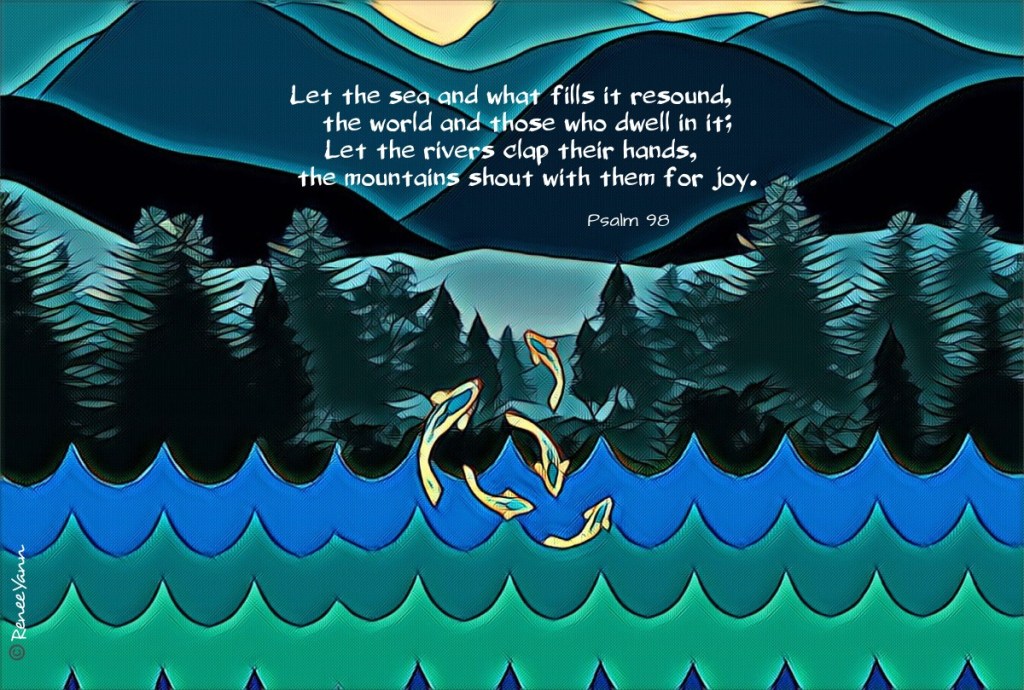
Let the sea and what fills it resound,
    the world and those who dwell in it;
Let the rivers clap their hands,
    the mountains shout with them for joy.

Psalm 98:7-8
  • Like our hearts that believe even through life’s intermingled joys and sorrows

This is your life,
joys and sorrow mingled,
one succeeding the other.

Catherine McAuley: Letter to Frances Warde (May 28, 1841)

Poetry: Flickering Mind – Denise Levertov

Lord, not you
it is I who am absent.
At first
belief was a joy I kept in secret,
stealing alone
into sacred places:
a quick glance, and away -- and back,
circling.
I have long since uttered your name
but now
I elude your presence.
I stop
to think about you, and my mind
at once
like a minnow darts away,
darts
into the shadows, into gleams that fret
unceasing over
the river's purling and passing.
Not for one second
will my self hold still, but wanders
anywhere,
everywhere it can turn.  Not you,
it is I am absent.
You are the stream, the fish, the light,
the pulsing shadow.
You the unchanging presence, in whom all
moves and changes.
How can I focus my flickering, perceive
at the fountain's heart
the sapphire I know is there?

Music: Let Your Heart Sing – Young Oceans

Twenty-first Sunday in Ordinary Time

Today, in God’s Lavish Mercy, as we pray with Psalm 34, our Sunday readings present us with spiritual ultimatums.

In our first reading, sensing his impending death, Joshua gathers the tribes on the Great Plains of Shechem – the land of their father Abraham. Joshua requires a commitment from the people:

“If it does not please you to serve the LORD,
decide today whom you will serve …
As for me and my household, we will serve the LORD.”

Joshua 24:15

In other words, “fish or cut bait” – you’re either with God, or you’re not. And your lives should reflect the choice.

In our Gospel, Jesus too feels death’s approach. His teachings have become more intense and direct, particularly regarding the Eucharist. This intensity has caused some of his listeners to waver. They’re not sure they can accept his words. Some drift away.

Jesus challenges the Twelve, those on whom he depends to carry his message after his death.

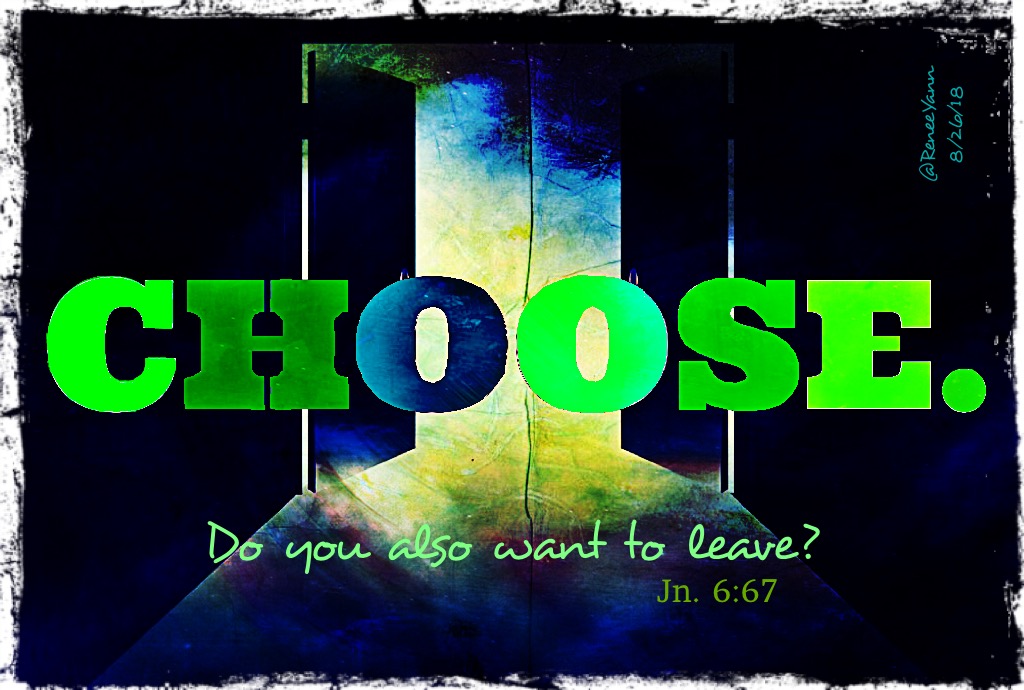
“Do you also want to leave?


These readings talk about the big choices, the soul’s orientation, either:

  • to seek and respond to God in our daily interactions
  • to be indifferent toward God’s Presence in our lives

Jesus’s question is before us all the time?
Do we hear it?


(As for the unfortunate and contested second reading from Ephesians, this long but superb article from Elizabeth Johnson is worth your time.)

https://bcm.bc.edu/issues/summer_2004/features.html


Poetry: Choose – Rainer Maria Rilke

You see, I want a lot.
Perhaps I want everything:
The darkness that comes with every infinite fall
And the shivering blaze of every step up.
So many live on and want nothing
And are raised to the rank of prince
By the slippery ease of their light judgments
But what you love to see are faces
That do work and feel thirst…
You have not grown old,
And it is not too late to dive
Into your increasing depths where life
Calmly gives out its own secret.

Music:  I Will Choose Christ – Tom Booth

Memorial of Saint Bernard

Friday, August 20, 2021

Today, in God’s Lavish Mercy, we pray with Psalm 146, chosen today to complement our first reading which is a rare lectionary passage from the Book of Ruth. In it, we meet Naomi who is, at one point, widowed and alone. 

The fatherless and the widow the Lord sustains,
    but the way of the wicked is thwarted.

Psalm 146:9
Ruth Carries Her Gleanings – James Tissot

The Book of Ruth is familiar to many of us because some of its charming story and verses seem a lovely fit for weddings and anniversaries. But in some ways, that isolated use tends to trivialize the powerful messages embedded in this short volume.


If we have a limited view of the Book of Ruth, Psalm 146 can help us widen it. The psalm points to elements central to a hopeful and just community, to a community in right relationship with God. This too is a core message of Ruth.


It is a community strengthened by compassion, loyalty, inclusivity, trust, hope and grateful praise. Each character, at some point in the story’s unfolding, exhibits some aspect of God’s merciful nature and steadfast attachment to us. They put flesh on the psalm’s Antiphons:

Happy are they who have the God of Jacob for their help! 
For their hope is in the Lord their God,
who made heaven and earth, 
the seas, and all that is in them;
who keeps promises for ever;
who gives justice to those who are oppressed,
food to those who hunger
and sets the prisoners free.
The Lord opens the eyes of the blind!
The Lord lifts up those who are bowed down
and loves the righteous.
The Lord cares for the stranger
and sustains the orphan and widow,
but frustrates the way of the wicked. 
The Lord shall reign for ever,
your God, O Zion, throughout all generations.
Hallelujah!

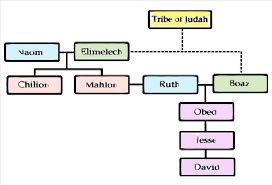
Ruth was the great-grandmother of David and blood ancestor of Jesus. Her story, and the tender mercy it declares, foretells the character of the Beloved Community Christ will establish.


The heart of that community – our community – is aptly described in today’s Gospel. When the Pharisees ask Jesus what is most important, he replies:

You shall love the Lord, your God, with all your heart,
with all your soul, and with all your mind.
This is the greatest and the first commandment.
The second is like it:
You shall love your neighbor as yourself.
The whole law and the prophets depend on these two commandments.

Ruth already knew what was most important.
May we learn it deeply from her story.


Poem: Ruth and Naomi by Frances Ellen Watkins Harper (1825-1911), an African American abolitionist and poet. Born free in Baltimore, Maryland, she had a long and prolific career, publishing her first book of poetry at twenty and her first novel, the widely praised Iola Leroy, at age 67. 

"Turn my daughters, full of woe,
Is my heart so sad and lone? 
Leave me children — I would go 
To my loved and distant home. 

From my bosom death has torn 
Husband, children, all my stay, 
Left me not a single one, 
For my life's declining day 

Want and woe surround my way, 
Grief and famine where I tread; 
In my native land they say
"God is giving Jacob bread.”

Naomi ceased, her daughters wept, 
Their yearning hearts were filled; 
Falling upon her withered neck, 
Their grief in tears distill'd. 

Like rain upon a blighted tree, 
The tears of Orpah fell 
Kissing the pale and quivering lip, 
She breathed her sad farewell. 

But Ruth stood up, on her brow 
There lay a heavenly calm; 
And from her lips came, soft and low 
Words like a holy charm. 

"I will not leave thee, on thy brow 
Are lines of sorrow, age and care; 
Thy form is bent, thy step is slow, 
Thy bosom stricken, lone and sear. 

Oh! when thy heart and home were glad, 
I freely shared thy joyous lot; 
And now that heart is lone and sad, 
Cease to entreat — I'll leave thee not. 

Oh! if a lofty palace proud 
Thy future home shall be; 
Where sycophants around thee crowd, 
I'll share that home with thee. 

And if on earth the humblest spot, 
Thy future home shall prove; 
I'll bring into thy lonely lot 
The wealth of woman's love. 

Go where thou wilt, my steps are there, 
Our path in life is one; 
Thou hast no lot I will not share, 
'Till life itself be done. 

My country and my home for thee, 
I freely, willingly resign, 
Thy people shall my people be, 
Thy God he shall be mine. 

Then, mother dear, entreat me not 
To turn from following thee; 
My heart is nerved to share thy lot, 
Whatever that may be.”

Music: Ruth’s Song – Marty and Misha Goetz

(Verse 1)
All my life, I have wondered
Wondered where I might belong
Feeling lost, like a stranger
Wandering far all on my own
(Verse 2)
Without a home. Without a people
Without a hope, without a prayer
Without a way, that I could follow
Then I turned, and you were there
(Chorus)
Where you go, I will go
Where you stay, I will stay forever
Where you lead, I will follow
So I can know the one you know
(Verse 3)
Under his wings, you found a shelter
You have no fear, you have no shame
And when you call, he seems to answer
He even seems to know your name
(Chorus)
(Bridge)
Then somehow should I find his favor
I won’t look back on all I’ve known
Your people then will be my people
And Your God my God alone
(Chorus)
Where you go, I will go
And you know I will never leave you
Not even death, will ever part us
Now that I know the one you know
I will go now, where you go

Monday of the Twentieth Week in Ordinary Time

Monday, August 16, 2021

Today, in God’s Lavish Mercy, we meet the rich young man of Mark 19. Since the first reading and psalm would be challenging to pray with, I would like to offer this homily I wrote some years ago on our Gospel for today

Christ and the Rich Young Man by Heinrich Hoffmann

Most had come to the rolling hills beyond the Jordan because of the miracles: the crippled walking, the dead raised, the demons cast out. Who wouldn’t take an afternoon hike to witness such amazing things? They came with their blankets and lunch baskets. They came to see.

But today, Jesus is not about miracles. He is about teaching. And it is hard to listen to him. The words are gentle but incisive. Like small scalpels, they deftly strip away the listeners’ harbored illusions. He says things like this:

  • Become humble like a child.
  • The last will be first and the first last.
  • If your hand or foot causes you to sin, cut it off.
  • Forgive seventy times seven.

His words challenge everything they had learned, believed, based their lives on! Nobody got anywhere in life by behaving the way he described! Jesus can see their consternation. What they had relied on – all that had justified their self-satisfied successes – lay now at his feet like a sculptor’s remnants. 


Jesus pauses to allow a long silence to envelop their startled hearts. Quietly, he retires to a shaded grove to let his own heart settle. On the hillside, it is lunchtime. The large crowd bundles into small neighborly bands. They open their baskets and uncork their water-skins while the curative words begin the hard transformation of their souls.

But one man is not hungry – at least not for earthly food.  He slowly approaches Jesus in his solitude, perhaps with a shy glance that asks, “May I come closer?” Jesus nods for the young man to join him. Settling beside Jesus, he asks, “Master, what must I do to gain eternal life?”


There is no lack of directness in this man. He comes bluntly to the point. But there is, nonetheless, a blindness in him. Jesus has already taken its measure even as the young man approached. His garments distinguish him from the rest of the crowd.  His robe is fine linen not rude camel hair. He is not unshod, but rather wears sandals of expertly tooled leather. He carries no basket; it is held by a servant standing off at a modest but ready distance. He is so accustomed to his privilege that he is unaware of his difference from all those who surround him. He no longer sees his wealth, just as he no longer sees their poverty. 

Commemorative Cross for the 150th Anniversary of the Philadelphia Sisters of Mercy,
featuring the Works of Mercy. Designed by the late Robert McGovern

Jesus at once pities his obliviousness yet loves his sincerity. He tests the young man even though he already reads his heart. The questions are not intended to derail the man. Instead, Jesus leads him by a rabbinical path through the levels of spiritual commitment.

  • Do you understand true goodness?
  • Do you then keep the commandments?
  • Do you then seek perfection?
  • Will you then give everything you have to embrace it?

At this final question, the young man goes away sad, “for he had many possessions”. 


Here Jesus defines for us the ultimate sticking point for a nearly committed person: “All you possess”. In other words, can we give everything in Christlike love?

The Christian ethic teaches us that this kind of self-donation is the only path to joy and salvation. Yet, it is a perfection few achieve. This failure in achievement leads to broken marriages, fractured families, rescinded vows and unfulfilled hopes. What is the secret to meeting its challenge?

Jesus may have given an answer two chapters earlier in Matthew’s Gospel. A desperate father has brought his possessed son to the disciples, but they are unable to cast out the demon.  Jesus is frustrated with their impotence, saying, “How long must I be with you (before you learn)?” What is it that these disciples have yet to learn? Jesus goes on to tell them that if their faith were even the size of a tiny mustard seed, they would have the power, not only to cast out this demon, but to move mountains.

To live fully by faith is to live in the understanding that we possess nothing.  Everything we think we have, including life itself, is a pure gift of God’s mercy to us. Abandonment to such understanding makes us truly rich and renders us divinely powerful. This is the continuing lesson Jesus is teaching his beloved disciples. This is the secret of eternal life to which Jesus tries to lead the rich young man. This is the daily invitation God places before us within the circumstances of our lives. Will we embrace it or will we go away sad?

Music: Do It All for Love – Sigala

Memorial of Saint Maximilian Kolbe

Saturday, August 14, 2021

Today, in God’s Lavish Mercy, we pray with Psalm 16, a prayer for God’s protection and blessing on the path of life. It is the prayer of one whose heart is committed to God, and recognizes God as the Source of All Life.

Keep me, O God, for in you I take refuge;
    I say to the LORD, “My Lord are you.”
O LORD, my allotted portion and my cup,
    you it is who hold fast my lot.

Psalm 16: 1-2

In our first reading, as Israel takes possession of the Promised Land, Joshua gathers the people in a recommitment reflective of Moses’ call to the people at Sinai. Joshua says that there is no either/or. Today is the day to choose and commit to the One God of your life:

Fear the LORD and serve him completely and sincerely.
Cast out the gods your fathers served beyond the River and in Egypt,
and serve the LORD.
If it does not please you to serve the LORD,
decide today whom you will serve,
the gods your fathers served beyond the River
or the gods of the Amorites in whose country you are dwelling.
As for me and my household, we will serve the LORD

Joshua 24: 14-15

Like those ancient Israelites, we need faith and courage not to fall back on our false gods — half-heartedness, hard-heartedness, heartlessness. This beautiful offering of Psalm 16 by the Dameans is a prayer for protection and grace for our commitment.


Music: And to give Joshua stage time, here is another song

As for Me and My House – Pat Barrett, Chris Tomlin