Psalm 102: Joys and Sorrows

Tuesday of the Fifth Week of Lent

Tuesday, March 23, 2021


Today, in God’s Lavish Mercy, we pray with Psalm 102, the prayer of someone in the midst of suffering. The psalm is introduced with stark honesty:

The prayer of one afflicted and wasting away 
whose anguish is poured out before the LORD.

Psalm 102: 1

Psalm 102 speaks to those places in life’s journey where we experience intense, perhaps overwhelming suffering.

In our first reading, the Israelites suffer through what seems like a never-ending journey of homelessness. In our Gospel, Jesus begins his final journey toward his Passion and Death. These both were journeys with suffering as a constant companion

No one avoids suffering in some way. It is part of being human. Even our beloved Catherine McAuley left us this succinct maxim:

This is your life, joys and sorrow mingled,
one succeeding the other.

Letter to Frances Warde (May 28, 1841)

The psalmist, in the midst of his suffering, calls out to God for a return of the promised joy.

O LORD, hear my prayer,
    and let my cry come to you.
Hide not your face from me
    in the day of my distress.
Incline your ear to me;
in the day when I call, answer me speedily.  


This prayer attests to the psalmist’s undaunted faith and to God’s unwavering fidelity.

This mutual faithfulness is where we all must stand in sorrow so that we may come, as Jesus did, to the fullness of Resurrection grace.

As we come closer to the profound mysteries of Holy Week, let us not only reverence our own joys and sorrows. Let us ask to enter more deeply into the experience of Jesus in this final unfolding of his life. May we deepen in the understanding that the suffering of Jesus is one with the suffering of our sisters and brothers.


Poetry: On Another’s Sorrow – William Blake 

Can I see another's woe,
And not be in sorrow too?
Can I see another's grief,
And not seek for kind relief?

Can I see a falling tear,
And not feel my sorrow's share?
Can a father see his child
Weep, nor be with sorrow filled?

Can a mother sit and hear
An infant groan, an infant fear?
No, no!  never can it be!
Never, never can it be!

And can He who smiles on all
Hear the wren with sorrows small,
Hear the small bird's grief and care,
Hear the woes that infants bear --

And not sit beside the next,
Pouring pity in their breast,
And not sit the cradle near,
Weeping tear on infant's tear?

And not sit both night and day,
Wiping all our tears away?
Oh no! never can it be!
Never, never can it be!

He doth give his joy to all:
He becomes an infant small,
He becomes a man of woe,
He doth feel the sorrow too.

Think not thou canst sigh a sigh,
And thy Maker is not by:
Think not thou canst weep a tear,
And thy Maker is not near.

Oh He gives to us his joy,
That our grief He may destroy:
Till our grief is fled an gone
He doth sit by us and moan

Music: You Raise Me Up – Josh Grogan

Psalm 51: Spring Cleaning

Fifth Sunday of Lent 

March 21, 2021

Today, in God’s Lavish Mercy, we pray with Psalm 51, a psalm to inspire our spring soul-cleaning.

A clean heart create for me, O God,
    and a steadfast spirit renew within me.

Psalm 51:12

Happy Spring to all of you in the northern hemisphere! Blessings of new life and hope!

And for my southern friends already in your Autumn Season, blessings of change and release!


Psalm 51 can speak to our hearts in whatever season we find ourselves.

After our long winters, external or internal, we may call upon God for a fresh budding of our hearts:

Give me back the joy of your salvation,
    and a willing spirit sustain in me.

Psalm 51: 14-15

When bright summer wanes and vibrant trees speak of leave-taking, we may pray to remain in warmth and light:

Cast me not out from your presence,
    and your Holy Spirit take not from me.

Psalm 51: 13

Across our hemispheres, we all share the longings of Lent to be cleared of all that blocks us from Grace in our lives – to have the hidden corners of our small selfishness swept, polished and ready for Loving Mercy:

Have mercy on me, O God, in your goodness;
    in the greatness of your compassion wipe out my offense.
Thoroughly wash me from my guilt
    and of my sin cleanse me.

Psalm 51: 3-4
The Heart Cave

       I must remember
To go down to the heart cave
& sweep it clean; make it warm
with a fire on the hearth,
& candles in their niches,
the pictures on the walls
       glowing with a quiet light.

       I must remember
To go down to the heart cave
       & make the bed
with the quilt from home,
strew
       the rushes on the floor
                                  hang
lavender and sage
                      from the corners.

           I must go down
To the heart cave & be there
           when you come.

- by Geoffrey Brown

Today, as we might take a walk under the nearly budding trees, or over their first fallen leaves, let’s ask God to walk with us:

Lord, you  open my lips;
and my mouth to proclaim your praise.
For you do not desire sacrifice or I would give it;
a burnt offering you would not accept.
What you want of me, O God, is a contrite spirit;
a contrite, humbled heart, O God, you will not scorn.

Psalm 51: 17-19

I open my heart, O God, to your Heart.
Teach me Love.

Poetry: A Spring Poem – Luci Shaw

all the field praises Him/all
dandelions are His glory/gold
and silver/all trilliums unfold
white flames above their trinities
of leaves all wild strawberries
and massed wood violets reflects His skies’ 
clean blue and white
all brambles/all oxeyes
all stalks and stems lift to His light
all young windflower bells
tremble on hair
springs for His air’s
carillon touch/last year’s yarrow (raising
brittle star skeletons) tells
age is not past praising
all small low unknown
unnamed weeds show His impossible greens 
all grasses sing
tone on clear tone
all mosses spread a spring-
soft velvet for His feet
and by all means all leaves/buds/all flowers cup
jewels of fire and ice
holding up
to His kind morning heat
a silver sacrifice
now
make of our hearts a field 
to raise Your praise.

Music: I Come to the Garden Alone – C. Austin Miles

“In the Garden” ( – sometimes rendered by its first line “I Come to the Garden Alone”) is a gospel song written by American songwriter C. Austin Miles (1868–1946), a former pharmacist who served as editor and manager at Hall-Mack publishers for 37 years. According to Miles’ great-granddaughter, the song was written “in a cold, dreary and leaky basement in Pitman, New Jersey that didn’t even have a window in it let alone a view of a garden.” The song was first published in 1912 and popularized during the Billy Sunday evangelistic campaigns of the early twentieth century.
(Source: Wikipedia)

Psalm 105: Tell the Story

Friday of the Second Week of Lent

March 5, 2021


Today, in God’s Lavish Mercy, we pray with Psalm 105. Together with our other readings, the psalm allows us to participate in Israel’s great family storytelling.

Give thanks to the LORD, invoke God’s name;
make known among the peoples God’s deeds!
Sing praise to the Lord, play music;
proclaim all the Lord’s wondrous deeds!

Psalm 105: 1-2

Psalm 105 is one of two historical psalms. (The other is Psalm 78.) Its verses summarize an amazing catalogue of God’s faithfulness to Israel and invites the listeners to grateful praise and unfettered hope.


Today’s particular passage is chosen because it recounts the same incidents as our first reading – the story of Joseph. And Joseph’s story prefigures Jesus’s own story which he offers in parable form in today’s Gospel.

When the LORD called down a famine on the land
    and ruined the crop that sustained them,
He sent a man before them,
    Joseph, sold as a slave.

Psalm 105: 16-17

For us, the telling and re-telling
of relationship stories
is an important human rubric,
practiced at
crowded Thanksgiving tables,
at relaxed summer reunions,
and at our inevitable bereavements.


Eventually, with enough retellings, a story becomes part of our family or friendship canon. Thence forward, it gains new dimension. Just like the canon of the Mass, whose formula becomes beautifully rote to us, the story now may be endlessly repeated without being exhausted. In its retelling, it always reveals something new and confirms something old.

Seek out the LORD and the Lord’s might;
constantly seek God’s face.
Recall the wondrous deeds God has done
for you and your beloved ones

Psalm 105: 4-5

In fact, such a story becomes a kind of sacrament, carrying within it the mysterious and unwordable blessings of what it means to live, love, die, and believe. 

Each human story is, in some form, a re-enactment of Christ’s life, death, and Resurrection. The faith, courage, humor, pathos, genius and serendipity of our lives carry the graces to make us holy, to make us Love as Jesus was Love.

When we gratefully retell the history of those graces – as Psalm 105 does today – we practice a powerful ritual of faith. By such liturgy, we are invited to the same grateful praise and unfettered hope as we meet in Psalm 105.

The LORD, is our God
whose judgments reach through all the earth.
Who remembers forever the covenant,
the word commanded for a thousand generations.

Psalm 105: 8-9

Poetry: The Storyteller – Mike Jones

I’m a teller of tales, a spinner of yarns,
A weaver of dreams and a liar.
I’ll teach you some stories to tell to your friends,
While sitting at home by the fire.
You may not believe everything that I say
But there’s one thing I’ll tell you that’s true
For my stories were given as presents to me
And now they are my gifts to you.

My stories are as old as the mountains and rivers
That flow through the land they were born in
They were told in the homes of peasants in rags
And kings with fine clothes adorning.
There’s no need for silver or gold in great store
For a tale becomes richer with telling
And as long as each listener has a pair of good ears
It matters not where they are dwelling.

A story well told can lift up your hearts
And help you forget all your sorrows
It can give you the strength and the courage to stand
And face all your troubles tomorrow.
For there’s wisdom and wit, beauty and charm
There’s laughter and sometimes there’s tears
But when the story is over and the spell it is broken
You’ll find that there’s nothing to fear

My stories were learned in my grandparent’s home
Where their grandparents also had heard them
They were given as payment by travelling folk
For a warm place to lay down their burdens
My stories are ageless, they never grow old
With each telling they are born anew
And when my story is ended, I’ll still be alive
In the tales that I’ve given to you.

Music: The Story I’ll Tell – Morgan Harper Nichols 

Psalm 23: The Shepherd

Feast of the Chair of Saint Peter, Apostle

February 22, 2021


Today, in God’s Lavish Mercy, on this Feast of St. Peter we pray with Psalm 23 – the Good Shepherd.

The LORD is my shepherd; I shall not want.
    In verdant pastures I am given repose;
Beside restful waters the Lord leads me;
    refreshing my soul.

Psalm 23

The history and devotion intrinsic to this feast can inspire us to pray especially today for our dear Pope Francis who carries Peter’s grace and burden in our time. He carries, in Primacy, the charge reflected in our first reading:

Tend the flock of God in your midst,
overseeing not by constraint but willingly,
as God would have it, not for shameful profit but eagerly.
Do not lord it over those assigned to you,
but be examples to the flock.
And when the chief Shepherd is revealed,
you will receive the unfading crown of glory.


Pope Francis faces resistances just as Peter did. There are always forces within a community who pull its energy in contradictory directions. When rooted in love and reverent dialogue, that counteraction can generate growth. But when born of selfishness and obstinance, such opposition poisons the whole Body.

Francis needs our prayer. The Church needs our prayer. According to Teresa of Avila, Saint and Doctor of the Church, that prayer should be scriptural:

All the troubles of the Church,
all the evils in the world,
flow from this source:
that human beings do not
by clear and sound knowledge
and serious consideration
penetrate into the truths
of Sacred Scripture.

St. Teresa of Avila

Today, Psalm 23 inspires our prayer for our Pope:

Even in the dark valley
    may you fear no evil; for you are at God’s side
Whose rod and staff
    give you courage.
May God spread graces before you
    in the sight of your troubles;
and anoint your head with oil;
    your cup overflowing.
May goodness and kindness follow you
    all the days of your life;
May you dwell in the LORD’s sanctuary
    for all your days.


Poetry: When I was a boy … (Da ich ein Knabe war …) – Friedrich Hölderlin

Pope Francis’s favorite poet is said to be the German writer Friedrich Hölderlin. Perhaps Francis, composer of the lyrical Laudato Sí and Fratelli Tutti, loves this rhapsodic poem.

When I was a boy
Often a god would save me
From the shouts and blows of men;
I played safely and well
With the flowers of the fields
And the winds of heaven
Played with me.

As you make happy
The hearts of plants
When they extend to you
Their delicate tendrils,
So you make my heart happy,
Father Sun, and like Endymion
I was your favorite,
Holy Moon!

All true and neighborly gods!
If only you knew
How much I loved you then!
True, at that time, I didn’t
Know your names, and you
Never bothered to name me, like men
Who only pretend to know one another.

Yet I know you better
Than I’ve ever known anyone,
I understood the silence of the upper air,
But I’ve never understood the words of men.
I was raised by the sounds
Of the rustling grove
And learned to love
Among the flowers.
I grew up in the arms of the gods.

Music: Psalm 23 with Bach’s Sheep May Safely Graze

Psalm 86: Lean to Me, Lord

Saturday after Ash Wednesday

February 20, 2021


INCLINE!

Today, in God’s Lavish Mercy, we pray with Psalm 86, a very personal prayer. The kingdom, the nation, the people are not mentioned. It is a plea from one aching heart to its merciful God.

Each one of us has been that person on occasion. We may not have employed the exact words of Psalm 86, but we have prayed its sentiments in our own way.

HARKEN!

For me, that prayer is grounded in two powerful verbs, intimate requests made to a God Who might otherwise seem distant in our times of trouble.

Incline and Harken

Let’s just walk and talk with our listening God today. Feel God bend near to listen. Listen in return.


Poetry: Listen, can you hear it? by Rabindranath Tagore

Listen, can you hear it?
God’s bamboo flute speaks
the pure language of love.
The moon enlightens the trees,
the path, the sinuous River.

Oblivious of the jasmine's scent
I stagger around,
disheveled heart bereft of modesty,
eyes wet with angst and delight.

Tell me, dear friend, say it aloud:
is God not my own Dark Lord?
Is it not my name God’s flute pours
into the empty evening?

For eons I longed for God,
I yearned to know the Holy One.
That's why God has come to me now,
deep emerald Lord of my breath.

O Lord, whenever your faraway flute thrills
through the dark, I say your name,
only your name, and will my body to dissolve
in your luminous River.

Hear me, Lord, in this moment.
What's stopping you?
The earth drowns in sleep.
Let's go. I'll walk with you, talk with you.

Music: O Lord, Hear My Prayer – Taize

Psalm 1: Aligned to God

Thursday after Ash Wednesday

February 18, 2021


Today, in God’s Lavish Mercy, we pray with Psalm 1, a familiar reminder of what a working relationship with God looks like:

Blessed the one who follows not
    the counsel of the wicked
Nor walks in the way of sinners,
    nor sits in the company of the insolent,
But delights in the law of the LORD
    and meditates on God’s law day and night.

Psalm 1:1-2

The phrases in that little verse are so powerful! 

We have seen all too clearly what happens when people “follow the counsel of the wicked”. We know how easily we can be infected by the negativity of “the insolent”. There is a spiritual distemper in us when these fractious humors fill the atmosphere.

Instead, we seek the peace and delight of being right with God. We embrace God’s law as a support and inspiration to guide us.


When we think of God’s Law, we might rightly think of the Commandments, the Beatitudes, the Torah, the Gospel – those places where we find the Law codified in words.

But we might also think of God’s Law as that silent omnipotent force that lifts the sun from darkness and sets it down again, that holds the seas in their global bowl, that lights the night with fiery stars.

Affinity with God’s Law is that loving practice which, by intrinsic prayer and reflection, gives over every moment of our lives to God’s order. That alignment, rooting us in God’s “due season”, allows goodness to blossom in us like a fruitful tree – an unfading, abundant harvest …

Like a tree
    planted near running water,
That yields its fruit in due season,
    and whose leaves never fade,
    ever prospering.

Psalm 1:3

Poetry: Onto a Vast Plain – Rainer Maria Rilke

Listen.
You are not surprised at the force of the storm—
you have seen it growing.
The trees flee. Their flight
sets the boulevards streaming. And you know:
he whom they flee is the one
you move toward. All your senses
sing him, as you stand at the window.

The weeks stood still in summer.
The trees’ blood rose. Now you feel
it wants to sink back
into the source of everything. You thought
you could trust that power
when you plucked the fruit:
now it becomes a riddle again
and you again a stranger.

Summer was like your house: you know
where each thing stood.
Now you must go out into your heart
as onto a vast plain. Now
the immense loneliness begins.

The days go numb, the wind
sucks the world from your senses like withered leaves.

Through the empty branches the sky remains.
It is what you have.
Be earth now, and evensong.
Be the ground lying under that sky.
Be modest now, like a thing
ripened until it is real,
so that he who began it all
can feel you when he reaches for you.

Music: How Deep, How Simple – Kathryn Kaye

Psalm 23: Ever Comforting

Memorial of Saint Paul Miki and Companions, Martyrs

Saturday, February 6, 2021


Today, in God’s Lavish Mercy, we pray with Psalm 23, that lovingly familiar song which, over the ages, has comforted so many.

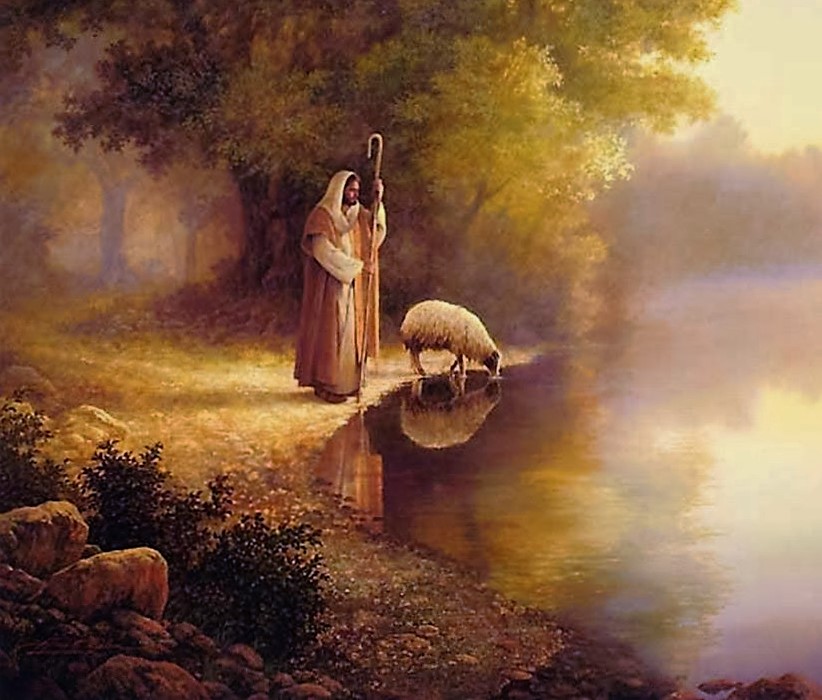
Beside Still Waters by Greg Olsen

We may wish to simply pray this psalm gently and slowly, remembering the many times it has comforted us.

(Below is the inclusive language translation from the Inclusive Language Liturgical Psalter of the Canadian Anglican Synod. Other inclusion collections include Evangelical Lutheran Worship, the Psalter for the Christian People, The Saint Helena Psalter and the Canadian publication, Songs for the Holy One.)

Psalm 23 (Dominus regit me)
The Lord is my shepherd; I shall not be in want.
You make me lie down in green pastures 
and lead me beside still waters.
You revive my soul 
and guide me along right pathways 
for your name’s sake.
Though I walk through the valley of the shadow of death, 
I shall fear no evil;
for you are with me;
your rod and your staff, they comfort me.
You spread a table before me
in the presence of those who trouble me;
you have anointed my head with oil, 
and my cup is running over.
Surely goodness and mercy shall follow me 
all the days of my life, 
and I will dwell in the house of the Lord for ever.


Music: Shepherd Me, O God – Marty Haugen

Psalm 95: Listening Softly

Fourth Sunday in Ordinary Time

January 31, 2021


Today, in God’s Lavish Mercy, we pray with Psalm 95, once again a call to a holy tenderheartedness – that mix of love, discernment, and generosity that magnetizes us into dynamic relationship with God.

Oh, that today you would hear his voice:
    “Harden not your hearts as at Meribah,
    as in the day of Massah in the desert,
Where your fathers tempted me;
    they tested me though they had seen my works.”

Psalm 95: 7-9

Our other Sunday readings, which Psalm 95 anchors, clarify the reason we seek this tenderheartedness. It is so that we might not only hear, but really listen and respond to the Truth of God in our lives.

Those who will not listen to my words
which a prophet speaks in my name,
I myself will make them answer for it.

Deuteronomy 18:18

In our first reading from Deuteronomy, the people were confused. They were passing into a new land with lots of rivaling religions and spiritualities. Moses was nearing the end of his life and leadership over them. They wanted to know who to listen to and how to behave in order to stay in God’s favor.

God promises that God’s voice will come through a prophet like Moses:

I will raise up for them a prophet like you from among their kin,
and will put my words into his mouth;
he shall tell them all that I command him.

Deuteronomy 18: 19

In our Gospel, we see Jesus – the fulfillment of the Deuteronomic Promise. The people witnessing his power are amazed. They struggle with whether they can believe in him when he seems just one of them, a Nazarene, Joseph’s son.

But some could believe – readily. Some, like the disciples, discerned quickly the Truth Jesus was. They heard, listened, believed and obeyed the Word.

Our psalm suggests that such readiness, such tenderheartedness comes from the consistent practice of relationship with God through praise, witness, thanksgiving, prayer, worship, humility, and obedience.


To me, it boils down to this:

  • let your life unfold in God’s Presence
  • be silent under God’s loving gaze
  • thank God for all you have been given
  • realize you are nothing without God
  • listen to your life as God speaks it to you
  • act on what you hear
Come, let us sing joyfully to the LORD;
    let us acclaim the rock of our salvation.
Let us come into God’s presence with thanksgiving;
    let us joyfully sing psalms to the Lord.
R. If today you hear God’s voice, harden not your hearts.
Come, let us bow down in worship;
    let us kneel before the LORD who made us.
For the Lord is our God,
    and we are the people God shepherds, the flock God guides.

Poetry: Rumi

I keep telling my heart,
“Go easy now.
I am submerged in golden treasure.”
It replies,
“Why should I be afraid of love?”

Music: Soften My Heart – by Music Meets Heaven

Psalm 110:Through Paul’s Lens

Wednesday of the Third Week in Ordinary Time

January 27, 2021


Today, in God’s Lavish Mercy, we pray with Psalm 110, but through the lens of our first reading from Hebrews.

We have prayed with this psalm a few times recently, exploring its links to priesthood, ministry, and good old Melchizedek. When I saw it again this morning, I was at little exhausted by it. Then I read Hebrews and got a new perspective on Psalm 110.

For by one offering Christ has made perfect forever 
those who are being consecrated.
The Holy Spirit also testifies to us, for after saying:
    This is the covenant I will establish with them
        after those days, says the Lord:
    “I will put my laws in their hearts,
        and I will write them upon their minds,”

Hebrews 10:14-16

This passage from Hebrews is a testament to Jesus Christ, the ultimate High Priest, the Complete Melchizedek. That which Christ sanctifies or consecrates is us – his Body, the Church.

This consecration places in our hearts the covenant once spoken of by Jeremiah:

See, days are coming says the LORD—
when I will make a new covenant with the house of Israel and the house of Judah.
It will not be like the covenant I made with their ancestors
the day I took them by the hand to lead them out of the land of Egypt.
They broke my covenant, though I was their master.
But this is the covenant I will make with the house of Israel after those days.
I will place my law within them, and write it upon their hearts;
I will be their God, and they shall be my people.

Jeremiah 31:31-33

Praying with Psalm 110 in this light, I give thanks for the Covenant expressed in my own life:

  • for my Baptism into Christ,
  • for the grace to witness to Christ’s law of love
  • for my inclusion into Christ’s ongoing ministry through the Holy Spirit

Poetry: The Covenant Prayer of John Wesley (1703–1791)

I am no longer my own, but thine.
Put me to what thou wilt, rank me with whom thou wilt.
Put me to doing, put me to suffering.
Let me be employed for thee or laid aside for thee,
exalted for thee or brought low for thee.
Let me be full, let me be empty.
Let me have all things, let me have nothing.
I freely and heartily yield all things to thy pleasure and disposal.
And now, O glorious and blessed God, Father, Son and Holy Spirit,
thou art mine, and I am thine.
So be it.
And the covenant which I have made on earth,
let it be ratified in heaven.
Amen.

Music: A New and Living Way – Michael Card

Year after year there the priest would stand
 An offering of blood held out in in his hand
 Before the curtain there he would stand in fright
 It hung there to hold in the holy ~ to keep in the light
 
A new and living way
 Through the curtain that was torn
 The climax of the cross
 The moment our hope was born
 By a new and living way
 
 And when time was full another Priest came to save
 He would offer forgiveness for He was the Offering He gave
 From the sacrifice ~ from that dark disgrace
 Came the power to make anywhere a Most Holy Place
 
 A new and living way
 Through the curtain that was torn
 The climax of the cross

Psalm 117: As We Pray with Paul

Feast of the Conversion of Saint Paul, Apostle

January 25, 2021


Today, in God’s Lavish Mercy, we pray with Psalm 117, a psalm used for the feast of an Apostle, reflecting his/her role to: 

Luke tells us how Jesus summarized the “Good News”:

The Spirit of the Lord God is upon me,
because the Lord has anointed me
to bring good news to the poor;
he has sent me to bind up the brokenhearted,
to proclaim liberty to the captives,
and the opening of the prison to those who are oppressed,
to proclaim the year of the Lord’s favor.
Luke 4:18-19


from the Palatine Chapel in Sicily

As we celebrate St. Paul, the Apostle to the Gentiles, Psalm 117 gives voice to the indescribable gratitude we feel for the call we share with the Apostles to live and witness to the “Good News”.

Praise the LORD, all you nations;
    glorify him, all you peoples!
For steadfast is God’s Mercy toward us,
   and the fidelity of the Lord endures forever.

Psalm 117: 1

Praying with Psalm 117, and with Saint Paul today, we may find inspiration in Paul’s self-description as an Apostle – a “servant”:

Paul, a servant of Christ Jesus, called to be an apostle and set apart for the gospel of God— the gospel he promised beforehand through his prophets in the Holy Scriptures regarding his Son, who as to his earthly life was a descendant of David, and who through the Spirit of holiness was appointed the Son of God in power by his resurrection from the dead: Jesus Christ our Lord.

Romans 1: 1-4

Poetry: A Thanksgiving -John Henry Newman (1801-1890)
I think this poem by Newman expresses sentiments similar to some of Paul’s thoughts on his life and vocation as found in his letters and in Acts.

LORD , in this dust Thy sovereign voice
First quicken’d love divine;
I am all Thine,–Thy care and choice,
My very praise is Thine.

I praise Thee, while Thy providence
In childhood frail I trace,
For blessings given, ere dawning sense
Could seek or scan Thy grace;

Blessings in boyhood’s marvelling hour,
Bright dreams, and fancyings strange;
Blessings, when reason’s awful power
Gave thought a bolder range;

Blessings of friends, which to my door
Unask’d, unhoped, have come;
And, choicer still, a countless store
Of eager smiles at home.

Yet, LORD , in memory’s fondest place
I shrine those seasons sad,
When, looking up, I saw Thy face
In kind austereness clad.

I would not miss one sigh or tear,
Heart-pang, or throbbing brow;
Sweet was the chastisement severe,
And sweet its memory now.

Yes! let the fragrant scars abide,
Love-tokens in Thy stead,
Faint shadows of the spear-pierced side
And thorn-encompass’d head.

And such Thy tender force be still,
When self would swerve or stray,
Shaping to truth the froward will
Along Thy narrow way.

Deny me wealth; far, far remove
The lure of power or name;
Hope thrives in straits, in weakness love,
And faith in this world’s shame

Music: Saul’s Transformation – one of many lovely pieces from the film, Paul Apostle of Christ by Jan A. P. Kaczmarek