Today, in Mercy, we celebrate John, “the Beloved Disciple”.
Throughout John’s magnificent writings, the themes of Love and Light stretch our perception of God, and challenge us to love like God loves.
John’s deep love of God, and devotion to the Gospel of Jesus Christ, pour out in his epistles which we will be blessed with over the next several weeks.
Sometimes John’s poetic style can be a little off-setting to those more comfortable with practical prose. But if we can allow our minds to savor the rich layers of meaning within the words, we will start to experience the lyrical mystery of John’s relationship with God.
Jesus and St. John at Last Supper from 19. cent. in St. Michaels church (Michelskerk).
On these holy days, while we still bask in Christmas glory, we might ask in prayer to be deepened in our friendship with God. We might imagine ourselves resting our head on Jesus’s shoulder, just as John did at the Last Supper. We might listen there for the holy secrets God wants to whisper into our lives.
Today, in Mercy, we celebrate St. Stephen, the first martyr for the Christian Faith. Martyrdom is a somber distance from the comforting angels and kindly stars of Christmas. But I think there’s a reason our liturgy places its hard reality here.
The story surrounding Stephen’s death reveals his beautiful soul. These are some of words describing Stephen:
filled with grace and power
working great wonders and signs
speaking with wisdom and spirit
filled with the Holy Spirit
Why would anyone want to kill such a man!
It is a question which resounds down the centuries following Stephen.
Why is innocence persecuted?
Why is faith opposed?
Why is goodness crushed?
Why is freedom strangled?
Why is love for neighbor so frightening?
Our reading from Acts exposes an “infuriated” crowd, burning with anger at Stephen. Why? How had he injured them?
The human heart can become so fixed in its securities, can’t it? Sometimes we build walled worlds where we are always right, first, best, strongest, and smartest. Smarter than anybody!
These oppressive little worlds are places where for me to be right, you must be wrong. For me to be first, you must be at least second, if not last. For me to be strong, you must be weak. If we live in such a crippling world, a challenge to listen and change is earth-shattering to our fearful, manufactured security.
Christ came to free us all from needing such worlds. Omnipotent Mercy chose to be born in utter vulnerability and poverty. Christmas was our first lesson on how to live in a world secured only by Grace. Stephen’s story, following so close upon Christmas, drives home the consequences of such a faith-filled life.
Rather than right, first, best, strongest and smartest, the invitation of Christ is to be open, humble, generous, courageous, wise. Stephen’s debaters didn’t like that invitation. His faithful conviction was so true that they could offer no argument against it to defend their walled-in lives. So they killed him.
All over our planet, we see innocent life crushed by war, trafficking, economic subjugation, prejudice, divisiveness, irrational hatred, and soulless indifference. We see both small and large tyrannies enacted on the global political stage, in business, in the Church, in schools and in families.
The witness of Stephen, first martyr, inspires us to live a life so open to the Holy Spirit that we may stand up strong and, like him, “see the glory of God and Jesus” even through the shadows of a sinful world.
Music: I Will Stand As a Witness for Christ – Sally DeFord
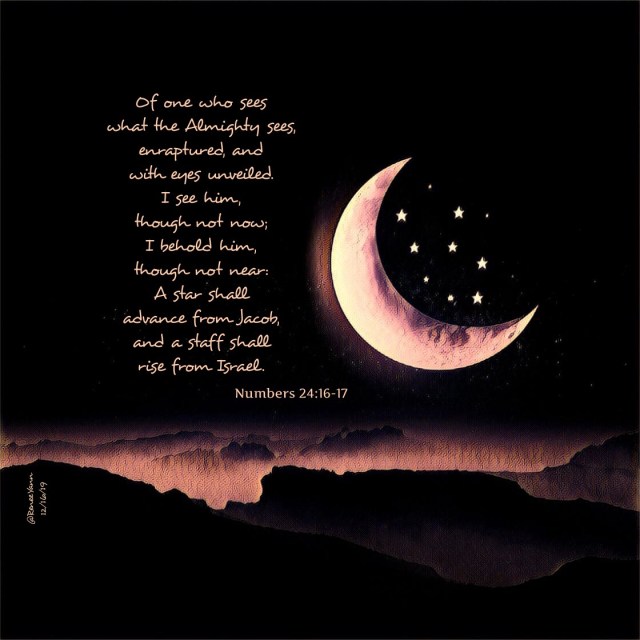
Today, in Mercy, Numbers gives us this beautiful verse:
(I leave just that with you, to pray with if you wish, because I am cheating a bit tonight. I want to run ahead to prepare for the O Antiphons. So I am sending a second reflection to encourage you to run there with me.)
Music for today’s passage:
If Not Now, Then When – Tracy Chapman – a song perhaps reflective of our impatience with God to perform the miracles that we might want. (Lyrics below)
If not now then when? If not today then Why make your promises ? A love declared for days to come Is as good as none.
You can wait ’til morning comes. You can wait for the new day. You can wait and lose this heart. You can wait and soon be sorry.
Now love’s the only thing that’s free. We must take it where it’s found. Pretty soon it may be costly.
If not now what then? We all must live our lives Always feeling Always thinking The moment has arrived!
Today, in Mercy, we celebrate Gaudete Sunday, a name which comes from the first word of the Introit of today’s Mass:
Gaudete in Domino semper: iterum dico, gaudete. Rejoice in the Lord always; again I say, rejoice.
Our readings, too, counsel us to rejoice, and to do so with patience and honesty before God.
REJOICE: Those whom the LORD has ransomed …. will meet with joy and gladness (Isaiah 35:10)
BE PATIENT: You too must be patient. Make your hearts firm, because the coming of the Lord is at hand. (James 5:8)
SPEAK HONESTLY WITH GOD: When John the Baptist heard in prison of the works of the Christ, he sent his disciples to Jesus with this question, “Are you the one who is to come, or should we look for another?” (Matthew 11:2)
As we pray with these verses, we might ask, similarly to John the Baptist:
Is the coming of the Lord really at hand?
Is our long wait to be complete in God really over?
Hasn’t this gone on for 2000 years with no Second Coming?
Well, it all depends on how we look at it.
With our feet and our experiences firmly planted in a time-bound world, it is hard for us to enter God’s timeless view of our salvation.
With God there is no waiting. We already live in the fullness of God’s eternal life.
Our time-bound life is our chance to open ourselves to that Fullness by allowing our experiences to fashion us in the image of Christ.
Every moment, every encounter, every experience carries the invitation to this Complete Love. Continually answering this invitation brings us into an ever deeper transparency with God.
When we see and live our lives this way, joy captures us. Circumstances may not always leave us happy or satisfied (I mean, look at John, he was imprisoned). But they cannot claim our joy, because we see patiently through time’s veil to the eternity already within us.
This sacred insight is the gift of our Baptism in Christ.
Today, we draw closer to the celebration of his presence with us in history by his birth on Christmas. But the deeper celebration is Christ’s continual rebirth in our lives of joy, patience and honest relationship with God.
Music: Patience People – John Foley, SJ (Lyrics below)
Patience, people, till the Lord is come.
See the farmer await the yield of the soil.
He watches it in winter and in spring rain.
Patience, people,
for the Lord is coming. Patience, people, till the Lord is come.
You have seen the purpose of the Lord.
You know of His compassion and His mercy.
Patience, people,
for the Lord is coming. Patience, people, till the Lord is come.
Steady your hearts for the Lord is close at hand.
And do not grumble, one against the other.
Patience, people, for the Lord is coming.
Today, in Mercy, we think about John the Baptist. For several days in this middle part of Advent, our Gospel makes reference to John, the Precursor of the Messiah.
John the Baptist by Anton Raphael Mengs – looking a lot better than he probably really looked!!!!
Faithful Jews had an expectation that there would be a Messiah, and that a fiery Precursor would announce him. They identified this forerunner with the prophet Elijah, based on writings like today’s from Sirach:
How awesome are you, Elijah, in your wondrous deeds! Whose glory is equal to yours? You were taken aloft in a whirlwind of fire, in a chariot with fiery horses. You were destined, it is written, in time to come to put an end to wrath before the day of the LORD…
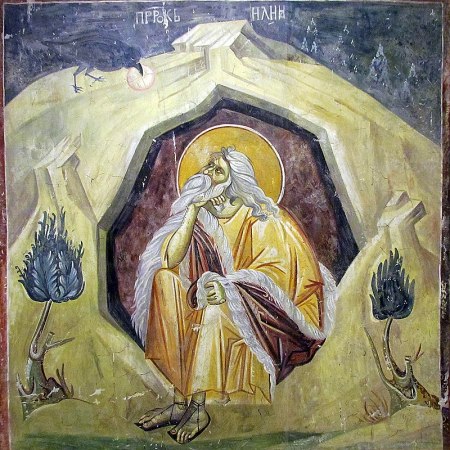
Elijah, a prophet and a miracle worker, Gračanica monastery
In our Gospel, Jesus indicates that John the Baptist is the new Elijah, preparing the way for Jesus’s ministry.
Scripture scholars can get pretty bundled up in trying to explicate the meanings around Elijah and his return. For the purpose of our prayer, I find it helpful to take another approach.
What is it in my life that prepares me to receive God in my heart?
What inspires me “prepare the way of the Lord” in the worlds that I touch?
Do I pay attention to God’s “announcements”, those quiet inklings that tell me God is trying to make something new in my life?
Jesus says that Elijah “has already come” but has been rejected by the people.
Are there habits and choices in my life that make it hard for God to get through to me?
Maybe God is sending an “Elijah”or “Baptist” my way today. Will I recognize that Precursor? Will I be open to the message?
Music: Days of Elijah – Robin Mark.
The commentary in the Worship & Song Leader’s Edition contains a good summary of this hymn’s text: “This is a song of victory and of hope, of God’s triumph forever over death and of Christ’s eternal reign. It also calls believers to stand fast, even in the face of troubles, and to witness to the promised coming of Christ.”
Today, in Mercy, Isaiah paints a poetic picture of the soul fully taught by God. He describes that sacred obedience, or heart’s listening to God, which leads to fullness of joy, peace and eternal life.
When looking for music to complement Isaiah’s passage, I found a hymn written in 1876 by Frances R. Havergal, an English Anglican poet and hymn writer.
Her hymn Like a River Glorious, although written in older style language, contains several beautiful metaphors, many reflective of today’s passage from Isaiah.
You might want to pray with one or two of these images today:
A river of grace – perfect, yet deepening
Our hearts “stayed” upon God, anchored in faith
Being hidden in the hollow of God’s hand
“no blast of hurry” to disturb our peace (so appropriate to this busy season)
Our joys and sorrows falling like shadows across the sundial of our lives
I hope enjoy praying with this hymn, and the accompanying pictures, as much as I did.
Music: Like a River Glorious – Frances R. Havergal – 1876; performed here by the Parkview Mennonite Church. Follow the images and verses below.
A river of grace – perfect, yet deepening
Like a river glorious is God’s perfect peace,
Over all victorious, in its bright increase;
Perfect, yet it floweth fuller every day,
Perfect, yet it groweth deeper all the way.
Our hearts “stayed” upon God, anchored in faith
Refrain: Stayed upon Jehovah, hearts are fully blest
Finding, as He promised, perfect peace and rest.
Being hidden in the hollow of God’s hand
Hidden in the hollow of His blessed hand,
Never foe can follow, never traitor stand;
“no blast of hurry” to disturb our peace (so appropriate to this busy season)
Not a surge of worry, not a shade of care,
Not a blast of hurry touch the spirit there.
Our joys and sorrows falling like shadows across the sundial of our lives
(Refrain then …)
Every joy or trial falleth from above,
Traced upon our dial by the Sun of Love;
We may trust Him fully, all for us to do;
They who trust Him wholly find Him wholly true.
First, we commemorate the feast of Our Lady of Guadalupe.
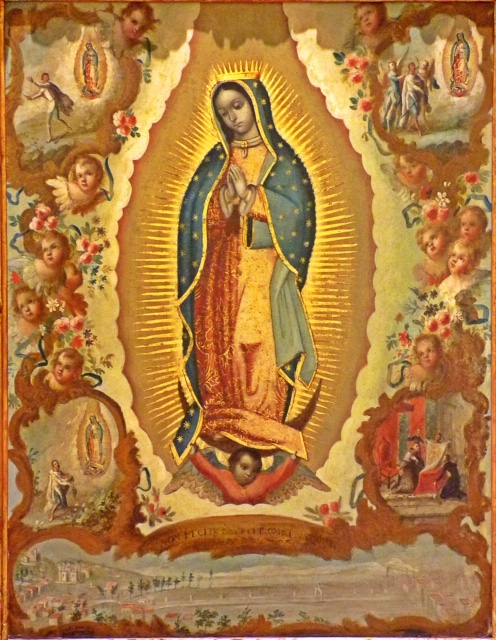
Virgen de Guadalupe con las cuatro apariciones by Juan de Sáenz (Virgin of Guadalupe with the four apparitions by Juan de Saenz)
Our Lady of Guadalupe is a Catholic title of Mary associated with an apparition and a venerated image enshrined within the Minor Basilica of Our Lady of Guadalupe in Mexico City.Catholic tradition asserts that the Virgin Mary appeared to a native Mexican peasant Saint Juan Diego, asking that a Church be built at the site.
The shrine of the Virgin of Guadalupe is the most visited Catholic pilgrimage destination in the world. Over the Friday and Saturday of December 11 to 12, 2009, a record number of 6.1 million pilgrims visited the Basilica of Guadalupe in Mexico City to commemorate the anniversary of the apparition.
The Virgin of Guadalupe is considered the Patroness of Mexico and the Continental Americas; she is also venerated by Native Americans, on the account of the devotion calling for the conversion of the Americas.
(Information from Wikipedia)
Not everyone is comfortable with the concept of religious apparitions. But whatever our personal feelings regarding them, there is no doubt that they have animated the faith of millions over the centuries. For me, their factual reality is less important than the devotion they inspire. If such devotions help us love God and our sisters and brothers, they are a source of blessing.
What images, devotions and understandings of Mary help you to exercise a more vigorous faith and generous charity?
Today is a good day to spend time with these inspirations.
The Sisters of Mercy celebrate a second blessing on this date.
On December 12, 1831, exactly 300 years after the Virgin Mary appeared to Saint Juan Diego Cuauhtlatoatzin in Mexico, three women – Catherine McAuley, Mary Ann Doyle and Elizabeth Harley – took vows to become the first Sisters of Mercy, beginning a religious community dedicated to serving those who are poor, sick and uneducated.
( Information from Mercy Education System of the Americas. See their website for excellent materials on celebrating these special days.)
Today, in Mercy, folks in Isaiah’s reading are exhausted! He’s written a plethora of words to convey that God’s People are just about done in! He uses the words “faint”, “weary”, and “burden” at least a dozen times! We get it! The image would be something like this:
But Isaiah encourages the people to look up from the weight of their burdens:
Do you not know or have you not heard? The LORD is the eternal God, Creator of the ends of the earth. He does not faint nor grow weary, and his knowledge is beyond scrutiny. He gives strength to the fainting; for the weak he makes vigor abound. Though young men faint and grow weary, and youths stagger and fall but …
Some of you, dear readers, carry heavy burdens just now, in yourselves and in your dear ones: illness, aging, sorrow, disappointment, the confusions of life, the passing of beloveds, unfulfilled dreams, an unmerciful world.
Know this:
God is with us in any darkness,
and God’s light will prevail.
This is the whole meaning of our faith-filled journey through Advent. Trust the Promise of our Incarnate God to be with us, given in today’s tender Gospel:
Come to me, all you who labor and are burdened, and I will give you rest. Take my yoke upon you and learn from me, for I am meek and humble of heart; and you will find rest for yourselves. For my yoke is easy, and my burden light.
Today, in Mercy, we have the exquisite “Comfort” passage from Isaiah. Our Gospel gives us Jesus tenderly seeking the single lost lamb.
The first and last words of these two readings – COMFORT, LOST – capture the whole intent of God’s message: Life is a maze whose walls are heightened by our incivility to one another. Isaiah calls to be a leveler of walls, a straightener of twists, a bridge over deadly valleys; Jesus calls us to seek and carry the lost sheep. They call us to be Mercy.
The US southern border is one of the many places in our world crying out for these acts of mercy. Please listen to our Sister Anne Connolly describe the cry:
Music: Comfort Ye from Handel’s Messiah – sung by Jerry Hadley
As we pray this glorious music today, let us ask for the strength and courage to be Mercy for the world, to find the ways to comfort God’s people, close by and at life’s borders.
Today, in. Mercy, we celebrate one of the many feasts honoring Mary, Mother of Jesus.
Today’s feast can be confusing to people. It is sometimes mixed up with the Virgin Birth – the moment when Jesus was born. What we celebrate today, however, is the moment Mary was conceived by her parents, Anna and Joachim.
From a young age, I have had a tender devotion to Mary under the title of the Immaculate Conception. Some of my local readers will be familiar with the Shrine of the Immaculate Conception in the Germantown section of Philadelphia. Established in 1915, the Shrine promotes this devotion through its well-known novena and other means.
My Mom and Dad said that novena every day. Most Monday evenings, Mom and I would walk to our parish church where the community gathered to pray the novena together, celebrate Benediction, and sing the rousing hymn to Mary entitled, “O Mary, Conceived Without Sin”. ( I know some of my old friends are humming the tune right now🤗) When I received my First Communion, I was given my first Miraculous Medal which I treasured.
( A little reminiscence about that coming later today. Hope you enjoy it.)
These remembered devotions were the foundation on which the legacy of faith was planted in our young hearts. But as with any good foundation, a rich garden of understanding has grown from that early soil. Over the intervening years, many graced theologians have helped me grow in understanding of, and relationship with Mary.
One powerful impetus for this growth has come from Elizabeth Johnson, CSJ, a Sister of St. Joseph and Professor Emerita at Fordham University. Her magnificent work Truly Our Sister opens with this sentence:
“ This book proposes that one fruitful approach to the theology of Mary, historically the mother of Jesus, called in faith the Theotokos or God-bearer, is to envision her as a concrete woman of our history who walked with the Spirit.”
Annunciation – Henry Ossawa Tanner
Reading Johnson and others has let me see Mary more fully, allowing Mary to move from an isolated perfectionism to a womanly humanity transformed by the Holy Spirit. Johnson says:
“ I am proposing that one fruitful way to work out a liberating feminist theology of Mary is to locate her in the communion of saints and there to remember her, dangerously and consolingly, as a woman with her own particular history among her contemporaries and before God. At first glance placing Mary in the company of the saints may seem strange to those accustomed to more traditional Catholic practice, even though the title ‘Saint Mary’ adorns many churches, schools, and other institutions. It may even seem a diminishment of the honor that is her due as the Theotokos, or bearer of God. But at root it grants her the greatest honor the Christian tradition acknowledges for a human being, namely, the core dignity of being created in the divine image and likeness and gifted, in community with others, with a graced relationship to the living God.”
Today, as we pray with our many images, devotions and understandings of Mary, may we open our hearts to be inspired by her singular witness to God’s desire to be among us.
Music: The Magnificat – Mary’s radical prayer for justice and mercy, sung here in Latin by the Daughters of Mary (English below)
My soul magnifies the Lord, and my spirit rejoices in God my Savior.
For he has regarded the lowliness of his handmaiden. For behold, from henceforth all generations shall call me blessed. And his mercy is on them that fear him throughout all generations.
He has shown strength with his arm. He has scattered the proud in the imagination of their hearts. He has put down the mighty from their seat s and has exalted the humble and meek.
He has filled the hungry with good things. And the rich he has sent empty away. Remembering his mercy, he has helped his servant Israel as he promised to our forefathers Abraham, and his posterity forever.

























 Lavish Mercy