St. Luke

Feast of Saint Luke, evangelist

Friday, October 18, 2019

Click here for readings

Jan Fossaert: Luke Painting the Virgin

Today, in Mercy, we celebrate the feast of St. Luke who gave us so many inspiring stories and insights not in the other three Gospels. Here are just a few:

  • the Visitation
  • the Magnificat
  • Zechariah’s Canticle
  • the Christmas angels
  • Simeon and Anna
  • the Miraculous Fish Catch
  • the Anointing of Jesus’s Feet
  • Mary and Martha
  • Zaccheus in the Tree
  • the Emmaus story
  • and many other stories and teachings

When we examine these unique stories, we can see many reflections of Mary’s viewpoint on various incidents. Indeed, Luke, from the outset, sets Mary as first of disciples and a model for all who desire to follow Christ.

Today’s Gospel is one of those passages unique to Luke. It must have been a cherished memory of the disciples as they continued Jesus’s preaching after his Ascension. As they met challenges in their lives and ministries, these words could keep them focused.

The Lord Jesus appointed seventy-two disciples
whom he sent ahead of him in pairs
to every town and place he intended to visit.
He said to them,
“The harvest is abundant but the laborers are few;
so ask the master of the harvest
to send out laborers for his harvest.
Go on your way…

Perhaps this, or another favorite passage from Luke, has encouragement to offer us today. Do you have favorite?

Music: my favorite – the Magnificat, the ultimate prayer of social justice sung here by the Daughters of Mary (Latin and English below)

Magníficat ánima mea Dóminum. 

Et exultávit spíritus meus: in Deo salutári meo. 

Quia respéxit humilitátem ancíllae suae: 

Ecce enim ex hoc beátam me dicent omnes generatiónes. 

Quia fécit mihi mágna qui pótens est: et sánctum nómen eius. 

Et misericórdia eius in progénies et progénies timéntibus eum. 

Fécit poténtiam in bráchio suo: dispérsit supérbos mente cordis sui. 

Depósuit poténtes de sede: et exaltávit húmiles. 

Esuriéntes implévit bonis: et dívites dimísit inánes. 

Suscépit Ísrael púerum suum: recordátus misericórdiae suae. 

Sicut locútus est ad patres nostros: Ábraham, et sémini eius in saecula. 

Glória Patri, et Fílio, et Spirítui Sancto, 

Sicut erat in princípio, et nunc, et semper, et in sæcula sæculórum. Amen.

My soul doth magnify the Lord. 

And my spirit hath rejoiced in God my Savior. 

Because He hath regarded the humility of His slave: 

For behold from henceforth all generations shall call me blessed. 

Because He that is mighty hath done great things to me; and holy is His name. 

And His mercy is from generation unto generations, to them that fear Him. 

He hath shewed might in His arm: He hath scattered the proud in the conceit of their heart. 

He hath put down the mighty from their seat, and hath exalted the humble. 

He hath filled the hungry with good things; and the rich He hath sent empty away. 

He hath received Israel His servant, being mindful of His mercy: 

As He spoke to our fathers, to Abraham and to his seed for ever. 

Glory be the Father, and to the Son, and to the Holy Spirit, 

As it was in the beginning, is now, and ever shall be, forever and ever, Amen.

Amazing Grace

Memorial of Saint Ignatius of Antioch, Bishop and Martyr

Thursday, October 17, 2019

Click here for readings

Rm3_24 grace

Today, in Mercy, Paul makes clear that Jesus came to redeem ALL people.

For there is no distinction;
all have sinned and are deprived of the glory of God.
They are justified freely by his grace
through the redemption in Christ Jesus…

This is the magnificent message of the Good News, the Gospel, to which Paul dedicated his apostolic life.


We celebrate another champion of the Gospel today in St. Ignatius of Antioch, (not to be confused with the 16th century founder of the Jesuits, Ignatius of Loyola.)

St. Ignatius of Antioch lived just a short time after Paul, dying in 107 BC. Like Paul, Ignatius was martyred in Rome. He too wrote many letters to his Church, although these are not included in the Bible.

Christianity is not a matter
of persuading people of particular ideas,
but of inviting them to share in the greatness of Christ.
So pray that I may never fall into the trap
of impressing people with clever speech,
but instead I may learn to speak with humility,
desiring only to impress people with Christ himself.

Ignatius lived a life of humble, faithful witness. He took to heart the cautions Jesus offers in today’s Gospel to those who teach and preach about faith:

Woe to you, scholars of the law!
You have taken away the key of knowledge.
You yourselves did not enter and you stopped those trying to enter.

We are all called to preach the Gospel by the witness of our lives. May we have humility,  courage and insight like that of Ignatius, so that we make it easier, not harder, for people to come to God.

Music: Amazing Grace – Sean Clive

God Alone

Memorial of Saint Teresa of Jesus, Virgin and Doctor of the Church

Tuesday, October 15, 2019

Click here for readings

Today, in Mercy, we celebrate the feast of the great Saint Teresa of Avila. 

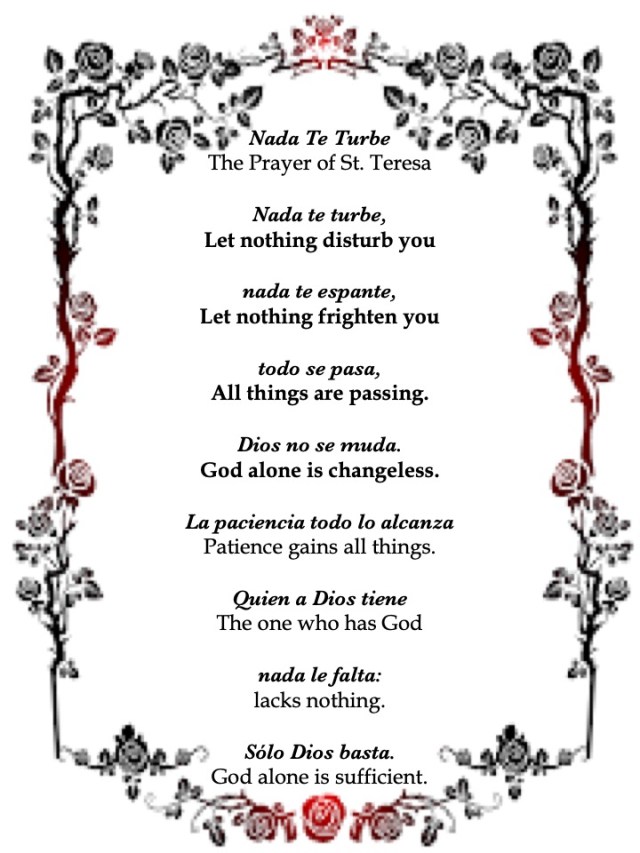
Teresa prayer

Teresa was a Spanish noblewoman who became a Carmelite nun, mystic, religious reformer, author, theologian, and one of the 36 Doctors of the Church.

(Until 1970, no woman had been named a Doctor in the Church, but since then four women have been designated: Saints Teresa of Àvila, Catherine of Siena, Therese of the Child Jesus, and Hildegard of Bingen)

png-divider-lines--1400

Our reading today from Romans is a good one for Teresa’s feast. In it, Paul expresses his complete trust in and devotion to the Gospel of Jesus Christ. By this, Paul means more than the written words of Matthew, Mark, Luke and John. He means the entire gift of the Incarnation, Life, Passion, Death and Resurrection, continuing among us in the indwelling Holy Spirit.

Teresa understood and lived this same trust and devotion. She said:

Christ has no body now, but yours.
No hands, no feet on earth, but yours.
Yours are the eyes through which
Christ looks compassion into the world.
Yours are the feet
with which Christ walks to do good.
Yours are the hands
with which Christ blesses the world.

Like Paul, Teresa was not ashamed to proclaim and live the Gospel. May these two strong and amazing saints help us to do the same.

Music: Christ Has No Body Now But Yours – David Ogden

Grace and Peace

Monday of the Twenty-eighth Week in Ordinary Time

October 14, 2019

Click here for readings

Today, in Mercy, we begin about a month of readings from Paul’s letter to the Romans. We will also continue with Luke’s Gospel all the way up to Advent.

To help me in praying with Romans, I am using a book by Scott W. Hahn, Father Michael Scanlan Chair of Biblical Theology at Steubenville University. In his introduction, Hahn says this:

Hahn_Romans

Today’s reading offered me these elements to ponder and pray with:

  • Paul calls himself a “slave” of Jesus Christ
  • He invokes his call as an Apostle
  • He sets himself in the company of the prophets
  • He appeals to Jews who revere David
  • but proclaims Christ, through his Resurrection, as Messiah beyond human lineage
  • He proclaims his mission to the Gentiles
  • to bring about “the obedience of faith”

I’ll be honest with you. I’ve read or heard this passage maybe fifty times in my lifetime, and it has meant little or nothing to me. At best, it has sounded like a formal introduction such as those we hear from government “whereas” type decrees.

But I took Dr. Hahn’s advice, studying the passage, and reading it slowly and prayerfully. Here’s what I received:

  • Paul’s Apostolic call, to which he willingly enslaved his heart, was to preach the Good News of our redemption in Jesus Christ – to preach it to Jews, Romans, Gentiles, and all people.
  • It is an awesomely incredible message that can be received only through the gift of faith.
  • It is a message rooted in the scripture stories we love, and where we look to find a reflection of our own stories.
  • Learning from these realities will help us come to a faith which expresses itself in action and gives glory to God in our own time.

Luke gives us one such story today. Jesus reminds the crowd of two familiar passages – that of Jonah and the “Queen of the South” (the Queen of Sheba, 1 Kings 10). He indicates that the people in these stories believed without a sign.

Jesus tells the people gathered around him  to learn from this. The crowd demands a sign, but Jesus says the sign is right in front of you – it is only your open heart that is lacking.

In his introduction, Paul prays for such open hearts in the Romans:

Rm1_grace_peace

Grace to you and peace from God our Father
and the Lord Jesus Christ.

By that same grace, may we receive faith’s blessing as well.

Music: Grace and Peace – Fernando Ortega

A Grateful Spirit

Twenty-eighth Sunday in Ordinary Time

October 13, 2019

Click here for readings

Today, in Mercy, two significant themes in our readings are gift-giving and gratitude.

In our first reading Naaman, a pretty hot-shot Syrian commander, is a leper. He takes the advice of a captured Israel slave girl who encourages Naaman to seek a cure from Elisa the prophet.

As Naaman approaches, Elisha sends word  to rinse in the Jordan. Naaman, who is obviously accustomed to personalized subservience, is not happy with Elisha’s absentee advice. Angry, Naaman sets out for home. But his servants encourage him to cool down and to act on Elisha’s instructions. 

Naaman receives the cure and he promises, half-heartedly, to from henceforth worship Yahweh. He then asks what he can pay for the gift of the cure. Elisha responds that there is no payment .

Notice: Naaman never says “Thank you”. Instead, he wants to pay, to owe nothing for the immense gift he has received. He doesn’t want to be beholden, even to God.

Elisha, in so many words, tells Naaman: What I was blessed to convey to you comes from God. The power is God’s. I am the instrument. You can’t buy or own it. I can’t sell it. It’s God’s – freely given.

2Tim2_9JPG

Paul repeats the theme to Timothy: the Word of God is not chained. God’s power, grace, and healing are given freely. We cannot earn them buy, them, control them, or ever thank God enough for them. But we should try.

In our Gospel, only one cured leper – a Samaritan – has the sense and humility to try to thank Jesus. Born of his faith, that gratitude saves him.

God is Infinite Gift. God’s love pours over us spontaneously and continually to bring us to wholeness. God can’t help loving us and hoping for our completeness in grace.

May we be delivered from any speck of entitlement, indifference, arrogance, or ingratitude in the face of such Goodness!

Music:  Thank You, Lord – Don Moen

The Lord’s Prayer

Wednesday of the Twenty-seventh Week in Ordinary Time

October 9, 2019

Click here for today’s reading

(Some of you may recognize this reflection as a “recycle”, but I think it may be worth another read.)

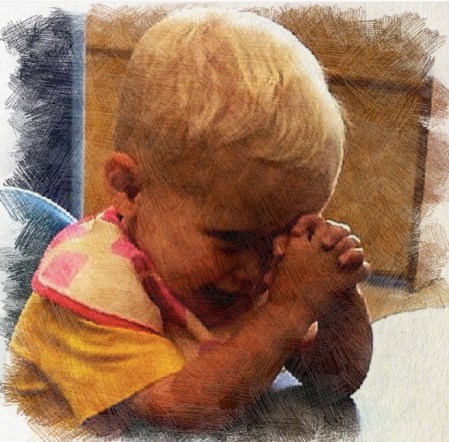
Ollie praying

Today, in Mercy,  Jesus teaches his disciples how to pray. His prayer is simple and direct, like talking to your Dad over a morning cup of coffee.

What about us? How do we pray?

Our first learned prayers are a lot like Jesus’s simple Our Father. We praise God, giving thanks, and asking for what we need.

Then we grow up and get sophisticated. We may begin to “say” or read prayers rather than use our own words. While such a practice can deepen our understanding of prayer, it places a layer between us and our conversation with God.

Sometimes others lead our prayer in the community of faith. This too can enrich us as we are inspired by a shared faith. But it is a little like trying to have a private conversation in an elevator.

Just as Jesus often went off in solitude to pray, this kind of prayer is our most intimate time with God – a time when God allows us to know God and ourselves in a deeper way. This sacred time alone with God may be spent in words, song, or the silence that speaks beyond words.

It is a time to be with the Beloved as we would our dearest, most faithful companion. We rest in the field of our experiences, letting them flow over God’s heart in tenderness. We listen with the ear of absolute trust to the secrets God tells us in the quiet.

Write It Down with Your Life!

Twenty-seventh Sunday in Ordinary Time

October 6, 2019

Click here for readings

Today, in Mercy,  our readings combine to offer us a powerful message: we are the translators of God’s Word for our time. Our choices and actions for justice and mercy make the vision “readable” – visible for our sisters and brothers.

Hab2_2 vision

Habakkuk starts our challenge. He is in a bit of a struggle with God, asking repeatedly how long God is going to allow the people to suffer. ( I have had similar conversations with God, especially during these charged political times).

In so many words, God tells Habakkuk to look to his faith – his vision through God’s eyes. God sees that “the just one, because of his faith, shall live.” God tells him to “write the vision down”, to make it apparent in his own choices and actions for justice and mercy. In other words, Habakkuk, I’ve done what I am going to do. The rest is up to you, Buddy!

In a similar way, Paul reminds Timothy to “stir up the flame” – the gift of God given at his profession of faith. Paul reminds Timothy that, by grace, he knows what is right and just. He must not be chicken about living and speaking that Truth – to write the vision down by his choices and actions for justice and mercy.

In our Gospel, the disciples seem to want their faith increased because the commitment to witness is scary. They think they might feel a little better about it all if their faith consoled them more. But “writing the vision with our lives” takes guts, and the disciples seem a little lacking in today’s reading.

Jesus tells them to buck up. They are blessed to serve the Word of God by the witness of their lives. It won’t always feel good, safe or successful. Still they, and we, must unfailingly write the vision down by our choices and actions for justice and mercy, because even …

When you have done all you have been commanded,
say, ‘We are unprofitable servants;
we have done what we were obliged to do.

Jesus calls it like it is today. We are blessed to be God’s translators. We have an undeniable call to live God’s just and merciful vision. No excuses. Get it together. Keep the pencil sharp. No asking God when He’s going to make things better. The legible  (just and merciful) translation depends on us!

Music: The Vision – Patrick Love

Names Written in Heaven

Saturday of the Twenty-sixth Week in Ordinary Time

October 5, 2019

Click here for readings

Today, in Mercy, we read from the Book of Baruch, a little book with a big punch. Baruch authored “scribal literature”, that which completed the message of another writer. Baruch was Jeremiah’s scribe, working to finish the edges of this most complex of the prophets.

Our reading today reflects this complexity. The Israelites have a history of intertwined faith and faithlessness. They also have current overwhelming sufferings. How does the prophet employ these two realities to impel hearts toward God?

Baruch characterizes God as angry and vengeful, punishing the people for their idolatry. It’s a model that works for Baruch’s time and purposes. But it’s not the God I know and love. So how can the passage speak to me?

The core of Baruch’s message is that things can be really bad sometimes in life, but that God is with us even in those times. Our turning to God in trust and patience will allow us to remain faithful and to deepen spiritually even in suffering. That fidelity brings joy and peace.

It’s hard to have that kind of faith. We want to manage our lives, and even manage God, in order to make sense of the chaos of life – to provide sensible, rectifiable reasons for suffering and evil.

We want to control demons like the early disciples did.

lk10_20 name_heaven

In our Gospel, these disciples return from their missionary trips all puffed up with their powers over evil. Jesus cautions them saying that’s not at all what it’s all about. Any miraculous power they have in a given moment is only a sign of a Greatness beyond them. 

Instead, their names a written in Heaven by the long, unshakeable fidelity that comes with keeping their eyes on God; by giving themselves to the mysterious, sometimes hidden, presence of God in every reality; by allowing that Presence to transform them and their circumstances.

(Speaking of prophets, a beautiful poem, Advice to a Prophet, came across my email today thanks to Joe Riley at Panhala. The poem is fitting as we close this Season of Creation. I will include it in a second post in case you’d like to read it.)

Music:  a little revival music today, New Name Written Down in Glory. Picture the disciples singing this after Jesus instructs them in today’s Gospel.

Celebrating Francis and his Followers

Memorial of Saint Francis of Assisi

October 4, 2019

Click here for readings

Francis
Francis of Assisi in Ecstasy- Caravaggio https://creativecommons.org/publicdomain/mark/1.0/deed.en

Today, in Mercy, in lieu of my usual reflection, I choose on this feast of St. Francis, to share with you my thoughts on our beloved Sisters of St. Francis of Philadelphia, and to give a well-deserved shout out to their Spiritual Center in Aston, PA.

I have been so enriched by their spirituality, their passion for justice, their unbounded hospitality, their love of the Gospel, and their witness for Christ.

Please join me in praying today for their community .. for its vigor, strength, holiness, witness and joy.

I commend to all my readers the Franciscan Spiritual Center at Aston, PA. If you are serious about your soul-life, consider their desire to assist you. I have found my relationship with these Sisters so beneficial for my spiritual life:

Click here for info on Franciscan Spiritual Center

I particularly send blessings to these beloved women who have blessed my life by their deep Franciscan spirituality. I have been brought into the world by them (Click to read about Old St. Mary’s Hospital – Kensington), taught by them, worked with them, prayed with them, laughed with them, mourned with them, been arrested for civil disobedience with them, and been edified by their gentle, hospitable goodness:

Sister Clare Immaculate
Sister Irma Catherine
Sister Jean Margaret McDevitt
Sister Marge Sullivan
Sister Marie Lucey
Sister Miriam Eileen Murray
Sister Kate O’Donnell
Sister Angela Presenza
Sister Annemarie Slavin
Sister Clare D’Auria
Sister Julia Keegan
and their devoted SSJ buddy, Sister Pat Hamill

Happy Feastday to all Franciscans and their co-ministers worldwide!

Music: Be Praised, My Lord – Andrea Likovich, OSF


The Word

Thursday of the Twenty-sixth Week in Ordinary Time

October 3, 2019

Click here for readings

Today, in Mercy, Ezra and Nehemiah gather all the People for a gargantuan spiritual renewal! It is the People themselves who request this renewal, realizing that they have drifted from the Law and desiring to ritualize their return to it.

It seems fitting that this reading comes just after the Jewish celebration of Rosh Hashana (from sundown on Sunday, September 29 until sundown on Tuesday, October 1, 2019.) This feast marks the beginning of the Jewish High Holy Days.

For more on these biblically rich celebrations, click here.


One of the lessons Christians can take from today’s passage is awareness of the great power and gift of God’s Word. Ezra’s community was changed by listening to that Word with open, repentant hearts.

word of God

In our Gospel, Jesus sends his disciples out to preach that Word, now transformed by the power of his Incarnation. He tells them to preach that “the Kingdom of God is at hand!”

Just this week, Pope Francis has taken steps to rekindle our appreciation of the Word. By declaring the Third Sunday in Ordinary Time as the Sunday of the Word of God, our Pope wants to help us grow in love and devotion to Sacred Scripture.

(Personally, I welcome this focus. At the time of the Second Vatican Council, there was a new and deepened awareness of the gift of Sacred Scripture. As a young religious, that awareness was central to my spiritual formation. Since that time, there seems to have been an unfortunate shift away from that emphasis. I see the Pope’s declaration as a welcome corrective to that shift.)

Pope Francis has designated the day “to the celebration, study and dissemination of the word of God “ so as to help the Church “experience anew how the risen Lord opens up for us the treasury of his word and enables us to proclaim its unfathomable riches before the world’.

May we gratefully respond!

(See below the music : If you are interested, I have copied a very good excerpt from Pope Francis Apostolic Letter.)

Music: We Come to Hear Your Word – Chris Jubilee

Below is an excerpt from the Pope’s Apostolic Letter APERUIT ILLIS -INSTITUTING THE SUNDAY OF THE WORD OF GOD. I found it to be helpful in understanding the Pope’s intent with this feast:


With this Letter, I wish to respond to the many requests I have received from the people of God that the entire Church celebrate, in unity of purpose, a Sunday of the Word of God. 

It is now common for the Christian community to set aside moments to reflect on the great importance of the word of God for everyday living. The various local Churches have undertaken a wealth of initiatives to make the sacred Scripture more accessible to believers, to increase their gratitude for so great a gift, and to help them to strive daily to embody and bear witness to its teachings.

The Second Vatican Council gave great impulse to the rediscovery of the word of God, thanks to its Dogmatic Constitution Dei Verbum, a document that deserves to be read and appropriated ever anew. The Constitution clearly expounds the nature of sacred Scripture, its transmission from generation to generation (Chapter II), its divine inspiration (Chapter III) embracing the Old and New Testaments (Chapters IV and V), and the importance of Scripture for the life of the Church (Chapter VI). 

To advance this teaching, Pope Benedict XVI convoked an Assembly of the Synod of Bishops in 2008 on “The Word of God in the Life and Mission of the Church”, and then issued the Apostolic Exhortation Verbum Domini, whose teaching remains fundamental for our communities.[1] That document emphasizes in particular the performative character of the Word of God, especially in the context of the liturgy, in which its distinctively sacramental character comes to the fore.[2]

It is fitting, then that the life of our people be constantly marked by this decisive relationship with the living word that the Lord never tires of speaking to his Bride, that she may grow in love and faithful witness.

Consequently, I hereby declare that the Third Sunday in Ordinary Time is to be devoted to the celebration, study and dissemination of the word of God. This Sunday of the Word of God will thus be a fitting part of that time of the year when we are encouraged to strengthen our bonds with the Jewish people and to pray for Christian unity. This is more than a temporal coincidence: the celebration of the Sunday of the Word of God has ecumenical value, since the Scriptures point out, for those who listen, the path to authentic and firm unity.