The Stars Will Teach Us

Wednesday of the Twelfth Week in Ordinary Time

June 26, 2019

Click here for readings

Today, in Mercy, our reading from Genesis invites us further into the gift of our faith.

We see God break into Abram’s life through a vision.

“Fear not!”, God says.
I am your shield;
I will make your reward very great.”

So Abram must have been a little frightened when God decided to visit him here. But why?

What Abram was nervous about was this: despite God’s earlier promise to him, Abram and Sarai were still childless – barren. In fact, he was so concerned that God would not prove true to the promise, that he was making plans about his own future without God’s help.

… if I keep on being childless
(I will) have as my heir
the steward of my house, Eliezer…

Abram was a very practical guy. His newly-sprouted faith expected practical, even instant results. It would take some time for Abraham to grow into a faith rooted in relationship rather than signs; to realize that faithful relationship is for the long run, not the immediate answer.

Gen15_5_stars

God helps Abram to understand this long, deep view.

God took him outside and said:
“Look up at the sky and count the stars, if you can.
Just so,” he added, “shall your descendants be.”

Abram looked at these stars, made and sustained by God’s hand. He saw that this God Who was inviting him to relationship was beyond time, beyond numbering, beyond human definitions – boundless in life, mercy and love. And so, letting go of his need for concreteness and Immediacy,

Abram put his faith in the LORD,
who credited it to him
as an act of righteousness.

Today’s scripture may lead us consider our own relationship with God, God’s promise in our life, how we are being drawn beyond our limited expectations. Is there a place of barrenness, an unmet need, a broken expectation shaking our heart or spirit? Let’s ask to abandon all these things to God’s love.

We might even want “to go outside” ourselves, literally or figuratively, asking God to teach us how God’s Presence in our life is infinite, even beyond the stars – if we have a faithful heart to see.

Music: Beyond the Moon and Stars – Dan Schutte 

Will We Live Our Faith Out Loud?

Tuesday of the Twelfth Week in Ordinary Time

June 25, 2019

Click here for readings

Today, in Mercy, we begin several weeks of readings from the Book of Genesis. 

Some people think of Genesis as a literal history. Others think of it more as a myth. Was there a real Adam and Eve? A real apple? A real snake?

When we get caught up in these ambivalences about Genesis, we are likely to miss the whole point. And the whole point, according to Hebrew Scripture scholar Walter Brueggemann is this:

… these texts should be taken neither as history nor as myth.
Rather, we insist that the text is a proclamation
of God’s decisive dealings with his creation. 


“God’s decisive dealings with God’s Creation…”

What a powerful phrase! So over the next few weeks, here is our opportunity:

How does God want to be with us,
to love us,
and to share the ongoing Creation with us?


Today’s reading, according to Brueggemann, is the second part of a four-part drama:

Genesis 11: 30—25: 18 “The Embraced Call of God”
Will Abraham live by faith? 

This second segment poses a profound question to us, and to our Church:
Have we embraced God’s call in our lives and will we live our faith OUT LOUD!

Jesus asks us the same question in today’s Gospel: Will we live our faith OUT LOUD?


Will we:
“Do to others whatever you would have them do to you.”

cage

How to help children at the border and in inhuman detention centers:

Click here.


Music: By Faith -Keith and Kristyn Getty

Is Scrooge My Hero?

Memorial of Saint Aloysius Gonzaga, Religious

June 21, 2019

Click here for readings

Today, in Mercy, Jesus puts the whole spiritual life in a nutshell:

Luke heart treasure

When I was a kid (and maybe even now), one of my favorite cartoon characters was Uncle Scrooge McDuck.

Scrooge

I was amazed to think that someone could accumulate all that money, and fascinated to see that all he wanted to do was sit on it!

Both Uncle Scrooge and Jesus pose some deep questions to us today.

  • How much do we really need to make us happy?
  • Will having it actually make us happy in the long run?
  • Where does our happiness come from, if we have happiness at all?

We have seen the theme in a hundred books and movies – poor little rich boy or girl starving for love. We all seem to realize that true wealth comes from love. But do we live and choose by that understanding?

Possessions can distract us from what is truly essential for our soul. Greed and selfishness can kill the Spirit within us.

Our coöptation by materialism and greediness doesn’t have to rise to the level of Scrooge’s mounted millions. So often a miserly heart is crippled by things much more complex than money. We can be sinfully stingy with:

  • our attention to those deemed unimportant
  • our kindness to those struggling with life
  • our forgiveness to the unappreciative 
  • our presuppositions about what belongs to whom

The following parable has always shaken me down at the root of my assumed entitlements:

A young woman was waiting to catch a flight in the boarding area of the airport. Given that her wait was going to be several hours she decided to buy a book to read along with a packet of cookies to enjoy. She sat down in an armchair in the VIP room of the airport to relax and read her book in peace. 

Beside the armchair where the packet of cookies lay, a man was seated next to her reading his magazine.  When the woman reached into the packet of cookies to take the first cookie, the man next to her also took one. She was irritated but said nothing. “What nerve this man has!” she thought.  For each cookie she took the man also took a cookie. 

She was infuriated but didn’t want to cause a scene. When only one cookie remained she thought to herself, “what will this horrible man do now?” The man reached down and broke the cookie into even halves and handed one half to her. It was more than she could handle!  She grabbed her things in a huff, refused the half, and stormed off to the boarding area.  

When she got onto her seat on the plane she reached into her purse to get her reading glasses and, to her surprise, her packet of cookies was sitting there untouched and unopened.

We might wish to spend some prayer time considering the application of this story to our own attitudes.

Music: Where Your Treasure Is – Marty Haugen

The Jealousy of God

Thursday of the Eleventh Week in Ordinary Time

June 20, 2019

Click here for readings

Today, in Mercy, we continue to read from Paul’s ardent letter to the Corinthians.

2 Cor 11_2

Second Corinthians gives us Paul, preaching at his passionate height. Paul loves the Corinthian community. I think the city’s personality was a good bit like his own. 

A dynamic cosmopolitan center, Corinth is situated on the southern side of an isthmus between two gulfs. This geography predisposed the site to become an active shipping center, highly populated with merchants and travelers from all over the known world.  

An informative article on preachingsource.com quotes Leon Morris, noted New Testament scholar, in describing the city as “intellectually alert, materially prosperous, and morally corrupt.”

Click here for article

This population would present just the kind of challenge to motivate Paul. His intellectual acuity, familiarity with prosperity, and repented moral challenges made him the perfect evangelist for this morally hungry community.

And he is highly successful in giving them the Gospel.

It is after he departs to continue the mission elsewhere that problems arise. New preachers come behind him, distorting the core message of the Cross and Resurrection. In today’s letter, Paul begs his beloved community not too be wooed by this diluted preaching.

Today’s Church is not immune from such dilution. Some preachers bend the Holy Word to fit their own agendas. We have, for example, the errancy of the “prosperity gospel”, the divisiveness of strident tradionalism, and the distortions of a flawed fundamentalism which equates faith with nationalism, ethnic supremacy, and economic domination.

When Paul speaks of loving the Corinthian community with the “jealousy” of God, he fore-echoes Pope Francis in his first Apostolic Exhortation, “Evangelii Gaudium”, (The Joy of the Gospel). Here are a few compelling excerpts for our prayer today as we consider what the Gospel means to us:

  • “The Gospel, radiant with the glory of Christ’s cross, constantly invites us to rejoice.”
  • “Before all else, the Gospel invites us to respond to the God of love who saves us, to see God in others and to go forth from ourselves to seek the good of others.”
  • “On the lips of the catechist the first proclamation must ring out over and over: ‘Jesus Christ loves you; he gave his life to save you; and now he is living at your side every day to enlighten, strengthen and free you.’”

Music: The Gospel – Ryan Stevenson

Character. Remember it?

Wednesday of the Eleventh Week in Ordinary Time

June 19, 2019

Click here for readings

Today, in Mercy, Jesus and Paul offer us lessons in character, something sorely needed in today’s world.

Ps112 characterJPG

Sometimes I think I’m just getting old, but I feel like our culture has abandoned the pursuit of “character”. 

Who are the models held up for our children? Overpaid, spoiled sports icons? Fat cat, indifferent politicians? Grossly sexualized entertainers? Self-indulgent religious and civic officials?

What are the messages our kids receive through our media? Unless you are the richest, the strongest, the flashiest, the cleverest, etc., you fail?

What about us adults? We are bombarded with these messages too. What do we begin to believe about ourselves and who we should be in the world?

Today our readings tell us this: Be upright, gracious, merciful and just. Be generous, humble and brave without needing to be recognized for it. Be honest, sincere, and wise. Wow! Are you kidding me?

As we continue to nourish our character, as we help our children build theirs, there are many blocks to choose from. We can turn every experience, act and choice either to light or to darkness, either to self or to God.

As we pray these readings today, let us ask for the grace to see ourselves clearly with God’s eyes- always true and always merciful. Let us ask for the courage and character to be someone God delights to see.

Music: Sanctify Me, O God – Rexband

Hmmm. The Other Cheek?

Monday of the Eleventh Week in Ordinary Time

June 17, 2019

Click here for readings

Today, in Mercy, our reading from Matthew again shows us how revolutionary Jesus really was!

Yield

For the Jews who listened to Jesus, and for us still listening, today’s instructions might be some of the hardest to swallow! These readings encompass a phrase classically known as the lex talionis or the law of talion.

We may not be familiar with the phrase but we probably are quite familiar with the practice. Most of us begin it very early in life, at least in my young neighborhood we did. It went like this: Harry bites you, you bite him back. Janey pushes you, you push her harder. Margie takes your pickle, you take her peach. Right? Isn’t that the way it should be?

Well, Jesus says not, although his listeners had lived by variations of this law from the time of:

Exodus 21:23-25
But if there is harm, then you shall pay life for life, eye for eye, tooth for tooth, hand for hand, foot for foot, burn for burn, wound for wound, stripe for stripe.

and Leviticus 24:19-21
Anyone who injures their neighbor is to be injured in the same manner: fracture for fracture, eye for eye, tooth for tooth. The one who has inflicted the injury must suffer the same injury.

Believe it or not, these harsh injunctions were actually intended to placate situations by preventing a backlash disproportionate to the original crime.

But Jesus says that is not enough. He says not to resist the evildoer. Scholars have considered for centuries exactly what this means. 

Does it mean to ignore evil, not calling it out for what it is? Obviously not, because Jesus Himself was quick to name the evils of his times.

Does it mean to be a doormat for evil-hearted people to walk all over? Definitely not. Jesus stood up to his persecutors and clearly named their wrong-doing.

What it means is not to return evil for evil, not to respond in-kind, as Paul writes in 1 Thessalonians 5:15

See that no one repays another with evil for evil,
but always seek after that which is good
for one another and for all people.

One of the key Critical Concerns of the Sisters of Mercy is non-violence. I find it one of the most challenging.

Mercy

This article, written by Rosemarie Tresp, RSM proved very helpful to me. You might find it so as well.

Click here for article

Music: Make Me a Channel of Your Peace – written by Sebastian Temple, sung by Susan Boyle

Climbing Toward God

Friday of the Tenth Week  in Ordinary Time

June 14, 2019

Click here for readings

Today, in Mercy, Paul, follows on yesterday’s magnificent passage about

the Gospel of the glory of Christ,
who is the image of God.

The power of this Gospel is the “treasure” about which Paul writes in today’s first reading.

2Cor4_7

In this passage, Paul describes the miracle of contradiction in us who believe. We carry the  infinite light of God’s Glory in the fragile, imperfect vessels of our existence. By the power of God, the omnipotent sublime shines from within the ordinary.

We see, in these lines, Paul the humble and tested preacher. He has grown in his deep understanding of himself as God’s imperfect instrument.

All of us who want to live the Gospel are called to experience a deepening like Paul’s. The poet Mary Oliver reflects such a transformation in her poem On Thy Wondrous Works I Will Meditate (Psalm 145). Here is the last delightful stanza, which may inspire our prayer today. (I will send the full poem a little later.)

Every morning I want to kneel down on the golden
cloth of the sand and say
some kind of musical thanks for
the world that is happening again—another day—
from the shawl of wind coming out of the
west to the firm green
flesh of the melon lately sliced open and
eaten, its chill and ample body
flavored with mercy. I want
to be worthy—of what? Glory? Yes, unimaginable glory.
O Lord of melons, of mercy, though I am
not ready, nor worthy, I am climbing toward you.

Music: Earthen Vessels – John Foley, SJ

Glory following Glory

Memorial of Saint Anthony of Padua, Priest and Doctor of the Church

June 13, 2019

Click here for readings

Today, in Mercy, we celebrate the feast of St. Anthony. Many of us are close friends with him, as we mislay our keys, glasses, phones and wallets on a regular basis. But we might want to consider St. Anthony’s more universal contribution to the Church. A Franciscan friar, Anthony was noted by his contemporaries for his powerful preaching, expert knowledge of scripture, and undying love and devotion to the poor and the sick – virtues we are called to imitate by his canonization.

On another note, today’s readings for Ordinary Time focus on seeing past the letter of the Law to its Spirit.


In today’s Gospel, Jesus, preaching charity over ritual, says:

Therefore, if you bring your gift to the altar,
and there recall that your brother
has anything against you,
leave your gift there at the altar,
go first and be reconciled with your brother,
and then come and offer your gift.

In the magnificent passage from 2 Corinthians, Paul, describing the Old Law of requirements as a veil over our eyes, writes:

2Cor3_18

Now the Lord is the Spirit and where the Spirit of the Lord is,
there is freedom.

All of us, gazing with unveiled face on the glory of the Lord,
are being transformed into the same image from glory to glory,
as from the Lord who is the Spirit.

glory

May our lives, blessed by the freedom of the Holy Spirit, move gratefully, humbly, and joyously “from glory to glory” – growing ever more deeply into the merciful Heart of God.

Music:  Dwelling Place – John Foley, SJ

No Ordinary Time

Wednesday of the Tenth Week in Ordinary Time

June 12, 2019

Click here for readings

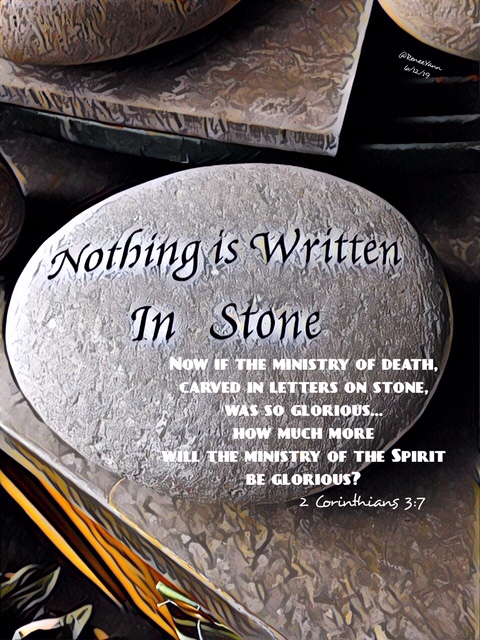
2Cor3_7JPG

Today, in Mercy, ah — here we are, back in Ordinary Time. Our journey through Lent and Eastertide has been completed and we now return to the “dailyness” of our spiritual lives and Liturgical Year. Really?

For the next two weeks, we will learn from 2 Corinthians. And from now, throughout the summer (or winter, depending on your hemisphere), we will listen to Matthew’s account of the life Christ. ( Some of you may want to pick up a good commentary on Matthew’s Gospel. My longtime favorite was The Gospel of Matthew by Daniel J. Harrington, SJ. It is out of print now but some good passages are available for free from Google books by clicking here.)

What we find in 2 Corinthians is Paul – when the rubber meets the road. Some of the first enthusiasm after the Resurrection has worn thin. The hard work of preaching the Gospel has spun strains of exhaustion in Paul. The very important Corinthian community proves difficult and resistant. Paul has already tried to deal with this dissonance in 1 Corinthians. But now, he has to raise some issues again.

In 2 Corinthians, we see a community hanging on to old definitions of godliness. Paul does not condemn the old, rather he challenges his people to fully put on the New Christ – the Christ of Mercy, Forgiveness, Calvary and Resurrected Hope. It’s a lofty challenge, particularly when one’s feet are stuck in the mud of “ordinary time” and old comforts.

In our Gospel, Jesus preaches the same message. He tells his followers that he has not come to abolish the Law, but to perfect it in the Spirit.

For some of us, it is a lot more comforting to hang on to the tried and the true, the words “written in stone”. But the Spirit of God will never be confined to stone.

The Spirit is always free, astonishing and alive. In the inspiration of these passages, let us ask God what new Pentecostal courage and hope God asks of us. It may be as small as a personal act of forgiveness, or as large as a Church welcoming previously alienated individuals and communities.

How can we announce God’s merciful heart for all people by the gracious exercise of our “ordinary” time?

Music: perhaps, if Paul were preaching today, this is the way he would speak to the Corinthians (Apologies to English teachers🧐)

Kelontae Gavin: No Ordinary Worship

A St. Barnabas Music Fest

Memorial of Saint Barnabas, Apostle

June 11, 2019

Click here for Readings

Mk9_49_ salt

Today, in Mercy, we celebrate the feast of St. Barnabas, “a good man”. Reading about his call in Acts, that phrase struck me.

“Barnabas … was a good man,
filled with the Holy Spirit and faith.”

Some of you classic jazz/blues fans may remember an old classic by Bessie Smith, “A Good Man Is Hard to Find.”

That’s a pretty sad song, but apparently it does not reflect the experience of the early disciples. They found several good men in Acts 11:

Now there were in the Church at Antioch prophets and teachers:
Barnabas, Symeon who was called Niger,
Lucius of Cyrene,
Manaen who was a close friend of Herod the tetrarch, and Saul.

What makes someone a “good man (or woman)? I can remember my Dad, a good man himself, using that phrase on occasion about someone he knew. It was a rare benediction – only someone of exceptional character earned it from my Dad.

All of Dad’s designees had these things in common: humble, hard-working, honest, generous, simple and respectful people. They had shown up for life, with a loyalty to those around them. They were God-loving, salt-of-the-earth fellas who would be shocked to think they were special. Barnabas was such a guy.

Jesus loved this kind of soul too. In our Gospel he says

“You are the salt of the earth.
You are the light of the world…
Just so, your light must shine before others,
that they may see your good deeds
and glorify your heavenly Father.”

…or, in Godspell terms:

As we pray these Scripture passages today, let us be inspired by Barnabas to hear Jesus speaking these words to us – because we are good men and good women.

Music: People Let Your Light Shine – Jesse Colin Young