Psalm 18: God’s Right Here

Friday of the Fifth Week of Lent

March 26, 2021


Today, in God’s Lavish Mercy, we pray with Psalm 18. It is a royal psalm, full of triumph, praise and rejoicing. But the psalmist, presumably David, never forgets the depths from which he has been delivered. He remembers the “storm” from which he called out to God.


The psalmist imagines God, in the distant temple, hearing his cry and responding. The image brought to my mind the memory of an early morning prayer time when I was a very young nun. 

An hour or so before dawn, I looked out my window to the morning star, imagining God out there in the heavens. Like David, I presumed God was distant and needed to be called into my experience. But, on that morning, I realized that God was not distant – that God was within me, my life, and the very storm I was praying about.

I still love to look out to the stars while I pray. But since that morning, I imagine God sitting beside me, enjoying the same beauty – sorting through my life with me from within my own heart. Verse 29 makes me think that David came to a similar realization:


Poetry: Go Not to the Temple – Ravindranath Tagore

Go not to the temple to put flowers upon the feet of God,
First fill your ownhouse with the Fragrance of love and kindness. 

Go not to the temple to light candles before the altar of God,
First remove the darkness of sin , pride and ego, 
from your heart…

Go not to the temple to bow down your head in prayer,
First learn to bow in humility before your fellowmen.
And apologize to those you have wronged. 

Go not to the temple to pray on bended knees,
First bend down to lift someone who is down-trodden.
And strengthen the young ones. 
Not crush them.

Go not to the temple to ask for forgiveness for your sins,
First forgive from your heart those who have hurt you!


Music: Christ Be Beside Me – St. Patrick’s Breastplate adapted by Michael Foscher
Bach Cantata BWV 1 “Wie Schön Leuchtet Der Morgenstern – Cantata for the Annunciation

On this special feast, I wanted to share an extra post with a lovely piece of music from Bach.

I love this feast so much. In 1963, March 25th was the date when I decided to become a Sister of Mercy. With dear Mary’s help, I have been slowly becoming one ever since.

I pray with Bach’s beautiful music today while thanking God and Mary for the gift of my call to Mercy.

I pray in gratitude for all of you who have given Mercy a human face in my life.

1. How brightly shines the Morning Star!

What ray divine streams from afar!

    God’s glory there is shining.

Bright beam of God, which scatters night,

And guides the wandering soul aright,

    Which after truth is pining!

        Jesus, God’s Word, truth revealing,

        Sorrow healing. Sooth our sighing,

        Dry our tears, and end our dying.

2. My comfort here, my joy above,

Man’s Son, Son of the Father’s love,

    Enthroned in highest heaven.

With my whole heart Thy praise I sing;

To Thee, our Prophet, Priest and King,

    Be endless honors given.

        Saviour, To Thee, trusting, clinging,

        Come I bringing Soul and spirit,

        Thee, my portion, to inherit.

3. Aid me, my God, to sing Thy praise,

Thine ageless love, Thy matchless grace,

    In Christ, our Lord, appearing.

When such a gift God gave for thee,

When such a brother true is He,

    Why still my soul be fearing?

        Choose Him, know Him, greatest, dearest,

        Best and nearest, To befriend thee

        ‘Gainst all foes who may offend thee.

4. To him who conquered death and hell,

To him let joyous anthems swell

    Throughout heaven’s great for ever.

Praise to the Lamb that once was slain,

Glory to him who bore our pain,

    Flow on, an endless riverl

        Earth and heaven—creatures lowly,

        Angels holy—join your voices,

        Till the world with praise rejoices.

5. Rejoice, ye heavens; thou, earth, reply;

With praise, ye sinners, fill the sky,

    For this, his incarnation.

Incarnate God, put forth thy power,

Ride on, ride on, great Conqueror,

    Till all know thy salvation.

        Amen, amen: hallelujah!

        Hallelujah! praise be given

Evermore by earth and heaven!

Psalm 40: The Will to Love

Solemnity of the Annunciation of the Lord

March 25, 2021

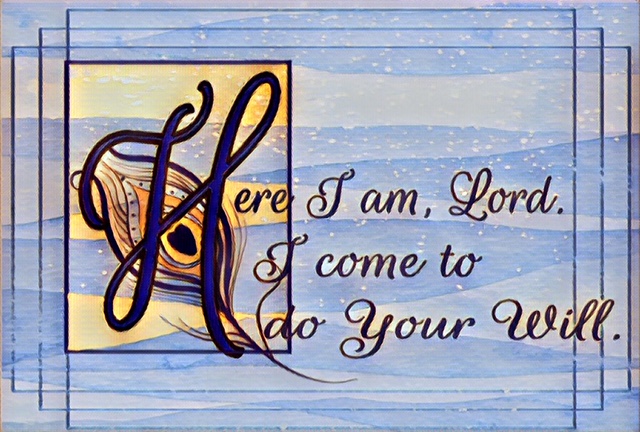
Today, in God’s Lavish Mercy, on this feast of the Annunciation, we pray with Psalm 40. We hear Mary proclaiming its refrain which echoes down through the ages:

Psalm 40:8-9

We are all here to do God’s Will. That’s why God made us. But sometimes, we struggle so hard either to learn God’s Will or to avoid it.

Praying with Mary this morning, I thought this about “God’s Will” – It is not a plan we must discover, or that unfolds in surprises throughout our lives. It’s not a set of circumstances meant to test our faith. If we think of it this linearly, we cripple and diffuse its power.

Because God is Love, God’s Will is simply this: 

Love. 
Always love. 
Love always as God would love. 
Choose always what Love would choose.
Love.

That’s what Mary did.


Annunciation – Henry Ossawa Tanner

Poetry:  Aubade: The Annunciation – Thomas Merton
(An aubade is a poem or piece of music appropriate to the dawn or early morning.)


When the dim light, at Lauds, comes strike her window,
Bellsong falls out of Heaven with a sound of glass.
Prayers fly in the mind like larks,
Thoughts hide in the height like hawks:
And while the country churches tell their blessings to the
distance,
Her slow words move
(Like summer winds the wheat) her innocent love:
Desires glitter in her mind
Like morning stars:
Until her name is suddenly spoken
Like a meteor falling.
She can no longer hear shrill day
Sing in the east,
Nor see the lovely woods begin to toss their manes.
The rivers have begun to sing.
The little clouds shine in the sky like girls:
She has no eyes to see their faces.
Speech of an angel shines in the waters of her thought
like diamonds,
Rides like a sunburst on the hillsides of her heart.
And is brought home like harvests,
Hid in her house, and stored
Like the sweet summer's riches in our peaceful barns.
But in the world of March outside her dwelling,
The farmers and the planters
Fear to begin their sowing, and its lengthy labor,
Where, on the brown, bare furrows,
The winter wind still croons as dumb as pain.

Music: Ave Maria – performed by Daniela de Santos

Our Psalm: If…

Wednesday of the Fifth Week of Lent

March 23, 2021


Today, in God’s Lavish Mercy, we pray with the Book of Daniel both for our Responsorial Psalm and for our first reading. 


As I read through today’s scripture passages, I immediately thought of my wonderful college Logic professor, Florence Fay. She was free-spirited, colorful, brilliant and clear. I loved her classes. It was Dr. Fay who implanted a love for syllogisms (if-then statements) in my young mind.

Today, multiple syllogisms popped out to me from our first reading and Gospel.

from Daniel:

If our God, whom we serve,
can save us from the white-hot furnace
and from your hands, O king, then may he save us!


from John:

But even if he will not, (then) know, O king,
that we will not serve your god
or worship the golden statue that you set up.

If you remain in my word, then you will truly be my disciples,
and you will know the truth, and the truth will set you free.

If you were Abraham’s children,
(then) you would be doing the works of Abraham. 
If God were your Father, (then) you would love me,
for I came from God and am here;
I did not come on my own, but he sent me.


I’ve prayed some pretty frantic “if-then” prayers at desperate times in my life. They sound like this:
“Dear God, if You just get me out of this mess I made, then I promise to turn into a Saint!”

But, obviously, with such prayers, I didn’t get the sacred “logic” right.
I think a lot of people don’t get it right, sometimes disastrously, as in:
“If God had answered my prayer, then I would still go to church. But he didn’t, so I don’t.”


Daniel’s “Psalm” serves as a perfect instruction for how we must respond to God, no matter the outcome of our “if-then” moments. If we close ourselves to God’s presence even in our disappointments, we will never grow into God’s ever-new imagination for our lives.

Glory and praise for ever!
Blessed are you, O Lord, the God of our fathers,
    praiseworthy and exalted above all forever;
And blessed is your holy and glorious name,
    praiseworthy and exalted above all for all ages.


Poetry: If— by Rudyard Kipling 1865-1936

If you can keep your head when all about you
   Are losing theirs and blaming it on you;
If you can trust yourself when all men doubt you,
   But make allowance for their doubting too;

If you can wait and not be tired by waiting,
   Or, being lied about, don’t deal in lies,
Or, being hated, don’t give way to hating,
   And yet don’t look too good, nor talk too wise;

If you can dream—and not make dreams your master;
   If you can think—and not make thoughts your aim;
If you can meet with triumph and disaster
   And treat those two impostors just the same;

If you can bear to hear the truth you’ve spoken
   Twisted by knaves to make a trap for fools,
Or watch the things you gave your life to broken,
   And stoop and build ’em up with wornout tools;

If you can make one heap of all your winnings
   And risk it on one turn of pitch-and-toss,
And lose, and start again at your beginnings
   And never breathe a word about your loss;

If you can force your heart and nerve and sinew
   To serve your turn long after they are gone,
And so hold on when there is nothing in you
   Except the Will which says to them: “Hold on”;

If you can talk with crowds and keep your virtue,
   Or walk with kings—nor lose the common touch;
If neither foes nor loving friends can hurt you;
   If all men count with you, but none too much;

If you can fill the unforgiving minute
With sixty seconds’ worth of distance run—
   Yours is the Earth and everything that’s in it,
And—which is more—you’ll be a Man, my son!


Music: Even If – MercyMe

Psalm 102: Joys and Sorrows

Tuesday of the Fifth Week of Lent

Tuesday, March 23, 2021


Today, in God’s Lavish Mercy, we pray with Psalm 102, the prayer of someone in the midst of suffering. The psalm is introduced with stark honesty:

The prayer of one afflicted and wasting away 
whose anguish is poured out before the LORD.

Psalm 102: 1

Psalm 102 speaks to those places in life’s journey where we experience intense, perhaps overwhelming suffering.

In our first reading, the Israelites suffer through what seems like a never-ending journey of homelessness. In our Gospel, Jesus begins his final journey toward his Passion and Death. These both were journeys with suffering as a constant companion

No one avoids suffering in some way. It is part of being human. Even our beloved Catherine McAuley left us this succinct maxim:

This is your life, joys and sorrow mingled,
one succeeding the other.

Letter to Frances Warde (May 28, 1841)

The psalmist, in the midst of his suffering, calls out to God for a return of the promised joy.

O LORD, hear my prayer,
    and let my cry come to you.
Hide not your face from me
    in the day of my distress.
Incline your ear to me;
in the day when I call, answer me speedily.  


This prayer attests to the psalmist’s undaunted faith and to God’s unwavering fidelity.

This mutual faithfulness is where we all must stand in sorrow so that we may come, as Jesus did, to the fullness of Resurrection grace.

As we come closer to the profound mysteries of Holy Week, let us not only reverence our own joys and sorrows. Let us ask to enter more deeply into the experience of Jesus in this final unfolding of his life. May we deepen in the understanding that the suffering of Jesus is one with the suffering of our sisters and brothers.


Poetry: On Another’s Sorrow – William Blake 

Can I see another's woe,
And not be in sorrow too?
Can I see another's grief,
And not seek for kind relief?

Can I see a falling tear,
And not feel my sorrow's share?
Can a father see his child
Weep, nor be with sorrow filled?

Can a mother sit and hear
An infant groan, an infant fear?
No, no!  never can it be!
Never, never can it be!

And can He who smiles on all
Hear the wren with sorrows small,
Hear the small bird's grief and care,
Hear the woes that infants bear --

And not sit beside the next,
Pouring pity in their breast,
And not sit the cradle near,
Weeping tear on infant's tear?

And not sit both night and day,
Wiping all our tears away?
Oh no! never can it be!
Never, never can it be!

He doth give his joy to all:
He becomes an infant small,
He becomes a man of woe,
He doth feel the sorrow too.

Think not thou canst sigh a sigh,
And thy Maker is not by:
Think not thou canst weep a tear,
And thy Maker is not near.

Oh He gives to us his joy,
That our grief He may destroy:
Till our grief is fled an gone
He doth sit by us and moan

Music: You Raise Me Up – Josh Grogan

Psalm 23: Darkness to Light

Monday of the Fifth Week of Lent

Monday, March 22, 2021

Today, in God’s Lavish Mercy, we pray with our revered Psalm 23. This powerful prayer of confidence and hope fits well with today’s readings.

In the passage from Daniel, the innocent Susanna never wavers in her trust:

O eternal God, you know what is hidden
and are aware of all things before they come to be:
you know that they have testified falsely against me. 
Here I am about to die,
though I have done none of the things
with which these wicked men have charged me.”
The Lord heard her prayer.

Daniel 13: 42-44

In our Gospel, the woman – though not innocent – stills finds refuge in Jesus’s mercy.

So he was left alone with the woman before him.
Then Jesus straightened up and said to her,
“Woman, where are they?
Has no one condemned you?”
She replied, “No one, sir.”
Then Jesus said, “Neither do I condemn you.
Go, and from now on do not sin any more.”

John 8: 9-11

Like these two women, we may find ourselves in a dark valley at times. Whether we are innocent or guilty in arriving there, God abides with us in mercy. 

The key is to acknowledge our situation and to reach out to that Mercy. In that way, even though we encounter difficulty, as said in Psalm 23, we live in Light and not in shadow:

Only goodness and kindness follow me
all the days of my life;
And I shall dwell in the house of the LORD
for years to come.

Psalm 23: 5-6

Poetry: Light by Rabindranath Tagore

Light, my light, the world-filling light, 
the eye-kissing light, heart-sweetening light!

Ah, the light dances, my darling, at the center of my life; 
the light strikes, my darling, the chords of my love; 
the sky opens, the wind runs wild, laughter passes over the earth.

The butterflies spread their sails on the sea of light. 
Lilies and jasmines surge up on the crest of the waves of light.

The light is shattered into gold on every cloud, my darling, 
and it scatters gems in profusion.

Mirth spreads from leaf to leaf, my darling, 
and gladness without measure.
 The heaven’s river has drowned its banks 
and the flood of joy is abroad.


Psalm 51: Spring Cleaning

Fifth Sunday of Lent 

March 21, 2021

Today, in God’s Lavish Mercy, we pray with Psalm 51, a psalm to inspire our spring soul-cleaning.

A clean heart create for me, O God,
    and a steadfast spirit renew within me.

Psalm 51:12

Happy Spring to all of you in the northern hemisphere! Blessings of new life and hope!

And for my southern friends already in your Autumn Season, blessings of change and release!


Psalm 51 can speak to our hearts in whatever season we find ourselves.

After our long winters, external or internal, we may call upon God for a fresh budding of our hearts:

Give me back the joy of your salvation,
    and a willing spirit sustain in me.

Psalm 51: 14-15

When bright summer wanes and vibrant trees speak of leave-taking, we may pray to remain in warmth and light:

Cast me not out from your presence,
    and your Holy Spirit take not from me.

Psalm 51: 13

Across our hemispheres, we all share the longings of Lent to be cleared of all that blocks us from Grace in our lives – to have the hidden corners of our small selfishness swept, polished and ready for Loving Mercy:

Have mercy on me, O God, in your goodness;
    in the greatness of your compassion wipe out my offense.
Thoroughly wash me from my guilt
    and of my sin cleanse me.

Psalm 51: 3-4
The Heart Cave

       I must remember
To go down to the heart cave
& sweep it clean; make it warm
with a fire on the hearth,
& candles in their niches,
the pictures on the walls
       glowing with a quiet light.

       I must remember
To go down to the heart cave
       & make the bed
with the quilt from home,
strew
       the rushes on the floor
                                  hang
lavender and sage
                      from the corners.

           I must go down
To the heart cave & be there
           when you come.

- by Geoffrey Brown

Today, as we might take a walk under the nearly budding trees, or over their first fallen leaves, let’s ask God to walk with us:

Lord, you  open my lips;
and my mouth to proclaim your praise.
For you do not desire sacrifice or I would give it;
a burnt offering you would not accept.
What you want of me, O God, is a contrite spirit;
a contrite, humbled heart, O God, you will not scorn.

Psalm 51: 17-19

I open my heart, O God, to your Heart.
Teach me Love.

Poetry: A Spring Poem – Luci Shaw

all the field praises Him/all
dandelions are His glory/gold
and silver/all trilliums unfold
white flames above their trinities
of leaves all wild strawberries
and massed wood violets reflects His skies’ 
clean blue and white
all brambles/all oxeyes
all stalks and stems lift to His light
all young windflower bells
tremble on hair
springs for His air’s
carillon touch/last year’s yarrow (raising
brittle star skeletons) tells
age is not past praising
all small low unknown
unnamed weeds show His impossible greens 
all grasses sing
tone on clear tone
all mosses spread a spring-
soft velvet for His feet
and by all means all leaves/buds/all flowers cup
jewels of fire and ice
holding up
to His kind morning heat
a silver sacrifice
now
make of our hearts a field 
to raise Your praise.

Music: I Come to the Garden Alone – C. Austin Miles

“In the Garden” ( – sometimes rendered by its first line “I Come to the Garden Alone”) is a gospel song written by American songwriter C. Austin Miles (1868–1946), a former pharmacist who served as editor and manager at Hall-Mack publishers for 37 years. According to Miles’ great-granddaughter, the song was written “in a cold, dreary and leaky basement in Pitman, New Jersey that didn’t even have a window in it let alone a view of a garden.” The song was first published in 1912 and popularized during the Billy Sunday evangelistic campaigns of the early twentieth century.
(Source: Wikipedia)

Psalm 7: Stressed!

Saturday of the Fourth Week of Lent

March 20, 2021

Today, in God’s Lavish Mercy, we pray with Psalm 7 in which the psalmist’s weakness is laid before the Lord’s strength. The very first verse sets the tone:


A plaintive song of David, which he sang to the LORD…
LORD my God, in you I trusted;
save me; rescue me from all who pursue me

Psalm 7:1-2


At times in our lives most of us feel “pursued” by some inimical force … financial worries, relationship concerns, family upsets, health challenges, work problems, the deficits of aging …. and on and on.
Life is challenging to say the least!


David felt that kind of stress too and asked the Lord to do something about it:

Do me justice, O LORD, because I am just,
    and because of the innocence that is mine.
Let the malice of the wicked come to an end,
    but sustain the just,
    O searcher of heart and soul, O just God.

Psalm 7: 9-10

David seems to be claiming God’s favor because of his own innocence and justice. Actually, though, reading the entire psalm, we get a wider picture. 

David realizes that his soul’s equanimity must be grounded in a just and reverent life. Given that, he will be able to meet life’s stresses with peace and trust in God.

A shield before me is God,
    who saves the upright of heart;
A just judge is God,
    Who is not angry with us.

Psalm 7: 11-12

We can learn a lot from David’s plaintive song.😉


Poetry: No, my life is not this precipitous hour -Rainer Maria Rilke

No, my life is not this precipitous hour
through which you see me passing at a run.
I stand before my background like a tree.
Of all my many mouths I am but one,
and that which soonest chooses to be dumb.
I am the rest between two notes
which, struck together, sound discordantly,
because death’s note would claim a higher key.
But in the dark pause, trembling, the notes meet,
harmonious.
………………… And the song continues sweet.

Music: The Lord is My Strength and My Shield – Hosanna Music

Psalm 89: Faithful Righteousness

Solemnity of Saint Joseph, husband of the Blessed Virgin Mary

March 19, 2021

A blessed and happy feast day to all the dear Sisters of St. Joseph
who have touched so many of our lives over the years.

Today, in God’s Lavish Mercy, we pray with Psalm 89 as we celebrate the feast of St. Joseph.

Joseph is a beloved figure despite that we know him only in outlines. So little is said about him in scripture, yet we draw our sentiments from how he treated Mary and Jesus. Through their relationships, we imagine a man who was spiritual, thoughtful, faithful, gentle and wise. These conclusions have generated an immense devotion to Joseph over the centuries, one that I share. He is my go-to-guy in prayer when discerning and faithful wisdom is needed.

Example of a Prayer to St. Joseph

But, beyond devotion, our psalm today reminds us of Joseph’s true and clear significance in salvation history. It was through his house that God’s promise to David was finally fulfilled.

The promises of the LORD I will sing forever;
    through all generations my mouth shall proclaim your faithfulness,
For you have said, “My kindness is established forever”;
    in heaven you have confirmed your faithfulness.

Psalm 89: 2-3

The person and life of Joseph is a lived confirmation of God’s faithfulness expressed centuries before in the psalmist’s hopeful proclamation:

I have made a covenant with my chosen one,
    I have sworn to David my servant:
Forever will I confirm your posterity
    and establish your throne for all generations.

Psalm 89: 4-5

Joseph was, as Paul describes in our second reading, a witness to “the righteousness that comes from faith.”  In other words, it is only because Joseph believed and lived out of his belief that God’s Promise was fulfilled in him and in the world he knew.

This is the deep lesson Joseph offers us, even beyond the stretch of our devotions. By faithful righteousness, Joseph – with Mary – became the new “House of Promise”. From that house, the New Covenant in Christ was fulfilled for all of us.


Let us pray to Joseph today
to be filled with our own measure
of justice that comes from faith,
and to act on it in the world
that God has given us.

Poetry: O Sapientia – by Madeleine L’Engle

It was from Joseph first I learned
of love. Like me he was dismayed.
How easily he could have turned
me from his house; but, unafraid,
he put me not away from him
(O God-sent angel, pray for him).
Thus through his love was Love obeyed.

The Child’s first cry came like a bell:
God’s Word aloud, God’s Word in deed.
The angel spoke: so it befell,
and Joseph with me in my need.
O Child whose father came from heaven,
to you another gift was given,
your earthly father chosen well.

With Joseph I was always warmed
and cherished. Even in the stable
I knew that I would not be harmed.
And, though above the angels swarmed,
man’s love it was that made me able
to bear God’s love, wild, formidable,
to bear God’s will, through me performed. 

Music: Te, Joseph, Celebrent

Psalm 106: Remember!

Thursday of the Fourth Week of Lent

March 18, 2021

Today, in God’s Lavish Mercy, we pray with Psalm 106 which, together with our other readings, focuses on the image of Moses – both the original Moses and the “New Moses” who is Jesus Christ.

Both figures led their people from slavery to freedom. Both help their people be “re-membered” – their broken pieces gathered back and the Body “remembered” – made whole again.


In Psalm 106, the psalmist speaks for a repentant community which recognizes that, time and again, God has met their sinfulness with mercy. God has made them whole again after their fracturing infidelities.

Their grateful and confident prayer grows from this sacred remembering. It teaches them not to be like their forefathers who worshipped the golden calf in place of the one, true God:

They forgot the God who had saved them…

Psalm 106: 21

We, too, sometimes “forget” God’s central place in our lives. Some very frivolous “golden calves” take over our love and attention. Money, fame, power, image – they all can take the pedestal on occasion. 

And maybe the worst idol we can enthrone is ourselves – the all-consuming power of self-absorption that breaks us off from both God and the community.


Today with Psalm 106, we humbly pray to be “re-membered” – “Confitemini, Domino”

Give thanks to the LORD, who is good,
whose mercy endures forever.
    Who can recount the mighty deeds of the LORD,
    proclaim in full God’s praise?
Blessed those who do what is right,
whose deeds are always just.
    Remember me, LORD, as you favor your people;
    come to me with your saving help,
That I may see the prosperity of your chosen ones,
rejoice in the joy of your people,
and glory with your heritage.

Poetry: THE OTHER SIDE OF THE STORY by Rachel Barenblat who writes a great blog called The Velveteen Rabbi

Already so many changes.
Our long column of refugees
snaking into the wilderness.
Through the sandal-sucking mud
where the waters had been.
Their men and horses consumed.
And then that Voice
speaking directly into us,
reverberating in our chests...!
But Moshe ascended by himself
into the sapphire sky
and he didn't come back.
Of course we asked Aharon 
to make something to remind us
we weren't as alone as we felt.

Music: Le Veau d’Or (The Golden Calf) by Faust from the opera Mephistopheles, Act II