Today, in Mercy, we resolve to turn our hearts more fully to God. The sacred journey of Lent, one we have traveled so often over the years, invites us each time to go deeper into the Well of Mercy.
Joel’s pregnant phrase summons us:
Think of the “even now” moments of your life, those times when, despite darkness and cold, you turned toward light and warmth. Think of a time when, in contradiction to all negativity, your soul proclaimed
Even now I hope
Even now I believe
Even now I love
Even now I care
Even now I repent
Even now I forgive
Even now I begin again
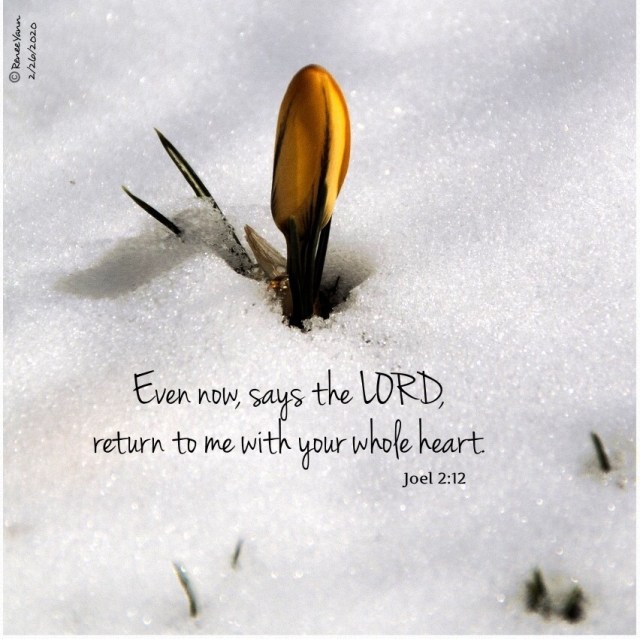
The rise of an “Even Now” moment in our souls is like the hint of spring pushing its head through the winter snow.
It is the reddish-green thread suggesting life at the tip of the brown, cold-cracked branch.
It is the moment we believe that what we desire and love will turn toward us and embrace us.
Can you imagine God having such moments, longing for our attention, love, presence, catching a glimpse of our turning?
Our reading from Joel describes such a God.
Even now, says the LORD, return to me with your whole heart…
These words suggest God’s longing for us, for our devotion and love.
But our holy intentions weaken and we often drift away from our “first fervors”. Our hearts attach to distractions from God. So God says:
Rend your hearts … and return to the LORD, your God. For I am gracious and merciful, slow to anger, rich in kindness … Come back to Me, with all your heart.
This is what Lent is all about. Each of us knows where our hearts have wandered. Each of knows what we must turn from — even now — to return to God’s embrace.
If we can hear God’s longing in this haunting reading from Joel perhaps the true turning will begin. A blessed Lent, my friends.
I found this modern song helpful to my prayer. I imagine God singing it to me, to the world, as we begin our Lenten journey. Perhaps it may touch your prayer too. God loves us so much, infinitely more than we can comprehend. But imagining God’s love in human terms, as John of the Cross did, can sometimes deepen our understanding and response to God.
Today, in Mercy, our readings leave me wondering about what makes God tick.
In our first reading, God exacts justice for Solomon’s unfaithfulness, but He does it sort of like a prosecutor in a plea bargain.
I will deprive you of the kingdom … but not during your lifetime It is your son whom I will deprive … but I won’t take away the whole kingdom.
What’s going on with God in this reading? Well, it’s more like “What’s going on with the writer as he tries, retrospectively, to interpret God’s role in Israel’s history?”
The passage is much more than a report on exchanges between God and Solomon.
It is a testament to Israel’s unwavering faith that God is intimately involved in their lives. In every circumstance, the believing community returns to the fact that experience leads to God and not away from Him.
So “Solomon … had TURNED his heart to strange gods” BUT God had not turned from Solomon. Nor would God EVER turn because God has CHOSEN Israel.
In our Gospel, the Syrophoenician woman tries to get the favor of Jesus to turn toward her. And actually, Jesus sounds pretty mean and stingy about it.
Again the writer Mark is portraying, retrospectively, a significant time in Christ’s ministry. Jesus has really gone into hiding in a remote place. Apparently, he wants space to figure some things out. The story indicates that one of those things might be whether or not his ministry should embrace the Gentiles.
The persistence of this woman’s faith is a turning point for Jesus Who evolved, as we all do, in his understanding of his sacred role and meaning in the world.
These passages encourage us to constantly turn toward God Who lives our life with us. Such conversation helps us to grow spiritually. As we become bigger in heart and soul, so does our concept of God and what God’s hope is for us.
Music: Perfect Wisdom of Our God – The Gettys (See poem after music video)
All this “turning” brought to mind some favorites lines from T.S. Eliot:
At the still point of the turning world. Neither flesh nor fleshless; Neither from nor towards; at the still point, there the dance is, But neither arrest nor movement. And do not call it fixity, Where past and future are gathered. Neither movement from nor towards, Neither ascent nor decline. Except for the point, the still point, There would be no dance, and there is only the dance.
I happened across a website where Eliot himself reads “Burnt Norton”, the poem from which these lines are taken. Eliot fans might enjoy this. Eliot’s poems take time and work as well as simple reading. But the effort is so worth it!
Time present and time past
Are both perhaps present in time future
And time future contained in time past.
If all time is eternally present
All time is unredeemable.
What might have been is an abstraction
Remaining a perpetual possibility
Only in a world of speculation.
What might have been and what has been
Point to one end, which is always present.
Footfalls echo in the memory
Down the passage which we did not take
Towards the door we never opened
Into the rose-garden. My words echo
Thus, in your mind.
But to what purpose
Disturbing the dust on a bowl of rose-leaves
I do not know.
Other echoes
Inhabit the garden. Shall we follow?
Quick, said the bird, find them, find them,
Round the corner. Through the first gate,
Into our first world, shall we follow
The deception of the thrush? Into our first world.
There they were, dignified, invisible,
Moving without pressure, over the dead leaves,
In the autumn heat, through the vibrant air,
And the bird called, in response to
The unheard music hidden in the shrubbery,
And the unseen eyebeam crossed, for the roses
Had the look of flowers that are looked at.
There they were as our guests, accepted and accepting.
So we moved, and they, in a formal pattern,
Along the empty alley, into the box circle,
To look down into the drained pool.
Dry the pool, dry concrete, brown edged,
And the pool was filled with water out of sunlight,
And the lotos rose, quietly, quietly,
The surface glittered out of heart of light,
And they were behind us, reflected in the pool.
Then a cloud passed, and the pool was empty.
Go, said the bird, for the leaves were full of children,
Hidden excitedly, containing laughter.
Go, go, go, said the bird: human kind
Cannot bear very much reality.
Time past and time future
What might have been and what has been
Point to one end, which is always present.
II
Garlic and sapphires in the mud
Clot the bedded axle-tree.
The trilling wire in the blood
Sings below inveterate scars
Appeasing long forgotten wars.
The dance along the artery
The circulation of the lymph
Are figured in the drift of stars
Ascend to summer in the tree
We move above the moving tree
In light upon the figured leaf
And hear upon the sodden floor
Below, the boarhound and the boar
Pursue their pattern as before
But reconciled among the stars.
At the still point of the turning world. Neither flesh nor fleshless;
Neither from nor towards; at the still point, there the dance is,
But neither arrest nor movement. And do not call it fixity,
Where past and future are gathered. Neither movement from nor towards,
Neither ascent nor decline. Except for the point, the still point,
There would be no dance, and there is only the dance.
I can only say, there we have been: but I cannot say where.
And I cannot say, how long, for that is to place it in time.
The inner freedom from the practical desire,
The release from action and suffering, release from the inner
And the outer compulsion, yet surrounded
By a grace of sense, a white light still and moving,
Erhebung without motion, concentration
Without elimination, both a new world
And the old made explicit, understood
In the completion of its partial ecstasy,
The resolution of its partial horror.
Yet the enchainment of past and future
Woven in the weakness of the changing body,
Protects mankind from heaven and damnation
Which flesh cannot endure.
Time past and time future
Allow but a little consciousness.
To be conscious is not to be in time
But only in time can the moment in the rose-garden,
The moment in the arbour where the rain beat,
The moment in the draughty church at smokefall
Be remembered; involved with past and future.
Only through time time is conquered.
III
Here is a place of disaffection
Time before and time after
In a dim light: neither daylight
Investing form with lucid stillness
Turning shadow into transient beauty
Wtih slow rotation suggesting permanence
Nor darkness to purify the soul
Emptying the sensual with deprivation
Cleansing affection from the temporal.
Neither plentitude nor vacancy. Only a flicker
Over the strained time-ridden faces
Distracted from distraction by distraction
Filled with fancies and empty of meaning
Tumid apathy with no concentration
Men and bits of paper, whirled by the cold wind
That blows before and after time,
Wind in and out of unwholesome lungs
Time before and time after.
Eructation of unhealthy souls
Into the faded air, the torpid
Driven on the wind that sweeps the gloomy hills of London,
Hampstead and Clerkenwell, Campden and Putney,
Highgate, Primrose and Ludgate. Not here
Not here the darkness, in this twittering world.
Descend lower, descend only
Into the world of perpetual solitude,
World not world, but that which is not world,
Internal darkness, deprivation
And destitution of all property,
Dessication of the world of sense,
Evacuation of the world of fancy,
Inoperancy of the world of spirit;
This is the one way, and the other
Is the same, not in movement
But abstention from movement; while the world moves
In appetency, on its metalled ways
Of time past and time future.
IV
Time and the bell have buried the day,
the black cloud carries the sun away.
Will the sunflower turn to us, will the clematis
Stray down, bend to us; tendril and spray
Clutch and cling?
Chill
Fingers of yew be curled
Down on us? After the kingfisher’s wing
Has answered light to light, and is silent, the light is still
At the still point of the turning world.
V
Words move, music moves
Only in time; but that which is only living
Can only die. Words, after speech, reach
Into the silence. Only by the form, the pattern,
Can words or music reach
The stillness, as a Chinese jar still
Moves perpetually in its stillness.
Not the stillness of the violin, while the note lasts,
Not that only, but the co-existence,
Or say that the end precedes the beginning,
And the end and the beginning were always there
Before the beginning and after the end.
And all is always now. Words strain,
Crack and sometimes break, under the burden,
Under the tension, slip, slide, perish,
Will not stay still. Shrieking voices
Scolding, mocking, or merely chattering,
Always assail them. The Word in the desert
Is most attacked by voices of temptation,
The crying shadow in the funeral dance,
The loud lament of the disconsolate chimera.
The detail of the pattern is movement,
As in the figure of the ten stairs.
Desire itself is movement
Not in itself desirable;
Love is itself unmoving,
Only the cause and end of movement,
Timeless, and undesiring
Except in the aspect of time
Caught in the form of limitation
Between un-being and being.
Sudden in a shaft of sunlight
Even while the dust moves
There rises the hidden laughter
Of children in the foliage
Quick now, here, now, always —
Ridiculous the waste sad time
Stretching before and after.
Today, in Mercy, Sirach gives us a beautiful eulogy for King David.
A eulogy sets a particular frame of remembrance around a person’s life. Like Sirach today, that frame tries to capture the positive accomplishments of the person who has died. We set aside any mistakes and negativity. Or we acknowledge them as Sirach has done for David by invoking God’s forgiveness:
The LORD forgave him his sins and exalted his strength forever.
To tell the truth, I’ve attended a few funerals where I wondered what the speaker might come up with in a positive regard. You know, you need more than a sentence or two for a decent eulogy! Despite my wondering, every tribute has provided an enriching lesson on the sacred beauty of a human life.
There are times when I leave such a life celebration thinking, “Gosh, I never realized that about him!” or “Wow, there are so many things we don’t understand about someone’s life!”
If only we could treat every living person with the same honor their eulogies inspire!
In our Gospel, we read the sad and violent story of John the Baptist’s martyrdom. It’s a passage filled with the best and the worst of the human heart. One would wonder what kind of eulogy could have eventually been crafted for the likes of Herod, Herodias, and Salome.
But for John the Baptist, Jesus had given him the perfect epitaph even before John died.
I say to you, among those born of women there is no one greater than John;
In the verse, Jesus also reveals what it takes to earn greatest accolade in God’s eyes:
… yet the one who is least in the kingdom of God is greater than John.
Luke 7:28
When Jesus spoke that verse, John had not yet died. If Jesus said anything about John after his death, the words are not recorded. All we have is this poignant response from Matthew:
Later, John’s disciples came for his body and buried it.
Then they went and told Jesus what had happened.
As soon as Jesus heard the news,
he left in a boat to a remote area to be alone.
But the crowds heard where he was headed
and followed on foot from many towns.
Jesus saw the huge crowd as he stepped from the boat,
and he had compassion on them and healed their sick. Matthew 14: 12-14
As we pray today with the legacies of David and the Baptist, we might consider what we’d want to see engraved on our own tombstones. I’ve told my friends I’d like to see this:
She was kind.
Still working on it!😉
What about you?
Music: Lay Me Down – in this song, two icons of country music, Loretta Lynn and Willie Nelson sing their own kind of eulogy. (Lyrics below)
I raised my head and set myself In the eye of the storm, in the belly of a whale My spirit stood on solid ground I’ll be at peace when they lay me down
When I was a child, I cried Until my needs were satisfied My needs have grown up, pound for pound I’ll be at peace when they lay me down
When they lay me down someday My soul will rise, then fly away This old world will turn around I’ll be at peace when they lay me down
This life isn’t fair, it seems It’s filled with tears and broken dreams There are no tears where I am bound And I’ll be at peace when they lay me down
When they lay me down some day My soul will rise, then fly away This old world will turn around I’ll be at peace when they lay down
When they lay me down some day My soul will rise and fly away This old world will turn around I’ll be at peace when they lay me down
Today, in Mercy, David gets himself in trouble once again.
In the later years of his kingship, David is pretty impressed with himself. The kingdom has grown exponentially. There is peace and prosperity. David wants a census taken so that he can assess his capacity for new expansion.
So why does God get so mad about this census? The Book of Exodus sets out that a person has the right to number only his own belongings. The People belong to God, not to David. David’s pride and self-satisfaction has taken him over.
However, as usual, David repents. This is probably the best lesson we can learn from him. Then, in a greatly allegorized treatment, God gives David a choice of three punishments.
Passages like this can confuse us if we interpret them literally. Does God really interact and punish like this?
It helps to remember the purpose of these writings — not to relay a factual history, but rather to tell a story that helps us grow in relationship with God.
What I believe happened here is that a pestilence did fall upon the country. At the same time, David realized that his heart had grown selfish and graceless. He took the natural event as a sign to turn back to God. And then the writers told the story in a way that the ancient peoples could relate to – with a God that forgives but gets even.
In our Gospel, Jesus preaches another vision of God – a vision of Complete Mercy, especially toward the vulnerable, weak, and sinful. That pretty much includes all of us.
Jesus releases the power of this Divine Mercy by his words and miracles. But his own family and neighbors reject him. They are more comfortable with a God who behaves like they do – meting out more judgement and punishment (preferably toward others!😉) than mercy and inclusive benediction.
In this Gospel, we begin to see Jesus as One who asks not only for repentance but for conversion – for a new way of being with God and neighbor, the way of Love.
How might we have responded had we been in that neighborhood synagogue? How are we responding today?
These are periled times we live in, trouble everywhere
Weary hearts will often give in to this world’s despair
But high and over all, our Father knows our every care
And in His Book, if you will look, you’ll find His promise there
(Chorus)
He who trusts in the Lord
Mercy shall surround him
He who trusts in the Lord
Mercy shall surround him
Be glad in the Lord and rejoice
You upright in heart, lift up your voice
For great is His mercy toward all who trust in the Lord
Soon will be the time when we will see the Holy One
Oh how sweet to know that He’ll complete what He’s begun
And blessed is the man who stands forgiven in God’s son
And blessed are they who in that day will hear Him say, “Well done”
(Chorus)
Gracious is He and slow to anger
His loving kindness has no end
With love to embrace both friend and stranger
Reaching out to one and all, who upon His name will call
(Chorus)
Mercy is His reward
For all who trust, for the pure and just
Who put their trust in the Lord
For all who trust for the pure and just who put their trust in the Lord
Today, in Mercy, we read one of the saddest lines in Scripture.
You have followed the story in these daily passages. Absalom rebels, designing to usurp his father’s throne. A massive battle rises between them. David, as commander-in-chief, remains behind, but gives instructions to his generals to spare Absalom’s life. Joab ignores the command, killing Absalom in a moment of vulnerability.
David is devastated.
David Mourning Absalom’s Death – Jean Colombe
I think there is no more wrenching human emotion than regret. When I ministered for nearly a decade as hospice chaplain, and later in the emergency room, I saw so much regret.
People who had waited too long to say “I’m sorry”, “I forgive you”, “Let’s start over”, “Thank you for all you did for me”, “I love you”…..
Instead, these people stood at lifeless bedsides saying things like, “I should have”, “I wish…”, “If only…”
Life is complex and sometimes difficult. We get hurt, and we hurt others — sometimes so hurt that we walk away from relationship, or stay but wall ourselves off.
We might think that what is missing in such times is love. But I think it is more likely truth. In times of painful conflict, if we can hear and speak our truth to ourselves and one another, we open the path to healing.
If you want the truth, I’ll tell you the truth.
Listen to the secret sound,
the real sound, which is inside you. ~ Kabir
That healing may demand adjustments, agreements, even a willingness to step apart in mutual respect. But if the changes emerge from shared truth, restoration and wholeness are possible.
David and Absalom never found that path because they were so absorbed in their own self-interests. Theirs was the perfect formula for regret – that fruitless stump that perpetually sticks in the heart.
I remember a trauma surgeon leaving the hospital late one night after an unsuccessful effort to save a young boy who had been shot. The doctor carried the loss so heavily as he walked into the night saying to me, “I’m just going to go home and hug my kids.”
As we pray over David and Absalom today, let us examine our lives for the fractures that are still healable and act on them. Let us “hug” the life we have. Regret is a useless substitute.
When David Heard – Eric Whitaker ( The piece builds. Be patient. Lyrics below)
When David heard that Absalom was slain,
he went up into his chamber over the gate and wept,
and thus he said;
My son, my son,
O Absalom my son,
would God I had died for thee!
When David heard that Absalom was slain,
he went up into his chamber over the gate and wept,
and thus he said;
Today, in Mercy, David gets his comeuppance after his sinful forays.
David Weeps – wikipedia.org – not for commercial use
The passage is hard to deal with. It suggests that God is vengeful, and gets us back for going against him. That’s not the God Who loves me.
Like much of the Old Testament, the writer is interpreting the circumstances of life in order to teach a lesson. The lesson here is not that God is a payback God. The core lesson is that our choices have repercussions, and should always be made in the light of God’s hope for us.
Sometimes in our own lives, we think of God as reacting in a human way to us – getting angry, forgetting us, paying us back, testing us, punishing us. Like the disciples in today’s storm-tossed boat, our faith is weak and maybe misdirected.
God is Love, and Love only. God is NEVER “I’ll getcha’ “. Deep faith directs us to find God’s love – God’s continuing call to intimacy – in every circumstance of our lives.
God didn’t kill David’s illegitimate son. It just happened, the way so much of life happens. We can blame God if we want to, but we’re missing the point.
The point is that God is with us in the inevitable joys and sorrows of our lives saying, as he did to his distraught shipmates:
“Why are you terrified? Do you not yet have faith?”
Our Gospel assures us that God is with us, “sleeping” even in our rocky boat. By faith and prayer, we “wake God”, as we actually wake ourselves to the truth of God’s immutable, loving Presence in our lives.
(Sorry for the late post. I had a brief episode of social life this afternoon. 🙂 )
Today, in Mercy, our readings talk about the polar opposites of unity and division.
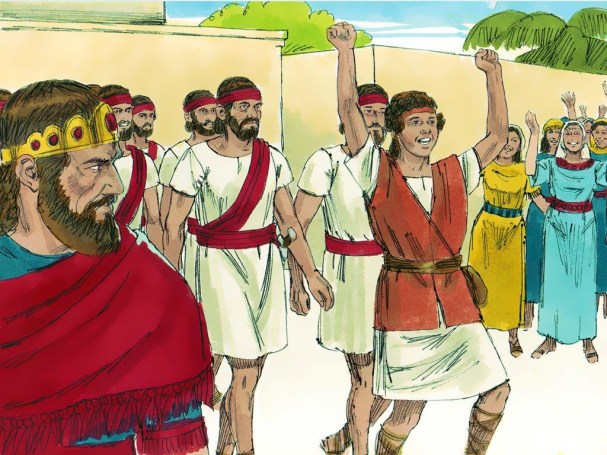
Our first reading gives us David, embraced by his kinsmen, and anointed King. Strong in his unified reign, David leads his people to victory over all their enemies. His is the idyllic kingdom – the “Camelot” of the Old Testament.
Then Mark gives us Jesus, of whom David was but a pale foreshadowing. Today’s passage follows the incident in which Jesus’s kinsmen, rather than embrace him, try to “seize”him because they think he’s “out of his mind”.
Clearly, the Kingdom of Mercy for sinners and outcasts is not as acceptable as David’s kingdom of prosperity and military might. Jesus had a hard sell on his hands as his listeners have their old definitions and expectations shattered. His family can’t accept his challenge – they think he’s crazy. And now his neighbors say he is possessed by the devil!
Pretty dispiriting for Jesus, right?
No way! Here, very early in Mark, Jesus – despite challenge – emerges as “the stronger one”:
But no one can enter a strong man’s house to plunder his property unless he first ties up the strong man.
Jesus’s strength lies in his Oneness with the Father and the Holy Spirit, the Divine Community that embraces and inspires his mission. Human rejection, even in the ultimate form of Calvary, will not change or diminish his Truth.
When Jesus talks about blaspheming against the Holy Spirit, it is that kind of rejection he is describing – that place where a human heart is hardened against an abandonment to grace.
Here the sin is unforgivable because those who charge Jesus
with demonic possession see goodness as evil, and therefore
are closed to the action of God’s Spirit. This makes sense for
Mark’s readers only in terms of the preceding narrative
where Jesus, endowed with the Spirit, preaches the good news of God. The unforgivable sin in biblical thought is similar to “hardness of heart”.
The Gospel of Mark ~ John R. Donahue, SJ, Daniel J. Harrington, SJ
Today’s Gospel reminds us to continually purify that inner heart where God wants to dwell in us. The demons that would petrify us are often more subtle than the ones in our Gospel story. They masquerade under the guise of a false “gospel” that fails to require our inner conversion to mercy, justice and love.
May we pray with today’s Responsorial Psalm that God’s faithfulness and mercy guide us as we seek to deepen in the Mystery of Christ.
Today, in Mercy, both David and Jesus deal with the effects of immense popularity.
In David’s case, Saul is so jealous and threatened by David’s military success that he plots to murder him. Saul’s son Jonathan, David’s dear friend intervenes to turn his father’s evil intention. Ultimately though, Saul remains a man destroyed by jealousy.
Jealousy is aptly characterized as the “Green-Eyed Monster”:
The phrase ‘green-eyed jealousy’ was used by, and possibly coined by, Shakespeare to denote jealousy, in The Merchant of Venice, 1596.
In Othello, 1604, Shakespeare refers explicitly to the ‘green-eyed monster’ as jealousy when treacherous Iago counsels Othello:
O, beware, my lord, of jealousy;
It is the green-eyed monster which doth mock The meat it feeds on; that cuckold lives in bliss
Who, certain of his fate, loves not his wronger;
But, O, what damned minutes tells he o’er
Who dotes, yet doubts, suspects, yet strongly loves!
These powerful words capture what it is like to feel, or to be the object of, jealousy – a feeling which grows out of one’s own insecurity. But since it is a feeling, it is not a sin. It is when we act on our jealousy, as Saul planned to do, that we sin.
I think, at sometime in our lives, most of us have experienced jealousy- either as donor or recipient. How we responded either fortified or eroded our character. Sincere reflection on those responses can continue to help us grow in charity.
Thinking about that, I benefitted from reading this passage from the Catholic Encyclopedia:
Jealousy is here taken to be synonymous with envy. It is defined to be a sorrow which one entertains at another’s well-being because of a view that one’s own excellence is in consequence lessened. Its distinctive malice comes from the opposition it implies to the supreme virtue of charity. The law of love constrains us to rejoice rather than to be distressed at the good fortune of our neighbor.
Our daily prayer and ever-deepening relationship with God can free us to face any “green-eyed monsters” we encounter, turning them into occasions of grace. Let’s pray for that!
Music:Envy and Jealousy – Sweet Comfort Band (Lyrics below)
(I published this reflection on last year’s feast. It seemed to touch people deeply, so I thought it bore another look. God bless you all, dear readers, and God bless your families here and in heaven.)
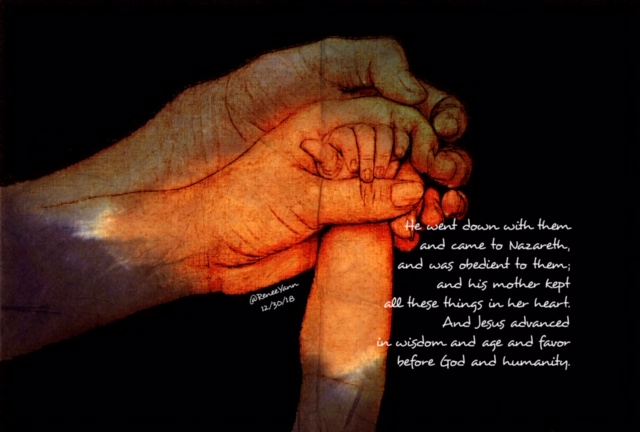
Today, in Mercy, our prayer is turned to the Holy Family, that unique configuration of love which nurtured the developing life of Jesus. Can you imagine how tenderly the Father shaped this triad, this nesting place of love for God’s own Word?
We look to the Holy Family so that we might be strengthened in the virtues that will help us build our own families: sacrificial love, reverence, courage, unfailing support, committed presence, shared faith, gentle honesty, unconditional acceptance.
“Family” is the primordial place where we learn who we are. The lessons it teaches us about ourselves – for better or worse — remain with us forever.
Not everyone is blessed by their family. Family can ground us in confidence or undermine us with self-doubt. It can free us from fear or cripple us with reservation. It can release either possibility or perpetual hesitation within us.
Some families are so dysfunctional that we spend the rest of our lives trying to recover from them. But some, like the Holy Family, allow God’s dream to be nurtured in us and to spread to new families, both of blood and spirit.
The challenge today is to thank God for whatever type of family bore us. Lessons can be learned from both lights and shadows. Let us spend time this morning lookingat our own families with love, gratitude, forgiveness, understanding. Where there are wounds to be healed, let us face them. Where there are belated thanks to be offered, let us give them. Where there are negligence and oversights to confess, let us use them as bridges to a new devotion.
For some, it may seem too late to heal or bless our family. Time may have swallowed some of our possibilities. But it is never too late to deepen relationships through prayer, both for and to our ancestors.
May this feast strengthen us for the families who need us today.
Music: God Bless My Family ~ Anne Hampton Calloway (Lyrics below)
GOD BLESS MY FAMILY Words and music – By Ann Hampton Callaway
1. It’s Christmas time
Outside the snow is falling
Like a million stars
Like a million dreams
All dressed up in white
I’m writing Christmas cards
A joy that’s tinged with sadness
As I think of friends
Some are here and some are gone
But our love goes on and on
Like the snow tonight
CHORUS
And oh, what a family My life has given me
From the corners of the earth
To the reaches of the sky
We touch eternally
And though my heart aches ev’ry day
This Christmas I will find a way
To let each face I’ve ever loved
Shine out in me
God bless my family
2. As years go by
The carols we sang as children
Gather memories
What was just a song
Now feels like a pray’r
Welcoming us home
To fathers, mothers
Sisters, brothers ev’rywhere
Some we’ve lost and some we’ve found
As love circles us around
In the songs we share
CHORUS
So fly, angels of my heart
We’ll never be apart
Tonight I say a pray’r
For loved ones ev’rywhere
CHORUS/CODA
You’re a part of my family
That life has given me
From the corners of the earth
To the reaches of the sky
We touch eternally
And though my heart aches ev’ryday
This Christmas I will find a way
To let each face I’ve ever loved
Shine out in me
God bless my family
You’ll always live in me
God bless my family
Today, in Mercy, our scripture readings are a little heavy. I had to dig to get my inspiration. But there are gems in these dense words!
It was not through the law that the promise was made to Abraham and his descendants that he would inherit the world, but through the righteousness that comes from faith.
This is a spiritually freeing passage. It assures us that God is with us through our faith, not through the perfection with which we keep laws and rules.
Our Gospel reinforces the message:
Everyone who speaks a word against the Son of Man will be forgiven, but the one who blasphemes against the Holy Spirit will not be forgiven
The passage is a little scary when first read, because we all hope we haven’t done anything to offend the Holy Spirit. But what Jesus is telling his listeners is this:
If a person criticizes or rejects my life and teaching, forgiveness is still possible when they come to their senses and repent. It’s like cutting the bad spot out of an otherwise good apple.
But if a person chooses to live a life which blasphemes (mocks, dismisses) the Spirit of life, love, mercy and peace, that person can never be forgiven — because they can never repent. They will be rotten to the core.
So the advice of Paul and Jesus boils down to this, I think. Befriend the Holy Spirit by your life of faithful choices. Listen to Her inspiration. Help others to do the same. And do not worry. when you make a few mistakes. God stands by the promise to be with us always.

 The rise of an “Even Now” moment in our souls is like the hint of spring pushing its head through the winter snow.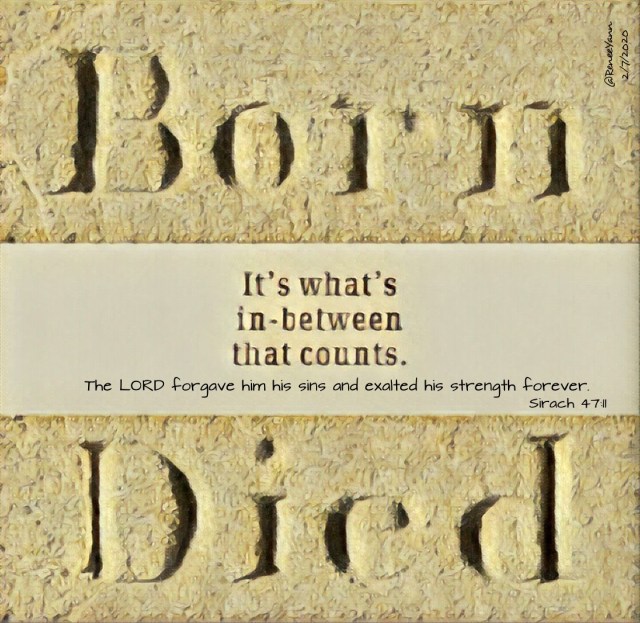





 Lavish Mercy